Copyright © Houghton Mifflin Harcourt Publishing Company
Unit 3 Lesson 1 The Electromagnetic Spectrum
Electromagnetic Light Show
Copyright © Houghton Mifflin Harcourt Publishing Company
What is the nature of light?
• Light waves are different from other kinds of
waves.
• Light waves are vibrating electric and magnetic
fields that transfer energy through space.
Unit 3 Lesson 1 The Electromagnetic Spectrum
What is the nature of light?
• Radiation is energy that has been transmitted by
waves or particles. This transfer of energy is
called EM radiation.
• All EM waves move at the same speed in a
vacuum: the speed of light.
• EM waves can travel through many materials.
Copyright © Houghton Mifflin Harcourt Publishing Company
Unit 3 Lesson 1 The Electromagnetic Spectrum
What determines the color of light?
• Different wavelengths of light are perceived by our
eyes as different colors.
• White light is what we perceive when we see all
the wavelengths of light at once, in equal
proportions.
• Our eyes only register three colors of light: red,
green, and blue. All other colors we see are a
mixture of these three colors.
Copyright © Houghton Mifflin Harcourt Publishing Company
Unit 3 Lesson 1 The Electromagnetic Spectrum
Invisible Colors
Copyright © Houghton Mifflin Harcourt Publishing Company
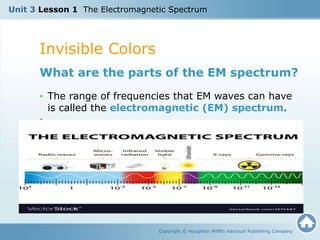
What are the parts of the EM spectrum?
• The range of frequencies that EM waves can have
is called the electromagnetic (EM) spectrum.
•
Unit 3 Lesson 1 The Electromagnetic Spectrum
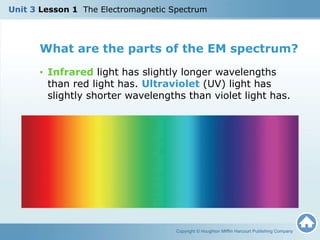
What are the parts of the EM spectrum?
• Infrared light has slightly longer wavelengths
than red light has. Ultraviolet (UV) light has
slightly shorter wavelengths than violet light has.
Copyright © Houghton Mifflin Harcourt Publishing Company
Unit 3 Lesson 1 The Electromagnetic Spectrum
Star Light, Star Bright
Copyright © Houghton Mifflin Harcourt Publishing Company
How much of the sun’s energy reaches
us?
• Most of the sun’s energy is in the narrow visible
light range, but the sun gives off some radiation in
every part of the spectrum.
Unit 3 Lesson 1 The Electromagnetic Spectrum
How much of the sun’s energy reaches
us?
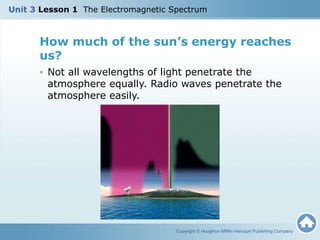
• Not all wavelengths of light penetrate the
atmosphere equally. Radio waves penetrate the
atmosphere easily.
Copyright © Houghton Mifflin Harcourt Publishing Company
Unit 3 Lesson 1 The Electromagnetic Spectrum
How much of the sun’s energy reaches
us?
• Some EM radiation can be dangerous to humans,
so we take extra steps to protect ourselves.
• UV light can be harmful. It can penetrate clouds.
• In space, the dangers from EM radiation are very
high because there is no atmosphere to filter the
radiation.
Copyright © Houghton Mifflin Harcourt Publishing Company
Unit 3 Lesson 1 The Electromagnetic Spectrum
Frequency Asked Questions
Copyright © Houghton Mifflin Harcourt Publishing Company
How much energy does EM radiation
have?
• Different frequencies of EM waves carry different
amounts of energy.
• High-frequency EM waves have more energy than
low-frequency EM waves have.
Unit 3 Lesson 1 The Electromagnetic Spectrum
How much energy does EM radiation
have?
• Because low-frequency waves, such as radio
waves, carry less energy, they are safer. Walkie-
talkies and baby monitors use radio waves.
• High-frequency waves, such as UV light, carry
more energy and can be harmful. UV light causes
sunburns, and X-rays require precautions.
Copyright © Houghton Mifflin Harcourt Publishing Company
Unit 3 Lesson 1 The Electromagnetic Spectrum

Science Fusion: The Electromagnetic Spectrum.ppt

  • 1.
    Copyright © HoughtonMifflin Harcourt Publishing Company Unit 3 Lesson 1 The Electromagnetic Spectrum
  • 2.
    Electromagnetic Light Show Copyright© Houghton Mifflin Harcourt Publishing Company What is the nature of light? • Light waves are different from other kinds of waves. • Light waves are vibrating electric and magnetic fields that transfer energy through space. Unit 3 Lesson 1 The Electromagnetic Spectrum
  • 3.
    What is thenature of light? • Radiation is energy that has been transmitted by waves or particles. This transfer of energy is called EM radiation. • All EM waves move at the same speed in a vacuum: the speed of light. • EM waves can travel through many materials. Copyright © Houghton Mifflin Harcourt Publishing Company Unit 3 Lesson 1 The Electromagnetic Spectrum
  • 4.
    What determines thecolor of light? • Different wavelengths of light are perceived by our eyes as different colors. • White light is what we perceive when we see all the wavelengths of light at once, in equal proportions. • Our eyes only register three colors of light: red, green, and blue. All other colors we see are a mixture of these three colors. Copyright © Houghton Mifflin Harcourt Publishing Company Unit 3 Lesson 1 The Electromagnetic Spectrum
  • 5.
    Invisible Colors Copyright ©Houghton Mifflin Harcourt Publishing Company What are the parts of the EM spectrum? • The range of frequencies that EM waves can have is called the electromagnetic (EM) spectrum. • Unit 3 Lesson 1 The Electromagnetic Spectrum
  • 6.
    What are theparts of the EM spectrum? • Infrared light has slightly longer wavelengths than red light has. Ultraviolet (UV) light has slightly shorter wavelengths than violet light has. Copyright © Houghton Mifflin Harcourt Publishing Company Unit 3 Lesson 1 The Electromagnetic Spectrum
  • 7.
    Star Light, StarBright Copyright © Houghton Mifflin Harcourt Publishing Company How much of the sun’s energy reaches us? • Most of the sun’s energy is in the narrow visible light range, but the sun gives off some radiation in every part of the spectrum. Unit 3 Lesson 1 The Electromagnetic Spectrum
  • 8.
    How much ofthe sun’s energy reaches us? • Not all wavelengths of light penetrate the atmosphere equally. Radio waves penetrate the atmosphere easily. Copyright © Houghton Mifflin Harcourt Publishing Company Unit 3 Lesson 1 The Electromagnetic Spectrum
  • 9.
    How much ofthe sun’s energy reaches us? • Some EM radiation can be dangerous to humans, so we take extra steps to protect ourselves. • UV light can be harmful. It can penetrate clouds. • In space, the dangers from EM radiation are very high because there is no atmosphere to filter the radiation. Copyright © Houghton Mifflin Harcourt Publishing Company Unit 3 Lesson 1 The Electromagnetic Spectrum
  • 10.
    Frequency Asked Questions Copyright© Houghton Mifflin Harcourt Publishing Company How much energy does EM radiation have? • Different frequencies of EM waves carry different amounts of energy. • High-frequency EM waves have more energy than low-frequency EM waves have. Unit 3 Lesson 1 The Electromagnetic Spectrum
  • 11.
    How much energydoes EM radiation have? • Because low-frequency waves, such as radio waves, carry less energy, they are safer. Walkie- talkies and baby monitors use radio waves. • High-frequency waves, such as UV light, carry more energy and can be harmful. UV light causes sunburns, and X-rays require precautions. Copyright © Houghton Mifflin Harcourt Publishing Company Unit 3 Lesson 1 The Electromagnetic Spectrum