


12/16/14Lockout Tagout
1
Lock out/Tag outLock out/Tag out
Try outTry out
Top 10 Most Frequently Cited
Standards
But first lets look at:
Top 10 Most Frequently Cited StandardsTop 10 Most Frequently Cited Standards
for Fiscal 2013 (Oct. 1, 2012 to Sept. 30, 2013)for Fiscal 2013 (Oct. 1, 2012 to Sept. 30, 2013)
 The following is a list of the top 10 most
frequently cited standards* following inspections
of worksites by federal OSHA. OSHA publishes
this list to alert employers about these commonly
cited standards so they can take steps to find and
fix recognized hazards addressed in these and
other standards before OSHA shows up. Far too
many preventable injuries and illnesses occur in
the workplace.
12/16/14Lockout Tagout
2
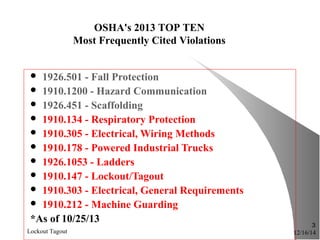
 1926.501 - Fall Protection
 1910.1200 - Hazard Communication
 1926.451 - Scaffolding
 1910.134 - Respiratory Protection
 1910.305 - Electrical, Wiring Methods
 1910.178 - Powered Industrial Trucks
 1926.1053 - Ladders
 1910.147 - Lockout/Tagout
 1910.303 - Electrical, General Requirements
 1910.212 - Machine Guarding
*As of 10/25/13
12/16/14Lockout Tagout
3
OSHA's 2013 TOP TEN
Most Frequently Cited Violations
12/16/14Lockout Tagout
4
Lockout/TagoutLockout/Tagout
Training
12/16/14Lockout Tagout
5
PurposePurpose
The purpose of this overview is to
increase understanding of how the
Lockout /Tagout program works to
reduce the risk of injury during
servicing and maintenance
operations.
12/16/14Lockout Tagout
6
Key Definitions
12/16/14Lockout Tagout
7
Key DefinitionsKey Definitions
Affected employee: An employee who operates or
uses a machine or equipment on which servicing or
maintenance is being performed under lockout or
tagout,or who works in an area where lockout tagout
is used.
Authorized employee: A person who locks out or
tags out machines or equipment to do serve or
maintenance work on them. An affected employee
becomes an authorized employee when his or her
duties include performing covered service or
maintenance work.
Other Employee: An employee whose work
operations are or may be in an area where energy
control procedures may be utilized.
12/16/14Lockout Tagout
8
Key Definitions cont.Key Definitions cont.
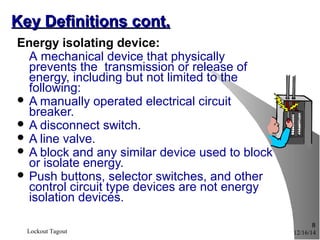
Energy isolating device:
A mechanical device that physically
prevents the transmission or release of
energy, including but not limited to the
following:
 A manually operated electrical circuit
breaker.
 A disconnect switch.
 A line valve.
 A block and any similar device used to block
or isolate energy.
 Push buttons, selector switches, and other
control circuit type devices are not energy
isolation devices.
12/16/14Lockout Tagout
9
Key Definitions cont.Key Definitions cont.
Energy source: Any source of electrical, mechanical,
hydraulic, pneumatic, chemical, thermal, gravity, or
other energy.
Energized: Connected to an energy source or
containing residual or stored energy.
Tagout: The placement of a tagout device on an energy
isolation device, in accordance with an established
procedure, to indicate that the energy isolating device and
the equipment being controlled may not be operated until
the tagout device is removed.
Tagout device:
A prominent warning device, such as a tag and a means of
attachment, that can be securely fastened to an energy
isolation device
12/16/14Lockout Tagout
10
When does the standard apply?When does the standard apply?
The standard applies to repair work (servicing
and or maintenance) to powered machines or
equipment.
The standard must be followed during work that
is done during normal production operations if :
– “An employee is required to remove or bypass a guard or
other safety device.”
– “An employee is required to place any part of his or her
body into a machine’s point of operation or a danger zone
associated with a machine’s operating cycle.”
The standard does not apply to cord and plug connected
electric equipment when unplugging the equipment controls
the hazards and the plug is under the exclusive control of the
employee who is doing the service or maintenance work.
12/16/14Lockout Tagout
11
Energy control programEnergy control program
The standard requires employers to have and energy
control program that include:
 Energy control procedures.
 Employee training.
 Periodic inspections.
Energy control procedures
Documented energy control (lockout/tagout) procedures
must clearly:
 Outline the intended use of the procedure.
 Indicate specific steps to lock out or tag out the machine or
equipment.
 Include rules and authorizations for using the procedure.
 Have an explanation of how compliance will be enforced.
12/16/14Lockout Tagout
12
Energy control procedures cont.Energy control procedures cont.
The employer must have multiple
procedures when various types of
machines or equipment in the
facility would need different
lockout tagout procedures. Each
lock out tag out procedure needs
to identify the machines or
equipment to which it applies.
12/16/14Lockout Tagout
13
Six steps for
applying
lockout/tagout
12/16/14Lockout Tagout
14
Six steps for applying lockout/tagoutSix steps for applying lockout/tagout
1. Prepare for shutdown.
 Understand the equipment.
2. Shutdown.
 Turn off or power down according to procedures.
3. Isolating equipment.
 Locate all disconnect switches, circuit breakers valves.
4. Applying locks and tags.
 Lockout devices must hold switches/valves in the “safe” or
“off” position.
12/16/14Lockout Tagout
15
Six steps for applying lockout/tagoutSix steps for applying lockout/tagout
12/16/14Lockout Tagout
16
Six steps for applying lockout/tagoutSix steps for applying lockout/tagout
5. Releasing stored energy.
 Bleed off pressure.
 Blocking elevated parts in place.
 Draining lines.
 Let equipment cool.
 Discharging capacitors.
12/16/14Lockout Tagout
17
Six steps for applying lockout/tagoutSix steps for applying lockout/tagout
6. Verification.
This last, crucial step ensures that the lockout
tagout procedure has successfully isolated the
machine or equipment from its energy
sources the machine is in a “zero energy
state.”
To do this the authorized employee may
operate the machine’s controls to verify the
equipment is isolated then return the controls
to their “Off” positions. The verification
process could also include reading pressure
or temperature gauges and using test
equipment.
12/16/14Lockout Tagout
18
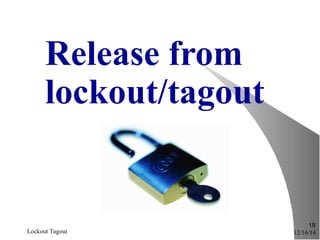
Release from
lockout/tagout
12/16/14Lockout Tagout
19
Release from lockout/tagoutRelease from lockout/tagout
When repair or maintenance work is
completed:
1. Check the machine.
 Replace guards, remove tools, blocking devices.
2. Check for employees.
3. Remove lockout tagout devices.
 Notify all affected employees that work is
complete.
12/16/14Lockout Tagout
20
Use of tag out aloneUse of tag out alone
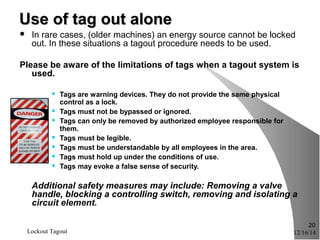
 In rare cases, (older machines) an energy source cannot be locked
out. In these situations a tagout procedure needs to be used.
Please be aware of the limitations of tags when a tagout system is
used.
 Tags are warning devices. They do not provide the same physical
control as a lock.
 Tags must not be bypassed or ignored.
 Tags can only be removed by authorized employee responsible for
them.
 Tags must be legible.
 Tags must be understandable by all employees in the area.
 Tags must hold up under the conditions of use.
 Tags may evoke a false sense of security.
Additional safety measures may include: Removing a valve
handle, blocking a controlling switch, removing and isolating a
circuit element.
12/16/14Lockout Tagout
21
Maintaining lockout/tagout during shiftMaintaining lockout/tagout during shift
change or personnel changeschange or personnel changes
If service or repair work needs to continue during the next shift.
And , there are situations where a mechanic is called away to
another job and another repairman arrives to continue the work.
In both of these cases, the lockout tagout condition needs
continue even though the people working on the project have
changed.
Remember that the employee who applied the LOTO device is the
employee who must remove it. An authorized employee is not
allowed to merely give the key to his lockout device to his
replacement.
It is also a requirement that the authorized employee who is
working on the equipment is the same person who applied the
lock and tag. The authorized employee who is leaving cannot
merely leave his or her lock in place and allow the on-coming
authorized employee to work on the equipment with out applying
his own lock and tag.
12/16/14Lockout Tagout
22
Removal of lockout/tagout when theRemoval of lockout/tagout when the
authorized employee is not availableauthorized employee is not available
There are situations where machines or equipment have
been locked out by personnel who then become
unavailable, (Gone home for the day) or not available for
any number of reasons.
This calls for alternate procedures to safely remove the
lockout tagout devices. Your employer needs to have
specific documented procedures as part of the company’s
energy control program in order to have these devices
removed. Employees who are involved in carrying out
these procedures need to be trained to follow them carefully.
 The employer must verify that the authorized employee
who applied the device is not at the facility.
 Reasonable efforts to contact the authorized employee
must be made to let him know that his or her lock will
be removed.
 Steps must be made to contact the employee to notify
him/her of the removal before they return to the facility.
12/16/14Lockout Tagout
23
OSHA Case StudyOSHA Case Study
A millwright is assigned to a servicing and maintenance task on
an overhead crane. The employee initiates the prescribed energy
control procedure by turning "off" the crane's electrical
disconnect switch and placing his lock onto this energy isolating
device.
However, the disconnect switch lever is corroded, allowing it to
physically separate from the disconnect switch assembly. As a
result, when the millwright places the lock on the lever in the
"off" position, the stub located inside the electrical box remains
in the "on" position.
When he contacts the energized electrical bus bar located near
the bridge railings, fatal injury results.
What action did the millwright fail to take that would have
saved his life?

Lock Out - Tag Out - Try Out Safety Course 2014

  • 1.
    12/16/14Lockout Tagout 1 Lock out/TagoutLock out/Tag out Try outTry out Top 10 Most Frequently Cited Standards But first lets look at:
  • 2.
    Top 10 MostFrequently Cited StandardsTop 10 Most Frequently Cited Standards for Fiscal 2013 (Oct. 1, 2012 to Sept. 30, 2013)for Fiscal 2013 (Oct. 1, 2012 to Sept. 30, 2013)  The following is a list of the top 10 most frequently cited standards* following inspections of worksites by federal OSHA. OSHA publishes this list to alert employers about these commonly cited standards so they can take steps to find and fix recognized hazards addressed in these and other standards before OSHA shows up. Far too many preventable injuries and illnesses occur in the workplace. 12/16/14Lockout Tagout 2
  • 3.
     1926.501 -Fall Protection  1910.1200 - Hazard Communication  1926.451 - Scaffolding  1910.134 - Respiratory Protection  1910.305 - Electrical, Wiring Methods  1910.178 - Powered Industrial Trucks  1926.1053 - Ladders  1910.147 - Lockout/Tagout  1910.303 - Electrical, General Requirements  1910.212 - Machine Guarding *As of 10/25/13 12/16/14Lockout Tagout 3 OSHA's 2013 TOP TEN Most Frequently Cited Violations
  • 4.
  • 5.
    12/16/14Lockout Tagout 5 PurposePurpose The purposeof this overview is to increase understanding of how the Lockout /Tagout program works to reduce the risk of injury during servicing and maintenance operations.
  • 6.
  • 7.
    12/16/14Lockout Tagout 7 Key DefinitionsKeyDefinitions Affected employee: An employee who operates or uses a machine or equipment on which servicing or maintenance is being performed under lockout or tagout,or who works in an area where lockout tagout is used. Authorized employee: A person who locks out or tags out machines or equipment to do serve or maintenance work on them. An affected employee becomes an authorized employee when his or her duties include performing covered service or maintenance work. Other Employee: An employee whose work operations are or may be in an area where energy control procedures may be utilized.
  • 8.
    12/16/14Lockout Tagout 8 Key Definitionscont.Key Definitions cont. Energy isolating device: A mechanical device that physically prevents the transmission or release of energy, including but not limited to the following:  A manually operated electrical circuit breaker.  A disconnect switch.  A line valve.  A block and any similar device used to block or isolate energy.  Push buttons, selector switches, and other control circuit type devices are not energy isolation devices.
  • 9.
    12/16/14Lockout Tagout 9 Key Definitionscont.Key Definitions cont. Energy source: Any source of electrical, mechanical, hydraulic, pneumatic, chemical, thermal, gravity, or other energy. Energized: Connected to an energy source or containing residual or stored energy. Tagout: The placement of a tagout device on an energy isolation device, in accordance with an established procedure, to indicate that the energy isolating device and the equipment being controlled may not be operated until the tagout device is removed. Tagout device: A prominent warning device, such as a tag and a means of attachment, that can be securely fastened to an energy isolation device
  • 10.
    12/16/14Lockout Tagout 10 When doesthe standard apply?When does the standard apply? The standard applies to repair work (servicing and or maintenance) to powered machines or equipment. The standard must be followed during work that is done during normal production operations if : – “An employee is required to remove or bypass a guard or other safety device.” – “An employee is required to place any part of his or her body into a machine’s point of operation or a danger zone associated with a machine’s operating cycle.” The standard does not apply to cord and plug connected electric equipment when unplugging the equipment controls the hazards and the plug is under the exclusive control of the employee who is doing the service or maintenance work.
  • 11.
    12/16/14Lockout Tagout 11 Energy controlprogramEnergy control program The standard requires employers to have and energy control program that include:  Energy control procedures.  Employee training.  Periodic inspections. Energy control procedures Documented energy control (lockout/tagout) procedures must clearly:  Outline the intended use of the procedure.  Indicate specific steps to lock out or tag out the machine or equipment.  Include rules and authorizations for using the procedure.  Have an explanation of how compliance will be enforced.
  • 12.
    12/16/14Lockout Tagout 12 Energy controlprocedures cont.Energy control procedures cont. The employer must have multiple procedures when various types of machines or equipment in the facility would need different lockout tagout procedures. Each lock out tag out procedure needs to identify the machines or equipment to which it applies.
  • 13.
    12/16/14Lockout Tagout 13 Six stepsfor applying lockout/tagout
  • 14.
    12/16/14Lockout Tagout 14 Six stepsfor applying lockout/tagoutSix steps for applying lockout/tagout 1. Prepare for shutdown.  Understand the equipment. 2. Shutdown.  Turn off or power down according to procedures.
  • 15.
    3. Isolating equipment. Locate all disconnect switches, circuit breakers valves. 4. Applying locks and tags.  Lockout devices must hold switches/valves in the “safe” or “off” position. 12/16/14Lockout Tagout 15 Six steps for applying lockout/tagoutSix steps for applying lockout/tagout
  • 16.
    12/16/14Lockout Tagout 16 Six stepsfor applying lockout/tagoutSix steps for applying lockout/tagout 5. Releasing stored energy.  Bleed off pressure.  Blocking elevated parts in place.  Draining lines.  Let equipment cool.  Discharging capacitors.
  • 17.
    12/16/14Lockout Tagout 17 Six stepsfor applying lockout/tagoutSix steps for applying lockout/tagout 6. Verification. This last, crucial step ensures that the lockout tagout procedure has successfully isolated the machine or equipment from its energy sources the machine is in a “zero energy state.” To do this the authorized employee may operate the machine’s controls to verify the equipment is isolated then return the controls to their “Off” positions. The verification process could also include reading pressure or temperature gauges and using test equipment.
  • 18.
  • 19.
    12/16/14Lockout Tagout 19 Release fromlockout/tagoutRelease from lockout/tagout When repair or maintenance work is completed: 1. Check the machine.  Replace guards, remove tools, blocking devices. 2. Check for employees. 3. Remove lockout tagout devices.  Notify all affected employees that work is complete.
  • 20.
    12/16/14Lockout Tagout 20 Use oftag out aloneUse of tag out alone  In rare cases, (older machines) an energy source cannot be locked out. In these situations a tagout procedure needs to be used. Please be aware of the limitations of tags when a tagout system is used.  Tags are warning devices. They do not provide the same physical control as a lock.  Tags must not be bypassed or ignored.  Tags can only be removed by authorized employee responsible for them.  Tags must be legible.  Tags must be understandable by all employees in the area.  Tags must hold up under the conditions of use.  Tags may evoke a false sense of security. Additional safety measures may include: Removing a valve handle, blocking a controlling switch, removing and isolating a circuit element.
  • 21.
    12/16/14Lockout Tagout 21 Maintaining lockout/tagoutduring shiftMaintaining lockout/tagout during shift change or personnel changeschange or personnel changes If service or repair work needs to continue during the next shift. And , there are situations where a mechanic is called away to another job and another repairman arrives to continue the work. In both of these cases, the lockout tagout condition needs continue even though the people working on the project have changed. Remember that the employee who applied the LOTO device is the employee who must remove it. An authorized employee is not allowed to merely give the key to his lockout device to his replacement. It is also a requirement that the authorized employee who is working on the equipment is the same person who applied the lock and tag. The authorized employee who is leaving cannot merely leave his or her lock in place and allow the on-coming authorized employee to work on the equipment with out applying his own lock and tag.
  • 22.
    12/16/14Lockout Tagout 22 Removal oflockout/tagout when theRemoval of lockout/tagout when the authorized employee is not availableauthorized employee is not available There are situations where machines or equipment have been locked out by personnel who then become unavailable, (Gone home for the day) or not available for any number of reasons. This calls for alternate procedures to safely remove the lockout tagout devices. Your employer needs to have specific documented procedures as part of the company’s energy control program in order to have these devices removed. Employees who are involved in carrying out these procedures need to be trained to follow them carefully.  The employer must verify that the authorized employee who applied the device is not at the facility.  Reasonable efforts to contact the authorized employee must be made to let him know that his or her lock will be removed.  Steps must be made to contact the employee to notify him/her of the removal before they return to the facility.
  • 23.
    12/16/14Lockout Tagout 23 OSHA CaseStudyOSHA Case Study A millwright is assigned to a servicing and maintenance task on an overhead crane. The employee initiates the prescribed energy control procedure by turning "off" the crane's electrical disconnect switch and placing his lock onto this energy isolating device. However, the disconnect switch lever is corroded, allowing it to physically separate from the disconnect switch assembly. As a result, when the millwright places the lock on the lever in the "off" position, the stub located inside the electrical box remains in the "on" position. When he contacts the energized electrical bus bar located near the bridge railings, fatal injury results. What action did the millwright fail to take that would have saved his life?