Subnetting
What was that masked address?
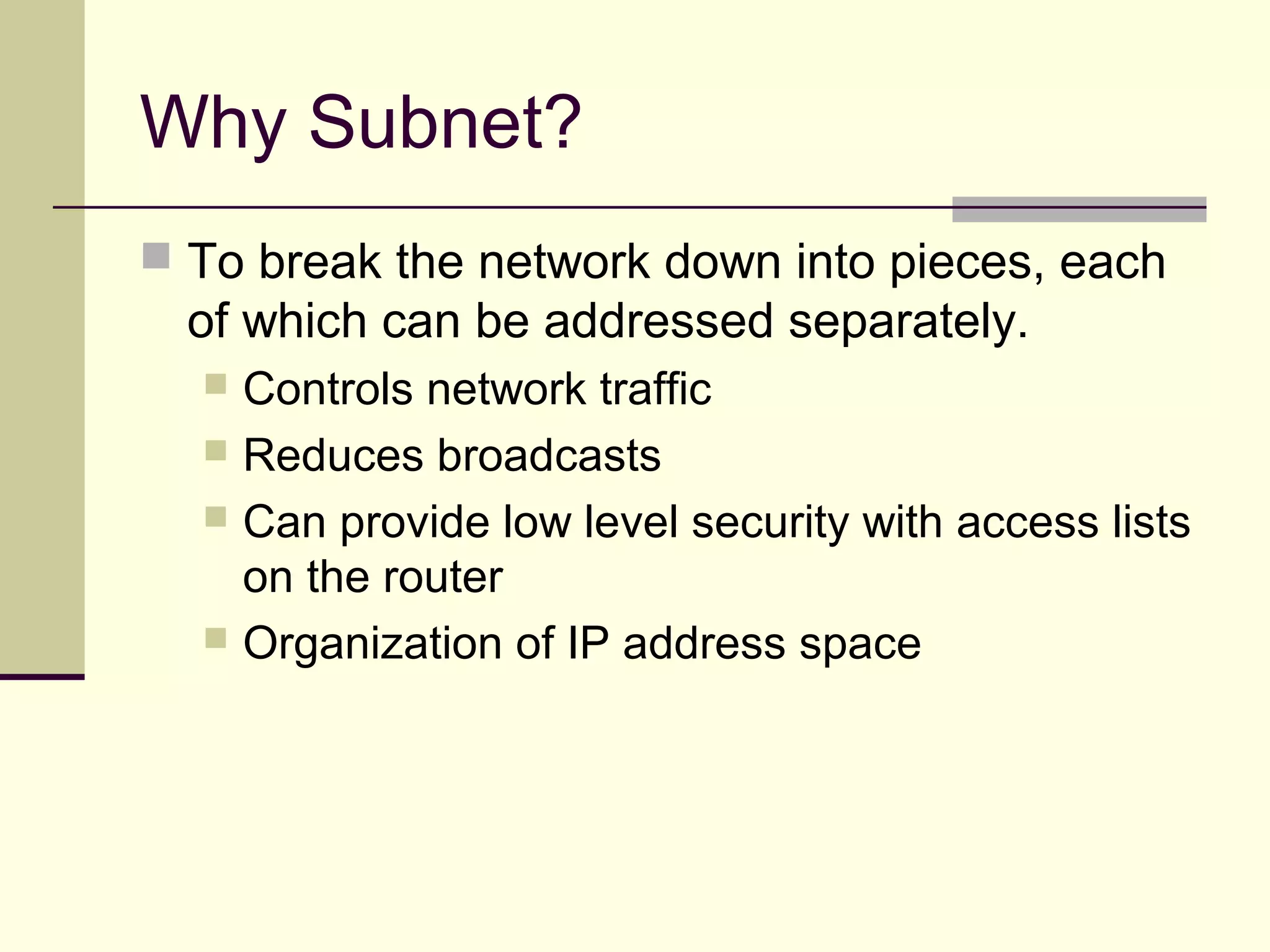
Why Subnet?
 To break the network down into pieces, each
of which can be addressed separately.
 Controls network traffic
 Reduces broadcasts
 Can provide low level security with access lists
on the router
 Organization of IP address space
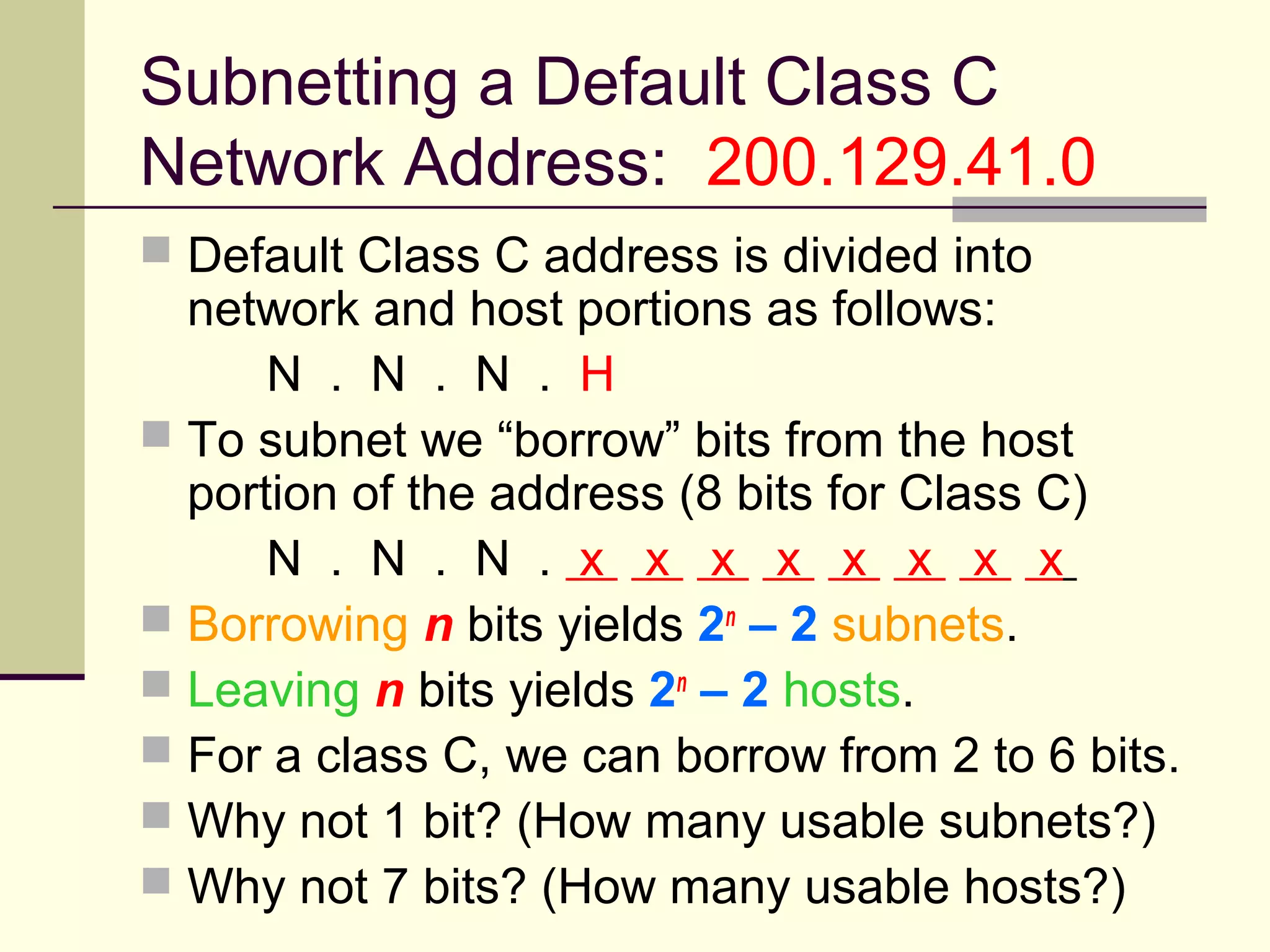
Subnetting a Default Class C
Network Address: 200.129.41.0
 Default Class C address is divided into
network and host portions as follows:
N . N . N . H
 To subnet we “borrow” bits from the host
portion of the address (8 bits for Class C)
N . N . N . x x x x x x x x
 Borrowing n bits yields 2n
– 2 subnets.
 Leaving n bits yields 2n
– 2 hosts.
 For a class C, we can borrow from 2 to 6 bits.
 Why not 1 bit? (How many usable subnets?)
 Why not 7 bits? (How many usable hosts?)
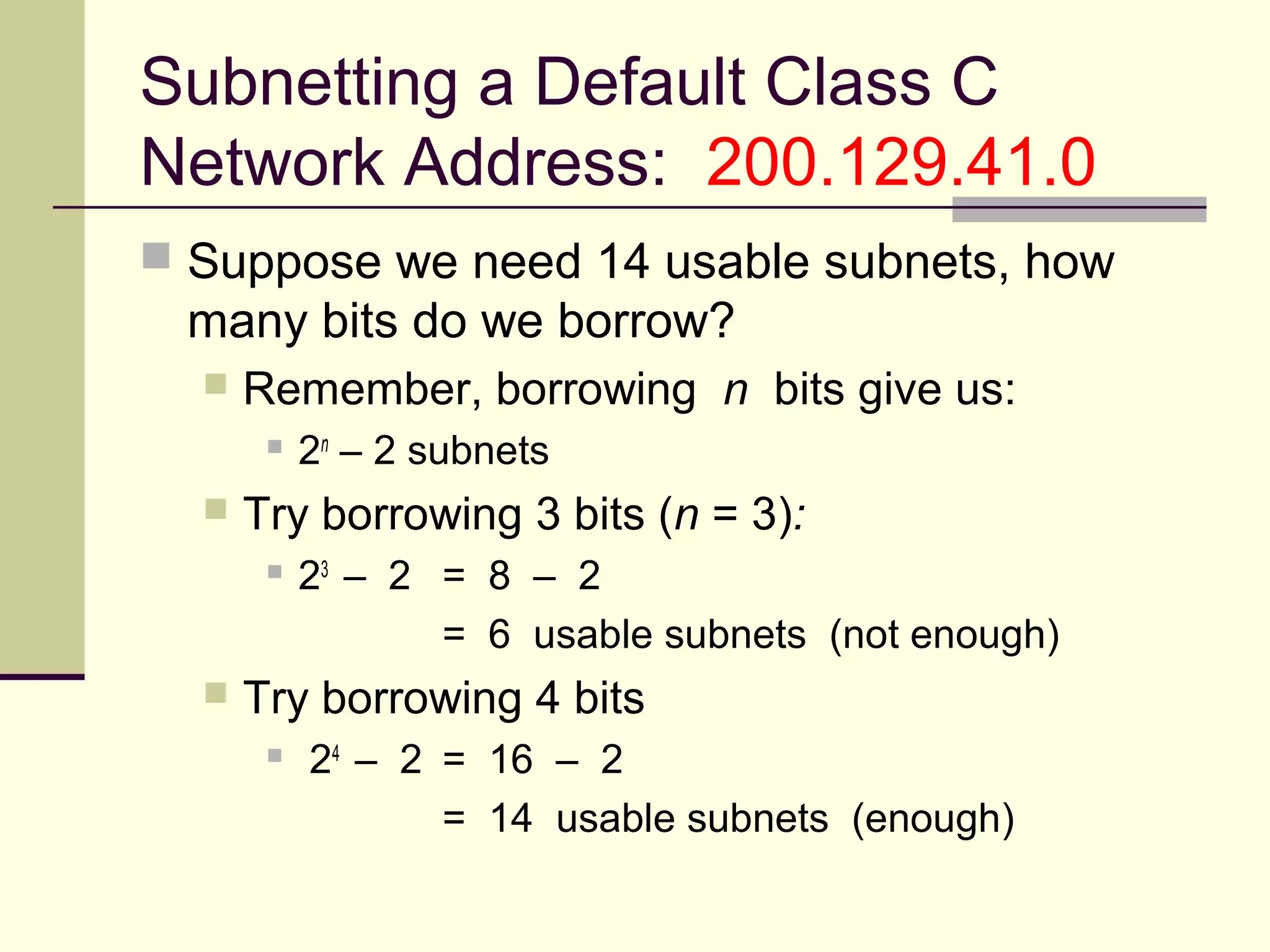
Subnetting a Default Class C
Network Address: 200.129.41.0
 Suppose we need 14 usable subnets, how
many bits do we borrow?
 Remember, borrowing n bits give us:
 2n
– 2 subnets
 Try borrowing 3 bits (n = 3):
 23
– 2 = 8 – 2
= 6 usable subnets (not enough)
 Try borrowing 4 bits
 24
– 2 = 16 – 2
= 14 usable subnets (enough)
Subnetting a Default Class C
Network Address: 200.129.41.0
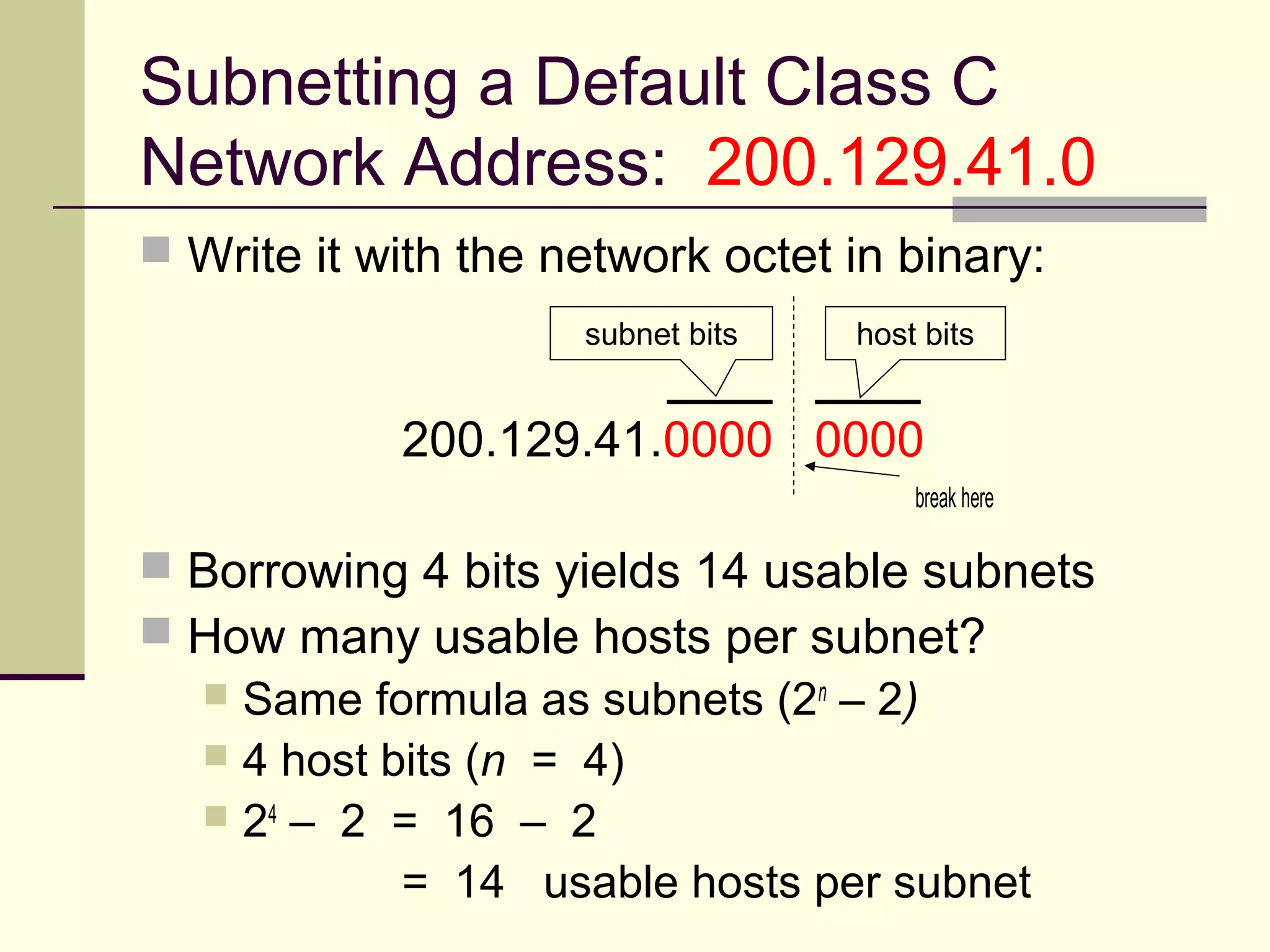
 Write it with the network octet in binary:
200.129.41.0000 0000
break here
 Borrowing 4 bits yields 14 usable subnets
 How many usable hosts per subnet?
 Same formula as subnets (2n
– 2)
 4 host bits (n = 4)
 24
– 2 = 16 – 2
= 14 usable hosts per subnet
subnet bits host bits
Subnetting a Default Class C
Network Address: 200.129.41.0
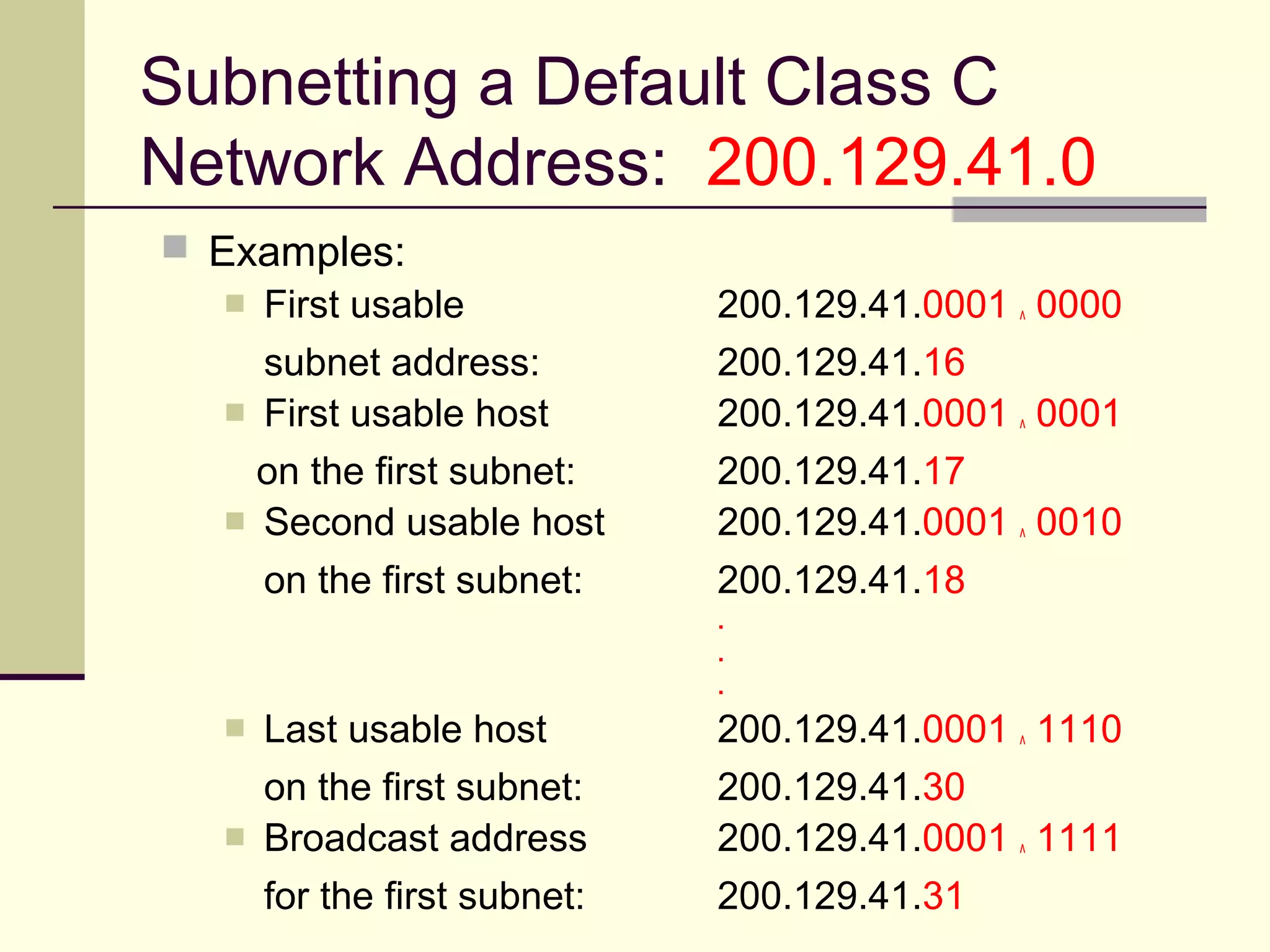
 Examples:
 First usable 200.129.41.0001 ^ 0000
subnet address: 200.129.41.16
 First usable host 200.129.41.0001 ^ 0001
on the first subnet: 200.129.41.17
 Second usable host 200.129.41.0001 ^ 0010
on the first subnet: 200.129.41.18
.
.
.
 Last usable host 200.129.41.0001 ^ 1110
on the first subnet: 200.129.41.30
 Broadcast address 200.129.41.0001 ^ 1111
for the first subnet: 200.129.41.31
Subnetting a Default Class C
Network Address: 200.129.41.0
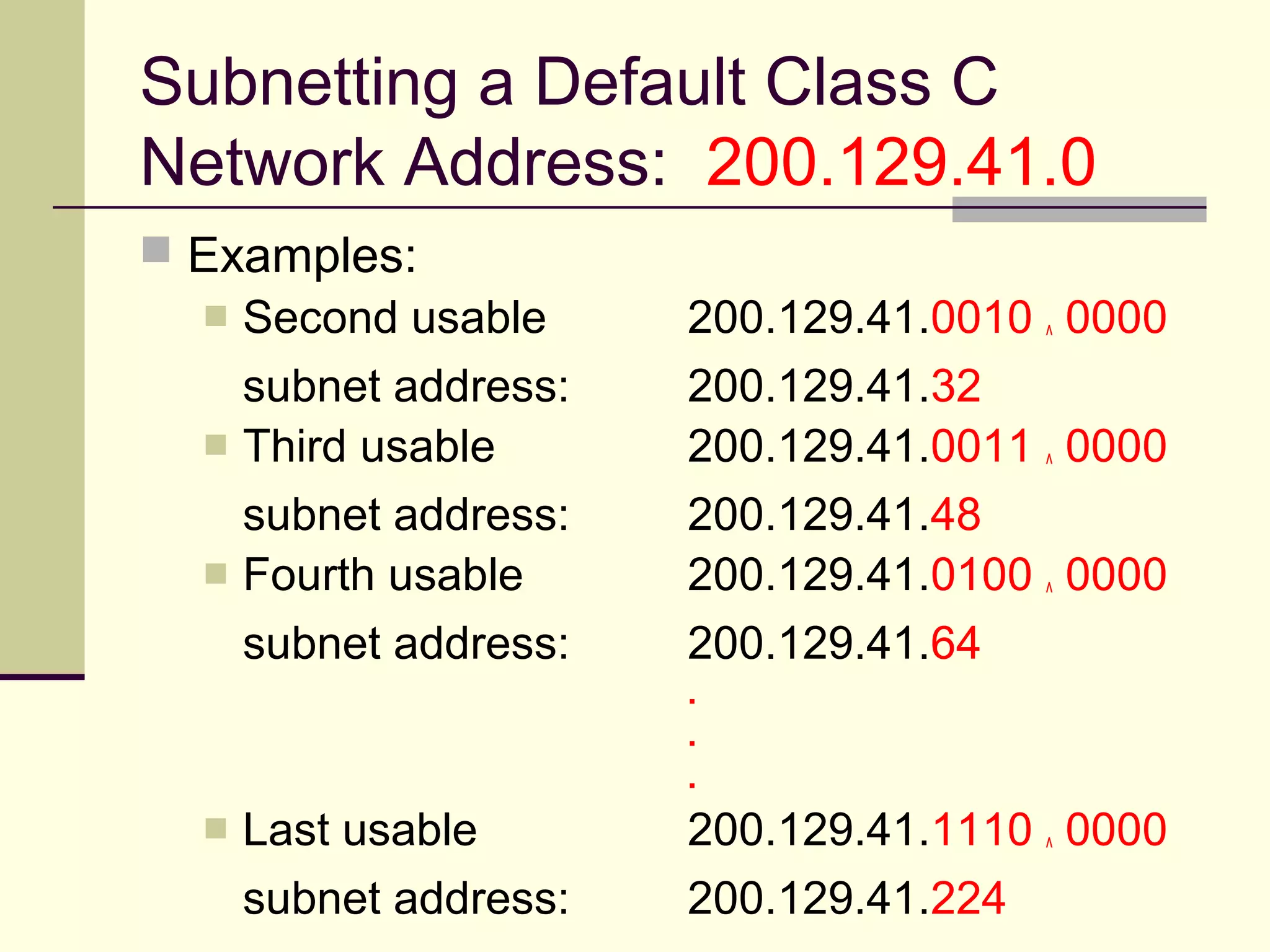
 Examples:
 Second usable 200.129.41.0010 ^ 0000
subnet address: 200.129.41.32
 Third usable 200.129.41.0011 ^ 0000
subnet address: 200.129.41.48
 Fourth usable 200.129.41.0100 ^ 0000
subnet address: 200.129.41.64
.
.
.
 Last usable 200.129.41.1110 ^ 0000
subnet address: 200.129.41.224
The Subnet Mask: How the
Router Determines the Subnet
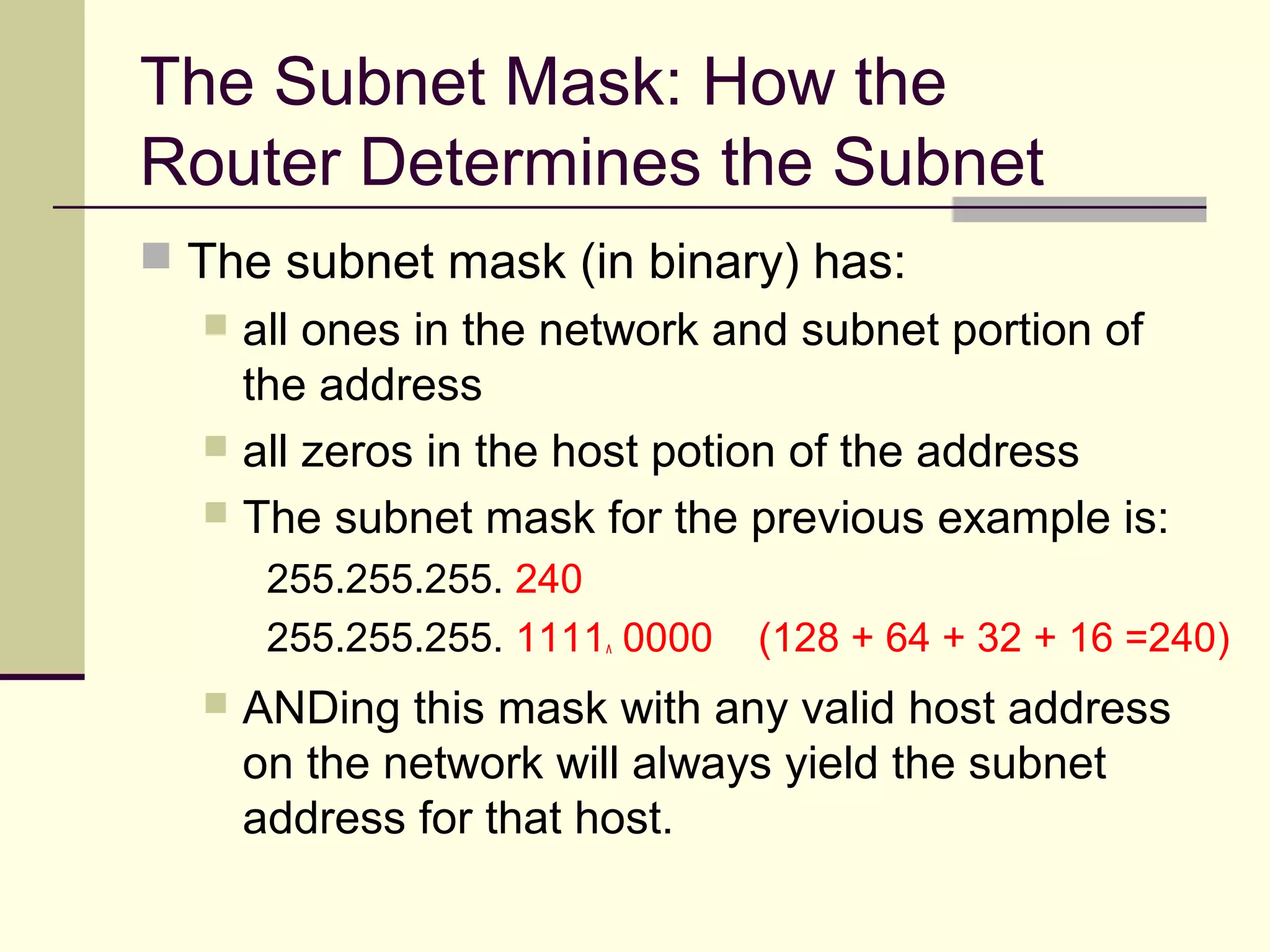
 The subnet mask (in binary) has:
 all ones in the network and subnet portion of
the address
 all zeros in the host potion of the address
 The subnet mask for the previous example is:
255.255.255. 240
255.255.255. 1111^ 0000 (128 + 64 + 32 + 16 =240)
 ANDing this mask with any valid host address
on the network will always yield the subnet
address for that host.
The Subnet Mask: How the
Router Determines the Subnet
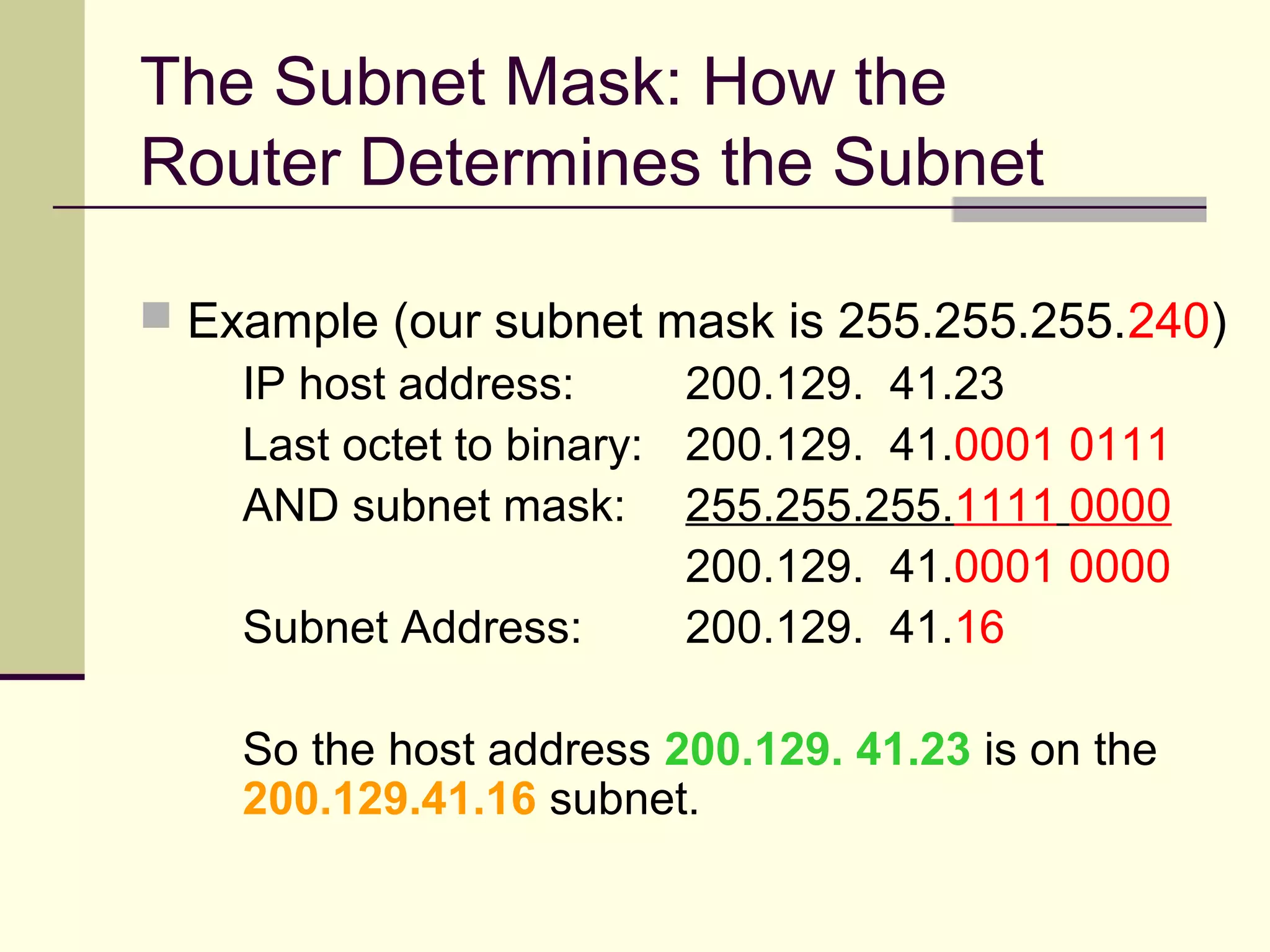
 Example (our subnet mask is 255.255.255.240)
IP host address: 200.129. 41.23
Last octet to binary: 200.129. 41.0001 0111
AND subnet mask: 255.255.255.1111 0000
200.129. 41.0001 0000
Subnet Address: 200.129. 41.16
So the host address 200.129. 41.23 is on the
200.129.41.16 subnet.
Subnetting a Default Class B
Network Address: 132.178.0.0
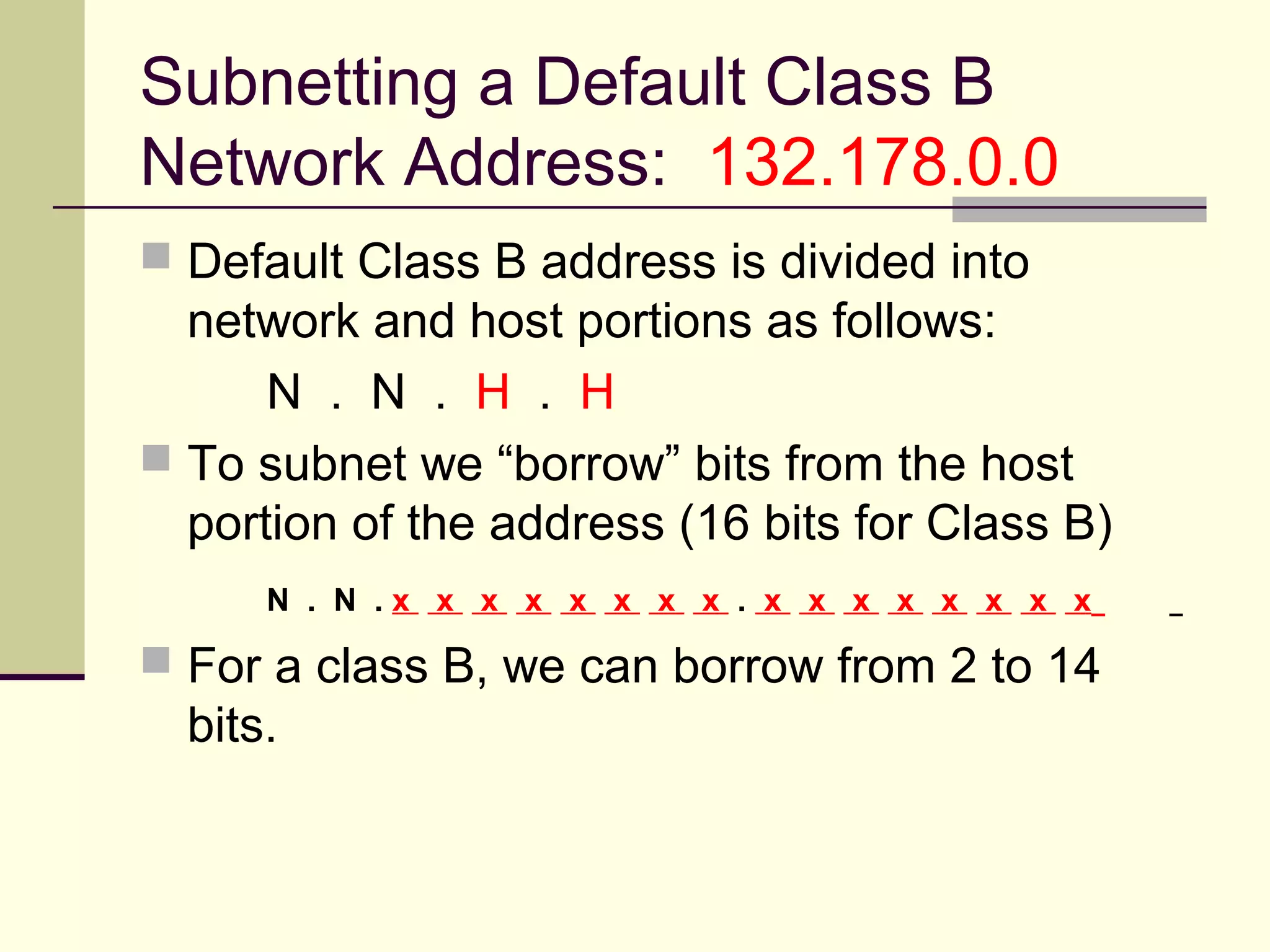
 Default Class B address is divided into
network and host portions as follows:
N . N . H . H
 To subnet we “borrow” bits from the host
portion of the address (16 bits for Class B)
N . N . x x x x x x x x . x x x x x x x x
 For a class B, we can borrow from 2 to 14
bits.
Subnetting a Default Class B
Network Address: 132.178.0.0
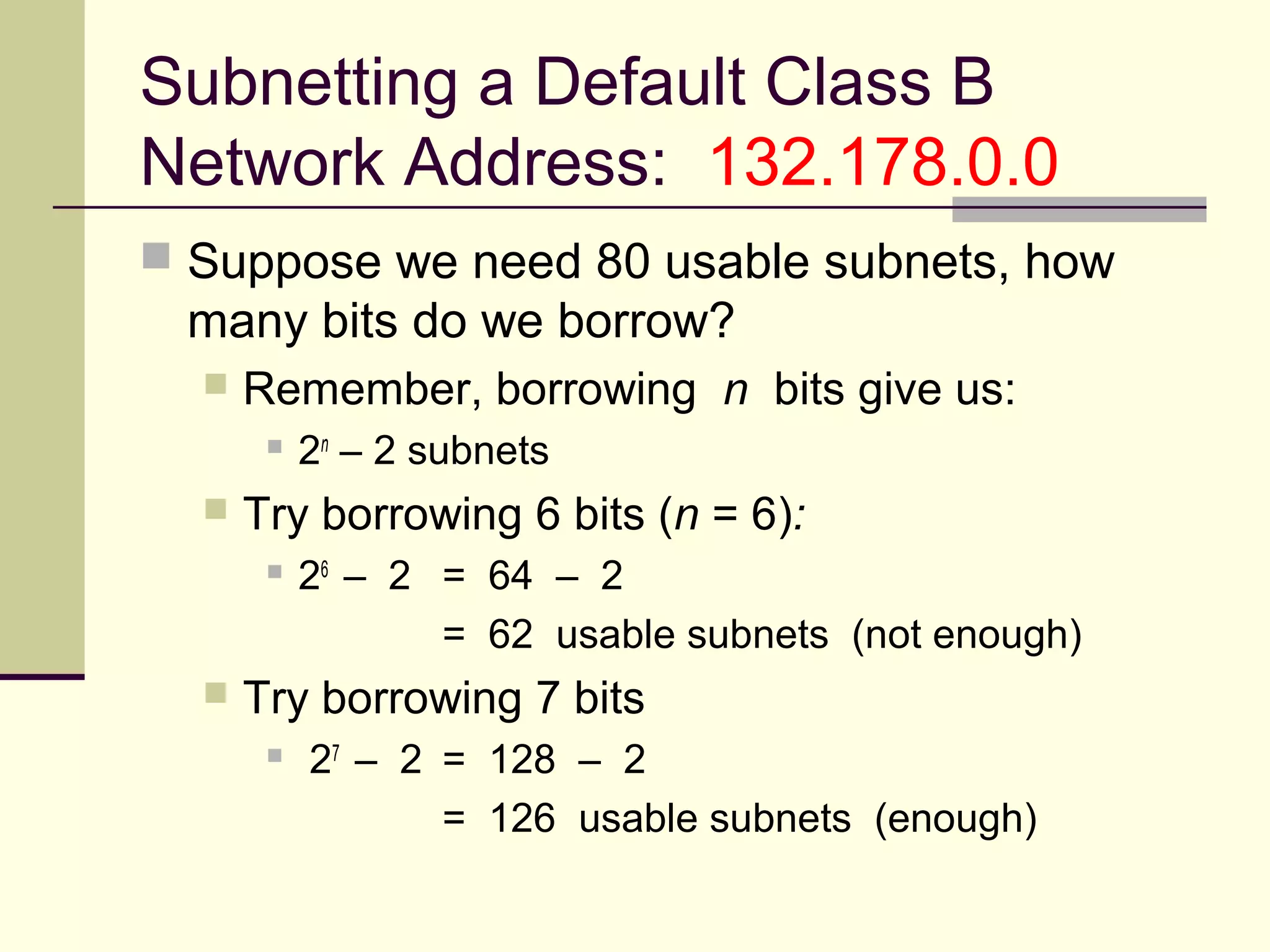
 Suppose we need 80 usable subnets, how
many bits do we borrow?
 Remember, borrowing n bits give us:
 2n
– 2 subnets
 Try borrowing 6 bits (n = 6):
 26
– 2 = 64 – 2
= 62 usable subnets (not enough)
 Try borrowing 7 bits
 27
– 2 = 128 – 2
= 126 usable subnets (enough)
Subnetting a Default Class B
Network Address: 132.178.0.0
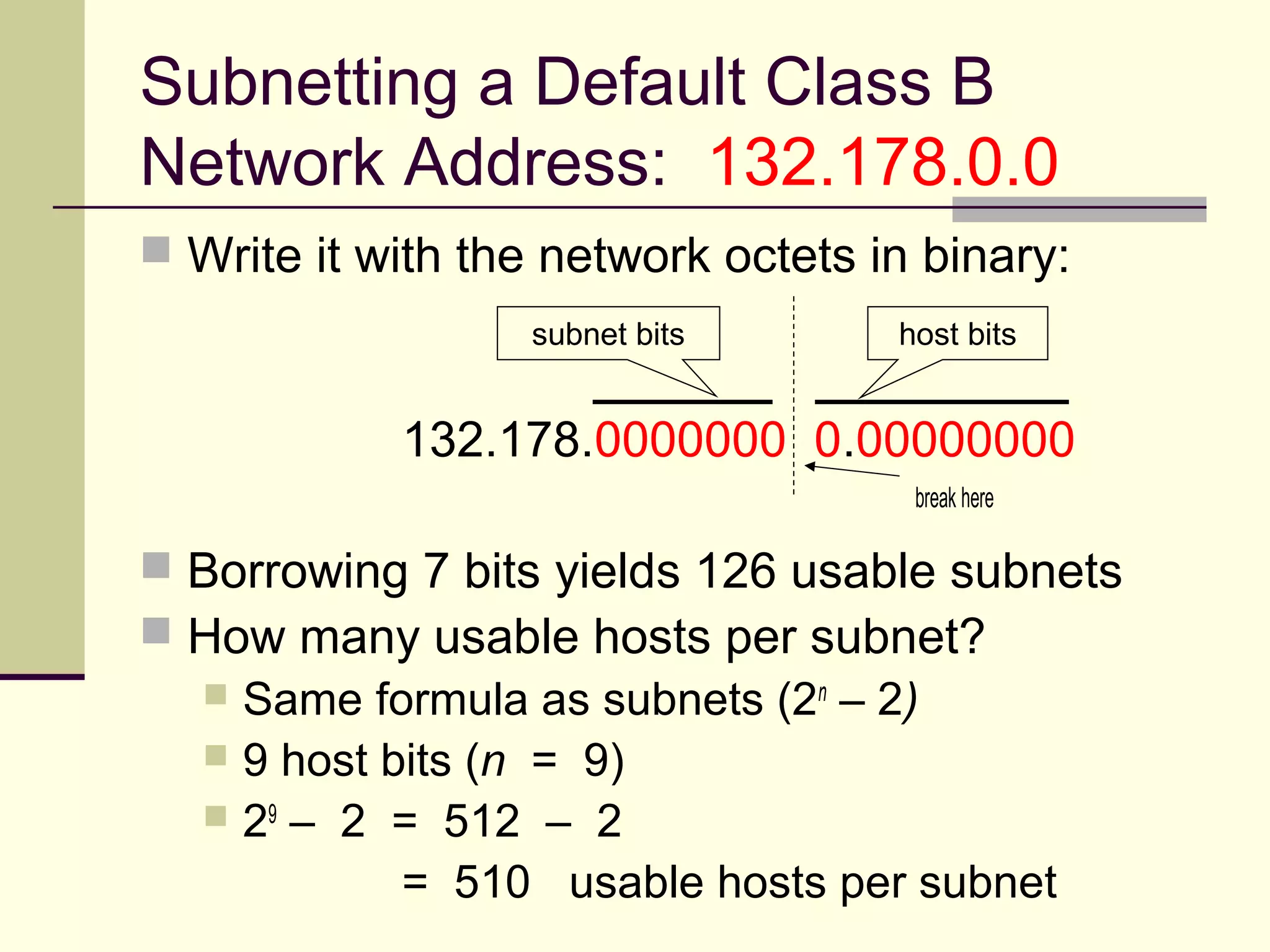
 Write it with the network octets in binary:
132.178.0000000 0.00000000
break here
 Borrowing 7 bits yields 126 usable subnets
 How many usable hosts per subnet?
 Same formula as subnets (2n
– 2)
 9 host bits (n = 9)
 29
– 2 = 512 – 2
= 510 usable hosts per subnet
subnet bits host bits
Subnetting a Default Class B
Network Address: 132.178.0.0
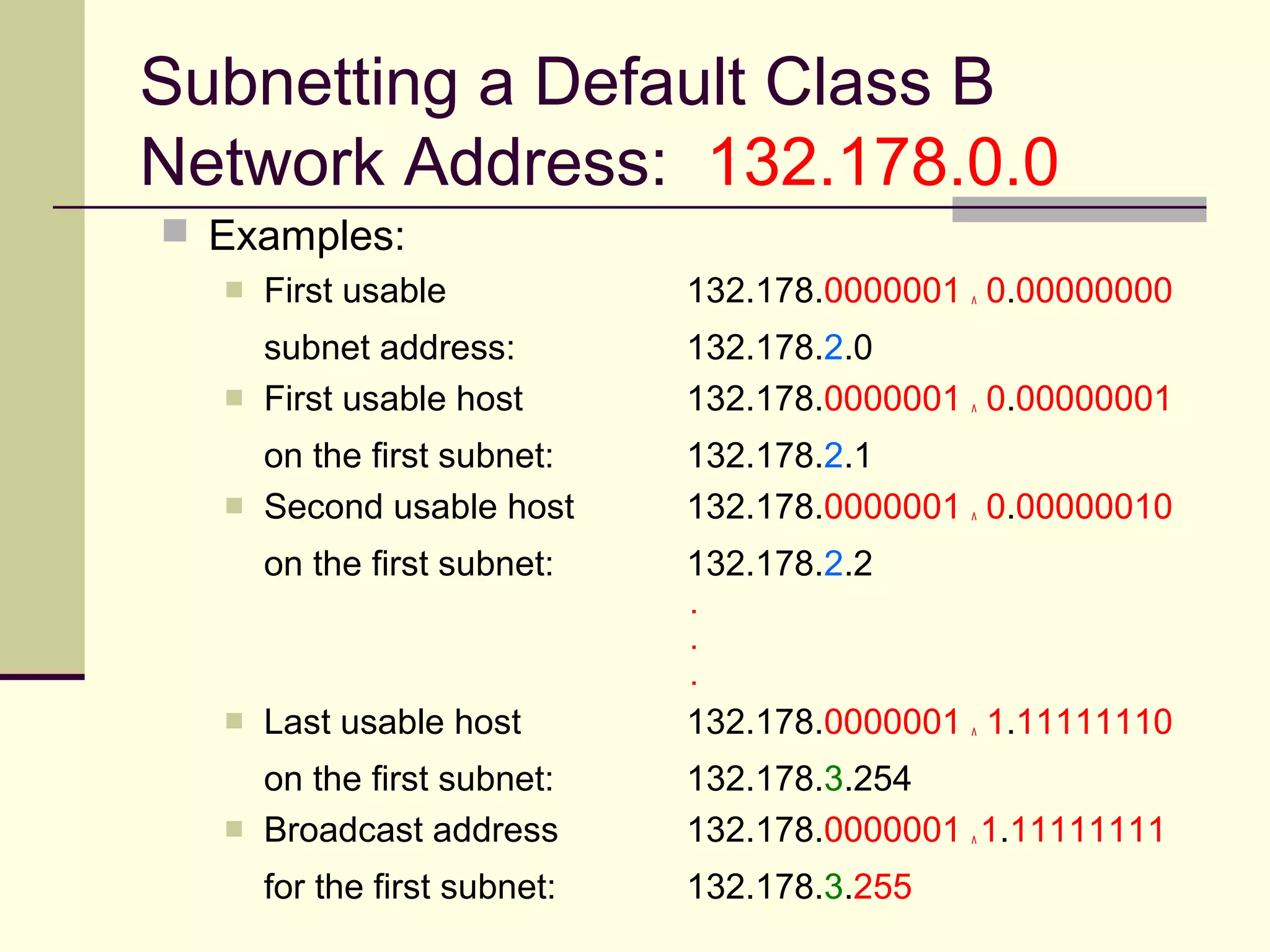
 Examples:
 First usable 132.178.0000001 ^ 0.00000000
subnet address: 132.178.2.0
 First usable host 132.178.0000001 ^ 0.00000001
on the first subnet: 132.178.2.1
 Second usable host 132.178.0000001 ^ 0.00000010
on the first subnet: 132.178.2.2
.
.
.
 Last usable host 132.178.0000001 ^ 1.11111110
on the first subnet: 132.178.3.254
 Broadcast address 132.178.0000001 ^1.11111111
for the first subnet: 132.178.3.255
Subnetting a Default Class B
Network Address: 132.178.0.0
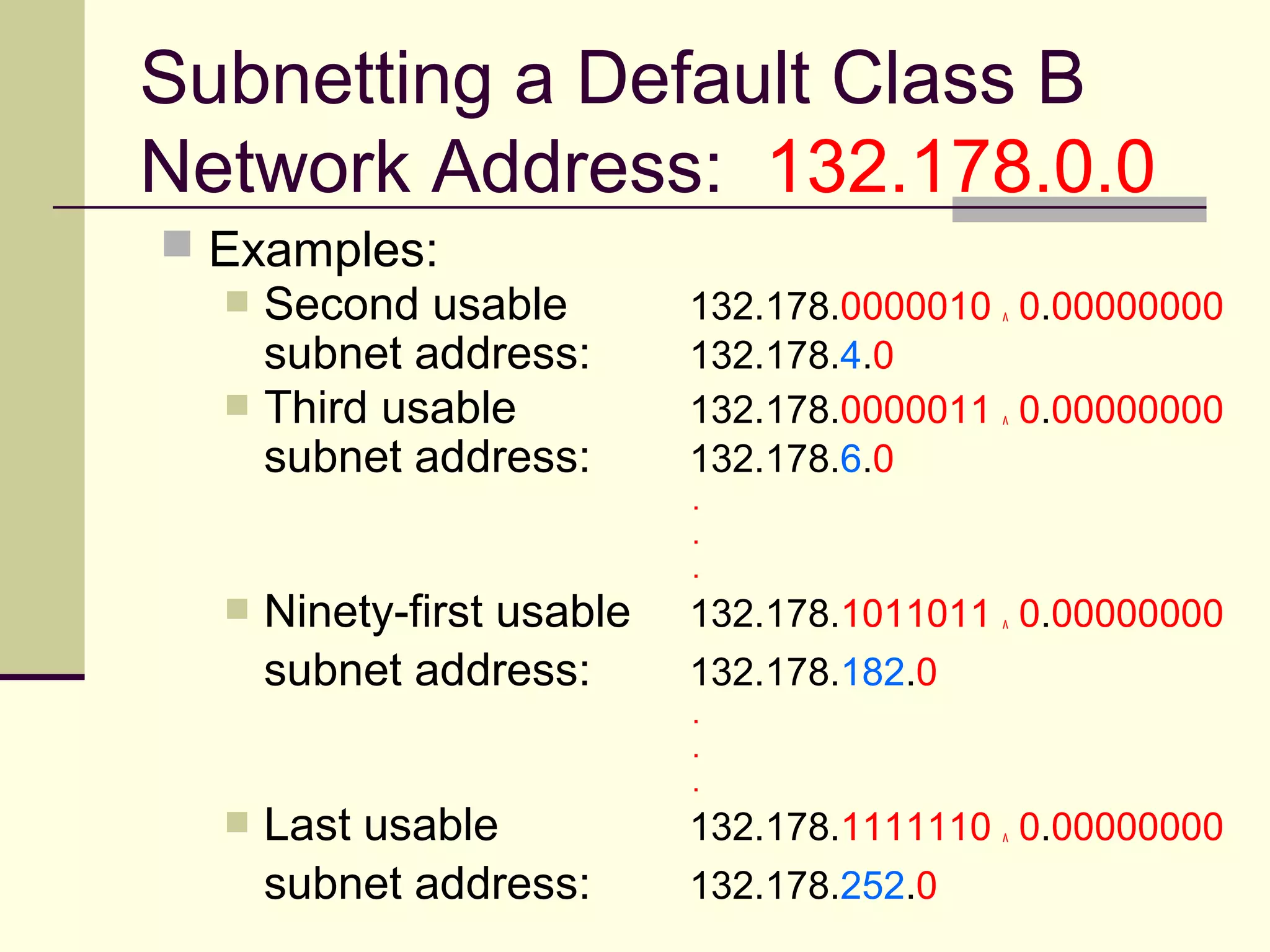
 Examples:
 Second usable 132.178.0000010 ^ 0.00000000
subnet address: 132.178.4.0
 Third usable 132.178.0000011 ^ 0.00000000
subnet address: 132.178.6.0
.
.
.
 Ninety-first usable 132.178.1011011 ^ 0.00000000
subnet address: 132.178.182.0
.
.
.
 Last usable 132.178.1111110 ^ 0.00000000
subnet address: 132.178.252.0
Subnetting a Default Class B
Network Address: 132.178.0.0
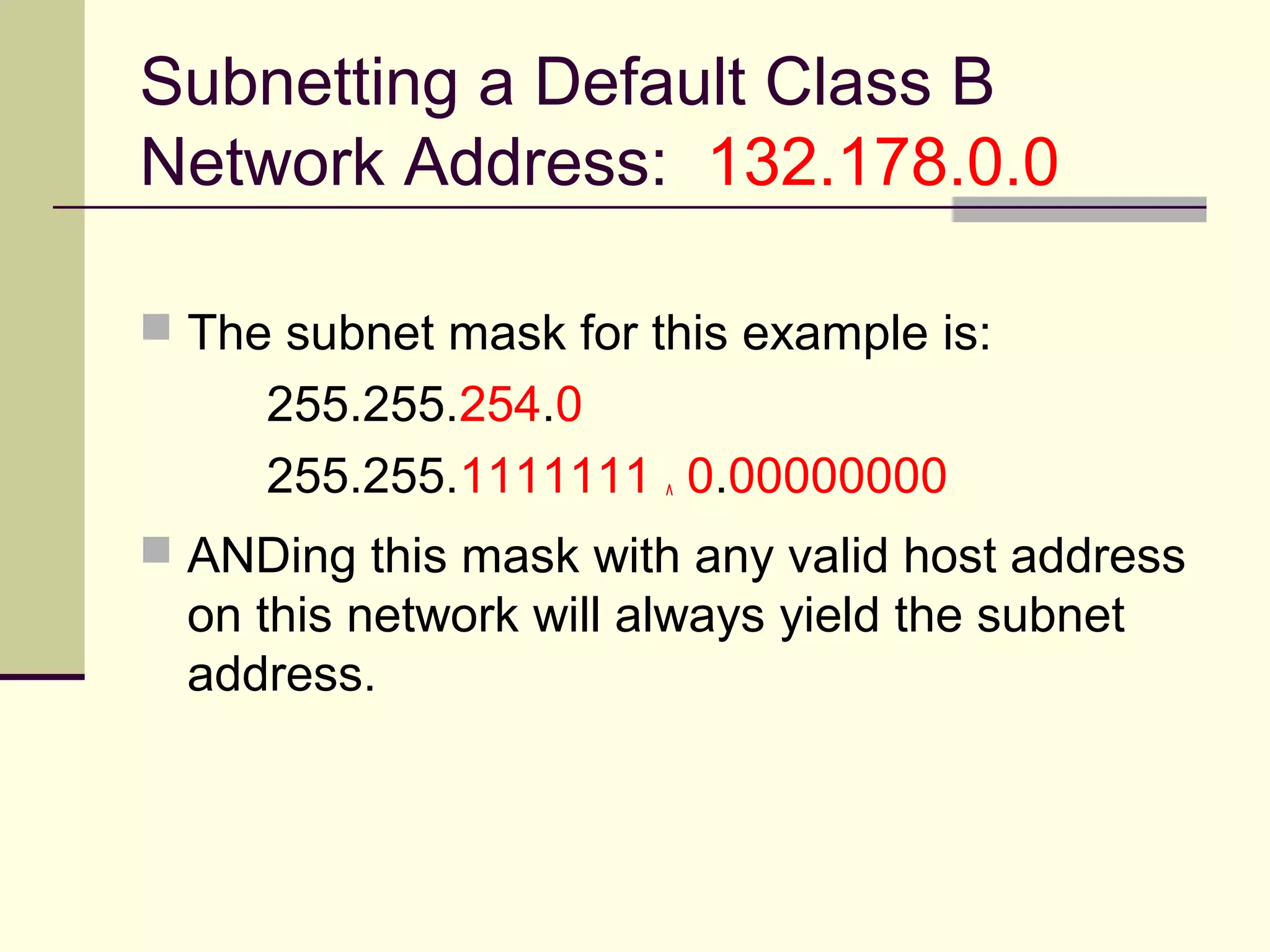
 The subnet mask for this example is:
255.255.254.0
255.255.1111111 ^ 0.00000000
 ANDing this mask with any valid host address
on this network will always yield the subnet
address.
Subnetting a Default Class B
Network Address: 132.178.0.0
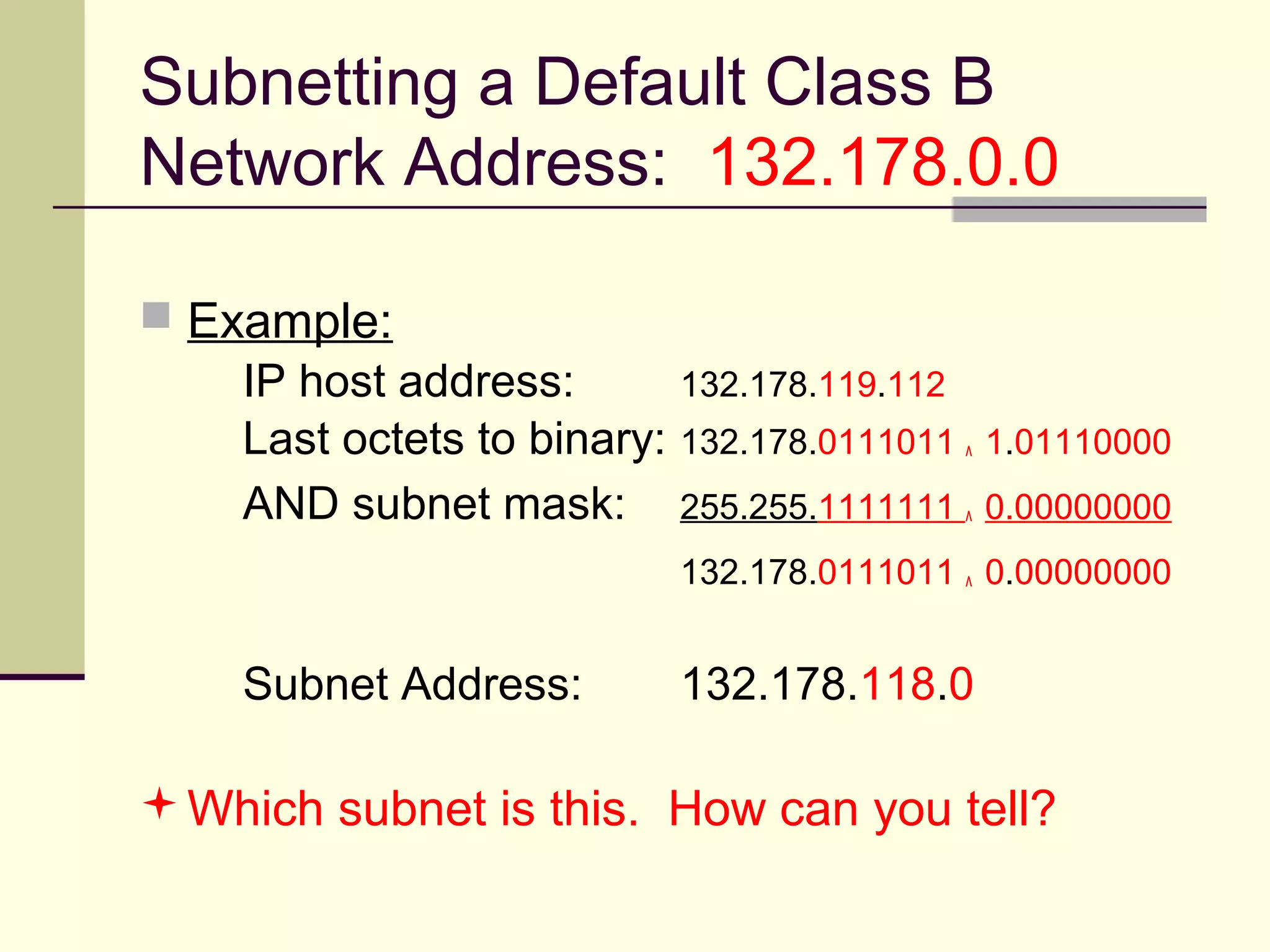
 Example:
IP host address: 132.178.119.112
Last octets to binary: 132.178.0111011 ^ 1.01110000
AND subnet mask: 255.255.1111111 ^ 0.00000000
132.178.0111011 ^ 0.00000000
Subnet Address: 132.178.118.0
Which subnet is this. How can you tell?

Subnitting

  • 1.
    Subnetting What was thatmasked address?
  • 2.
    Why Subnet?  Tobreak the network down into pieces, each of which can be addressed separately.  Controls network traffic  Reduces broadcasts  Can provide low level security with access lists on the router  Organization of IP address space
  • 3.
    Subnetting a DefaultClass C Network Address: 200.129.41.0  Default Class C address is divided into network and host portions as follows: N . N . N . H  To subnet we “borrow” bits from the host portion of the address (8 bits for Class C) N . N . N . x x x x x x x x  Borrowing n bits yields 2n – 2 subnets.  Leaving n bits yields 2n – 2 hosts.  For a class C, we can borrow from 2 to 6 bits.  Why not 1 bit? (How many usable subnets?)  Why not 7 bits? (How many usable hosts?)
  • 4.
    Subnetting a DefaultClass C Network Address: 200.129.41.0  Suppose we need 14 usable subnets, how many bits do we borrow?  Remember, borrowing n bits give us:  2n – 2 subnets  Try borrowing 3 bits (n = 3):  23 – 2 = 8 – 2 = 6 usable subnets (not enough)  Try borrowing 4 bits  24 – 2 = 16 – 2 = 14 usable subnets (enough)
  • 5.
    Subnetting a DefaultClass C Network Address: 200.129.41.0  Write it with the network octet in binary: 200.129.41.0000 0000 break here  Borrowing 4 bits yields 14 usable subnets  How many usable hosts per subnet?  Same formula as subnets (2n – 2)  4 host bits (n = 4)  24 – 2 = 16 – 2 = 14 usable hosts per subnet subnet bits host bits
  • 6.
    Subnetting a DefaultClass C Network Address: 200.129.41.0  Examples:  First usable 200.129.41.0001 ^ 0000 subnet address: 200.129.41.16  First usable host 200.129.41.0001 ^ 0001 on the first subnet: 200.129.41.17  Second usable host 200.129.41.0001 ^ 0010 on the first subnet: 200.129.41.18 . . .  Last usable host 200.129.41.0001 ^ 1110 on the first subnet: 200.129.41.30  Broadcast address 200.129.41.0001 ^ 1111 for the first subnet: 200.129.41.31
  • 7.
    Subnetting a DefaultClass C Network Address: 200.129.41.0  Examples:  Second usable 200.129.41.0010 ^ 0000 subnet address: 200.129.41.32  Third usable 200.129.41.0011 ^ 0000 subnet address: 200.129.41.48  Fourth usable 200.129.41.0100 ^ 0000 subnet address: 200.129.41.64 . . .  Last usable 200.129.41.1110 ^ 0000 subnet address: 200.129.41.224
  • 8.
    The Subnet Mask:How the Router Determines the Subnet  The subnet mask (in binary) has:  all ones in the network and subnet portion of the address  all zeros in the host potion of the address  The subnet mask for the previous example is: 255.255.255. 240 255.255.255. 1111^ 0000 (128 + 64 + 32 + 16 =240)  ANDing this mask with any valid host address on the network will always yield the subnet address for that host.
  • 9.
    The Subnet Mask:How the Router Determines the Subnet  Example (our subnet mask is 255.255.255.240) IP host address: 200.129. 41.23 Last octet to binary: 200.129. 41.0001 0111 AND subnet mask: 255.255.255.1111 0000 200.129. 41.0001 0000 Subnet Address: 200.129. 41.16 So the host address 200.129. 41.23 is on the 200.129.41.16 subnet.
  • 10.
    Subnetting a DefaultClass B Network Address: 132.178.0.0  Default Class B address is divided into network and host portions as follows: N . N . H . H  To subnet we “borrow” bits from the host portion of the address (16 bits for Class B) N . N . x x x x x x x x . x x x x x x x x  For a class B, we can borrow from 2 to 14 bits.
  • 11.
    Subnetting a DefaultClass B Network Address: 132.178.0.0  Suppose we need 80 usable subnets, how many bits do we borrow?  Remember, borrowing n bits give us:  2n – 2 subnets  Try borrowing 6 bits (n = 6):  26 – 2 = 64 – 2 = 62 usable subnets (not enough)  Try borrowing 7 bits  27 – 2 = 128 – 2 = 126 usable subnets (enough)
  • 12.
    Subnetting a DefaultClass B Network Address: 132.178.0.0  Write it with the network octets in binary: 132.178.0000000 0.00000000 break here  Borrowing 7 bits yields 126 usable subnets  How many usable hosts per subnet?  Same formula as subnets (2n – 2)  9 host bits (n = 9)  29 – 2 = 512 – 2 = 510 usable hosts per subnet subnet bits host bits
  • 13.
    Subnetting a DefaultClass B Network Address: 132.178.0.0  Examples:  First usable 132.178.0000001 ^ 0.00000000 subnet address: 132.178.2.0  First usable host 132.178.0000001 ^ 0.00000001 on the first subnet: 132.178.2.1  Second usable host 132.178.0000001 ^ 0.00000010 on the first subnet: 132.178.2.2 . . .  Last usable host 132.178.0000001 ^ 1.11111110 on the first subnet: 132.178.3.254  Broadcast address 132.178.0000001 ^1.11111111 for the first subnet: 132.178.3.255
  • 14.
    Subnetting a DefaultClass B Network Address: 132.178.0.0  Examples:  Second usable 132.178.0000010 ^ 0.00000000 subnet address: 132.178.4.0  Third usable 132.178.0000011 ^ 0.00000000 subnet address: 132.178.6.0 . . .  Ninety-first usable 132.178.1011011 ^ 0.00000000 subnet address: 132.178.182.0 . . .  Last usable 132.178.1111110 ^ 0.00000000 subnet address: 132.178.252.0
  • 15.
    Subnetting a DefaultClass B Network Address: 132.178.0.0  The subnet mask for this example is: 255.255.254.0 255.255.1111111 ^ 0.00000000  ANDing this mask with any valid host address on this network will always yield the subnet address.
  • 16.
    Subnetting a DefaultClass B Network Address: 132.178.0.0  Example: IP host address: 132.178.119.112 Last octets to binary: 132.178.0111011 ^ 1.01110000 AND subnet mask: 255.255.1111111 ^ 0.00000000 132.178.0111011 ^ 0.00000000 Subnet Address: 132.178.118.0 Which subnet is this. How can you tell?

Editor's Notes

  • #10 See page 10 in the workbook and show students what happens with 255 octets in the mask when converted to binary for ANDing.