Variable Length Subnet Masking
(VLSM)
Supports more efficient use of the assigned IP addresses and reduces
the amount of routing information at the top level
VLSM (By Example)
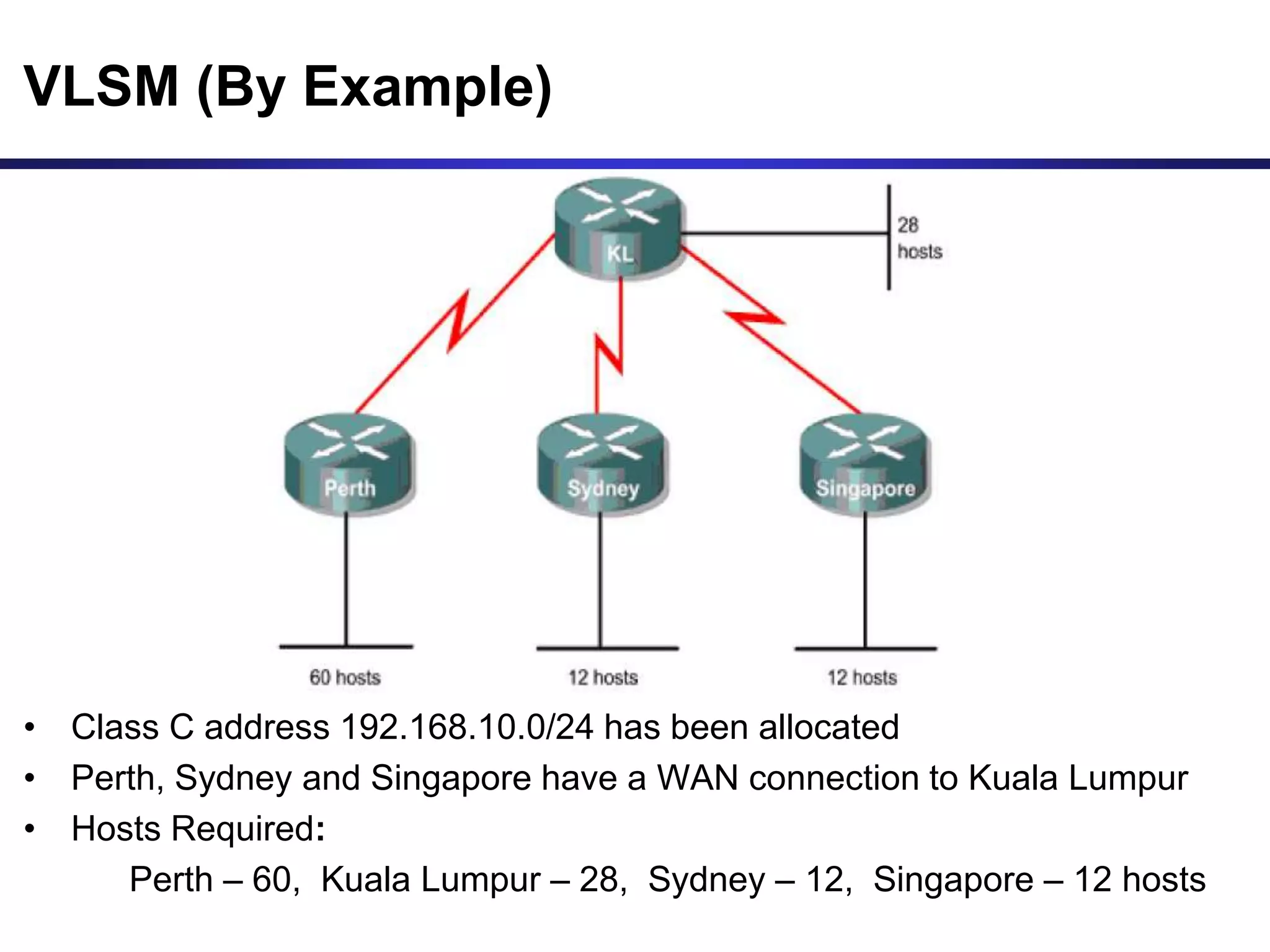
• Class C address 192.168.10.0/24 has been allocated
• Perth, Sydney and Singapore have a WAN connection to Kuala Lumpur
• Hosts Required:
Perth – 60, Kuala Lumpur – 28, Sydney – 12, Singapore – 12 hosts
VLSM (By Example)
• To calculate VLSM subnets and the respective hosts allocate
the largest requirements first from the address range
• Requirements levels should be listed from the largest to the
smallest
• In this example, Perth requires 60 hosts (largest)
– Use 6 bits, since 26 – 2 = 62 usable addresses
– 2 bits will be used from the 4th octet to represent the
extended-network-prefix of /26
– Remaining 6 bits will be used for host addresses
VLSM (By Example)
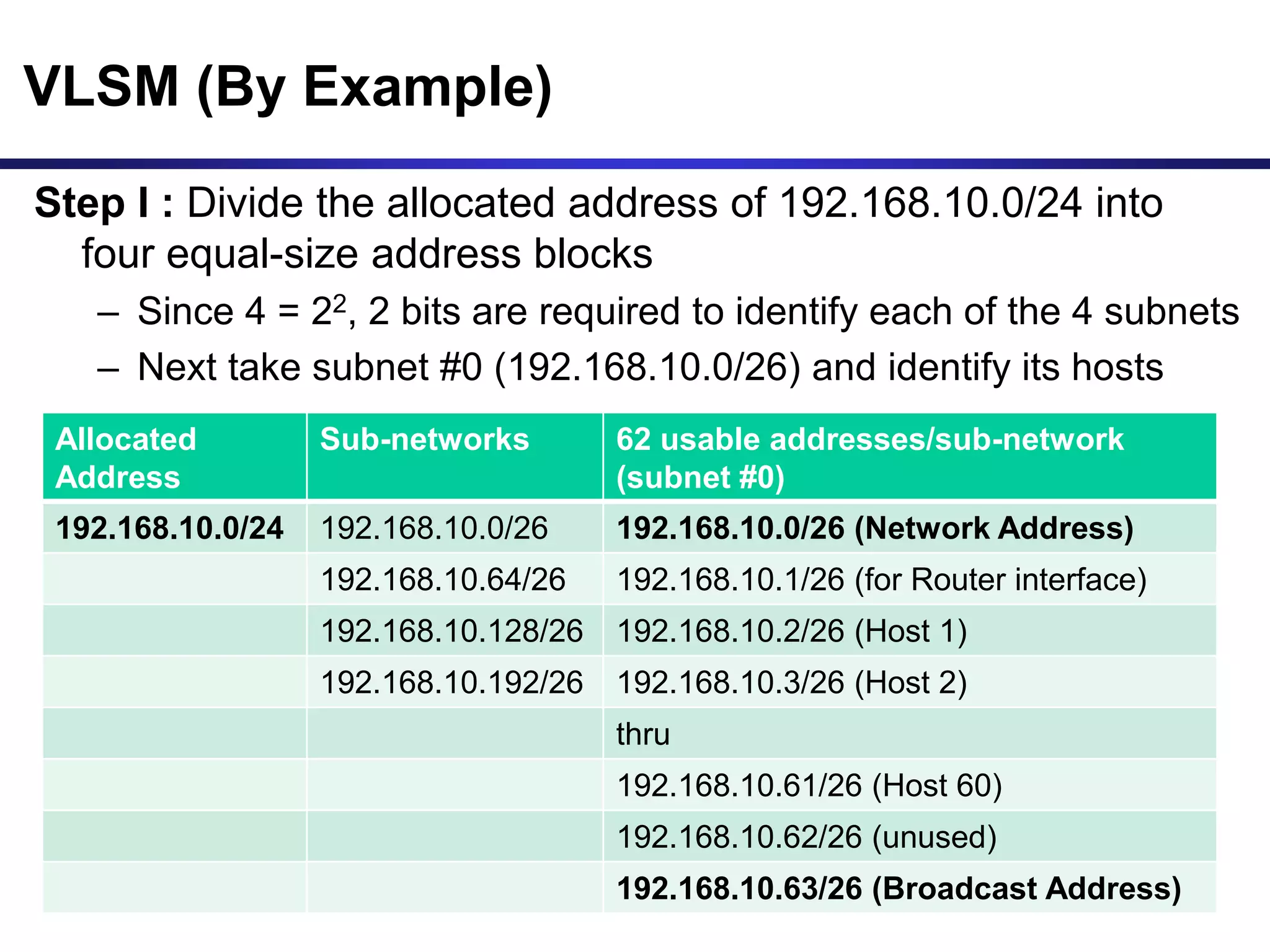
Step I : Divide the allocated address of 192.168.10.0/24 into
four equal-size address blocks
– Since 4 = 22, 2 bits are required to identify each of the 4 subnets
– Next take subnet #0 (192.168.10.0/26) and identify its hosts
Allocated
Address
Sub-networks 62 usable addresses/sub-network
(subnet #0)
192.168.10.0/24 192.168.10.0/26 192.168.10.0/26 (Network Address)
192.168.10.64/26 192.168.10.1/26 (for Router interface)
192.168.10.128/26 192.168.10.2/26 (Host 1)
192.168.10.192/26 192.168.10.3/26 (Host 2)
thru
192.168.10.61/26 (Host 60)
192.168.10.62/26 (unused)
192.168.10.63/26 (Broadcast Address)
VLSM (By Example)
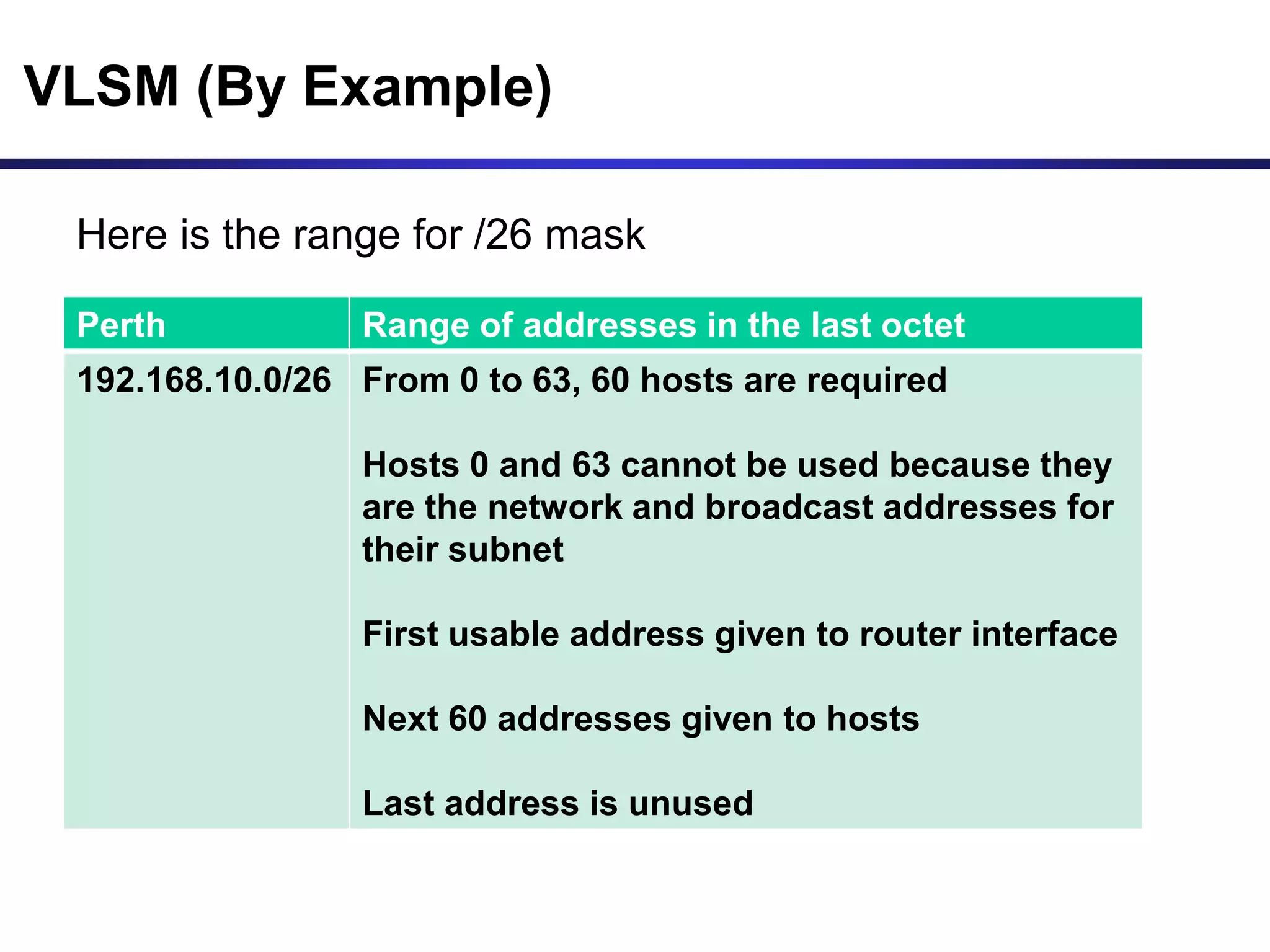
Here is the range for /26 mask
Perth Range of addresses in the last octet
192.168.10.0/26 From 0 to 63, 60 hosts are required
Hosts 0 and 63 cannot be used because they
are the network and broadcast addresses for
their subnet
First usable address given to router interface
Next 60 addresses given to hosts
Last address is unused
VLSM (By Example)
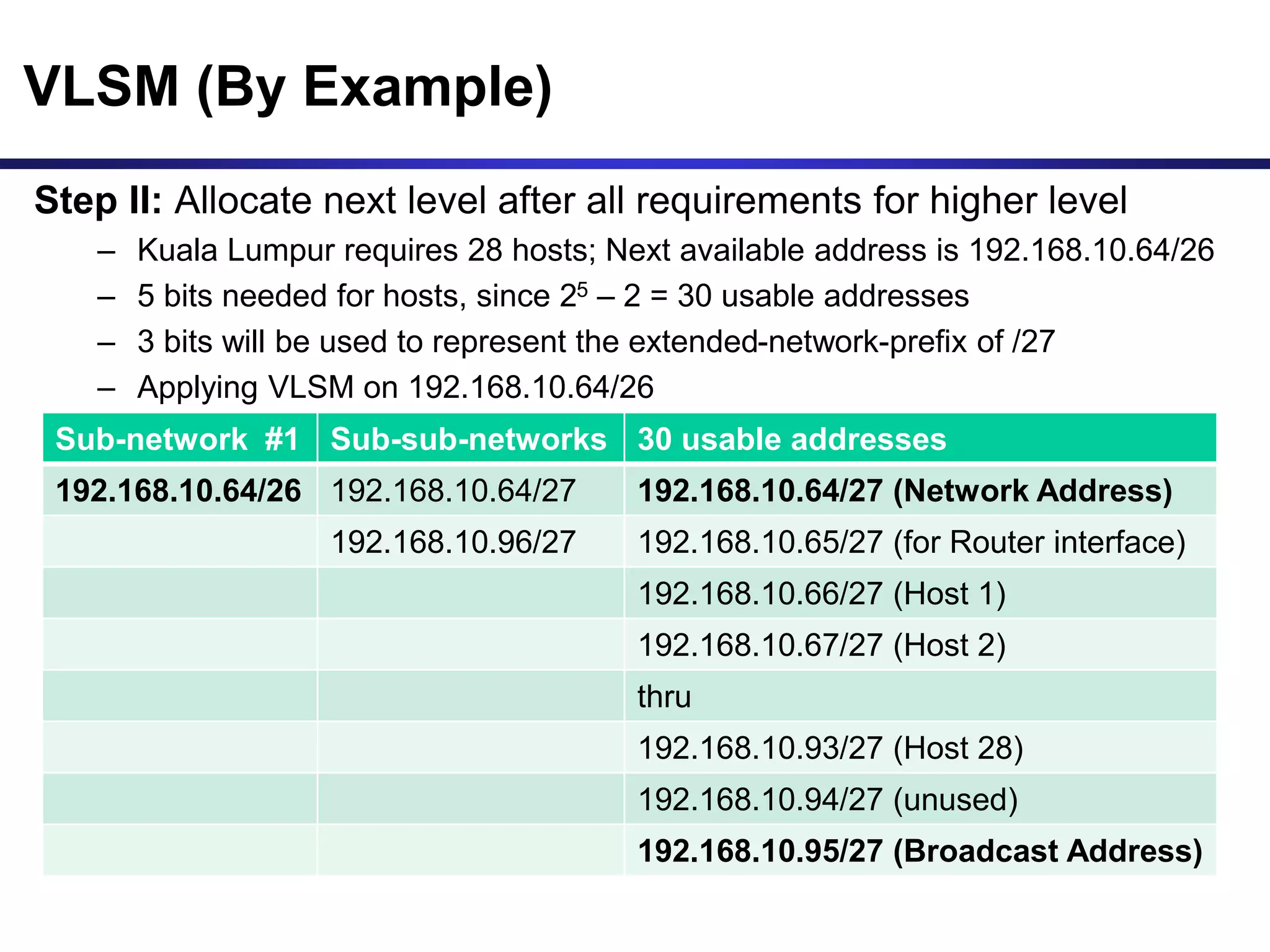
Step II: Allocate next level after all requirements for higher level
– Kuala Lumpur requires 28 hosts; Next available address is 192.168.10.64/26
– 5 bits needed for hosts, since 25 – 2 = 30 usable addresses
– 3 bits will be used to represent the extended-network-prefix of /27
– Applying VLSM on 192.168.10.64/26
Sub-network #1 Sub-sub-networks 30 usable addresses
192.168.10.64/26 192.168.10.64/27 192.168.10.64/27 (Network Address)
192.168.10.96/27 192.168.10.65/27 (for Router interface)
192.168.10.66/27 (Host 1)
192.168.10.67/27 (Host 2)
thru
192.168.10.93/27 (Host 28)
192.168.10.94/27 (unused)
192.168.10.95/27 (Broadcast Address)
VLSM (By Example)
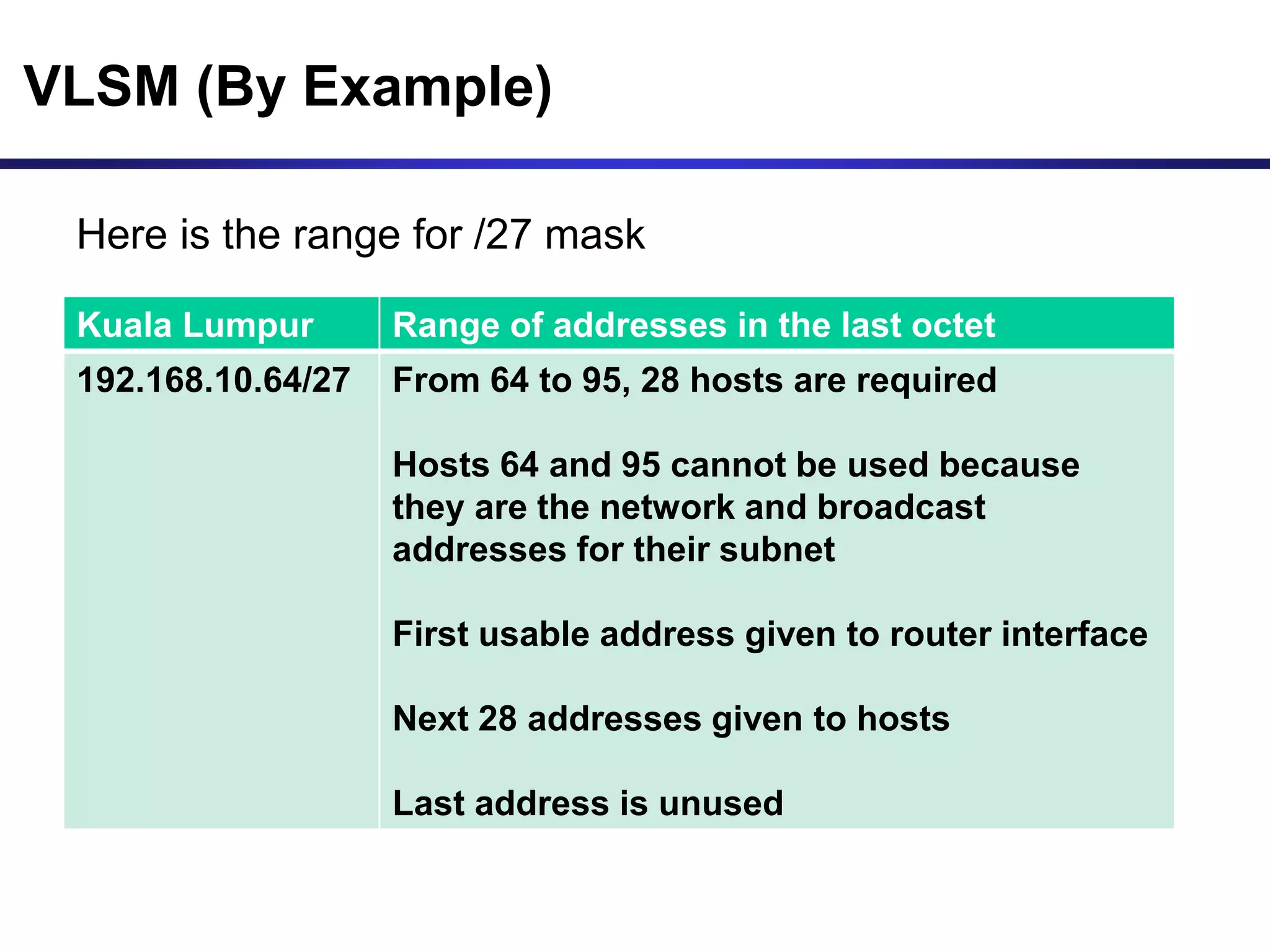
Here is the range for /27 mask
Kuala Lumpur Range of addresses in the last octet
192.168.10.64/27 From 64 to 95, 28 hosts are required
Hosts 64 and 95 cannot be used because
they are the network and broadcast
addresses for their subnet
First usable address given to router interface
Next 28 addresses given to hosts
Last address is unused
VLSM (By Example)
Step III : Allocate next level after all requirements for higher level
– Sydney requires 12 hosts; Next available address is 192.168.10.96/27
– 4 bits needed for hosts, since 24 – 2 = 14 usable addresses
– 4 bits will be used to represent the extended-network-prefix of /28
– Applying VLSM on 192.168.10.96/27
Sub-network #1 Sub-sub-networks 14 usable addresses
192.168.10.96/27 192.168.10.96/28 192.168.10.96/28 (Network Address)
192.168.10.112/28 192.168.10.97/28 (for Router interface)
192.168.10.98/28 (Host 1)
192.168.10.99/28 (Host 2)
thru
192.168.10.109/28 (Host 12)
192.168.10.110/28 (unused)
192.168.10.111/28 (Broadcast Address)
VLSM (By Example)
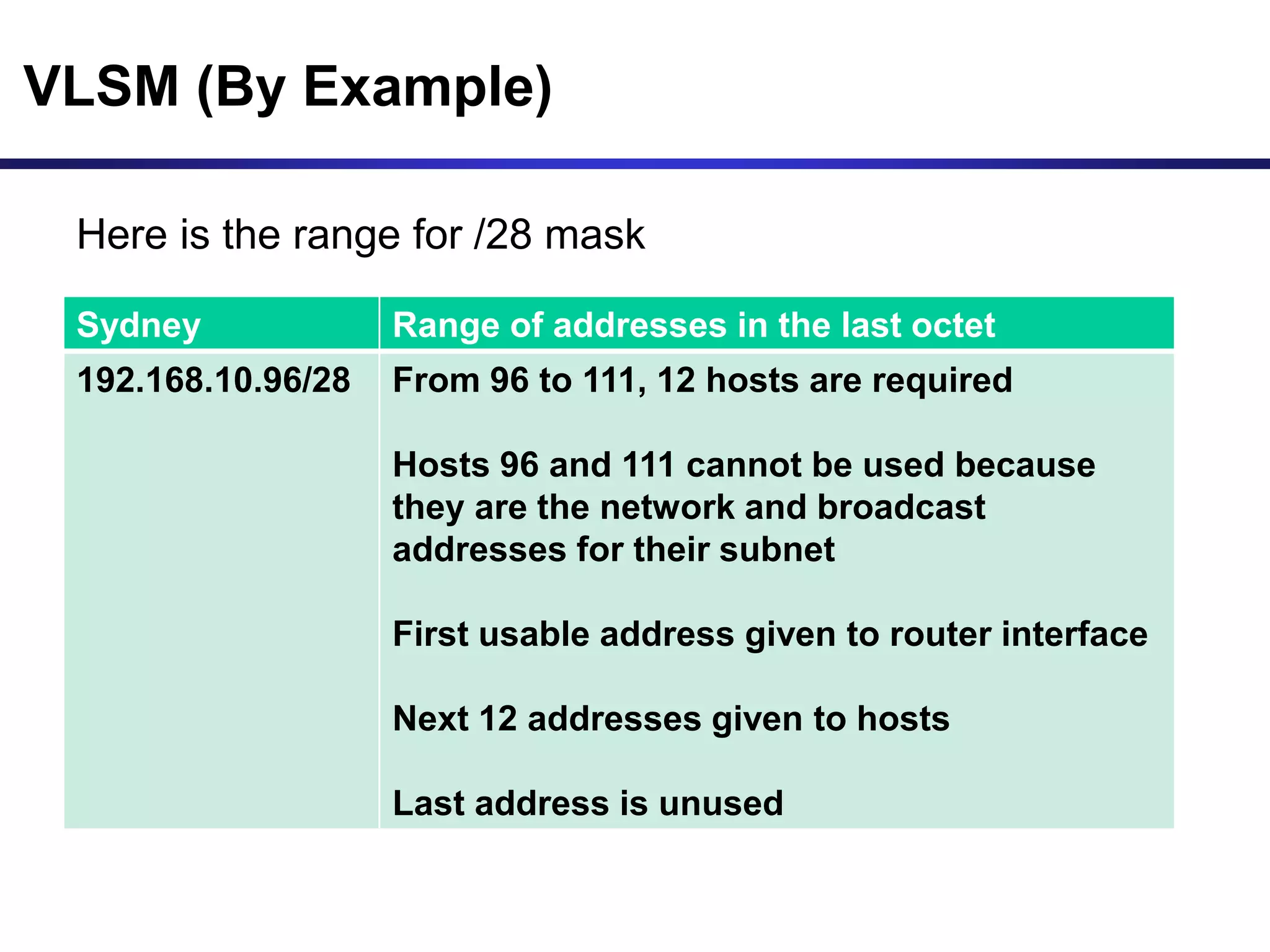
Here is the range for /28 mask
Sydney Range of addresses in the last octet
192.168.10.96/28 From 96 to 111, 12 hosts are required
Hosts 96 and 111 cannot be used because
they are the network and broadcast
addresses for their subnet
First usable address given to router interface
Next 12 addresses given to hosts
Last address is unused
VLSM (By Example)
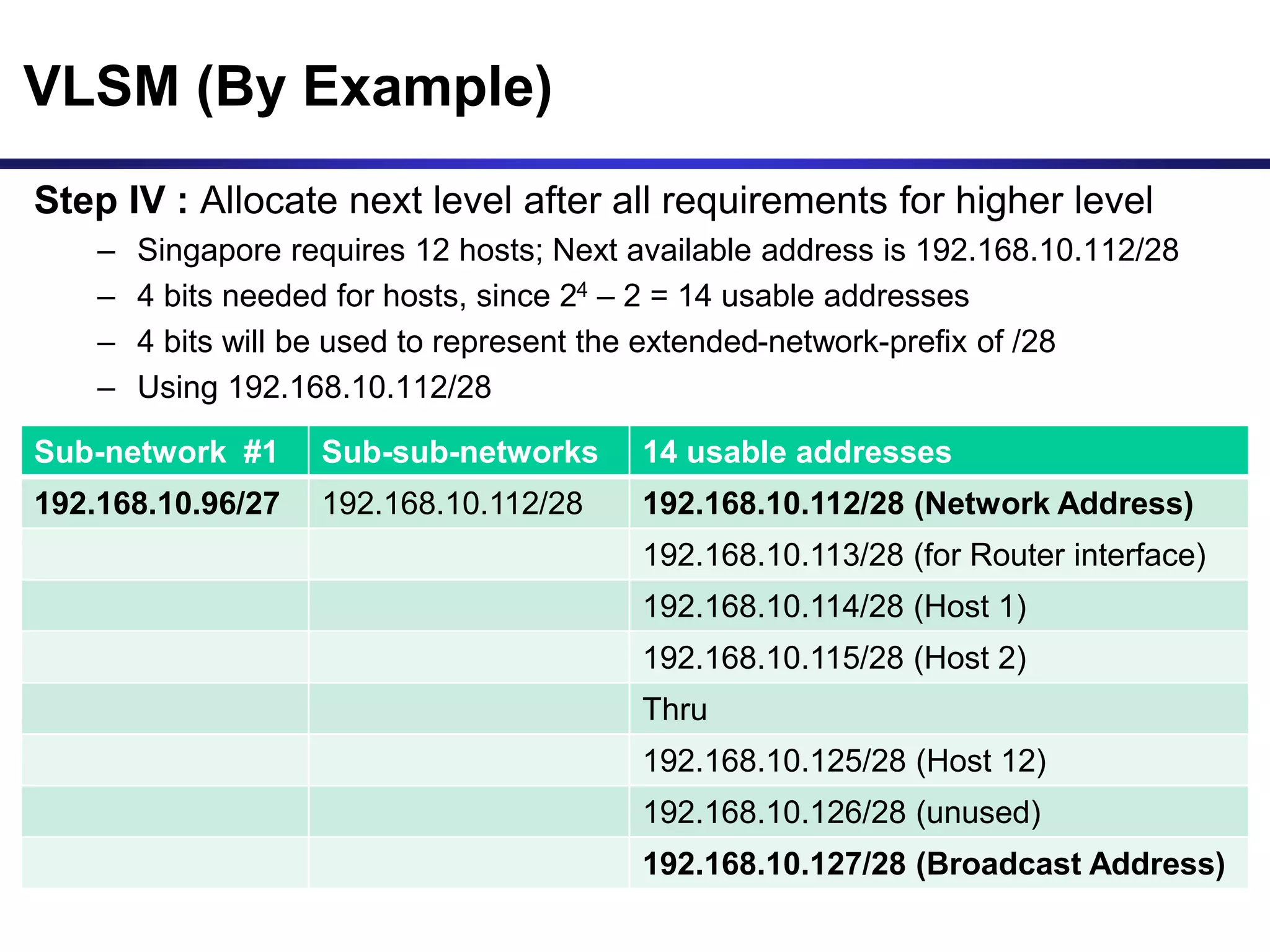
Step IV : Allocate next level after all requirements for higher level
– Singapore requires 12 hosts; Next available address is 192.168.10.112/28
– 4 bits needed for hosts, since 24 – 2 = 14 usable addresses
– 4 bits will be used to represent the extended-network-prefix of /28
– Using 192.168.10.112/28
Sub-network #1 Sub-sub-networks 14 usable addresses
192.168.10.96/27 192.168.10.112/28 192.168.10.112/28 (Network Address)
192.168.10.113/28 (for Router interface)
192.168.10.114/28 (Host 1)
192.168.10.115/28 (Host 2)
Thru
192.168.10.125/28 (Host 12)
192.168.10.126/28 (unused)
192.168.10.127/28 (Broadcast Address)
VLSM (By Example)
Here is the range for /28 mask
Singapore Range of addresses in the last octet
192.168.10.112/28 From 112 to 127, 12 hosts are required
Hosts 112 and 127 cannot be used because
they are the network and broadcast
addresses for their subnet
First usable address given to router interface
Next 12 addresses given to hosts
Last address is unused
VLSM (By Example)
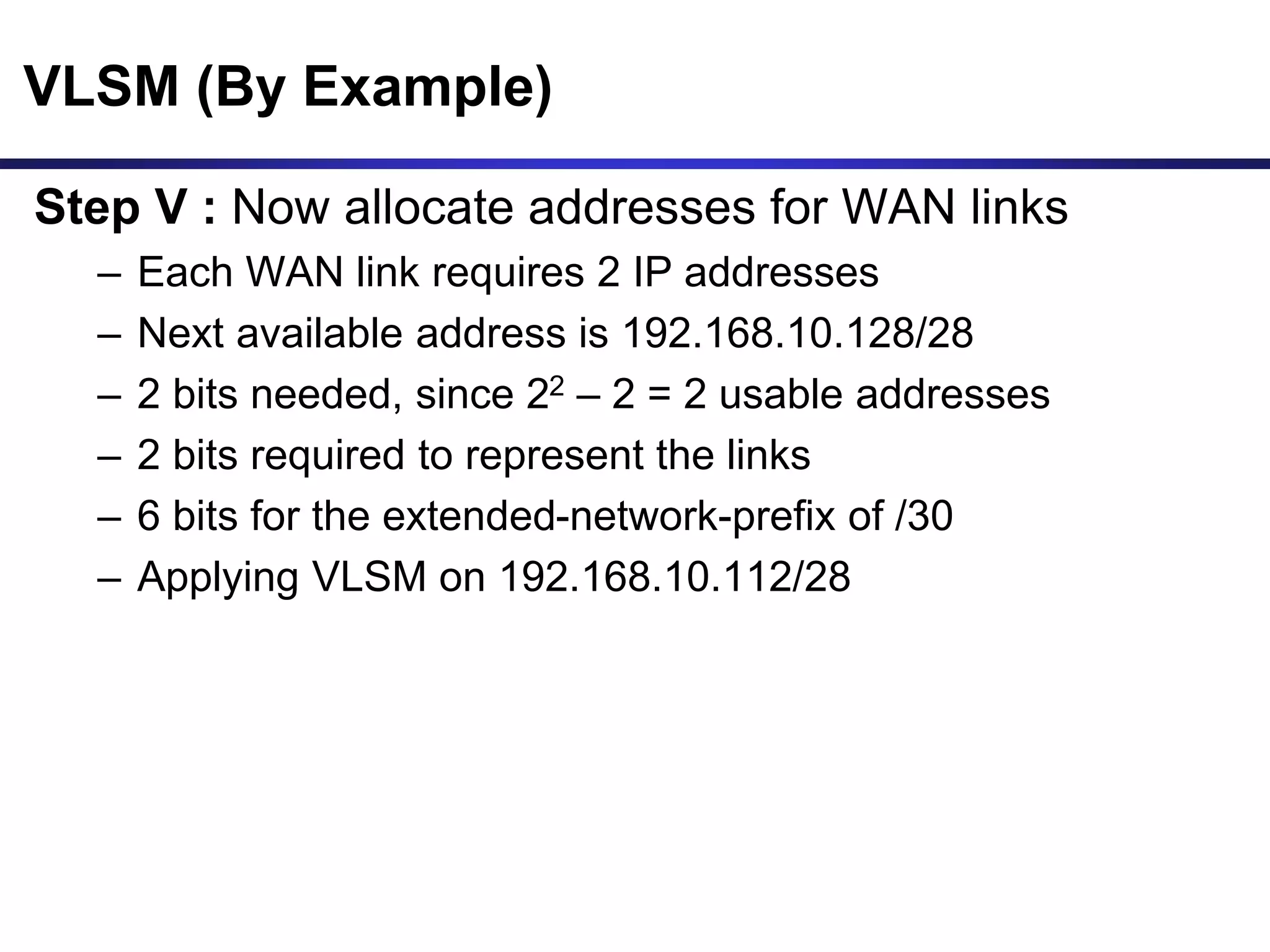
Step V : Now allocate addresses for WAN links
– Each WAN link requires 2 IP addresses
– Next available address is 192.168.10.128/28
– 2 bits needed, since 22 – 2 = 2 usable addresses
– 2 bits required to represent the links
– 6 bits for the extended-network-prefix of /30
– Applying VLSM on 192.168.10.112/28
VLSM (By Example)
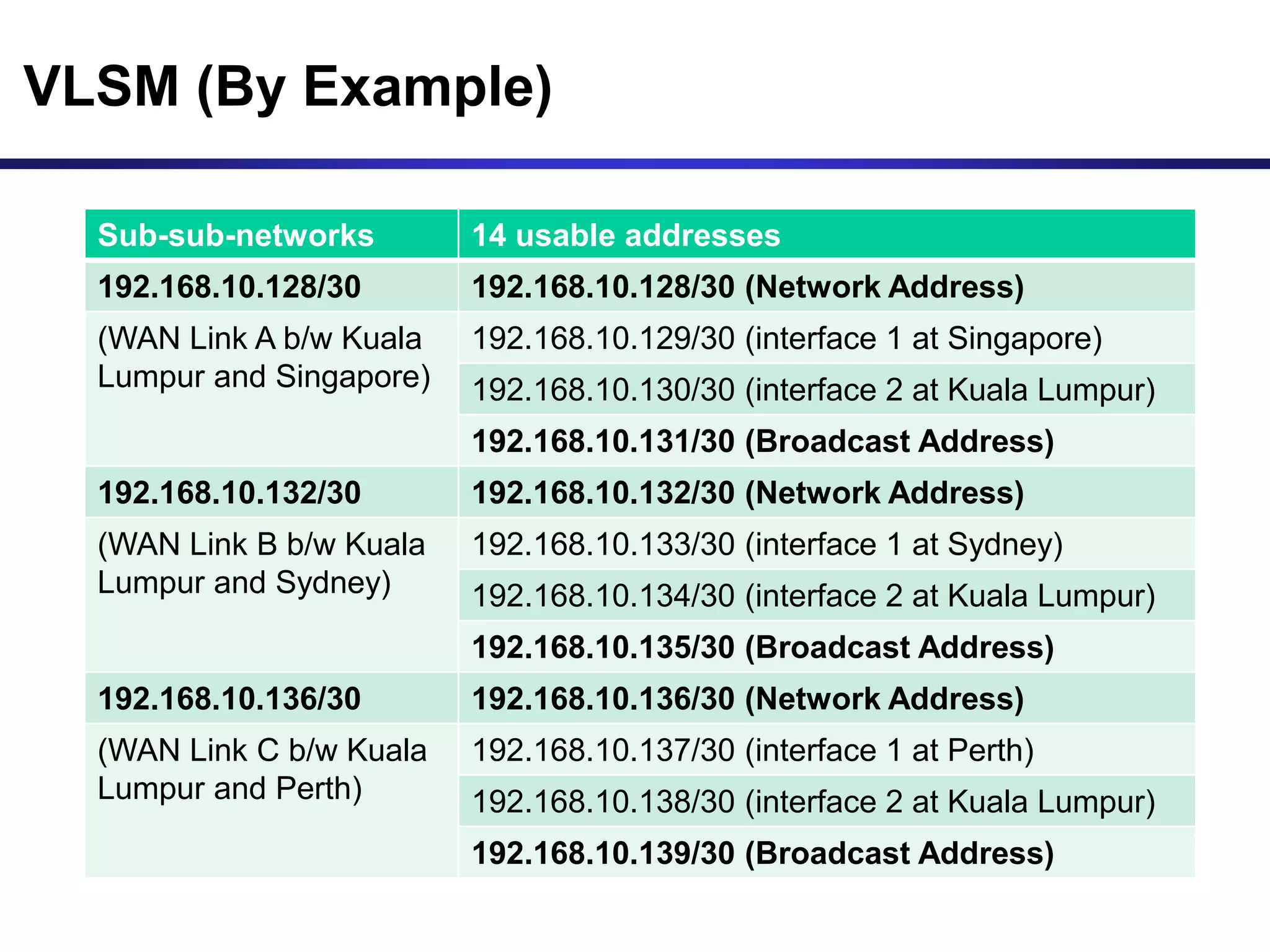
Sub-sub-networks 14 usable addresses
192.168.10.128/30 192.168.10.128/30 (Network Address)
(WAN Link A b/w Kuala
Lumpur and Singapore)
192.168.10.129/30 (interface 1 at Singapore)
192.168.10.130/30 (interface 2 at Kuala Lumpur)
192.168.10.131/30 (Broadcast Address)
192.168.10.132/30 192.168.10.132/30 (Network Address)
(WAN Link B b/w Kuala
Lumpur and Sydney)
192.168.10.133/30 (interface 1 at Sydney)
192.168.10.134/30 (interface 2 at Kuala Lumpur)
192.168.10.135/30 (Broadcast Address)
192.168.10.136/30 192.168.10.136/30 (Network Address)
(WAN Link C b/w Kuala
Lumpur and Perth)
192.168.10.137/30 (interface 1 at Perth)
192.168.10.138/30 (interface 2 at Kuala Lumpur)
192.168.10.139/30 (Broadcast Address)
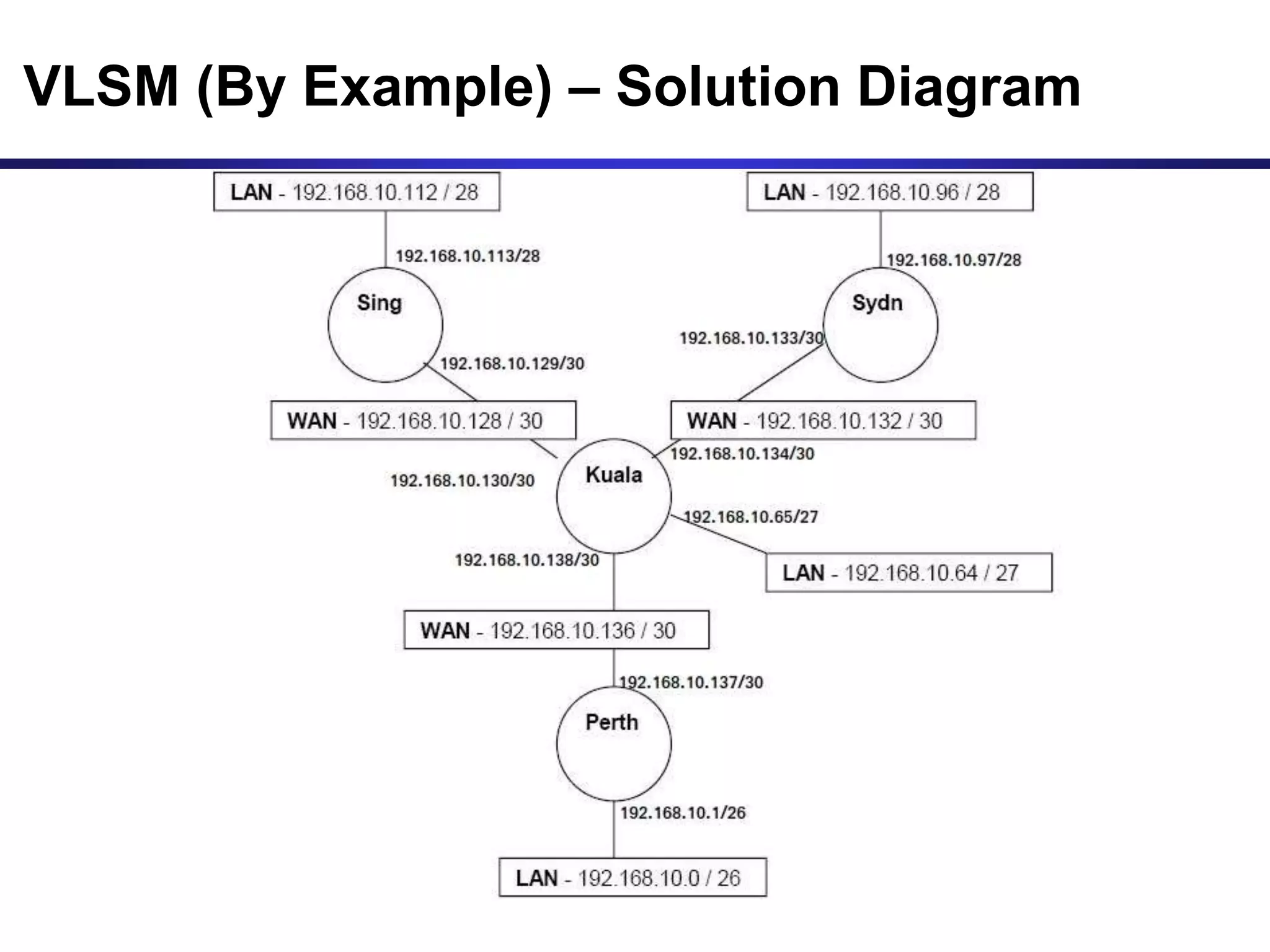
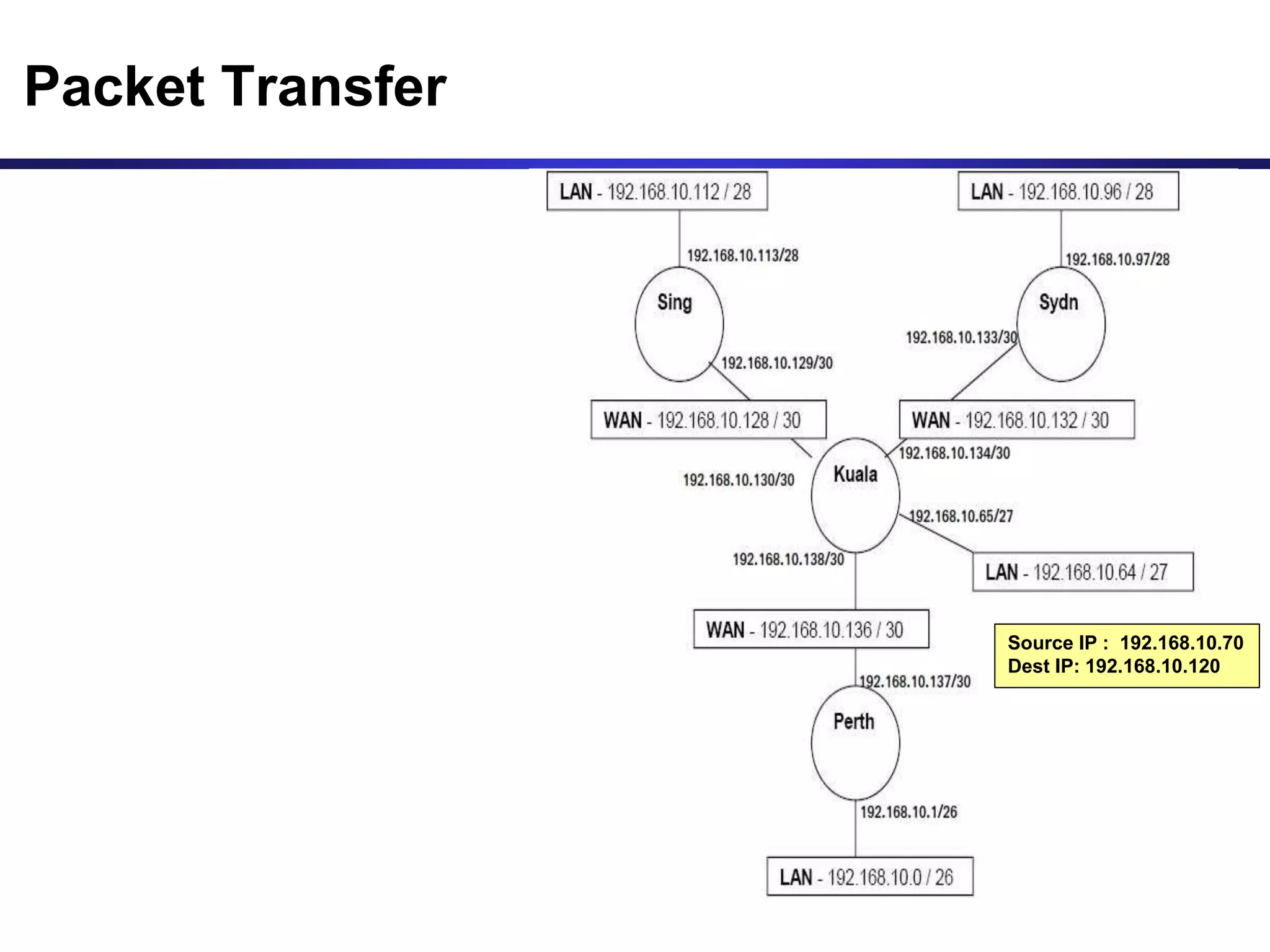
VLSM (By Example) – Solution Diagram
VLSM (By Example)
• This is how the Class C address was subnetted using VLSM
• The network address and broadcast address for each subnet are shown in the
corners of each box
Routing Table for Router at Perth
Network
Destination
Network
Mask
Next-hop Interface
192.168.10.0 /26 Direct 192.168.10.1/26
192.168.10.136 /30 Direct 192.168.10.137/30
192.168.10.64 /27 192.168.10.138 192.168.10.137/30
192.168.10.132 /30 192.168.10.138 192.168.10.137/30
192.168.10.96 /28 192.168.10.138 192.168.10.137/30
192.168.10.128 /30 192.168.10.138 192.168.10.137/30
192.168.10.112 /28 192.168.10.138 192.168.10.137/30
Routing Table for Router at Sydney
Network
Destination
Network
Mask
Next-hop Interface
192.168.10.96 /28 Direct 192.168.10.97/26
192.168.10.132 /30 Direct 192.168.10.133/30
192.168.10.64 /27 192.168.10.134 192.168.10.133/30
192.168.10.136 /30 192.168.10.134 192.168.10.133/30
192.168.10.0 /26 192.168.10.134 192.168.10.133/30
192.168.10.128 /30 192.168.10.134 192.168.10.133/30
192.168.10.112 /28 192.168.10.134 192.168.10.133/30
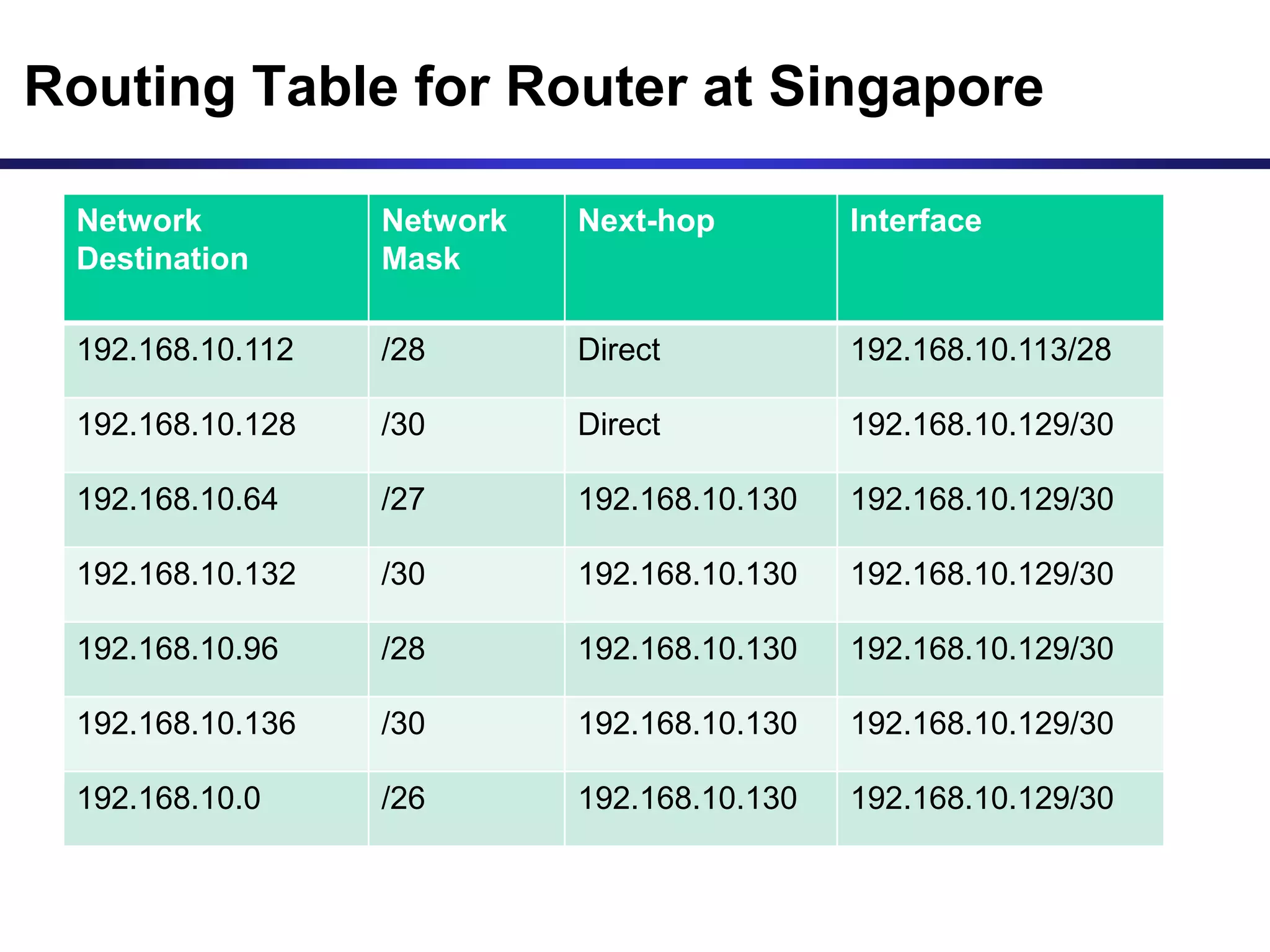
Routing Table for Router at Singapore
Network
Destination
Network
Mask
Next-hop Interface
192.168.10.112 /28 Direct 192.168.10.113/28
192.168.10.128 /30 Direct 192.168.10.129/30
192.168.10.64 /27 192.168.10.130 192.168.10.129/30
192.168.10.132 /30 192.168.10.130 192.168.10.129/30
192.168.10.96 /28 192.168.10.130 192.168.10.129/30
192.168.10.136 /30 192.168.10.130 192.168.10.129/30
192.168.10.0 /26 192.168.10.130 192.168.10.129/30
Routing Table for Router at Kuala Lumpur
Network
Destination
Network
Mask
Next-hop Interface
192.168.10.64 /27 Direct 192.168.10.65/27
192.168.10.136 /30 Direct 192.168.10.138/30
192.168.10.132 /30 Direct 192.168.10.134/30
192.168.10.128 /30 Direct 192.168.10.130/30
192.168.10.0 /26 192.168.10.137 192.168.10.138/30
192.168.10.96 /28 192.168.10.133 192.168.10.134/30
192.168.10.112 /28 192.168.10.129 192.168.10.130/30
Complete Scenario
Routing Table at Perth
Network
Destination
Net-
Mask
Next-hop Interface
192.168.10.0 /26 Direct 192.168.10.1/26
192.168.10.136 /30 Direct 192.168.10.137/30
192.168.10.64 /27 192.168.10.138 192.168.10.137/30
192.168.10.132 /30 192.168.10.138 192.168.10.137/30
192.168.10.96 /28 192.168.10.138 192.168.10.137/30
192.168.10.128 /30 192.168.10.138 192.168.10.137/30
192.168.10.112 /28 192.168.10.138 192.168.10.137/30
Routing Table at Sydney
Network Destination
/Mask
Next-hop Interface
192.168.10.96/28 Direct 192.168.10.97/26
192.168.10.132/30 Direct 192.168.10.133/30
192.168.10.64/27 192.168.10.134 192.168.10.133/30
192.168.10.136/30 192.168.10.134 192.168.10.133/30
192.168.10.0/26 192.168.10.134 192.168.10.133/30
192.168.10.128/30 192.168.10.134 192.168.10.133/30
192.168.10.112/28 192.168.10.134 192.168.10.133/30
Routing Table at Singapore
Network
Destination
Net-
Mask
Next-hop Interface
192.168.10.112 /28 Direct 192.168.10.113/28
192.168.10.128 /30 Direct 192.168.10.129/30
192.168.10.64 /27 192.168.10.130 192.168.10.129/30
192.168.10.132 /30 192.168.10.130 192.168.10.129/30
192.168.10.96 /28 192.168.10.130 192.168.10.129/30
192.168.10.136 /30 192.168.10.130 192.168.10.129/30
192.168.10.0 /26 192.168.10.130 192.168.10.129/30
Routing Table at Kuala Lumpur
Network
Destination
Net-
Mask
Next-hop Interface
192.168.10.64 /27 Direct 192.168.10.65/27
192.168.10.136 /30 Direct 192.168.10.138/30
192.168.10.132 /30 Direct 192.168.10.134/30
192.168.10.128 /30 Direct 192.168.10.130/30
192.168.10.0 /26 192.168.10.137 192.168.10.138/30
192.168.10.96 /28 192.168.10.133 192.168.10.134/30
192.168.10.112 /28 192.168.10.129 192.168.10.130/30
Packet Transfer
Source IP : 192.168.10.70
Dest IP: 192.168.10.120
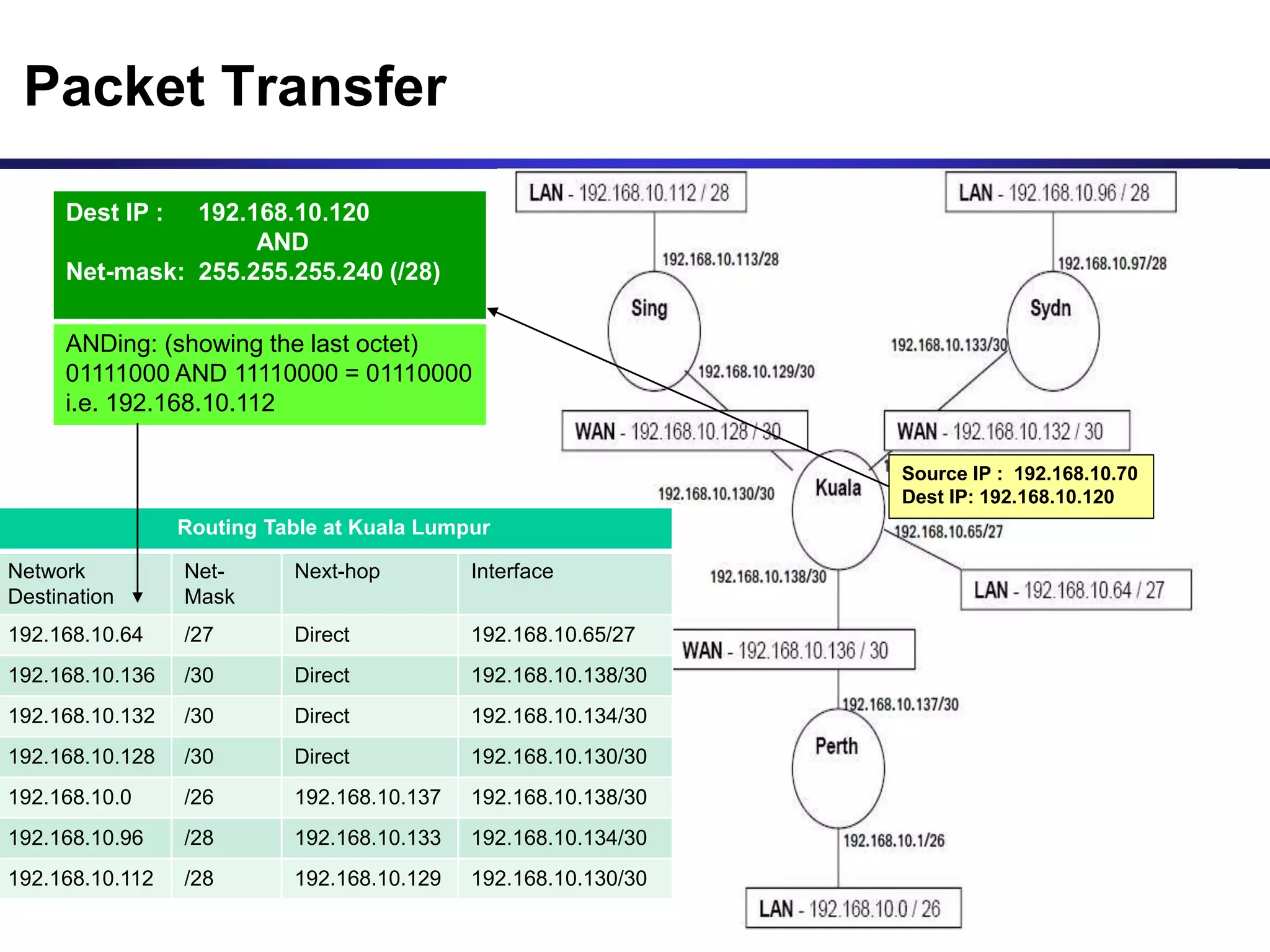
Packet Transfer
Routing Table at Kuala Lumpur
Network
Destination
Net-
Mask
Next-hop Interface
192.168.10.64 /27 Direct 192.168.10.65/27
192.168.10.136 /30 Direct 192.168.10.138/30
192.168.10.132 /30 Direct 192.168.10.134/30
192.168.10.128 /30 Direct 192.168.10.130/30
192.168.10.0 /26 192.168.10.137 192.168.10.138/30
192.168.10.96 /28 192.168.10.133 192.168.10.134/30
192.168.10.112 /28 192.168.10.129 192.168.10.130/30
Source IP : 192.168.10.70
Dest IP: 192.168.10.120
Dest IP : 192.168.10.120
AND
Net-mask: 255.255.255.240 (/28)
ANDing: (showing the last octet)
01111000 AND 11110000 = 01110000
i.e. 192.168.10.112
Packet Transfer
Routing Table at Kuala Lumpur
Network
Destination
Net-
Mask
Next-hop Interface
192.168.10.64 /27 Direct 192.168.10.65/27
192.168.10.136 /30 Direct 192.168.10.138/30
192.168.10.132 /30 Direct 192.168.10.134/30
192.168.10.128 /30 Direct 192.168.10.130/30
192.168.10.0 /26 192.168.10.137 192.168.10.138/30
192.168.10.96 /28 192.168.10.133 192.168.10.134/30
192.168.10.112 /28 192.168.10.129 192.168.10.130/30
Source IP : 192.168.10.70
Dest IP: 192.168.10.120
Dest IP : 192.168.10.120
AND
Net-mask: 255.255.255.240 (/28)
ANDing: (showing the last octet)
01111000 AND 11110000 = 01110000
i.e. 192.168.10.112
Packet Transfer
Routing Table at Kuala Lumpur
Network
Destination
Net-
Mask
Next-hop Interface
192.168.10.64 /27 Direct 192.168.10.65/27
192.168.10.136 /30 Direct 192.168.10.138/30
192.168.10.132 /30 Direct 192.168.10.134/30
192.168.10.128 /30 Direct 192.168.10.130/30
192.168.10.0 /26 192.168.10.137 192.168.10.138/30
192.168.10.96 /28 192.168.10.133 192.168.10.134/30
192.168.10.112 /28 192.168.10.129 192.168.10.130/30
Source IP : 192.168.10.70
Dest IP: 192.168.10.120
Packet Transfer
Source IP : 192.168.10.70
Dest IP: 192.168.10.120
Routing Table at Singapore
Network
Destination
Net-
Mask
Next-hop Interface
192.168.10.112 /28 Direct 192.168.10.113/28
192.168.10.128 /30 Direct 192.168.10.129/30
192.168.10.64 /27 192.168.10.130 192.168.10.129/30
192.168.10.132 /30 192.168.10.130 192.168.10.129/30
192.168.10.96 /28 192.168.10.130 192.168.10.129/30
192.168.10.136 /30 192.168.10.130 192.168.10.129/30
192.168.10.0 /26 192.168.10.130 192.168.10.129/30
Dest IP : 192.168.10.120
AND
Net-mask: 255.255.255.240 (/28)
ANDing: (showing the last octet)
01111000 AND 11110000 = 01110000
i.e. 192.168.10.112
Packet Transfer
Source IP : 192.168.10.70
Dest IP: 192.168.10.120
Routing Table at Singapore
Network
Destination
Net-
Mask
Next-hop Interface
192.168.10.112 /28 Direct 192.168.10.113/28
192.168.10.128 /30 Direct 192.168.10.129/30
192.168.10.64 /27 192.168.10.130 192.168.10.129/30
192.168.10.132 /30 192.168.10.130 192.168.10.129/30
192.168.10.96 /28 192.168.10.130 192.168.10.129/30
192.168.10.136 /30 192.168.10.130 192.168.10.129/30
192.168.10.0 /26 192.168.10.130 192.168.10.129/30
Dest IP : 192.168.10.120
AND
Net-mask: 255.255.255.240 (/28)
ANDing: (showing the last octet)
01111000 AND 11110000 = 01110000
i.e. 192.168.10.112
Packet Transfer
Source IP : 192.168.10.70
Dest IP: 192.168.10.120
Routing Table at Singapore
Network
Destination
Net-
Mask
Next-hop Interface
192.168.10.112 /28 Direct 192.168.10.113/28
192.168.10.128 /30 Direct 192.168.10.129/30
192.168.10.64 /27 192.168.10.130 192.168.10.129/30
192.168.10.132 /30 192.168.10.130 192.168.10.129/30
192.168.10.96 /28 192.168.10.130 192.168.10.129/30
192.168.10.136 /30 192.168.10.130 192.168.10.129/30
192.168.10.0 /26 192.168.10.130 192.168.10.129/30
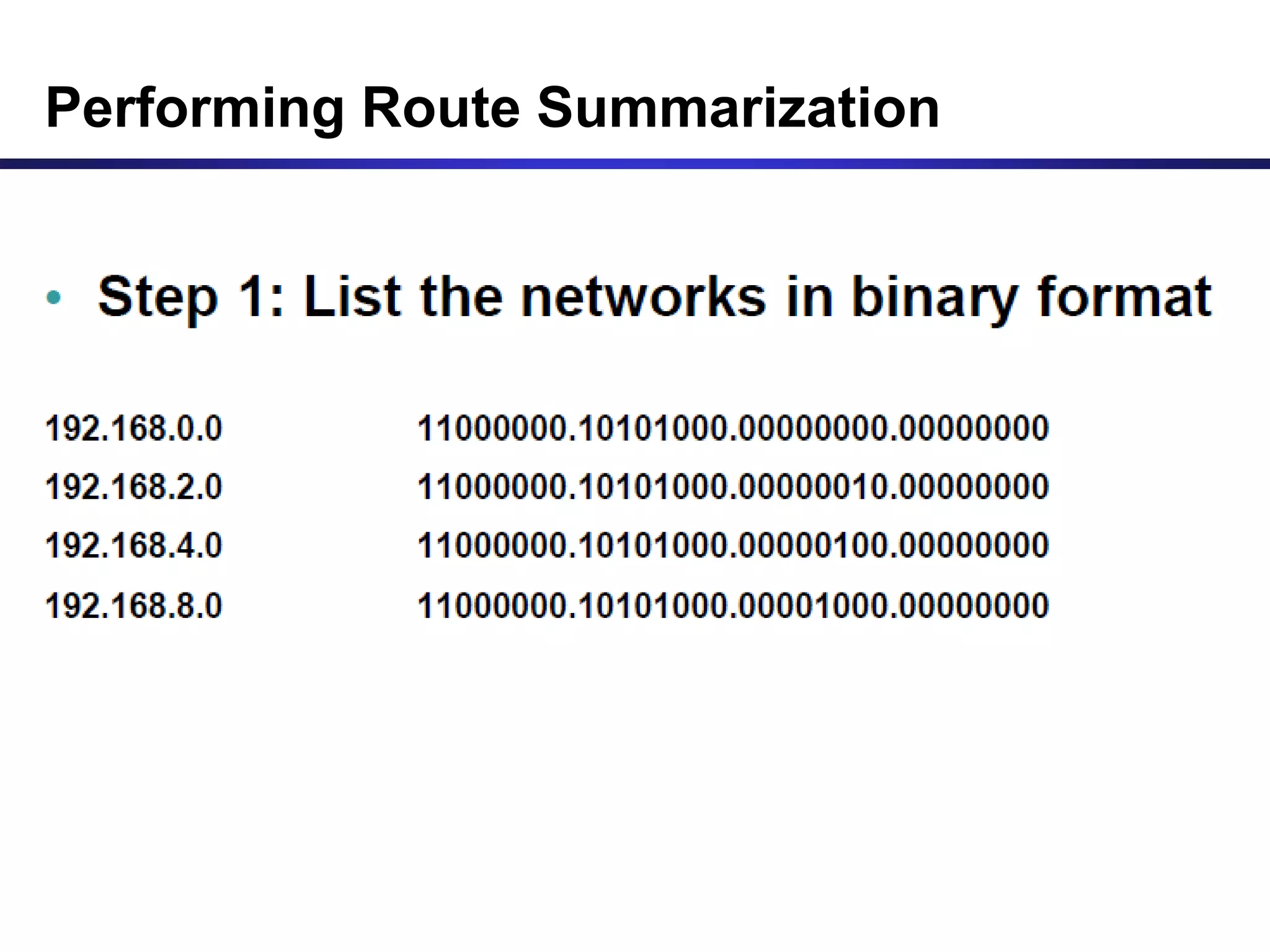
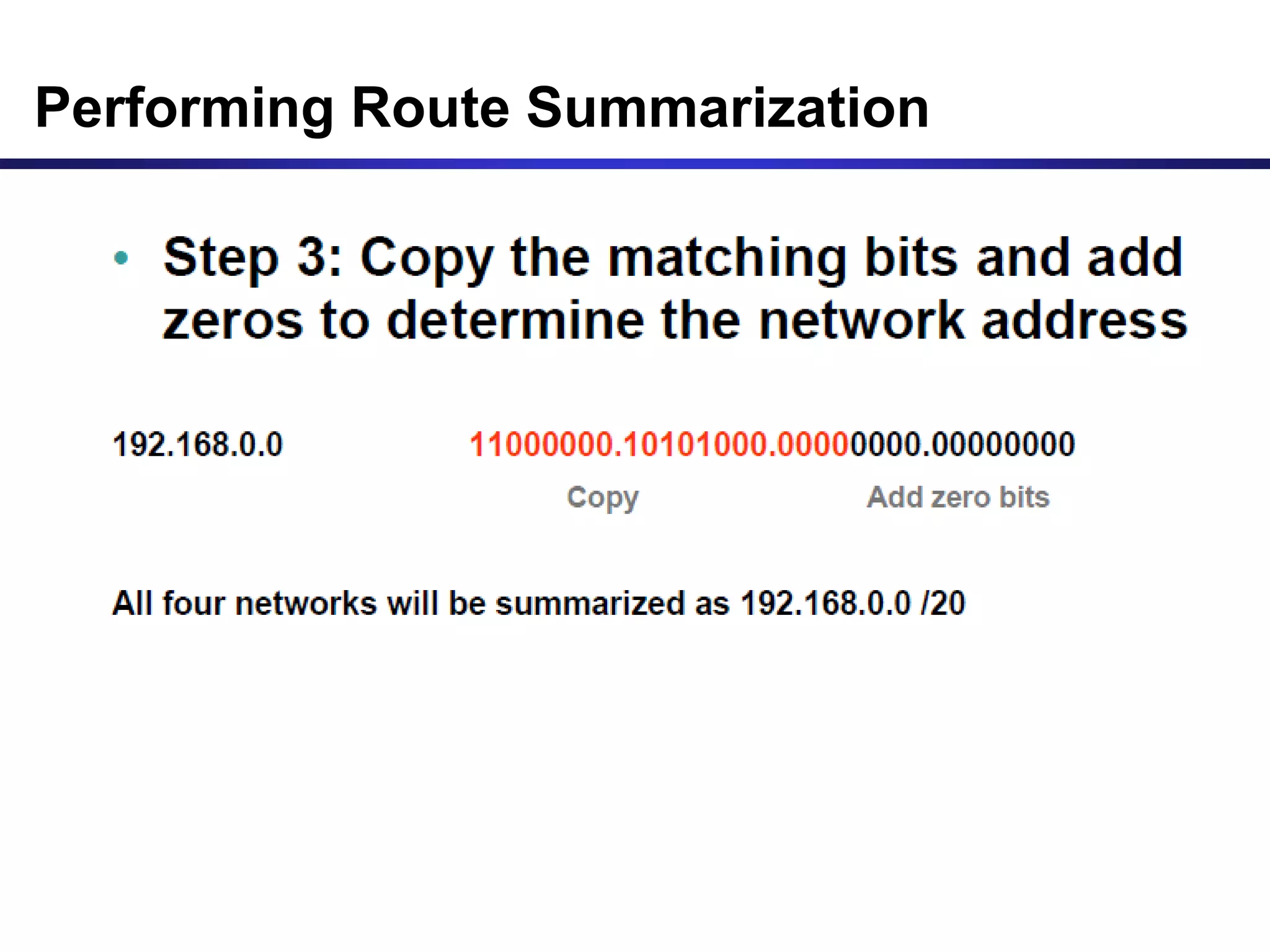
Route Summarization
Performing Route Summarization

VLSM (1).ppt

  • 1.
    Variable Length SubnetMasking (VLSM) Supports more efficient use of the assigned IP addresses and reduces the amount of routing information at the top level
  • 2.
    VLSM (By Example) •Class C address 192.168.10.0/24 has been allocated • Perth, Sydney and Singapore have a WAN connection to Kuala Lumpur • Hosts Required: Perth – 60, Kuala Lumpur – 28, Sydney – 12, Singapore – 12 hosts
  • 3.
    VLSM (By Example) •To calculate VLSM subnets and the respective hosts allocate the largest requirements first from the address range • Requirements levels should be listed from the largest to the smallest • In this example, Perth requires 60 hosts (largest) – Use 6 bits, since 26 – 2 = 62 usable addresses – 2 bits will be used from the 4th octet to represent the extended-network-prefix of /26 – Remaining 6 bits will be used for host addresses
  • 4.
    VLSM (By Example) StepI : Divide the allocated address of 192.168.10.0/24 into four equal-size address blocks – Since 4 = 22, 2 bits are required to identify each of the 4 subnets – Next take subnet #0 (192.168.10.0/26) and identify its hosts Allocated Address Sub-networks 62 usable addresses/sub-network (subnet #0) 192.168.10.0/24 192.168.10.0/26 192.168.10.0/26 (Network Address) 192.168.10.64/26 192.168.10.1/26 (for Router interface) 192.168.10.128/26 192.168.10.2/26 (Host 1) 192.168.10.192/26 192.168.10.3/26 (Host 2) thru 192.168.10.61/26 (Host 60) 192.168.10.62/26 (unused) 192.168.10.63/26 (Broadcast Address)
  • 5.
    VLSM (By Example) Hereis the range for /26 mask Perth Range of addresses in the last octet 192.168.10.0/26 From 0 to 63, 60 hosts are required Hosts 0 and 63 cannot be used because they are the network and broadcast addresses for their subnet First usable address given to router interface Next 60 addresses given to hosts Last address is unused
  • 6.
    VLSM (By Example) StepII: Allocate next level after all requirements for higher level – Kuala Lumpur requires 28 hosts; Next available address is 192.168.10.64/26 – 5 bits needed for hosts, since 25 – 2 = 30 usable addresses – 3 bits will be used to represent the extended-network-prefix of /27 – Applying VLSM on 192.168.10.64/26 Sub-network #1 Sub-sub-networks 30 usable addresses 192.168.10.64/26 192.168.10.64/27 192.168.10.64/27 (Network Address) 192.168.10.96/27 192.168.10.65/27 (for Router interface) 192.168.10.66/27 (Host 1) 192.168.10.67/27 (Host 2) thru 192.168.10.93/27 (Host 28) 192.168.10.94/27 (unused) 192.168.10.95/27 (Broadcast Address)
  • 7.
    VLSM (By Example) Hereis the range for /27 mask Kuala Lumpur Range of addresses in the last octet 192.168.10.64/27 From 64 to 95, 28 hosts are required Hosts 64 and 95 cannot be used because they are the network and broadcast addresses for their subnet First usable address given to router interface Next 28 addresses given to hosts Last address is unused
  • 8.
    VLSM (By Example) StepIII : Allocate next level after all requirements for higher level – Sydney requires 12 hosts; Next available address is 192.168.10.96/27 – 4 bits needed for hosts, since 24 – 2 = 14 usable addresses – 4 bits will be used to represent the extended-network-prefix of /28 – Applying VLSM on 192.168.10.96/27 Sub-network #1 Sub-sub-networks 14 usable addresses 192.168.10.96/27 192.168.10.96/28 192.168.10.96/28 (Network Address) 192.168.10.112/28 192.168.10.97/28 (for Router interface) 192.168.10.98/28 (Host 1) 192.168.10.99/28 (Host 2) thru 192.168.10.109/28 (Host 12) 192.168.10.110/28 (unused) 192.168.10.111/28 (Broadcast Address)
  • 9.
    VLSM (By Example) Hereis the range for /28 mask Sydney Range of addresses in the last octet 192.168.10.96/28 From 96 to 111, 12 hosts are required Hosts 96 and 111 cannot be used because they are the network and broadcast addresses for their subnet First usable address given to router interface Next 12 addresses given to hosts Last address is unused
  • 10.
    VLSM (By Example) StepIV : Allocate next level after all requirements for higher level – Singapore requires 12 hosts; Next available address is 192.168.10.112/28 – 4 bits needed for hosts, since 24 – 2 = 14 usable addresses – 4 bits will be used to represent the extended-network-prefix of /28 – Using 192.168.10.112/28 Sub-network #1 Sub-sub-networks 14 usable addresses 192.168.10.96/27 192.168.10.112/28 192.168.10.112/28 (Network Address) 192.168.10.113/28 (for Router interface) 192.168.10.114/28 (Host 1) 192.168.10.115/28 (Host 2) Thru 192.168.10.125/28 (Host 12) 192.168.10.126/28 (unused) 192.168.10.127/28 (Broadcast Address)
  • 11.
    VLSM (By Example) Hereis the range for /28 mask Singapore Range of addresses in the last octet 192.168.10.112/28 From 112 to 127, 12 hosts are required Hosts 112 and 127 cannot be used because they are the network and broadcast addresses for their subnet First usable address given to router interface Next 12 addresses given to hosts Last address is unused
  • 12.
    VLSM (By Example) StepV : Now allocate addresses for WAN links – Each WAN link requires 2 IP addresses – Next available address is 192.168.10.128/28 – 2 bits needed, since 22 – 2 = 2 usable addresses – 2 bits required to represent the links – 6 bits for the extended-network-prefix of /30 – Applying VLSM on 192.168.10.112/28
  • 13.
    VLSM (By Example) Sub-sub-networks14 usable addresses 192.168.10.128/30 192.168.10.128/30 (Network Address) (WAN Link A b/w Kuala Lumpur and Singapore) 192.168.10.129/30 (interface 1 at Singapore) 192.168.10.130/30 (interface 2 at Kuala Lumpur) 192.168.10.131/30 (Broadcast Address) 192.168.10.132/30 192.168.10.132/30 (Network Address) (WAN Link B b/w Kuala Lumpur and Sydney) 192.168.10.133/30 (interface 1 at Sydney) 192.168.10.134/30 (interface 2 at Kuala Lumpur) 192.168.10.135/30 (Broadcast Address) 192.168.10.136/30 192.168.10.136/30 (Network Address) (WAN Link C b/w Kuala Lumpur and Perth) 192.168.10.137/30 (interface 1 at Perth) 192.168.10.138/30 (interface 2 at Kuala Lumpur) 192.168.10.139/30 (Broadcast Address)
  • 14.
    VLSM (By Example)– Solution Diagram
  • 15.
    VLSM (By Example) •This is how the Class C address was subnetted using VLSM • The network address and broadcast address for each subnet are shown in the corners of each box
  • 16.
    Routing Table forRouter at Perth Network Destination Network Mask Next-hop Interface 192.168.10.0 /26 Direct 192.168.10.1/26 192.168.10.136 /30 Direct 192.168.10.137/30 192.168.10.64 /27 192.168.10.138 192.168.10.137/30 192.168.10.132 /30 192.168.10.138 192.168.10.137/30 192.168.10.96 /28 192.168.10.138 192.168.10.137/30 192.168.10.128 /30 192.168.10.138 192.168.10.137/30 192.168.10.112 /28 192.168.10.138 192.168.10.137/30
  • 17.
    Routing Table forRouter at Sydney Network Destination Network Mask Next-hop Interface 192.168.10.96 /28 Direct 192.168.10.97/26 192.168.10.132 /30 Direct 192.168.10.133/30 192.168.10.64 /27 192.168.10.134 192.168.10.133/30 192.168.10.136 /30 192.168.10.134 192.168.10.133/30 192.168.10.0 /26 192.168.10.134 192.168.10.133/30 192.168.10.128 /30 192.168.10.134 192.168.10.133/30 192.168.10.112 /28 192.168.10.134 192.168.10.133/30
  • 18.
    Routing Table forRouter at Singapore Network Destination Network Mask Next-hop Interface 192.168.10.112 /28 Direct 192.168.10.113/28 192.168.10.128 /30 Direct 192.168.10.129/30 192.168.10.64 /27 192.168.10.130 192.168.10.129/30 192.168.10.132 /30 192.168.10.130 192.168.10.129/30 192.168.10.96 /28 192.168.10.130 192.168.10.129/30 192.168.10.136 /30 192.168.10.130 192.168.10.129/30 192.168.10.0 /26 192.168.10.130 192.168.10.129/30
  • 19.
    Routing Table forRouter at Kuala Lumpur Network Destination Network Mask Next-hop Interface 192.168.10.64 /27 Direct 192.168.10.65/27 192.168.10.136 /30 Direct 192.168.10.138/30 192.168.10.132 /30 Direct 192.168.10.134/30 192.168.10.128 /30 Direct 192.168.10.130/30 192.168.10.0 /26 192.168.10.137 192.168.10.138/30 192.168.10.96 /28 192.168.10.133 192.168.10.134/30 192.168.10.112 /28 192.168.10.129 192.168.10.130/30
  • 20.
    Complete Scenario Routing Tableat Perth Network Destination Net- Mask Next-hop Interface 192.168.10.0 /26 Direct 192.168.10.1/26 192.168.10.136 /30 Direct 192.168.10.137/30 192.168.10.64 /27 192.168.10.138 192.168.10.137/30 192.168.10.132 /30 192.168.10.138 192.168.10.137/30 192.168.10.96 /28 192.168.10.138 192.168.10.137/30 192.168.10.128 /30 192.168.10.138 192.168.10.137/30 192.168.10.112 /28 192.168.10.138 192.168.10.137/30 Routing Table at Sydney Network Destination /Mask Next-hop Interface 192.168.10.96/28 Direct 192.168.10.97/26 192.168.10.132/30 Direct 192.168.10.133/30 192.168.10.64/27 192.168.10.134 192.168.10.133/30 192.168.10.136/30 192.168.10.134 192.168.10.133/30 192.168.10.0/26 192.168.10.134 192.168.10.133/30 192.168.10.128/30 192.168.10.134 192.168.10.133/30 192.168.10.112/28 192.168.10.134 192.168.10.133/30 Routing Table at Singapore Network Destination Net- Mask Next-hop Interface 192.168.10.112 /28 Direct 192.168.10.113/28 192.168.10.128 /30 Direct 192.168.10.129/30 192.168.10.64 /27 192.168.10.130 192.168.10.129/30 192.168.10.132 /30 192.168.10.130 192.168.10.129/30 192.168.10.96 /28 192.168.10.130 192.168.10.129/30 192.168.10.136 /30 192.168.10.130 192.168.10.129/30 192.168.10.0 /26 192.168.10.130 192.168.10.129/30 Routing Table at Kuala Lumpur Network Destination Net- Mask Next-hop Interface 192.168.10.64 /27 Direct 192.168.10.65/27 192.168.10.136 /30 Direct 192.168.10.138/30 192.168.10.132 /30 Direct 192.168.10.134/30 192.168.10.128 /30 Direct 192.168.10.130/30 192.168.10.0 /26 192.168.10.137 192.168.10.138/30 192.168.10.96 /28 192.168.10.133 192.168.10.134/30 192.168.10.112 /28 192.168.10.129 192.168.10.130/30
  • 21.
    Packet Transfer Source IP: 192.168.10.70 Dest IP: 192.168.10.120
  • 22.
    Packet Transfer Routing Tableat Kuala Lumpur Network Destination Net- Mask Next-hop Interface 192.168.10.64 /27 Direct 192.168.10.65/27 192.168.10.136 /30 Direct 192.168.10.138/30 192.168.10.132 /30 Direct 192.168.10.134/30 192.168.10.128 /30 Direct 192.168.10.130/30 192.168.10.0 /26 192.168.10.137 192.168.10.138/30 192.168.10.96 /28 192.168.10.133 192.168.10.134/30 192.168.10.112 /28 192.168.10.129 192.168.10.130/30 Source IP : 192.168.10.70 Dest IP: 192.168.10.120 Dest IP : 192.168.10.120 AND Net-mask: 255.255.255.240 (/28) ANDing: (showing the last octet) 01111000 AND 11110000 = 01110000 i.e. 192.168.10.112
  • 23.
    Packet Transfer Routing Tableat Kuala Lumpur Network Destination Net- Mask Next-hop Interface 192.168.10.64 /27 Direct 192.168.10.65/27 192.168.10.136 /30 Direct 192.168.10.138/30 192.168.10.132 /30 Direct 192.168.10.134/30 192.168.10.128 /30 Direct 192.168.10.130/30 192.168.10.0 /26 192.168.10.137 192.168.10.138/30 192.168.10.96 /28 192.168.10.133 192.168.10.134/30 192.168.10.112 /28 192.168.10.129 192.168.10.130/30 Source IP : 192.168.10.70 Dest IP: 192.168.10.120 Dest IP : 192.168.10.120 AND Net-mask: 255.255.255.240 (/28) ANDing: (showing the last octet) 01111000 AND 11110000 = 01110000 i.e. 192.168.10.112
  • 24.
    Packet Transfer Routing Tableat Kuala Lumpur Network Destination Net- Mask Next-hop Interface 192.168.10.64 /27 Direct 192.168.10.65/27 192.168.10.136 /30 Direct 192.168.10.138/30 192.168.10.132 /30 Direct 192.168.10.134/30 192.168.10.128 /30 Direct 192.168.10.130/30 192.168.10.0 /26 192.168.10.137 192.168.10.138/30 192.168.10.96 /28 192.168.10.133 192.168.10.134/30 192.168.10.112 /28 192.168.10.129 192.168.10.130/30 Source IP : 192.168.10.70 Dest IP: 192.168.10.120
  • 25.
    Packet Transfer Source IP: 192.168.10.70 Dest IP: 192.168.10.120 Routing Table at Singapore Network Destination Net- Mask Next-hop Interface 192.168.10.112 /28 Direct 192.168.10.113/28 192.168.10.128 /30 Direct 192.168.10.129/30 192.168.10.64 /27 192.168.10.130 192.168.10.129/30 192.168.10.132 /30 192.168.10.130 192.168.10.129/30 192.168.10.96 /28 192.168.10.130 192.168.10.129/30 192.168.10.136 /30 192.168.10.130 192.168.10.129/30 192.168.10.0 /26 192.168.10.130 192.168.10.129/30 Dest IP : 192.168.10.120 AND Net-mask: 255.255.255.240 (/28) ANDing: (showing the last octet) 01111000 AND 11110000 = 01110000 i.e. 192.168.10.112
  • 26.
    Packet Transfer Source IP: 192.168.10.70 Dest IP: 192.168.10.120 Routing Table at Singapore Network Destination Net- Mask Next-hop Interface 192.168.10.112 /28 Direct 192.168.10.113/28 192.168.10.128 /30 Direct 192.168.10.129/30 192.168.10.64 /27 192.168.10.130 192.168.10.129/30 192.168.10.132 /30 192.168.10.130 192.168.10.129/30 192.168.10.96 /28 192.168.10.130 192.168.10.129/30 192.168.10.136 /30 192.168.10.130 192.168.10.129/30 192.168.10.0 /26 192.168.10.130 192.168.10.129/30 Dest IP : 192.168.10.120 AND Net-mask: 255.255.255.240 (/28) ANDing: (showing the last octet) 01111000 AND 11110000 = 01110000 i.e. 192.168.10.112
  • 27.
    Packet Transfer Source IP: 192.168.10.70 Dest IP: 192.168.10.120 Routing Table at Singapore Network Destination Net- Mask Next-hop Interface 192.168.10.112 /28 Direct 192.168.10.113/28 192.168.10.128 /30 Direct 192.168.10.129/30 192.168.10.64 /27 192.168.10.130 192.168.10.129/30 192.168.10.132 /30 192.168.10.130 192.168.10.129/30 192.168.10.96 /28 192.168.10.130 192.168.10.129/30 192.168.10.136 /30 192.168.10.130 192.168.10.129/30 192.168.10.0 /26 192.168.10.130 192.168.10.129/30
  • 28.
  • 29.
  • 30.
  • 31.