21CSC201J
DATA STRUCTURES AND
ALGORITHMS
UNIT-3
Topic : Infix to Postfix Conversion
Infix to Postfix Conversion
Infix Notation
• Infix Notation is the common arithmetic and logical formula notation.
• In which operators are written infix-style between the operands they act on.
Example: A + B
Infix to Postfix Conversion
Postfix Notation
• In Postfix Notation, the operators come after the operands.
• For example, the infix expression A + B will be written as AB+ in its Postfix Notation.
• Postfix Notation is also called as “Reverse Polish Notation”
Infix to Postfix Conversion
Conversion from Infix to Postfix Algorithm
Step 1
• Scan the Infix expression from left to right for tokens (Operators, operands and
Parenthesis) and perform the steps 2 to 5 for each token in the expression.
Step 2
• If token is operand, Append it in postfix expression.
Step 3
• If token is left parenthesis “(“, push it in stack.
Infix to Postfix Conversion
Conversion from Infix to Postfix Algorithm
Step 4
If the token is an operator,
• Pop all the operators that are of higher or equal precedence than the incoming
token and append them (in the same order) to the output expression.
• After popping out all such operators, push the new token on the stack.
Infix to Postfix Conversion
Conversion from Infix to Postfix Algorithm
Step 5
If “)” parenthesis is found,
• Pop all the operators from the stack and append them to the output string, till
you encounter the opening parenthesis “(“.
• Pop the left parenthesis but don’t append it to the output string (Postfix notation
does not have brackets).
Infix to Postfix Conversion
Conversion from Infix to Postfix Algorithm
Step 6
• When all tokens of infix expression have been scanned. Pop all the elements from
the stack and append them to the output string.
• The output string is the corresponding postfix notation.
Infix to Postfix Conversion
Example
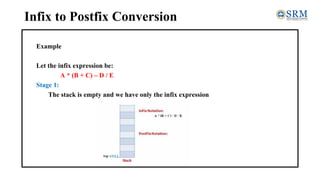
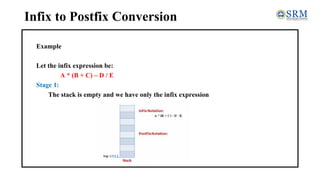
Let the infix expression be:
A * (B + C) – D / E
Stage 1:
The stack is empty and we have only the infix expression
Infix to Postfix Conversion
Example
Let the infix expression be:
A * (B + C) – D / E
Stage 1:
The stack is empty and we have only the infix expression
Infix to Postfix Conversion
Example
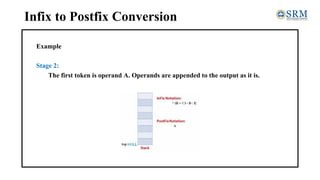
Stage 2:
The first token is operand A. Operands are appended to the output as it is.
Infix to Postfix Conversion
Example
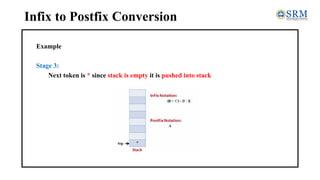
Stage 3:
Next token is * since stack is empty it is pushed into stack
Infix to Postfix Conversion
Example
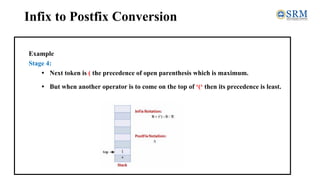
Stage 4:
• Next token is ( the precedence of open parenthesis which is maximum.
• But when another operator is to come on the top of ‘(‘ then its precedence is least.
Infix to Postfix Conversion
Example
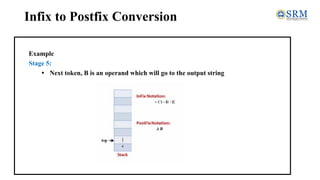
Stage 5:
• Next token, B is an operand which will go to the output string
Infix to Postfix Conversion
Example
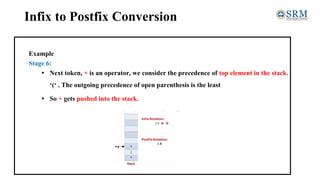
Stage 6:
• Next token, + is an operator, we consider the precedence of top element in the stack.
‘(‘ . The outgoing precedence of open parenthesis is the least
• So + gets pushed into the stack.
Infix to Postfix Conversion
Example
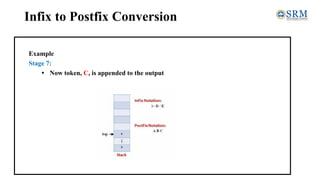
Stage 7:
• Now token, C, is appended to the output
Infix to Postfix Conversion
Example
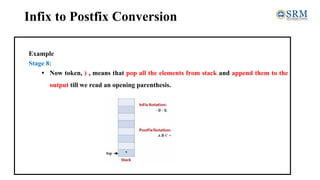
Stage 8:
• Now token, ) , means that pop all the elements from stack and append them to the
output till we read an opening parenthesis.
Infix to Postfix Conversion
Example
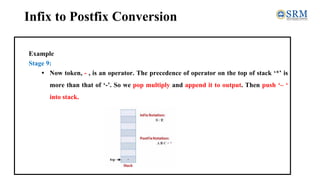
Stage 9:
• Now token, - , is an operator. The precedence of operator on the top of stack ‘*’ is
more than that of ‘-’. So we pop multiply and append it to output. Then push ‘– ‘
into stack.
Infix to Postfix Conversion
Example
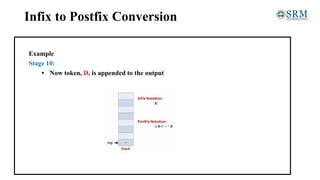
Stage 10:
• Now token, D, is appended to the output
Infix to Postfix Conversion
Example
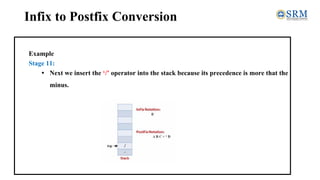
Stage 11:
• Next we insert the ‘/’ operator into the stack because its precedence is more that the
minus.
Infix to Postfix Conversion
Example
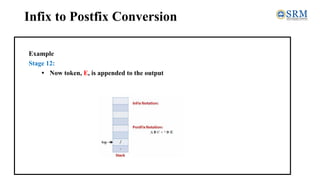
Stage 12:
• Now token, E, is appended to the output
Infix to Postfix Conversion
Example
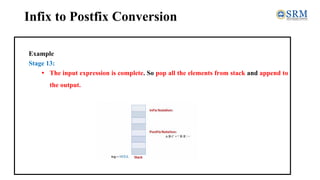
Stage 13:
• The input expression is complete. So pop all the elements from stack and append to
the output.
Thank You

Infix to Postfix Conversion.pdf

  • 1.
  • 2.
    Infix to PostfixConversion Infix Notation • Infix Notation is the common arithmetic and logical formula notation. • In which operators are written infix-style between the operands they act on. Example: A + B
  • 3.
    Infix to PostfixConversion Postfix Notation • In Postfix Notation, the operators come after the operands. • For example, the infix expression A + B will be written as AB+ in its Postfix Notation. • Postfix Notation is also called as “Reverse Polish Notation”
  • 4.
    Infix to PostfixConversion Conversion from Infix to Postfix Algorithm Step 1 • Scan the Infix expression from left to right for tokens (Operators, operands and Parenthesis) and perform the steps 2 to 5 for each token in the expression. Step 2 • If token is operand, Append it in postfix expression. Step 3 • If token is left parenthesis “(“, push it in stack.
  • 5.
    Infix to PostfixConversion Conversion from Infix to Postfix Algorithm Step 4 If the token is an operator, • Pop all the operators that are of higher or equal precedence than the incoming token and append them (in the same order) to the output expression. • After popping out all such operators, push the new token on the stack.
  • 6.
    Infix to PostfixConversion Conversion from Infix to Postfix Algorithm Step 5 If “)” parenthesis is found, • Pop all the operators from the stack and append them to the output string, till you encounter the opening parenthesis “(“. • Pop the left parenthesis but don’t append it to the output string (Postfix notation does not have brackets).
  • 7.
    Infix to PostfixConversion Conversion from Infix to Postfix Algorithm Step 6 • When all tokens of infix expression have been scanned. Pop all the elements from the stack and append them to the output string. • The output string is the corresponding postfix notation.
  • 8.
    Infix to PostfixConversion Example Let the infix expression be: A * (B + C) – D / E Stage 1: The stack is empty and we have only the infix expression
  • 9.
    Infix to PostfixConversion Example Let the infix expression be: A * (B + C) – D / E Stage 1: The stack is empty and we have only the infix expression
  • 10.
    Infix to PostfixConversion Example Stage 2: The first token is operand A. Operands are appended to the output as it is.
  • 11.
    Infix to PostfixConversion Example Stage 3: Next token is * since stack is empty it is pushed into stack
  • 12.
    Infix to PostfixConversion Example Stage 4: • Next token is ( the precedence of open parenthesis which is maximum. • But when another operator is to come on the top of ‘(‘ then its precedence is least.
  • 13.
    Infix to PostfixConversion Example Stage 5: • Next token, B is an operand which will go to the output string
  • 14.
    Infix to PostfixConversion Example Stage 6: • Next token, + is an operator, we consider the precedence of top element in the stack. ‘(‘ . The outgoing precedence of open parenthesis is the least • So + gets pushed into the stack.
  • 15.
    Infix to PostfixConversion Example Stage 7: • Now token, C, is appended to the output
  • 16.
    Infix to PostfixConversion Example Stage 8: • Now token, ) , means that pop all the elements from stack and append them to the output till we read an opening parenthesis.
  • 17.
    Infix to PostfixConversion Example Stage 9: • Now token, - , is an operator. The precedence of operator on the top of stack ‘*’ is more than that of ‘-’. So we pop multiply and append it to output. Then push ‘– ‘ into stack.
  • 18.
    Infix to PostfixConversion Example Stage 10: • Now token, D, is appended to the output
  • 19.
    Infix to PostfixConversion Example Stage 11: • Next we insert the ‘/’ operator into the stack because its precedence is more that the minus.
  • 20.
    Infix to PostfixConversion Example Stage 12: • Now token, E, is appended to the output
  • 21.
    Infix to PostfixConversion Example Stage 13: • The input expression is complete. So pop all the elements from stack and append to the output.
  • 22.