SUBJECT- VERB
AGREEMENT
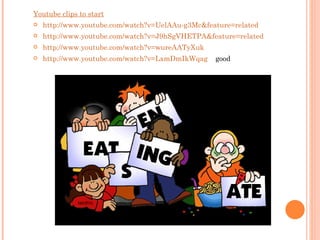
C an’t they all jus t get along?
Youtube clips to start
   http://www.youtube.com/watch?v=UelAAu-g3Mc&feature=related
   http://www.youtube.com/watch?v=J9hSgVHETPA&feature=related
   http://www.youtube.com/watch?v=wureAATyXuk
   http://www.youtube.com/watch?v=LxmDmIkWqag    good
SUBJECT – VERB AGREEMENT
   Subjects and verbs must AGREE with one
    another in number (singular or plural). 


     S ingular   s ubjects take s ingular
      verbs

     Plural   s ubjec ts take plural
      verbs
WORKING IN THE PRESENT
TENSE
In present tenses, nouns and verbs form plurals in
  ‘opposite’ ways:

 Singular   subject =       ADD an ‘S’ to the VERB

 Plural   subject    =      NO ‘S’ on the VERB


     All will become clear – promise!
SINGLE SUBJECTS + SINGLE
VERBS


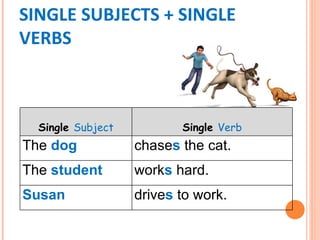
  Single Subject          Single Verb
The dog            chases the cat.
The student        works hard.
Susan              drives to work.
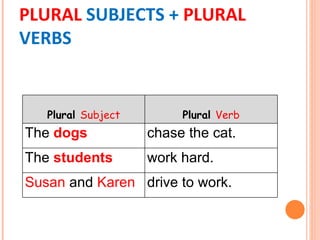
PLURAL SUBJECTS + PLURAL
VERBS


   Plural Subject        Plural Verb
The dogs            chase the cat.
The students        work hard.
Susan and Karen drive to work.
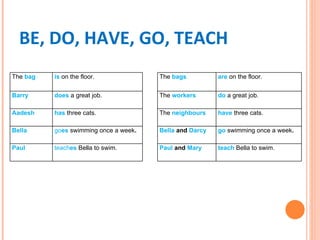
BE, DO, HAVE, GO, TEACH
The bag   is on the floor.             The bags          are on the floor.


Barry     does a great job.            The workers       do a great job.

Aadesh    has three cats.              The neighbours    have three cats.

Bella     goes swimming once a week.   Bella and Darcy   go swimming once a week.

Paul      teaches Bella to swim.       Paul and Mary     teach Bella to swim.
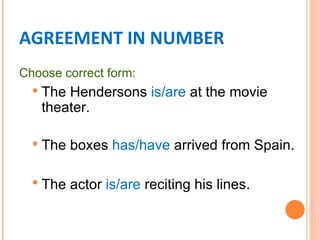
AGREEMENT IN NUMBER
Choose correct form:
   TheHendersons is/are at the movie
   theater.

   The   boxes has/have arrived from Spain.

   The   actor is/are reciting his lines.
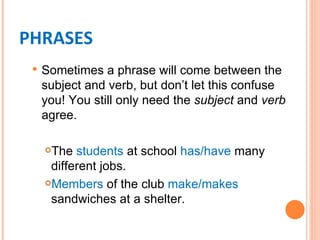
PHRASES
    Sometimes a phrase will come between the
     subject and verb, but don’t let this confuse
     you! You still only need the subject and verb
     agree.

     The students at school has/have many
      different jobs.
     Members of the club make/makes

      sandwiches at a shelter.
WATCH OUT FOR COMPOUND
SUBJECTS
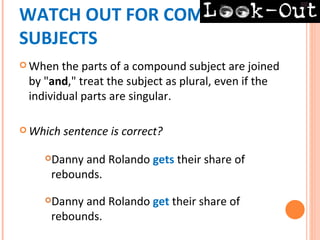
 When  the parts of a compound subject are joined
 by "and," treat the subject as plural, even if the
 individual parts are singular.

 Which   sentence is correct?

    Danny and Rolando gets their share of
     rebounds.
    Danny and Rolando get their share of
     rebounds.
SUBJECTS JOINED BY ‘OR’ OR ‘NO R’
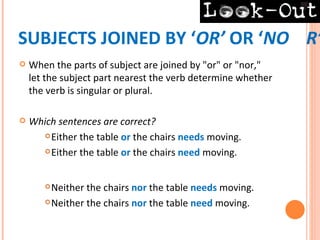
   When the parts of subject are joined by "or" or "nor,"
    let the subject part nearest the verb determine whether
    the verb is singular or plural.

   Which sentences are correct?
       Either the table or the chairs needs moving.

       Either the table or the chairs need moving.


        Neither the chairs nor the table needs moving.
        Neither the chairs nor the table need moving.
DON'T BE MISLED BY FALSE
SUBJECTS
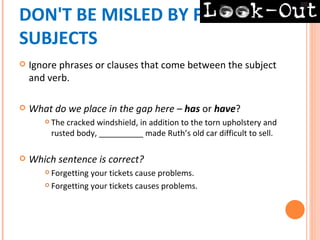
   Ignore phrases or clauses that come between the subject
    and verb.

   What do we place in the gap here – has or have?
          The cracked windshield, in addition to the torn upholstery and
           rusted body, __________ made Ruth’s old car difficult to sell.

   Which sentence is correct?
        Forgetting your tickets cause problems.
        Forgetting your tickets causes problems.
WATCH OUT FOR COLLECTIVE
NOUNS
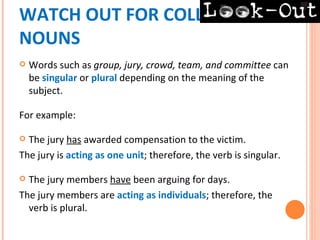
   Words such as group, jury, crowd, team, and committee can
    be singular or plural depending on the meaning of the
    subject.

For example:

 The jury has awarded compensation to the victim.
The jury is acting as one unit; therefore, the verb is singular.

 The jury members have been arguing for days.
The jury members are acting as individuals; therefore, the
  verb is plural.
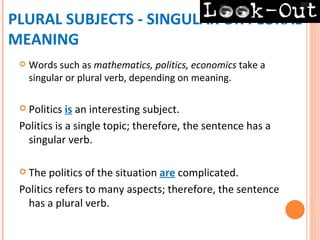
PLURAL SUBJECTS - SINGULAR OR PLURAL
MEANING
    Words such as mathematics, politics, economics take a
     singular or plural verb, depending on meaning.

  Politics  is an interesting subject.
 Politics is a single topic; therefore, the sentence has a
   singular verb.

  The  politics of the situation are complicated.
 Politics refers to many aspects; therefore, the sentence
   has a plural verb.
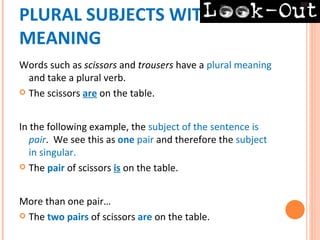
PLURAL SUBJECTS WITH PLURAL
MEANING
Words such as scissors and trousers have a plural meaning
  and take a plural verb.
 The scissors are on the table.


In the following example, the subject of the sentence is
   pair. We see this as one pair and therefore the subject
   in singular.
 The pair of scissors is on the table.


More than one pair…
 The two pairs of scissors are on the table.
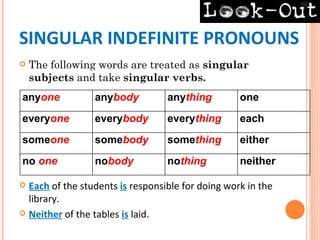
SINGULAR INDEFINITE PRONOUNS
   The following words are treated as singular
    subjects and take singular verbs.
anyone           anybody          anything         one
everyone         everybody        everything       each
someone          somebody         something        either
no one           nobody           nothing          neither

 Each of the students is responsible for doing work in the
  library.
 Neither of the tables is laid.
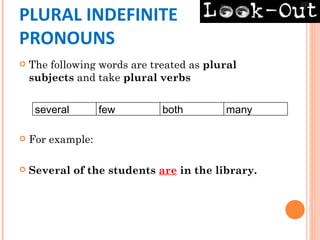
PLURAL INDEFINITE
PRONOUNS
   The following words are treated as plural
    subjects and take plural verbs


     several       few        both        many

   For example:

   Several of the students are in the library.
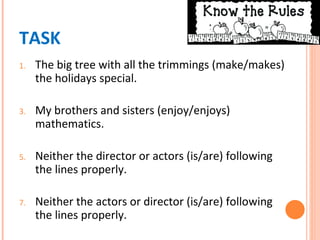
TASK
1.   The big tree with all the trimmings (make/makes)
     the holidays special.

3.   My brothers and sisters (enjoy/enjoys)
     mathematics.

5.   Neither the director or actors (is/are) following
     the lines properly.

7.   Neither the actors or director (is/are) following
     the lines properly.
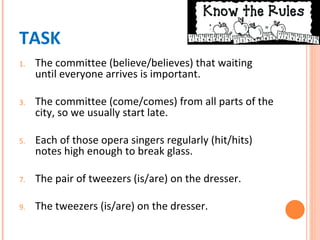
TASK
1.   The committee (believe/believes) that waiting
     until everyone arrives is important.

3.   The committee (come/comes) from all parts of the
     city, so we usually start late.

5.   Each of those opera singers regularly (hit/hits)
     notes high enough to break glass.

7.   The pair of tweezers (is/are) on the dresser.

9.   The tweezers (is/are) on the dresser.

Subject verb agreement

  • 1.
    SUBJECT- VERB AGREEMENT C an’tthey all jus t get along?
  • 2.
    Youtube clips tostart  http://www.youtube.com/watch?v=UelAAu-g3Mc&feature=related  http://www.youtube.com/watch?v=J9hSgVHETPA&feature=related  http://www.youtube.com/watch?v=wureAATyXuk  http://www.youtube.com/watch?v=LxmDmIkWqag good
  • 3.
    SUBJECT – VERBAGREEMENT  Subjects and verbs must AGREE with one another in number (singular or plural).   S ingular s ubjects take s ingular verbs  Plural s ubjec ts take plural verbs
  • 4.
    WORKING IN THEPRESENT TENSE In present tenses, nouns and verbs form plurals in ‘opposite’ ways:  Singular subject = ADD an ‘S’ to the VERB  Plural subject = NO ‘S’ on the VERB  All will become clear – promise!
  • 5.
    SINGLE SUBJECTS +SINGLE VERBS Single Subject Single Verb The dog chases the cat. The student works hard. Susan drives to work.
  • 6.
    PLURAL SUBJECTS +PLURAL VERBS Plural Subject Plural Verb The dogs chase the cat. The students work hard. Susan and Karen drive to work.
  • 7.
    BE, DO, HAVE,GO, TEACH The bag is on the floor. The bags are on the floor. Barry does a great job. The workers do a great job. Aadesh has three cats. The neighbours have three cats. Bella goes swimming once a week. Bella and Darcy go swimming once a week. Paul teaches Bella to swim. Paul and Mary teach Bella to swim.
  • 8.
    AGREEMENT IN NUMBER Choosecorrect form:  TheHendersons is/are at the movie theater.  The boxes has/have arrived from Spain.  The actor is/are reciting his lines.
  • 9.
    PHRASES  Sometimes a phrase will come between the subject and verb, but don’t let this confuse you! You still only need the subject and verb agree. The students at school has/have many different jobs. Members of the club make/makes sandwiches at a shelter.
  • 10.
    WATCH OUT FORCOMPOUND SUBJECTS  When the parts of a compound subject are joined by "and," treat the subject as plural, even if the individual parts are singular.  Which sentence is correct? Danny and Rolando gets their share of rebounds. Danny and Rolando get their share of rebounds.
  • 11.
    SUBJECTS JOINED BY‘OR’ OR ‘NO R’  When the parts of subject are joined by "or" or "nor," let the subject part nearest the verb determine whether the verb is singular or plural.  Which sentences are correct?  Either the table or the chairs needs moving.  Either the table or the chairs need moving.  Neither the chairs nor the table needs moving.  Neither the chairs nor the table need moving.
  • 12.
    DON'T BE MISLEDBY FALSE SUBJECTS  Ignore phrases or clauses that come between the subject and verb.  What do we place in the gap here – has or have?  The cracked windshield, in addition to the torn upholstery and rusted body, __________ made Ruth’s old car difficult to sell.  Which sentence is correct?  Forgetting your tickets cause problems.  Forgetting your tickets causes problems.
  • 13.
    WATCH OUT FORCOLLECTIVE NOUNS  Words such as group, jury, crowd, team, and committee can be singular or plural depending on the meaning of the subject. For example:  The jury has awarded compensation to the victim. The jury is acting as one unit; therefore, the verb is singular.  The jury members have been arguing for days. The jury members are acting as individuals; therefore, the verb is plural.
  • 14.
    PLURAL SUBJECTS -SINGULAR OR PLURAL MEANING  Words such as mathematics, politics, economics take a singular or plural verb, depending on meaning.  Politics is an interesting subject. Politics is a single topic; therefore, the sentence has a singular verb.  The politics of the situation are complicated. Politics refers to many aspects; therefore, the sentence has a plural verb.
  • 15.
    PLURAL SUBJECTS WITHPLURAL MEANING Words such as scissors and trousers have a plural meaning and take a plural verb.  The scissors are on the table. In the following example, the subject of the sentence is pair. We see this as one pair and therefore the subject in singular.  The pair of scissors is on the table. More than one pair…  The two pairs of scissors are on the table.
  • 16.
    SINGULAR INDEFINITE PRONOUNS  The following words are treated as singular subjects and take singular verbs. anyone anybody anything one everyone everybody everything each someone somebody something either no one nobody nothing neither  Each of the students is responsible for doing work in the library.  Neither of the tables is laid.
  • 17.
    PLURAL INDEFINITE PRONOUNS  The following words are treated as plural subjects and take plural verbs several few both many  For example:  Several of the students are in the library.
  • 18.
    TASK 1. The big tree with all the trimmings (make/makes) the holidays special. 3. My brothers and sisters (enjoy/enjoys) mathematics. 5. Neither the director or actors (is/are) following the lines properly. 7. Neither the actors or director (is/are) following the lines properly.
  • 19.
    TASK 1. The committee (believe/believes) that waiting until everyone arrives is important. 3. The committee (come/comes) from all parts of the city, so we usually start late. 5. Each of those opera singers regularly (hit/hits) notes high enough to break glass. 7. The pair of tweezers (is/are) on the dresser. 9. The tweezers (is/are) on the dresser.