SUBJECT-VERB AGREEMENT
Singular
The subject and the verb of a sentence must always agree for the
sentence to be grammatically correct.
Subject/Verb Agreement: The Rules
A singular (one) subject is always followed by the singular form of
the verb.
Thomas likes milk.
A hen lays eggs.
What do you notice about the subject and verb in these sentences?
Thomas likes milk.
A hen lays eggs.
Plural
Subject/Verb Agreement: The Rules
A plural (more than one) subject is always followed by the plural form
of the verb.
The mice run from the cat.
The children follow the Pied Piper.
What do you notice about the subject and verb in these
sentences?
The mice run from the cat.
The children follow the Pied Piper.
To help with correct verb
agreement,
the basic rule is:
• If the subject is singular (one)
the verb must be singular.
• If the subject is plural (more than
one) the verb must be plural.
Subject/Verb Agreement: The Rules
To form the plural of a verb in the
present tense, you should remove the
s (or sometimes ‘es’ or ‘ies’) from the
singular form.
Here are some examples of verbs in
their present tense singular and plural
form…
Singular Plural
becomes become
catches catch
drinks drink
flies fly
forgives forgive
goes go
hides hide
leads lead
rides ride
seeks seek
springs spring
tears tear
writes write
Plurals in English Grammar
• To make a noun plural, we add –s
• Singular: girl
• Plural: girls
• To make a verb plural, we take away
the –s.
• Singular: he talks
• Plural: they talk
Watch the Verb Endings!
Singular
• I walk
• You walk
• He/She/It walk s
• Joe walk s
• The girl walk s
Plural
• We walk
• You walk
• They walk
• Joe and Maria walk
• The girls walk
Remember there are irregular verbs:
• DO
Singular Plural
• He does They do
• HAVE
• She has They have
• BE
• He is They are
• She was They were
Tip for Subject/verb Agreement
Generally, if the subject doesn’t
end in –S, the verb will.
If the subject does end in –S,
the verb won’t.
The girl dances.
No –S on
subject
-S on
verb
The girls dance.
-S on
subject
No –S
on verb
20 Rules of Subject Verb Agreement
Can’t we all just get along?
1- Multiple subjects joined by
“and”
• If there are two or more subjects joined
by and, the subject must be plural, so
the verb will not get an “s”.
Example
• The boy and the girl dance.
(= They dance.)
No –S on
verb
2. Don’t get confused by the words
that come between the subject and
verb.
The detective who was called to the case
is usually very good.
3. Prepositional phrases between
the subject and verb usually do not
affect the agreement.
The biker in this race is very competitive.
The bikers in this race are very competitive.
4. If a sentence starts with “there” or
“ here”, the subject will always be
placed after the verb.
There is a meeting today.
Here are the results from this past month.
5. Subjects can come after the verb
in questions.
• Does Ali always play with dolls?
• How are the boys today?
6. If two subjects are joined by
“and”, they typically require a plural
verb.
• The puppy and the lady are friends.
7. If two subjects are separated by
“and” refer to the same thing, the
verb is singular.
• Spaghetti and meatballs is my favorite
pasta dish.
8. If both subjects are singular and
connected by or, nor, neither/nor,
either/or and not only/but also, the verb
is singular.
• Sally or Bubba has stolen the
scarecrow.
• Not only the guitar player but also the
drummer was soaked with sweat.
9. If both subjects are plural and connected
by the words or, nor, neither/nor, either/or,
and not only/but also, the verb is plural.
• Cookies or brownies are nice treats for
your teacher.
10. If one subject is singular and one plural
and are connected by the words or, nor,
neither/nor, either/or, and not only/but also,
use the subject that is nearest the verb.
• Either my sisters or my mom has sent
me a present.
• Not only Bob but also the Smiths want
some hamburgers for supper.
11. Units of measurement usually
use a singular verb.
• Six gallons of paint was used on the
house.
• Five dollars is too much for a cup of
coffee.
12. Collective nouns usually take
a singular verb.
• The herd is stampeding.
The class was ready for the test.
13. Titles of books, movies,
novels, etc. are treated as
singular.
• Holes was one of my favorite books. I
want to see the movie.
14. Two infinitives separated by
and take a plural verb.
• To run and to read are my two favorite
“Free-time” activities.
15. Gerunds alone take a singular
verb. Gerunds linked by and take
a plural verb.
• Dancing is not something everyone
can do as well as I can!
16. If the words each, every or no
come before the subject, the verb is
singular.
• Each boy and girl has to take the test.
• Every frog and toad turns into a prince.
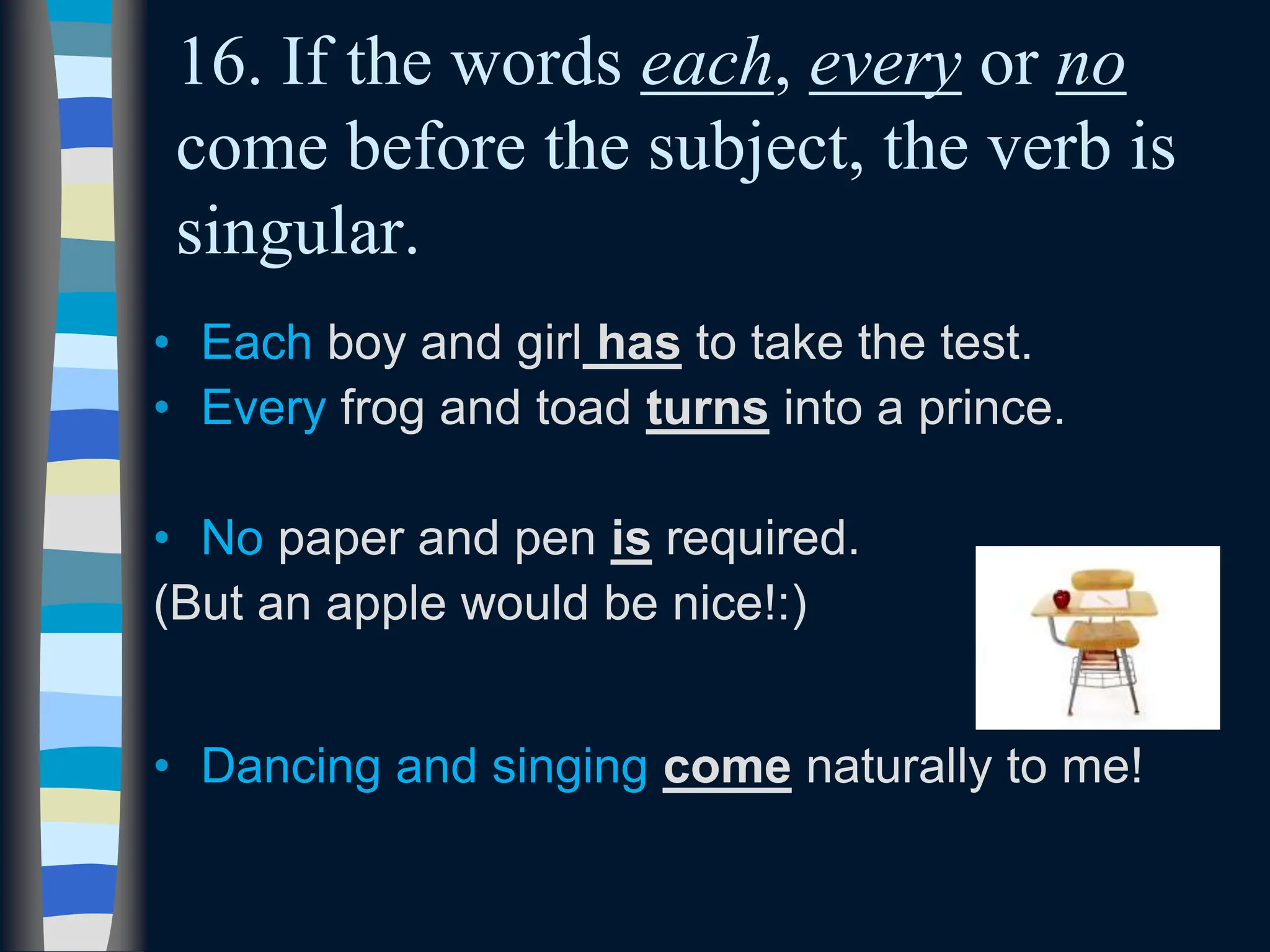
• No paper and pen is required.
(But an apple would be nice!:)
• Dancing and singing come naturally to me!
17. Most indefinite pronouns take
singular verbs.
Little One * Everybody is happy.
Another Neither * No one has a dime.
Much Either * Nothing was going to help.
Each
one body thing
someone somebody something
anyone anybody anything
No one nobody nothing
everyone everybody everything
18. Both, few, many, others, and
several take a plural verb.
• Several need to finish the race.
• A few have the right answer.
19. When the subject is all, any, more,
most, none, or some, this is the ONLY
time you must look at the object of the
prepositional phrase to determine whether
it is singular or plural.
• All of the chickens have laid eggs.
• Some of the milk has spilled.
20-Multiple subjects joined by
“or”
If there are two or more subjects joined by
or, the verb agrees with the part of the
subject closest to it.
Examples:
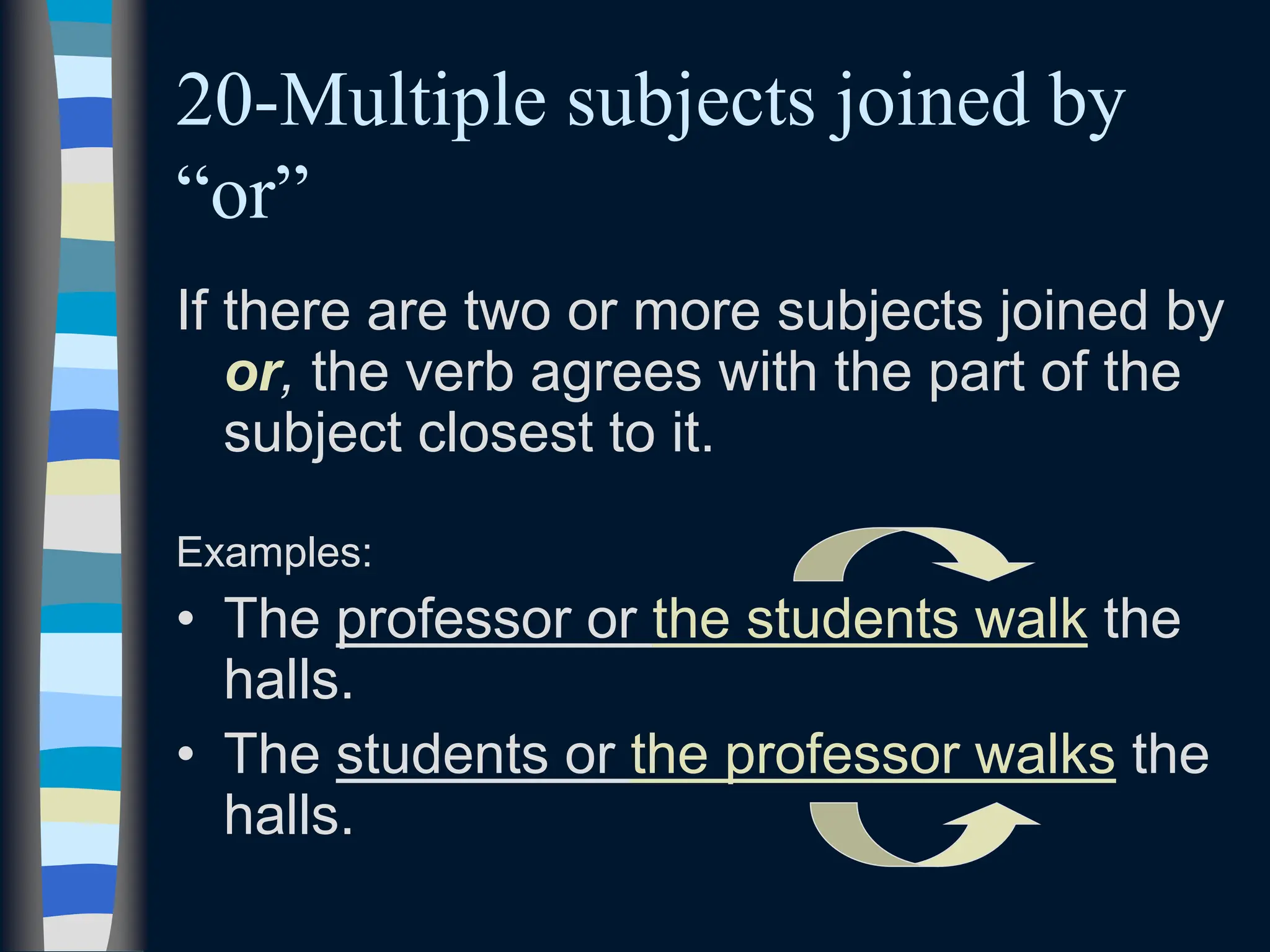
• The professor or the students walk the
halls.
• The students or the professor walks the
halls.
21- Relative Pronouns
Relative Pronouns (who/which/that) can be
either singular or plural, depending on the
word they refer to.
• The student who works hard will succeed.
• The students who work hard will succeed.
Helpful hints
Sometimes, several words come between the subject
and the verb. Just take out the phrase in the middle
to see whether or not the subject and verb agree.
 The student, though she had lots of problems in
other schools, finds/find (?) her new class easy.
 The student, though she had lots of problems
in other schools, finds her new class easy.
 The student finds her new class easy.
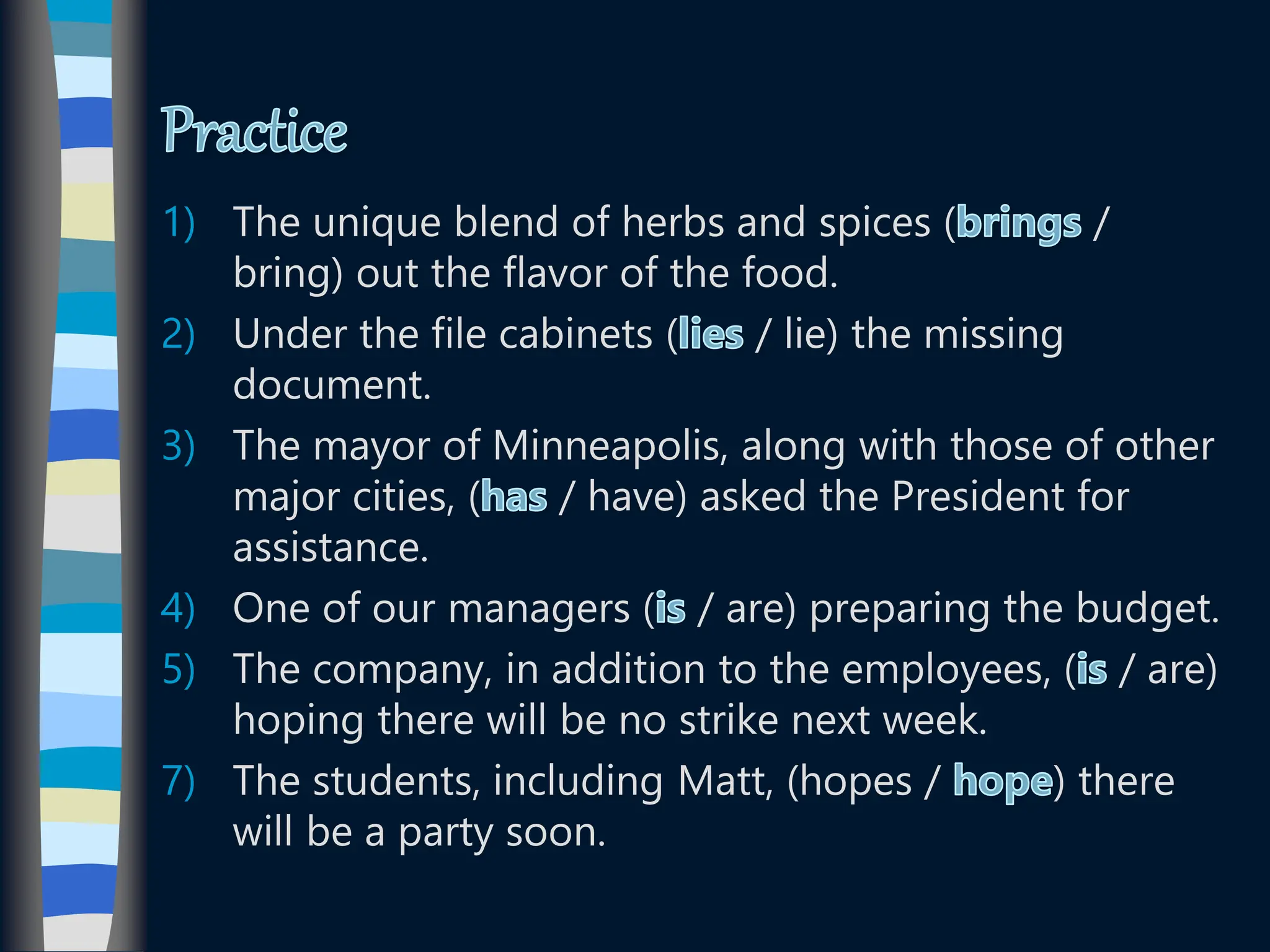
1) The unique blend of herbs and spices ( /
bring) out the flavor of the food.
2) Under the file cabinets ( / lie) the missing
document.
3) The mayor of Minneapolis, along with those of other
major cities, ( / have) asked the President for
assistance.
4) One of our managers ( / are) preparing the budget.
5) The company, in addition to the employees, ( / are)
hoping there will be no strike next week.
7) The students, including Matt, (hopes / ) there
will be a party soon.
7) The company ( / are) planning ( / their) annual
Christmas party.
8) No one ( / want) ( / their) GPA to go
down.
9) The students, as well as the instructor, (keeps /
) very busy.
10) The administrators, who wrote the books, (sticks /
) to the rules.
11) The Pirates of the Caribbean ( / are) released next
week.
12) A driver’s license or two credit cards (is / )
required.
13) A number of the excuses (seems / )
unacceptable.
1) Mathematics ( / were) never my favorite
school subject.
2) Each of the plants ( / have) been sold.
3) Some of the rocks (is / ) slippery.
4) Neither of the teachers ( / are) interested in
excuses.
5) Dr. Barker knew that Frank was the only one of
his sons who ( / were) responsible enough
to handle the family business.
6) The statistics (indicates / ) that crime
is decreasing in the city.
7) Each tree, shrub, and vine (need / ) to
be trimmed.
8) Jill’s natural ability and her desire to help
others (has / ) led to a career in the
ministry.
9) There (is / ) surprisingly few children in
our neighborhood.
10)High levels of air pollution (causes / )
damage to the respiratory system.
11)Neither the students nor their teacher
( / want) to postpone the exam.
12)Everyone ( / are) hoping that ( /
they) may leave school early on Friday.
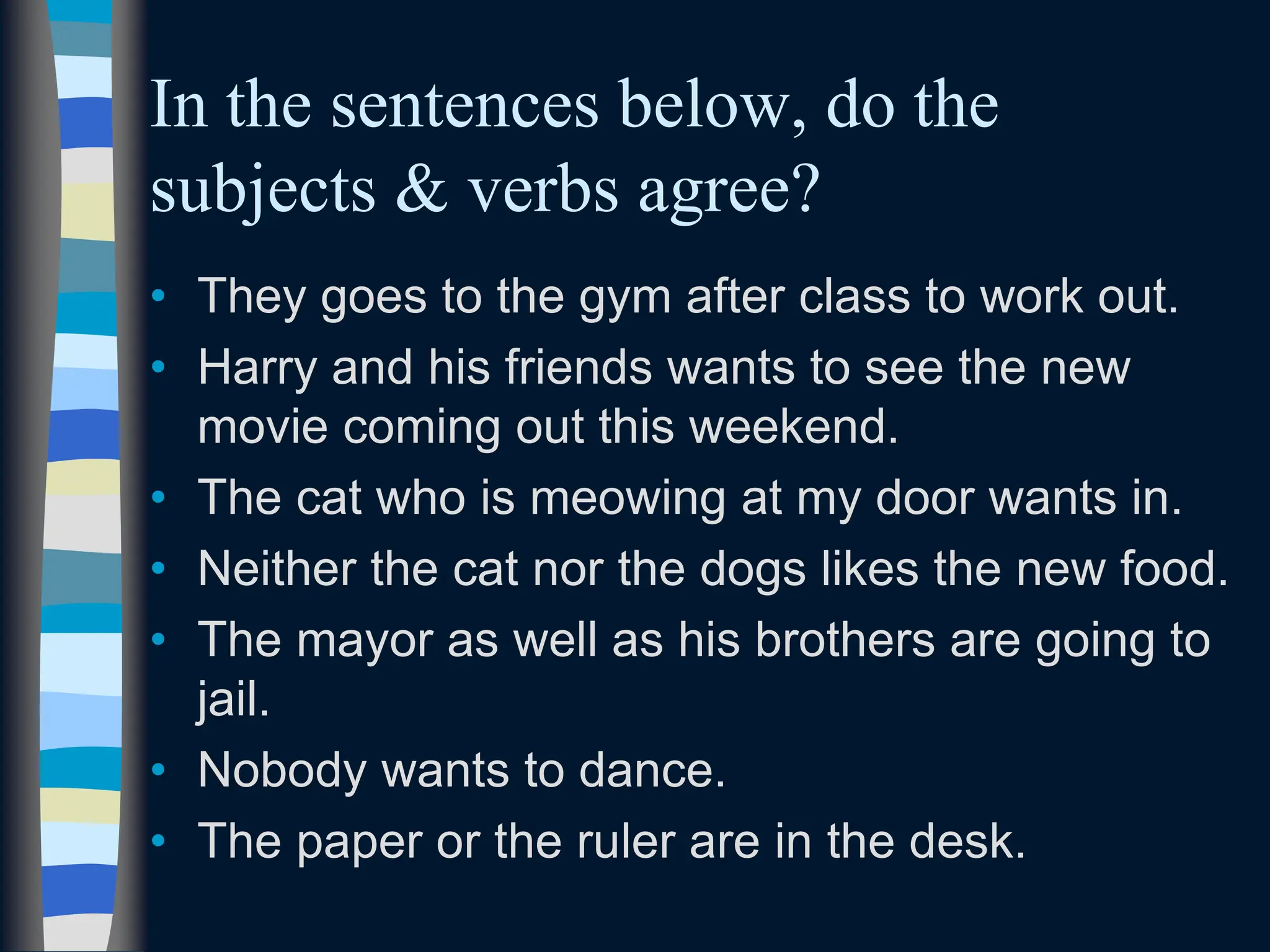
In the sentences below, do the
subjects & verbs agree?
• They goes to the gym after class to work out.
• Harry and his friends wants to see the new
movie coming out this weekend.
• The cat who is meowing at my door wants in.
• Neither the cat nor the dogs likes the new food.
• The mayor as well as his brothers are going to
jail.
• Nobody wants to dance.
• The paper or the ruler are in the desk.

subject verb agreement basic grammar.ppt

  • 1.
  • 2.
    Singular The subject andthe verb of a sentence must always agree for the sentence to be grammatically correct. Subject/Verb Agreement: The Rules A singular (one) subject is always followed by the singular form of the verb. Thomas likes milk. A hen lays eggs. What do you notice about the subject and verb in these sentences? Thomas likes milk. A hen lays eggs.
  • 3.
    Plural Subject/Verb Agreement: TheRules A plural (more than one) subject is always followed by the plural form of the verb. The mice run from the cat. The children follow the Pied Piper. What do you notice about the subject and verb in these sentences? The mice run from the cat. The children follow the Pied Piper.
  • 4.
    To help withcorrect verb agreement, the basic rule is: • If the subject is singular (one) the verb must be singular. • If the subject is plural (more than one) the verb must be plural. Subject/Verb Agreement: The Rules To form the plural of a verb in the present tense, you should remove the s (or sometimes ‘es’ or ‘ies’) from the singular form. Here are some examples of verbs in their present tense singular and plural form… Singular Plural becomes become catches catch drinks drink flies fly forgives forgive goes go hides hide leads lead rides ride seeks seek springs spring tears tear writes write
  • 5.
    Plurals in EnglishGrammar • To make a noun plural, we add –s • Singular: girl • Plural: girls • To make a verb plural, we take away the –s. • Singular: he talks • Plural: they talk
  • 6.
    Watch the VerbEndings! Singular • I walk • You walk • He/She/It walk s • Joe walk s • The girl walk s Plural • We walk • You walk • They walk • Joe and Maria walk • The girls walk
  • 7.
    Remember there areirregular verbs: • DO Singular Plural • He does They do • HAVE • She has They have • BE • He is They are • She was They were
  • 8.
    Tip for Subject/verbAgreement Generally, if the subject doesn’t end in –S, the verb will. If the subject does end in –S, the verb won’t.
  • 9.
    The girl dances. No–S on subject -S on verb
  • 10.
    The girls dance. -Son subject No –S on verb
  • 11.
    20 Rules ofSubject Verb Agreement Can’t we all just get along?
  • 12.
    1- Multiple subjectsjoined by “and” • If there are two or more subjects joined by and, the subject must be plural, so the verb will not get an “s”. Example • The boy and the girl dance. (= They dance.) No –S on verb
  • 13.
    2. Don’t getconfused by the words that come between the subject and verb. The detective who was called to the case is usually very good.
  • 14.
    3. Prepositional phrasesbetween the subject and verb usually do not affect the agreement. The biker in this race is very competitive. The bikers in this race are very competitive.
  • 15.
    4. If asentence starts with “there” or “ here”, the subject will always be placed after the verb. There is a meeting today. Here are the results from this past month.
  • 16.
    5. Subjects cancome after the verb in questions. • Does Ali always play with dolls? • How are the boys today?
  • 17.
    6. If twosubjects are joined by “and”, they typically require a plural verb. • The puppy and the lady are friends.
  • 18.
    7. If twosubjects are separated by “and” refer to the same thing, the verb is singular. • Spaghetti and meatballs is my favorite pasta dish.
  • 19.
    8. If bothsubjects are singular and connected by or, nor, neither/nor, either/or and not only/but also, the verb is singular. • Sally or Bubba has stolen the scarecrow. • Not only the guitar player but also the drummer was soaked with sweat.
  • 20.
    9. If bothsubjects are plural and connected by the words or, nor, neither/nor, either/or, and not only/but also, the verb is plural. • Cookies or brownies are nice treats for your teacher.
  • 21.
    10. If onesubject is singular and one plural and are connected by the words or, nor, neither/nor, either/or, and not only/but also, use the subject that is nearest the verb. • Either my sisters or my mom has sent me a present. • Not only Bob but also the Smiths want some hamburgers for supper.
  • 22.
    11. Units ofmeasurement usually use a singular verb. • Six gallons of paint was used on the house. • Five dollars is too much for a cup of coffee.
  • 23.
    12. Collective nounsusually take a singular verb. • The herd is stampeding. The class was ready for the test.
  • 24.
    13. Titles ofbooks, movies, novels, etc. are treated as singular. • Holes was one of my favorite books. I want to see the movie.
  • 25.
    14. Two infinitivesseparated by and take a plural verb. • To run and to read are my two favorite “Free-time” activities.
  • 26.
    15. Gerunds alonetake a singular verb. Gerunds linked by and take a plural verb. • Dancing is not something everyone can do as well as I can!
  • 27.
    16. If thewords each, every or no come before the subject, the verb is singular. • Each boy and girl has to take the test. • Every frog and toad turns into a prince. • No paper and pen is required. (But an apple would be nice!:) • Dancing and singing come naturally to me!
  • 28.
    17. Most indefinitepronouns take singular verbs. Little One * Everybody is happy. Another Neither * No one has a dime. Much Either * Nothing was going to help. Each one body thing someone somebody something anyone anybody anything No one nobody nothing everyone everybody everything
  • 29.
    18. Both, few,many, others, and several take a plural verb. • Several need to finish the race. • A few have the right answer.
  • 30.
    19. When thesubject is all, any, more, most, none, or some, this is the ONLY time you must look at the object of the prepositional phrase to determine whether it is singular or plural. • All of the chickens have laid eggs. • Some of the milk has spilled.
  • 31.
    20-Multiple subjects joinedby “or” If there are two or more subjects joined by or, the verb agrees with the part of the subject closest to it. Examples: • The professor or the students walk the halls. • The students or the professor walks the halls.
  • 32.
    21- Relative Pronouns RelativePronouns (who/which/that) can be either singular or plural, depending on the word they refer to. • The student who works hard will succeed. • The students who work hard will succeed.
  • 33.
    Helpful hints Sometimes, severalwords come between the subject and the verb. Just take out the phrase in the middle to see whether or not the subject and verb agree.  The student, though she had lots of problems in other schools, finds/find (?) her new class easy.  The student, though she had lots of problems in other schools, finds her new class easy.  The student finds her new class easy.
  • 34.
    1) The uniqueblend of herbs and spices ( / bring) out the flavor of the food. 2) Under the file cabinets ( / lie) the missing document. 3) The mayor of Minneapolis, along with those of other major cities, ( / have) asked the President for assistance. 4) One of our managers ( / are) preparing the budget. 5) The company, in addition to the employees, ( / are) hoping there will be no strike next week. 7) The students, including Matt, (hopes / ) there will be a party soon.
  • 35.
    7) The company( / are) planning ( / their) annual Christmas party. 8) No one ( / want) ( / their) GPA to go down. 9) The students, as well as the instructor, (keeps / ) very busy. 10) The administrators, who wrote the books, (sticks / ) to the rules. 11) The Pirates of the Caribbean ( / are) released next week. 12) A driver’s license or two credit cards (is / ) required. 13) A number of the excuses (seems / ) unacceptable.
  • 36.
    1) Mathematics (/ were) never my favorite school subject. 2) Each of the plants ( / have) been sold. 3) Some of the rocks (is / ) slippery. 4) Neither of the teachers ( / are) interested in excuses. 5) Dr. Barker knew that Frank was the only one of his sons who ( / were) responsible enough to handle the family business. 6) The statistics (indicates / ) that crime is decreasing in the city.
  • 37.
    7) Each tree,shrub, and vine (need / ) to be trimmed. 8) Jill’s natural ability and her desire to help others (has / ) led to a career in the ministry. 9) There (is / ) surprisingly few children in our neighborhood. 10)High levels of air pollution (causes / ) damage to the respiratory system. 11)Neither the students nor their teacher ( / want) to postpone the exam. 12)Everyone ( / are) hoping that ( / they) may leave school early on Friday.
  • 38.
    In the sentencesbelow, do the subjects & verbs agree? • They goes to the gym after class to work out. • Harry and his friends wants to see the new movie coming out this weekend. • The cat who is meowing at my door wants in. • Neither the cat nor the dogs likes the new food. • The mayor as well as his brothers are going to jail. • Nobody wants to dance. • The paper or the ruler are in the desk.