BASIC RULE
• Asingular subject (she, bill, car) takes a singular verb (is,
goes, shines), whereas a plural subject takes a plural verb.
• Example:
• The list of items is/are on the desk.
• If you know that list is the subject, then you will choose
is for the verb.
5.
RULE 1
•A subjectwill come before a phrase beginning with of.
•Incorrect: A bouquet of yellow roses lend colour and
fragrance to the room.
•Correct: A bouquet of yellow roses lends . . . (bouquet
lends, not roses lend)
6.
RULE 2
• Twosingular subjects connected by or, either/or, or
neither/nor require a singular verb.
Examples:
• My aunt or my uncle is arriving by train today.
• Neither Juan nor Carmen is available.
• Either Kiana or Casey is helping today with stage decorations.
7.
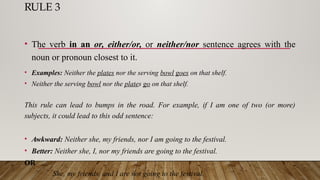
RULE 3
• Theverb in an or, either/or, or neither/nor sentence agrees with the
noun or pronoun closest to it.
• Examples: Neither the plates nor the serving bowl goes on that shelf.
• Neither the serving bowl nor the plates go on that shelf.
This rule can lead to bumps in the road. For example, if I am one of two (or more)
subjects, it could lead to this odd sentence:
• Awkward: Neither she, my friends, nor I am going to the festival.
• Better: Neither she, I, nor my friends are going to the festival.
OR
She, my friends, and I are not going to the festival.
8.
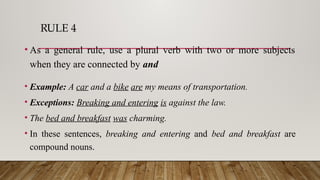
RULE 4
• Asa general rule, use a plural verb with two or more subjects
when they are connected by and
• Example: A car and a bike are my means of transportation.
• Exceptions: Breaking and entering is against the law.
• The bed and breakfast was charming.
• In these sentences, breaking and entering and bed and breakfast are
compound nouns.
9.
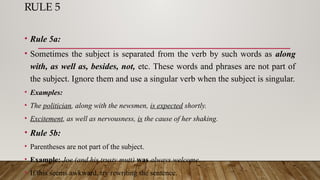
RULE 5
• Rule5a:
• Sometimes the subject is separated from the verb by such words as along
with, as well as, besides, not, etc. These words and phrases are not part of
the subject. Ignore them and use a singular verb when the subject is singular.
• Examples:
• The politician, along with the newsmen, is expected shortly.
• Excitement, as well as nervousness, is the cause of her shaking.
• Rule 5b:
• Parentheses are not part of the subject.
• Example: Joe (and his trusty mutt) was always welcome.
• If this seems awkward, try rewriting the sentence.
10.
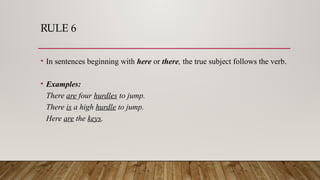
RULE 6
• Insentences beginning with here or there, the true subject follows the verb.
• Examples:
There are four hurdles to jump.
There is a high hurdle to jump.
Here are the keys.
11.
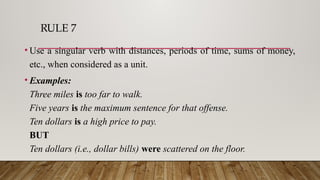
RULE 7
• Usea singular verb with distances, periods of time, sums of money,
etc., when considered as a unit.
• Examples:
Three miles is too far to walk.
Five years is the maximum sentence for that offense.
Ten dollars is a high price to pay.
BUT
Ten dollars (i.e., dollar bills) were scattered on the floor.
12.
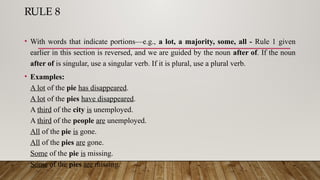
RULE 8
• Withwords that indicate portions—e.g., a lot, a majority, some, all - Rule 1 given
earlier in this section is reversed, and we are guided by the noun after of. If the noun
after of is singular, use a singular verb. If it is plural, use a plural verb.
• Examples:
A lot of the pie has disappeared.
A lot of the pies have disappeared.
A third of the city is unemployed.
A third of the people are unemployed.
All of the pie is gone.
All of the pies are gone.
Some of the pie is missing.
Some of the pies are missing.
13.
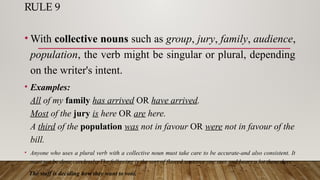
RULE 9
• Withcollective nouns such as group, jury, family, audience,
population, the verb might be singular or plural, depending
on the writer's intent.
• Examples:
All of my family has arrived OR have arrived.
Most of the jury is here OR are here.
A third of the population was not in favour OR were not in favour of the
bill.
• Anyone who uses a plural verb with a collective noun must take care to be accurate-and also consistent. It
must not be done carelessly. The following is the sort of flawed sentence one sees and hears a lot these days:
The staff is deciding how they want to vote.
14.
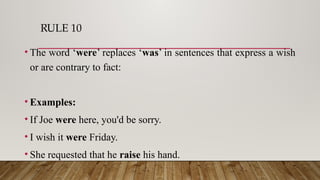
RULE 10
• Theword ‘were’ replaces ‘was’ in sentences that express a wish
or are contrary to fact:
• Examples:
• If Joe were here, you'd be sorry.
• I wish it were Friday.
• She requested that he raise his hand.
15.
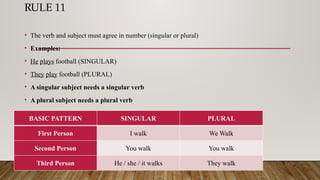
RULE 11
• Theverb and subject must agree in number (singular or plural)
• Examples:
• He plays football (SINGULAR)
• They play football (PLURAL)
• A singular subject needs a singular verb
• A plural subject needs a plural verb
BASIC PATTERN SINGULAR PLURAL
First Person I walk We Walk
Second Person You walk You walk
Third Person He / she / it walks They walk
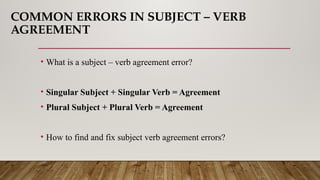
COMMON ERRORS INSUBJECT – VERB
AGREEMENT
• What is a subject – verb agreement error?
• Singular Subject + Singular Verb = Agreement
• Plural Subject + Plural Verb = Agreement
• How to find and fix subject verb agreement errors?
19.
COMMON ERRORS INSUBJECT – VERB
AGREEMENT
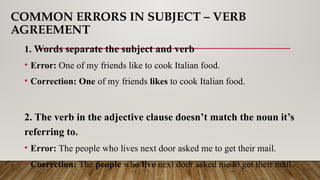
1. Words separate the subject and verb
• Error: One of my friends like to cook Italian food.
• Correction: One of my friends likes to cook Italian food.
2. The verb in the adjective clause doesn’t match the noun it’s
referring to.
• Error: The people who lives next door asked me to get their mail.
• Correction: The people who live next door asked me to get their mail.
20.
COMMON ERRORS INSUBJECT – VERB
AGREEMENT
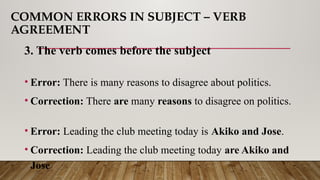
3. The verb comes before the subject
• Error: There is many reasons to disagree about politics.
• Correction: There are many reasons to disagree on politics.
• Error: Leading the club meeting today is Akiko and Jose.
• Correction: Leading the club meeting today are Akiko and
Jose
21.
COMMON ERRORS INSUBJECT – VERB
AGREEMENT
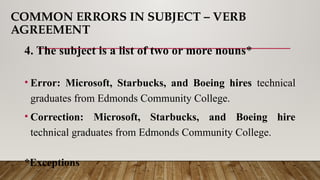
4. The subject is a list of two or more nouns*
• Error: Microsoft, Starbucks, and Boeing hires technical
graduates from Edmonds Community College.
• Correction: Microsoft, Starbucks, and Boeing hire
technical graduates from Edmonds Community College.
*Exceptions
22.
COMMON ERRORS INSUBJECT – VERB
AGREEMENT
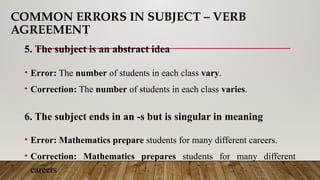
5. The subject is an abstract idea
• Error: The number of students in each class vary.
• Correction: The number of students in each class varies.
6. The subject ends in an -s but is singular in meaning
• Error: Mathematics prepare students for many different careers.
• Correction: Mathematics prepares students for many different
careers
23.
COMMON ERRORS INSUBJECT – VERB
AGREEMENT
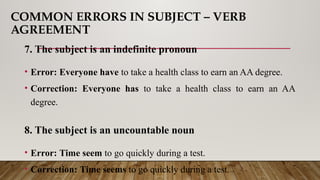
7. The subject is an indefinite pronoun
• Error: Everyone have to take a health class to earn an AA degree.
• Correction: Everyone has to take a health class to earn an AA
degree.
8. The subject is an uncountable noun
• Error: Time seem to go quickly during a test.
• Correction: Time seems to go quickly during a test.
24.
COMMON ERRORS INSUBJECT – VERB
AGREEMENT
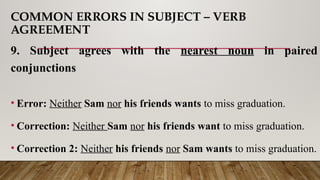
9. Subject agrees with the nearest noun in paired
conjunctions
• Error: Neither Sam nor his friends wants to miss graduation.
• Correction: Neither Sam nor his friends want to miss graduation.
• Correction 2: Neither his friends nor Sam wants to miss graduation.
NOUN PRONOUN AGREEMENT
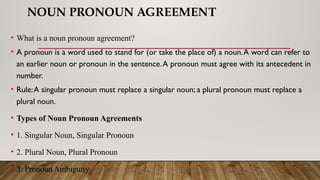
•What is a noun pronoun agreement?
• A pronoun is a word used to stand for (or take the place of) a noun.A word can refer to
an earlier noun or pronoun in the sentence.A pronoun must agree with its antecedent in
number.
• Rule:A singular pronoun must replace a singular noun; a plural pronoun must replace a
plural noun.
• Types of Noun Pronoun Agreements
• 1. Singular Noun, Singular Pronoun
• 2. Plural Noun, Plural Pronoun
• 3. Pronoun Ambiguity
28.
NOUN PRONOUN AGREEMENT
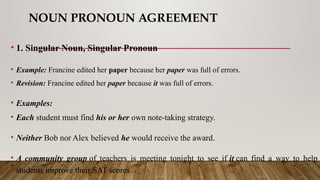
•1. Singular Noun, Singular Pronoun
• Example: Francine edited her paper because her paper was full of errors.
• Revision: Francine edited her paper because it was full of errors.
• Examples:
• Each student must find his or her own note-taking strategy.
• Neither Bob nor Alex believed he would receive the award.
• A community group of teachers is meeting tonight to see if it can find a way to help
students improve their SAT scores
29.
NOUN PRONOUN AGREEMENT
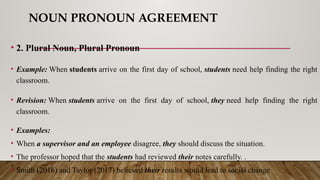
•2. Plural Noun, Plural Pronoun
• Example: When students arrive on the first day of school, students need help finding the right
classroom.
• Revision: When students arrive on the first day of school, they need help finding the right
classroom.
• Examples:
• When a supervisor and an employee disagree, they should discuss the situation.
• The professor hoped that the students had reviewed their notes carefully. .
• Smith (2016) and Taylor (2017) believed their results would lead to social change
30.
NOUN PRONOUN AGREEMENT
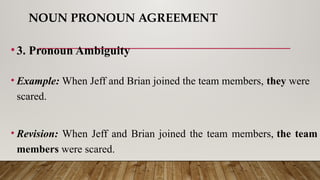
•3.Pronoun Ambiguity
• Example: When Jeff and Brian joined the team members, they were
scared.
• Revision: When Jeff and Brian joined the team members, the team
members were scared.
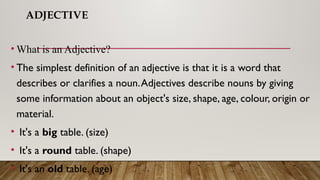
ADJECTIVE
• What isan Adjective?
• The simplest definition of an adjective is that it is a word that
describes or clarifies a noun.Adjectives describe nouns by giving
some information about an object's size, shape, age, colour, origin or
material.
• It's a big table. (size)
• It's a round table. (shape)
• It's an old table. (age)
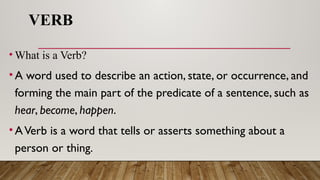
VERB
• What isa Verb?
•A word used to describe an action, state, or occurrence, and
forming the main part of the predicate of a sentence, such as
hear, become, happen.
•AVerb is a word that tells or asserts something about a
person or thing.
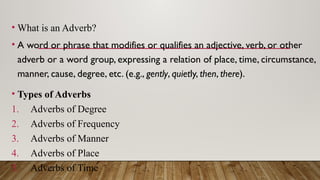
• What isan Adverb?
• A word or phrase that modifies or qualifies an adjective, verb, or other
adverb or a word group, expressing a relation of place, time, circumstance,
manner, cause, degree, etc. (e.g., gently, quietly, then, there).
• Types of Adverbs
1. Adverbs of Degree
2. Adverbs of Frequency
3. Adverbs of Manner
4. Adverbs of Place
5. Adverbs of Time
SEQUENCE OF TENSES
•Meaningof Sequence of Tenses
•The sequence of tenses is the principle, according to which the
tense of the verb in the subordinate clause follows the tense of
the verb in the principal clause
45.
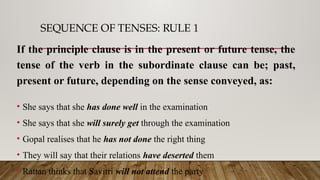
SEQUENCE OF TENSES:RULE 1
If the principle clause is in the present or future tense, the
tense of the verb in the subordinate clause can be; past,
present or future, depending on the sense conveyed, as:
• She says that she has done well in the examination
• She says that she will surely get through the examination
• Gopal realises that he has not done the right thing
• They will say that their relations have deserted them
• Rattan thinks that Savitri will not attend the party
46.
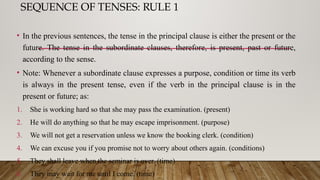
SEQUENCE OF TENSES:RULE 1
• In the previous sentences, the tense in the principal clause is either the present or the
future. The tense in the subordinate clauses, therefore, is present, past or future,
according to the sense.
• Note: Whenever a subordinate clause expresses a purpose, condition or time its verb
is always in the present tense, even if the verb in the principal clause is in the
present or future; as:
1. She is working hard so that she may pass the examination. (present)
2. He will do anything so that he may escape imprisonment. (purpose)
3. We will not get a reservation unless we know the booking clerk. (condition)
4. We can excuse you if you promise not to worry about others again. (conditions)
5. They shall leave when the seminar is over. (time)
6. They may wait for me until I come. (time)
47.
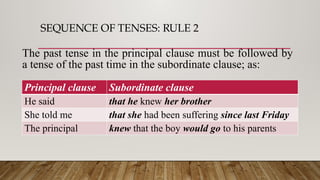
SEQUENCE OF TENSES:RULE 2
Principal clause Subordinate clause
He said that he knew her brother
She told me that she had been suffering since last Friday
The principal knew that the boy would go to his parents
The past tense in the principal clause must be followed by
a tense of the past time in the subordinate clause; as:
48.
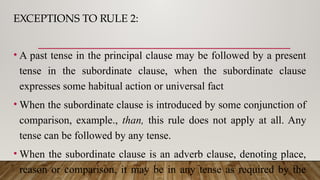
EXCEPTIONS TO RULE2:
• A past tense in the principal clause may be followed by a present
tense in the subordinate clause, when the subordinate clause
expresses some habitual action or universal fact
• When the subordinate clause is introduced by some conjunction of
comparison, example., than, this rule does not apply at all. Any
tense can be followed by any tense.
• When the subordinate clause is an adverb clause, denoting place,
reason or comparison, it may be in any tense as required by the
49.
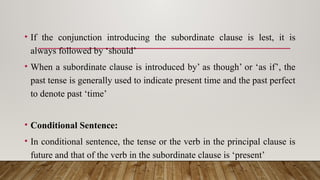
• If theconjunction introducing the subordinate clause is lest, it is
always followed by ‘should’
• When a subordinate clause is introduced by’ as though’ or ‘as if’, the
past tense is generally used to indicate present time and the past perfect
to denote past ‘time’
• Conditional Sentence:
• In conditional sentence, the tense or the verb in the principal clause is
future and that of the verb in the subordinate clause is ‘present’
KINDS OF MISPLACEDMODIFIERS
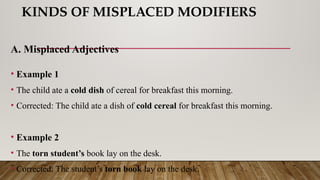
A. Misplaced Adjectives
• Example 1
• The child ate a cold dish of cereal for breakfast this morning.
• Corrected: The child ate a dish of cold cereal for breakfast this morning.
• Example 2
• The torn student’s book lay on the desk.
• Corrected: The student’s torn book lay on the desk.
54.
KINDS OF MISPLACEDMODIFIERS
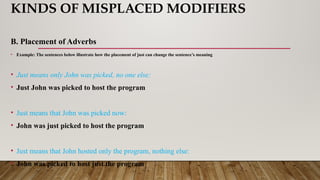
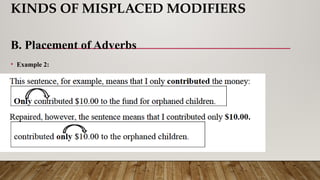
B. Placement of Adverbs
• Example: The sentences below illustrate how the placement of just can change the sentence’s meaning
• Just means only John was picked, no one else:
• Just John was picked to host the program
• Just means that John was picked now:
• John was just picked to host the program
• Just means that John hosted only the program, nothing else:
• John was picked to host just the program
KINDS OF MISPLACEDMODIFIERS
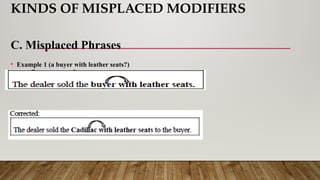
C. Misplaced Phrases
• Example 1 (a buyer with leather seats?)
58.
KINDS OF MISPLACEDMODIFIERS
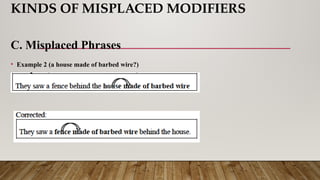
C. Misplaced Phrases
• Example 2 (a house made of barbed wire?)
59.
KINDS OF MISPLACEDMODIFIERS
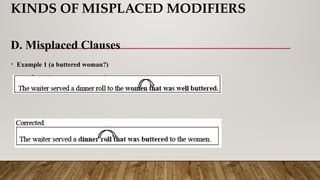
D. Misplaced Clauses
• Example 1 (a buttered woman?)
60.
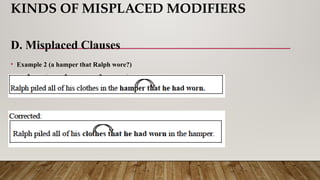
KINDS OF MISPLACEDMODIFIERS
D. Misplaced Clauses
• Example 2 (a hamper that Ralph wore?)
61.
KINDS OF MISPLACEDMODIFIERS
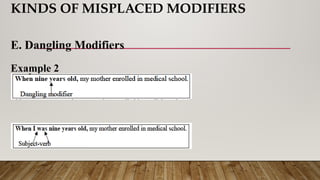
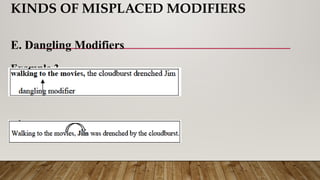
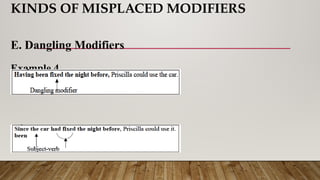
E. Dangling Modifiers
• What are Dangling Modifiers?
• Two Notes about Dangling Modifiers:
1. Unlike a misplaced modifier, a dangling modifier cannot be corrected by simply
moving it to a different place in a sentence
2. In most cases, the dangling modifier appears at the beginning of the sentence,
although it can also come at the end
• Sometimes the dangling modifier error occurs because the sentence fails to specify
anything to which the modifier can refer
62.
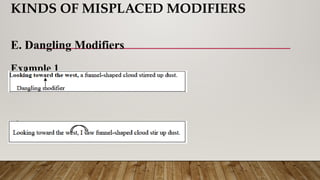
KINDS OF MISPLACEDMODIFIERS
E. Dangling Modifiers
• How to correct Dangling Modifiers?
Correction Method 1:
• Leave the modifier as it is
• Change the main part of the sentence so that it begins with the term actually modified
• This change will put the modifier next to the term it modifies
Correction Method 2:
• Change the dangling modifier phrase to a subordinate clause, creating a subject and verb
• Leave the rest of the sentence as it is
ARTICLES
• What areArticles?
• The words a or an, and the are called articles. Articles come
before nouns.
• Types of Articles:
1. Indefinite Articles
2. Definite Articles
70.
The article aor an is called the indefinite article because it doesn’t state which person or thing we are
talking about.
• For example, a doctor means any doctor
• A child means any child
The article the is called the definite article because it points out a particular person or thing.
Compare:
• You must consult the doctor. (Which doctor? It could be your family doctor.)
• You must consult a doctor. (Which doctor? It could be any doctor. Here the speaker does not have a
particular doctor in mind.)
71.
The indefinite article(a/an) is used before singular countable nouns. It cannot be used before plural nouns.
• We can say an apple or a tree, but not an apples or a trees
The definite article (the) can be used before singular countable nouns, plural countable nouns and
uncountable nouns.
• We can say, the book, the books, the rice or the milk
A or an
The choice between a and an is determined by sound and not spelling.
• A is used before words beginning with a consonant sound. Examples are: a boy, a tree, a ball, a flower, a horse,
a hole, a European and a university.
• An is used before words beginning with a vowel sound. Examples are: an elephant, an egg, an orange, an
umbrella, an hour, an heir etc.
PREPOSITIONS
•What is aPreposition?
•A preposition is a word used to link nouns, pronouns, or
phrases to other words within a sentence.They act to
connect the people, objects, time and locations of a sentence.
Prepositions are usually short words, and they are normally
placed directly in front of nouns. In some cases, you’ll find
prepositions in front of gerund verbs.
• What areConjunctions?
• Conjunctions are words that link other words, phrases, or clauses
together.
• Examples:
• Incorrect: I work quickly and am careful.
• Correct: I work quickly and carefully.
• I like cooking and eating, but I don’t like washing dishes afterward
• Sophie is clearly exhausted, yet she insists on dancing till dawn
78.
Conjunctions allow youto form complex, elegant sentences and avoid
the choppiness of multiple short sentences. Make sure that the
phrases joined by conjunctions are parallel.
• Types of Conjunctions?
1. Coordinating Conjunctions
2. Correlative Conjunctions
3. Subordinating Conjunctions
79.
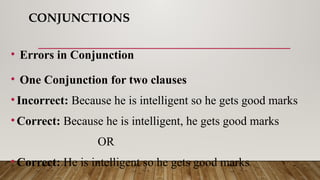
CONJUNCTIONS
• Errors inConjunction
• One Conjunction for two clauses
•Incorrect: Because he is intelligent so he gets good marks
•Correct: Because he is intelligent, he gets good marks
OR
•Correct: He is intelligent so he gets good marks
80.
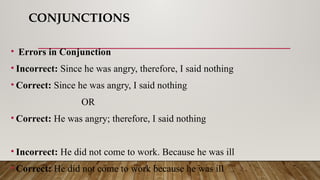
CONJUNCTIONS
• Errors inConjunction
• Incorrect: Since he was angry, therefore, I said nothing
• Correct: Since he was angry, I said nothing
OR
• Correct: He was angry; therefore, I said nothing
• Incorrect: He did not come to work. Because he was ill
• Correct: He did not come to work because he was ill
81.
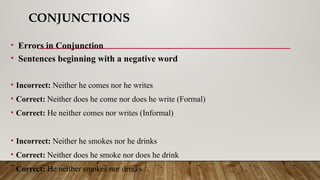
CONJUNCTIONS
• Errors inConjunction
• Sentences beginning with a negative word
• Incorrect: Neither he comes nor he writes
• Correct: Neither does he come nor does he write (Formal)
• Correct: He neither comes nor writes (Informal)
• Incorrect: Neither he smokes nor he drinks
• Correct: Neither does he smoke nor does he drink
• Correct: He neither smokes nor drinks
82.
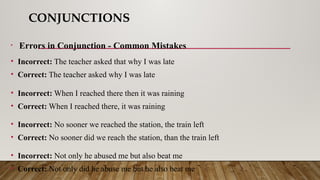
CONJUNCTIONS
• Errors inConjunction - Common Mistakes
• Incorrect: The teacher asked that why I was late
• Correct: The teacher asked why I was late
• Incorrect: When I reached there then it was raining
• Correct: When I reached there, it was raining
• Incorrect: No sooner we reached the station, the train left
• Correct: No sooner did we reach the station, than the train left
• Incorrect: Not only he abused me but also beat me
• Correct: Not only did he abuse me but he also beat me
83.
CONJUNCTIONS
• Errors inConjunction - Common Mistakes
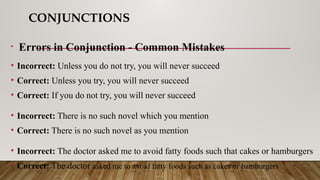
• Incorrect: Unless you do not try, you will never succeed
• Correct: Unless you try, you will never succeed
• Correct: If you do not try, you will never succeed
• Incorrect: There is no such novel which you mention
• Correct: There is no such novel as you mention
• Incorrect: The doctor asked me to avoid fatty foods such that cakes or hamburgers
• Correct: The doctor asked me to avoid fatty foods such as cakes or hamburgers
WORD ORDER
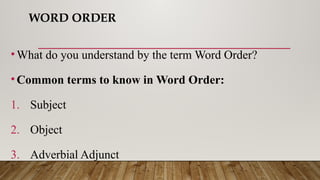
•What doyou understand by the term Word Order?
•Common terms to know in Word Order:
1. Subject
2. Object
3. Adverbial Adjunct
87.
For Simple Sentences:
•Identify the subject.
• Identify the action. (verb)
• Identify the object.
• Make the sentence and see if it makes proper sense.
For Complex Sentences:
• Identify the subject.
• Identify the action.
• Identify the object.
• Identify adverbial adjunct
IDIOMS
An idiom isa special phrase (a group of words) whose total meaning
is different from the meaning of individual words in the phrase.
A few common Idioms – Guess their meanings
1. The best of both worlds
2. Speak of the devil
3. See eye to eye
4. Once in a blue moon
5. When pigs fly
91.
IDIOMS
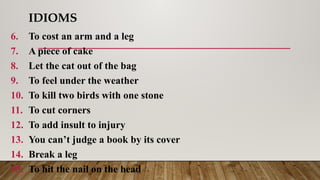
6. To costan arm and a leg
7. A piece of cake
8. Let the cat out of the bag
9. To feel under the weather
10. To kill two birds with one stone
11. To cut corners
12. To add insult to injury
13. You can’t judge a book by its cover
14. Break a leg
15. To hit the nail on the head
92.
PHRASES
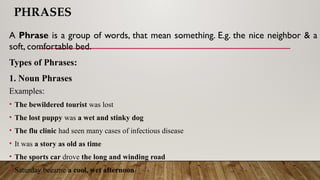
A Phrase isa group of words, that mean something. E.g. the nice neighbor & a
soft, comfortable bed.
Types of Phrases:
1. Noun Phrases
Examples:
• The bewildered tourist was lost
• The lost puppy was a wet and stinky dog
• The flu clinic had seen many cases of infectious disease
• It was a story as old as time
• The sports car drove the long and winding road
• Saturday became a cool, wet afternoon
93.
PHRASES – TYPES
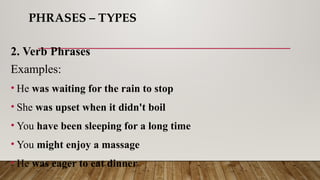
2.Verb Phrases
Examples:
• He was waiting for the rain to stop
• She was upset when it didn't boil
• You have been sleeping for a long time
• You might enjoy a massage
• He was eager to eat dinner
94.
PHRASES – TYPES
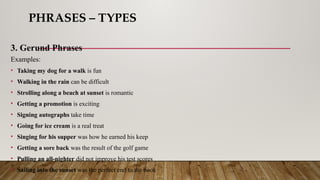
3.Gerund Phrases
Examples:
• Taking my dog for a walk is fun
• Walking in the rain can be difficult
• Strolling along a beach at sunset is romantic
• Getting a promotion is exciting
• Signing autographs take time
• Going for ice cream is a real treat
• Singing for his supper was how he earned his keep
• Getting a sore back was the result of the golf game
• Pulling an all-nighter did not improve his test scores
• Sailing into the sunset was the perfect end to the book
95.
PHRASES – TYPES
4.Infinitive Phrases
Examples:
• To make lemonade, you have to start with lemons
• I tried to see the stage, but I was too short
• She organized a boycott to make a statement
• To see Niagara Falls is mind-boggling
• He really needs to get his priorities in order
• The company decided to reduce hours for everyone
• To donate time or money is an honourable thing
• I went to Spain to study language and culture
96.
PHRASES – TYPES
5.Appositive Phrases
Examples:
• My favourite pastime, needlepoint, surprises some people
• Her horse, an Arabian, was her pride and joy
• My wife, the love of my life, is also my best friend
• A cheetah, the fastest land animal, can run 70 miles an hour
• My idea, a recycling bin for the office, was accepted by the boss
• The Florida panther, the state animal of Florida, is an endangered species
97.
PHRASES – TYPES
6.Participial Phrases
Examples:
• Washed with my clothes, my cell phone no longer worked
• Knowing what I know now, I wish I had never come here
• I am really excited, considering all the people that will be there
• We are looking forward to the movie, having seen the trailer last week
• Grinning from ear to ear, she accepted her award
• The happy dog ran the entire length of the park, pausing only to sniff the dandelions
• Painted a brilliant white, the small room appeared bigger
• The lake, frozen over all winter, was finally thawing
98.
PHRASES – TYPES
7.Prepositional Phrases
Examples:
• The book was on the table
• We camped by the brook
• He knew it was over the rainbow
• She was lost in the dark of night
• He was between a rock and a hard place
• I waited for a while
• She smelled of strawberries and cream
• He won the challenge against all odds
99.
PHRASES – TYPES
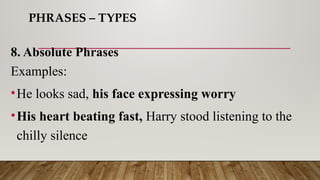
8.Absolute Phrases
Examples:
•He looks sad, his face expressing worry
•His heart beating fast, Harry stood listening to the
chilly silence
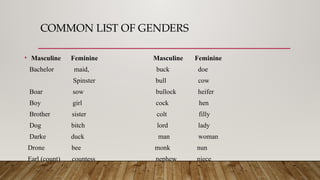
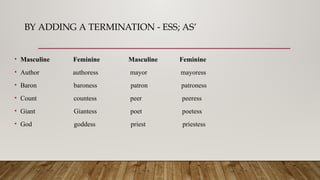
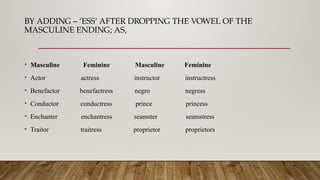
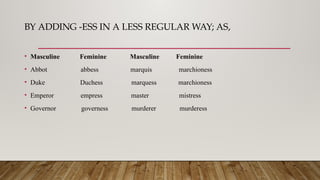
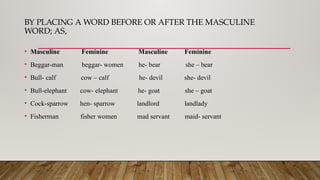
COMMON LIST OFGENDERS
• Masculine Feminine Masculine Feminine
Bachelor maid, buck doe
Spinster bull cow
Boar sow bullock heifer
Boy girl cock hen
Brother sister colt filly
Dog bitch lord lady
Darke duck man woman
Drone bee monk nun
Earl (count) countess nephew niece
SINGULAR & PLURAL
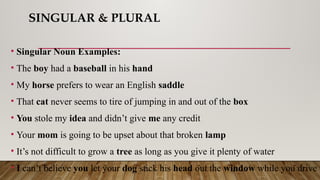
•Singular Noun Examples:
• The boy had a baseball in his hand
• My horse prefers to wear an English saddle
• That cat never seems to tire of jumping in and out of the box
• You stole my idea and didn’t give me any credit
• Your mom is going to be upset about that broken lamp
• It’s not difficult to grow a tree as long as you give it plenty of water
• I can’t believe you let your dog stick his head out the window while you drive
112.
SINGULAR & PLURAL
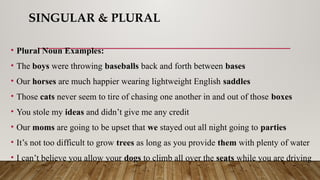
•Plural Noun Examples:
• The boys were throwing baseballs back and forth between bases
• Our horses are much happier wearing lightweight English saddles
• Those cats never seem to tire of chasing one another in and out of those boxes
• You stole my ideas and didn’t give me any credit
• Our moms are going to be upset that we stayed out all night going to parties
• It’s not too difficult to grow trees as long as you provide them with plenty of water
• I can’t believe you allow your dogs to climb all over the seats while you are driving