CLASSIFICATION 
WRITING 
Steps Chap 4
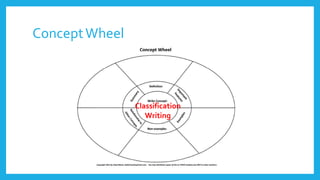
Concept Wheel 
Classification 
Writing
Definition 
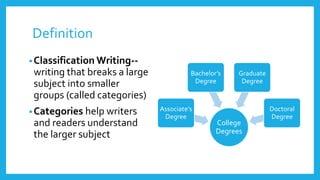
•Classification Writing-- 
writing that breaks a large 
subject into smaller 
groups (called categories) 
•Categories help writers 
and readers understand 
the larger subject 
Bachelor’s 
Degree 
College 
Degrees 
Associate’s 
Degree 
Graduate 
Degree 
Doctoral 
Degree
Important Features 
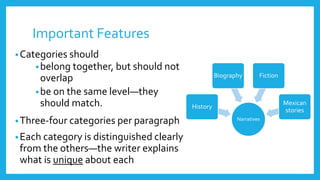
•Categories should 
•belong together, but should not 
overlap 
•be on the same level—they 
should match. 
•Three-four categories per paragraph 
•Each category is distinguished clearly 
from the others—the writer explains 
what is unique about each 
Narratives 
History 
Biography Fiction 
Mexican 
stories
Important Features 
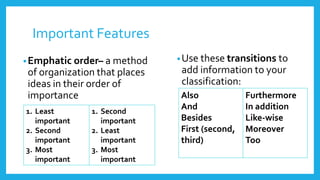
•Emphatic order– a method 
of organization that places 
ideas in their order of 
importance 
•Use these transitions to 
add information to your 
classification: 
1. Least 
important 
2. Second 
important 
3. Most 
important 
1. Second 
important 
2. Least 
important 
3. Most 
important 
Also 
And 
Besides 
First (second, 
third) 
Furthermore 
In addition 
Like-wise 
Moreover 
Too
Examples 
•Biological taxonomy—grouping plants and animals into 
species, genus, and family to understand them 
•Book/movie genres—grouping books/movies according 
to content
Relationship to Other Concepts 
Academic Research 
•How can I group my sources so I can find what I need? 
Critical Reading 
•What ideas in an essay/story seem to go together? 
•What point is the author making by grouping these 
ideas?
Summary 
In two-three sentences, briefly describe what 
classification writing is.

Classification Writing

  • 1.
  • 2.
  • 3.
    Definition •Classification Writing-- writing that breaks a large subject into smaller groups (called categories) •Categories help writers and readers understand the larger subject Bachelor’s Degree College Degrees Associate’s Degree Graduate Degree Doctoral Degree
  • 4.
    Important Features •Categoriesshould •belong together, but should not overlap •be on the same level—they should match. •Three-four categories per paragraph •Each category is distinguished clearly from the others—the writer explains what is unique about each Narratives History Biography Fiction Mexican stories
  • 5.
    Important Features •Emphaticorder– a method of organization that places ideas in their order of importance •Use these transitions to add information to your classification: 1. Least important 2. Second important 3. Most important 1. Second important 2. Least important 3. Most important Also And Besides First (second, third) Furthermore In addition Like-wise Moreover Too
  • 6.
    Examples •Biological taxonomy—groupingplants and animals into species, genus, and family to understand them •Book/movie genres—grouping books/movies according to content
  • 7.
    Relationship to OtherConcepts Academic Research •How can I group my sources so I can find what I need? Critical Reading •What ideas in an essay/story seem to go together? •What point is the author making by grouping these ideas?
  • 8.
    Summary In two-threesentences, briefly describe what classification writing is.

Editor's Notes

  • #5 Large Cities overlaps the other categories. Ex. Seattle belongs in both Large Cities and Northwest. Large Cities is not on the same level as the regions I have used as my other categories. Including only three categories (I will remove Large Cities) allows me to go into depth about each category. I can use plenty of specific evidence to explain each category. I will distinguish each category by explaining its unique features.