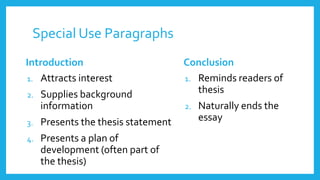
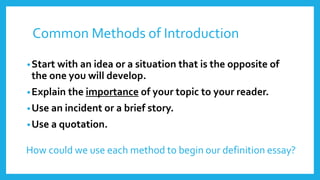
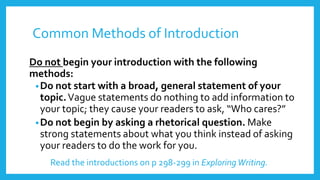
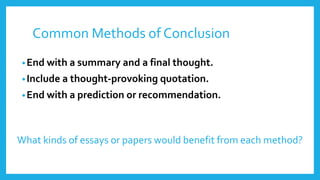
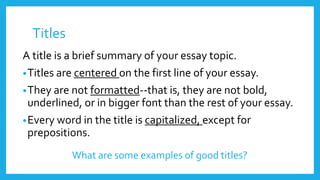
This document discusses introductions and conclusions for college writing. It provides guidance on crafting effective introductions, including attracting interest, providing background information, and presenting the thesis statement. It also discusses common methods for introductions, such as starting with an opposing idea, explaining importance, using a story, or quotation. The document cautions against broad general statements or rhetorical questions to open introductions. For conclusions, it recommends ending with a summary and final thought, thought-provoking quotation, or prediction. The document also provides guidance on writing effective titles for essays.


![Basic Guide To Writing An Essay[1]](https://cdn.slidesharecdn.com/ss_thumbnails/basic-guide-to-writing-an-essay1-1212725667553489-9-thumbnail.jpg?width=640&height=640&fit=bounds)


![Basic guide to writing an essay[1]](https://cdn.slidesharecdn.com/ss_thumbnails/basicguidetowritinganessay1-140419125900-phpapp02-thumbnail.jpg?width=640&height=640&fit=bounds)

![Basic Guide to Writing an Essay[1].ppt](https://cdn.slidesharecdn.com/ss_thumbnails/basicguidetowritinganessay1-221020190535-a2b7662f-thumbnail.jpg?width=640&height=640&fit=bounds)
![Basic Guide to Writing an Essay[1].ppt](https://cdn.slidesharecdn.com/ss_thumbnails/basicguidetowritinganessay1-230517134745-9b22983b-thumbnail.jpg?width=640&height=640&fit=bounds)
![Basic Guide to Writing an Essay[1].ppt](https://cdn.slidesharecdn.com/ss_thumbnails/basicguidetowritinganessay1-230615205149-c20f44ab-thumbnail.jpg?width=640&height=640&fit=bounds)
![Basic Guide to Writing an Essay[1].ppt](https://cdn.slidesharecdn.com/ss_thumbnails/basicguidetowritinganessay1-230827023234-cbb17291-thumbnail.jpg?width=640&height=640&fit=bounds)
![Basic Guide to Writing an Essay[1].ppt](https://cdn.slidesharecdn.com/ss_thumbnails/basicguidetowritinganessay1-230421091024-aa169f94-thumbnail.jpg?width=640&height=640&fit=bounds)


![Basic guide to writing an essay[1]](https://cdn.slidesharecdn.com/ss_thumbnails/basicguidetowritinganessay1-150610212749-lva1-app6891-thumbnail.jpg?width=640&height=640&fit=bounds)
![Basic guide to writing an essay[1]](https://cdn.slidesharecdn.com/ss_thumbnails/basicguidetowritinganessay1-151215085422-thumbnail.jpg?width=640&height=640&fit=bounds)
![Basic guide to writing an essay[1]](https://cdn.slidesharecdn.com/ss_thumbnails/basicguidetowritinganessay1-101115203213-phpapp01-thumbnail.jpg?width=640&height=640&fit=bounds)


