Present, Past and
 Future Tenses
    Tense means time
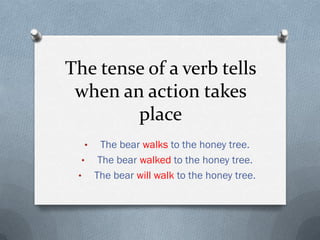
The tense of a verb tells
 when an action takes
        place
  •  The bear walks to the honey tree.
  • The bear walked to the honey tree.
 • The bear will walk to the honey tree.
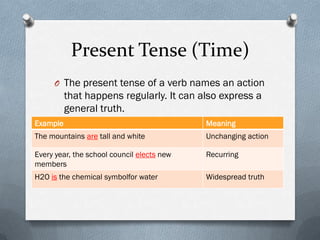
Present Tense (Time)
     O The present tense of a verb names an action
          that happens regularly. It can also express a
          general truth.
Example                                     Meaning
The mountains are tall and white            Unchanging action

Every year, the school council elects new   Recurring
members
H2O is the chemical symbolfor water         Widespread truth
The present tense of the verb is
  the base form of the verb.
 When the subject is a singular noun or he,
  she, or it, you usually add „s‟ to the verb.
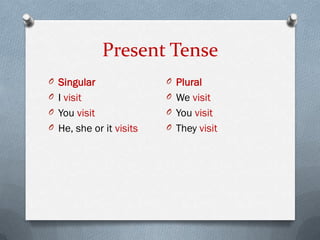
Present Tense
O Singular               O Plural
O I visit                O We visit
O You visit              O You visit
O He, she or it visits   O They visit
The verb ‘be’
The present tense of the verb „be‟ differs from
the base form :
am, are, is,

I am. You are. She is.
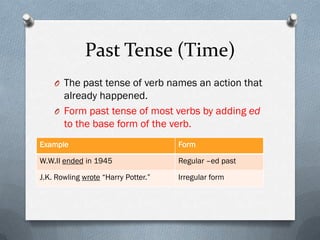
Past Tense (Time)
    O The past tense of verb names an action that
      already happened.
    O Form past tense of most verbs by adding ed
      to the base form of the verb.
Example                              Form

W.W.II ended in 1945                 Regular –ed past

J.K. Rowling wrote “Harry Potter.”   Irregular form
Future Tense (Time)
O The future tense of a verb names an action
  that will take place in the future.
O This tense is formed by using will/shall with
  the simple form of the verb.
O Example: The speaker of the Parliament will
  finish her term in May of 2013
The future tense can also be
expressed by using am, is or
     are with going to.
O Example: The surgeon is going to perform
  the first bypass in Canada.
We can also use the present
 tense form with an adverb or
adverbial phrase to show future
             time.
 O The president speaks tomorrow. (Tomorrow
   is a future time adverb).

Present, past and future tenses

  • 1.
    Present, Past and Future Tenses Tense means time
  • 2.
    The tense ofa verb tells when an action takes place • The bear walks to the honey tree. • The bear walked to the honey tree. • The bear will walk to the honey tree.
  • 3.
    Present Tense (Time) O The present tense of a verb names an action that happens regularly. It can also express a general truth. Example Meaning The mountains are tall and white Unchanging action Every year, the school council elects new Recurring members H2O is the chemical symbolfor water Widespread truth
  • 4.
    The present tenseof the verb is the base form of the verb. When the subject is a singular noun or he, she, or it, you usually add „s‟ to the verb.
  • 5.
    Present Tense O Singular O Plural O I visit O We visit O You visit O You visit O He, she or it visits O They visit
  • 6.
    The verb ‘be’ Thepresent tense of the verb „be‟ differs from the base form : am, are, is, I am. You are. She is.
  • 7.
    Past Tense (Time) O The past tense of verb names an action that already happened. O Form past tense of most verbs by adding ed to the base form of the verb. Example Form W.W.II ended in 1945 Regular –ed past J.K. Rowling wrote “Harry Potter.” Irregular form
  • 8.
    Future Tense (Time) OThe future tense of a verb names an action that will take place in the future. O This tense is formed by using will/shall with the simple form of the verb. O Example: The speaker of the Parliament will finish her term in May of 2013
  • 9.
    The future tensecan also be expressed by using am, is or are with going to. O Example: The surgeon is going to perform the first bypass in Canada.
  • 10.
    We can alsouse the present tense form with an adverb or adverbial phrase to show future time. O The president speaks tomorrow. (Tomorrow is a future time adverb).