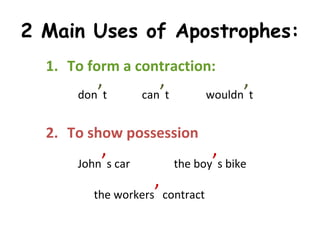
2 Main Uses of Apostrophes: To form a contraction: don ’ t can ’ t wouldn ’ t To show possession John ’ s car  the boy ’ s bike the workers ’  contract
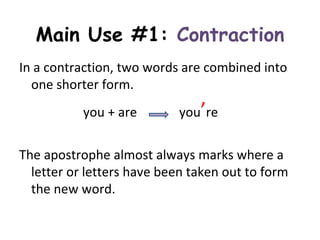
Main Use #1:  Contraction In a contraction, two words are combined into one shorter form.  you + are you ’ re The apostrophe almost always marks where a letter or letters have been taken out to form the new word.
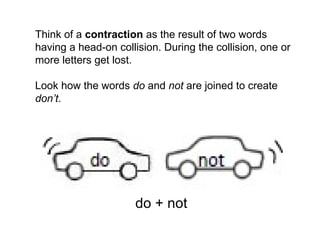
Think of a  contraction  as the result of two words having a head-on collision. During the collision, one or more letters get lost. Look how the words  do  and  not  are joined to create  don’t . do + not
When the words collide, the  o  is ejected. donot
The apostrophe goes to mark where the letter  o  has been don ’ t
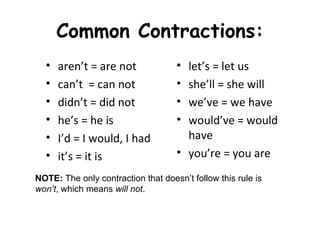
Common Contractions: aren’t = are not can’t  = can not didn’t = did not he’s = he is I’d = I would, I had it’s = it is let’s = let us she’ll = she will we’ve = we have would’ve = would have you’re = you are NOTE:  The only contraction that doesn’t follow this rule is  won’t , which means  will not .
Main Use #2:  Possession Possessives  are words used to show ownership or belonging. Like contractions, they’re also formed with the apostrophe.  Example:  Professor  Walker’s  laptop the laptop  belongs  to Professor Walker Professor Walker  owns   the laptop.
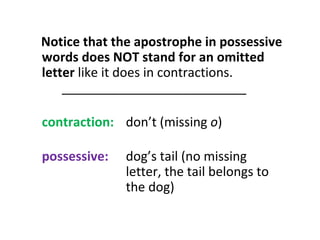
Notice that the apostrophe in possessive words does NOT stand for an omitted letter  like it does in contractions.  __________________________ contraction:  don’t (missing  o ) possessive:  dog’s tail (no missing   letter, the tail belongs to the dog)
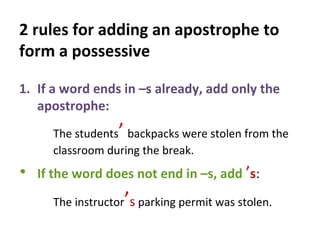
2 rules for adding an apostrophe to form a possessive If a word ends in –s already, add only the apostrophe: The students ’   backpacks were stolen from the classroom during the break. If the word does not end in –s, add  ’ s : The instructor ’ s  parking permit was stolen.
ALERT: Some words are possessive without the apostrophe. These words are the  possessive pronouns : my, mine its  his  her, hers  your, yours  our, ours  their, theirs  whose Tip: Be careful not to confuse  it’s  and  its .  it’s = it is
3 Other Uses for the Apostrophe 1) Used to indicate numbers that have been omitted.   1995  ‘ 95 2) Used to show missing letters in slang or informal speech   going    goin ’ 3) Can be used  to form the plural of some numbers or letters to prevent misreading.       A ’ s  0 ’ s (plural of zero)  1950s ( NO apostrophe )
Test Your Understanding by Completing the Directed Learning Activity TIP : You may want to refer to this PowerPoint again while you’re completing the activity.

Apostrophe

  • 1.
  • 2.
    2 Main Usesof Apostrophes: To form a contraction: don ’ t can ’ t wouldn ’ t To show possession John ’ s car the boy ’ s bike the workers ’ contract
  • 3.
    Main Use #1: Contraction In a contraction, two words are combined into one shorter form. you + are you ’ re The apostrophe almost always marks where a letter or letters have been taken out to form the new word.
  • 4.
    Think of a contraction as the result of two words having a head-on collision. During the collision, one or more letters get lost. Look how the words do and not are joined to create don’t . do + not
  • 5.
    When the wordscollide, the o is ejected. donot
  • 6.
    The apostrophe goesto mark where the letter o has been don ’ t
  • 7.
    Common Contractions: aren’t= are not can’t = can not didn’t = did not he’s = he is I’d = I would, I had it’s = it is let’s = let us she’ll = she will we’ve = we have would’ve = would have you’re = you are NOTE: The only contraction that doesn’t follow this rule is won’t , which means will not .
  • 8.
    Main Use #2: Possession Possessives are words used to show ownership or belonging. Like contractions, they’re also formed with the apostrophe. Example: Professor Walker’s laptop the laptop belongs to Professor Walker Professor Walker owns the laptop.
  • 9.
    Notice that theapostrophe in possessive words does NOT stand for an omitted letter like it does in contractions. __________________________ contraction: don’t (missing o ) possessive: dog’s tail (no missing letter, the tail belongs to the dog)
  • 10.
    2 rules foradding an apostrophe to form a possessive If a word ends in –s already, add only the apostrophe: The students ’ backpacks were stolen from the classroom during the break. If the word does not end in –s, add ’ s : The instructor ’ s parking permit was stolen.
  • 11.
    ALERT: Some wordsare possessive without the apostrophe. These words are the possessive pronouns : my, mine its his her, hers your, yours our, ours their, theirs whose Tip: Be careful not to confuse it’s and its . it’s = it is
  • 12.
    3 Other Usesfor the Apostrophe 1) Used to indicate numbers that have been omitted. 1995 ‘ 95 2) Used to show missing letters in slang or informal speech going goin ’ 3) Can be used to form the plural of some numbers or letters to prevent misreading.   A ’ s 0 ’ s (plural of zero) 1950s ( NO apostrophe )
  • 13.
    Test Your Understandingby Completing the Directed Learning Activity TIP : You may want to refer to this PowerPoint again while you’re completing the activity.