SUBACUTE SCLEROSING
PANENCEPHALITIS
Ade Wijaya, MD – August
2019
DEFINITION
Progressive and fatal neurodegenerative encephalitis caused by the
persistence of
the measles virus in the central nervous system (CNS)
Mekki M, Eley B, Hardie D, Wilmshurst JM. Subacute sclerosing panencephalitis: clinical phenotype, epidemiology, and preventive interventions. Developmental Medicine & Child Neurology. 2019
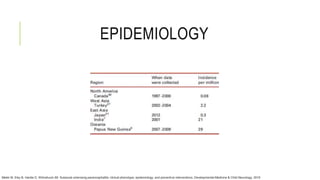
EPIDEMIOLOGY
Mekki M, Eley B, Hardie D, Wilmshurst JM. Subacute sclerosing panencephalitis: clinical phenotype, epidemiology, and preventive interventions. Developmental Medicine & Child Neurology. 2019
RISK FACTORS
Measles contracted under 5 years of age has highest risk of
developing subacute sclerosing panencephalitis (SSPE)
Children with, or exposed to, human immunodeficiency virus
infection, who contract measles may be at increased risk of SSPE
Mekki M, Eley B, Hardie D, Wilmshurst JM. Subacute sclerosing panencephalitis: clinical phenotype, epidemiology, and preventive interventions. Developmental Medicine & Child Neurology. 2019
PATHOPHYSIOLOGY
 Mutations that alter viral envelope glycoproteins, in particular the F
protein, are
responsible for neurovirulence
 Measles virus is believed to enter the brain during the primary
infection
 By remaining in cells, the virus evades the host’s immune response
 Strong antiviral immune responses in the host are evidenced by
high levels of specific antibody in blood and cerebrospinal fluid
Griffin DE. Measles virus and the nervous system. Handb Clin Neurol 2014; 123: 577–90.
Sato Y, Watanabe S, Fukuda Y, Hashiguchi T, Yanagi Y, Ohno S. Cell-to-cell measles virus spread between human neurons is dependent on hemagglutinin and hyperfusogenic fusion protein. J Virol 2018; 92: e02166–17.
Watanabe S, Ohno S, Shirogane Y, Suzuki SO, Koga R, Yanagi Y. Measles virus mutants possessing the fusion protein with enhanced fusion activity spread effectively in neuronal cells, but not in other cells, without causing strong cytopathology. J Virol 2015; 89:
2710–17.
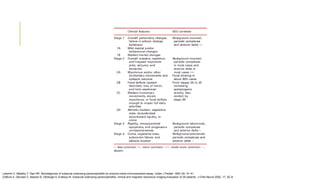
CLINICAL COURSE
SSPE typically begins with behavioural and intellectual disability followed by paroxysmal
movements, myoclonic jerks, and/or negative myoclonia (head drops)
Periodic myoclonus often leads to difficulty in walking and repeated falls
The myoclonic jerks are generalized and involve the head, trunk, and limbs, they do not
interfere with consciousness, and are exacerbated by the state of excitement
Clinical manifestations occur, on average, 6 years after measles virus infection and
progressive neurological deterioration with death generally occuring within 4 years (range
45d–12y)
Other complications, reported in case reports and series, include ophthalmological
abnormalities (optic atrophy) and pyramidal signs
Mekki M, Eley B, Hardie D, Wilmshurst JM. Subacute sclerosing panencephalitis: clinical phenotype, epidemiology, and preventive interventions. Developmental Medicine & Child Neurology. 2019
Lakshmi V, Malathy Y, Rao RR. Serodiagnosis of subacute sclerosing panencephalitis by enzyme linked immunosorbent assay. Indian J Pediatr 1993; 60: 37–41.
Ozt€urk A, G€urses C, Baykan B, G€okyigit A, Eraksoy M. Subacute sclerosing panencephalitis: clinical and magnetic resonance imaging evaluation of 36 patients. J Child Neurol 2002; 17: 25–9.
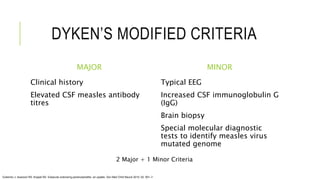
DYKEN’S MODIFIED CRITERIA
MAJOR
Clinical history
Elevated CSF measles antibody
titres
MINOR
Typical EEG
Increased CSF immunoglobulin G
(IgG)
Brain biopsy
Special molecular diagnostic
tests to identify measles virus
mutated genome
2 Major + 1 Minor Criteria
Gutierrez J, Issacson RS, Koppel BS. Subacute sclerosing panencephalitis: an update. Dev Med Child Neurol 2010; 52: 901–7.
EEG
Mekki M, Eley B, Hardie D, Wilmshurst JM. Subacute sclerosing panencephalitis: clinical phenotype, epidemiology, and preventive interventions. Developmental Medicine & Child Neurology. 2019
MANAGEMENT
• A life-threatening disease with no cure
• Generally, death occurs within 4 years
• Isoprinosine monotherapy and isoprinosine plus ribavirin were the
standard treatments, but also intravenous immunoglobulin therapy,
intrathecal a-interferon (a-IFN), and amantadine therapy
Mekki M, Eley B, Hardie D, Wilmshurst JM. Subacute sclerosing panencephalitis: clinical phenotype, epidemiology, and preventive interventions. Developmental Medicine & Child Neurology. 2019
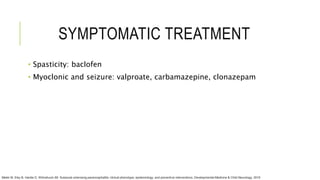
SYMPTOMATIC TREATMENT
• Spasticity: baclofen
• Myoclonic and seizure: valproate, carbamazepine, clonazepam
Mekki M, Eley B, Hardie D, Wilmshurst JM. Subacute sclerosing panencephalitis: clinical phenotype, epidemiology, and preventive interventions. Developmental Medicine & Child Neurology. 2019
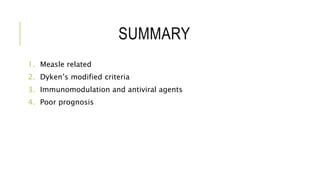
SUMMARY
1. Measle related
2. Dyken’s modified criteria
3. Immunomodulation and antiviral agents
4. Poor prognosis
Subacute Sclerosing Panencephalitis

Subacute Sclerosing Panencephalitis

  • 1.
  • 2.
    DEFINITION Progressive and fatalneurodegenerative encephalitis caused by the persistence of the measles virus in the central nervous system (CNS) Mekki M, Eley B, Hardie D, Wilmshurst JM. Subacute sclerosing panencephalitis: clinical phenotype, epidemiology, and preventive interventions. Developmental Medicine & Child Neurology. 2019
  • 3.
    EPIDEMIOLOGY Mekki M, EleyB, Hardie D, Wilmshurst JM. Subacute sclerosing panencephalitis: clinical phenotype, epidemiology, and preventive interventions. Developmental Medicine & Child Neurology. 2019
  • 4.
    RISK FACTORS Measles contractedunder 5 years of age has highest risk of developing subacute sclerosing panencephalitis (SSPE) Children with, or exposed to, human immunodeficiency virus infection, who contract measles may be at increased risk of SSPE Mekki M, Eley B, Hardie D, Wilmshurst JM. Subacute sclerosing panencephalitis: clinical phenotype, epidemiology, and preventive interventions. Developmental Medicine & Child Neurology. 2019
  • 5.
    PATHOPHYSIOLOGY  Mutations thatalter viral envelope glycoproteins, in particular the F protein, are responsible for neurovirulence  Measles virus is believed to enter the brain during the primary infection  By remaining in cells, the virus evades the host’s immune response  Strong antiviral immune responses in the host are evidenced by high levels of specific antibody in blood and cerebrospinal fluid Griffin DE. Measles virus and the nervous system. Handb Clin Neurol 2014; 123: 577–90. Sato Y, Watanabe S, Fukuda Y, Hashiguchi T, Yanagi Y, Ohno S. Cell-to-cell measles virus spread between human neurons is dependent on hemagglutinin and hyperfusogenic fusion protein. J Virol 2018; 92: e02166–17. Watanabe S, Ohno S, Shirogane Y, Suzuki SO, Koga R, Yanagi Y. Measles virus mutants possessing the fusion protein with enhanced fusion activity spread effectively in neuronal cells, but not in other cells, without causing strong cytopathology. J Virol 2015; 89: 2710–17.
  • 6.
    CLINICAL COURSE SSPE typicallybegins with behavioural and intellectual disability followed by paroxysmal movements, myoclonic jerks, and/or negative myoclonia (head drops) Periodic myoclonus often leads to difficulty in walking and repeated falls The myoclonic jerks are generalized and involve the head, trunk, and limbs, they do not interfere with consciousness, and are exacerbated by the state of excitement Clinical manifestations occur, on average, 6 years after measles virus infection and progressive neurological deterioration with death generally occuring within 4 years (range 45d–12y) Other complications, reported in case reports and series, include ophthalmological abnormalities (optic atrophy) and pyramidal signs Mekki M, Eley B, Hardie D, Wilmshurst JM. Subacute sclerosing panencephalitis: clinical phenotype, epidemiology, and preventive interventions. Developmental Medicine & Child Neurology. 2019
  • 7.
    Lakshmi V, MalathyY, Rao RR. Serodiagnosis of subacute sclerosing panencephalitis by enzyme linked immunosorbent assay. Indian J Pediatr 1993; 60: 37–41. Ozt€urk A, G€urses C, Baykan B, G€okyigit A, Eraksoy M. Subacute sclerosing panencephalitis: clinical and magnetic resonance imaging evaluation of 36 patients. J Child Neurol 2002; 17: 25–9.
  • 8.
    DYKEN’S MODIFIED CRITERIA MAJOR Clinicalhistory Elevated CSF measles antibody titres MINOR Typical EEG Increased CSF immunoglobulin G (IgG) Brain biopsy Special molecular diagnostic tests to identify measles virus mutated genome 2 Major + 1 Minor Criteria Gutierrez J, Issacson RS, Koppel BS. Subacute sclerosing panencephalitis: an update. Dev Med Child Neurol 2010; 52: 901–7.
  • 9.
    EEG Mekki M, EleyB, Hardie D, Wilmshurst JM. Subacute sclerosing panencephalitis: clinical phenotype, epidemiology, and preventive interventions. Developmental Medicine & Child Neurology. 2019
  • 10.
    MANAGEMENT • A life-threateningdisease with no cure • Generally, death occurs within 4 years • Isoprinosine monotherapy and isoprinosine plus ribavirin were the standard treatments, but also intravenous immunoglobulin therapy, intrathecal a-interferon (a-IFN), and amantadine therapy Mekki M, Eley B, Hardie D, Wilmshurst JM. Subacute sclerosing panencephalitis: clinical phenotype, epidemiology, and preventive interventions. Developmental Medicine & Child Neurology. 2019
  • 11.
    SYMPTOMATIC TREATMENT • Spasticity:baclofen • Myoclonic and seizure: valproate, carbamazepine, clonazepam Mekki M, Eley B, Hardie D, Wilmshurst JM. Subacute sclerosing panencephalitis: clinical phenotype, epidemiology, and preventive interventions. Developmental Medicine & Child Neurology. 2019
  • 12.
    SUMMARY 1. Measle related 2.Dyken’s modified criteria 3. Immunomodulation and antiviral agents 4. Poor prognosis