ENCEPHALITIS
INTRODUCTION
 Encephalitis is an acute inflammation of
the
parenchyma of brain
 Meningoencephalitis –consistent with
inflammation of the meninges and brain
parenchyma.
 Encephalomyelitis –inflammation of the
brain parenchyma and spinal cord.
EPIDEMIOLOGY
 A rare disease occurring in approximately
0.5 per 100,000 individuals
 Most common in children, elderly, and
people with weakened immune systems
(HIV/AIDS or cancer).
 The incidence is highest among infants <1
year. In a study based on data from the Pediatric Health
Information System database that included >7000 pediatric
admissions for encephalitis during the years 2004 to 2013
CAUSES
 The exact cause of encephalitis is
unknown.
 Usually caused by a virus or sometimes even a bacterial
infestation as well as non infectious inflammatory
conditions may cause encephalitis .
 Few viruses that may be instrumental in causing:
 Herpes simplex (HSV)
 Polio viruses
 Mosquito Tick – borne viruses (arboviruses)
 EBV
 childhood viruses(echovirus, coxsackievirus A and
B, influenza, varicella zoster, cytomegalovirus, human
herpesvirus 6)
PATHOLOGY
 Virus enters blood & reaches the parenchyma of
brain, cortex, white matter, basal ganglia &
brainstem.
 Virus’s can cause postinfectious encephalitis by
provoking an autoimmune response, leading to
acute disseminated encephalomyelitis (ADEM)
 There is neuronal degeneration & diffuse glial
proliferation often associated with cerebral
edema & increased ICP
TYPES OF ENCEPHALITIS
• Infectious encephalitis
• Autoimmune encephalitis
• Chronic encephalitis
• Limbic encephalitis
• HIV encephalitis
• Encephalitis Lethargica
INFECTIOUS ENCEPHALITIS
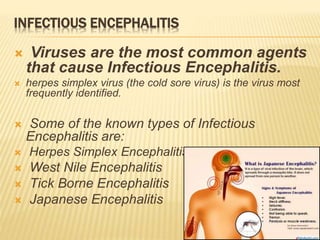
 Viruses are the most common agents
that cause Infectious Encephalitis.
 herpes simplex virus (the cold sore virus) is the virus most
frequently identified.
 Some of the known types of Infectious
Encephalitis are:
 Herpes Simplex Encephalitis
 West Nile Encephalitis
 Tick Borne Encephalitis
 Japanese Encephalitis
AUTOIMMUNE ENCEPHALITIS
 Autoimmune Encephalitis may be triggered by
infection "Post-infectious Encephalitis"
 Encephalitis usually follows infection (such as viruses
cause rashes in childhood) or immunizations.
 These are associate with antibodies against neuronal
cell surface proteins and synaptic receptors
 The symptoms vary according to the function of
receptors.
Typically there is a delay of days to two to three
weeks between the triggering infection and
development of the Encephalitis.
TYPE OF AUTOIMMUNE ENCEPHALITIS
 Acute Disseminated Encephalomyelitis (ADEM)
 NMDA Receptor associated Encephalitis [N-
methylD-aspartate (NMDA) ]
EEG “extreme delta brush”, Brain MRI: non specific ,CSF: pleocytosis and/or
protein in>80%, NMDAR antibodies in CSF or serum.
 Hashimoto’s Encephalopathy
Hypothyroidism 50% ,MRI often normal,EEG: slow activity ,CSF:elevated protein
 Rasmussen Encephalitis
Progressive refractory partial seizures, cognitive decline, focal deficits, and
brain hemi atrophy
MRI: progressive unilateral hemispheric atrophy
 LIMBIC ENCEPHALITIS
Hyponatremia, dystonic or myoclonic-like movements, described as
faciobrachial dystonic seizures,with EEG features of tonic seizures.
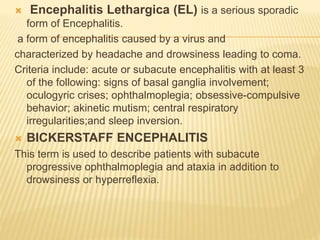
 Encephalitis Lethargica (EL) is a serious sporadic
form of Encephalitis.
a form of encephalitis caused by a virus and
characterized by headache and drowsiness leading to coma.
Criteria include: acute or subacute encephalitis with at least 3
of the following: signs of basal ganglia involvement;
oculogyric crises; ophthalmoplegia; obsessive-compulsive
behavior; akinetic mutism; central respiratory
irregularities;and sleep inversion.
 BICKERSTAFF ENCEPHALITIS
This term is used to describe patients with subacute
progressive ophthalmoplegia and ataxia in addition to
drowsiness or hyperreflexia.
SYMPTOMATOLOGY
NEONATES AND YOUNG INFANTS
 the presentation of encephalitis can be nonspecific.
 Encephalitis should be considered in a neonate or
young infant who has
 fever, seizure, poor feeding, irritability, or lethargy, a
full or bulging fontanel Decreased perfusion may
occur in infants with encephalitis and viral infection
(eg, herpes simplex virus [HSV]), crying that doesn't
stop or that seems worse when an infant is picked
upor handled in some way .
 Fever is a variable finding. Neonates who have viral
illness, especially HSV and enterovirus, are at risk for
severe central nervous system and systemic illness
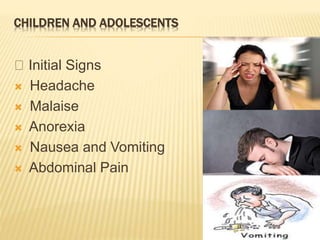
CHILDREN AND ADOLESCENTS
Initial Signs
 Headache
 Malaise
 Anorexia
 Nausea and Vomiting
 Abdominal Pain
IN MORE SEVERE CASES OF ENCEPHALITIS:
 high fever
 severe headache
 nausea and vomiting
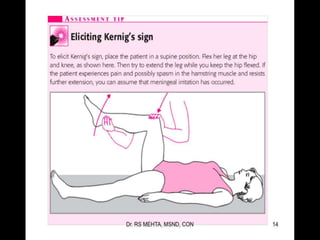
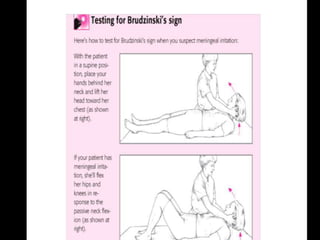
 stiff neck, photophobia
 confusion
 disorientation
 personality changes
 convulsions(seizures)
 problems with speech orhearing
 hallucinations
 memory loss
 drowsiness
 coma
POSSIBLE COMPLICATIONS
 • Permanent brain damage may occur in
severecases of encephalitis. It can affect:
 Hearing
 Memory
 Muscle control
 Sensation
 Speech
 Vision
DIAGNOSIS
 Encephalitis is largely a clinical diagnosis based on the following
criteria :
 ●Altered mental status (ie, decreased or altered level of
consciousness, lethargy, or personality change) lasting ≥24 hours
with no alternative cause identified, plus ≥2 of the following for a
"possible" diagnosis or ≥3 of the following for a "probable"
diagnosis:
 •Documented fever ≥38°C (100.4°F) within 72 hours (before or
after) presentation
 Generalized or partial seizures
 New onset focal neurologic findings
 CSF WBC count ≥5 cells/microL
 Abnormality of brain parenchyma on neuroimaging suggestive of
encephalitis that is new or appears to have acute onset
 Abnormality on EEG that is consistent with encephalitis and not
attributable to another cause
IMAGING TECHNIQUES
 For suspected encephalitis scanning technique
is often the first diagnostic step.
 (CT) or (MRI) scans can show the extent of the
inflammation in the brain and help differentiate
encephalitis from other conditions.
MRIs are recommended over CT ,can suggest
infection with herpes virus at the onset of the
disease, while CT scans cannot. 30 % of normal
initial CT ,found to have abnormalities on MRI
 (EEG), which records brainwaves, may reveal
abnormalities in the temporal lobe that are
indicative of herpes simplex encephalitis.
LABS TESTS
 • When encephalitis is suspected, LP should be
performed in all patients The sample is taken to
count white blood cells,proteins and sugar levels,
and to test for herpes simplex virus, Epstein-Barr
virus, varicella-zoster virus, enteroviruses, and to
look for the presence of antibodies to the West Nile
virus.
 CSF protein may be normal or moderately elevated (generally
<150 mg/dL).
 Glucos
 CSF pleocytosis is present in approximately 60 percent of children with
encephalitis . The CSF (WBC) count typically ranges from 0 to
500 cells/microL with a lymphocytic predominancee
 Blood tests may be used to test for West Nile virus
and other arbovirus infections.
 Blood and urine tests are used to isolate and identify
viruses.
 Enzyme-linked immunosorbent assays (ELISA),
including IgM-capture ELISA (MAC-ELISA) and IgG
ELISA, can identify viruses that cause encephalitis soon
after infection.
 Polymerase chain reaction (PCR) can identify small
amounts of viral DNA.
BRAIN BIOPSY
 Brain biopsy is rarely indicated in children
with suspected encephalitis. It can be
considered if the etiology remains uncertain
after extensive noninvasive testing in a
patient with a severe and/or progressive
disease course despite empiric therapy
TREATMENT
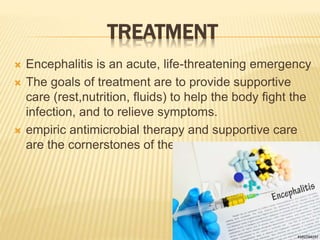
 Encephalitis is an acute, life-threatening emergency
 The goals of treatment are to provide supportive
care (rest,nutrition, fluids) to help the body fight the
infection, and to relieve symptoms.
 empiric antimicrobial therapy and supportive care
are the cornerstones of therapy
SUPPORTIVE CARE
 Initial supportive care measures include
 Cardiorespiratory status.
 Neurologic status .
 Fluid balance and electrolytes.
EMPIRIC THERAPY
 Empiric antimicrobial treatment is warranted
in children who present with suspected
encephalitis:
 Initial empiric antimicrobial coverage includes
intravenous (IV) acyclovirfor potential herpes
simplex virus (HSV) infection and empiric
antibiotics (eg, vancomycin and a third-
generation cephalosporin) for potential
bacterial central nervous system infection.
 Empiric acyclovir :
 Neonates Indications for acyclovir are
 Virologically proven HSV disease.
 Asymptomatic but at risk due to exposure (maternal
active genital lesions)
 The indications for initiation of empiric acyclovir are not
standardized.
 Infants and children beyond the neonatal period who
present with suspected encephalitis, recommended
initiation of IV acyclovir.

 Dose — The dose of acyclovir varies depending on age
 Duration — The duration of empiric acyclovir therapy depends upon
laboratory results:
 ●HSV confirmed or probable – If HSV polymerase chain reaction
(PCR) from CSF or other site is positive, acyclovir should be continued
for 21 days
 Lumbar puncture (LP) should be performed near the end of acyclovir
treatment to ensure that HSV PCR is negative; acyclovir therapy should
be continued if CSF HSV PCR remains positive.
 ●HSV PCR is negative – For patients in whom HSV PCR is negative,
the decision to continue acyclovir therapy must be individualized. If there
are strong clinical indicators of HSV encephalitis (eg, temporal spikes on
EEG or temporal lobe involvement on imaging), repeat LP may be
warranted to exclude the possibility of a false-negative result on initial
testing . Repeat LP also may be warranted in patients with severe
neurologic dysfunction even in the absence of clinical indicators of HSV,
 Empiric antibiotics — the usual practice is
to initiate empiric antibiotic therapy till
pending cultures in most patients, Antibiotics
can be discontinued after 48 hours if cultures
remain negative.
 Anti-seizure medications (such as
phenytoin) -- to prevent seizures.
 • Steroids (such as dexamethasone) -- to
reduce brain swelling (in rare cases)
 • Sedatives -- to treat irritability or
restlessness
 • Acetaminophen -- for fever and
headache.
ADJUNCTIVE THERAPIES
 Based on the available evidence, we
suggest not routinely treating children with
encephalitis with adjunctive therapies, including
glucocorticoids, plasmapheresis, intravenous immune
globulin, interferon-alpha, and therapeutic
hypothermia
 . Although observational reports have described
beneficial effects in some limited settings
 adjunctive dexamethasone for herpes simplex virus
(HSV) encephalitis , glucocorticoids are not
recommended in the routine management of children
with HSV encephalitis.
PROGNOSIS
 depending upon the age, neurologic findings at
the time of presentation, pathogen. Poor
outcome is associated with:
 ●Coma, convulsion, or focal neurologic findings
in the acute phase
 ●Young age (<5 years)
 ●Need for intensive care
 ●Herpes simplex encephalitis
 ●Diffusion restriction on magnetic resonance
imaging
 Neurologic sequelae — In self-limited cases, lethargy and coma
gradually improve over days to weeks .
 Focal deficits resolve more slowly.
 Persistent neurologic effects may include
 personality change, behavior disorder (including attention deficit
disorder).
 movement disorder (including tic disorders).
 intellectual disability
 learning disorders
 blindness, paresis, ataxia, recurrent headaches, and sleeping
problems .
 Mortality — The overall risk of death in childhood encephalitis
ranges from 0 to 7 percent
Thank You

Encephalitis

  • 1.
  • 2.
    INTRODUCTION  Encephalitis isan acute inflammation of the parenchyma of brain  Meningoencephalitis –consistent with inflammation of the meninges and brain parenchyma.  Encephalomyelitis –inflammation of the brain parenchyma and spinal cord.
  • 3.
    EPIDEMIOLOGY  A raredisease occurring in approximately 0.5 per 100,000 individuals  Most common in children, elderly, and people with weakened immune systems (HIV/AIDS or cancer).  The incidence is highest among infants <1 year. In a study based on data from the Pediatric Health Information System database that included >7000 pediatric admissions for encephalitis during the years 2004 to 2013
  • 4.
    CAUSES  The exactcause of encephalitis is unknown.  Usually caused by a virus or sometimes even a bacterial infestation as well as non infectious inflammatory conditions may cause encephalitis .  Few viruses that may be instrumental in causing:  Herpes simplex (HSV)  Polio viruses  Mosquito Tick – borne viruses (arboviruses)  EBV  childhood viruses(echovirus, coxsackievirus A and B, influenza, varicella zoster, cytomegalovirus, human herpesvirus 6)
  • 5.
    PATHOLOGY  Virus entersblood & reaches the parenchyma of brain, cortex, white matter, basal ganglia & brainstem.  Virus’s can cause postinfectious encephalitis by provoking an autoimmune response, leading to acute disseminated encephalomyelitis (ADEM)  There is neuronal degeneration & diffuse glial proliferation often associated with cerebral edema & increased ICP
  • 6.
    TYPES OF ENCEPHALITIS •Infectious encephalitis • Autoimmune encephalitis • Chronic encephalitis • Limbic encephalitis • HIV encephalitis • Encephalitis Lethargica
  • 7.
    INFECTIOUS ENCEPHALITIS  Virusesare the most common agents that cause Infectious Encephalitis.  herpes simplex virus (the cold sore virus) is the virus most frequently identified.  Some of the known types of Infectious Encephalitis are:  Herpes Simplex Encephalitis  West Nile Encephalitis  Tick Borne Encephalitis  Japanese Encephalitis
  • 8.
    AUTOIMMUNE ENCEPHALITIS  AutoimmuneEncephalitis may be triggered by infection "Post-infectious Encephalitis"  Encephalitis usually follows infection (such as viruses cause rashes in childhood) or immunizations.  These are associate with antibodies against neuronal cell surface proteins and synaptic receptors  The symptoms vary according to the function of receptors. Typically there is a delay of days to two to three weeks between the triggering infection and development of the Encephalitis.
  • 9.
    TYPE OF AUTOIMMUNEENCEPHALITIS  Acute Disseminated Encephalomyelitis (ADEM)  NMDA Receptor associated Encephalitis [N- methylD-aspartate (NMDA) ] EEG “extreme delta brush”, Brain MRI: non specific ,CSF: pleocytosis and/or protein in>80%, NMDAR antibodies in CSF or serum.  Hashimoto’s Encephalopathy Hypothyroidism 50% ,MRI often normal,EEG: slow activity ,CSF:elevated protein  Rasmussen Encephalitis Progressive refractory partial seizures, cognitive decline, focal deficits, and brain hemi atrophy MRI: progressive unilateral hemispheric atrophy  LIMBIC ENCEPHALITIS Hyponatremia, dystonic or myoclonic-like movements, described as faciobrachial dystonic seizures,with EEG features of tonic seizures.
  • 10.
     Encephalitis Lethargica(EL) is a serious sporadic form of Encephalitis. a form of encephalitis caused by a virus and characterized by headache and drowsiness leading to coma. Criteria include: acute or subacute encephalitis with at least 3 of the following: signs of basal ganglia involvement; oculogyric crises; ophthalmoplegia; obsessive-compulsive behavior; akinetic mutism; central respiratory irregularities;and sleep inversion.  BICKERSTAFF ENCEPHALITIS This term is used to describe patients with subacute progressive ophthalmoplegia and ataxia in addition to drowsiness or hyperreflexia.
  • 11.
  • 12.
    NEONATES AND YOUNGINFANTS  the presentation of encephalitis can be nonspecific.  Encephalitis should be considered in a neonate or young infant who has  fever, seizure, poor feeding, irritability, or lethargy, a full or bulging fontanel Decreased perfusion may occur in infants with encephalitis and viral infection (eg, herpes simplex virus [HSV]), crying that doesn't stop or that seems worse when an infant is picked upor handled in some way .  Fever is a variable finding. Neonates who have viral illness, especially HSV and enterovirus, are at risk for severe central nervous system and systemic illness
  • 13.
    CHILDREN AND ADOLESCENTS InitialSigns  Headache  Malaise  Anorexia  Nausea and Vomiting  Abdominal Pain
  • 14.
    IN MORE SEVERECASES OF ENCEPHALITIS:  high fever  severe headache  nausea and vomiting  stiff neck, photophobia  confusion  disorientation  personality changes  convulsions(seizures)  problems with speech orhearing  hallucinations  memory loss  drowsiness  coma
  • 17.
    POSSIBLE COMPLICATIONS  •Permanent brain damage may occur in severecases of encephalitis. It can affect:  Hearing  Memory  Muscle control  Sensation  Speech  Vision
  • 18.
    DIAGNOSIS  Encephalitis islargely a clinical diagnosis based on the following criteria :  ●Altered mental status (ie, decreased or altered level of consciousness, lethargy, or personality change) lasting ≥24 hours with no alternative cause identified, plus ≥2 of the following for a "possible" diagnosis or ≥3 of the following for a "probable" diagnosis:  •Documented fever ≥38°C (100.4°F) within 72 hours (before or after) presentation  Generalized or partial seizures  New onset focal neurologic findings  CSF WBC count ≥5 cells/microL  Abnormality of brain parenchyma on neuroimaging suggestive of encephalitis that is new or appears to have acute onset  Abnormality on EEG that is consistent with encephalitis and not attributable to another cause
  • 19.
    IMAGING TECHNIQUES  Forsuspected encephalitis scanning technique is often the first diagnostic step.  (CT) or (MRI) scans can show the extent of the inflammation in the brain and help differentiate encephalitis from other conditions. MRIs are recommended over CT ,can suggest infection with herpes virus at the onset of the disease, while CT scans cannot. 30 % of normal initial CT ,found to have abnormalities on MRI  (EEG), which records brainwaves, may reveal abnormalities in the temporal lobe that are indicative of herpes simplex encephalitis.
  • 20.
    LABS TESTS  •When encephalitis is suspected, LP should be performed in all patients The sample is taken to count white blood cells,proteins and sugar levels, and to test for herpes simplex virus, Epstein-Barr virus, varicella-zoster virus, enteroviruses, and to look for the presence of antibodies to the West Nile virus.  CSF protein may be normal or moderately elevated (generally <150 mg/dL).  Glucos  CSF pleocytosis is present in approximately 60 percent of children with encephalitis . The CSF (WBC) count typically ranges from 0 to 500 cells/microL with a lymphocytic predominancee
  • 21.
     Blood testsmay be used to test for West Nile virus and other arbovirus infections.  Blood and urine tests are used to isolate and identify viruses.  Enzyme-linked immunosorbent assays (ELISA), including IgM-capture ELISA (MAC-ELISA) and IgG ELISA, can identify viruses that cause encephalitis soon after infection.  Polymerase chain reaction (PCR) can identify small amounts of viral DNA.
  • 22.
    BRAIN BIOPSY  Brainbiopsy is rarely indicated in children with suspected encephalitis. It can be considered if the etiology remains uncertain after extensive noninvasive testing in a patient with a severe and/or progressive disease course despite empiric therapy
  • 23.
    TREATMENT  Encephalitis isan acute, life-threatening emergency  The goals of treatment are to provide supportive care (rest,nutrition, fluids) to help the body fight the infection, and to relieve symptoms.  empiric antimicrobial therapy and supportive care are the cornerstones of therapy
  • 24.
    SUPPORTIVE CARE  Initialsupportive care measures include  Cardiorespiratory status.  Neurologic status .  Fluid balance and electrolytes.
  • 25.
    EMPIRIC THERAPY  Empiricantimicrobial treatment is warranted in children who present with suspected encephalitis:  Initial empiric antimicrobial coverage includes intravenous (IV) acyclovirfor potential herpes simplex virus (HSV) infection and empiric antibiotics (eg, vancomycin and a third- generation cephalosporin) for potential bacterial central nervous system infection.
  • 26.
     Empiric acyclovir:  Neonates Indications for acyclovir are  Virologically proven HSV disease.  Asymptomatic but at risk due to exposure (maternal active genital lesions)  The indications for initiation of empiric acyclovir are not standardized.  Infants and children beyond the neonatal period who present with suspected encephalitis, recommended initiation of IV acyclovir. 
  • 27.
     Dose —The dose of acyclovir varies depending on age  Duration — The duration of empiric acyclovir therapy depends upon laboratory results:  ●HSV confirmed or probable – If HSV polymerase chain reaction (PCR) from CSF or other site is positive, acyclovir should be continued for 21 days  Lumbar puncture (LP) should be performed near the end of acyclovir treatment to ensure that HSV PCR is negative; acyclovir therapy should be continued if CSF HSV PCR remains positive.  ●HSV PCR is negative – For patients in whom HSV PCR is negative, the decision to continue acyclovir therapy must be individualized. If there are strong clinical indicators of HSV encephalitis (eg, temporal spikes on EEG or temporal lobe involvement on imaging), repeat LP may be warranted to exclude the possibility of a false-negative result on initial testing . Repeat LP also may be warranted in patients with severe neurologic dysfunction even in the absence of clinical indicators of HSV,
  • 28.
     Empiric antibiotics— the usual practice is to initiate empiric antibiotic therapy till pending cultures in most patients, Antibiotics can be discontinued after 48 hours if cultures remain negative.
  • 29.
     Anti-seizure medications(such as phenytoin) -- to prevent seizures.  • Steroids (such as dexamethasone) -- to reduce brain swelling (in rare cases)  • Sedatives -- to treat irritability or restlessness  • Acetaminophen -- for fever and headache.
  • 30.
    ADJUNCTIVE THERAPIES  Basedon the available evidence, we suggest not routinely treating children with encephalitis with adjunctive therapies, including glucocorticoids, plasmapheresis, intravenous immune globulin, interferon-alpha, and therapeutic hypothermia  . Although observational reports have described beneficial effects in some limited settings  adjunctive dexamethasone for herpes simplex virus (HSV) encephalitis , glucocorticoids are not recommended in the routine management of children with HSV encephalitis.
  • 31.
    PROGNOSIS  depending uponthe age, neurologic findings at the time of presentation, pathogen. Poor outcome is associated with:  ●Coma, convulsion, or focal neurologic findings in the acute phase  ●Young age (<5 years)  ●Need for intensive care  ●Herpes simplex encephalitis  ●Diffusion restriction on magnetic resonance imaging
  • 32.
     Neurologic sequelae— In self-limited cases, lethargy and coma gradually improve over days to weeks .  Focal deficits resolve more slowly.  Persistent neurologic effects may include  personality change, behavior disorder (including attention deficit disorder).  movement disorder (including tic disorders).  intellectual disability  learning disorders  blindness, paresis, ataxia, recurrent headaches, and sleeping problems .  Mortality — The overall risk of death in childhood encephalitis ranges from 0 to 7 percent
  • 33.