ENCEPHALITISENCEPHALITIS
Dr . Sunny LohiaDr . Sunny Lohia
Encephalitis usually affects the meninges as well as the brain, the
term MENINGOENCEPHALITIS is more accurate.
MENINGITIS
Inflammation of meninges
ENCEPHALITIS
An acute inflammatory process affecting the brain parenchyma.
Encephalopathy syndrome of altered mental status,
manifesting as reduced consciousness or altered behaviour.
 Viral infection is the most common and important cause of encephalitis.
 Most common cause in world- Japanese encephalitis
 Most common cause in asia – Entero virus
 Most common cause in india - Japanese encephalitis
 Most common causes of endemic VE- HHV
 Most common causes of epidemic VE-HSV
 Cause of encephalitis in immuno-competent hosts - Varicella,
herpes zoster, HHV 6 and 7, and EBV
 Severe and Fatal Encephalitis- Arbo viruses and HSV
•Ricketssial
•Mycoplasma
•Bacterial
•Cat Scratch Disease
•Spirocheatal
•Protozoal
•Metazoal
•Fungal
•SSPE
•CJD
•KURU
•HIV
•Progressive multifocal -
Leuko encephalopathy
•Post Infections
•Allergic
•Autoimmune
• Post Vaccine
•Para-neoplastic
•REYE Syndrome
•Toxins
•Island Disease
•Ideopathic
Causes ofCauses of
ENCEPHALITISENCEPHALITIS
VIRAL
INFECTIO
NS
HUM
AN
SLO
W
VIRUS
DISEASE
PARAINFECTIO
NS
&
UNKNO
W
N
•Mump
•Measles
•Rubella
•Hsv
•Entero
•Arbo
• Influenza
•Adeno
•Pox, Rabies
CAUSES of ENCEPHALITIS
NON
VIRAL
INFECTIONS
Mode of transmission
Exposure to viruses can occur through:
 Breathing in respiratory droplets from Infected person
 Contaminated food or drink
 Mosquito, tick, and other insect bites
 Skin contact
PATHOGENESIS
 Neurological damage is caused by direct invasion &
destruction of neural tissue or by host reaction to viral
antigens .
 There are varying degree of parenchymal & maningeal
inflammation, edema & necrosis.
 Temporal lobe is often severly affected by HSV.
 Arbo virus tends to affect entire brain.
 Rabies virus mostly affect basal structures (hippocampus).
PATHOLOGY
 Meningeal congestion & mononuclear infiltration
 Perivascular cuffs of lymphocytes & plasma cells
 Perivascular tissue necrosis with myelin breakdown
 Neuronal disruption
 Demyelination may follow infection
ENCEPHALITIS SYMPTOMS
Fever that is
not very high
hyperasthesia
drowsiness
Some patients may have symptoms of a cold or stomach infection before encephalitis
symptoms begin.
Symptoms in Newborns and Infants
Symptoms in newborns and younger infants may not be
easy to recognize :
 Body stiffness
 Irritability and crying more often
 Poor feeding
 Bulging ant fontanelle
 Vomiting
Emergency Symptoms
 Loss of consciousness, poor responsiveness, stupor, coma
 Muscle weakness or paralysis
 Seizures
 Severe headache
 Sudden change in mental functions:
"Flat" mood, lack of mood
Impaired judgment
Less interest in daily activities
Memory loss (amnesia),
DIAGNOSIS
 Clinical presentation of non specific prodrome followed by
progressive CNS symptoms.
 CSF Analysis
 EEG: Diffuse slow-wave activity.
 CT/MRI: Swelling of the brain parenchyma.
LABORATORY FINDINGS
 CSF EXAMINATION
Pleocytosis : Initially Polymorphs & later mononuclear cells predominate.
Increased or normal protein.
Normal sugar.
 Isolation of virus from serum
 Detection of viral DNA or RNA by PCR
 CSF Serology
 Serological tests
 Specific IgM Antibody level
 CSF to Serum Ratio of Anti HSV IgG
CSF Examination
To be done in all cases
 Absent CSF pleocytosis –
immuno-compromised, glucocorticoid, malignancies
 >5 cells/µl - 90 % cases
 >500 cells/µl – 10 % cases
 >1000 cells /µl – mumps ,LCMV.
 Atypical lymphocytes – EBV, CMV, HSV
 Neutrophils -40% WNV, Echovirus
 >20% RBC – HSV hemorrhagic encephalitis
 Decreased CSF glucose – MUMPS, LCMV
CSF PCR
 Primary test for CMV, HSV, VZV, EBV
 Sensitive(>90%) and specific(100%) for HSV
 Positivity increases with duration of illness
 Not affected by less than 1 week of therapy
 Next specific for entero-viruses
 Not established for EBV
 RT-PCR
 MultiplexPCR
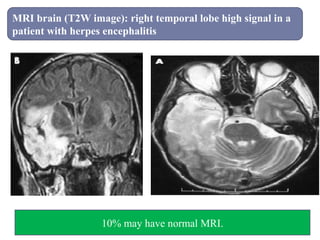
MRI brain (T2W image): right temporal lobe high signal in a
patient with herpes encephalitis
10% may have normal MRI.
DIFFERENTIAL DIAGNOSIS
 Acute bacterial meningitis
 Parameningeal bacterial infection
- brain abscess
- subdural/epidural empyma
 Infections
- M.tuberculosis, T.pallidum, B. burgdorferi, B. henselae,
rickettsial, Cat scratch disease, fungal, protozoal,
metazoal
 Malignancy
 ICH
 Exposure to certain drugs & toxins
 Auto Immune Encephalitis(anti NMDA receptor
antibodies)
 ADEM
 HIV
 Creutzfeldt-jakob disease
 Vacccine associated- rabies, measles, vaccinia, yellow fever
ENCPHALITIS COMPLICATIONS
Meningitis vs Encephalitis
Constitutional symptoms Encephalitis Meningitis
Fever Yes Yes
Headache, nausea, vomitting, lethargy Yes Yes
Photophobia, neck stiffness No Yes
seizures Yes Minimal
Cranial nerve palsies Yes No
Altered mental status yes minimal
Encephalopathy vs Encephalitis
Encephalopathy Encephalitis
Clinical features
Fever Uncommon Common
Headache Uncommon Common
Depressed mental status Steady deterioration May fluctuate
Focal neurological signs Uncommon Common
Type of seizure Generalised Generalised or focal
Laboratory findings
Blood Leucocytosis uncommon Leucocytosis common
CSF Pleocytosis uncommon Pleocytosis common
EEG Diffuse slowing Diffuse slowing and focal
abnormalities
MRI Often normal Focal abnormalities
TREATMENT
supportive
 Rest
 Reduction in room light, visitors, & noise
 Maintain airway, breathing and circulation.
 Control of seizures.
 Treatment of raised ICT.
 Manage fever ((Never give aspirin)Never give aspirin)..
 Maintain fluid & electrolyte balance.
 Maintain blood-sugar level.
 Feeding: NPO initially then NG Tube Feeding.
 physiotherapy
 Specific Treatment.
 Methyl-prednisolone or dexa-methasone must be given to children
with suspected ADEM.
ACYCLOVIR
 start empirically
 Available in oral and suspension form and IV formulation
 Very poor bioavailability – required frequent dosing
 10 mg/kg IV every 8 hrs for 14 days (30 mg/kg/day)
 Additional 7 days in case of positive CSF PCR at 14 days.
 VALACYCLOVIR – prodrug of acyclovir
 FAMCICLOVIR – prodrug of penciclovir
 Resistance to acyclovir and penciclovir occur in
immuno-compromised persons.
Both have very
good oral
bioavailability
PROGNOSIS
 Most children completely recover from viral
encephalitis, although prognosis depends on severity
of illness, causative organism and age of child.
 Potential deficits- intellectual, motor, psychiatric,
epileptic, visual or auditory in nature.
 10% of children younger than 2 years of age with
entero-viral CNS infections suffers acute
complications as seizures, increased ICP , coma.
 Almost all have favourable long term neurological
outcomes.
PREVENTION
 Effective viral vaccines
 Control of insect vector
 Eradications of insect breeding sites
 Insect repllents- DEET
JAPANESE ENCEPHALITIS
 One of the commonest cause of AES, mainly
prevalent in Assam, West Bengal, Uttar Pradesh and
Jharkhand.
 Primarily affects children under age 15.
 Acute onset, fulminant course, and high mortality & morbidity.
 70% of patients either die or survive with long term
neurological disability.
JE VIRUS
 Group-B arbo virus (Flavi virus).
 Single stranded RNA virus.
 Transmitted by culex mosquitoes(Zoonotic Disease).
 Peak season : june to september
 Man is an incidental dead end host.
 Man-to-man transmission not reported.
 Pigs are amplifier of virus.
Epidemiology
 Incubation Period: 5-15 days.
 Cases represent tip of iceberg.
 Case Fatality Rate: 10 –70%.
 Incidence: 1- 10/10, 000 population.
 IN HUMANS, prior dengue virus infection provides partial
protection from clinical Japanese Encephalitis
DIAGNOSIS
 Virus isolation
 CSF
 Nasopharynx
 Faeces
 Urine
 Detection of viral component (antigen detection)
 Nucleic Acid ProbeNucleic Acid Probe
 PCRPCR
 RIARIA
 ELISAELISA
 Viral serology
 IgM appears early within 2 weeks of infection
 IgG appears later, peaking around 8 weeks.
MANAGEMENT
 there is no specific treatment for JE.
 The treatment is intensive supportive care, including control of
seizure.
PREVENTION
 Vaccination against JE is advised in endemic areas.
 There are 4 main types of JE vaccines currently in use
 inactivated mouse brain-derived vaccines,
 inactivated Vero cell-derived vaccines,
 live attenuated vaccines
 live recombinant vaccines.
 In such areas, it is given routinely to children above 1 year of
age.
 Protective immunity develops in about a month’s time after
the second dose.
 Revaccination after 3 yrs.
 Best used in inter-epidemic period.
 JE vaccine not recommended for routine use.
ADEM
 ADEM is an initial inflammatory , demyelinating event
with multifocal neurological deficits, typically
accompanied by encephalopathy.
 Most common age group – 5 to 8 years.
 More common in males.
 0.07-0.4 /lakh pediatric population.
PATHOGENESIS
 It maybe induced by infectious exposure or vaccine may
trigger production of CNS auto-antigens.
CLINICAL MANIFESTATION
 Lethargy, fever, headache, vomiting , meningeal signs, and
seizures including s. Epilepticus .
 Encephalopathy is hallmark of ADEM , ranging from
ongoing confusion to persistent irritability to coma.
 Focal neurological signs include visual loss, cranial
neuropathies, ataxia, motor and sensory deficits with
concurrent spinal cord demyelination.
INVESTIGATIONS
 CSF – Pleocytosis with lymphocytic or monocytic
predominance.
CSF protein can be elevated
In 10% - oligoclonal bands
Elevated CSF immunoglobulin production
 EEG- Generalised slowing
 Head CT – may be normal or show hypodense regions.
MRI
 BRAIN MRI – large , multifocal and sometimes confluent
or edematous mass like tumefactive T2 lesions with
variable enhancement within white and often grey matter
of cerebral hemispheres, cerebellum , and brain stem.
 Spinal cord may have abnormal T2 signal or
enhancement, with or without clinical signs of myelitis.
TREATMENT
 High dose IV Steroid-Methylprednisolone 20-30mg/kg/day
for 5 days with a max dose of 1000mg/day.
Oral prednisolone taper over 1 month may prevent
relapse.
 IVIG- 2gm/kg/day over 2-5 days
 Plasmapheresis
 Rituximab
 Cyclophosphamide
Many children experience full recovery but some are left with residual
motor and/or cognitive deficit.
AUTOIMMUNE ENCEPHALITIS
 Can occur at all ages.
 These disorders associated with antibodies against
neuronal cell surface proteins and synaptic receptors.
 Most of these are severe and potentially fatal.
 Mechanisms that trigger the antibodies production are
unknown.
AIE in Children
 Anti NMDAR Encephalitis
 Limbic Encephalitis
 Cerebellar-brain stem Encephalitis
 Bickerstaff Encephalitis
 Hashimoto Encephalitis
 Rasmussen Encephalitis
 Bsal ganglia Encephalitis
 CLIPPERS
 ROHHAD
Anti NMDAR Encephalitis
INVESTIGATIONS
Brain MRI –
•Abnormal in 35%
cases
•Nonspecific cortical &
sub-cortical T2 FLAIR
signal abnormalities.
EEG
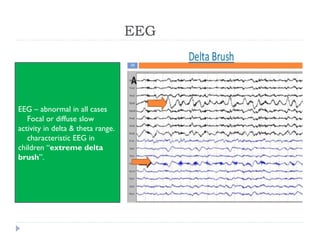
EEG – abnormal in all cases
Focal or diffuse slow
activity in delta & theta range.
characteristic EEG in
children “extreme delta
brush”.
 CSF –abnormal in 80% cases
Moderate lymphocytic pleocytosis & less frequently
increased protein synthesis and oligoclonal bands.
 Diagnosis established by demonstrating NMDAR
antibodies in CSF or serum(sensitivity higher in CSF
100% vs 85%)
 Presence of underlying tumour, mostly teratoma is age &
sex dependent.
 In few patients anti NMDAR occur after variety of
pathogen like M. pneumoniae, HSV 1 & 6 , entero virus &
influenza.
 Mortality rate – 7%
 Substantial or full recovery – 80%
Recovery is usually slow can take upto 2 years.
 Relapse rate – 15%
TREATMENT
 Tumour removal
 Immunotherapies
• Corticosteroids
• IVIG
• Plasma exchange
 Rituximab
 Cyclophosphamide
Encephalitis

Encephalitis

  • 1.
  • 2.
    Encephalitis usually affectsthe meninges as well as the brain, the term MENINGOENCEPHALITIS is more accurate. MENINGITIS Inflammation of meninges ENCEPHALITIS An acute inflammatory process affecting the brain parenchyma. Encephalopathy syndrome of altered mental status, manifesting as reduced consciousness or altered behaviour.
  • 3.
     Viral infectionis the most common and important cause of encephalitis.  Most common cause in world- Japanese encephalitis  Most common cause in asia – Entero virus  Most common cause in india - Japanese encephalitis  Most common causes of endemic VE- HHV  Most common causes of epidemic VE-HSV  Cause of encephalitis in immuno-competent hosts - Varicella, herpes zoster, HHV 6 and 7, and EBV  Severe and Fatal Encephalitis- Arbo viruses and HSV
  • 4.
    •Ricketssial •Mycoplasma •Bacterial •Cat Scratch Disease •Spirocheatal •Protozoal •Metazoal •Fungal •SSPE •CJD •KURU •HIV •Progressivemultifocal - Leuko encephalopathy •Post Infections •Allergic •Autoimmune • Post Vaccine •Para-neoplastic •REYE Syndrome •Toxins •Island Disease •Ideopathic Causes ofCauses of ENCEPHALITISENCEPHALITIS VIRAL INFECTIO NS HUM AN SLO W VIRUS DISEASE PARAINFECTIO NS & UNKNO W N •Mump •Measles •Rubella •Hsv •Entero •Arbo • Influenza •Adeno •Pox, Rabies CAUSES of ENCEPHALITIS NON VIRAL INFECTIONS
  • 5.
    Mode of transmission Exposureto viruses can occur through:  Breathing in respiratory droplets from Infected person  Contaminated food or drink  Mosquito, tick, and other insect bites  Skin contact
  • 6.
    PATHOGENESIS  Neurological damageis caused by direct invasion & destruction of neural tissue or by host reaction to viral antigens .  There are varying degree of parenchymal & maningeal inflammation, edema & necrosis.  Temporal lobe is often severly affected by HSV.  Arbo virus tends to affect entire brain.  Rabies virus mostly affect basal structures (hippocampus).
  • 7.
    PATHOLOGY  Meningeal congestion& mononuclear infiltration  Perivascular cuffs of lymphocytes & plasma cells  Perivascular tissue necrosis with myelin breakdown  Neuronal disruption  Demyelination may follow infection
  • 8.
    ENCEPHALITIS SYMPTOMS Fever thatis not very high hyperasthesia drowsiness Some patients may have symptoms of a cold or stomach infection before encephalitis symptoms begin.
  • 9.
    Symptoms in Newbornsand Infants Symptoms in newborns and younger infants may not be easy to recognize :  Body stiffness  Irritability and crying more often  Poor feeding  Bulging ant fontanelle  Vomiting
  • 10.
    Emergency Symptoms  Lossof consciousness, poor responsiveness, stupor, coma  Muscle weakness or paralysis  Seizures  Severe headache  Sudden change in mental functions: "Flat" mood, lack of mood Impaired judgment Less interest in daily activities Memory loss (amnesia),
  • 11.
    DIAGNOSIS  Clinical presentationof non specific prodrome followed by progressive CNS symptoms.  CSF Analysis  EEG: Diffuse slow-wave activity.  CT/MRI: Swelling of the brain parenchyma.
  • 12.
    LABORATORY FINDINGS  CSFEXAMINATION Pleocytosis : Initially Polymorphs & later mononuclear cells predominate. Increased or normal protein. Normal sugar.  Isolation of virus from serum  Detection of viral DNA or RNA by PCR  CSF Serology  Serological tests  Specific IgM Antibody level  CSF to Serum Ratio of Anti HSV IgG
  • 13.
    CSF Examination To bedone in all cases  Absent CSF pleocytosis – immuno-compromised, glucocorticoid, malignancies  >5 cells/µl - 90 % cases  >500 cells/µl – 10 % cases  >1000 cells /µl – mumps ,LCMV.  Atypical lymphocytes – EBV, CMV, HSV  Neutrophils -40% WNV, Echovirus  >20% RBC – HSV hemorrhagic encephalitis  Decreased CSF glucose – MUMPS, LCMV
  • 14.
    CSF PCR  Primarytest for CMV, HSV, VZV, EBV  Sensitive(>90%) and specific(100%) for HSV  Positivity increases with duration of illness  Not affected by less than 1 week of therapy  Next specific for entero-viruses  Not established for EBV  RT-PCR  MultiplexPCR
  • 15.
    MRI brain (T2Wimage): right temporal lobe high signal in a patient with herpes encephalitis 10% may have normal MRI.
  • 16.
    DIFFERENTIAL DIAGNOSIS  Acutebacterial meningitis  Parameningeal bacterial infection - brain abscess - subdural/epidural empyma  Infections - M.tuberculosis, T.pallidum, B. burgdorferi, B. henselae, rickettsial, Cat scratch disease, fungal, protozoal, metazoal
  • 17.
     Malignancy  ICH Exposure to certain drugs & toxins  Auto Immune Encephalitis(anti NMDA receptor antibodies)  ADEM  HIV  Creutzfeldt-jakob disease  Vacccine associated- rabies, measles, vaccinia, yellow fever
  • 18.
  • 19.
    Meningitis vs Encephalitis Constitutionalsymptoms Encephalitis Meningitis Fever Yes Yes Headache, nausea, vomitting, lethargy Yes Yes Photophobia, neck stiffness No Yes seizures Yes Minimal Cranial nerve palsies Yes No Altered mental status yes minimal
  • 20.
    Encephalopathy vs Encephalitis EncephalopathyEncephalitis Clinical features Fever Uncommon Common Headache Uncommon Common Depressed mental status Steady deterioration May fluctuate Focal neurological signs Uncommon Common Type of seizure Generalised Generalised or focal Laboratory findings Blood Leucocytosis uncommon Leucocytosis common CSF Pleocytosis uncommon Pleocytosis common EEG Diffuse slowing Diffuse slowing and focal abnormalities MRI Often normal Focal abnormalities
  • 21.
    TREATMENT supportive  Rest  Reductionin room light, visitors, & noise  Maintain airway, breathing and circulation.  Control of seizures.  Treatment of raised ICT.  Manage fever ((Never give aspirin)Never give aspirin)..  Maintain fluid & electrolyte balance.  Maintain blood-sugar level.  Feeding: NPO initially then NG Tube Feeding.  physiotherapy  Specific Treatment.  Methyl-prednisolone or dexa-methasone must be given to children with suspected ADEM.
  • 22.
    ACYCLOVIR  start empirically Available in oral and suspension form and IV formulation  Very poor bioavailability – required frequent dosing  10 mg/kg IV every 8 hrs for 14 days (30 mg/kg/day)  Additional 7 days in case of positive CSF PCR at 14 days.
  • 23.
     VALACYCLOVIR –prodrug of acyclovir  FAMCICLOVIR – prodrug of penciclovir  Resistance to acyclovir and penciclovir occur in immuno-compromised persons. Both have very good oral bioavailability
  • 24.
    PROGNOSIS  Most childrencompletely recover from viral encephalitis, although prognosis depends on severity of illness, causative organism and age of child.  Potential deficits- intellectual, motor, psychiatric, epileptic, visual or auditory in nature.  10% of children younger than 2 years of age with entero-viral CNS infections suffers acute complications as seizures, increased ICP , coma.  Almost all have favourable long term neurological outcomes.
  • 25.
    PREVENTION  Effective viralvaccines  Control of insect vector  Eradications of insect breeding sites  Insect repllents- DEET
  • 26.
    JAPANESE ENCEPHALITIS  Oneof the commonest cause of AES, mainly prevalent in Assam, West Bengal, Uttar Pradesh and Jharkhand.  Primarily affects children under age 15.  Acute onset, fulminant course, and high mortality & morbidity.  70% of patients either die or survive with long term neurological disability.
  • 27.
    JE VIRUS  Group-Barbo virus (Flavi virus).  Single stranded RNA virus.  Transmitted by culex mosquitoes(Zoonotic Disease).  Peak season : june to september  Man is an incidental dead end host.  Man-to-man transmission not reported.  Pigs are amplifier of virus.
  • 28.
    Epidemiology  Incubation Period:5-15 days.  Cases represent tip of iceberg.  Case Fatality Rate: 10 –70%.  Incidence: 1- 10/10, 000 population.  IN HUMANS, prior dengue virus infection provides partial protection from clinical Japanese Encephalitis
  • 30.
    DIAGNOSIS  Virus isolation CSF  Nasopharynx  Faeces  Urine  Detection of viral component (antigen detection)  Nucleic Acid ProbeNucleic Acid Probe  PCRPCR  RIARIA  ELISAELISA  Viral serology  IgM appears early within 2 weeks of infection  IgG appears later, peaking around 8 weeks.
  • 31.
    MANAGEMENT  there isno specific treatment for JE.  The treatment is intensive supportive care, including control of seizure.
  • 32.
    PREVENTION  Vaccination againstJE is advised in endemic areas.  There are 4 main types of JE vaccines currently in use  inactivated mouse brain-derived vaccines,  inactivated Vero cell-derived vaccines,  live attenuated vaccines  live recombinant vaccines.  In such areas, it is given routinely to children above 1 year of age.
  • 33.
     Protective immunitydevelops in about a month’s time after the second dose.  Revaccination after 3 yrs.  Best used in inter-epidemic period.  JE vaccine not recommended for routine use.
  • 34.
    ADEM  ADEM isan initial inflammatory , demyelinating event with multifocal neurological deficits, typically accompanied by encephalopathy.  Most common age group – 5 to 8 years.  More common in males.  0.07-0.4 /lakh pediatric population. PATHOGENESIS  It maybe induced by infectious exposure or vaccine may trigger production of CNS auto-antigens.
  • 35.
    CLINICAL MANIFESTATION  Lethargy,fever, headache, vomiting , meningeal signs, and seizures including s. Epilepticus .  Encephalopathy is hallmark of ADEM , ranging from ongoing confusion to persistent irritability to coma.  Focal neurological signs include visual loss, cranial neuropathies, ataxia, motor and sensory deficits with concurrent spinal cord demyelination.
  • 36.
    INVESTIGATIONS  CSF –Pleocytosis with lymphocytic or monocytic predominance. CSF protein can be elevated In 10% - oligoclonal bands Elevated CSF immunoglobulin production  EEG- Generalised slowing  Head CT – may be normal or show hypodense regions.
  • 37.
    MRI  BRAIN MRI– large , multifocal and sometimes confluent or edematous mass like tumefactive T2 lesions with variable enhancement within white and often grey matter of cerebral hemispheres, cerebellum , and brain stem.  Spinal cord may have abnormal T2 signal or enhancement, with or without clinical signs of myelitis.
  • 38.
    TREATMENT  High doseIV Steroid-Methylprednisolone 20-30mg/kg/day for 5 days with a max dose of 1000mg/day. Oral prednisolone taper over 1 month may prevent relapse.  IVIG- 2gm/kg/day over 2-5 days  Plasmapheresis  Rituximab  Cyclophosphamide Many children experience full recovery but some are left with residual motor and/or cognitive deficit.
  • 39.
    AUTOIMMUNE ENCEPHALITIS  Canoccur at all ages.  These disorders associated with antibodies against neuronal cell surface proteins and synaptic receptors.  Most of these are severe and potentially fatal.  Mechanisms that trigger the antibodies production are unknown.
  • 40.
    AIE in Children Anti NMDAR Encephalitis  Limbic Encephalitis  Cerebellar-brain stem Encephalitis  Bickerstaff Encephalitis  Hashimoto Encephalitis  Rasmussen Encephalitis  Bsal ganglia Encephalitis  CLIPPERS  ROHHAD
  • 41.
  • 42.
    INVESTIGATIONS Brain MRI – •Abnormalin 35% cases •Nonspecific cortical & sub-cortical T2 FLAIR signal abnormalities.
  • 43.
    EEG EEG – abnormalin all cases Focal or diffuse slow activity in delta & theta range. characteristic EEG in children “extreme delta brush”.
  • 44.
     CSF –abnormalin 80% cases Moderate lymphocytic pleocytosis & less frequently increased protein synthesis and oligoclonal bands.  Diagnosis established by demonstrating NMDAR antibodies in CSF or serum(sensitivity higher in CSF 100% vs 85%)
  • 45.
     Presence ofunderlying tumour, mostly teratoma is age & sex dependent.  In few patients anti NMDAR occur after variety of pathogen like M. pneumoniae, HSV 1 & 6 , entero virus & influenza.  Mortality rate – 7%  Substantial or full recovery – 80% Recovery is usually slow can take upto 2 years.  Relapse rate – 15%
  • 46.
    TREATMENT  Tumour removal Immunotherapies • Corticosteroids • IVIG • Plasma exchange  Rituximab  Cyclophosphamide