Cerebral Malaria
ADE WIJAYA, MD – AUGUST 2019
Introduction
 Malaria is a parasitic disease caused by protozoans of the Plasmodium genus
 There are four main species which are pathogenic to humans; these include Plasmodium
falciparum (P.falciparum), Plasmodium vivax (P.vivax), Plasmodium ovale (P. ovale), and
Plasmodium malariae (P. malariae)
 P. falciparum is considered the most dangerous and is responsible for the vast majority of
the high mortality rates associated with Plasmodium infection
Luzolo AL, Ngoyi DM. Cerebral malaria. Brain research bulletin. 2019 Jan 15.
Epidemiology
 About 216 million cases of malaria
 Mortality: 445 000
 Eighty percent of the global burden of malaria is accounted for by reports from
just 15 countries, all of which are located in Sub-Saharan Africa, with the
exception of India.
(World Health Organization, 2017)
Transmission
 Human transmission of Plasmodium occurs during the blood meal of an infected
female mosquito of the Anopheles genus
Luzolo AL, Ngoyi DM. Cerebral malaria. Brain research bulletin. 2019 Jan 15.
Severe Malaria
 Presence of Plasmodium in peripheral Blood
 In addition to clinical or laboratory confirmation of severe vital organ dysfunction
(Idro et al., 2016)
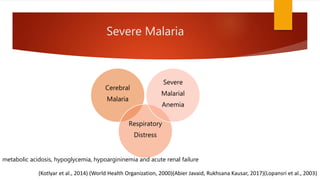
Severe Malaria
Cerebral
Malaria
Respiratory
Distress
Severe
Malarial
Anemia
metabolic acidosis, hypoglycemia, hypoargininemia and acute renal failure
(Kotlyar et al., 2014) (World Health Organization, 2000)(Abier Javaid, Rukhsana Kausar, 2017)(Lopansri et al., 2003)
Cerebral Malaria
 A serious neurological complications induced by infection with P. falciparum (Nanfack, Bilong,
Kagmeni, Nathan, & Bella, 2017)
 Around 1 % of children infected with P. falciparum will develop CM(Storm & Craig, 2014)
 A leading cause of malaria mortality, responsible for almost 20 % of adult deaths and 15 % of
childhood deaths (Wang, Qian, & Cao, 2015
 11 % sequelae - long-term damage from the development of CM (Polimeni & Prato, 2014)
Clinical Manifestation
 Patient cannot localize a painful stimulus
 Has peripheral asexual P. falciparum parasitemia
 Has no other identified causes of an encephalopathy
(World Health Organization, 2000)
Generally, patients have a history of a 2 or 3 day fever along with the subsequent abrupt onset of convulsions
and/or severely impaired consciousness
Clinical Manifestation
Main Symptoms: headache, muscle pain and altered state of consciousness
 Fixed jaw closure and tooth grinding (bruxism)
 Motor abnormalities like decerebrate rigidity, decorticate rigidity and
opisthotonos can occur in individuals with CM.
 Other symptoms and signs include seizures, enlargement of liver and spleen,
jaundice, pulmonary edema, renal dysfunction, pallor, hypoglycemia, bleeding,
hypotension and severe anemia
(Koshy & Koshy, 2014)
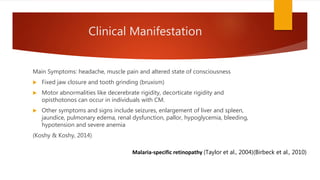
Malaria-specific retinopathy (Taylor et al., 2004)(Birbeck et al., 2010)
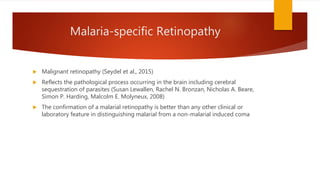
Malaria-specific Retinopathy
 Malignant retinopathy (Seydel et al., 2015)
 Reflects the pathological process occurring in the brain including cerebral
sequestration of parasites (Susan Lewallen, Rachel N. Bronzan, Nicholas A. Beare,
Simon P. Harding, Malcolm E. Molyneux, 2008)
 The confirmation of a malarial retinopathy is better than any other clinical or
laboratory feature in distinguishing malarial from a non-malarial induced coma
Malaria-specific Retinopathy
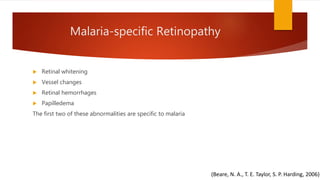
 Retinal whitening
 Vessel changes
 Retinal hemorrhages
 Papilledema
The first two of these abnormalities are specific to malaria
(Beare, N. A., T. E. Taylor, S. P. Harding, 2006)
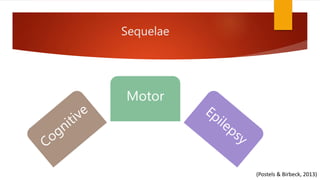
Sequelae
Motor
(Postels & Birbeck, 2013)
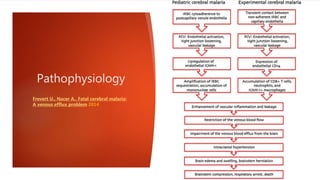
Pathophysiology
Frevert U., Nacer A., Fatal cerebral malaria:
A venous efflux problem 2014
Diagnosis
 Should be considered in every comatose patient with a history of fever who has
been in an affected area within the prior two months of symptom onset
 Rule out other variables
 Asexual forms of P. falciparum present in both the thin and thick stained blood
films/smear
(Dondorp, 2005) (Misra et al., 2011)
Diagnosis
 Funduscopy
 EEG
 Brain CT / MRI
 Laboratory
Luzolo AL, Ngoyi DM. Cerebral malaria. Brain research bulletin. 2019 Jan 15.
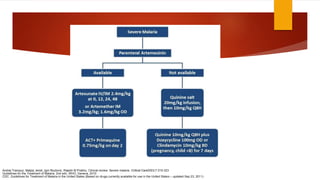
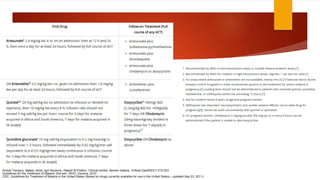
Treatment
 Supportive nursing care
 Various antimalarial treatments
 Anticipation of complications
 Aggressive treatment
 Intensive care
(Postels & Birbeck, 2013)
Guidelines for the Treatment of Malaria. 2nd edn. WHO, Geneva, 2010
CDC. Guidelines for Treatment of Malaria in the United States (Based on drugs currently available for use in the United States – updated Sep 23, 2011)
Andrej Trampuz, Matjaz Jereb, Igor Muzlovic, Rajesh M Prabhu. Clinical review: Severe malaria. Critical Care2003;7:315-323
CDC. Guidelines for Treatment of Malaria in the United States (Based on drugs currently available for use in the United States – updated Sep 23, 2011)
Guidelines for the Treatment of Malaria. 2nd edn. WHO, Geneva, 2010
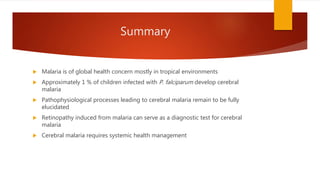
Summary
 Malaria is of global health concern mostly in tropical environments
 Approximately 1 % of children infected with P. falciparum develop cerebral
malaria
 Pathophysiological processes leading to cerebral malaria remain to be fully
elucidated
 Retinopathy induced from malaria can serve as a diagnostic test for cerebral
malaria
 Cerebral malaria requires systemic health management
THANK YOU

Cerebral Malaria

  • 1.
    Cerebral Malaria ADE WIJAYA,MD – AUGUST 2019
  • 2.
    Introduction  Malaria isa parasitic disease caused by protozoans of the Plasmodium genus  There are four main species which are pathogenic to humans; these include Plasmodium falciparum (P.falciparum), Plasmodium vivax (P.vivax), Plasmodium ovale (P. ovale), and Plasmodium malariae (P. malariae)  P. falciparum is considered the most dangerous and is responsible for the vast majority of the high mortality rates associated with Plasmodium infection Luzolo AL, Ngoyi DM. Cerebral malaria. Brain research bulletin. 2019 Jan 15.
  • 3.
    Epidemiology  About 216million cases of malaria  Mortality: 445 000  Eighty percent of the global burden of malaria is accounted for by reports from just 15 countries, all of which are located in Sub-Saharan Africa, with the exception of India. (World Health Organization, 2017)
  • 4.
    Transmission  Human transmissionof Plasmodium occurs during the blood meal of an infected female mosquito of the Anopheles genus Luzolo AL, Ngoyi DM. Cerebral malaria. Brain research bulletin. 2019 Jan 15.
  • 5.
    Severe Malaria  Presenceof Plasmodium in peripheral Blood  In addition to clinical or laboratory confirmation of severe vital organ dysfunction (Idro et al., 2016)
  • 6.
    Severe Malaria Cerebral Malaria Respiratory Distress Severe Malarial Anemia metabolic acidosis,hypoglycemia, hypoargininemia and acute renal failure (Kotlyar et al., 2014) (World Health Organization, 2000)(Abier Javaid, Rukhsana Kausar, 2017)(Lopansri et al., 2003)
  • 7.
    Cerebral Malaria  Aserious neurological complications induced by infection with P. falciparum (Nanfack, Bilong, Kagmeni, Nathan, & Bella, 2017)  Around 1 % of children infected with P. falciparum will develop CM(Storm & Craig, 2014)  A leading cause of malaria mortality, responsible for almost 20 % of adult deaths and 15 % of childhood deaths (Wang, Qian, & Cao, 2015  11 % sequelae - long-term damage from the development of CM (Polimeni & Prato, 2014)
  • 8.
    Clinical Manifestation  Patientcannot localize a painful stimulus  Has peripheral asexual P. falciparum parasitemia  Has no other identified causes of an encephalopathy (World Health Organization, 2000) Generally, patients have a history of a 2 or 3 day fever along with the subsequent abrupt onset of convulsions and/or severely impaired consciousness
  • 9.
    Clinical Manifestation Main Symptoms:headache, muscle pain and altered state of consciousness  Fixed jaw closure and tooth grinding (bruxism)  Motor abnormalities like decerebrate rigidity, decorticate rigidity and opisthotonos can occur in individuals with CM.  Other symptoms and signs include seizures, enlargement of liver and spleen, jaundice, pulmonary edema, renal dysfunction, pallor, hypoglycemia, bleeding, hypotension and severe anemia (Koshy & Koshy, 2014) Malaria-specific retinopathy (Taylor et al., 2004)(Birbeck et al., 2010)
  • 10.
    Malaria-specific Retinopathy  Malignantretinopathy (Seydel et al., 2015)  Reflects the pathological process occurring in the brain including cerebral sequestration of parasites (Susan Lewallen, Rachel N. Bronzan, Nicholas A. Beare, Simon P. Harding, Malcolm E. Molyneux, 2008)  The confirmation of a malarial retinopathy is better than any other clinical or laboratory feature in distinguishing malarial from a non-malarial induced coma
  • 11.
    Malaria-specific Retinopathy  Retinalwhitening  Vessel changes  Retinal hemorrhages  Papilledema The first two of these abnormalities are specific to malaria (Beare, N. A., T. E. Taylor, S. P. Harding, 2006)
  • 12.
  • 13.
    Pathophysiology Frevert U., NacerA., Fatal cerebral malaria: A venous efflux problem 2014
  • 14.
    Diagnosis  Should beconsidered in every comatose patient with a history of fever who has been in an affected area within the prior two months of symptom onset  Rule out other variables  Asexual forms of P. falciparum present in both the thin and thick stained blood films/smear (Dondorp, 2005) (Misra et al., 2011)
  • 15.
    Diagnosis  Funduscopy  EEG Brain CT / MRI  Laboratory Luzolo AL, Ngoyi DM. Cerebral malaria. Brain research bulletin. 2019 Jan 15.
  • 16.
    Treatment  Supportive nursingcare  Various antimalarial treatments  Anticipation of complications  Aggressive treatment  Intensive care (Postels & Birbeck, 2013)
  • 17.
    Guidelines for theTreatment of Malaria. 2nd edn. WHO, Geneva, 2010 CDC. Guidelines for Treatment of Malaria in the United States (Based on drugs currently available for use in the United States – updated Sep 23, 2011) Andrej Trampuz, Matjaz Jereb, Igor Muzlovic, Rajesh M Prabhu. Clinical review: Severe malaria. Critical Care2003;7:315-323
  • 18.
    Andrej Trampuz, MatjazJereb, Igor Muzlovic, Rajesh M Prabhu. Clinical review: Severe malaria. Critical Care2003;7:315-323 CDC. Guidelines for Treatment of Malaria in the United States (Based on drugs currently available for use in the United States – updated Sep 23, 2011) Guidelines for the Treatment of Malaria. 2nd edn. WHO, Geneva, 2010
  • 19.
    Summary  Malaria isof global health concern mostly in tropical environments  Approximately 1 % of children infected with P. falciparum develop cerebral malaria  Pathophysiological processes leading to cerebral malaria remain to be fully elucidated  Retinopathy induced from malaria can serve as a diagnostic test for cerebral malaria  Cerebral malaria requires systemic health management
  • 20.