Neurological manifestations of
Erdheim–Chester Disease
Ade Wijaya, MD – July 2024
Introduction
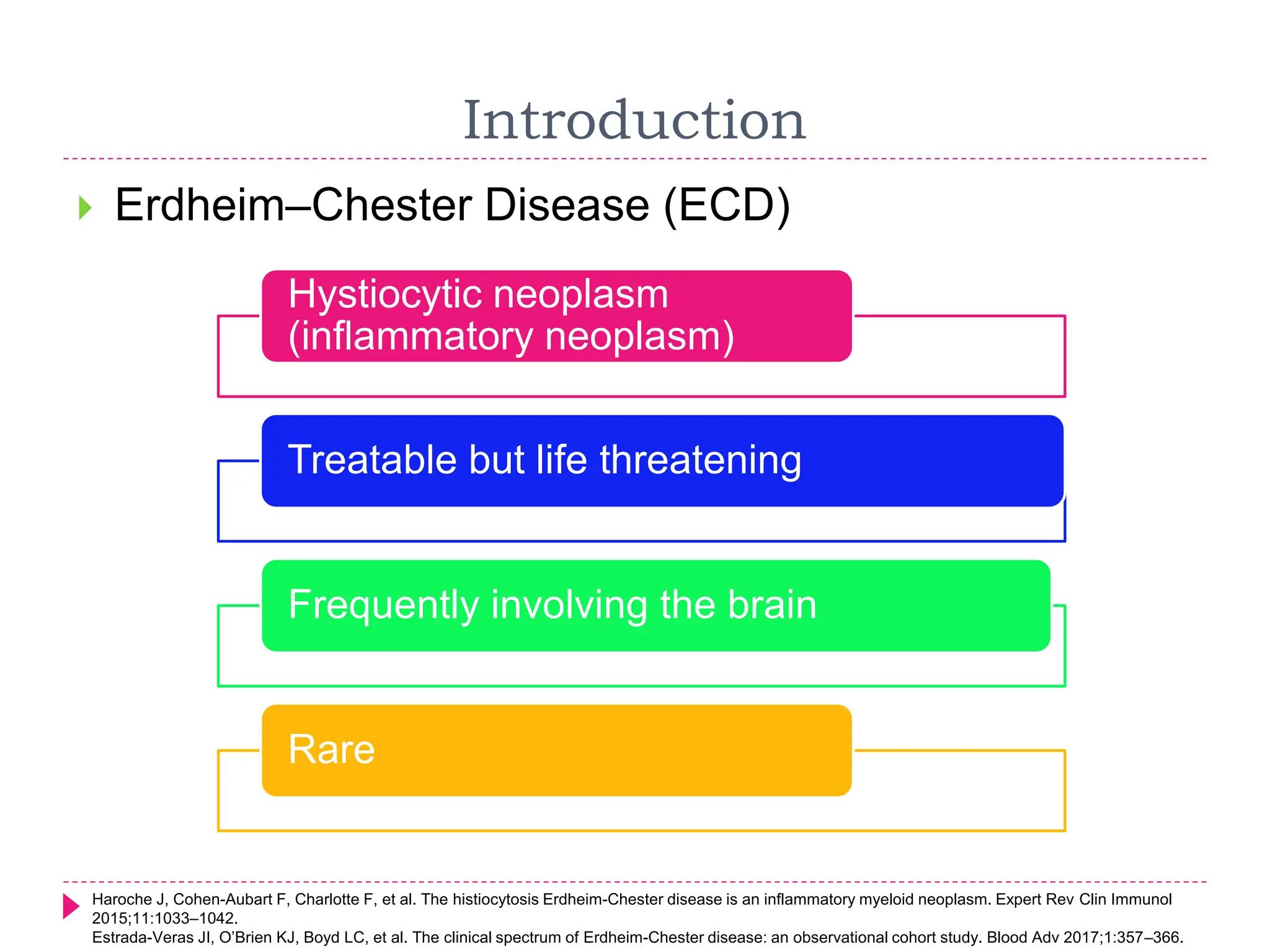
 Erdheim–Chester Disease (ECD)
Hystiocytic neoplasm
(inflammatory neoplasm)
Treatable but life threatening
Frequently involving the brain
Rare
Haroche J, Cohen-Aubart F, Charlotte F, et al. The histiocytosis Erdheim-Chester disease is an inflammatory myeloid neoplasm. Expert Rev Clin Immunol
2015;11:1033–1042.
Estrada-Veras JI, O’Brien KJ, Boyd LC, et al. The clinical spectrum of Erdheim-Chester disease: an observational cohort study. Blood Adv 2017;1:357–366.
Pathophysiology
 Infiltration and accumulation of inflammatory foamy
macrophages in multiple tissues leading to end-
organ dysfunction and failure through mass effect,
tissue restriction, organ encasement, and by local
and systemic inflammatory cytokines
 The most commonly involved organs are bone,
retroperitoneum, kidneys, brain, heart, skin, and
lungs
Haroche J, Cohen-Aubart F, Charlotte F, et al. The histiocytosis Erdheim-Chester disease is an inflammatory myeloid neoplasm. Expert Rev Clin Immunol
2015;11:1033–1042.
Estrada-Veras JI, O’Brien KJ, Boyd LC, et al. The clinical spectrum of Erdheim-Chester disease: an observational cohort study. Blood Adv 2017;1:357–366.
Clinical Features
CNS
• Cranial neuropathy
• Cognitive symptoms
• Cerebellar ataxia
• Pyramidal tract
involvement
• Seizure
PNS
• Peripheral neuropathy
• Myelopathy
Boyd LC, O’Brien KJ, Ozkaya N, Lehky T, Meoded A, Gochuico BR, Hannah‐Shmouni F, Nath A, Toro C, Gahl WA, Estrada‐Veras JI. Neurological manifestations of
Erdheim–Chester disease. Annals of clinical and translational neurology. 2020 Apr;7(4):497-506.
Radiology
Boyd LC, O’Brien KJ, Ozkaya N, Lehky T, Meoded A, Gochuico BR, Hannah‐Shmouni F, Nath A, Toro C, Gahl WA, Estrada‐Veras JI. Neurological manifestations of
Erdheim–Chester disease. Annals of clinical and translational neurology. 2020 Apr;7(4):497-506.
Radiology
Boyd LC, O’Brien KJ, Ozkaya N, Lehky T, Meoded A, Gochuico BR, Hannah‐Shmouni F, Nath A, Toro C, Gahl WA, Estrada‐Veras JI. Neurological manifestations of
Erdheim–Chester disease. Annals of clinical and translational neurology. 2020 Apr;7(4):497-506.
Radiology
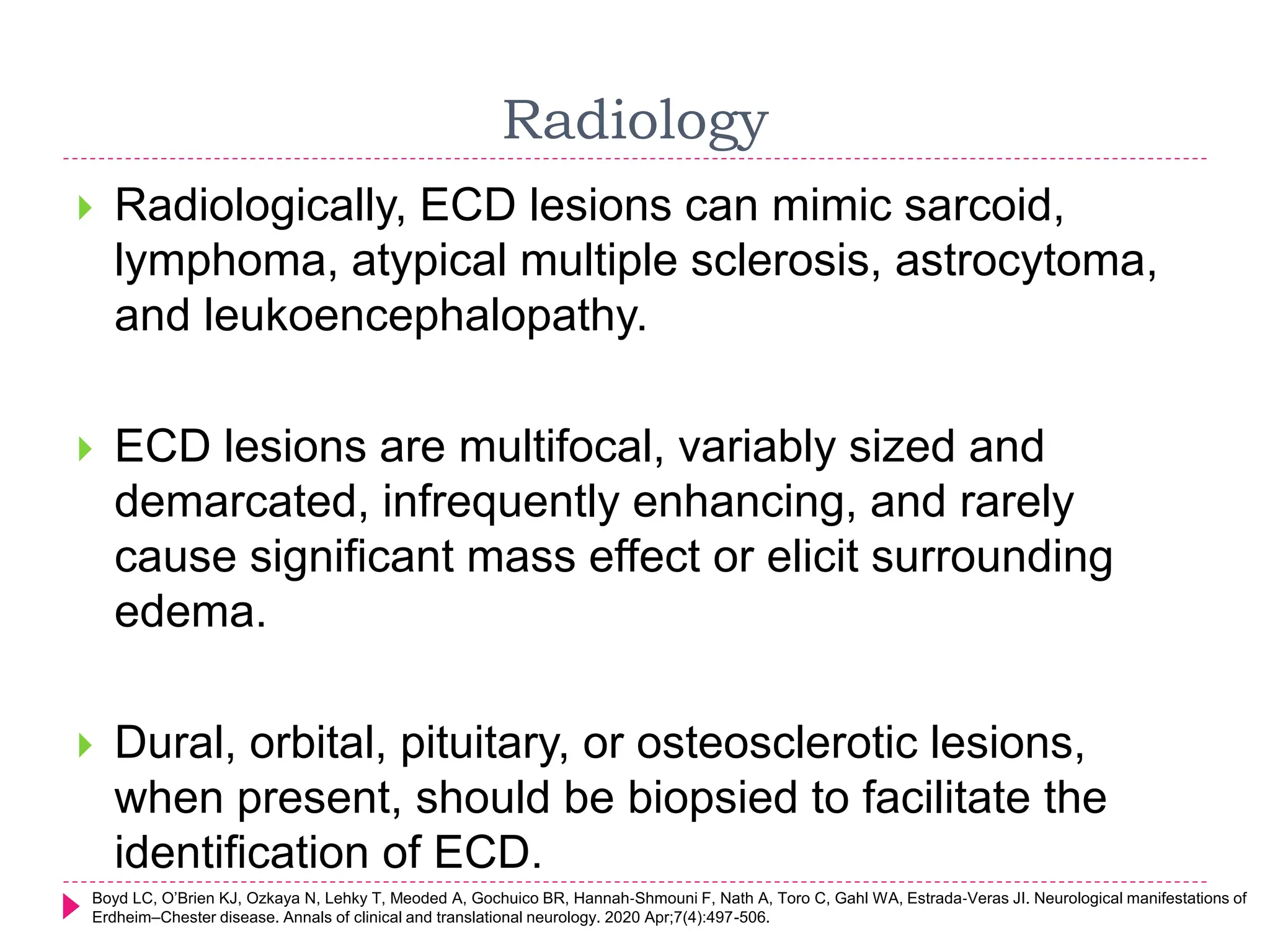
 Radiologically, ECD lesions can mimic sarcoid,
lymphoma, atypical multiple sclerosis, astrocytoma,
and leukoencephalopathy.
 ECD lesions are multifocal, variably sized and
demarcated, infrequently enhancing, and rarely
cause significant mass effect or elicit surrounding
edema.
 Dural, orbital, pituitary, or osteosclerotic lesions,
when present, should be biopsied to facilitate the
identification of ECD.
Boyd LC, O’Brien KJ, Ozkaya N, Lehky T, Meoded A, Gochuico BR, Hannah‐Shmouni F, Nath A, Toro C, Gahl WA, Estrada‐Veras JI. Neurological manifestations of
Erdheim–Chester disease. Annals of clinical and translational neurology. 2020 Apr;7(4):497-506.
Histopathology
Boyd LC, O’Brien KJ, Ozkaya N, Lehky T, Meoded A, Gochuico BR, Hannah‐Shmouni F, Nath A, Toro C, Gahl WA, Estrada‐Veras JI. Neurological manifestations of
Erdheim–Chester disease. Annals of clinical and translational neurology. 2020 Apr;7(4):497-506.
Histopathology
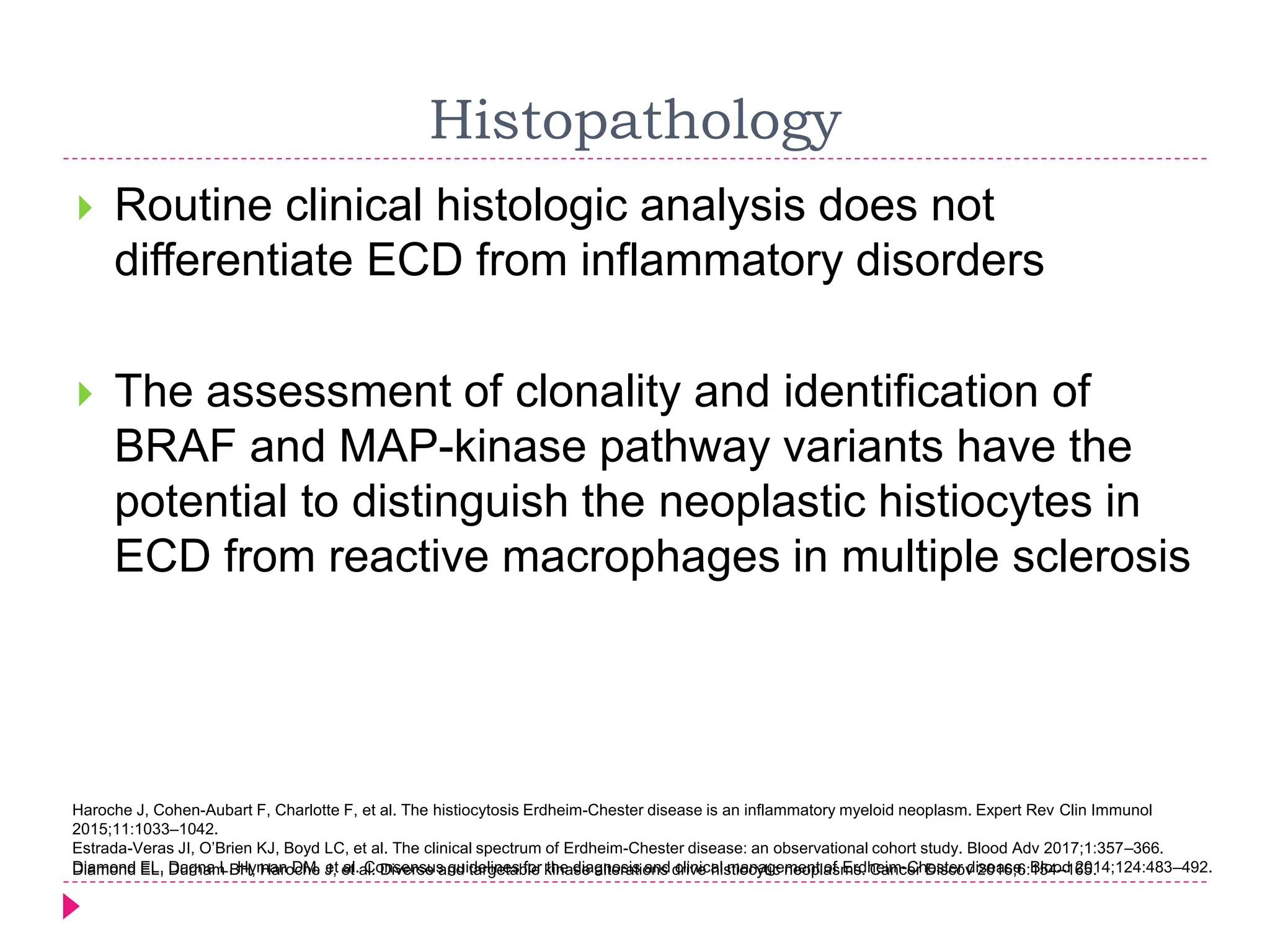
 Routine clinical histologic analysis does not
differentiate ECD from inflammatory disorders
 The assessment of clonality and identification of
BRAF and MAP-kinase pathway variants have the
potential to distinguish the neoplastic histiocytes in
ECD from reactive macrophages in multiple sclerosis
Haroche J, Cohen-Aubart F, Charlotte F, et al. The histiocytosis Erdheim-Chester disease is an inflammatory myeloid neoplasm. Expert Rev Clin Immunol
2015;11:1033–1042.
Estrada-Veras JI, O’Brien KJ, Boyd LC, et al. The clinical spectrum of Erdheim-Chester disease: an observational cohort study. Blood Adv 2017;1:357–366.
Diamond EL, Dagna L, Hyman DM, et al. Consensus guidelines for the diagnosis and clinical management of Erdheim-Chester disease. Blood 2014;124:483–492.
Diamond EL, Durham BH, Haroche J, et al. Diverse and targetable kinase alterations drive histiocytic neoplasms. Cancer Discov 2016;6:154–165.
Differential Diagnosis
 Progressive multiple sclerosis
 Neurosarcoid
 CNS vasculitis
 IgG4 disease
 Adrenoleukodystrophy
 ECD should be a consideration in patients who
respond poorly to lymphocyte-directed
immunotherapy (such as natalizumab,
cyclophosphamide, rituximab, or ocrelizumab).
Boyd LC, O’Brien KJ, Ozkaya N, Lehky T, Meoded A, Gochuico BR, Hannah‐Shmouni F, Nath A, Toro C, Gahl WA, Estrada‐Veras JI. Neurological manifestations of
Erdheim–Chester disease. Annals of clinical and translational neurology. 2020 Apr;7(4):497-506.
Estrada-Veras JI, O’Brien KJ, Boyd LC, et al. The clinical spectrum of Erdheim-Chester disease: an observational cohort study. Blood Adv 2017;1:357–366.
Treatment
 BRAF and MEK inhibitors are effective in treating
systemic ECD, and investigations are underway to
assess the efficacy of these agents in modulating
CNS disease
 Vemurafenib is FDA approved for patients bearing
the BRAF V600E variant
 Cobimetinib may be effective in BRAF-negative
patients who have other MAP kinase pathway
variants
Oneal PA, Kwitkowski V, Luo L, et al. FDA approval summary: vemurafenib for the treatment of patients with Erdheim-Chester Disease with the BRAFV600 mutation. Onc
2018;23:1520–1524
Tzoulis C, Schwarzlmuller T, Gjerde IO, et al. Excellent response of intramedullary Erdheim-Chester disease to vemurafenib: a case report. BMC Res Notes
2015;8:171.
Diamond EL, Durham BH, Ulaner GA, et al. Efficacy of MEK inhibition in patients with histiocytic neoplasms. Nature 2019;567:521–524.
Summary
 Neurologists play a critical role in identifying and
monitoring ECD and other histiocytic disorders,
because patients may present with neurologic
symptoms, isolated neurologic disease occurs, and
neurologic involvement portends a poorer prognosis
 Identification of ECD can spare patients morbidity
associated with immunotherapies directed toward
other diseases and ineffective therapies
THANK YOU

Neurological manifestations of Erdheim–Chester Disease.pptx

  • 1.
    Neurological manifestations of Erdheim–ChesterDisease Ade Wijaya, MD – July 2024
  • 2.
    Introduction  Erdheim–Chester Disease(ECD) Hystiocytic neoplasm (inflammatory neoplasm) Treatable but life threatening Frequently involving the brain Rare Haroche J, Cohen-Aubart F, Charlotte F, et al. The histiocytosis Erdheim-Chester disease is an inflammatory myeloid neoplasm. Expert Rev Clin Immunol 2015;11:1033–1042. Estrada-Veras JI, O’Brien KJ, Boyd LC, et al. The clinical spectrum of Erdheim-Chester disease: an observational cohort study. Blood Adv 2017;1:357–366.
  • 3.
    Pathophysiology  Infiltration andaccumulation of inflammatory foamy macrophages in multiple tissues leading to end- organ dysfunction and failure through mass effect, tissue restriction, organ encasement, and by local and systemic inflammatory cytokines  The most commonly involved organs are bone, retroperitoneum, kidneys, brain, heart, skin, and lungs Haroche J, Cohen-Aubart F, Charlotte F, et al. The histiocytosis Erdheim-Chester disease is an inflammatory myeloid neoplasm. Expert Rev Clin Immunol 2015;11:1033–1042. Estrada-Veras JI, O’Brien KJ, Boyd LC, et al. The clinical spectrum of Erdheim-Chester disease: an observational cohort study. Blood Adv 2017;1:357–366.
  • 4.
    Clinical Features CNS • Cranialneuropathy • Cognitive symptoms • Cerebellar ataxia • Pyramidal tract involvement • Seizure PNS • Peripheral neuropathy • Myelopathy Boyd LC, O’Brien KJ, Ozkaya N, Lehky T, Meoded A, Gochuico BR, Hannah‐Shmouni F, Nath A, Toro C, Gahl WA, Estrada‐Veras JI. Neurological manifestations of Erdheim–Chester disease. Annals of clinical and translational neurology. 2020 Apr;7(4):497-506.
  • 5.
    Radiology Boyd LC, O’BrienKJ, Ozkaya N, Lehky T, Meoded A, Gochuico BR, Hannah‐Shmouni F, Nath A, Toro C, Gahl WA, Estrada‐Veras JI. Neurological manifestations of Erdheim–Chester disease. Annals of clinical and translational neurology. 2020 Apr;7(4):497-506.
  • 6.
    Radiology Boyd LC, O’BrienKJ, Ozkaya N, Lehky T, Meoded A, Gochuico BR, Hannah‐Shmouni F, Nath A, Toro C, Gahl WA, Estrada‐Veras JI. Neurological manifestations of Erdheim–Chester disease. Annals of clinical and translational neurology. 2020 Apr;7(4):497-506.
  • 7.
    Radiology  Radiologically, ECDlesions can mimic sarcoid, lymphoma, atypical multiple sclerosis, astrocytoma, and leukoencephalopathy.  ECD lesions are multifocal, variably sized and demarcated, infrequently enhancing, and rarely cause significant mass effect or elicit surrounding edema.  Dural, orbital, pituitary, or osteosclerotic lesions, when present, should be biopsied to facilitate the identification of ECD. Boyd LC, O’Brien KJ, Ozkaya N, Lehky T, Meoded A, Gochuico BR, Hannah‐Shmouni F, Nath A, Toro C, Gahl WA, Estrada‐Veras JI. Neurological manifestations of Erdheim–Chester disease. Annals of clinical and translational neurology. 2020 Apr;7(4):497-506.
  • 8.
    Histopathology Boyd LC, O’BrienKJ, Ozkaya N, Lehky T, Meoded A, Gochuico BR, Hannah‐Shmouni F, Nath A, Toro C, Gahl WA, Estrada‐Veras JI. Neurological manifestations of Erdheim–Chester disease. Annals of clinical and translational neurology. 2020 Apr;7(4):497-506.
  • 9.
    Histopathology  Routine clinicalhistologic analysis does not differentiate ECD from inflammatory disorders  The assessment of clonality and identification of BRAF and MAP-kinase pathway variants have the potential to distinguish the neoplastic histiocytes in ECD from reactive macrophages in multiple sclerosis Haroche J, Cohen-Aubart F, Charlotte F, et al. The histiocytosis Erdheim-Chester disease is an inflammatory myeloid neoplasm. Expert Rev Clin Immunol 2015;11:1033–1042. Estrada-Veras JI, O’Brien KJ, Boyd LC, et al. The clinical spectrum of Erdheim-Chester disease: an observational cohort study. Blood Adv 2017;1:357–366. Diamond EL, Dagna L, Hyman DM, et al. Consensus guidelines for the diagnosis and clinical management of Erdheim-Chester disease. Blood 2014;124:483–492. Diamond EL, Durham BH, Haroche J, et al. Diverse and targetable kinase alterations drive histiocytic neoplasms. Cancer Discov 2016;6:154–165.
  • 10.
    Differential Diagnosis  Progressivemultiple sclerosis  Neurosarcoid  CNS vasculitis  IgG4 disease  Adrenoleukodystrophy  ECD should be a consideration in patients who respond poorly to lymphocyte-directed immunotherapy (such as natalizumab, cyclophosphamide, rituximab, or ocrelizumab). Boyd LC, O’Brien KJ, Ozkaya N, Lehky T, Meoded A, Gochuico BR, Hannah‐Shmouni F, Nath A, Toro C, Gahl WA, Estrada‐Veras JI. Neurological manifestations of Erdheim–Chester disease. Annals of clinical and translational neurology. 2020 Apr;7(4):497-506. Estrada-Veras JI, O’Brien KJ, Boyd LC, et al. The clinical spectrum of Erdheim-Chester disease: an observational cohort study. Blood Adv 2017;1:357–366.
  • 11.
    Treatment  BRAF andMEK inhibitors are effective in treating systemic ECD, and investigations are underway to assess the efficacy of these agents in modulating CNS disease  Vemurafenib is FDA approved for patients bearing the BRAF V600E variant  Cobimetinib may be effective in BRAF-negative patients who have other MAP kinase pathway variants Oneal PA, Kwitkowski V, Luo L, et al. FDA approval summary: vemurafenib for the treatment of patients with Erdheim-Chester Disease with the BRAFV600 mutation. Onc 2018;23:1520–1524 Tzoulis C, Schwarzlmuller T, Gjerde IO, et al. Excellent response of intramedullary Erdheim-Chester disease to vemurafenib: a case report. BMC Res Notes 2015;8:171. Diamond EL, Durham BH, Ulaner GA, et al. Efficacy of MEK inhibition in patients with histiocytic neoplasms. Nature 2019;567:521–524.
  • 12.
    Summary  Neurologists playa critical role in identifying and monitoring ECD and other histiocytic disorders, because patients may present with neurologic symptoms, isolated neurologic disease occurs, and neurologic involvement portends a poorer prognosis  Identification of ECD can spare patients morbidity associated with immunotherapies directed toward other diseases and ineffective therapies
  • 13.