9.2 Transport in Angiospermophytes
Topic 9 Plant Science
Transport in Angiospermophytes
 9.2.1 Outline how the root system provides a large surface
area for mineral ion and water uptake by means of branching
and root hairs.
 9.2.2 List ways in which mineral ions in the soil move to the
root. (There are three processes: diffusion of mineral ions,
fungal hyphae (mutualism), and mass flow of water in the
soil carrying ions).
 9.2.3 Explain the process of mineral ion absorption from the
soil into roots by active transport.
 9.2.4 State that terrestrial plants support themselves by
means of thickened cellulose, cell turgor and lignified xylem.
Transport in Angiospermophytes
 9.2.5 Define transpiration. Transpiration is the loss of water
vapour from the leaves and stems of plants.
 Aim 7: Data logging with pressure sensors, humidity, light
or temperature probes to measure rates of transpiration can
be performed.
 9.2.6 Explain how water is carried by the transpiration
stream, including the structure of xylem vessels,
transpiration pull, cohesion, adhesion and evaporation.
(Limit the structure of xylem vessels to one type of primary
xylem).
Transport in Angiospermophytes
 9.2.7 State that guard cells can regulate transpiration by
opening and closing stomata.
 9.2.8 State that the plant hormone abscisic acid causes the
closing of stomata.
 9.2.9 Explain how the abiotic factors light, temperature, wind
and humidity, affect the rate of transpiration in a typical
terrestrial plant.
Transport in Angiospermophytes
9.2.10 Outline four adaptations of xerophytes that help to
reduce transpiration.
These could include: reduced leaves, rolled leaves, spines, deep
roots, thickened waxy cuticle, reduced number of stomata,
stomata in pits surrounded by hairs, water storage tissue, low
growth form, CAM (crassulacean acid metabolism) and C4
physiology.
Transport in Angiospermophytes
 9.2.11 Outline the role of phloem in active translocation of
sugars (sucrose) and amino acids from source
(photosynthetic tissue and storage organs) to sink (fruits,
seeds, roots).
 No detail of the mechanism of translocation or the structure
of phloem is required.
Water Uptake in Roots
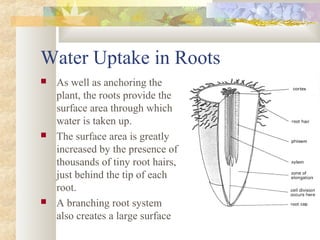
 As well as anchoring the
plant, the roots provide the
surface area through which
water is taken up.
 The surface area is greatly
increased by the presence of
thousands of tiny root hairs,
just behind the tip of each
root.
 A branching root system
also creates a large surface
Water Uptake in Roots
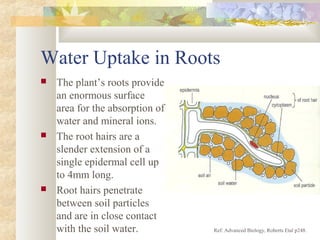
 The plant’s roots provide
an enormous surface
area for the absorption of
water and mineral ions.
 The root hairs are a
slender extension of a
single epidermal cell up
to 4mm long.
 Root hairs penetrate
between soil particles
and are in close contact
with the soil water. Ref: Advanced Biology, Roberts Etal p248.
Mineral Ion Uptake by Active
Transport
 Mineral ion concentration inside the root is usually higher
that in the surrounding soil.
 Thus mineral ions are taken up by Active Transport
(requiring energy to move ions against the concentration
gradient).
 This is supported by the fact that mineral uptake requires
energy (in the form of ATP).
 In experiments, mineral uptake has been brought to a halt
by depriving the roots of oxygen or adding a substance
that blocks cellular respiration.
Additional mechanisms of
mineral ion uptake
 Facilitated diffusion (if suitable
concentration gradient)
 Mass flow (minerals move in with water)
 Mutualistic fungi growing on the root: their
fine threadlike hyphae provide a large
surface area for mineral uptake and most of
these are passed on to the plant
Water Uptake
 The epidermal cells absorb mineral ions by active
transport.
 Thus the solute concentration is higher in the epidermal
cell that in the soil water.
 Thus water moves into the cells by Osmosis (down the
concentration gradient).
 Solute concentration in the epidermal cells less than in the
cortex, so water moves into the cortex.
 This repeats across the cortex into the Xylem vessels, in
the center of the root
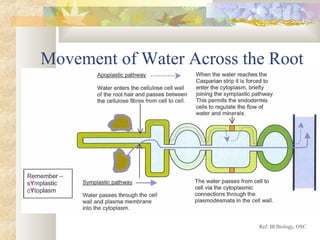
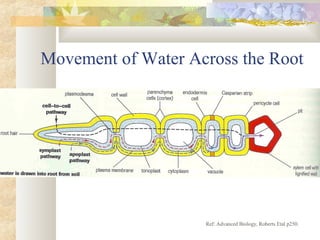
Movement of Water Across the Root
(not in current course)
 To get water from the root hairs to the xylem, 3 routes are
possible:
 The apoplastic pathway
 Water does not enter the cell.
 Water travels along the cell walls until it reaches the endodermis
 The symplastic pathway
 Water enters the cells3
 It passes from cell to cell via plasmodesmata (tiny holes in the cell
walls
Movement of Water Across the Root
Ref: IB Biology, OSC
Movement of Water Across the Root
Ref: Advanced Biology, Roberts Etal p250.
Support in Terrestrial Plants
 Plants do not have a skeleton to keep them upright.
 Trees and shrubs have woody stems that support them.
 However herbaceous plants depend mainly on turgor for
their support:
 The vacuole swells with water pushing the cell walls out.
 This gives the cells a rigid structure.
 Other methods terrestrial plants use to support themselves
are:
 Thickened cellulose cell walls
 Xylem with thickened walls.
Transpiration
 Transpiration is:
“the loss of water vapour from the leaves and
stems of the plant”
 Transpiration causes a flow of water from the roots,
through the stem to the leaves of plants.
 This is called the Transpiration Stream.
Transpiration
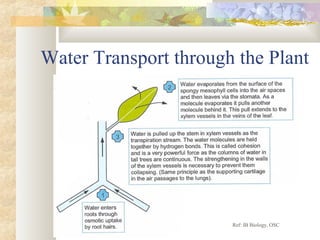
 The process starts with evaporation of water from the
leaves.
 This water is replaced with water from the xylem vessels in
the leaf.
 Low pressure or suction is created inside xylem vessels
when water is pulled out. This is called transpiration pull.
 Xylem vessels are long continuous columns of water and
this transpiration pull is transmitted down to the roots.
 The transmission of the transpiration pull through the
xylem vessels depends on the cohesion of water molecules,
due to hydrogen bonding.
 Adhesion of water to the wall of vessels is also important
when water starts to rise up the vessel again in spring.
Water Transport through the Plant
Ref: IB Biology, OSC
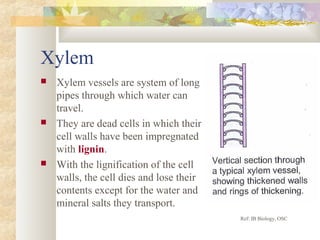
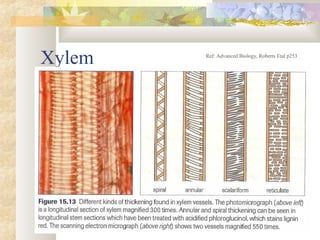
Xylem
 Xylem vessels are system of long
pipes through which water can
travel.
 They are dead cells in which their
cell walls have been impregnated
with lignin.
 With the lignification of the cell
walls, the cell dies and lose their
contents except for the water and
mineral salts they transport.
Ref: IB Biology, OSC
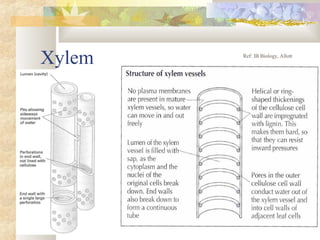
Xylem Ref: IB Biology, Allott
Xylem Ref: Advanced Biology, Roberts Etal p253
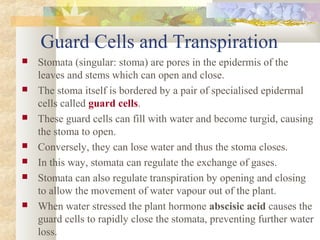
Guard Cells and Transpiration
 Stomata (singular: stoma) are pores in the epidermis of the
leaves and stems which can open and close.
 The stoma itself is bordered by a pair of specialised epidermal
cells called guard cells.
 These guard cells can fill with water and become turgid, causing
the stoma to open.
 Conversely, they can lose water and thus the stoma closes.
 In this way, stomata can regulate the exchange of gases.
 Stomata can also regulate transpiration by opening and closing
to allow the movement of water vapour out of the plant.
 When water stressed the plant hormone abscisic acid causes the
guard cells to rapidly close the stomata, preventing further water
loss.
Factors Affecting Transpiration
 There are 4 main abiotic factors that can affect the rate of
transpiration in a typical terrestrial mesophytic plant:
 Temperature
 Increase in temp  increase in transpiration
 Light
 Increase in light  increase in transpiration
 Wind
 Increase in wind  increase in transpiration
 Humidity
 Increase in humidity  decrease in transpiration
Explanation of external factors
 Light: guard cells close in darkness so transpiration
greater in the light.
 Temperature: higher temperatures increase
evaporation, rate of diffusion of water vapour
through the air spaces and reduce relative humidity
of the external air (increasing conc. gradient).
 Humidity: a lower humidity outside the leaf
increases the concentration gradient for water
vapour.
 Wind: blows air saturated with water vapour away,
Xerophytes
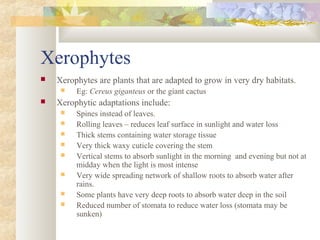
 Xerophytes are plants that are adapted to grow in very dry habitats.
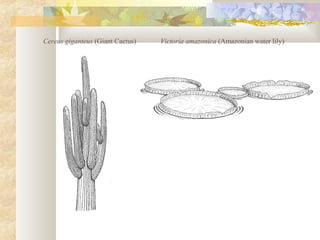
 Eg: Cereus giganteus or the giant cactus
 Xerophytic adaptations include:
 Spines instead of leaves.
 Rolling leaves – reduces leaf surface in sunlight and water loss
 Thick stems containing water storage tissue
 Very thick waxy cuticle covering the stem
 Vertical stems to absorb sunlight in the morning and evening but not at
midday when the light is most intense
 Very wide spreading network of shallow roots to absorb water after
rains.
 Some plants have very deep roots to absorb water deep in the soil
 Reduced number of stomata to reduce water loss (stomata may be
sunken)
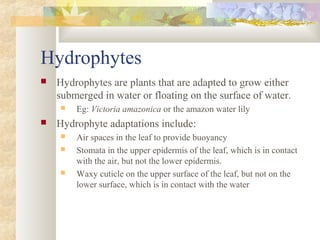
Hydrophytes
 Hydrophytes are plants that are adapted to grow either
submerged in water or floating on the surface of water.
 Eg: Victoria amazonica or the amazon water lily
 Hydrophyte adaptations include:
 Air spaces in the leaf to provide buoyancy
 Stomata in the upper epidermis of the leaf, which is in contact
with the air, but not the lower epidermis.
 Waxy cuticle on the upper surface of the leaf, but not on the
lower surface, which is in contact with the water
Cereus giganteus (Giant Cactus) Victoria amazonica (Amazonian water lily)
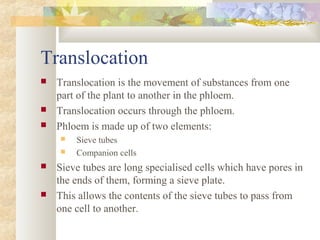
Translocation
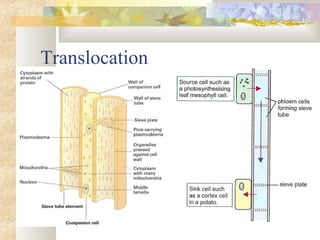
 Translocation is the movement of substances from one
part of the plant to another in the phloem.
 Translocation occurs through the phloem.
 Phloem is made up of two elements:
 Sieve tubes
 Companion cells
 Sieve tubes are long specialised cells which have pores in
the ends of them, forming a sieve plate.
 This allows the contents of the sieve tubes to pass from
one cell to another.
Translocation
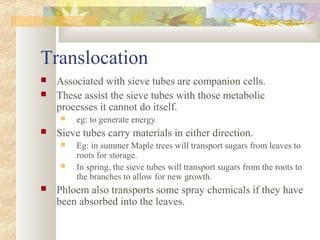
 Associated with sieve tubes are companion cells.
 These assist the sieve tubes with those metabolic
processes it cannot do itself.
 eg: to generate energy
 Sieve tubes carry materials in either direction.
 Eg: in summer Maple trees will transport sugars from leaves to
roots for storage.
 In spring, the sieve tubes will transport sugars from the roots to
the branches to allow for new growth.
 Phloem also transports some spray chemicals if they have
been absorbed into the leaves.
Translocation
Transport in Angiospermophytes
 9.2.1 Outline how the root system provides a large surface
area for mineral ion and water uptake by means of branching
and root hairs.
 9.2.2 List ways in which mineral ions in the soil move to the
root. (There are three processes: diffusion of mineral ions,
fungal hyphae (mutualism), and mass flow of water in the
soil carrying ions).
 9.2.3 Explain the process of mineral ion absorption from the
soil into roots by active transport.
 9.2.4 State that terrestrial plants support themselves by
means of thickened cellulose, cell turgor and lignified xylem.
Transport in Angiospermophytes
 9.2.5 Define transpiration. Transpiration is the loss of water
vapour from the leaves and stems of plants.
 Aim 7: Data logging with pressure sensors, humidity, light
or temperature probes to measure rates of transpiration can
be performed.
 9.2.6 Explain how water is carried by the transpiration
stream, including the structure of xylem vessels,
transpiration pull, cohesion, adhesion and evaporation.
(Limit the structure of xylem vessels to one type of primary
xylem).
Transport in Angiospermophytes
 9.2.7 State that guard cells can regulate transpiration by
opening and closing stomata.
 9.2.8 State that the plant hormone abscisic acid causes the
closing of stomata.
 9.2.9 Explain how the abiotic factors light, temperature, wind
and humidity, affect the rate of transpiration in a typical
terrestrial plant.
Transport in Angiospermophytes
9.2.10 Outline four adaptations of xerophytes that help to
reduce transpiration.
These could include: reduced leaves, rolled leaves, spines, deep
roots, thickened waxy cuticle, reduced number of stomata,
stomata in pits surrounded by hairs, water storage tissue, low
growth form, CAM (crassulacean acid metabolism) and C4
physiology.
Transport in Angiospermophytes
 9.2.11 Outline the role of phloem in active translocation of
sugars (sucrose) and amino acids from source
(photosynthetic tissue and storage organs) to sink (fruits,
seeds, roots).
 No detail of the mechanism of translocation or the structure
of phloem is required.

9.2 transport in angiospermophytes

  • 1.
    9.2 Transport inAngiospermophytes Topic 9 Plant Science
  • 2.
    Transport in Angiospermophytes 9.2.1 Outline how the root system provides a large surface area for mineral ion and water uptake by means of branching and root hairs.  9.2.2 List ways in which mineral ions in the soil move to the root. (There are three processes: diffusion of mineral ions, fungal hyphae (mutualism), and mass flow of water in the soil carrying ions).  9.2.3 Explain the process of mineral ion absorption from the soil into roots by active transport.  9.2.4 State that terrestrial plants support themselves by means of thickened cellulose, cell turgor and lignified xylem.
  • 3.
    Transport in Angiospermophytes 9.2.5 Define transpiration. Transpiration is the loss of water vapour from the leaves and stems of plants.  Aim 7: Data logging with pressure sensors, humidity, light or temperature probes to measure rates of transpiration can be performed.  9.2.6 Explain how water is carried by the transpiration stream, including the structure of xylem vessels, transpiration pull, cohesion, adhesion and evaporation. (Limit the structure of xylem vessels to one type of primary xylem).
  • 4.
    Transport in Angiospermophytes 9.2.7 State that guard cells can regulate transpiration by opening and closing stomata.  9.2.8 State that the plant hormone abscisic acid causes the closing of stomata.  9.2.9 Explain how the abiotic factors light, temperature, wind and humidity, affect the rate of transpiration in a typical terrestrial plant.
  • 5.
    Transport in Angiospermophytes 9.2.10Outline four adaptations of xerophytes that help to reduce transpiration. These could include: reduced leaves, rolled leaves, spines, deep roots, thickened waxy cuticle, reduced number of stomata, stomata in pits surrounded by hairs, water storage tissue, low growth form, CAM (crassulacean acid metabolism) and C4 physiology.
  • 6.
    Transport in Angiospermophytes 9.2.11 Outline the role of phloem in active translocation of sugars (sucrose) and amino acids from source (photosynthetic tissue and storage organs) to sink (fruits, seeds, roots).  No detail of the mechanism of translocation or the structure of phloem is required.
  • 7.
    Water Uptake inRoots  As well as anchoring the plant, the roots provide the surface area through which water is taken up.  The surface area is greatly increased by the presence of thousands of tiny root hairs, just behind the tip of each root.  A branching root system also creates a large surface
  • 8.
    Water Uptake inRoots  The plant’s roots provide an enormous surface area for the absorption of water and mineral ions.  The root hairs are a slender extension of a single epidermal cell up to 4mm long.  Root hairs penetrate between soil particles and are in close contact with the soil water. Ref: Advanced Biology, Roberts Etal p248.
  • 9.
    Mineral Ion Uptakeby Active Transport  Mineral ion concentration inside the root is usually higher that in the surrounding soil.  Thus mineral ions are taken up by Active Transport (requiring energy to move ions against the concentration gradient).  This is supported by the fact that mineral uptake requires energy (in the form of ATP).  In experiments, mineral uptake has been brought to a halt by depriving the roots of oxygen or adding a substance that blocks cellular respiration.
  • 10.
    Additional mechanisms of mineralion uptake  Facilitated diffusion (if suitable concentration gradient)  Mass flow (minerals move in with water)  Mutualistic fungi growing on the root: their fine threadlike hyphae provide a large surface area for mineral uptake and most of these are passed on to the plant
  • 11.
    Water Uptake  Theepidermal cells absorb mineral ions by active transport.  Thus the solute concentration is higher in the epidermal cell that in the soil water.  Thus water moves into the cells by Osmosis (down the concentration gradient).  Solute concentration in the epidermal cells less than in the cortex, so water moves into the cortex.  This repeats across the cortex into the Xylem vessels, in the center of the root
  • 12.
    Movement of WaterAcross the Root (not in current course)  To get water from the root hairs to the xylem, 3 routes are possible:  The apoplastic pathway  Water does not enter the cell.  Water travels along the cell walls until it reaches the endodermis  The symplastic pathway  Water enters the cells3  It passes from cell to cell via plasmodesmata (tiny holes in the cell walls
  • 13.
    Movement of WaterAcross the Root Ref: IB Biology, OSC
  • 14.
    Movement of WaterAcross the Root Ref: Advanced Biology, Roberts Etal p250.
  • 15.
    Support in TerrestrialPlants  Plants do not have a skeleton to keep them upright.  Trees and shrubs have woody stems that support them.  However herbaceous plants depend mainly on turgor for their support:  The vacuole swells with water pushing the cell walls out.  This gives the cells a rigid structure.  Other methods terrestrial plants use to support themselves are:  Thickened cellulose cell walls  Xylem with thickened walls.
  • 16.
    Transpiration  Transpiration is: “theloss of water vapour from the leaves and stems of the plant”  Transpiration causes a flow of water from the roots, through the stem to the leaves of plants.  This is called the Transpiration Stream.
  • 17.
    Transpiration  The processstarts with evaporation of water from the leaves.  This water is replaced with water from the xylem vessels in the leaf.  Low pressure or suction is created inside xylem vessels when water is pulled out. This is called transpiration pull.  Xylem vessels are long continuous columns of water and this transpiration pull is transmitted down to the roots.  The transmission of the transpiration pull through the xylem vessels depends on the cohesion of water molecules, due to hydrogen bonding.  Adhesion of water to the wall of vessels is also important when water starts to rise up the vessel again in spring.
  • 18.
    Water Transport throughthe Plant Ref: IB Biology, OSC
  • 19.
    Xylem  Xylem vesselsare system of long pipes through which water can travel.  They are dead cells in which their cell walls have been impregnated with lignin.  With the lignification of the cell walls, the cell dies and lose their contents except for the water and mineral salts they transport. Ref: IB Biology, OSC
  • 20.
    Xylem Ref: IBBiology, Allott
  • 21.
    Xylem Ref: AdvancedBiology, Roberts Etal p253
  • 22.
    Guard Cells andTranspiration  Stomata (singular: stoma) are pores in the epidermis of the leaves and stems which can open and close.  The stoma itself is bordered by a pair of specialised epidermal cells called guard cells.  These guard cells can fill with water and become turgid, causing the stoma to open.  Conversely, they can lose water and thus the stoma closes.  In this way, stomata can regulate the exchange of gases.  Stomata can also regulate transpiration by opening and closing to allow the movement of water vapour out of the plant.  When water stressed the plant hormone abscisic acid causes the guard cells to rapidly close the stomata, preventing further water loss.
  • 23.
    Factors Affecting Transpiration There are 4 main abiotic factors that can affect the rate of transpiration in a typical terrestrial mesophytic plant:  Temperature  Increase in temp  increase in transpiration  Light  Increase in light  increase in transpiration  Wind  Increase in wind  increase in transpiration  Humidity  Increase in humidity  decrease in transpiration
  • 24.
    Explanation of externalfactors  Light: guard cells close in darkness so transpiration greater in the light.  Temperature: higher temperatures increase evaporation, rate of diffusion of water vapour through the air spaces and reduce relative humidity of the external air (increasing conc. gradient).  Humidity: a lower humidity outside the leaf increases the concentration gradient for water vapour.  Wind: blows air saturated with water vapour away,
  • 25.
    Xerophytes  Xerophytes areplants that are adapted to grow in very dry habitats.  Eg: Cereus giganteus or the giant cactus  Xerophytic adaptations include:  Spines instead of leaves.  Rolling leaves – reduces leaf surface in sunlight and water loss  Thick stems containing water storage tissue  Very thick waxy cuticle covering the stem  Vertical stems to absorb sunlight in the morning and evening but not at midday when the light is most intense  Very wide spreading network of shallow roots to absorb water after rains.  Some plants have very deep roots to absorb water deep in the soil  Reduced number of stomata to reduce water loss (stomata may be sunken)
  • 26.
    Hydrophytes  Hydrophytes areplants that are adapted to grow either submerged in water or floating on the surface of water.  Eg: Victoria amazonica or the amazon water lily  Hydrophyte adaptations include:  Air spaces in the leaf to provide buoyancy  Stomata in the upper epidermis of the leaf, which is in contact with the air, but not the lower epidermis.  Waxy cuticle on the upper surface of the leaf, but not on the lower surface, which is in contact with the water
  • 27.
    Cereus giganteus (GiantCactus) Victoria amazonica (Amazonian water lily)
  • 28.
    Translocation  Translocation isthe movement of substances from one part of the plant to another in the phloem.  Translocation occurs through the phloem.  Phloem is made up of two elements:  Sieve tubes  Companion cells  Sieve tubes are long specialised cells which have pores in the ends of them, forming a sieve plate.  This allows the contents of the sieve tubes to pass from one cell to another.
  • 29.
    Translocation  Associated withsieve tubes are companion cells.  These assist the sieve tubes with those metabolic processes it cannot do itself.  eg: to generate energy  Sieve tubes carry materials in either direction.  Eg: in summer Maple trees will transport sugars from leaves to roots for storage.  In spring, the sieve tubes will transport sugars from the roots to the branches to allow for new growth.  Phloem also transports some spray chemicals if they have been absorbed into the leaves.
  • 30.
  • 31.
    Transport in Angiospermophytes 9.2.1 Outline how the root system provides a large surface area for mineral ion and water uptake by means of branching and root hairs.  9.2.2 List ways in which mineral ions in the soil move to the root. (There are three processes: diffusion of mineral ions, fungal hyphae (mutualism), and mass flow of water in the soil carrying ions).  9.2.3 Explain the process of mineral ion absorption from the soil into roots by active transport.  9.2.4 State that terrestrial plants support themselves by means of thickened cellulose, cell turgor and lignified xylem.
  • 32.
    Transport in Angiospermophytes 9.2.5 Define transpiration. Transpiration is the loss of water vapour from the leaves and stems of plants.  Aim 7: Data logging with pressure sensors, humidity, light or temperature probes to measure rates of transpiration can be performed.  9.2.6 Explain how water is carried by the transpiration stream, including the structure of xylem vessels, transpiration pull, cohesion, adhesion and evaporation. (Limit the structure of xylem vessels to one type of primary xylem).
  • 33.
    Transport in Angiospermophytes 9.2.7 State that guard cells can regulate transpiration by opening and closing stomata.  9.2.8 State that the plant hormone abscisic acid causes the closing of stomata.  9.2.9 Explain how the abiotic factors light, temperature, wind and humidity, affect the rate of transpiration in a typical terrestrial plant.
  • 34.
    Transport in Angiospermophytes 9.2.10Outline four adaptations of xerophytes that help to reduce transpiration. These could include: reduced leaves, rolled leaves, spines, deep roots, thickened waxy cuticle, reduced number of stomata, stomata in pits surrounded by hairs, water storage tissue, low growth form, CAM (crassulacean acid metabolism) and C4 physiology.
  • 35.
    Transport in Angiospermophytes 9.2.11 Outline the role of phloem in active translocation of sugars (sucrose) and amino acids from source (photosynthetic tissue and storage organs) to sink (fruits, seeds, roots).  No detail of the mechanism of translocation or the structure of phloem is required.