

11a Bilegdemberel.M
Why plants need a
    transport system?
           
Plants cells need a regular supply
 of oxygen and nutrients.
Their body is too large.
Diffusion from external
 environment is not an option.
Xylem and phloem tissue in
     roots, stems and leaves
                                 
 Xylem: Water uptake near roots->Water enters xylem-> water moves
  up xylem->Water moves from xylem to leaf cells
 Phloem: This process is called translocation and involves the
  movement of organic substances around the plant. It requires energy
  to create a pressure difference and so is considered an active process.
 Sucrose is loaded into the phloem at a source, usually a
  photosynthesizing leaf. For this to occur, hydrogen ions are pumped
  out of the companion cell using ATP. This creates a high concentration
  of hydrogen ions outside the companion cell. Sucrose is loaded
  (moved into companion cells) by active transport, against the
  concentration gradient.
 However, the protein carrier involved in the loading, has two sites, one
  for sucrose and one for a hydrogen ion. When it is used to pump
  sucrose into the companion cell, hydrogen will move in the opposite
  direction, back down its concentration gradient. This is why a high
  concentration of ions is needed outside the cell.
 The sucrose can then diffuse down the concentration
  gradient into the sieve tube element via the
  plasmodesmata that connects the companion cell with the
  sieve tube element. This lowers the water potential of the
                            
  sieve element so water enters by osmosis.
 At another point sucrose will be unloaded from the
  phloem into a sink (e.g. root). It is likely that the sucrose
  moves out by diffusion and is then converted into another
  substance to maintain a concentration gradient. Again,
  water will follow by osmosis.
 This loading and unloading results in the mass flow of
  substances in the phloem. There is evidence to support
  this theory; the rate of flow in the phloem is about 10,000
  times faster than it would be if it was due only to
  diffusion, the pH of the phloem sap is around 8 (it is
  alkaline due to loss of hydrogen ions), and there is an
  electrical potential difference across the cell surface
  (negative inside due presumably to the loss of positively
  charged ions).
Mechanism Of Water
       Transport
           
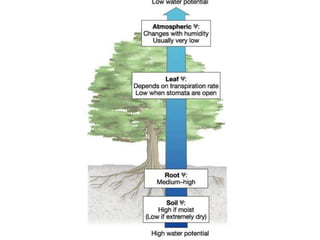
 The root hair cells have a concentrated cell sap vacuole which
  means that the water potential is low in it and high in the soil,
  osmosis takes place and water enters the cell.
 Minerals are also present in the soil but in low concentration,
  using active up take, the root hair cells takes the mineral ions in.
 The mixture of mineral and water moves from the root hair cells
  through the other cells by osmosis active uptake till it reaches
  the xylem vessel in the root, it enters the xylem through pits.
 The xylem vessel transports the water from the root to the stem
  (forming the vascular bundle with the phloem) and upwards to
  the leaves.
 The water and dissolved minerals leave the xylem and get
  absorbed by the cells in the leaves.

How Water Moves
     Through The Xylem
             
 In root hair cells, the mineral concentration is high, it
  helps pushing the water towards the xylem and the stem.
 Capillarity is a factor that helps in the movement of water
  in the xylem vessels. The water molecules are attracted to
  each other, as one moves upwards it pulls its
  neighbouring molecule with it. The molecules are also
  attracted to the walls of the xylem, the narrower the
  xylem the easier it is for water to move.
 Transpiration force is the most effective force that causes
  water movement. In the leaf, the water evaporates and
  leaves the plant through the stomata, one molecule
  escapes pulling the other with it, and so on, creating a
  suction force. You can think of it as using a straw to drink.
Transpiration
                 
 Transpiration is the evaporation of water from plants.
  It occurs chiefly at the leaves while their stomata are
  open for the passage of CO2 and
  O2 during photosynthesis.
Environmental factors that
 affect the rate of transpiration
                               
 1. Light
  Plants transpire more rapidly in the light than in the dark. This is
  largely because light stimulates the opening of the stomata
  (mechanism). Light also speeds up transpiration by warming the
  leaf.
 2. Temperature
  Plants transpire more rapidly at higher temperatures because
  water evaporates more rapidly as the temperature rises. At
  30 C, a leaf may transpire three times as fast as it does at
  20 C.
 3. Humidity
  The rate of diffusion of any substance increases as the
  difference in concentration of the substances in the two regions
  increases.When the surrounding air is dry, diffusion of water out
  of the leaf goes on more rapidly.
Environmental factors that
 affect the rate of transpiration
                                     
 3. Humidity
  The rate of diffusion of any substance increases as the difference in
  concentration of the substances in the two regions increases.When the
  surrounding air is dry, diffusion of water out of the leaf goes on more
  rapidly.
 4. Wind
  When there is no breeze, the air surrounding a leaf becomes increasingly
  humid thus reducing the rate of transpiration. When a breeze is present,
  the humid air is carried away and replaced by drier air.
 5. Soil water
  A plant cannot continue to transpire rapidly if its water loss is not made up
  by replacement from the soil. When absorption of water by the roots fails
  to keep up with the rate of transpiration, loss of turgor occurs, and the
  stomata close. This immediately reduces the rate of transpiration (as well
  as of photosynthesis). If the loss of turgor extends to the rest of the leaf and
  stem, the plant wilts.
Companion cells
              
 A cell with an unthickened cellulose wall and dense
  cytoplasm that is found in close association with a
  phloem sieve element to which it is directly linked via
  many plasmodemata.
 Companion cells probably provide ATP, proteins, and
  other substances to the sieve-tube elements, whose
  cytoplasm lacks many structures necessary for cell
  maintenance.
Xerophyte
                          
 A type of plant that is well-adapted to water
  shortages and exhibits adaptations that enable it to
  store or conserve water. Xerophytes often live in
  regions where evapotranspiration (the sum of
  evaporation and plant transpiration) is greater than
  precipitation for the region during all or part of the
  growing season. Adaptations that xerophytes might
  exhibit include succulent leaves and stems (to store
  water), fewer stomata (to reduce water loss), and a
  deep or widespread root system (to optimize water
  uptake).


    The end

Transport in multicellular plants

  • 1.
  • 2.
    Why plants needa transport system?  Plants cells need a regular supply of oxygen and nutrients. Their body is too large. Diffusion from external environment is not an option.
  • 3.
    Xylem and phloemtissue in roots, stems and leaves   Xylem: Water uptake near roots->Water enters xylem-> water moves up xylem->Water moves from xylem to leaf cells  Phloem: This process is called translocation and involves the movement of organic substances around the plant. It requires energy to create a pressure difference and so is considered an active process.  Sucrose is loaded into the phloem at a source, usually a photosynthesizing leaf. For this to occur, hydrogen ions are pumped out of the companion cell using ATP. This creates a high concentration of hydrogen ions outside the companion cell. Sucrose is loaded (moved into companion cells) by active transport, against the concentration gradient.  However, the protein carrier involved in the loading, has two sites, one for sucrose and one for a hydrogen ion. When it is used to pump sucrose into the companion cell, hydrogen will move in the opposite direction, back down its concentration gradient. This is why a high concentration of ions is needed outside the cell.
  • 4.
     The sucrosecan then diffuse down the concentration gradient into the sieve tube element via the plasmodesmata that connects the companion cell with the sieve tube element. This lowers the water potential of the  sieve element so water enters by osmosis.  At another point sucrose will be unloaded from the phloem into a sink (e.g. root). It is likely that the sucrose moves out by diffusion and is then converted into another substance to maintain a concentration gradient. Again, water will follow by osmosis.  This loading and unloading results in the mass flow of substances in the phloem. There is evidence to support this theory; the rate of flow in the phloem is about 10,000 times faster than it would be if it was due only to diffusion, the pH of the phloem sap is around 8 (it is alkaline due to loss of hydrogen ions), and there is an electrical potential difference across the cell surface (negative inside due presumably to the loss of positively charged ions).
  • 5.
    Mechanism Of Water Transport   The root hair cells have a concentrated cell sap vacuole which means that the water potential is low in it and high in the soil, osmosis takes place and water enters the cell.  Minerals are also present in the soil but in low concentration, using active up take, the root hair cells takes the mineral ions in.  The mixture of mineral and water moves from the root hair cells through the other cells by osmosis active uptake till it reaches the xylem vessel in the root, it enters the xylem through pits.  The xylem vessel transports the water from the root to the stem (forming the vascular bundle with the phloem) and upwards to the leaves.  The water and dissolved minerals leave the xylem and get absorbed by the cells in the leaves.
  • 6.
  • 7.
    How Water Moves Through The Xylem   In root hair cells, the mineral concentration is high, it helps pushing the water towards the xylem and the stem.  Capillarity is a factor that helps in the movement of water in the xylem vessels. The water molecules are attracted to each other, as one moves upwards it pulls its neighbouring molecule with it. The molecules are also attracted to the walls of the xylem, the narrower the xylem the easier it is for water to move.  Transpiration force is the most effective force that causes water movement. In the leaf, the water evaporates and leaves the plant through the stomata, one molecule escapes pulling the other with it, and so on, creating a suction force. You can think of it as using a straw to drink.
  • 8.
    Transpiration   Transpiration is the evaporation of water from plants. It occurs chiefly at the leaves while their stomata are open for the passage of CO2 and O2 during photosynthesis.
  • 9.
    Environmental factors that affect the rate of transpiration   1. Light Plants transpire more rapidly in the light than in the dark. This is largely because light stimulates the opening of the stomata (mechanism). Light also speeds up transpiration by warming the leaf.  2. Temperature Plants transpire more rapidly at higher temperatures because water evaporates more rapidly as the temperature rises. At 30 C, a leaf may transpire three times as fast as it does at 20 C.  3. Humidity The rate of diffusion of any substance increases as the difference in concentration of the substances in the two regions increases.When the surrounding air is dry, diffusion of water out of the leaf goes on more rapidly.
  • 10.
    Environmental factors that affect the rate of transpiration   3. Humidity The rate of diffusion of any substance increases as the difference in concentration of the substances in the two regions increases.When the surrounding air is dry, diffusion of water out of the leaf goes on more rapidly.  4. Wind When there is no breeze, the air surrounding a leaf becomes increasingly humid thus reducing the rate of transpiration. When a breeze is present, the humid air is carried away and replaced by drier air.  5. Soil water A plant cannot continue to transpire rapidly if its water loss is not made up by replacement from the soil. When absorption of water by the roots fails to keep up with the rate of transpiration, loss of turgor occurs, and the stomata close. This immediately reduces the rate of transpiration (as well as of photosynthesis). If the loss of turgor extends to the rest of the leaf and stem, the plant wilts.
  • 11.
    Companion cells   A cell with an unthickened cellulose wall and dense cytoplasm that is found in close association with a phloem sieve element to which it is directly linked via many plasmodemata.  Companion cells probably provide ATP, proteins, and other substances to the sieve-tube elements, whose cytoplasm lacks many structures necessary for cell maintenance.
  • 12.
    Xerophyte   A type of plant that is well-adapted to water shortages and exhibits adaptations that enable it to store or conserve water. Xerophytes often live in regions where evapotranspiration (the sum of evaporation and plant transpiration) is greater than precipitation for the region during all or part of the growing season. Adaptations that xerophytes might exhibit include succulent leaves and stems (to store water), fewer stomata (to reduce water loss), and a deep or widespread root system (to optimize water uptake).
  • 13.
    The end