Structured Exception Handler
                                 EXPLOITATION


http://www.htbridge.ch/                                  Brian Mariani
What is an exception

•   An exception is an event that occurs during the execution of a program

•   Requires the execution of code outside the normal flow of control
Structured Exception Handling
•   Blocks of code are encapsulated, with each block having one or more associated
    handlers.

•   Each handler specifies some form of filter condition on the type of exception it
    handles

•   When an exception is raised by code in a protected block, the set of corresponding
    handlers is searched in order, and the first one with a matchingfilter condition is
    executed

•   A single method can have multiple structured exception handling blocks, and the
    blocks can also be nested within each other
Exception pointers structure (1)

•   Contains an exception record with a machine-independent description of an
    exception

•   A context record with a machine-dependent description of the processor context at
    the time of the exception
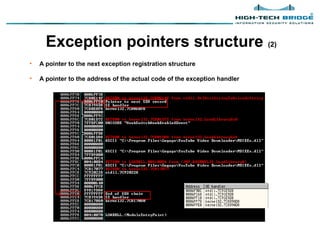
Exception pointers structure (2)
•   A pointer to the next exception registration structure

•   A pointer to the address of the actual code of the exception handler
Thread information block
•   The Thread Information Block (TIB) is a data structure in Win32 that stores
    information
    about the currently running thread

•   At the position FS:[0x00] we found the current exception handler
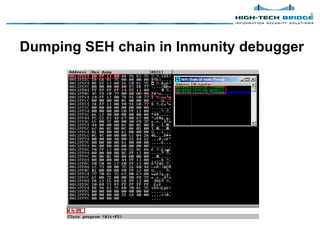
Dumping SEH chain in Inmunity debugger
How SEH works?


•   The exception handlers are linked to each other

•   They form a linked list chain on the stack, and sit relatively close to the bottom of the
    stack

•   When an exception occurs, Windows retrieves the head of the SEH chain walks
    through the list and tries to find the suitable handler to close the application properly
Abusing the SEH
•   When exploiting an SEH overwrite and attacker clobbers the handler attribute of the
    EXCEPTION_REGISTRATION_RECORD with the address of an instruction sequence
    similar to POP POP RET

•   When the exception occurs, this causes Windows to pass execution to this address,
    which subsequently returns to the location on the stack of the Next attribute of the

    EXCEPTION_REGISTRATION_RECORD

•   The Next attribute is also controlled by the attacker, but if we recall the stack layout
    from earlier, the Next attribute is below the Handler attribute

•   This limits the attacker to 4 bytes before running into the Handler address he
    previously supplied to originally obtain code execution

•   However, by overwriting the Next attribute with the instructions that jump the Handler
    attribute, the attacker typically has enough room for arbitrary shellcode, and this is
    exactly what happens
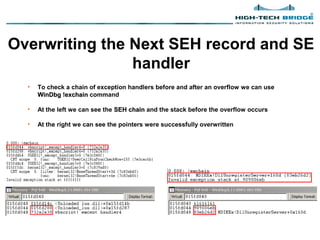
Overwriting the Next SEH record and SE
                handler
  •   To check a chain of exception handlers before and after an overflow we can use
      WinDbg !exchain command

  •   At the left we can see the SEH chain and the stack before the overflow occurs

  •   At the right we can see the pointers were successfully overwritten
What are we overwriting?


•   When we performs a regular stack based buffer overflow, we overwrite the return
    address of the Extended Instruction Pointer (EIP)

•   When doing a SEH overflow, we will continue overwriting the stack after overwriting
                       overflow
    EIP, so we can overwrite the default exception handler as well
    EIP
Viewing the SEH before the overflow
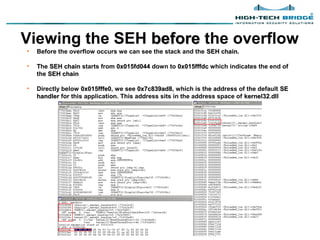
•   Before the overflow occurs we can see the stack and the SEH chain.

•   The SEH chain starts from 0x015fd044 down to 0x015fffdc which indicates the end of
    the SEH chain

•   Directly below 0x015fffe0, we see 0x7c839ad8, which is the address of the default SE
                    0x015fffe0          0x7c839ad8
    handler for this application. This address sits in the address space of kernel32.dll
Viewing the SEH after the overflow
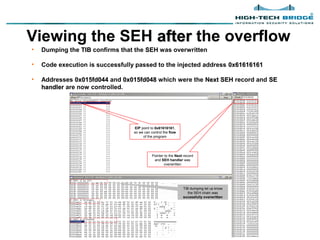
•   Dumping the TIB confirms that the SEH was overwritten

•   Code execution is successfully passed to the injected address 0x61616161

•   Addresses 0x015fd044 and 0x015fd048 which were the Next SEH record and SE
    handler are now controlled.


                                  EIP point to 0x61616161,
                                  so we can control the flow
                                       of the program


                                             Pointer to the Next record
                                              and SEH handler was
                                                     overwritten


                                                                TIB dumping let us know
                                                                   the SEH chain was
                                                                sucessfully overwritten
See an exception analysis
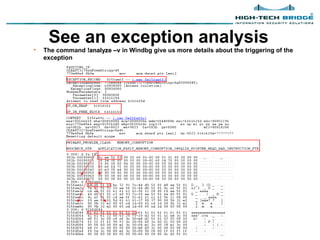
•   The command !analyze –v in Windbg give us more details about the triggering of the
    exception
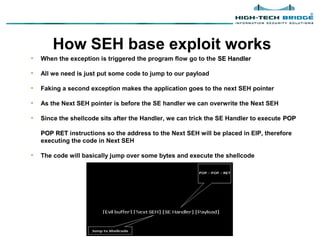
How SEH base exploit works
•   When the exception is triggered the program flow go to the SE Handler

•   All we need is just put some code to jump to our payload

•   Faking a second exception makes the application goes to the next SEH pointer

•   As the Next SEH pointer is before the SE handler we can overwrite the Next SEH

•   Since the shellcode sits after the Handler, we can trick the SE Handler to execute POP

    POP RET instructions so the address to the Next SEH will be placed in EIP, therefore
    executing the code in Next SEH

•   The code will basically jump over some bytes and execute the shellcode
Exploiting the application
•   We will exploit a vulnerability in Gogago Youtube Downloader Video ActiveX
    www.gogago.net/download/youtube_video_downloader_setup.exe

•   A buffer overflow is triggered after injecting more that 2230 bytes in the Download()
    function

•   This vulnerability could be exploited using a basic RET CALL technique

•   We will use SEH based exploitation which is also functioning in this particular case
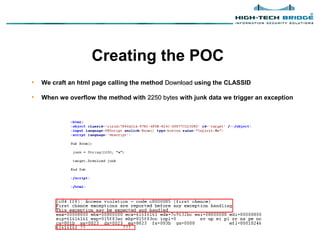
Creating the POC
•   We craft an html page calling the method Download using the CLASSID

•   When we overflow the method with 2250 bytes with junk data we trigger an exception
Overwriting Next pointer and SE
                handler
•   To successfully overwrite the Next Pointer and SE Handler we must calculate the exact
            number of bytes to inject

•   You can use tools as pattern_create and pattern_search from Metasploit, or you can do
    it manually injecting buffers with different patterns
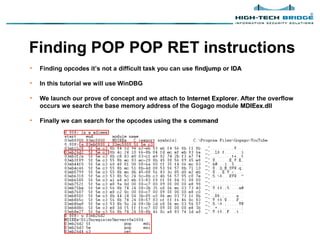
Finding POP POP RET instructions
•   Finding opcodes it’s not a difficult task you can use findjump or IDA

•   In this tutorial we will use WinDBG

•   We launch our prove of concept and we attach to Internet Explorer. After the overflow
                                                             Explorer
    occurs we search the base memory address of the Gogago module MDIEex.dll

•   Finally we can search for the opcodes using the s command
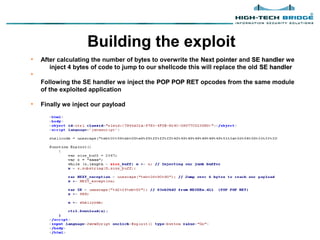
Building the exploit
•   After calculating the number of bytes to overwrite the Next pointer and SE handler we
       inject 4 bytes of code to jump to our shellcode this will replace the old SE handler
•
    Following the SE handler we inject the POP POP RET opcodes from the same module
    of the exploited application

•   Finally we inject our payload
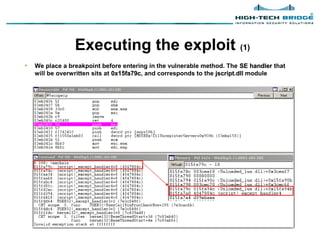
Executing the exploit (1)
•   We place a breakpoint before entering in the vulnerable method. The SE handler that
    will be overwritten sits at 0x15fa79c, and corresponds to the jscript.dll module
                                0x15fa79c
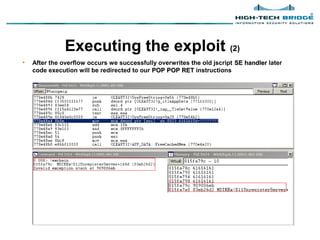
Executing the exploit (2)
•   After the overflow occurs we successfully overwrites the old jscript SE handler later
    code execution will be redirected to our POP POP RET instructions
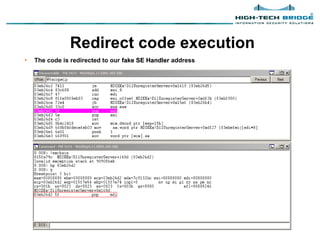
Redirect code execution
•   The code is redirected to our fake SE Handler address
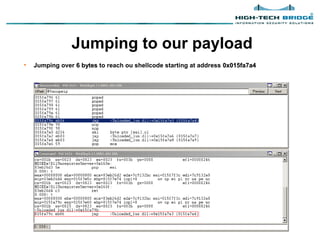
Jumping to our payload
•   Jumping over 6 bytes to reach ou shellcode starting at address 0x015fa7a4
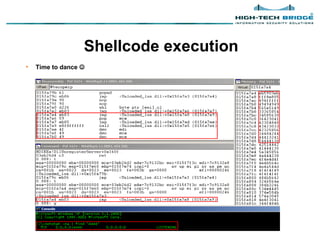
Shellcode execution
•   Time to dance 
Questions


brian.mariani@htbridge.ch
References
•   http://msdn.microsoft.com/en-us/library/ms680663%28v=VS.85%29.aspx

•   http://msdn.microsoft.com/en-us/library/c68xfk56%28v=vs.71%29.aspx

•   http://en.wikipedia.org/wiki/Win32_Thread_Information_Block

•   http://corelan.be

Structured Exception Handler Exploitation

  • 1.
    Structured Exception Handler EXPLOITATION http://www.htbridge.ch/ Brian Mariani
  • 2.
    What is anexception • An exception is an event that occurs during the execution of a program • Requires the execution of code outside the normal flow of control
  • 3.
    Structured Exception Handling • Blocks of code are encapsulated, with each block having one or more associated handlers. • Each handler specifies some form of filter condition on the type of exception it handles • When an exception is raised by code in a protected block, the set of corresponding handlers is searched in order, and the first one with a matchingfilter condition is executed • A single method can have multiple structured exception handling blocks, and the blocks can also be nested within each other
  • 4.
    Exception pointers structure(1) • Contains an exception record with a machine-independent description of an exception • A context record with a machine-dependent description of the processor context at the time of the exception
  • 5.
    Exception pointers structure(2) • A pointer to the next exception registration structure • A pointer to the address of the actual code of the exception handler
  • 6.
    Thread information block • The Thread Information Block (TIB) is a data structure in Win32 that stores information about the currently running thread • At the position FS:[0x00] we found the current exception handler
  • 7.
    Dumping SEH chainin Inmunity debugger
  • 8.
    How SEH works? • The exception handlers are linked to each other • They form a linked list chain on the stack, and sit relatively close to the bottom of the stack • When an exception occurs, Windows retrieves the head of the SEH chain walks through the list and tries to find the suitable handler to close the application properly
  • 9.
    Abusing the SEH • When exploiting an SEH overwrite and attacker clobbers the handler attribute of the EXCEPTION_REGISTRATION_RECORD with the address of an instruction sequence similar to POP POP RET • When the exception occurs, this causes Windows to pass execution to this address, which subsequently returns to the location on the stack of the Next attribute of the EXCEPTION_REGISTRATION_RECORD • The Next attribute is also controlled by the attacker, but if we recall the stack layout from earlier, the Next attribute is below the Handler attribute • This limits the attacker to 4 bytes before running into the Handler address he previously supplied to originally obtain code execution • However, by overwriting the Next attribute with the instructions that jump the Handler attribute, the attacker typically has enough room for arbitrary shellcode, and this is exactly what happens
  • 10.
    Overwriting the NextSEH record and SE handler • To check a chain of exception handlers before and after an overflow we can use WinDbg !exchain command • At the left we can see the SEH chain and the stack before the overflow occurs • At the right we can see the pointers were successfully overwritten
  • 11.
    What are weoverwriting? • When we performs a regular stack based buffer overflow, we overwrite the return address of the Extended Instruction Pointer (EIP) • When doing a SEH overflow, we will continue overwriting the stack after overwriting overflow EIP, so we can overwrite the default exception handler as well EIP
  • 12.
    Viewing the SEHbefore the overflow • Before the overflow occurs we can see the stack and the SEH chain. • The SEH chain starts from 0x015fd044 down to 0x015fffdc which indicates the end of the SEH chain • Directly below 0x015fffe0, we see 0x7c839ad8, which is the address of the default SE 0x015fffe0 0x7c839ad8 handler for this application. This address sits in the address space of kernel32.dll
  • 13.
    Viewing the SEHafter the overflow • Dumping the TIB confirms that the SEH was overwritten • Code execution is successfully passed to the injected address 0x61616161 • Addresses 0x015fd044 and 0x015fd048 which were the Next SEH record and SE handler are now controlled. EIP point to 0x61616161, so we can control the flow of the program Pointer to the Next record and SEH handler was overwritten TIB dumping let us know the SEH chain was sucessfully overwritten
  • 14.
    See an exceptionanalysis • The command !analyze –v in Windbg give us more details about the triggering of the exception
  • 15.
    How SEH baseexploit works • When the exception is triggered the program flow go to the SE Handler • All we need is just put some code to jump to our payload • Faking a second exception makes the application goes to the next SEH pointer • As the Next SEH pointer is before the SE handler we can overwrite the Next SEH • Since the shellcode sits after the Handler, we can trick the SE Handler to execute POP POP RET instructions so the address to the Next SEH will be placed in EIP, therefore executing the code in Next SEH • The code will basically jump over some bytes and execute the shellcode
  • 16.
    Exploiting the application • We will exploit a vulnerability in Gogago Youtube Downloader Video ActiveX www.gogago.net/download/youtube_video_downloader_setup.exe • A buffer overflow is triggered after injecting more that 2230 bytes in the Download() function • This vulnerability could be exploited using a basic RET CALL technique • We will use SEH based exploitation which is also functioning in this particular case
  • 17.
    Creating the POC • We craft an html page calling the method Download using the CLASSID • When we overflow the method with 2250 bytes with junk data we trigger an exception
  • 18.
    Overwriting Next pointerand SE handler • To successfully overwrite the Next Pointer and SE Handler we must calculate the exact number of bytes to inject • You can use tools as pattern_create and pattern_search from Metasploit, or you can do it manually injecting buffers with different patterns
  • 19.
    Finding POP POPRET instructions • Finding opcodes it’s not a difficult task you can use findjump or IDA • In this tutorial we will use WinDBG • We launch our prove of concept and we attach to Internet Explorer. After the overflow Explorer occurs we search the base memory address of the Gogago module MDIEex.dll • Finally we can search for the opcodes using the s command
  • 20.
    Building the exploit • After calculating the number of bytes to overwrite the Next pointer and SE handler we inject 4 bytes of code to jump to our shellcode this will replace the old SE handler • Following the SE handler we inject the POP POP RET opcodes from the same module of the exploited application • Finally we inject our payload
  • 21.
    Executing the exploit(1) • We place a breakpoint before entering in the vulnerable method. The SE handler that will be overwritten sits at 0x15fa79c, and corresponds to the jscript.dll module 0x15fa79c
  • 22.
    Executing the exploit(2) • After the overflow occurs we successfully overwrites the old jscript SE handler later code execution will be redirected to our POP POP RET instructions
  • 23.
    Redirect code execution • The code is redirected to our fake SE Handler address
  • 24.
    Jumping to ourpayload • Jumping over 6 bytes to reach ou shellcode starting at address 0x015fa7a4
  • 25.
    Shellcode execution • Time to dance 
  • 26.
  • 27.
    References • http://msdn.microsoft.com/en-us/library/ms680663%28v=VS.85%29.aspx • http://msdn.microsoft.com/en-us/library/c68xfk56%28v=vs.71%29.aspx • http://en.wikipedia.org/wiki/Win32_Thread_Information_Block • http://corelan.be