CNIT 141
Cryptography for Computer Networks
1. Encryption
Updated to Python 3 on 8-27-2020
Topics
• The Basics
• Classical Ciphers
• How Ciphers Work
• Perfect Encryption: The One-Time Pad
• Encryption Security
• Asymmetric Encryption
• When Ciphers Do More Than Encryption
• How Things Can Go Wrong
The Basics
• P: Plaintext
• K: Key
• C: Cleartext
• E: Encryption via cipher
• D: Decryption via cipher
Classical Ciphers
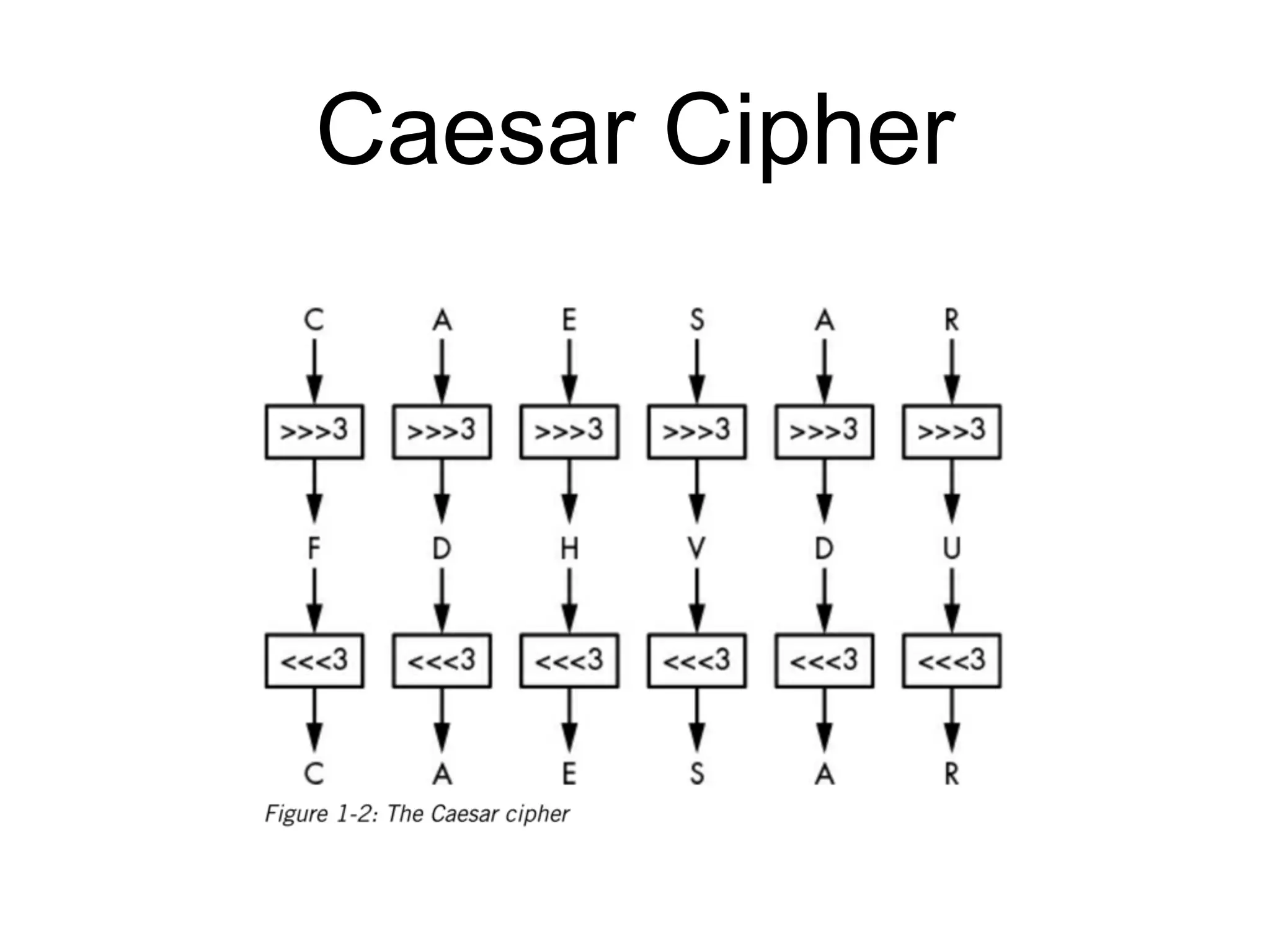
Caesar Cipher
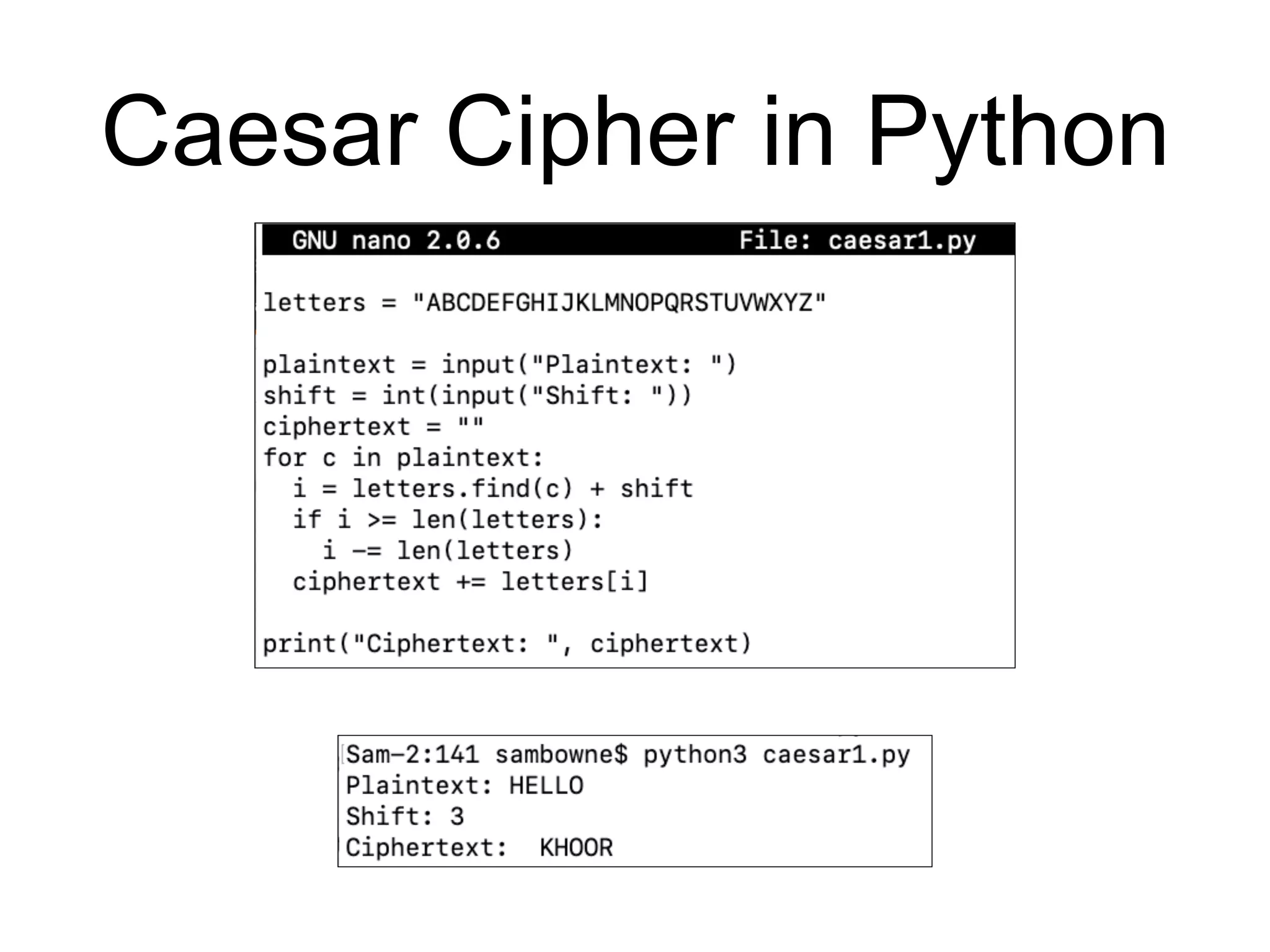
Caesar Cipher in Python
Brute Force Attack
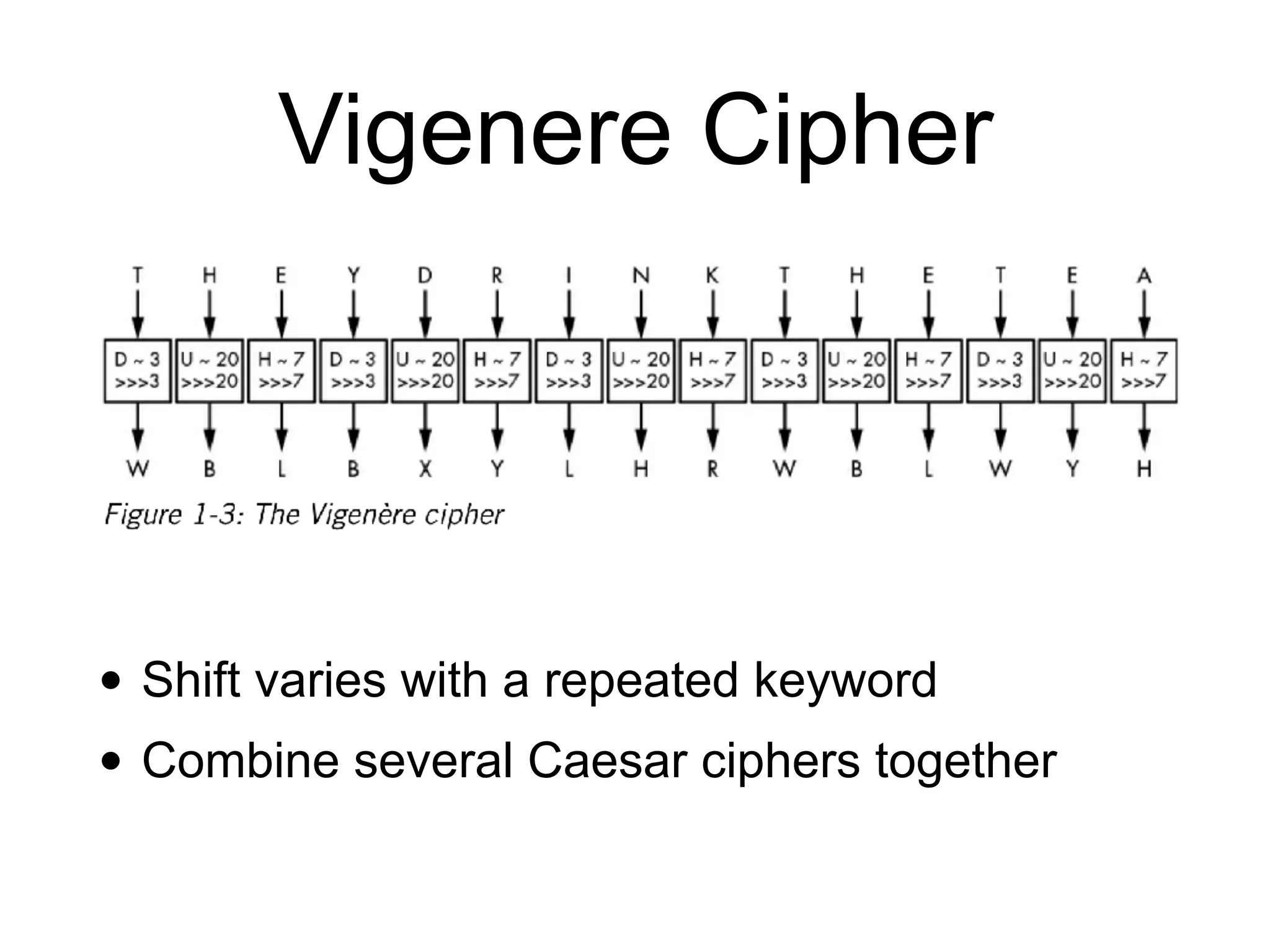
Vigenere Cipher
• Shift varies with a repeated keyword
• Combine several Caesar ciphers together
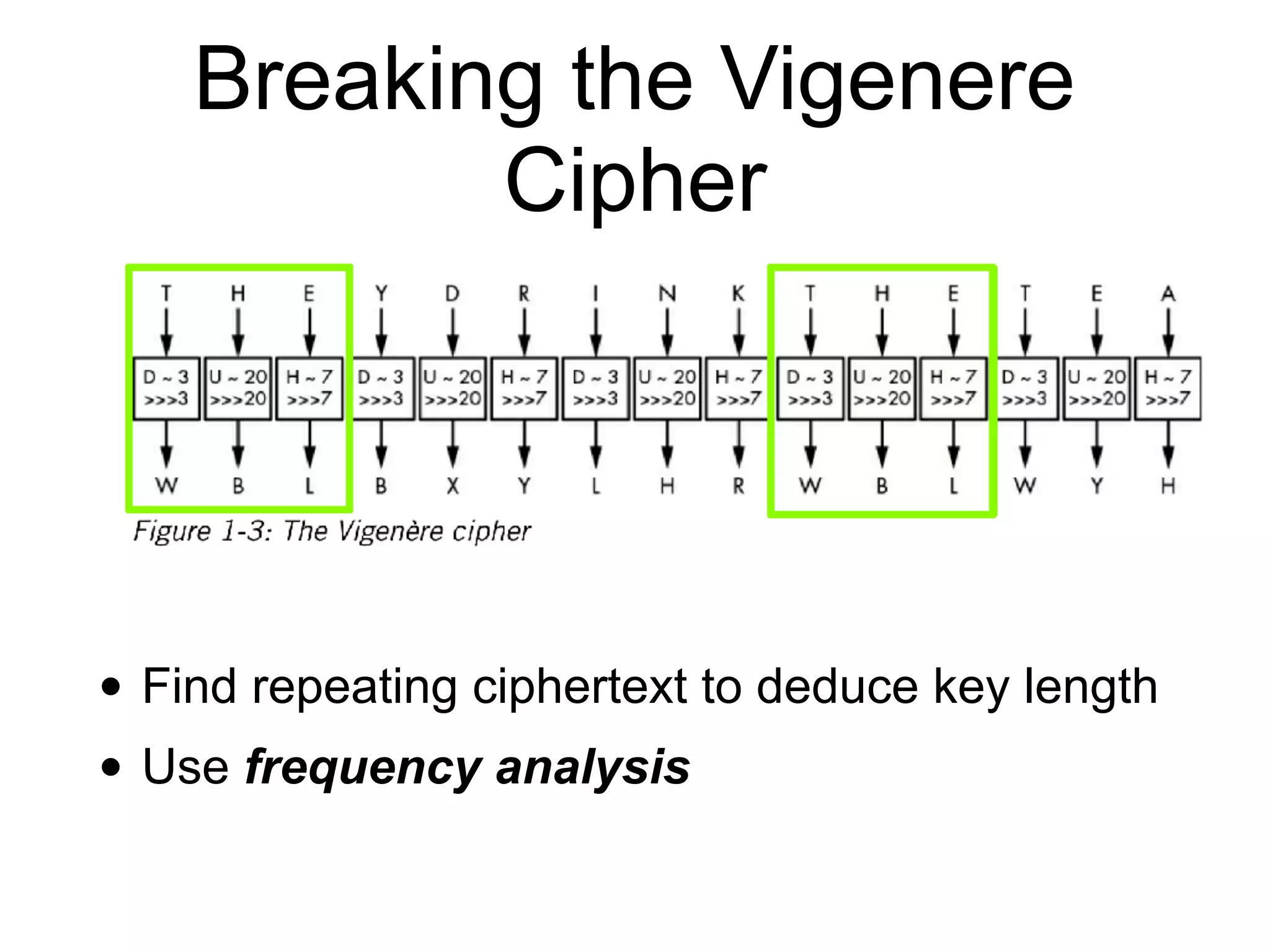
Breaking the Vigenere
Cipher
• Find repeating ciphertext to deduce key length
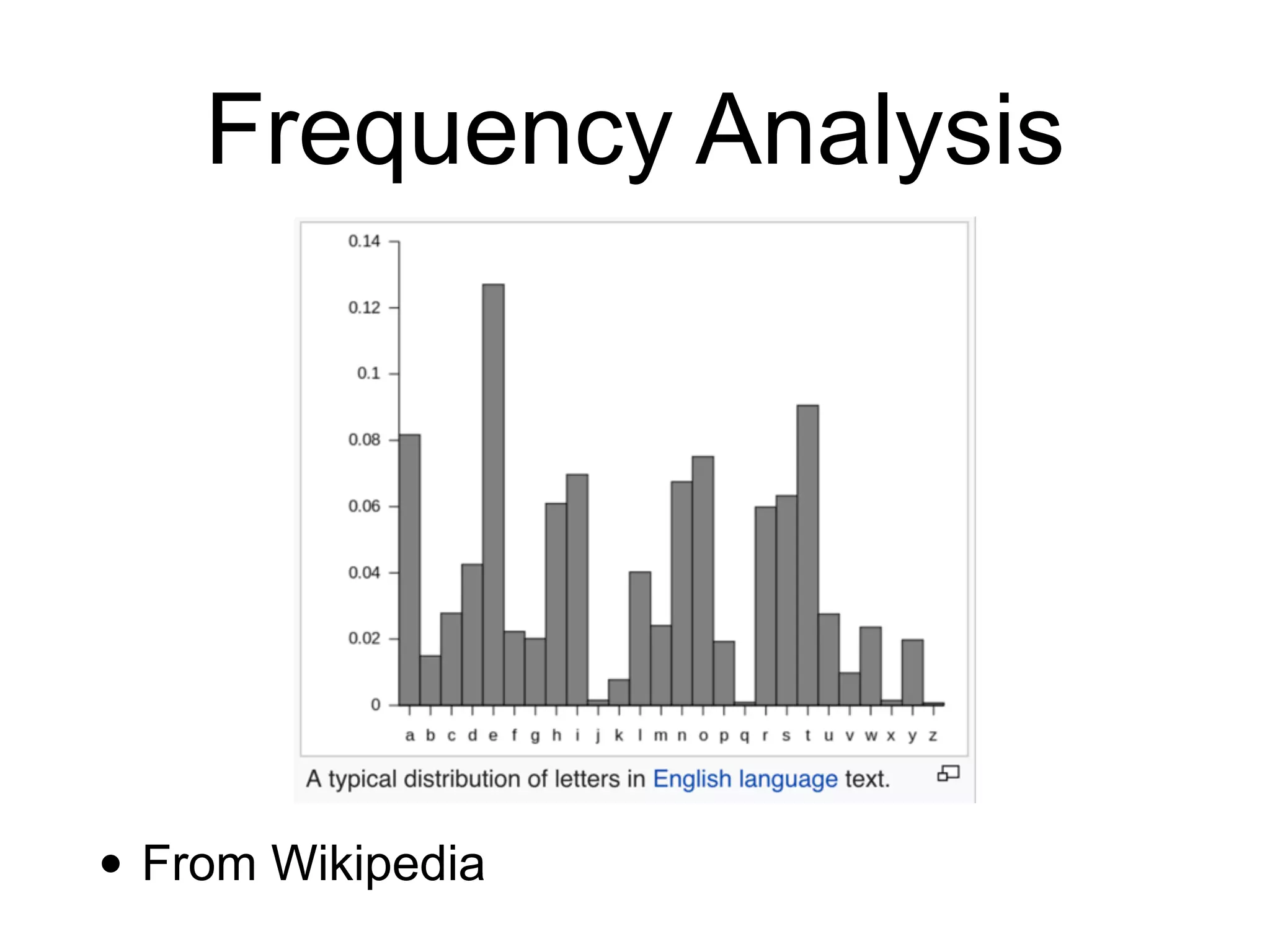
• Use frequency analysis
Frequency Analysis
• From Wikipedia
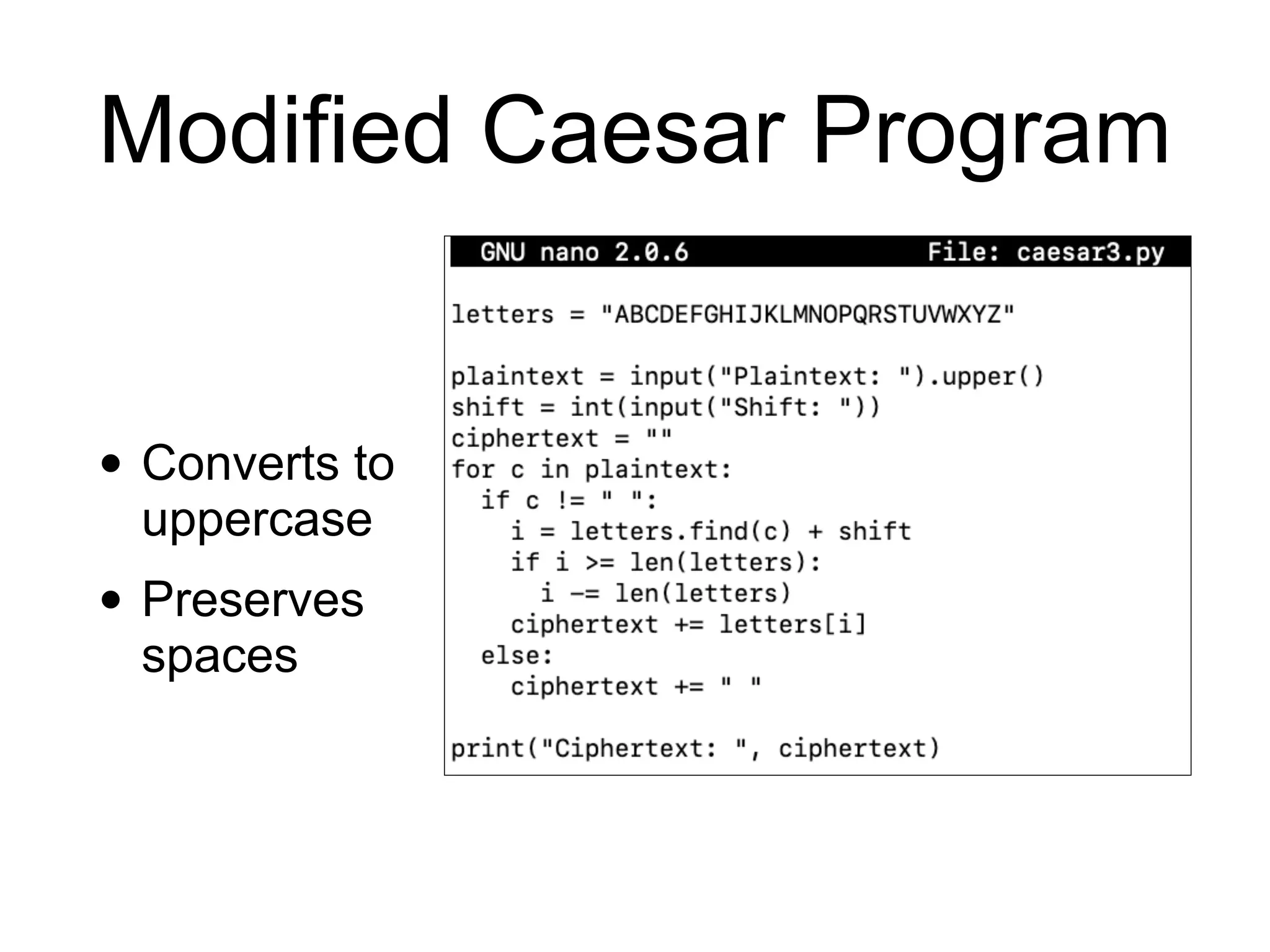
Modified Caesar Program
• Converts to
uppercase
• Preserves
spaces
Encrypt a Paragraph
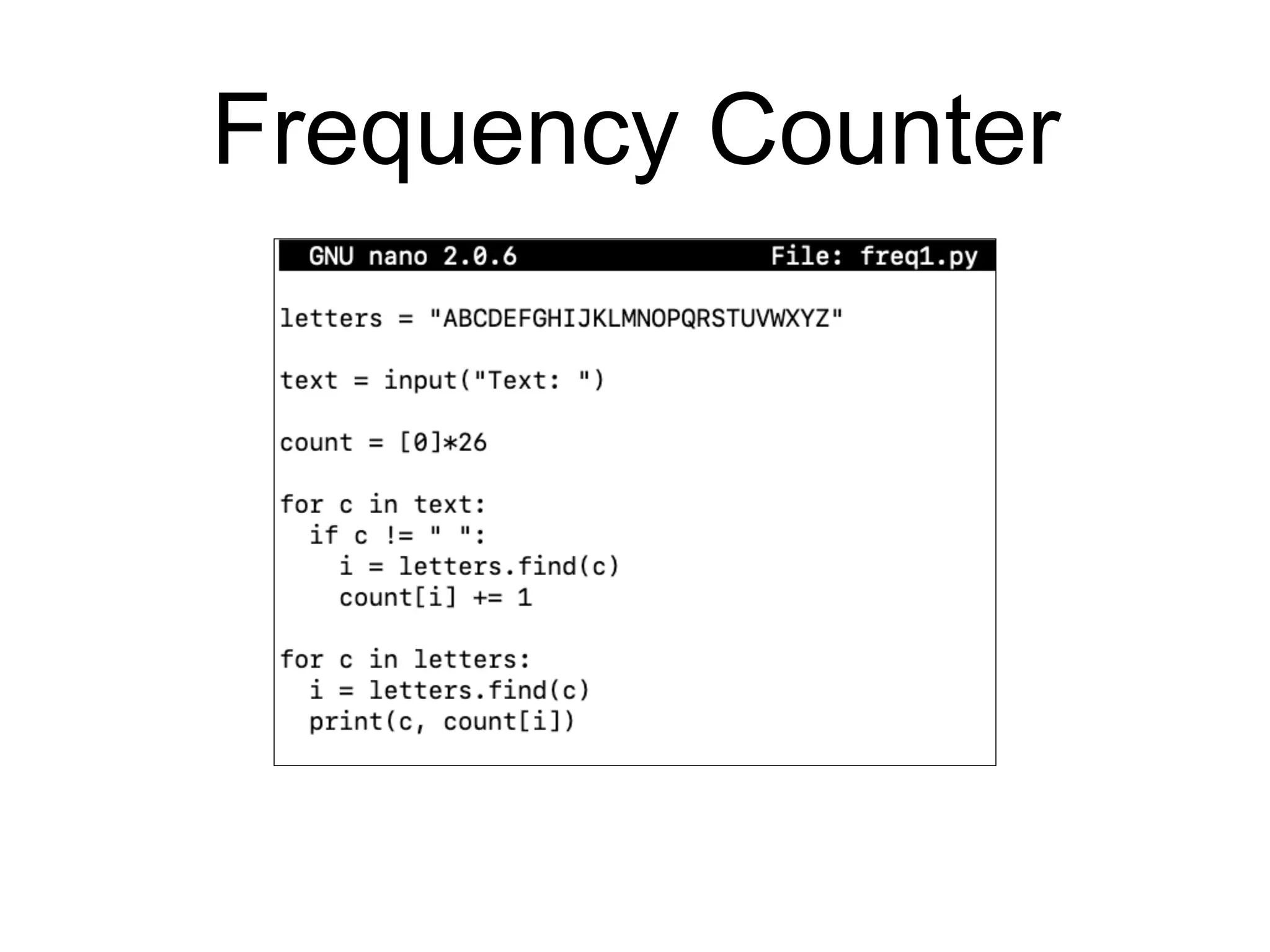
Frequency Counter
How Ciphers Work
Two Components
• Permutation
• Transforms one letter to another letter
• In Caesar cipher, shift letter three places
• Mode of Operation
• Algorithm to handle messages of arbitrary
size
• In Caesar cipher, process each letter
independently
Permutation Security
• Permutation should be determined by
the key
• If key is secret, attacker can’t easily
decrypt
• Different keys should result in different
permutations
• Permutation should look random
• No pattern in ciphertext
Mode of Operation
• Caesar cipher encrypts letters one at a time
• Double letters remain doubled
• HELLO -> KHOOR
• Patterns in plaintext are preserved in ciphertext
• Insecure (now called “Electronic Code Book”
mode)
• More secure modes encrypt repeated text
differently each time
Perfect Encryption:
The One-Time Pad
XOR
• XOR combines two bits
• 0 ^ 0 = 0
• 0 ^ 1 = 1
• 1 ^ 0 = 1
• 1 ^ 1 = 0
Encrypting a Stream of
Bits
• Plain: ABC = 0100 0001 0100 0010 0100 0011
• Key: 0110 0110 0110 0101 1010 1110
• Cipher: 0010 0111 0010 0111 1110 1101
•Key must be random and never re-used
•Key must be longer than all the plaintexts you
want to send
Unbreakable
• If an attacker uses a brute-force attack
• Trying all possible keys
• They get all possible letter sequences
• No way to identify the correct decryption
Encryption Security
Attack Models
• Set requirements for cryptographers who
design ciphers
• So they know what attacks to prevent
• Give guidelines to users
• Whether a cipher is safe in their environment
• Provide clues for cryptanalysts who attempt to
break ciphers
• Is an attack doable in the model considered?
Attack Models
Kerckhoff’s Principle
• The key is secret
• The cipher is not secret
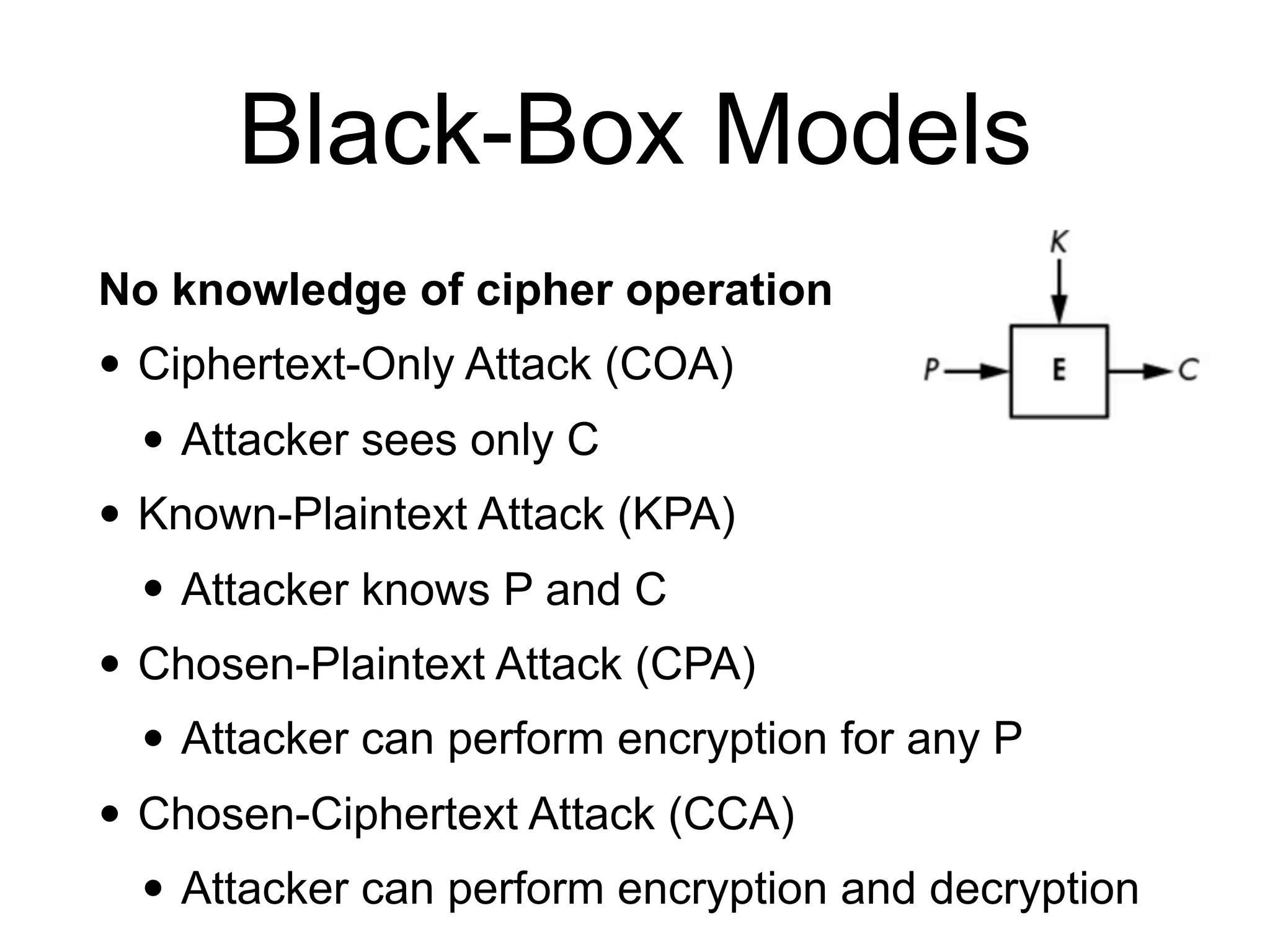
Black-Box Models
No knowledge of cipher operation
• Ciphertext-Only Attack (COA)
• Attacker sees only C
• Known-Plaintext Attack (KPA)
• Attacker knows P and C
• Chosen-Plaintext Attack (CPA)
• Attacker can perform encryption for any P
• Chosen-Ciphertext Attack (CCA)
• Attacker can perform encryption and decryption
Gray-Box Models
• Attacker has access to the implementation
• Can tamper with the system’s internals
• Side-channel attack
• Attacker measures something else about the
cipher’s operation
• Such as timing or power consumption
• Noninvasive — does not alter integrity of
system
Gray-Box Models
• Invasive attacks
• Modify system
• Examples
• Using acid to dissolve parts of a microchip
• Injecting faults with lasers
Security Goals
• Indistinguishability
• Ciphertext should be indistinguishable from
a random string
• Non-malleability
• Ciphertext cannot be altered and produce
meaningful plaintext
Security Notions
• IND-CPA
• Indistinguishability against a Chosen-
Plaintext Attack
• Also called semantic security
• Two identical plaintext strings must result in
different ciphertexts
• Accomplished by adding “random” bits each
time you encrypt
Asymmetric Encryption
• Uses two keys
• Also called Public-Key encryption
• Public key freely published to everyone
• Private key held secret
• Will be in later chapters—everything in this
chapter is about symmetric encryption
When Ciphers Do More
Than Encryption
Authenticated Encryption
• Returns an authentication
tag with the ciphertext
• Tag ensures integrity of the
message and also
authenticates the author
• Authenticated Encryption
with Associated Data
(AWAD)
• Another variant
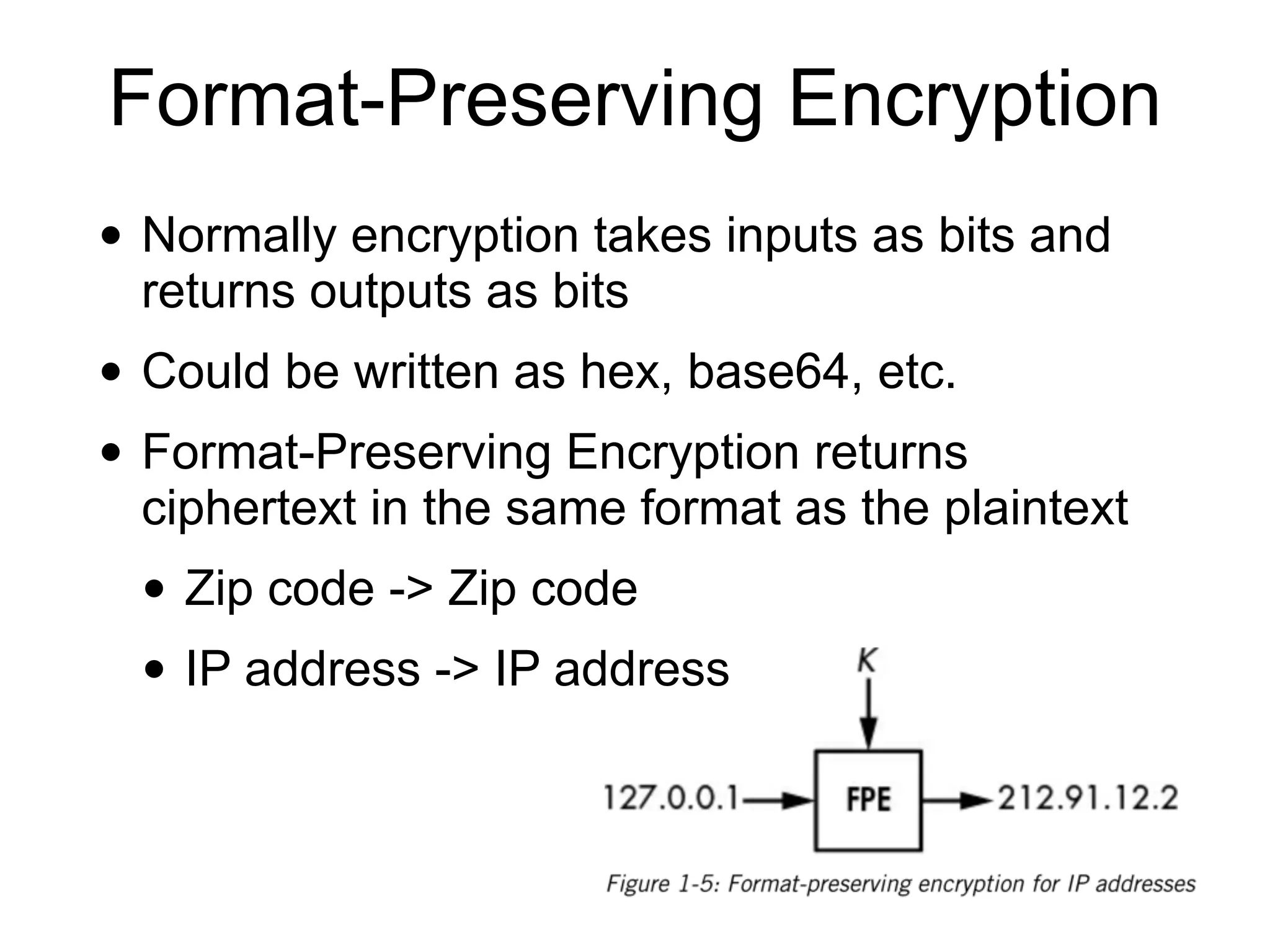
Format-Preserving Encryption
• Normally encryption takes inputs as bits and
returns outputs as bits
• Could be written as hex, base64, etc.
• Format-Preserving Encryption returns
ciphertext in the same format as the plaintext
• Zip code -> Zip code
• IP address -> IP address
Fully Homomorphic
Encryption
• Allows modification of encrypted data without
decrypting it
• The first FHE scheme was created in 2009
• Very slow
Searchable Encryption
• Searches encrypted data without decrypting it
• Using an encrypted search string
• Protects privacy of search engine users
• Experimental at present
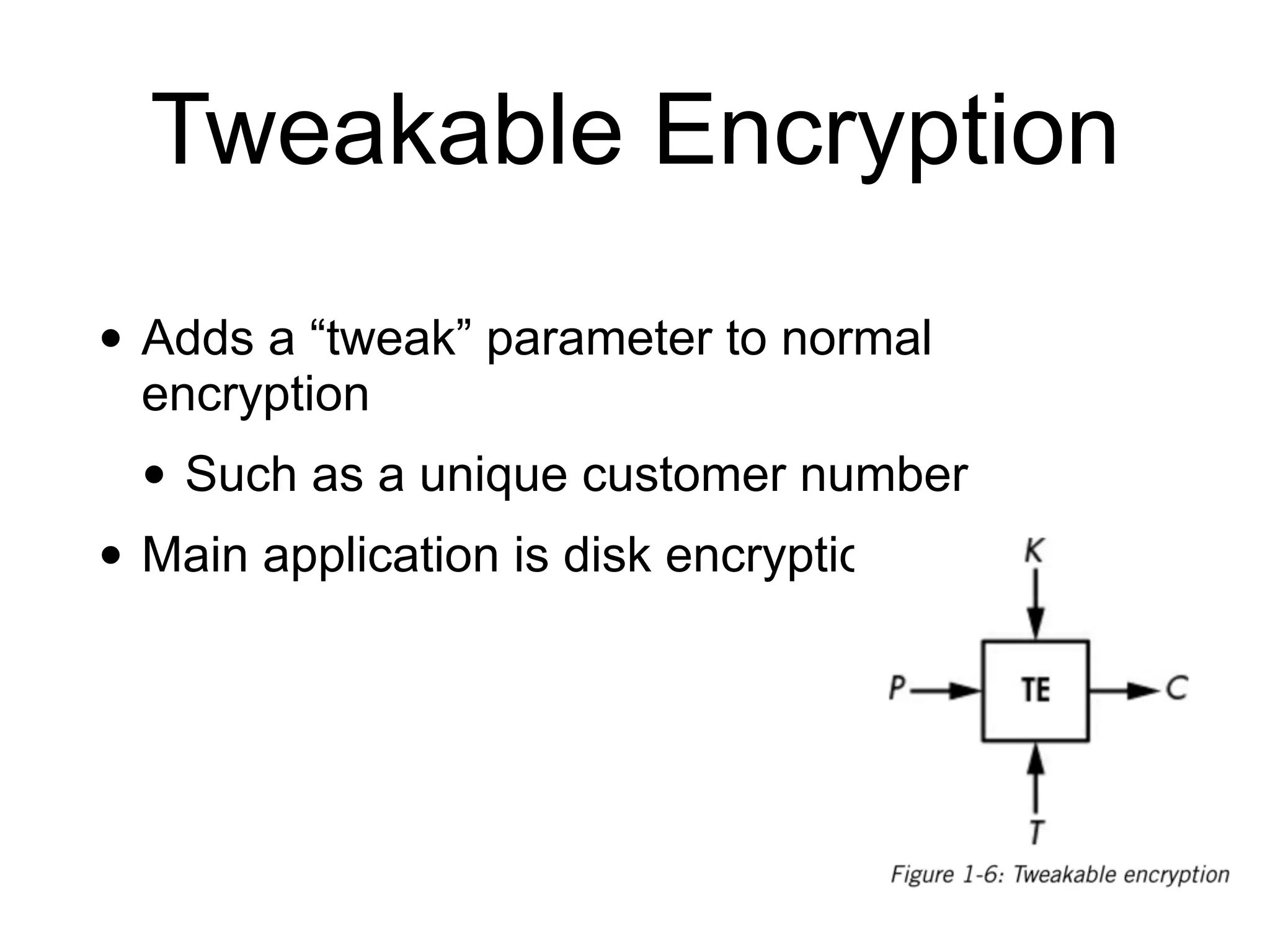
Tweakable Encryption
• Adds a “tweak” parameter to normal
encryption
• Such as a unique customer number
• Main application is disk encryption
How Things Can Go
Wrong
Weak Cipher
• 2G phone networks used the A5/1 cipher
• Vulnerable to a time-memory trade-off attack
• Using large lookup tables to speed up an
attack
Wrong Model
• Padding Oracle attack
• If a user submitted data that decrypted to a
valid string, that was taken as authentication
• Even if the string contained nonsense
• Server provided error messages for incorrect
padding
• Those erroirs can be used to find valid
ciohertext without knowing the key
CNIT 141: 1. Encryption

CNIT 141: 1. Encryption

  • 1.
    CNIT 141 Cryptography forComputer Networks 1. Encryption Updated to Python 3 on 8-27-2020
  • 2.
    Topics • The Basics •Classical Ciphers • How Ciphers Work • Perfect Encryption: The One-Time Pad • Encryption Security • Asymmetric Encryption • When Ciphers Do More Than Encryption • How Things Can Go Wrong
  • 3.
    The Basics • P:Plaintext • K: Key • C: Cleartext • E: Encryption via cipher • D: Decryption via cipher
  • 4.
  • 5.
  • 6.
  • 7.
  • 8.
    Vigenere Cipher • Shiftvaries with a repeated keyword • Combine several Caesar ciphers together
  • 9.
    Breaking the Vigenere Cipher •Find repeating ciphertext to deduce key length • Use frequency analysis
  • 10.
  • 11.
    Modified Caesar Program •Converts to uppercase • Preserves spaces
  • 12.
  • 13.
  • 15.
  • 16.
    Two Components • Permutation •Transforms one letter to another letter • In Caesar cipher, shift letter three places • Mode of Operation • Algorithm to handle messages of arbitrary size • In Caesar cipher, process each letter independently
  • 17.
    Permutation Security • Permutationshould be determined by the key • If key is secret, attacker can’t easily decrypt • Different keys should result in different permutations • Permutation should look random • No pattern in ciphertext
  • 18.
    Mode of Operation •Caesar cipher encrypts letters one at a time • Double letters remain doubled • HELLO -> KHOOR • Patterns in plaintext are preserved in ciphertext • Insecure (now called “Electronic Code Book” mode) • More secure modes encrypt repeated text differently each time
  • 19.
  • 20.
    XOR • XOR combinestwo bits • 0 ^ 0 = 0 • 0 ^ 1 = 1 • 1 ^ 0 = 1 • 1 ^ 1 = 0
  • 21.
    Encrypting a Streamof Bits • Plain: ABC = 0100 0001 0100 0010 0100 0011 • Key: 0110 0110 0110 0101 1010 1110 • Cipher: 0010 0111 0010 0111 1110 1101 •Key must be random and never re-used •Key must be longer than all the plaintexts you want to send
  • 22.
    Unbreakable • If anattacker uses a brute-force attack • Trying all possible keys • They get all possible letter sequences • No way to identify the correct decryption
  • 24.
  • 25.
    Attack Models • Setrequirements for cryptographers who design ciphers • So they know what attacks to prevent • Give guidelines to users • Whether a cipher is safe in their environment • Provide clues for cryptanalysts who attempt to break ciphers • Is an attack doable in the model considered?
  • 26.
  • 27.
    Kerckhoff’s Principle • Thekey is secret • The cipher is not secret
  • 28.
    Black-Box Models No knowledgeof cipher operation • Ciphertext-Only Attack (COA) • Attacker sees only C • Known-Plaintext Attack (KPA) • Attacker knows P and C • Chosen-Plaintext Attack (CPA) • Attacker can perform encryption for any P • Chosen-Ciphertext Attack (CCA) • Attacker can perform encryption and decryption
  • 29.
    Gray-Box Models • Attackerhas access to the implementation • Can tamper with the system’s internals • Side-channel attack • Attacker measures something else about the cipher’s operation • Such as timing or power consumption • Noninvasive — does not alter integrity of system
  • 30.
    Gray-Box Models • Invasiveattacks • Modify system • Examples • Using acid to dissolve parts of a microchip • Injecting faults with lasers
  • 31.
    Security Goals • Indistinguishability •Ciphertext should be indistinguishable from a random string • Non-malleability • Ciphertext cannot be altered and produce meaningful plaintext
  • 32.
    Security Notions • IND-CPA •Indistinguishability against a Chosen- Plaintext Attack • Also called semantic security • Two identical plaintext strings must result in different ciphertexts • Accomplished by adding “random” bits each time you encrypt
  • 33.
    Asymmetric Encryption • Usestwo keys • Also called Public-Key encryption • Public key freely published to everyone • Private key held secret • Will be in later chapters—everything in this chapter is about symmetric encryption
  • 34.
    When Ciphers DoMore Than Encryption
  • 35.
    Authenticated Encryption • Returnsan authentication tag with the ciphertext • Tag ensures integrity of the message and also authenticates the author • Authenticated Encryption with Associated Data (AWAD) • Another variant
  • 36.
    Format-Preserving Encryption • Normallyencryption takes inputs as bits and returns outputs as bits • Could be written as hex, base64, etc. • Format-Preserving Encryption returns ciphertext in the same format as the plaintext • Zip code -> Zip code • IP address -> IP address
  • 37.
    Fully Homomorphic Encryption • Allowsmodification of encrypted data without decrypting it • The first FHE scheme was created in 2009 • Very slow
  • 38.
    Searchable Encryption • Searchesencrypted data without decrypting it • Using an encrypted search string • Protects privacy of search engine users • Experimental at present
  • 39.
    Tweakable Encryption • Addsa “tweak” parameter to normal encryption • Such as a unique customer number • Main application is disk encryption
  • 40.
  • 41.
    Weak Cipher • 2Gphone networks used the A5/1 cipher • Vulnerable to a time-memory trade-off attack • Using large lookup tables to speed up an attack
  • 42.
    Wrong Model • PaddingOracle attack • If a user submitted data that decrypted to a valid string, that was taken as authentication • Even if the string contained nonsense • Server provided error messages for incorrect padding • Those erroirs can be used to find valid ciohertext without knowing the key