www.SecurityXploded.com
Disclaimer
The Content, Demonstration, Source Code and Programs presented here
is "AS IS" without any warranty or conditions of any kind. Also the
views/ideas/knowledge expressed here are solely of the trainer’s only and
nothing to do with the company or the organization in which the trainer is
currently working.

However in no circumstances neither the trainer nor SecurityXploded is
responsible for any damage or loss caused due to use or misuse of the
information presented here.


                              www.SecurityXploded.com
Acknowledgement
 Special thanks to Null & Garage4Hackers community for their extended
  support and cooperation.
 Thanks to all the Trainers who have devoted their precious time and
  countless hours to make it happen.
 Thanks to ThoughtWorks for the beautiful and bigger venue.


                               www.SecurityXploded.com
Reversing & Malware Analysis Training

This presentation is a part of our Reverse Engineering & Malware
Analysis training program. Currently it is delivered only during our local
meet for FREE of cost.


For complete details of this course, visit our Security Training page.


                              www.SecurityXploded.com
Who am I #1
Amit Malik (sometimes DouBle_Zer0,DZZ)
     Member SecurityXploded & Garage4Hackers
     Security Researcher @ McAfee Labs
     RE, Exploit Analysis/Development, Malware Analysis
     Email: m.amit30@gmail.com


                        www.SecurityXploded.com
Agenda
   The material in this presentation is a bit complicated so
    I will be using the zig-zag approach.
     Recap

     Protections (GS and SAFESEH)

     Client side exploits and Heap Spray
     Protections (DEP)

     Protections (ASLR)

   If time permits then few words on the following:
     Heap buffer overflows


                           www.SecurityXploded.com
Recap
   In previous session we covered:
       Stack based buffer overflow
        ○ EIP overwrite (saved return address)

        ○ SEH Overwrite


   We also discussed “why we need pop pop ret or other
    similar instruction in SEH overflow”
   Now Question: Which one is more reliable or considered
    to be more reliable in terms of exploitation ?
     Consider we have overwritten EIP and SEH successfully.

                                  www.SecurityXploded.com
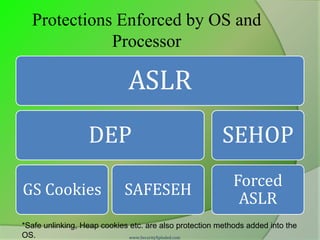
Protections Enforced by OS and
             Processor

                             ASLR
                  DEP                                   SEHOP
                                                           Forced
GS Cookies                  SAFESEH
                                                            ASLR
*Safe unlinking, Heap cookies etc. are also protection methods added into the
OS.                           www.SecurityXploded.com
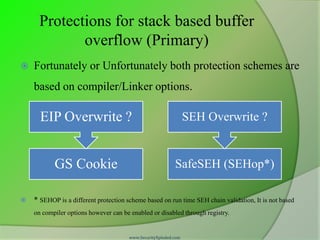
Protections for stack based buffer
            overflow (Primary)
   Fortunately or Unfortunately both protection schemes are
    based on compiler/Linker options.

      EIP Overwrite ?                                            SEH Overwrite ?


           GS Cookie                                       SafeSEH (SEHop*)

   * SEHOP is a different protection scheme based on run time SEH chain validation, It is not based
    on compiler options however can be enabled or disabled through registry.


                                       www.SecurityXploded.com
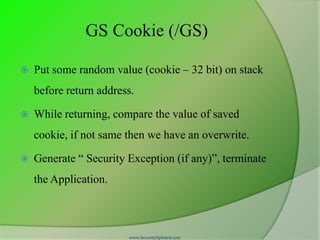
GS Cookie (/GS)

   Put some random value (cookie – 32 bit) on stack
    before return address.

   While returning, compare the value of saved
    cookie, if not same then we have an overwrite.

   Generate “ Security Exception (if any)”, terminate
    the Application.


                        www.SecurityXploded.com
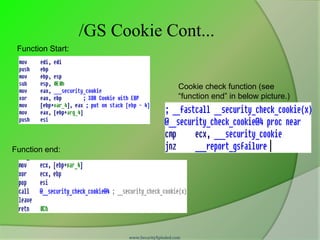
/GS Cookie Cont...
 Function Start:


                                               Cookie check function (see
                                               “function end” in below picture.)


Function end:


                         www.SecurityXploded.com
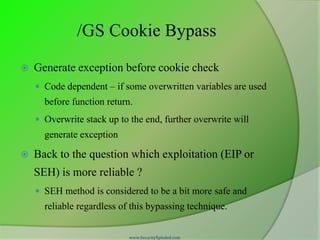
/GS Cookie Bypass
   Generate exception before cookie check
     Code dependent – if some overwritten variables are used
      before function return.
     Overwrite stack up to the end, further overwrite will
      generate exception

   Back to the question which exploitation (EIP or
    SEH) is more reliable ?
     SEH method is considered to be a bit more safe and
      reliable regardless of this bypassing technique.


                            www.SecurityXploded.com
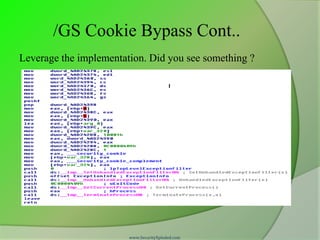
/GS Cookie Bypass Cont..
Leverage the implementation. Did you see something ?


                        www.SecurityXploded.com
SafeSEH
   Compiler [Linker] /SAFESEH option

   Static list of known good exception handlers for the binary.

   Checks every time when a handler is called against the static list, if

    not in the list then handler is invalid and takes preventive measures.

   Load configuration directory stores meta information about safe

    exception handlers.

   If any module is not compiled with /SAFESEH then no check is

    done to ensure the integrity of the handler for that module.

                             www.SecurityXploded.com
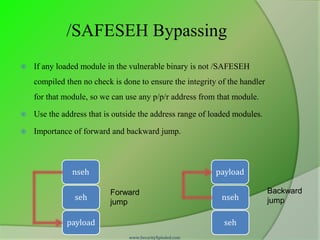
/SAFESEH Bypassing
   If any loaded module in the vulnerable binary is not /SAFESEH
    compiled then no check is done to ensure the integrity of the handler
    for that module, so we can use any p/p/r address from that module.

   Use the address that is outside the address range of loaded modules.

   Importance of forward and backward jump.


               nseh                                       payload

                          Forward                                           Backward
                seh                                         nseh            jump
                          jump

             payload                                        seh
                                www.SecurityXploded.com
DEP (Data Execution Prevention)

   Two types:
     Software DEP (forget it)

     Hardware DEP (NX/XD enabled processors) – we will be

      talking about it in the rest of the session.

   We can’t execute the code from non executable
    area anymore.

   We are directly dealing with processer in this case.


                             www.SecurityXploded.com
DEP (HW) Bypass

   ROP (Return Oriented Programming)
     Use the system/existing code

     How stack works ?

   Main theme
     Either make non executable area executable

     Or allocate new area with executable permissions

     How ?

      ○ Well, use ROP 

                           www.SecurityXploded.com
Stack Heap Flipping (Stack Pivoting)

   I think this deserve a dedicated slide

   Depending on the conditions we may have large ROP payload while
    space on stack may be less or may be our entire payload is on heap.

   Flip the heap on to the stack so that we can get larger room.

   Instructions like XCHG ESP[REG], REG[ESP] can be used.

   We can also jump inside the valid instructions to change their meaning.

     Example: jump one byte inside “setz al” instruction ( From Adobe

       U3D exploit in wild)


                                www.SecurityXploded.com
DEP (HW) Bypass (DEMO)

   Methods
     HeapCreate

     VirtualAlloc

     VirtualProtect

     WriteProcessMemory (DEMO – simple, easy,

      demonstrate the entire concept – XpSp3)

   Often times the small code chunks in ROP are
    termed as “gadgets”

                          www.SecurityXploded.com
DEP (HW) Bypass (DEMO)


   http://vimeo.com/49069964


             www.SecurityXploded.com
ASLR

   Address Space Layout Randomization

   Involves randomly positioning the memory areas
    like base address of the binary, position of stack
    and heap.

   Compiler[linker] /DYNAMICBASE option


                          www.SecurityXploded.com
ASLR Bypass

   Search for Non-ASLR loaded libraries in the
    vulnerable application or if possible load one. 
     JRE ?

   Memory leaks

   Brute force

   Heavily depends on vulnerability conditions


                         www.SecurityXploded.com
Client Side Exploits
   Exploits that targets client applications like
    browsers, plugins, media players, readers etc.
   Much more dangerous then any other form of
    exploits
   Huge impact and landscape
   Provides solid infection vector
   Big malicious infrastructure.
     Botnets, DDOS, Spam etc.


                         www.SecurityXploded.com
Heap Spray
   A technique used in client side exploits
   IT’S NOT A VULNERABILITY or CLASS OF VUL.
   It’s a technique used for code execution.
   Think about the followings again:
     EIP overwrite

     SEH overwrite

    • What we used in the above and why we used that ?

   Heap spray provides very simple method for code execution.


                             www.SecurityXploded.com
Heap Spray Cont...
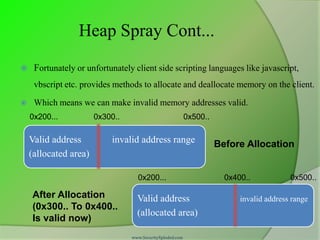
    Fortunately or unfortunately client side scripting languages like javascript,
     vbscript etc. provides methods to allocate and deallocate memory on the client.

    Which means we can make invalid memory addresses valid.
    0x200...           0x300..                             0x500..

    Valid address          invalid address range                     Before Allocation
    (allocated area)

                                   0x200...                            0x400..            0x500..

    After Allocation               Valid address                           invalid address range
    (0x300.. To 0x400..
                                   (allocated area)
    Is valid now)
                                 www.SecurityXploded.com
Heap Spray Cont..

   Allocate memory and fill with nop + shellcode

   Overwrite the EIP or SEH with any address within
    the newly allocated area (the nop region).

   Here EIP overwrite or SEH overwrite can be by
    any means.
     Stack buffer overflow, Heap buffer overflow, memory

      corruption, use after free etc..


                             www.SecurityXploded.com
Heap Spray (DEMO – IEPeers
  Vulnerability (IE6, IE7)
       http://vimeo.com/49070337


            www.SecurityXploded.com
Heap Spray (Stability Comments)

   Use intelligent guesses

   Stability depends on the exploitation conditions

   Fragmented heap, choose little higher addresses.

   Large number of allocations, choose little lower
    addresses 


                        www.SecurityXploded.com
Reference
   Complete Reference Guide for Reversing & Malware
    Analysis Training


                           www.SecurityXploded.com
Thank You !


www.SecurityXploded.com

Reversing & Malware Analysis Training Part 11 - Exploit Development [Advanced]

  • 1.
  • 2.
    Disclaimer The Content, Demonstration,Source Code and Programs presented here is "AS IS" without any warranty or conditions of any kind. Also the views/ideas/knowledge expressed here are solely of the trainer’s only and nothing to do with the company or the organization in which the trainer is currently working. However in no circumstances neither the trainer nor SecurityXploded is responsible for any damage or loss caused due to use or misuse of the information presented here. www.SecurityXploded.com
  • 3.
    Acknowledgement  Special thanksto Null & Garage4Hackers community for their extended support and cooperation.  Thanks to all the Trainers who have devoted their precious time and countless hours to make it happen.  Thanks to ThoughtWorks for the beautiful and bigger venue. www.SecurityXploded.com
  • 4.
    Reversing & MalwareAnalysis Training This presentation is a part of our Reverse Engineering & Malware Analysis training program. Currently it is delivered only during our local meet for FREE of cost. For complete details of this course, visit our Security Training page. www.SecurityXploded.com
  • 5.
    Who am I#1 Amit Malik (sometimes DouBle_Zer0,DZZ)  Member SecurityXploded & Garage4Hackers  Security Researcher @ McAfee Labs  RE, Exploit Analysis/Development, Malware Analysis  Email: m.amit30@gmail.com www.SecurityXploded.com
  • 6.
    Agenda  The material in this presentation is a bit complicated so I will be using the zig-zag approach.  Recap  Protections (GS and SAFESEH)  Client side exploits and Heap Spray  Protections (DEP)  Protections (ASLR)  If time permits then few words on the following:  Heap buffer overflows www.SecurityXploded.com
  • 7.
    Recap  In previous session we covered:  Stack based buffer overflow ○ EIP overwrite (saved return address) ○ SEH Overwrite  We also discussed “why we need pop pop ret or other similar instruction in SEH overflow”  Now Question: Which one is more reliable or considered to be more reliable in terms of exploitation ?  Consider we have overwritten EIP and SEH successfully. www.SecurityXploded.com
  • 8.
    Protections Enforced byOS and Processor ASLR DEP SEHOP Forced GS Cookies SAFESEH ASLR *Safe unlinking, Heap cookies etc. are also protection methods added into the OS. www.SecurityXploded.com
  • 9.
    Protections for stackbased buffer overflow (Primary)  Fortunately or Unfortunately both protection schemes are based on compiler/Linker options. EIP Overwrite ? SEH Overwrite ? GS Cookie SafeSEH (SEHop*)  * SEHOP is a different protection scheme based on run time SEH chain validation, It is not based on compiler options however can be enabled or disabled through registry. www.SecurityXploded.com
  • 10.
    GS Cookie (/GS)  Put some random value (cookie – 32 bit) on stack before return address.  While returning, compare the value of saved cookie, if not same then we have an overwrite.  Generate “ Security Exception (if any)”, terminate the Application. www.SecurityXploded.com
  • 11.
    /GS Cookie Cont... Function Start: Cookie check function (see “function end” in below picture.) Function end: www.SecurityXploded.com
  • 12.
    /GS Cookie Bypass  Generate exception before cookie check  Code dependent – if some overwritten variables are used before function return.  Overwrite stack up to the end, further overwrite will generate exception  Back to the question which exploitation (EIP or SEH) is more reliable ?  SEH method is considered to be a bit more safe and reliable regardless of this bypassing technique. www.SecurityXploded.com
  • 13.
    /GS Cookie BypassCont.. Leverage the implementation. Did you see something ? www.SecurityXploded.com
  • 14.
    SafeSEH  Compiler [Linker] /SAFESEH option  Static list of known good exception handlers for the binary.  Checks every time when a handler is called against the static list, if not in the list then handler is invalid and takes preventive measures.  Load configuration directory stores meta information about safe exception handlers.  If any module is not compiled with /SAFESEH then no check is done to ensure the integrity of the handler for that module. www.SecurityXploded.com
  • 15.
    /SAFESEH Bypassing  If any loaded module in the vulnerable binary is not /SAFESEH compiled then no check is done to ensure the integrity of the handler for that module, so we can use any p/p/r address from that module.  Use the address that is outside the address range of loaded modules.  Importance of forward and backward jump. nseh payload Forward Backward seh nseh jump jump payload seh www.SecurityXploded.com
  • 16.
    DEP (Data ExecutionPrevention)  Two types:  Software DEP (forget it)  Hardware DEP (NX/XD enabled processors) – we will be talking about it in the rest of the session.  We can’t execute the code from non executable area anymore.  We are directly dealing with processer in this case. www.SecurityXploded.com
  • 17.
    DEP (HW) Bypass  ROP (Return Oriented Programming)  Use the system/existing code  How stack works ?  Main theme  Either make non executable area executable  Or allocate new area with executable permissions  How ? ○ Well, use ROP  www.SecurityXploded.com
  • 18.
    Stack Heap Flipping(Stack Pivoting)  I think this deserve a dedicated slide  Depending on the conditions we may have large ROP payload while space on stack may be less or may be our entire payload is on heap.  Flip the heap on to the stack so that we can get larger room.  Instructions like XCHG ESP[REG], REG[ESP] can be used.  We can also jump inside the valid instructions to change their meaning.  Example: jump one byte inside “setz al” instruction ( From Adobe U3D exploit in wild) www.SecurityXploded.com
  • 19.
    DEP (HW) Bypass(DEMO)  Methods  HeapCreate  VirtualAlloc  VirtualProtect  WriteProcessMemory (DEMO – simple, easy, demonstrate the entire concept – XpSp3)  Often times the small code chunks in ROP are termed as “gadgets” www.SecurityXploded.com
  • 20.
    DEP (HW) Bypass(DEMO) http://vimeo.com/49069964 www.SecurityXploded.com
  • 21.
    ASLR  Address Space Layout Randomization  Involves randomly positioning the memory areas like base address of the binary, position of stack and heap.  Compiler[linker] /DYNAMICBASE option www.SecurityXploded.com
  • 22.
    ASLR Bypass  Search for Non-ASLR loaded libraries in the vulnerable application or if possible load one.   JRE ?  Memory leaks  Brute force  Heavily depends on vulnerability conditions www.SecurityXploded.com
  • 23.
    Client Side Exploits  Exploits that targets client applications like browsers, plugins, media players, readers etc.  Much more dangerous then any other form of exploits  Huge impact and landscape  Provides solid infection vector  Big malicious infrastructure.  Botnets, DDOS, Spam etc. www.SecurityXploded.com
  • 24.
    Heap Spray  A technique used in client side exploits  IT’S NOT A VULNERABILITY or CLASS OF VUL.  It’s a technique used for code execution.  Think about the followings again:  EIP overwrite  SEH overwrite • What we used in the above and why we used that ?  Heap spray provides very simple method for code execution. www.SecurityXploded.com
  • 25.
    Heap Spray Cont...  Fortunately or unfortunately client side scripting languages like javascript, vbscript etc. provides methods to allocate and deallocate memory on the client.  Which means we can make invalid memory addresses valid. 0x200... 0x300.. 0x500.. Valid address invalid address range Before Allocation (allocated area) 0x200... 0x400.. 0x500.. After Allocation Valid address invalid address range (0x300.. To 0x400.. (allocated area) Is valid now) www.SecurityXploded.com
  • 26.
    Heap Spray Cont..  Allocate memory and fill with nop + shellcode  Overwrite the EIP or SEH with any address within the newly allocated area (the nop region).  Here EIP overwrite or SEH overwrite can be by any means.  Stack buffer overflow, Heap buffer overflow, memory corruption, use after free etc.. www.SecurityXploded.com
  • 27.
    Heap Spray (DEMO– IEPeers Vulnerability (IE6, IE7) http://vimeo.com/49070337 www.SecurityXploded.com
  • 28.
    Heap Spray (StabilityComments)  Use intelligent guesses  Stability depends on the exploitation conditions  Fragmented heap, choose little higher addresses.  Large number of allocations, choose little lower addresses  www.SecurityXploded.com
  • 29.
    Reference  Complete Reference Guide for Reversing & Malware Analysis Training www.SecurityXploded.com
  • 30.