Windows Heap Overflows David Litchfield <david@ngssoftware.com>
This presentation will examine how to exploit heap based buffer overflows on the Windows platform. Heap overflows have been well documented on *nix platforms, for example Matt Connover’s paper – w00w00 on heap overflows, but they’ve not been well documented on Windows, though Halvar Flake’s Third Generation Exploits paper covered the key concepts. Windows Heap Overflows Introduction
Most developers are aware of the dangers of stack based buffer overflows but too many still believe that if a heap based buffer is overflowed it’s not too much of a problem. One paper on secure coding suggested that to solve the problem of stack based overflows was to move the buffer to the heap! Windows Heap Overflows Heap based buffers are safe…. ?????
The heap is an area of memory used for storage of dynamic data. Every process has a default process heap but a developer can create their own private heaps. Space is allocated from the heap and freed when finished with. Windows Heap Overflows What is a heap?
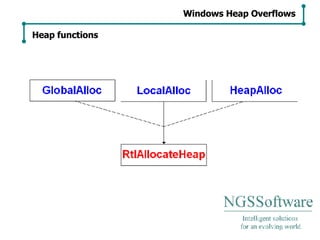
Windows Heap Overflows Heap functions
Each heap starts with a structure. This structure, amongst other data, contains an array of  128   LIST_ENTRY  structures. Each LIST_ENTRY structure contains two pointers – see winnt.h. This array can be found at  0x178  bytes into the heap structure – call it the  FreeList  array. Windows Heap Overflows Heap Design
When a heap is first created there are two pointers that point to the first free block set in  FreeList[0].  Assuming the heap base address is  0x00350000  then first available block can be found at  0x00350688 . Windows Heap Overflows Heap Design
0x00350178 (FreeList[0].Flink) = 0x00350688 (First Free Block) 0x0035017C (FreeList[0].Blink) = 0x00350688 (First Free Block) 0x00350688 (First Free Block) = 0x00350178 (FreeList[0]) 0x0035068C (First Free Block+4) = 0x00350178 (FreeList[0]) When an allocation occurs these pointers are updated accordingly. As more allocations and frees occur these pointers are continually updated and in this fashion allocated blocks are tracked in a doubly linked list. Windows Heap Overflows Heap Design
When a heap based buffer is overflowed the control information is overwritten so when the buffer (allocated block) is freed and it comes to updating the pointers in the FreeList array there’s going to be an access violation. Windows Heap Overflows So where’s the problem?
Example: See code listing A – heap.c Windows Heap Overflows So where’s the problem?
Access violation 77F6256F mov dword ptr [ecx],eax 77F62571 mov dword ptr [eax+4],ecx EAX = 0x42424242 ECX = 0x42424242 If we own both EAX and ECX we have an arbitrary DWORD overwrite. We can overwrite the data at any 32bit address with a 32bit value of our choosing. Windows Heap Overflows So where’s the problem?
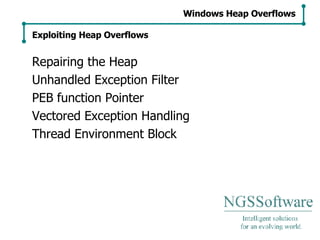
Repairing the Heap Unhandled Exception Filter PEB function Pointer Vectored Exception Handling Thread Environment Block Windows Heap Overflows Exploiting Heap Overflows
After the overflow the heap is corrupt so you’ll need to repair the heap. Many of the Windows API calls use the default process heap and if this is corrupt the exploit will access violate. Windows Heap Overflows Repairing the heap
Could repair on a per vulnerability/exploit basis. Time consuming and could run into problems. Need a generic way to repair the heap which is effective for all exploits. Write it once and reuse it. Windows Heap Overflows Repairing the heap
The best method for repairing the heap is to reset the heap making it “appear” as if it is a fresh new heap. This will keep other heap data intact but allow fresh allocations. Windows Heap Overflows Repairing the heap
We reset our overflow heap control structure with  heap.TotalFreeSize  and set the flags to  0x14  then set  heap.FreeLists[0].Flink  and  heap.FreeLists[0].Blink  to the start of the fake control structure. See code listing B – asm-repair-heap. Windows Heap Overflows Repairing the heap
The Unhandled Exception Filter method is the most common method used. The UEF is the “last ditch effort” exception handler.  Windows Heap Overflows Exploit: Using the Unhandled Exception Filter
Location varies from OS to OS and SP to SP. Disassemble the SetUnhandledExceptionFilter function. 77E7E5A1 mov ecx,dword ptr [esp+4] 77E7E5A5 mov eax,[77ED73B4] 77E7E5AA mov dword ptr ds:[77ED73B4h],ecx 77E7E5B0 ret 4 UEF =  0x77ED73B4 Windows Heap Overflows Exploit: Using the Unhandled Exception Filter
When an unhandled exception occurs the following block of code is executed: 77E93114 mov eax,[77ED73B4] 77E93119 cmp eax,esi 77E9311B je 77E93132 77E9311D push edi *** 77E9311E call eax Windows Heap Overflows Exploit: Using the Unhandled Exception Filter
Essence of the method is to set our own Unhandled Exception Filter. EDI was pushed onto the stack.  0x78  bytes past EDI is a pointer to the end of the buffer – just before the heap management control stuff. Windows Heap Overflows Exploit: Using the Unhandled Exception Filter
Set the UEF to an address that points to a CALL DWORD PTR [EDI + 0x78] Many can be found in netapi32.dll, user32.dll, rpcrt4.dll for example. Windows Heap Overflows Exploit: Using the Unhandled Exception Filter
Notes: Other OSes may not use EDI. Windows 2000 for example has a pointer at  ESI+0x4C  and  EBP+0x74 . Using this method you need to know the target system – i.e. what OS and what SP level. Windows Heap Overflows Exploit: Using the Unhandled Exception Filter
Example: See code listing C – heap-uef.c and code listing D - exploit-uef.c Windows Heap Overflows Exploit: Using the Unhandled Exception Filter
Vectored Exception Handling is new as of Windows XP. Unlike traditional frame based exception handling where  EXCEPTION_REGISTRATION  structures are stored on the stack information about VEH is stored on the heap. Windows Heap Overflows Exploit: Using Vectored Exception Handling
A pointer to the first Vectored Exception Handler is stored at  0x 77FC3210 . Points to a  _VECTORED_EXCEPTION_NODE .   Windows Heap Overflows Exploit: Using Vectored Exception Handling
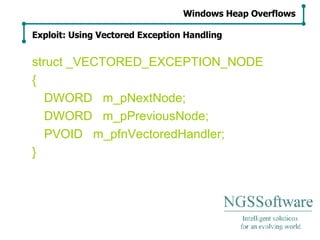
struct _VECTORED_EXCEPTION_NODE { DWORD  m_pNextNode; DWORD  m_pPreviousNode; PVOID  m_pfnVectoredHandler; } Windows Heap Overflows Exploit: Using Vectored Exception Handling
Vectored handlers are called  before  any frame based handlers! Technique involves overwriting the pointer to the first  _VECTORED_EXCEPTION_NODE  @  0x77FC3210  with a pointer to a fake VE node. Windows Heap Overflows Exploit: Using Vectored Exception Handling
77F7F49E mov  esi,dword ptr ds:[77FC3210h] 77F7F4A4 jmp  77F7F4B4 77F7F4A6 lea  eax,[ebp-8] 77F7F4A9 push  eax 77F7F4AA call  dword ptr [esi+8] 77F7F4AD cmp  eax,0FFh 77F7F4B0 je  77F7F4CC 77F7F4B2 mov  esi,dword ptr [esi] 77F7F4B4 cmp  esi,edi 77F7F4B6 jne  77F7F4A6 The code behind calling the vectored exception handler. Windows Heap Overflows Exploit: Using Vectored Exception Handling
Need to find a pointer on the stack to our buffer. Assume it can be found at  0x0012FF50 . This becomes our  m_pfnVectoredHandler  making the address of our pseudo  _VECTORED_EXCEPTION_NODE   0x0012FF48 . Windows Heap Overflows Exploit: Using Vectored Exception Handling
Remember on the free we get an arbitrary DWORD overwrite: 77F6256F mov dword ptr [ecx],eax 77F62571 mov dword ptr [eax+4],ecx We set EAX to  0x77FC320C  and ECX to  0x0012FF48 . Windows Heap Overflows Exploit: Using Vectored Exception Handling
0x77FC320C  is moved into  0x0012FF48  then  0x0012FF48  is moved into  0x77FC3210  – thus our pointer is set. When an exception occurs  0x0012FF48  (our pseudo VEN) is moved into  ESI  and  DWORD PTR[ESI+8]  is called.  ESI+8  is a pointer to our buffer. Windows Heap Overflows Exploit: Using Vectored Exception Handling
Notes: If the location of the stack (and thus the pointer to the buffer) moves this method can be unreliable. Example: See code listing E – heap-vector.c and F – exploit-vector.c Windows Heap Overflows Exploit: Using Vectored Exception Handling
Each process contains a structure known as the PROCESS ENVIRONMENT BLOCK or PEB. The PEB can be referenced from the Thread Information/Environment Block TIB/TEB.  FS:[0]  points to the TEB. mov eax, dword ptr fs:[0x30] mov eax, dword ptr fs:[eax+0x18] Windows Heap Overflows Exploit: RtlEnterCriticalSection pointer in the PEB
As well as containing other process specific data the PEB contains some pointers to RtlEnterCriticalSection and RtlLeaveCriticalSection. These pointers are referenced from RtlAccquirePebLock and RtlReleasePebLock. RtlAccquirePebLock is called from ExitProcess for example. Windows Heap Overflows Exploit: RtlEnterCriticalSection pointer in the PEB
The location of the PEB is stable across Windows NT 4 / 2000 / XP and thus the pointer to RtlEnterCriticalSection can be found at 0x7FFDF020. Whilst the PEB can be found at the same address in Windows 2003 the function pointers are no longer present so this method won’t work with 2003. Windows Heap Overflows Exploit: RtlEnterCriticalSection pointer in the PEB
The method simply involves overwriting the pointer to RtlEnterCriticalSection in the PEB with the address of an instruction that will return to the buffer. Example: See code listing G – heap-peb.c and H – exploit-peb.c Windows Heap Overflows Exploit: RtlEnterCriticalSection pointer in the PEB
Each Thread Environment Block contains a pointer to the first frame based exception handler. The first thread’s TEB has a base address of  0x7FFDE000 and each new thread’s TEB is assigned an address   growing towards 0x00000000. If a thread exits and a new thread is created then it will get the address of the previous thread’s TEB. Windows Heap Overflows Exploit: TEB Exception Handler Pointer
This can lead to a “messy” TEB table and can make this method uncertain. However, if the address of the vulnerable thread’s TEB is stable then this method can be used quite effectively. Windows Heap Overflows Exploit: TEB Exception Handler Pointer
The method involves overwriting the pointer to the first exception handler in the TEB with an address that points to an instruction that will get path of execution back to the buffer. Windows Heap Overflows Exploit: TEB Exception Handler Pointer
There are other ways to exploit heap based buffer overflows to execute arbitrary code to defeat mechanisms such as marking the heap as non-executable. Windows Heap Overflows Exploit: Getting Creative!
Assume we have a process with the heap marked as non-executable. This can be defeated with pointer subversion. An example of this can be found in the fault reporting functionality of the  UnhandledExceptionFilter()  function. Windows Heap Overflows Exploit: Getting Creative!
The fault reporting code calls  GetSystemDirectoryW()  to which “faultrep.dll” is concatenated. This library is the loaded and the  ReportFault()  function is called. Windows Heap Overflows Exploit: Getting Creative!
GetSystemDirectoryW()  references a pointer in the .data section of kernel32.dll that points to where the wide character string of the Windows system directory can be found. This pointer can be found at  0x77ED73BC . On overflow we can set this pointer to our own system directory.  Windows Heap Overflows Exploit: Getting Creative!
Thus when  GetSystemDirectoryW()  is called the “system” directory is a directory owned by the attacker – this can even be a UNC path. The attacker would create their own faultrep.dll which exports a  ReportFault()  function and so when the  UnhandledExceptionFilter()  function is called arbitrary code can be executed. Windows Heap Overflows Exploit: Getting Creative!
Whilst code paths are finite I’d argue that the possibilities of what can be done is limited more by the imagination. Windows Heap Overflows Exploit: Getting Creative!
Hopefully this presentation has demonstrated the dangers of heap based buffer overflows and that developers not treat them as benign. Any questions? Windows Heap Overflows Conclusion
Thanks for coming and enjoy the rest of the conference! Windows Heap Overflows Thanks for coming!

exploiting heap overflows

  • 1.
    Windows Heap OverflowsDavid Litchfield <david@ngssoftware.com>
  • 2.
    This presentation willexamine how to exploit heap based buffer overflows on the Windows platform. Heap overflows have been well documented on *nix platforms, for example Matt Connover’s paper – w00w00 on heap overflows, but they’ve not been well documented on Windows, though Halvar Flake’s Third Generation Exploits paper covered the key concepts. Windows Heap Overflows Introduction
  • 3.
    Most developers areaware of the dangers of stack based buffer overflows but too many still believe that if a heap based buffer is overflowed it’s not too much of a problem. One paper on secure coding suggested that to solve the problem of stack based overflows was to move the buffer to the heap! Windows Heap Overflows Heap based buffers are safe…. ?????
  • 4.
    The heap isan area of memory used for storage of dynamic data. Every process has a default process heap but a developer can create their own private heaps. Space is allocated from the heap and freed when finished with. Windows Heap Overflows What is a heap?
  • 5.
    Windows Heap OverflowsHeap functions
  • 6.
    Each heap startswith a structure. This structure, amongst other data, contains an array of 128 LIST_ENTRY structures. Each LIST_ENTRY structure contains two pointers – see winnt.h. This array can be found at 0x178 bytes into the heap structure – call it the FreeList array. Windows Heap Overflows Heap Design
  • 7.
    When a heapis first created there are two pointers that point to the first free block set in FreeList[0]. Assuming the heap base address is 0x00350000 then first available block can be found at 0x00350688 . Windows Heap Overflows Heap Design
  • 8.
    0x00350178 (FreeList[0].Flink) =0x00350688 (First Free Block) 0x0035017C (FreeList[0].Blink) = 0x00350688 (First Free Block) 0x00350688 (First Free Block) = 0x00350178 (FreeList[0]) 0x0035068C (First Free Block+4) = 0x00350178 (FreeList[0]) When an allocation occurs these pointers are updated accordingly. As more allocations and frees occur these pointers are continually updated and in this fashion allocated blocks are tracked in a doubly linked list. Windows Heap Overflows Heap Design
  • 9.
    When a heapbased buffer is overflowed the control information is overwritten so when the buffer (allocated block) is freed and it comes to updating the pointers in the FreeList array there’s going to be an access violation. Windows Heap Overflows So where’s the problem?
  • 10.
    Example: See codelisting A – heap.c Windows Heap Overflows So where’s the problem?
  • 11.
    Access violation 77F6256Fmov dword ptr [ecx],eax 77F62571 mov dword ptr [eax+4],ecx EAX = 0x42424242 ECX = 0x42424242 If we own both EAX and ECX we have an arbitrary DWORD overwrite. We can overwrite the data at any 32bit address with a 32bit value of our choosing. Windows Heap Overflows So where’s the problem?
  • 12.
    Repairing the HeapUnhandled Exception Filter PEB function Pointer Vectored Exception Handling Thread Environment Block Windows Heap Overflows Exploiting Heap Overflows
  • 13.
    After the overflowthe heap is corrupt so you’ll need to repair the heap. Many of the Windows API calls use the default process heap and if this is corrupt the exploit will access violate. Windows Heap Overflows Repairing the heap
  • 14.
    Could repair ona per vulnerability/exploit basis. Time consuming and could run into problems. Need a generic way to repair the heap which is effective for all exploits. Write it once and reuse it. Windows Heap Overflows Repairing the heap
  • 15.
    The best methodfor repairing the heap is to reset the heap making it “appear” as if it is a fresh new heap. This will keep other heap data intact but allow fresh allocations. Windows Heap Overflows Repairing the heap
  • 16.
    We reset ouroverflow heap control structure with heap.TotalFreeSize and set the flags to 0x14 then set heap.FreeLists[0].Flink and heap.FreeLists[0].Blink to the start of the fake control structure. See code listing B – asm-repair-heap. Windows Heap Overflows Repairing the heap
  • 17.
    The Unhandled ExceptionFilter method is the most common method used. The UEF is the “last ditch effort” exception handler. Windows Heap Overflows Exploit: Using the Unhandled Exception Filter
  • 18.
    Location varies fromOS to OS and SP to SP. Disassemble the SetUnhandledExceptionFilter function. 77E7E5A1 mov ecx,dword ptr [esp+4] 77E7E5A5 mov eax,[77ED73B4] 77E7E5AA mov dword ptr ds:[77ED73B4h],ecx 77E7E5B0 ret 4 UEF = 0x77ED73B4 Windows Heap Overflows Exploit: Using the Unhandled Exception Filter
  • 19.
    When an unhandledexception occurs the following block of code is executed: 77E93114 mov eax,[77ED73B4] 77E93119 cmp eax,esi 77E9311B je 77E93132 77E9311D push edi *** 77E9311E call eax Windows Heap Overflows Exploit: Using the Unhandled Exception Filter
  • 20.
    Essence of themethod is to set our own Unhandled Exception Filter. EDI was pushed onto the stack. 0x78 bytes past EDI is a pointer to the end of the buffer – just before the heap management control stuff. Windows Heap Overflows Exploit: Using the Unhandled Exception Filter
  • 21.
    Set the UEFto an address that points to a CALL DWORD PTR [EDI + 0x78] Many can be found in netapi32.dll, user32.dll, rpcrt4.dll for example. Windows Heap Overflows Exploit: Using the Unhandled Exception Filter
  • 22.
    Notes: Other OSesmay not use EDI. Windows 2000 for example has a pointer at ESI+0x4C and EBP+0x74 . Using this method you need to know the target system – i.e. what OS and what SP level. Windows Heap Overflows Exploit: Using the Unhandled Exception Filter
  • 23.
    Example: See codelisting C – heap-uef.c and code listing D - exploit-uef.c Windows Heap Overflows Exploit: Using the Unhandled Exception Filter
  • 24.
    Vectored Exception Handlingis new as of Windows XP. Unlike traditional frame based exception handling where EXCEPTION_REGISTRATION structures are stored on the stack information about VEH is stored on the heap. Windows Heap Overflows Exploit: Using Vectored Exception Handling
  • 25.
    A pointer tothe first Vectored Exception Handler is stored at 0x 77FC3210 . Points to a _VECTORED_EXCEPTION_NODE . Windows Heap Overflows Exploit: Using Vectored Exception Handling
  • 26.
    struct _VECTORED_EXCEPTION_NODE {DWORD m_pNextNode; DWORD m_pPreviousNode; PVOID m_pfnVectoredHandler; } Windows Heap Overflows Exploit: Using Vectored Exception Handling
  • 27.
    Vectored handlers arecalled before any frame based handlers! Technique involves overwriting the pointer to the first _VECTORED_EXCEPTION_NODE @ 0x77FC3210 with a pointer to a fake VE node. Windows Heap Overflows Exploit: Using Vectored Exception Handling
  • 28.
    77F7F49E mov esi,dword ptr ds:[77FC3210h] 77F7F4A4 jmp 77F7F4B4 77F7F4A6 lea eax,[ebp-8] 77F7F4A9 push eax 77F7F4AA call dword ptr [esi+8] 77F7F4AD cmp eax,0FFh 77F7F4B0 je 77F7F4CC 77F7F4B2 mov esi,dword ptr [esi] 77F7F4B4 cmp esi,edi 77F7F4B6 jne 77F7F4A6 The code behind calling the vectored exception handler. Windows Heap Overflows Exploit: Using Vectored Exception Handling
  • 29.
    Need to finda pointer on the stack to our buffer. Assume it can be found at 0x0012FF50 . This becomes our m_pfnVectoredHandler making the address of our pseudo _VECTORED_EXCEPTION_NODE 0x0012FF48 . Windows Heap Overflows Exploit: Using Vectored Exception Handling
  • 30.
    Remember on thefree we get an arbitrary DWORD overwrite: 77F6256F mov dword ptr [ecx],eax 77F62571 mov dword ptr [eax+4],ecx We set EAX to 0x77FC320C and ECX to 0x0012FF48 . Windows Heap Overflows Exploit: Using Vectored Exception Handling
  • 31.
    0x77FC320C ismoved into 0x0012FF48 then 0x0012FF48 is moved into 0x77FC3210 – thus our pointer is set. When an exception occurs 0x0012FF48 (our pseudo VEN) is moved into ESI and DWORD PTR[ESI+8] is called. ESI+8 is a pointer to our buffer. Windows Heap Overflows Exploit: Using Vectored Exception Handling
  • 32.
    Notes: If thelocation of the stack (and thus the pointer to the buffer) moves this method can be unreliable. Example: See code listing E – heap-vector.c and F – exploit-vector.c Windows Heap Overflows Exploit: Using Vectored Exception Handling
  • 33.
    Each process containsa structure known as the PROCESS ENVIRONMENT BLOCK or PEB. The PEB can be referenced from the Thread Information/Environment Block TIB/TEB. FS:[0] points to the TEB. mov eax, dword ptr fs:[0x30] mov eax, dword ptr fs:[eax+0x18] Windows Heap Overflows Exploit: RtlEnterCriticalSection pointer in the PEB
  • 34.
    As well ascontaining other process specific data the PEB contains some pointers to RtlEnterCriticalSection and RtlLeaveCriticalSection. These pointers are referenced from RtlAccquirePebLock and RtlReleasePebLock. RtlAccquirePebLock is called from ExitProcess for example. Windows Heap Overflows Exploit: RtlEnterCriticalSection pointer in the PEB
  • 35.
    The location ofthe PEB is stable across Windows NT 4 / 2000 / XP and thus the pointer to RtlEnterCriticalSection can be found at 0x7FFDF020. Whilst the PEB can be found at the same address in Windows 2003 the function pointers are no longer present so this method won’t work with 2003. Windows Heap Overflows Exploit: RtlEnterCriticalSection pointer in the PEB
  • 36.
    The method simplyinvolves overwriting the pointer to RtlEnterCriticalSection in the PEB with the address of an instruction that will return to the buffer. Example: See code listing G – heap-peb.c and H – exploit-peb.c Windows Heap Overflows Exploit: RtlEnterCriticalSection pointer in the PEB
  • 37.
    Each Thread EnvironmentBlock contains a pointer to the first frame based exception handler. The first thread’s TEB has a base address of 0x7FFDE000 and each new thread’s TEB is assigned an address growing towards 0x00000000. If a thread exits and a new thread is created then it will get the address of the previous thread’s TEB. Windows Heap Overflows Exploit: TEB Exception Handler Pointer
  • 38.
    This can leadto a “messy” TEB table and can make this method uncertain. However, if the address of the vulnerable thread’s TEB is stable then this method can be used quite effectively. Windows Heap Overflows Exploit: TEB Exception Handler Pointer
  • 39.
    The method involvesoverwriting the pointer to the first exception handler in the TEB with an address that points to an instruction that will get path of execution back to the buffer. Windows Heap Overflows Exploit: TEB Exception Handler Pointer
  • 40.
    There are otherways to exploit heap based buffer overflows to execute arbitrary code to defeat mechanisms such as marking the heap as non-executable. Windows Heap Overflows Exploit: Getting Creative!
  • 41.
    Assume we havea process with the heap marked as non-executable. This can be defeated with pointer subversion. An example of this can be found in the fault reporting functionality of the UnhandledExceptionFilter() function. Windows Heap Overflows Exploit: Getting Creative!
  • 42.
    The fault reportingcode calls GetSystemDirectoryW() to which “faultrep.dll” is concatenated. This library is the loaded and the ReportFault() function is called. Windows Heap Overflows Exploit: Getting Creative!
  • 43.
    GetSystemDirectoryW() referencesa pointer in the .data section of kernel32.dll that points to where the wide character string of the Windows system directory can be found. This pointer can be found at 0x77ED73BC . On overflow we can set this pointer to our own system directory. Windows Heap Overflows Exploit: Getting Creative!
  • 44.
    Thus when GetSystemDirectoryW() is called the “system” directory is a directory owned by the attacker – this can even be a UNC path. The attacker would create their own faultrep.dll which exports a ReportFault() function and so when the UnhandledExceptionFilter() function is called arbitrary code can be executed. Windows Heap Overflows Exploit: Getting Creative!
  • 45.
    Whilst code pathsare finite I’d argue that the possibilities of what can be done is limited more by the imagination. Windows Heap Overflows Exploit: Getting Creative!
  • 46.
    Hopefully this presentationhas demonstrated the dangers of heap based buffer overflows and that developers not treat them as benign. Any questions? Windows Heap Overflows Conclusion
  • 47.
    Thanks for comingand enjoy the rest of the conference! Windows Heap Overflows Thanks for coming!