Raft
Understandable Consensus Algorithm
Presentation for Seminar
Muayyad Saleh Alsadi
(20158043)
Based on Raft Paper
“In Search of an Understandable
Consensus Algorithm”
Diego Ongaro and John Ousterhout, Stanford
University
Raft
Introduction
Introduction
Raft is a consensus algorithm for managing a
replicated log. It produces a result equivalent
to multi-Paxos, and it is as efficient as Paxos
but with completely different structure meant
to be understandable as the most key
objective.
Raft
Introduction to consensus algorithms
What is a consensus
algorithm?
“Consensus algorithms allow a collection of
machines to work as a coherent group that
can survive the failures of some of its
members. Because of this, they play a
key role in building reliable large-scale
software systems.”
Raft
Introduction to consensus algorithms
Replicated State
Machine
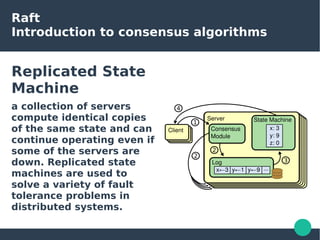
a collection of servers
compute identical copies
of the same state and can
continue operating even if
some of the servers are
down. Replicated state
machines are used to
solve a variety of fault
tolerance problems in
distributed systems.
Raft
Introduction to consensus algorithms
Why not Paxos?
“There are significant gaps between the
description of the Paxos algorithm and the
needs of a real-world system… the final
system will be based on an unproven
protocol”
Quoted from Google's Chubby implementers
Raft
Introduction to consensus algorithms
Why not Paxos?
#1 Single-decree Paxos is dense and subtle:
it is divided into two stages that do not have
simple intuitive explanations and cannot be
understood independently. Because of this, it
is difficult to develop intuitions about why the
single-decree protocol works. The
composition rules for multi-Paxos add
significant additional complexity and subtlety.
Raft
Introduction to consensus algorithms
Why not Paxos?
#2 it does not provide a good foundation for
building practical implementations. One
reason is that there is no widely agreed-upon
algorithm for multi-Paxos. Lamport’s
descriptions are mostly about single-decree
Paxos; he sketched possible approaches to
multi-Paxos, but many details are missing.
Raft
Properties and key features
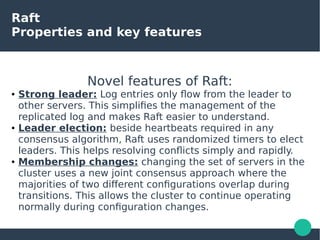
Novel features of Raft:
● Strong leader: Log entries only flow from the leader to
other servers. This simplifies the management of the
replicated log and makes Raft easier to understand.
● Leader election: beside heartbeats required in any
consensus algorithm, Raft uses randomized timers to elect
leaders. This helps resolving conflicts simply and rapidly.
● Membership changes: changing the set of servers in the
cluster uses a new joint consensus approach where the
majorities of two different configurations overlap during
transitions. This allows the cluster to continue operating
normally during configuration changes.
Raft
Properties and key features
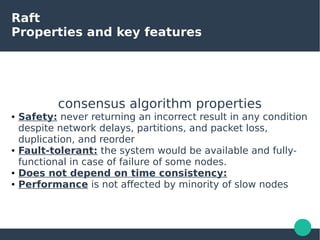
consensus algorithm properties
● Safety: never returning an incorrect result in any condition
despite network delays, partitions, and packet loss,
duplication, and reorder
● Fault-tolerant: the system would be available and fully-
functional in case of failure of some nodes.
● Does not depend on time consistency:
● Performance is not affected by minority of slow nodes
Raft
Sub-problems
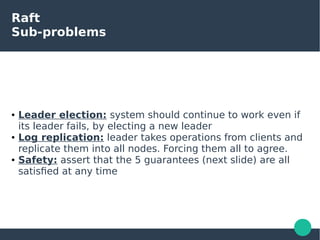
● Leader election: system should continue to work even if
its leader fails, by electing a new leader
● Log replication: leader takes operations from clients and
replicate them into all nodes. Forcing them all to agree.
● Safety: assert that the 5 guarantees (next slide) are all
satisfied at any time
Raft
The 5 guarantees
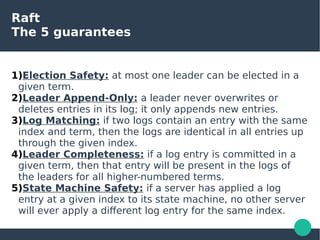
1)Election Safety: at most one leader can be elected in a
given term.
2)Leader Append-Only: a leader never overwrites or
deletes entries in its log; it only appends new entries.
3)Log Matching: if two logs contain an entry with the same
index and term, then the logs are identical in all entries up
through the given index.
4)Leader Completeness: if a log entry is committed in a
given term, then that entry will be present in the logs of
the leaders for all higher-numbered terms.
5)State Machine Safety: if a server has applied a log
entry at a given index to its state machine, no other server
will ever apply a different log entry for the same index.
Raft
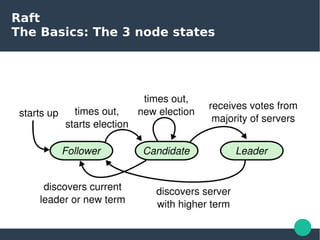
The Basics: The 3 node states
Raft
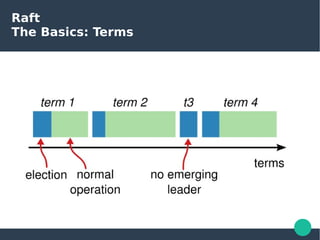
The Basics: Terms
Raft
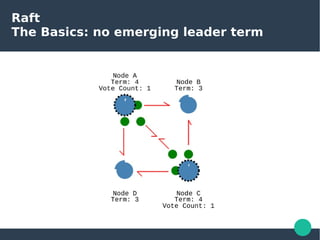
The Basics: no emerging leader term
Raft
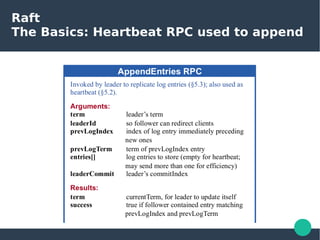
The Basics: Heartbeat RPC used to append
Raft
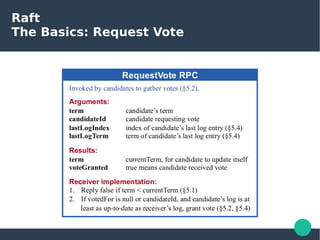
The Basics: Request Vote
Raft
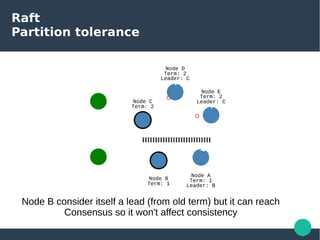
Partition tolerance
Node B consider itself a lead (from old term) but it can reach
Consensus so it won't affect consistency
Raft
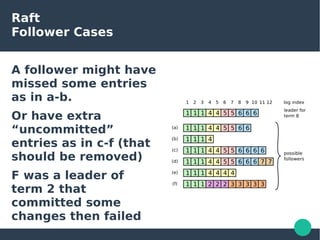
Follower Cases
A follower might have
missed some entries
as in a-b.
Or have extra
“uncommitted”
entries as in c-f (that
should be removed)
F was a leader of
term 2 that
committed some
changes then failed
Raft
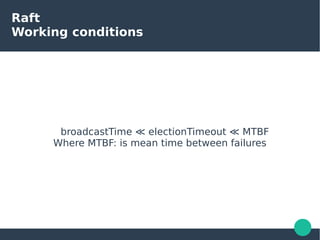
Working conditions
broadcastTime ≪ electionTimeout ≪ MTBF
Where MTBF: is mean time between failures
Raft
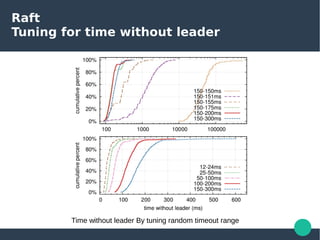
Tuning for time without leader
Time without leader By tuning random timeout range
Raft
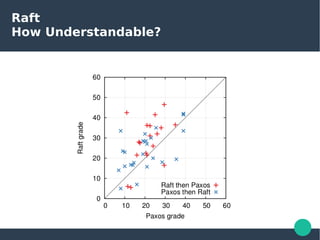
How Understandable?
Raft
Resources
● The Paper
● Visualization of Raft operations
● Etcd - implementation
● Consul – another implementation
● http://raftconsensus.github.io/
● CoreOS/Fleet uses Etcd
● Google Kubernetes - a distributed system
● Mesos / Mesosphere– a distributed system

Introduction to Raft algorithm

  • 1.
    Raft Understandable Consensus Algorithm Presentationfor Seminar Muayyad Saleh Alsadi (20158043) Based on Raft Paper “In Search of an Understandable Consensus Algorithm” Diego Ongaro and John Ousterhout, Stanford University
  • 2.
    Raft Introduction Introduction Raft is aconsensus algorithm for managing a replicated log. It produces a result equivalent to multi-Paxos, and it is as efficient as Paxos but with completely different structure meant to be understandable as the most key objective.
  • 3.
    Raft Introduction to consensusalgorithms What is a consensus algorithm? “Consensus algorithms allow a collection of machines to work as a coherent group that can survive the failures of some of its members. Because of this, they play a key role in building reliable large-scale software systems.”
  • 4.
    Raft Introduction to consensusalgorithms Replicated State Machine a collection of servers compute identical copies of the same state and can continue operating even if some of the servers are down. Replicated state machines are used to solve a variety of fault tolerance problems in distributed systems.
  • 5.
    Raft Introduction to consensusalgorithms Why not Paxos? “There are significant gaps between the description of the Paxos algorithm and the needs of a real-world system… the final system will be based on an unproven protocol” Quoted from Google's Chubby implementers
  • 6.
    Raft Introduction to consensusalgorithms Why not Paxos? #1 Single-decree Paxos is dense and subtle: it is divided into two stages that do not have simple intuitive explanations and cannot be understood independently. Because of this, it is difficult to develop intuitions about why the single-decree protocol works. The composition rules for multi-Paxos add significant additional complexity and subtlety.
  • 7.
    Raft Introduction to consensusalgorithms Why not Paxos? #2 it does not provide a good foundation for building practical implementations. One reason is that there is no widely agreed-upon algorithm for multi-Paxos. Lamport’s descriptions are mostly about single-decree Paxos; he sketched possible approaches to multi-Paxos, but many details are missing.
  • 8.
    Raft Properties and keyfeatures Novel features of Raft: ● Strong leader: Log entries only flow from the leader to other servers. This simplifies the management of the replicated log and makes Raft easier to understand. ● Leader election: beside heartbeats required in any consensus algorithm, Raft uses randomized timers to elect leaders. This helps resolving conflicts simply and rapidly. ● Membership changes: changing the set of servers in the cluster uses a new joint consensus approach where the majorities of two different configurations overlap during transitions. This allows the cluster to continue operating normally during configuration changes.
  • 9.
    Raft Properties and keyfeatures consensus algorithm properties ● Safety: never returning an incorrect result in any condition despite network delays, partitions, and packet loss, duplication, and reorder ● Fault-tolerant: the system would be available and fully- functional in case of failure of some nodes. ● Does not depend on time consistency: ● Performance is not affected by minority of slow nodes
  • 10.
    Raft Sub-problems ● Leader election:system should continue to work even if its leader fails, by electing a new leader ● Log replication: leader takes operations from clients and replicate them into all nodes. Forcing them all to agree. ● Safety: assert that the 5 guarantees (next slide) are all satisfied at any time
  • 11.
    Raft The 5 guarantees 1)ElectionSafety: at most one leader can be elected in a given term. 2)Leader Append-Only: a leader never overwrites or deletes entries in its log; it only appends new entries. 3)Log Matching: if two logs contain an entry with the same index and term, then the logs are identical in all entries up through the given index. 4)Leader Completeness: if a log entry is committed in a given term, then that entry will be present in the logs of the leaders for all higher-numbered terms. 5)State Machine Safety: if a server has applied a log entry at a given index to its state machine, no other server will ever apply a different log entry for the same index.
  • 12.
    Raft The Basics: The3 node states
  • 13.
  • 14.
    Raft The Basics: noemerging leader term
  • 15.
    Raft The Basics: HeartbeatRPC used to append
  • 16.
  • 17.
    Raft Partition tolerance Node Bconsider itself a lead (from old term) but it can reach Consensus so it won't affect consistency
  • 18.
    Raft Follower Cases A followermight have missed some entries as in a-b. Or have extra “uncommitted” entries as in c-f (that should be removed) F was a leader of term 2 that committed some changes then failed
  • 19.
    Raft Working conditions broadcastTime ≪electionTimeout ≪ MTBF Where MTBF: is mean time between failures
  • 20.
    Raft Tuning for timewithout leader Time without leader By tuning random timeout range
  • 21.
  • 22.
    Raft Resources ● The Paper ●Visualization of Raft operations ● Etcd - implementation ● Consul – another implementation ● http://raftconsensus.github.io/ ● CoreOS/Fleet uses Etcd ● Google Kubernetes - a distributed system ● Mesos / Mesosphere– a distributed system