Studying Life Section 1-3 pg. 16-23
 
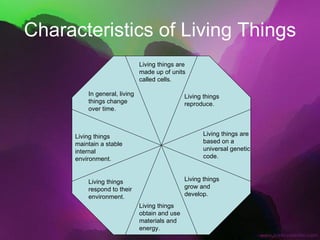
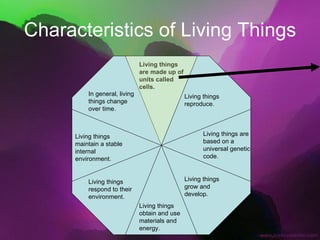
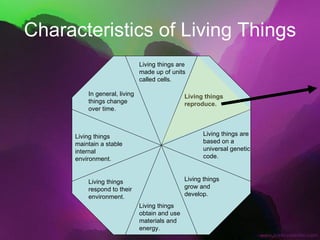
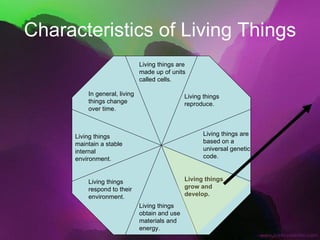
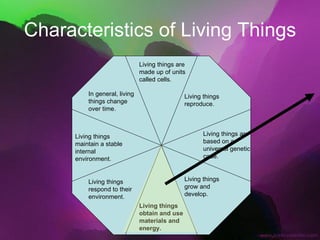
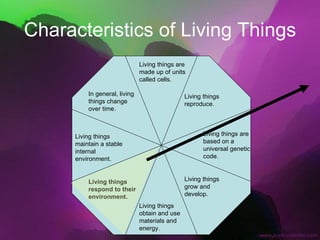
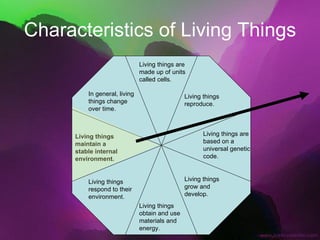
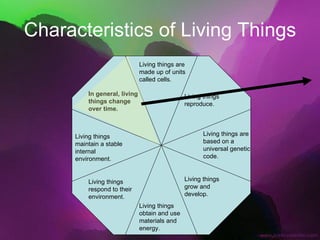
Characteristics of Living Things Living things are made up of units called cells. Living things reproduce. Living things are based on a universal genetic code. Living things grow and develop. Living things obtain and use materials and energy. Living things respond to their environment. Living things maintain a stable internal environment. In general, living things change over time.
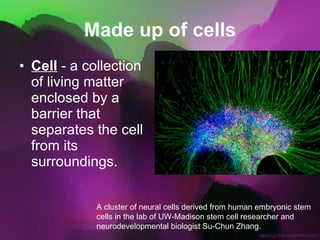
Made up of cells Cell  - a collection of living matter enclosed by a barrier that separates the cell from its surroundings. A cluster of neural cells derived from human embryonic stem cells in the lab of UW-Madison stem cell researcher and neurodevelopmental biologist Su-Chun Zhang.
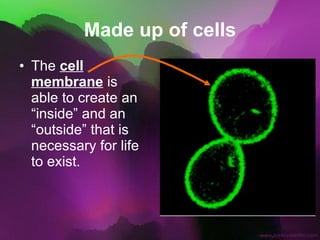
Made up of cells The  cell membrane  is able to create an “inside” and an “outside” that is necessary for life to exist.
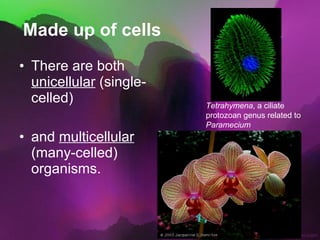
Made up of cells There are both  unicellular  (single-celled)  and  multicellular  (many-celled) organisms. Tetrahymena , a ciliate protozoan genus related to  Paramecium
Characteristics of Living Things Living things are made up of units called cells. Living things reproduce. Living things are based on a universal genetic code. Living things grow and develop. Living things obtain and use materials and energy. Living things respond to their environment. Living things maintain a stable internal environment. In general, living things change over time.
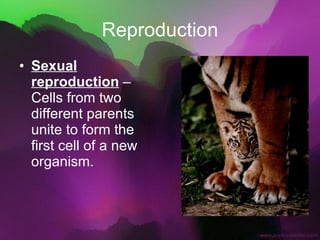
Reproduction Sexual reproduction  – Cells from two different parents unite to form the first cell of a new organism.
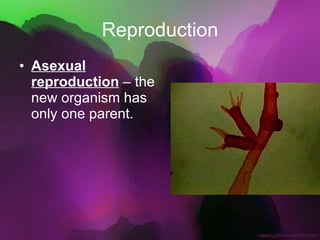
Reproduction Asexual reproduction  – the new organism has only one parent.
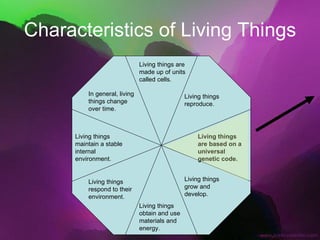
Characteristics of Living Things Living things are made up of units called cells. Living things reproduce. Living things are based on a universal genetic code. Living things grow and develop. Living things obtain and use materials and energy. Living things respond to their environment. Living things maintain a stable internal environment. In general, living things change over time.
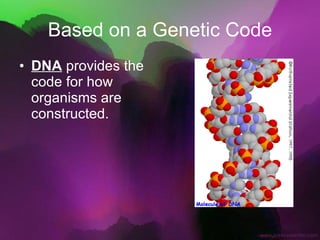
Based on a Genetic Code DNA  provides the code for how organisms are constructed.
Characteristics of Living Things Living things are made up of units called cells. Living things reproduce. Living things are based on a universal genetic code. Living things grow and develop. Living things obtain and use materials and energy. Living things respond to their environment. Living things maintain a stable internal environment. In general, living things change over time.
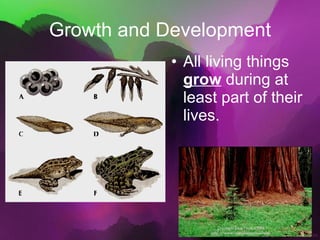
Growth and Development All living things  grow  during at least part of their lives.
Growth and Development Differentiation  – the development of many types of cells with many different functions from a single original cell.
Characteristics of Living Things Living things are made up of units called cells. Living things reproduce. Living things are based on a universal genetic code. Living things grow and develop. Living things obtain and use materials and energy. Living things respond to their environment. Living things maintain a stable internal environment. In general, living things change over time.
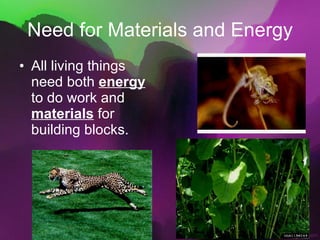
Need for Materials and Energy All living things need both  energy  to do work and  materials  for building blocks.
Need for Materials and Energy Metabolism  – the combination of chemical reactions through which an organism  builds up  or  breaks down  materials. Energy is required to build up large molecules. Energy is released by breaking down large molecules.
Characteristics of Living Things Living things are made up of units called cells. Living things reproduce. Living things are based on a universal genetic code. Living things grow and develop. Living things obtain and use materials and energy. Living things respond to their environment. Living things maintain a stable internal environment. In general, living things change over time.
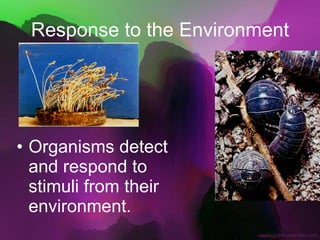
Response to the Environment Organisms detect and respond to stimuli from their environment.
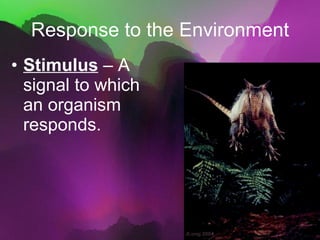
Response to the Environment Stimulus  – A signal to which an organism responds.
Characteristics of Living Things Living things are made up of units called cells. Living things reproduce. Living things are based on a universal genetic code. Living things grow and develop. Living things obtain and use materials and energy. Living things respond to their environment. Living things maintain a stable internal environment. In general, living things change over time.
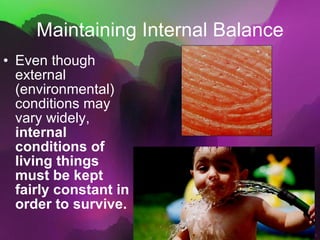
Maintaining Internal Balance Even though external (environmental) conditions may vary widely,  internal conditions of living things must be kept fairly constant in order to survive.
Maintaining Internal Balance Homeostasis  – The process of maintaining constant internal conditions or balance.
Characteristics of Living Things Living things are made up of units called cells. Living things reproduce. Living things are based on a universal genetic code. Living things grow and develop. Living things obtain and use materials and energy. Living things respond to their environment. Living things maintain a stable internal environment. In general, living things change over time.
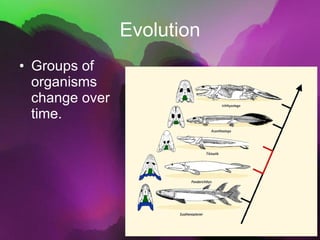
Evolution Groups of organisms change over time.
Branches of Biology
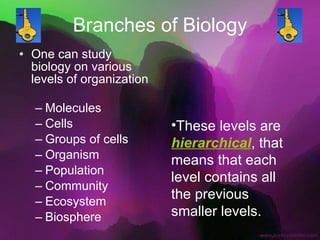
Branches of Biology One can study biology on various levels of organization Molecules Cells Groups of cells Organism Population Community Ecosystem Biosphere These levels are  hierarchical , that means that each level contains all the previous smaller levels.
 
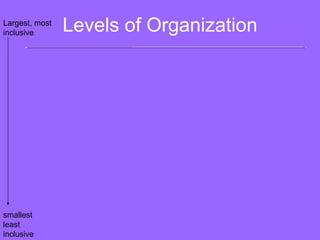
Levels of Organization Biosphere Ecosystem Community Population The part of Earth that contains all ecosystems Community and  its nonliving  surroundings Populations that live together in a  defined area Group of  organisms of one type that live in  the same area Biosphere Hawk, snake, bison, prairie dog, grass, stream, rocks, air Hawk, snake, bison, prairie dog, grass Bison herd Largest, most inclusive smallestleast inclusive
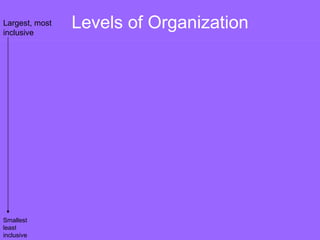
Levels of Organization Organism Groups of Cells Cells Molecules Individual living thing Tissues, organs, and organ systems Smallest functional unit of life Groups of atoms; smallest unit of  most chemical compounds Bison Nervous   tissue Nervous   system Brain Nerve cell Water DNA Largest, most inclusive Smallest least inclusive
End
End for the day
You can drop a mouse down a thousand-yard mine shaft; and, on arriving at the bottom it gets a slight shock and walks away, provided that the ground is fairly soft. A rat is killed, a man is broken, a horse splashes.  From  On Being the Right Size   by J. B. S. Haldane

1 3 v2

  • 1.
    Studying Life Section1-3 pg. 16-23
  • 2.
  • 3.
    Characteristics of LivingThings Living things are made up of units called cells. Living things reproduce. Living things are based on a universal genetic code. Living things grow and develop. Living things obtain and use materials and energy. Living things respond to their environment. Living things maintain a stable internal environment. In general, living things change over time.
  • 4.
    Characteristics of LivingThings Living things are made up of units called cells. Living things reproduce. Living things are based on a universal genetic code. Living things grow and develop. Living things obtain and use materials and energy. Living things respond to their environment. Living things maintain a stable internal environment. In general, living things change over time.
  • 5.
    Made up ofcells Cell - a collection of living matter enclosed by a barrier that separates the cell from its surroundings. A cluster of neural cells derived from human embryonic stem cells in the lab of UW-Madison stem cell researcher and neurodevelopmental biologist Su-Chun Zhang.
  • 6.
    Made up ofcells The cell membrane is able to create an “inside” and an “outside” that is necessary for life to exist.
  • 7.
    Made up ofcells There are both unicellular (single-celled) and multicellular (many-celled) organisms. Tetrahymena , a ciliate protozoan genus related to Paramecium
  • 8.
    Characteristics of LivingThings Living things are made up of units called cells. Living things reproduce. Living things are based on a universal genetic code. Living things grow and develop. Living things obtain and use materials and energy. Living things respond to their environment. Living things maintain a stable internal environment. In general, living things change over time.
  • 9.
    Reproduction Sexual reproduction – Cells from two different parents unite to form the first cell of a new organism.
  • 10.
    Reproduction Asexual reproduction – the new organism has only one parent.
  • 11.
    Characteristics of LivingThings Living things are made up of units called cells. Living things reproduce. Living things are based on a universal genetic code. Living things grow and develop. Living things obtain and use materials and energy. Living things respond to their environment. Living things maintain a stable internal environment. In general, living things change over time.
  • 12.
    Based on aGenetic Code DNA provides the code for how organisms are constructed.
  • 13.
    Characteristics of LivingThings Living things are made up of units called cells. Living things reproduce. Living things are based on a universal genetic code. Living things grow and develop. Living things obtain and use materials and energy. Living things respond to their environment. Living things maintain a stable internal environment. In general, living things change over time.
  • 14.
    Growth and DevelopmentAll living things grow during at least part of their lives.
  • 15.
    Growth and DevelopmentDifferentiation – the development of many types of cells with many different functions from a single original cell.
  • 16.
    Characteristics of LivingThings Living things are made up of units called cells. Living things reproduce. Living things are based on a universal genetic code. Living things grow and develop. Living things obtain and use materials and energy. Living things respond to their environment. Living things maintain a stable internal environment. In general, living things change over time.
  • 17.
    Need for Materialsand Energy All living things need both energy to do work and materials for building blocks.
  • 18.
    Need for Materialsand Energy Metabolism – the combination of chemical reactions through which an organism builds up or breaks down materials. Energy is required to build up large molecules. Energy is released by breaking down large molecules.
  • 19.
    Characteristics of LivingThings Living things are made up of units called cells. Living things reproduce. Living things are based on a universal genetic code. Living things grow and develop. Living things obtain and use materials and energy. Living things respond to their environment. Living things maintain a stable internal environment. In general, living things change over time.
  • 20.
    Response to theEnvironment Organisms detect and respond to stimuli from their environment.
  • 21.
    Response to theEnvironment Stimulus – A signal to which an organism responds.
  • 22.
    Characteristics of LivingThings Living things are made up of units called cells. Living things reproduce. Living things are based on a universal genetic code. Living things grow and develop. Living things obtain and use materials and energy. Living things respond to their environment. Living things maintain a stable internal environment. In general, living things change over time.
  • 23.
    Maintaining Internal BalanceEven though external (environmental) conditions may vary widely, internal conditions of living things must be kept fairly constant in order to survive.
  • 24.
    Maintaining Internal BalanceHomeostasis – The process of maintaining constant internal conditions or balance.
  • 25.
    Characteristics of LivingThings Living things are made up of units called cells. Living things reproduce. Living things are based on a universal genetic code. Living things grow and develop. Living things obtain and use materials and energy. Living things respond to their environment. Living things maintain a stable internal environment. In general, living things change over time.
  • 26.
    Evolution Groups oforganisms change over time.
  • 27.
  • 28.
    Branches of BiologyOne can study biology on various levels of organization Molecules Cells Groups of cells Organism Population Community Ecosystem Biosphere These levels are hierarchical , that means that each level contains all the previous smaller levels.
  • 29.
  • 30.
    Levels of OrganizationBiosphere Ecosystem Community Population The part of Earth that contains all ecosystems Community and its nonliving surroundings Populations that live together in a defined area Group of organisms of one type that live in the same area Biosphere Hawk, snake, bison, prairie dog, grass, stream, rocks, air Hawk, snake, bison, prairie dog, grass Bison herd Largest, most inclusive smallestleast inclusive
  • 31.
    Levels of OrganizationOrganism Groups of Cells Cells Molecules Individual living thing Tissues, organs, and organ systems Smallest functional unit of life Groups of atoms; smallest unit of most chemical compounds Bison Nervous tissue Nervous system Brain Nerve cell Water DNA Largest, most inclusive Smallest least inclusive
  • 32.
  • 33.
  • 34.
    You can dropa mouse down a thousand-yard mine shaft; and, on arriving at the bottom it gets a slight shock and walks away, provided that the ground is fairly soft. A rat is killed, a man is broken, a horse splashes. From On Being the Right Size by J. B. S. Haldane