Atoms and Elements Chemical Foundations
Atoms and Elements Element - Substances that can not be broken down further by ordinary chemical means Atoms - The smallest particle of an element that retains the properties of the element
Postulates Elements consist of tiny particles called atoms Atoms retain their identity in reactions They do not change into other types of atoms Carbon stays carbon, Oxygen stays oxygen In a compound, atoms of two or more elements are combined
Atoms have parts Atoms are composed of protons, neutrons and electrons All of the parts of the atom stay together as that atom in chemical reactions
Elements Elements represent the different types of atoms that are known Come in solid, liquid and gas forms at earths normal temperatures
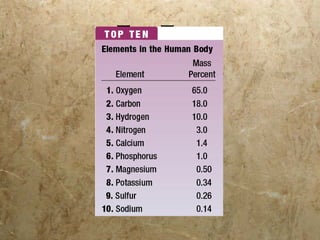
Top Ten
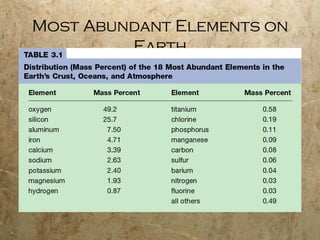
Most Abundant Elements on Earth
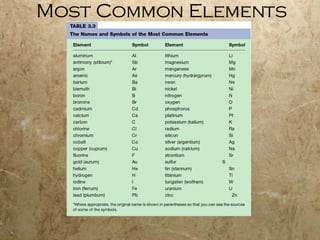
Most Common Elements
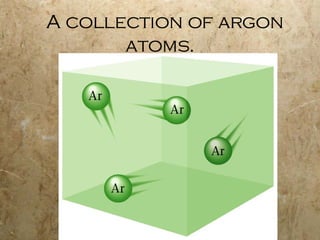
A collection of argon atoms.
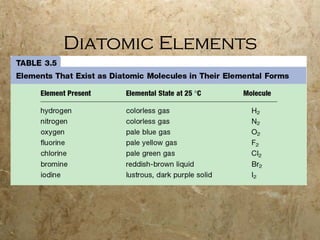
Diatomic Elements
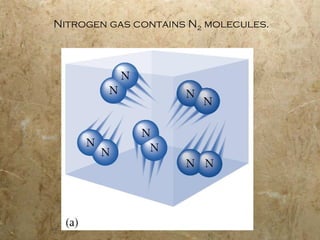
Nitrogen gas contains N 2  molecules.
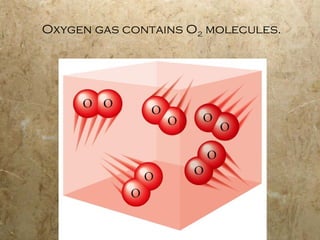
Oxygen gas contains O 2  molecules.
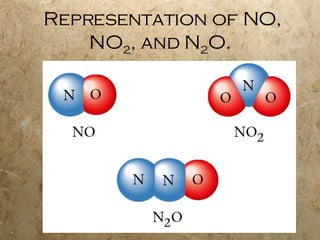
Representation of NO, NO 2 , and N 2 O.
History of the discovery of the atom 300 BC in Greece School of thought that matter is made up of tiny indivisible, invisible, indestructable, fundamental units of matter called atmos Democritus of Abdera most well known atmostist.  Did no experiments No proof philosopher
1770’s Antoine Lavosier made observations and did experiments resulting in the Law of Conservation of Mass Law of Conservation of Mass Matter can not be created or destroyed Mass of materials before the chemical reaction is the same mass after the reaction
1799 - Proust Joseph Proust showed that the proportion by mass of the elements in a compound is always the same Now called the Law of Definite Proportions Part of our definition of a chemical - any substance with a definite composition
John Dalton English School Teacher Alchemists were trying to change different metals into gold Wanted to learn in what ratios that different elements combine Performed experiments Formulated theories to explain his observations Proposed his theories in 1808 Based on the Greek idea of the atom
Key idea - Dalton’s Atomic Theory All matter is made of indivisible, invisible, and indestructible particles called atoms Atoms of the same element are identical Atoms of different elements differ in their physical and chemical properties
Dalton’s Atomic Theory Con’t Atoms of different elements combine in simple whole number ratios to form compounds Chemical Reactions occur when atoms are separated, joined or rearranged.  Atoms of one element are NEVER changed into atoms of another element as a result of a reaction
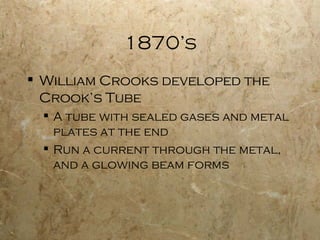
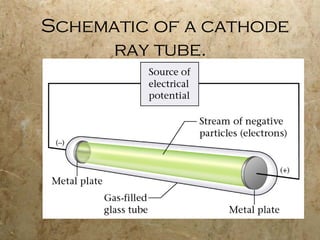
1870’s William Crooks developed the Crook’s Tube A tube with sealed gases and metal plates at the end Run a current through the metal, and a glowing beam forms
Schematic of a cathode ray tube.
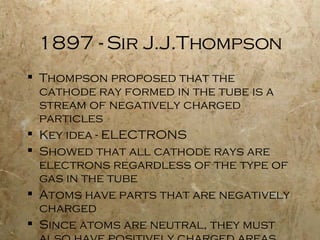
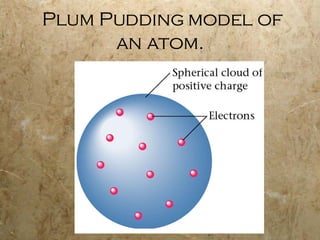
1897 - Sir J.J.Thompson Thompson proposed that the cathode ray formed in the tube is a stream of negatively charged particles Key idea - ELECTRONS Showed that all cathode rays are electrons regardless of the type of gas in the tube Atoms have parts that are negatively charged Since atoms are neutral, they must also have positively charged areas Gave rise to the plum pudding model of the atom
Plum Pudding model of an atom.
1886 - Goldstein E. Goldstein discovered a positively charged particle. Called them PROTONS  Work was largely ignored
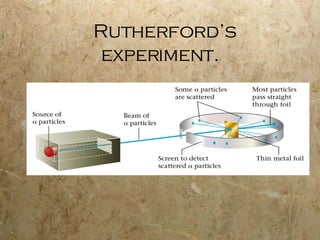
1909 - Ernst Rutherford Rutherford physicist who experimented with the positively charged particle He figured Atoms have no charge Electrical charges are properties of matter Electrical charges exist in single whole number units + or - (no fractions) Electrical Charges cancel each other, therefore a + and a - together = neutral atom
Rutherford’s experiment.
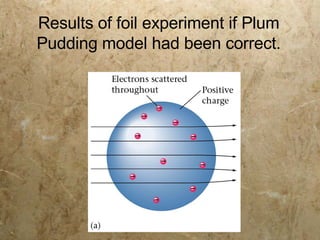
Results of foil experiment if Plum Pudding model had been correct.
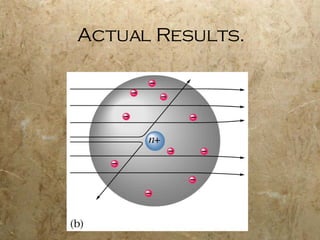
Actual Results.
Rutherford’s model Key Idea -NUCLEAR ATOM All of the mass of the positive particles (protons) is at the center region of the atom Center region called the NUCLEUS Electrons surround the nucleus in a “cloud”
1913 - Niels Bohr Danish Physicist Rutherford’s model did not work because the electrons are so small compared to the positive mass in the center of the atom
Bohr’s Atom There are certain energy levels in the space of the electron cloud that mathematically allow the electron to stay in the cloud (not crash into the nucleus) Key idea - There are certain ORBITS in which an electron can travel around the nucleus without losing energy
Bohr’s atom con’t Suggested circular orbits The farther away from the nucleus, the higher the energy level Under normal conditions, electrons are arranged in the GROUND STATE.  In the ground state, the electrons occupy the lowest energy level closest to the nucleus
All models have problems All models are not exactly correct, but they lead to further science and discovery All have important key ideas
We now know… Atoms are made up of subparticles Atoms are divisible, but not by ordinary chemical means Atoms of elements can vary (isotopes) Electrons reside in ORBITALS, not orbits

Minooka - Elements Part 2

  • 1.
    Atoms and ElementsChemical Foundations
  • 2.
    Atoms and ElementsElement - Substances that can not be broken down further by ordinary chemical means Atoms - The smallest particle of an element that retains the properties of the element
  • 3.
    Postulates Elements consistof tiny particles called atoms Atoms retain their identity in reactions They do not change into other types of atoms Carbon stays carbon, Oxygen stays oxygen In a compound, atoms of two or more elements are combined
  • 4.
    Atoms have partsAtoms are composed of protons, neutrons and electrons All of the parts of the atom stay together as that atom in chemical reactions
  • 5.
    Elements Elements representthe different types of atoms that are known Come in solid, liquid and gas forms at earths normal temperatures
  • 6.
  • 7.
  • 8.
  • 9.
    A collection ofargon atoms.
  • 10.
  • 11.
    Nitrogen gas containsN 2 molecules.
  • 12.
    Oxygen gas containsO 2 molecules.
  • 13.
    Representation of NO,NO 2 , and N 2 O.
  • 14.
    History of thediscovery of the atom 300 BC in Greece School of thought that matter is made up of tiny indivisible, invisible, indestructable, fundamental units of matter called atmos Democritus of Abdera most well known atmostist. Did no experiments No proof philosopher
  • 15.
    1770’s Antoine Lavosiermade observations and did experiments resulting in the Law of Conservation of Mass Law of Conservation of Mass Matter can not be created or destroyed Mass of materials before the chemical reaction is the same mass after the reaction
  • 16.
    1799 - ProustJoseph Proust showed that the proportion by mass of the elements in a compound is always the same Now called the Law of Definite Proportions Part of our definition of a chemical - any substance with a definite composition
  • 17.
    John Dalton EnglishSchool Teacher Alchemists were trying to change different metals into gold Wanted to learn in what ratios that different elements combine Performed experiments Formulated theories to explain his observations Proposed his theories in 1808 Based on the Greek idea of the atom
  • 18.
    Key idea -Dalton’s Atomic Theory All matter is made of indivisible, invisible, and indestructible particles called atoms Atoms of the same element are identical Atoms of different elements differ in their physical and chemical properties
  • 19.
    Dalton’s Atomic TheoryCon’t Atoms of different elements combine in simple whole number ratios to form compounds Chemical Reactions occur when atoms are separated, joined or rearranged. Atoms of one element are NEVER changed into atoms of another element as a result of a reaction
  • 20.
    1870’s William Crooksdeveloped the Crook’s Tube A tube with sealed gases and metal plates at the end Run a current through the metal, and a glowing beam forms
  • 21.
    Schematic of acathode ray tube.
  • 22.
    1897 - SirJ.J.Thompson Thompson proposed that the cathode ray formed in the tube is a stream of negatively charged particles Key idea - ELECTRONS Showed that all cathode rays are electrons regardless of the type of gas in the tube Atoms have parts that are negatively charged Since atoms are neutral, they must also have positively charged areas Gave rise to the plum pudding model of the atom
  • 23.
    Plum Pudding modelof an atom.
  • 24.
    1886 - GoldsteinE. Goldstein discovered a positively charged particle. Called them PROTONS Work was largely ignored
  • 25.
    1909 - ErnstRutherford Rutherford physicist who experimented with the positively charged particle He figured Atoms have no charge Electrical charges are properties of matter Electrical charges exist in single whole number units + or - (no fractions) Electrical Charges cancel each other, therefore a + and a - together = neutral atom
  • 26.
  • 27.
    Results of foilexperiment if Plum Pudding model had been correct.
  • 28.
  • 29.
    Rutherford’s model KeyIdea -NUCLEAR ATOM All of the mass of the positive particles (protons) is at the center region of the atom Center region called the NUCLEUS Electrons surround the nucleus in a “cloud”
  • 30.
    1913 - NielsBohr Danish Physicist Rutherford’s model did not work because the electrons are so small compared to the positive mass in the center of the atom
  • 31.
    Bohr’s Atom Thereare certain energy levels in the space of the electron cloud that mathematically allow the electron to stay in the cloud (not crash into the nucleus) Key idea - There are certain ORBITS in which an electron can travel around the nucleus without losing energy
  • 32.
    Bohr’s atom con’tSuggested circular orbits The farther away from the nucleus, the higher the energy level Under normal conditions, electrons are arranged in the GROUND STATE. In the ground state, the electrons occupy the lowest energy level closest to the nucleus
  • 33.
    All models haveproblems All models are not exactly correct, but they lead to further science and discovery All have important key ideas
  • 34.
    We now know…Atoms are made up of subparticles Atoms are divisible, but not by ordinary chemical means Atoms of elements can vary (isotopes) Electrons reside in ORBITALS, not orbits