Concept of
Stereoisomerism of
Natural Products
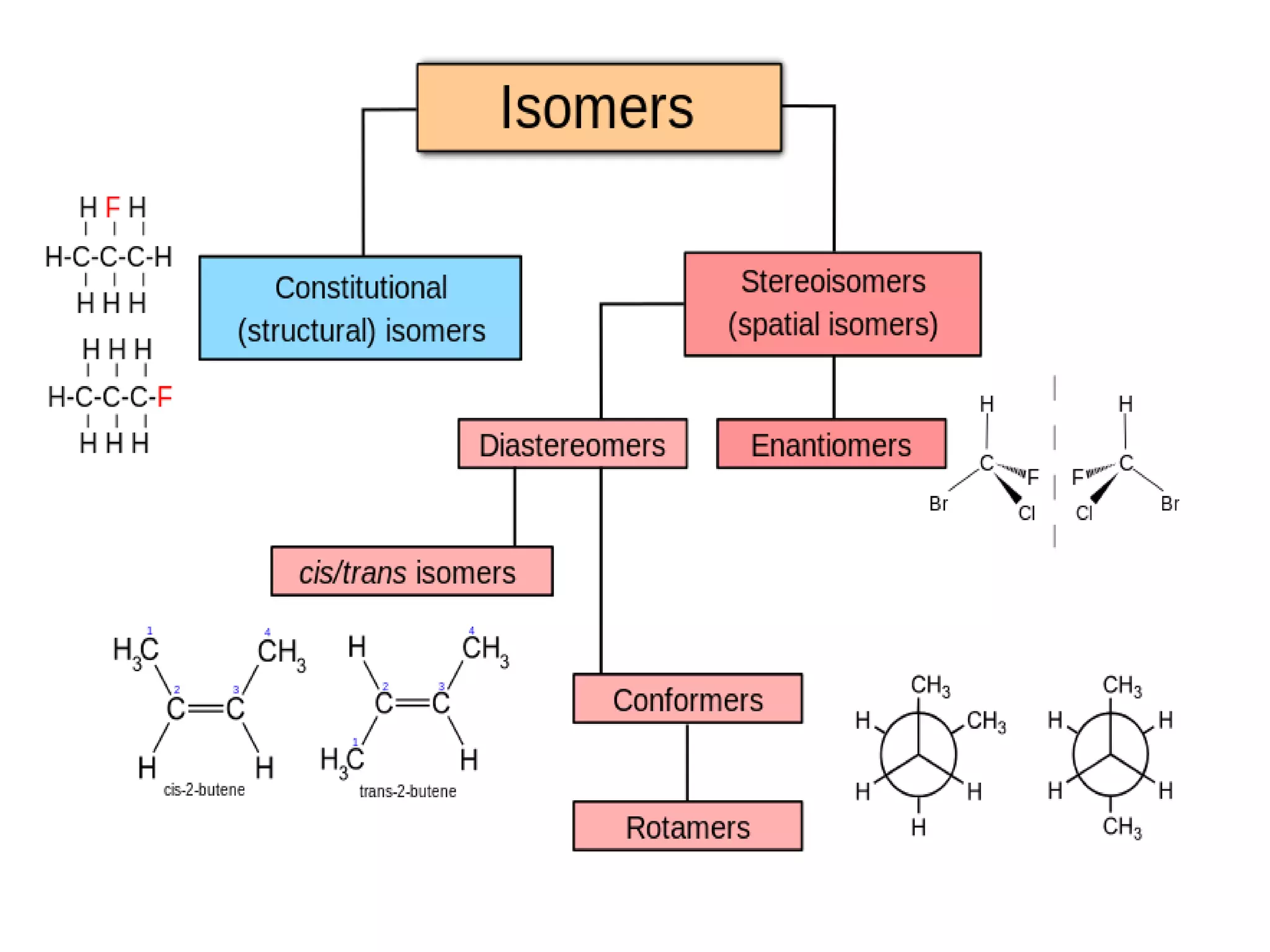
Isomers
Different compounds having the same molecular
formula but with a different chemical structure are
called isomers.
isomers contain the same number of atoms of each
element, but have different arrangements of their atoms.
 Isomers do not necessarily share similar properties,
unless they also have the same functional groups.
There are two main forms of isomerism :
1.structural isomerism (or constitutional isomerism) and
2.stereoisomerism(or spatial isomerism).
While structural isomers typically have different chemical
properties, stereoisomers behave identically in most
chemical reactions, except in their reaction with other
stereoisomers.
structural isomers, ( constitutional isomers, )-they have
same molecular formula but atoms and functional
groups are joined together in different ways.
Structural isomers have different IUPAC names and may or
may not belong to the same functional group
example of isomerism is given by propanol : It has the
formula C3H8O (or C3H7OH) and occurs as three
isomers: 1.propan-1-ol (n-propyl alcohol; I) and 2.propan-2-
ol (isopropyl alcohol; II), 3.methoxyethane(ethyl-methyl-
ether; III).
propadiene (or allene) and
propyne (or methylacetylene) are examples of
isomers containing different bond types.
Propadiene contains two double bonds, whereas
propyne contains one triple bond
propadiene propyne
stereoisomers
stereoisomers are isomeric molecules that
have the same molecular formula and
sequence of bonded atoms (constitution), but
differ in the three-dimensional orientations of
their atoms in space.
molecules that are stereoisomers of each
other represent the same structural isomer.
 This class includes enantomers which are
non-superposable mirror-images of each
other, and diastereomers, which are not mirror
images.
Enantiomers always contain chiral centers and
diastereomers often do, but there are some
diastereomers that neither are chiral nor contain
chiral centers.
 confermational isomers(conformers), may be
rotamers, diastereomers, or enantiomers depending
on the exact compound.
E/Z isomers which have restricted rotation at a
double bond, are configurational isomers. It is an
extension of cis/trans notation (which only
describes relative stereochemistry) that can be used
to describe double bonds having two, three or four
substituents.
(E)-But-2-ene
(Z)-But-2-ene
cis–trans isomerism is "geometric isomerism.
cis–trans isomers are used to describe any molecules
with restricted rotation in the molecule. For alkenes with
more than two substituents, E-Z notation is used instead
of cis and trans
although conformers can be referred to as stereoisomers,
they are not stable isomers, since bonds in conformers can
easily rotate, thus converting one conformer to another,
which can be either diastereomeric or enantiomeric to the
original one.
Enantiomers
Enantiomers, also known as optical isomers,- stereoisomers that are
related to each other by a reflection: they are mirror images of each
other that are non- superimposable. Human hands are a
macroscopic analog of this .
Two compounds that are enantiomers of each other have the
same physical properties, except for the direction in which they
rotate polarized light.
 different enantiomers of a compound may have substantially
different biological effects

Concept of stereoisomerism of natural products

  • 1.
  • 2.
    Isomers Different compounds havingthe same molecular formula but with a different chemical structure are called isomers. isomers contain the same number of atoms of each element, but have different arrangements of their atoms.  Isomers do not necessarily share similar properties, unless they also have the same functional groups. There are two main forms of isomerism : 1.structural isomerism (or constitutional isomerism) and 2.stereoisomerism(or spatial isomerism).
  • 3.
    While structural isomerstypically have different chemical properties, stereoisomers behave identically in most chemical reactions, except in their reaction with other stereoisomers. structural isomers, ( constitutional isomers, )-they have same molecular formula but atoms and functional groups are joined together in different ways. Structural isomers have different IUPAC names and may or may not belong to the same functional group example of isomerism is given by propanol : It has the formula C3H8O (or C3H7OH) and occurs as three isomers: 1.propan-1-ol (n-propyl alcohol; I) and 2.propan-2- ol (isopropyl alcohol; II), 3.methoxyethane(ethyl-methyl- ether; III).
  • 5.
    propadiene (or allene)and propyne (or methylacetylene) are examples of isomers containing different bond types. Propadiene contains two double bonds, whereas propyne contains one triple bond propadiene propyne
  • 6.
    stereoisomers stereoisomers are isomericmolecules that have the same molecular formula and sequence of bonded atoms (constitution), but differ in the three-dimensional orientations of their atoms in space. molecules that are stereoisomers of each other represent the same structural isomer.  This class includes enantomers which are non-superposable mirror-images of each other, and diastereomers, which are not mirror images.
  • 8.
    Enantiomers always containchiral centers and diastereomers often do, but there are some diastereomers that neither are chiral nor contain chiral centers.  confermational isomers(conformers), may be rotamers, diastereomers, or enantiomers depending on the exact compound. E/Z isomers which have restricted rotation at a double bond, are configurational isomers. It is an extension of cis/trans notation (which only describes relative stereochemistry) that can be used to describe double bonds having two, three or four substituents.
  • 9.
  • 10.
    cis–trans isomerism is"geometric isomerism. cis–trans isomers are used to describe any molecules with restricted rotation in the molecule. For alkenes with more than two substituents, E-Z notation is used instead of cis and trans
  • 11.
    although conformers canbe referred to as stereoisomers, they are not stable isomers, since bonds in conformers can easily rotate, thus converting one conformer to another, which can be either diastereomeric or enantiomeric to the original one.
  • 12.
    Enantiomers Enantiomers, also knownas optical isomers,- stereoisomers that are related to each other by a reflection: they are mirror images of each other that are non- superimposable. Human hands are a macroscopic analog of this . Two compounds that are enantiomers of each other have the same physical properties, except for the direction in which they rotate polarized light.  different enantiomers of a compound may have substantially different biological effects