Structural Isomerism Exclusively Developed by K. Chandana For my sincere online students. For further enquiry write to chandanakota1@gmail.com
Isomers Structural Isomers:  Isomers ,which have same molecular formula, but different  structural formula are called structural isomers. Different Structural formula means  Different bond pattern or  Different arrangement of    bonds or  Different connectivity of atoms. The key to organic chemistry is crystal clear understanding of different terms used.
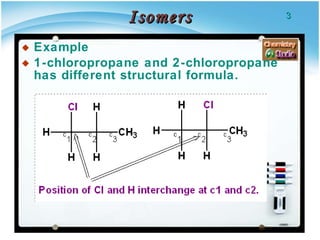
Isomers Example  1-chloropropane and 2-chloropropane has different structural formula.
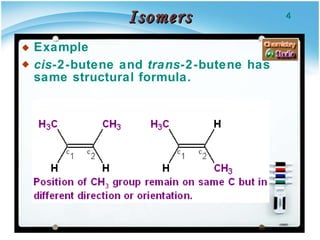
Isomers Example  cis -2-butene and  trans -2-butene has same structural formula.
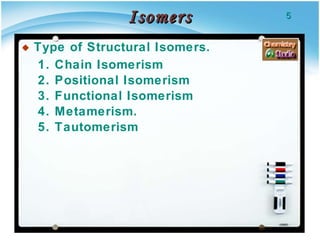
Isomers Type of Structural Isomers. 1.   Chain Isomerism 2. Positional Isomerism 3. Functional Isomerism 4. Metamerism. 5. Tautomerism
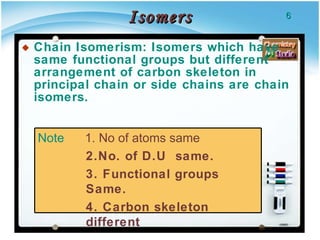
Isomers Chain Isomerism: Isomers which have same functional groups but different arrangement of carbon skeleton in principal chain or side chains are chain isomers. Note  1. No of atoms same 2.No. of D.U  same. 3. Functional groups Same. 4. Carbon skeleton different
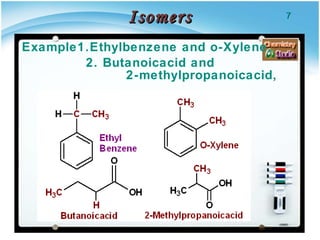
Isomers Example1.Ethylbenzene and o-Xylene. 2. Butanoicacid and  2-methylpropanoicacid,
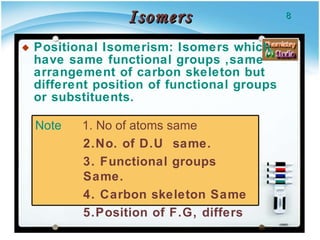
Isomers Positional Isomerism: Isomers which have same functional groups ,same arrangement of carbon skeleton but different position of functional groups or substituents. Note  1. No of atoms same 2.No. of D.U  same. 3. Functional groups Same. 4. Carbon skeleton Same 5.Position of F.G, differs
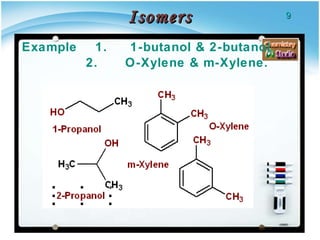
Isomers Example  1.  1-butanol & 2-butanol 2.  O-Xylene & m-Xylene.
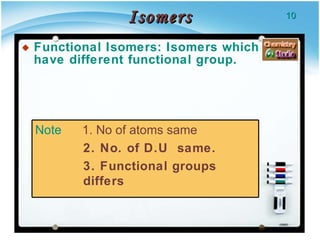
Isomers Functional Isomers: Isomers which have different functional group.  Note  1. No of atoms same 2. No. of D.U  same. 3. Functional groups differs
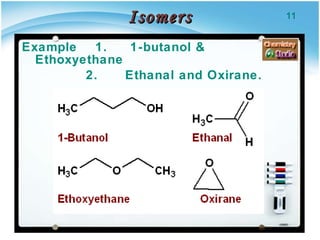
Isomers Example  1.  1-butanol & Ethoxyethane 2.  Ethanal and Oxirane.
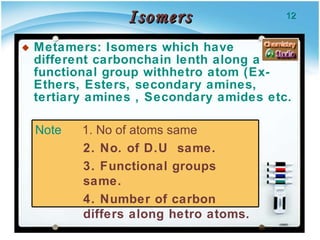
Isomers Metamers: Isomers which have different carbonchain lenth along a functional group withhetro atom (Ex- Ethers, Esters, secondary amines, tertiary amines , Secondary amides etc. Note  1. No of atoms same 2. No. of D.U  same. 3. Functional groups same. 4. Number of carbon differs along hetro atoms.
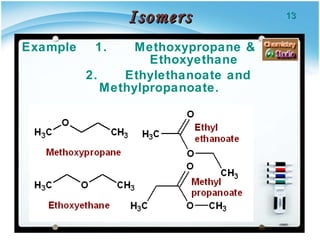
Isomers Example  1.  Methoxypropane &  Ethoxyethane 2.  Ethylethanoate and  Methylpropanoate.
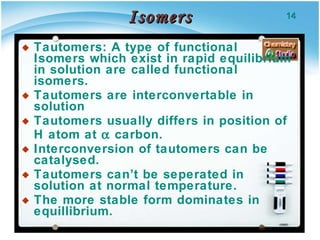
Isomers Tautomers: A type of functional Isomers which exist in rapid equilibrium in solution are called functional isomers. Tautomers are interconvertable in solution Tautomers usually differs in position of H atom at    carbon. Interconversion of tautomers can be catalysed. Tautomers can’t be seperated in solution at normal temperature. The more stable form dominates in equillibrium.
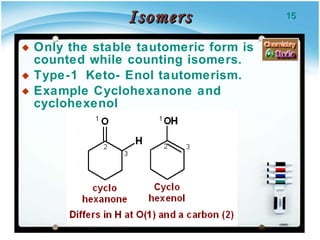
Isomers Only the stable tautomeric form is counted while counting isomers. Type-1  Keto- Enol tautomerism. Example Cyclohexanone and cyclohexenol
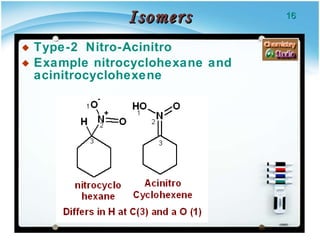
Isomers Type-2  Nitro-Acinitro Example nitrocyclohexane and acinitrocyclohexene
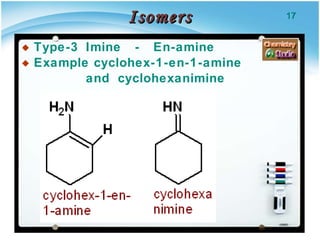
Isomers Type-3  Imine  -  En-amine Example cyclohex-1-en-1-amine  and  cyclohexanimine
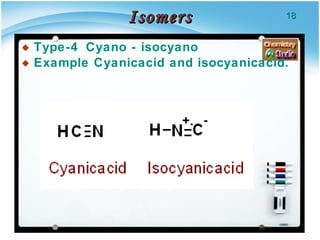
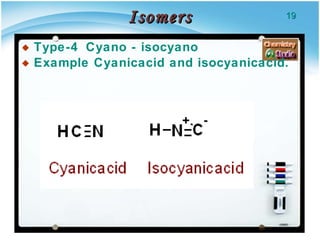
Isomers Type-4  Cyano - isocyano Example Cyanicacid and isocyanicacid.
Isomers There are several types of tautomerism, which will be discussed in details in carbanion section of reaction mechanism.
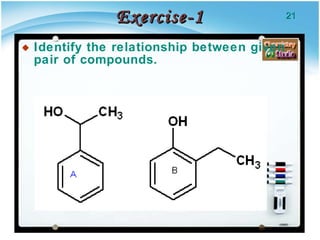
Exercise-1 Identify the relationship between given pair of compounds.
Exercise-1 Answer:- Functional isomers.
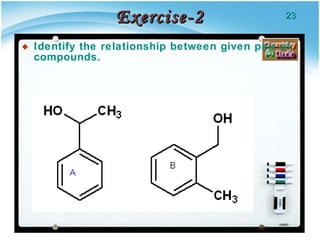
Exercise-2 Identify the relationship between given pair of compounds.
Exercise-2 Answer- Chain isomerism.
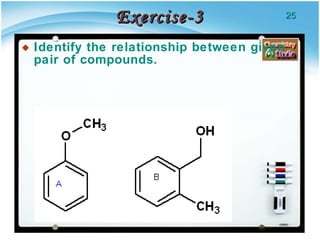
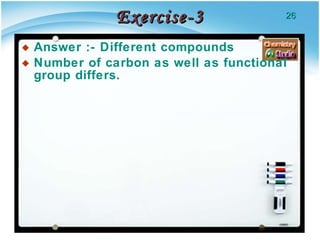
Exercise-3 Identify the relationship between given pair of compounds.
Exercise-3 Answer :- Different compounds Number of carbon as well as functional group differs.
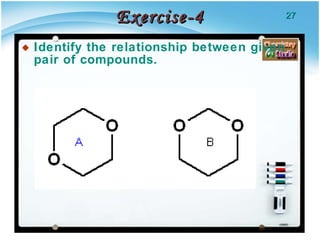
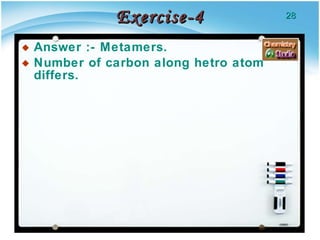
Exercise-4 Identify the relationship between given pair of compounds.
Exercise-4 Answer :- Metamers. Number of carbon along hetro atom differs.
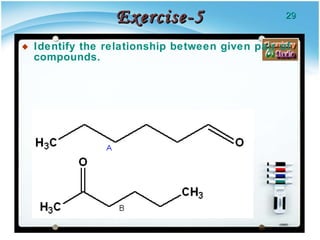
Exercise-5 Identify the relationship between given pair of compounds.
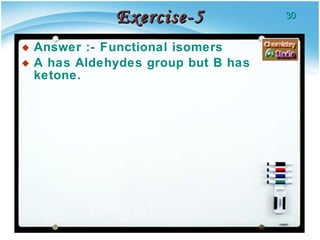
Exercise-5 Answer :- Functional isomers  A has Aldehydes group but B has ketone.
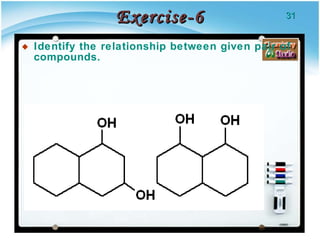
Exercise-6 Identify the relationship between given pair of compounds.
Exercise-6 Answer :- Positional  isomers
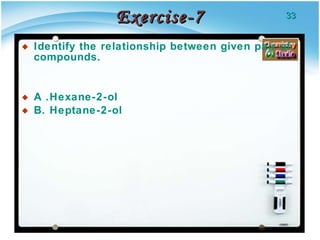
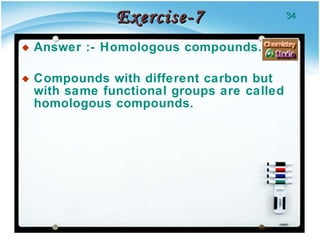
Exercise-7 Identify the relationship between given pair of compounds. A .Hexane-2-ol B. Heptane-2-ol
Exercise-7 Answer :- Homologous compounds. Compounds with different carbon but with same functional groups are called homologous compounds.
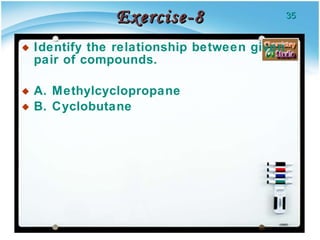
Exercise-8 Identify the relationship between given pair of compounds. A. Methylcyclopropane B. Cyclobutane
Exercise-8 Answer :- Chain  isomers
Exercise-9 Identify the relationship between given pair of compounds. A. 1-Butene  B.  cyclobutane
Exercise-9 Answer :- Functional  isomers  (Some literature also mention ring chain isomerism.)
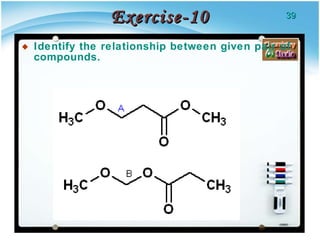
Exercise-10 Identify the relationship between given pair of compounds.
Exercise-10 Answer :- Metamers.
Concept Developed by  K.Chandana. [email_address]
Concept Developed by  Previous Presentation DU and isomerism  Next Presentation. How to find no of structural isomers

Structural isomerism

  • 1.
    Structural Isomerism ExclusivelyDeveloped by K. Chandana For my sincere online students. For further enquiry write to chandanakota1@gmail.com
  • 2.
    Isomers Structural Isomers: Isomers ,which have same molecular formula, but different structural formula are called structural isomers. Different Structural formula means Different bond pattern or Different arrangement of  bonds or Different connectivity of atoms. The key to organic chemistry is crystal clear understanding of different terms used.
  • 3.
    Isomers Example 1-chloropropane and 2-chloropropane has different structural formula.
  • 4.
    Isomers Example cis -2-butene and trans -2-butene has same structural formula.
  • 5.
    Isomers Type ofStructural Isomers. 1. Chain Isomerism 2. Positional Isomerism 3. Functional Isomerism 4. Metamerism. 5. Tautomerism
  • 6.
    Isomers Chain Isomerism:Isomers which have same functional groups but different arrangement of carbon skeleton in principal chain or side chains are chain isomers. Note 1. No of atoms same 2.No. of D.U same. 3. Functional groups Same. 4. Carbon skeleton different
  • 7.
    Isomers Example1.Ethylbenzene ando-Xylene. 2. Butanoicacid and 2-methylpropanoicacid,
  • 8.
    Isomers Positional Isomerism:Isomers which have same functional groups ,same arrangement of carbon skeleton but different position of functional groups or substituents. Note 1. No of atoms same 2.No. of D.U same. 3. Functional groups Same. 4. Carbon skeleton Same 5.Position of F.G, differs
  • 9.
    Isomers Example 1. 1-butanol & 2-butanol 2. O-Xylene & m-Xylene.
  • 10.
    Isomers Functional Isomers:Isomers which have different functional group. Note 1. No of atoms same 2. No. of D.U same. 3. Functional groups differs
  • 11.
    Isomers Example 1. 1-butanol & Ethoxyethane 2. Ethanal and Oxirane.
  • 12.
    Isomers Metamers: Isomerswhich have different carbonchain lenth along a functional group withhetro atom (Ex- Ethers, Esters, secondary amines, tertiary amines , Secondary amides etc. Note 1. No of atoms same 2. No. of D.U same. 3. Functional groups same. 4. Number of carbon differs along hetro atoms.
  • 13.
    Isomers Example 1. Methoxypropane & Ethoxyethane 2. Ethylethanoate and Methylpropanoate.
  • 14.
    Isomers Tautomers: Atype of functional Isomers which exist in rapid equilibrium in solution are called functional isomers. Tautomers are interconvertable in solution Tautomers usually differs in position of H atom at  carbon. Interconversion of tautomers can be catalysed. Tautomers can’t be seperated in solution at normal temperature. The more stable form dominates in equillibrium.
  • 15.
    Isomers Only thestable tautomeric form is counted while counting isomers. Type-1 Keto- Enol tautomerism. Example Cyclohexanone and cyclohexenol
  • 16.
    Isomers Type-2 Nitro-Acinitro Example nitrocyclohexane and acinitrocyclohexene
  • 17.
    Isomers Type-3 Imine - En-amine Example cyclohex-1-en-1-amine and cyclohexanimine
  • 18.
    Isomers Type-4 Cyano - isocyano Example Cyanicacid and isocyanicacid.
  • 19.
    Isomers Type-4 Cyano - isocyano Example Cyanicacid and isocyanicacid.
  • 20.
    Isomers There areseveral types of tautomerism, which will be discussed in details in carbanion section of reaction mechanism.
  • 21.
    Exercise-1 Identify therelationship between given pair of compounds.
  • 22.
  • 23.
    Exercise-2 Identify therelationship between given pair of compounds.
  • 24.
  • 25.
    Exercise-3 Identify therelationship between given pair of compounds.
  • 26.
    Exercise-3 Answer :-Different compounds Number of carbon as well as functional group differs.
  • 27.
    Exercise-4 Identify therelationship between given pair of compounds.
  • 28.
    Exercise-4 Answer :-Metamers. Number of carbon along hetro atom differs.
  • 29.
    Exercise-5 Identify therelationship between given pair of compounds.
  • 30.
    Exercise-5 Answer :-Functional isomers A has Aldehydes group but B has ketone.
  • 31.
    Exercise-6 Identify therelationship between given pair of compounds.
  • 32.
    Exercise-6 Answer :-Positional isomers
  • 33.
    Exercise-7 Identify therelationship between given pair of compounds. A .Hexane-2-ol B. Heptane-2-ol
  • 34.
    Exercise-7 Answer :-Homologous compounds. Compounds with different carbon but with same functional groups are called homologous compounds.
  • 35.
    Exercise-8 Identify therelationship between given pair of compounds. A. Methylcyclopropane B. Cyclobutane
  • 36.
    Exercise-8 Answer :-Chain isomers
  • 37.
    Exercise-9 Identify therelationship between given pair of compounds. A. 1-Butene B. cyclobutane
  • 38.
    Exercise-9 Answer :-Functional isomers (Some literature also mention ring chain isomerism.)
  • 39.
    Exercise-10 Identify therelationship between given pair of compounds.
  • 40.
  • 41.
    Concept Developed by K.Chandana. [email_address]
  • 42.
    Concept Developed by Previous Presentation DU and isomerism Next Presentation. How to find no of structural isomers