The basics that every physics
student should know about
string theory
Muhammad Hassaan Saleem
Department of Physics
University of the Punjab
Contents
1) Why string theory?
2) Ideas and potential of string theory
3) Experimental support
Why string theory?
1) Conflicts in Physics
2) Quantum gravity
The conflicts in Physics: An overview
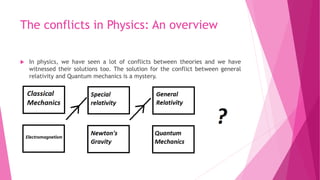
 In physics, we have seen a lot of conflicts between theories and we have
witnessed their solutions too. The solution for the conflict between general
relativity and Quantum mechanics is a mystery.
The conflicts in Physics: GR vs. QM
1) General Relativity: Idea
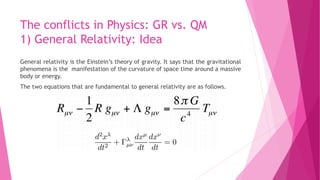
General relativity is the Einstein’s theory of gravity. It says that the gravitational
phenomena is the manifestation of the curvature of space time around a massive
body or energy.
The two equations that are fundamental to general relativity are as follows.
The conflicts in Physics: GR vs. QM
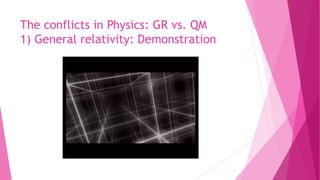
1) General relativity: Demonstration
The conflicts in Physics: GR vs. QM
2) Quantum Field theory
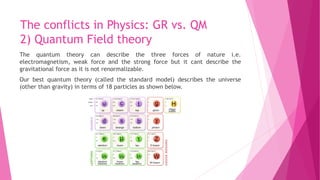
The quantum theory can describe the three forces of nature i.e.
electromagnetism, weak force and the strong force but it cant describe the
gravitational force as it is not renormalizable.
Our best quantum theory (called the standard model) describes the universe
(other than gravity) in terms of 18 particles as shown below.
The conflicts in Physics: GR vs. QM
2) Quantum field theory
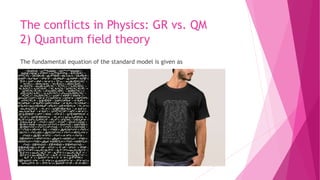
The fundamental equation of the standard model is given as
Quantum gravity
The solution to the conflict between general relativity and quantum theory is
studied in the subject of quantum gravity. This subject is concerned to the ways
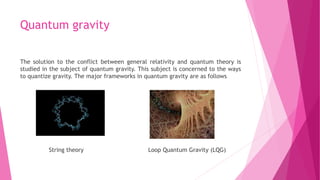
to quantize gravity. The major frameworks in quantum gravity are as follows
String theory Loop Quantum Gravity (LQG)
Ideas and potential
of string theory
1) Vibrating strings
2) Extra dimensions
3) Calculating the 20 numbers
4) Calculating the Hawking Beckenstein entropy
5) Solving the hierarchy problem
The basic idea: Enter string vibrations
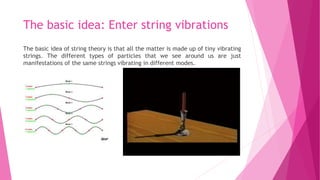
The basic idea of string theory is that all the matter is made up of tiny vibrating
strings. The different types of particles that we see around us are just
manifestations of the same strings vibrating in different modes.
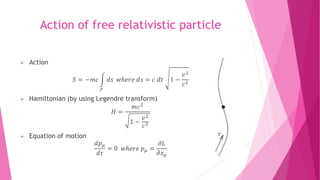
Action of free relativistic particle
 Action
𝑆 = −𝑚𝑐
𝑃
𝑑𝑠 𝑤ℎ𝑒𝑟𝑒 𝑑𝑠 = 𝑐 𝑑𝑡 1 −
𝑣2
𝑐2
 Hamiltonian (by using Legendre transform)
𝐻 =
𝑚𝑐2
1 −
𝑣2
𝑐2
 Equation of motion
𝑑𝑝 𝜇
𝑑𝜏
= 0 𝑤ℎ𝑒𝑟𝑒 𝑝 𝜇 =
𝜕𝐿
𝜕𝑥 𝜇
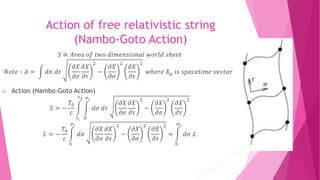
Action of free relativistic string
(Nambo-Goto Action)
𝑆 ∝ 𝐴𝑟𝑒𝑎 𝑜𝑓 𝑡𝑤𝑜 𝑑𝑖𝑚𝑒𝑛𝑠𝑖𝑜𝑛𝑎𝑙 𝑤𝑜𝑟𝑙𝑑 𝑠ℎ𝑒𝑒𝑡
𝑁𝑜𝑡𝑒 ∶ 𝐴 = 𝑑𝜎 𝑑𝜏
𝜕𝑋
𝜕𝜎
𝜕𝑋
𝜕𝜏
2
−
𝜕𝑋
𝜕𝜎
2
𝜕𝑋
𝜕𝜏
2
𝑤ℎ𝑒𝑟𝑒 𝑋 𝜇 𝑖𝑠 𝑠𝑝𝑎𝑐𝑒𝑡𝑖𝑚𝑒 𝑣𝑒𝑐𝑡𝑜𝑟
 Action (Nambo-Goto Action)
𝑆 = −
𝑇0
𝑐
𝜏 𝑖
𝜏 𝑓
0
𝜎1
𝑑𝜎 𝑑𝜏
𝜕𝑋
𝜕𝜎
𝜕𝑋
𝜕𝜏
2
−
𝜕𝑋
𝜕𝜎
2
𝜕𝑋
𝜕𝜏
2
𝐿 = −
𝑇0
𝑐
0
𝜎1
𝑑𝜎
𝜕𝑋
𝜕𝜎
𝜕𝑋
𝜕𝜏
2
−
𝜕𝑋
𝜕𝜎
2
𝜕𝑋
𝜕𝜏
2
=
0
𝜎1
𝑑𝜎 ℒ
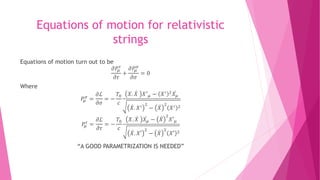
Equations of motion for relativistic
strings
Equations of motion turn out to be
𝜕𝑃𝜇
𝜏
𝜕𝜏
+
𝜕𝑃𝜇
𝜎
𝜕𝜎
= 0
Where
𝑃𝜇
𝜎 =
𝜕ℒ
𝜕𝜎
= −
𝑇0
𝑐
𝑋. 𝑋 𝑋′
𝜇 − 𝑋′ 2 𝑋 𝜇
𝑋. 𝑋′ 2
− 𝑋
2
𝑋′ 2
𝑃𝜇
𝜏 =
𝜕ℒ
𝜕𝜏
= −
𝑇0
𝑐
𝑋. 𝑋 𝑋 𝜇 − 𝑋
2
𝑋′ 𝜇
𝑋. 𝑋′
2
− 𝑋
2
𝑋′ 2
“A GOOD PARAMETRIZATION IS NEEDED”
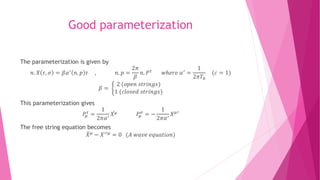
Good parameterization
The parameterization is given by
𝑛. 𝑋 𝜏, 𝜎 = 𝛽𝛼′
𝑛. 𝑝 𝜏 , 𝑛. 𝑝 =
2𝜋
𝛽
𝑛. 𝑃 𝜏
𝑤ℎ𝑒𝑟𝑒 𝛼′
=
1
2𝜋𝑇0
(𝑐 = 1)
𝛽 =
2 (𝑜𝑝𝑒𝑛 𝑠𝑡𝑟𝑖𝑛𝑔𝑠)
1 (𝑐𝑙𝑜𝑠𝑒𝑑 𝑠𝑡𝑟𝑖𝑛𝑔𝑠)
This parameterization gives
𝑃𝜇
𝜏
=
1
2𝜋𝛼′ 𝑋 𝜇 𝑃𝜇
𝜎
= −
1
2𝜋𝛼′ 𝑋 𝜇
′
The free string equation becomes
𝑋 𝜇
− 𝑋′′𝜇
= 0 (𝐴 𝑤𝑎𝑣𝑒 𝑒𝑞𝑢𝑎𝑡𝑖𝑜𝑛)
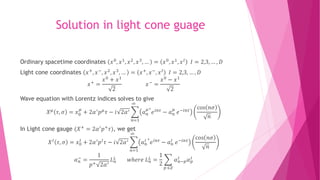
Solution in light cone guage
Ordinary spacetime coordinates 𝑥0
, 𝑥1
, 𝑥2
, 𝑥3
, … = 𝑥0
, 𝑥1
, 𝑥 𝐼
𝐼 = 2,3, … , 𝐷
Light cone coordinates 𝑥+, 𝑥−, 𝑥2, 𝑥3, … = 𝑥+, 𝑥−, 𝑥 𝐼 𝐼 = 2,3, … , 𝐷
𝑥+ =
𝑥0
+ 𝑥1
2
𝑥− =
𝑥0
− 𝑥1
2
Wave equation with Lorentz indices solves to give
𝑋 𝜇
𝜏, 𝜎 = 𝑥0
𝜇
+ 2𝛼′
𝑝 𝜇
𝜏 − 𝑖 2𝛼′
𝑛=1
∞
𝑎 𝑛
𝜇∗
𝑒 𝑖𝑛𝜏
− 𝑎 𝑛
𝜇
𝑒−𝑖𝑛𝜏
cos 𝑛𝜎
𝑛
In Light cone gauge (𝑋+
= 2𝛼′
𝑝+
𝜏), we get
𝑋 𝐼 𝜏, 𝜎 = 𝑥0
𝐼
+ 2𝛼′ 𝑝 𝐼 𝜏 − 𝑖 2𝛼′
𝑛=1
∞
𝑎 𝑛
𝐼 ∗
𝑒 𝑖𝑛𝜏 − 𝑎 𝑛
𝐼 𝑒−𝑖𝑛𝜏
cos 𝑛𝜎
𝑛
𝛼 𝑛
−
=
1
𝑝+ 2𝛼′
𝐿 𝑛
⊥
𝑤ℎ𝑒𝑟𝑒 𝐿 𝑛
⊥
=
1
2
𝑝 ∈𝑍
𝛼 𝑛−𝑝
𝐼
𝛼 𝑝
𝐼
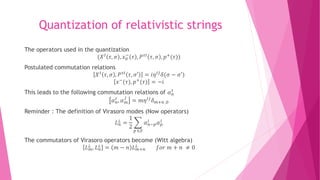
Quantization of relativistic strings
The operators used in the quantization
(𝑋 𝐼
𝜏, 𝜎 , 𝑥0
−
𝜏 , 𝑃 𝜏𝐼
𝜏, 𝜎 , 𝑝+
(𝜏))
Postulated commutation relations
𝑋 𝐼
𝜏, 𝜎 , 𝑃 𝜏𝐼
𝜏, 𝜎′ = 𝑖𝜂 𝐼𝐽
𝛿(𝜎 − 𝜎′)
𝑥−(𝜏), 𝑝+(𝜏) = −𝑖
This leads to the following commutation relations of 𝛼 𝑛
𝐼
𝛼 𝑛
𝐼 , 𝛼 𝑚
𝐽
= 𝑚𝜂 𝐼𝐽 𝛿 𝑚+𝑛 ,0
Reminder : The definition of Virasoro modes (Now operators)
𝐿 𝑛
⊥
=
1
2
𝑝 ∈𝑍
𝛼 𝑛−𝑝
𝐼
𝛼 𝑝
𝐼
The commutators of Virasoro operators become (Witt algebra)
𝐿 𝑚
⊥ , 𝐿 𝑛
⊥ = 𝑚 − 𝑛 𝐿 𝑚+𝑛
⊥ 𝑓𝑜𝑟 𝑚 + 𝑛 ≠ 0
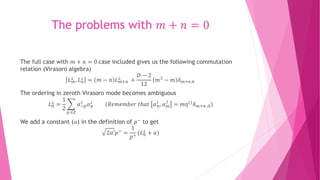
The problems with 𝑚 + 𝑛 = 0
The full case with 𝑚 + 𝑛 = 0 case included gives us the following commutation
relation (Virasoro algebra)
𝐿 𝑚
⊥
, 𝐿 𝑛
⊥
= 𝑚 − 𝑛 𝐿 𝑚+𝑛
⊥
+
𝐷 − 2
12
𝑚3
− 𝑚 𝛿 𝑚+𝑛,0
The ordering in zeroth Virasoro mode becomes ambiguous
𝐿0
⊥
=
1
2
𝑝 ∈𝑍
𝛼−𝑝
𝐼
𝛼 𝑝
𝐼
(𝑅𝑒𝑚𝑒𝑚𝑏𝑒𝑟 𝑡ℎ𝑎𝑡 𝛼 𝑛
𝐼
, 𝛼 𝑚
𝐽
= 𝑚𝜂 𝐼𝐽
𝛿 𝑚+𝑛 ,0)
We add a constant (𝑎) in the definition of 𝑝−
to get
2𝛼′𝑝−
=
1
𝑝+ (𝐿0
⊥
+ 𝑎)
The Lorentz generators in light cone
gauge
The Lorentz generators are given in light cone coordinates as (with their
antisymmetric counterparts)
(𝑀+ −, 𝑀+𝐼, 𝑀−𝐼, 𝑀 𝐼𝐽)
They need to be Hermitian and this sets the 𝑀−𝐼
generator to be of the form
𝑀−𝐼 = 𝑥0
−
𝑝 𝐼 −
1
4𝛼′ 𝑝+
𝑥0
𝐼
, 𝐿0
⊥
+ 𝑎 −
𝑖
𝑝+ 2𝛼′
𝑛=1
∞
1
𝑛
(𝐿−𝑛
⊥ 𝛼 𝑛
𝐼 − 𝛼−𝑛
𝐼 𝐿 𝑛
⊥)
The commutator [𝑀−𝐼, 𝑀−𝐽] should be zero. This commutators turns out to be
𝑀−𝐼
, 𝑀−𝐽
= −
1
𝛼′ 𝑝+2
𝑚=1
∞
(𝛼−𝑚
𝐼
𝛼 𝑚
𝐽
− 𝛼−𝑚
𝐽
𝛼 𝑚
𝐼
) m 1 −
D − 2
24
+
1
m
D − 2
12
+ a
⇒ m 1 −
D − 2
24
+
1
m
D − 2
12
+ a = 0 ∀ 𝑚 ∈ 𝑍 ⟹ 𝐷 = 26 & 𝑎 = −1
A small description of superstrings
Inclusion of fermions ⟹ inclusion of new, anticommuting world sheet variables
𝜓1 𝜏, 𝜎 and 𝜓2(𝜏, 𝜎).
Then, the theory is called superstring theory.
The action is given by
𝑆 𝜓 =
1
2𝜋
𝑑𝜏
0
𝜋
𝑑𝜎 [𝜓1
𝐼
𝜕𝜏 + 𝜕 𝜎 𝜓2
𝐼
+ 𝜓2
𝐼
𝜕𝜏 − 𝜕 𝜎 𝜓1
𝐼
]
No. of Dimensions =10
In M-Theory , No. of dimensions =11
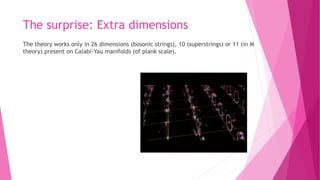
The surprise: Extra dimensions
The theory works only in 26 dimensions (bosonic strings), 10 (superstrings) or 11 (in M
theory) present on Calabi-Yau manifolds (of plank scale).
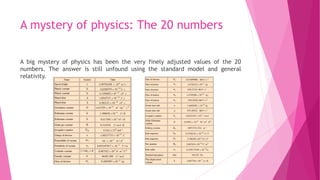
A mystery of physics: The 20 numbers
A big mystery of physics has been the very finely adjusted values of the 20
numbers. The answer is still unfound using the standard model and general
relativity.
The potential of string theory
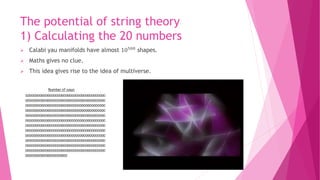
1) Calculating the 20 numbers
 Calabi yau manifolds have almost 10500
shapes.
 Maths gives no clue.
 This idea gives rise to the idea of multiverse.
The potential of string theory
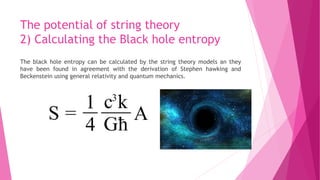
2) Calculating the Black hole entropy
The black hole entropy can be calculated by the string theory models an they
have been found in agreement with the derivation of Stephen hawking and
Beckenstein using general relativity and quantum mechanics.
The potential of string theory
3) Solving the hierarchy problem
String theory can actually explain the fact that gravity is very weak as compared
to the other forces (i.e. the hierarchy problem). It says that gravity isn’t that
weak, it just appears to be weak as its strength gets distributed in other
dimensions because it is made of closed strings.
Experimental support
1) Lack of experimental support
2) The search for evidence
Lack of experimental proof
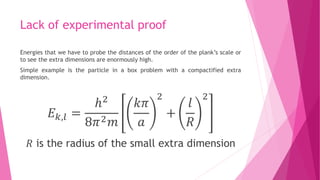
Energies that we have to probe the distances of the order of the plank’s scale or
to see the extra dimensions are enormously high.
Simple example is the particle in a box problem with a compactified extra
dimension.
𝐸 𝑘,𝑙 =
ℎ2
8𝜋2 𝑚
𝑘𝜋
𝑎
2
+
𝑙
𝑅
2
𝑅 is the radius of the small extra dimension
The search for evidence
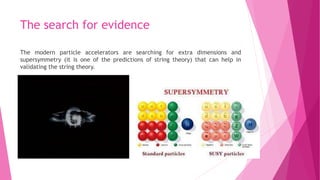
The modern particle accelerators are searching for extra dimensions and
supersymmetry (it is one of the predictions of string theory) that can help in
validating the string theory.
Questions?

String theory basics

  • 1.
    The basics thatevery physics student should know about string theory Muhammad Hassaan Saleem Department of Physics University of the Punjab
  • 2.
    Contents 1) Why stringtheory? 2) Ideas and potential of string theory 3) Experimental support
  • 3.
    Why string theory? 1)Conflicts in Physics 2) Quantum gravity
  • 4.
    The conflicts inPhysics: An overview  In physics, we have seen a lot of conflicts between theories and we have witnessed their solutions too. The solution for the conflict between general relativity and Quantum mechanics is a mystery.
  • 5.
    The conflicts inPhysics: GR vs. QM 1) General Relativity: Idea General relativity is the Einstein’s theory of gravity. It says that the gravitational phenomena is the manifestation of the curvature of space time around a massive body or energy. The two equations that are fundamental to general relativity are as follows.
  • 6.
    The conflicts inPhysics: GR vs. QM 1) General relativity: Demonstration
  • 7.
    The conflicts inPhysics: GR vs. QM 2) Quantum Field theory The quantum theory can describe the three forces of nature i.e. electromagnetism, weak force and the strong force but it cant describe the gravitational force as it is not renormalizable. Our best quantum theory (called the standard model) describes the universe (other than gravity) in terms of 18 particles as shown below.
  • 8.
    The conflicts inPhysics: GR vs. QM 2) Quantum field theory The fundamental equation of the standard model is given as
  • 9.
    Quantum gravity The solutionto the conflict between general relativity and quantum theory is studied in the subject of quantum gravity. This subject is concerned to the ways to quantize gravity. The major frameworks in quantum gravity are as follows String theory Loop Quantum Gravity (LQG)
  • 10.
    Ideas and potential ofstring theory 1) Vibrating strings 2) Extra dimensions 3) Calculating the 20 numbers 4) Calculating the Hawking Beckenstein entropy 5) Solving the hierarchy problem
  • 11.
    The basic idea:Enter string vibrations The basic idea of string theory is that all the matter is made up of tiny vibrating strings. The different types of particles that we see around us are just manifestations of the same strings vibrating in different modes.
  • 12.
    Action of freerelativistic particle  Action 𝑆 = −𝑚𝑐 𝑃 𝑑𝑠 𝑤ℎ𝑒𝑟𝑒 𝑑𝑠 = 𝑐 𝑑𝑡 1 − 𝑣2 𝑐2  Hamiltonian (by using Legendre transform) 𝐻 = 𝑚𝑐2 1 − 𝑣2 𝑐2  Equation of motion 𝑑𝑝 𝜇 𝑑𝜏 = 0 𝑤ℎ𝑒𝑟𝑒 𝑝 𝜇 = 𝜕𝐿 𝜕𝑥 𝜇
  • 13.
    Action of freerelativistic string (Nambo-Goto Action) 𝑆 ∝ 𝐴𝑟𝑒𝑎 𝑜𝑓 𝑡𝑤𝑜 𝑑𝑖𝑚𝑒𝑛𝑠𝑖𝑜𝑛𝑎𝑙 𝑤𝑜𝑟𝑙𝑑 𝑠ℎ𝑒𝑒𝑡 𝑁𝑜𝑡𝑒 ∶ 𝐴 = 𝑑𝜎 𝑑𝜏 𝜕𝑋 𝜕𝜎 𝜕𝑋 𝜕𝜏 2 − 𝜕𝑋 𝜕𝜎 2 𝜕𝑋 𝜕𝜏 2 𝑤ℎ𝑒𝑟𝑒 𝑋 𝜇 𝑖𝑠 𝑠𝑝𝑎𝑐𝑒𝑡𝑖𝑚𝑒 𝑣𝑒𝑐𝑡𝑜𝑟  Action (Nambo-Goto Action) 𝑆 = − 𝑇0 𝑐 𝜏 𝑖 𝜏 𝑓 0 𝜎1 𝑑𝜎 𝑑𝜏 𝜕𝑋 𝜕𝜎 𝜕𝑋 𝜕𝜏 2 − 𝜕𝑋 𝜕𝜎 2 𝜕𝑋 𝜕𝜏 2 𝐿 = − 𝑇0 𝑐 0 𝜎1 𝑑𝜎 𝜕𝑋 𝜕𝜎 𝜕𝑋 𝜕𝜏 2 − 𝜕𝑋 𝜕𝜎 2 𝜕𝑋 𝜕𝜏 2 = 0 𝜎1 𝑑𝜎 ℒ
  • 14.
    Equations of motionfor relativistic strings Equations of motion turn out to be 𝜕𝑃𝜇 𝜏 𝜕𝜏 + 𝜕𝑃𝜇 𝜎 𝜕𝜎 = 0 Where 𝑃𝜇 𝜎 = 𝜕ℒ 𝜕𝜎 = − 𝑇0 𝑐 𝑋. 𝑋 𝑋′ 𝜇 − 𝑋′ 2 𝑋 𝜇 𝑋. 𝑋′ 2 − 𝑋 2 𝑋′ 2 𝑃𝜇 𝜏 = 𝜕ℒ 𝜕𝜏 = − 𝑇0 𝑐 𝑋. 𝑋 𝑋 𝜇 − 𝑋 2 𝑋′ 𝜇 𝑋. 𝑋′ 2 − 𝑋 2 𝑋′ 2 “A GOOD PARAMETRIZATION IS NEEDED”
  • 15.
    Good parameterization The parameterizationis given by 𝑛. 𝑋 𝜏, 𝜎 = 𝛽𝛼′ 𝑛. 𝑝 𝜏 , 𝑛. 𝑝 = 2𝜋 𝛽 𝑛. 𝑃 𝜏 𝑤ℎ𝑒𝑟𝑒 𝛼′ = 1 2𝜋𝑇0 (𝑐 = 1) 𝛽 = 2 (𝑜𝑝𝑒𝑛 𝑠𝑡𝑟𝑖𝑛𝑔𝑠) 1 (𝑐𝑙𝑜𝑠𝑒𝑑 𝑠𝑡𝑟𝑖𝑛𝑔𝑠) This parameterization gives 𝑃𝜇 𝜏 = 1 2𝜋𝛼′ 𝑋 𝜇 𝑃𝜇 𝜎 = − 1 2𝜋𝛼′ 𝑋 𝜇 ′ The free string equation becomes 𝑋 𝜇 − 𝑋′′𝜇 = 0 (𝐴 𝑤𝑎𝑣𝑒 𝑒𝑞𝑢𝑎𝑡𝑖𝑜𝑛)
  • 16.
    Solution in lightcone guage Ordinary spacetime coordinates 𝑥0 , 𝑥1 , 𝑥2 , 𝑥3 , … = 𝑥0 , 𝑥1 , 𝑥 𝐼 𝐼 = 2,3, … , 𝐷 Light cone coordinates 𝑥+, 𝑥−, 𝑥2, 𝑥3, … = 𝑥+, 𝑥−, 𝑥 𝐼 𝐼 = 2,3, … , 𝐷 𝑥+ = 𝑥0 + 𝑥1 2 𝑥− = 𝑥0 − 𝑥1 2 Wave equation with Lorentz indices solves to give 𝑋 𝜇 𝜏, 𝜎 = 𝑥0 𝜇 + 2𝛼′ 𝑝 𝜇 𝜏 − 𝑖 2𝛼′ 𝑛=1 ∞ 𝑎 𝑛 𝜇∗ 𝑒 𝑖𝑛𝜏 − 𝑎 𝑛 𝜇 𝑒−𝑖𝑛𝜏 cos 𝑛𝜎 𝑛 In Light cone gauge (𝑋+ = 2𝛼′ 𝑝+ 𝜏), we get 𝑋 𝐼 𝜏, 𝜎 = 𝑥0 𝐼 + 2𝛼′ 𝑝 𝐼 𝜏 − 𝑖 2𝛼′ 𝑛=1 ∞ 𝑎 𝑛 𝐼 ∗ 𝑒 𝑖𝑛𝜏 − 𝑎 𝑛 𝐼 𝑒−𝑖𝑛𝜏 cos 𝑛𝜎 𝑛 𝛼 𝑛 − = 1 𝑝+ 2𝛼′ 𝐿 𝑛 ⊥ 𝑤ℎ𝑒𝑟𝑒 𝐿 𝑛 ⊥ = 1 2 𝑝 ∈𝑍 𝛼 𝑛−𝑝 𝐼 𝛼 𝑝 𝐼
  • 17.
    Quantization of relativisticstrings The operators used in the quantization (𝑋 𝐼 𝜏, 𝜎 , 𝑥0 − 𝜏 , 𝑃 𝜏𝐼 𝜏, 𝜎 , 𝑝+ (𝜏)) Postulated commutation relations 𝑋 𝐼 𝜏, 𝜎 , 𝑃 𝜏𝐼 𝜏, 𝜎′ = 𝑖𝜂 𝐼𝐽 𝛿(𝜎 − 𝜎′) 𝑥−(𝜏), 𝑝+(𝜏) = −𝑖 This leads to the following commutation relations of 𝛼 𝑛 𝐼 𝛼 𝑛 𝐼 , 𝛼 𝑚 𝐽 = 𝑚𝜂 𝐼𝐽 𝛿 𝑚+𝑛 ,0 Reminder : The definition of Virasoro modes (Now operators) 𝐿 𝑛 ⊥ = 1 2 𝑝 ∈𝑍 𝛼 𝑛−𝑝 𝐼 𝛼 𝑝 𝐼 The commutators of Virasoro operators become (Witt algebra) 𝐿 𝑚 ⊥ , 𝐿 𝑛 ⊥ = 𝑚 − 𝑛 𝐿 𝑚+𝑛 ⊥ 𝑓𝑜𝑟 𝑚 + 𝑛 ≠ 0
  • 18.
    The problems with𝑚 + 𝑛 = 0 The full case with 𝑚 + 𝑛 = 0 case included gives us the following commutation relation (Virasoro algebra) 𝐿 𝑚 ⊥ , 𝐿 𝑛 ⊥ = 𝑚 − 𝑛 𝐿 𝑚+𝑛 ⊥ + 𝐷 − 2 12 𝑚3 − 𝑚 𝛿 𝑚+𝑛,0 The ordering in zeroth Virasoro mode becomes ambiguous 𝐿0 ⊥ = 1 2 𝑝 ∈𝑍 𝛼−𝑝 𝐼 𝛼 𝑝 𝐼 (𝑅𝑒𝑚𝑒𝑚𝑏𝑒𝑟 𝑡ℎ𝑎𝑡 𝛼 𝑛 𝐼 , 𝛼 𝑚 𝐽 = 𝑚𝜂 𝐼𝐽 𝛿 𝑚+𝑛 ,0) We add a constant (𝑎) in the definition of 𝑝− to get 2𝛼′𝑝− = 1 𝑝+ (𝐿0 ⊥ + 𝑎)
  • 19.
    The Lorentz generatorsin light cone gauge The Lorentz generators are given in light cone coordinates as (with their antisymmetric counterparts) (𝑀+ −, 𝑀+𝐼, 𝑀−𝐼, 𝑀 𝐼𝐽) They need to be Hermitian and this sets the 𝑀−𝐼 generator to be of the form 𝑀−𝐼 = 𝑥0 − 𝑝 𝐼 − 1 4𝛼′ 𝑝+ 𝑥0 𝐼 , 𝐿0 ⊥ + 𝑎 − 𝑖 𝑝+ 2𝛼′ 𝑛=1 ∞ 1 𝑛 (𝐿−𝑛 ⊥ 𝛼 𝑛 𝐼 − 𝛼−𝑛 𝐼 𝐿 𝑛 ⊥) The commutator [𝑀−𝐼, 𝑀−𝐽] should be zero. This commutators turns out to be 𝑀−𝐼 , 𝑀−𝐽 = − 1 𝛼′ 𝑝+2 𝑚=1 ∞ (𝛼−𝑚 𝐼 𝛼 𝑚 𝐽 − 𝛼−𝑚 𝐽 𝛼 𝑚 𝐼 ) m 1 − D − 2 24 + 1 m D − 2 12 + a ⇒ m 1 − D − 2 24 + 1 m D − 2 12 + a = 0 ∀ 𝑚 ∈ 𝑍 ⟹ 𝐷 = 26 & 𝑎 = −1
  • 20.
    A small descriptionof superstrings Inclusion of fermions ⟹ inclusion of new, anticommuting world sheet variables 𝜓1 𝜏, 𝜎 and 𝜓2(𝜏, 𝜎). Then, the theory is called superstring theory. The action is given by 𝑆 𝜓 = 1 2𝜋 𝑑𝜏 0 𝜋 𝑑𝜎 [𝜓1 𝐼 𝜕𝜏 + 𝜕 𝜎 𝜓2 𝐼 + 𝜓2 𝐼 𝜕𝜏 − 𝜕 𝜎 𝜓1 𝐼 ] No. of Dimensions =10 In M-Theory , No. of dimensions =11
  • 21.
    The surprise: Extradimensions The theory works only in 26 dimensions (bosonic strings), 10 (superstrings) or 11 (in M theory) present on Calabi-Yau manifolds (of plank scale).
  • 22.
    A mystery ofphysics: The 20 numbers A big mystery of physics has been the very finely adjusted values of the 20 numbers. The answer is still unfound using the standard model and general relativity.
  • 23.
    The potential ofstring theory 1) Calculating the 20 numbers  Calabi yau manifolds have almost 10500 shapes.  Maths gives no clue.  This idea gives rise to the idea of multiverse.
  • 24.
    The potential ofstring theory 2) Calculating the Black hole entropy The black hole entropy can be calculated by the string theory models an they have been found in agreement with the derivation of Stephen hawking and Beckenstein using general relativity and quantum mechanics.
  • 25.
    The potential ofstring theory 3) Solving the hierarchy problem String theory can actually explain the fact that gravity is very weak as compared to the other forces (i.e. the hierarchy problem). It says that gravity isn’t that weak, it just appears to be weak as its strength gets distributed in other dimensions because it is made of closed strings.
  • 26.
    Experimental support 1) Lackof experimental support 2) The search for evidence
  • 27.
    Lack of experimentalproof Energies that we have to probe the distances of the order of the plank’s scale or to see the extra dimensions are enormously high. Simple example is the particle in a box problem with a compactified extra dimension. 𝐸 𝑘,𝑙 = ℎ2 8𝜋2 𝑚 𝑘𝜋 𝑎 2 + 𝑙 𝑅 2 𝑅 is the radius of the small extra dimension
  • 28.
    The search forevidence The modern particle accelerators are searching for extra dimensions and supersymmetry (it is one of the predictions of string theory) that can help in validating the string theory.
  • 29.