Conformal Boundary States
for free boson
Hassaan Saleem
What is Quantum Field Theory (QFT)?
 A quantum theory with local operators (fields) 𝜙(𝑥) as degrees of freedom.
 Relativistic QFT is symmetric in spacetime translations, rotations and boosts.
Rotational symmetry + Boost symmetry → Lorentz symmetry
Translation symmetry + Lorentz symmetry → Poincare symmetry
 Should have at least one vacuum (lowest energy state)
 Can have internal (non spacetime) symmetries
 Has a vacuum state |0⟩. Main objects of study are correlation functions
⟨0 𝜙1 𝑥1 … 𝜙𝑛 𝑥𝑛 0⟩
Why study Conformal Field Theory (CFT)?
 CFTs can be made very rigorous.
 Fixed Points in RG flow.
 Extensive use in condensed matter physics (phase transitions and
behaviour near criticality).
 Super String Theory is a (super) conformal theory.
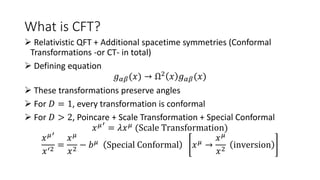
What is CFT?
 Relativistic QFT + Additional spacetime symmetries (Conformal
Transformations -or CT- in total)
 Defining equation
𝑔𝛼𝛽(𝑥) → Ω2 𝑥 𝑔𝛼𝛽(𝑥)
 These transformations preserve angles
 For 𝐷 = 1, every transformation is conformal
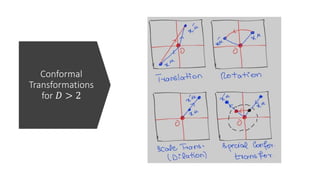
 For 𝐷 > 2, Poincare + Scale Transformation + Special Conformal
𝑥𝜇′
= 𝜆𝑥𝜇
(Scale Transformation)
𝑥𝜇′
𝑥′2
=
𝑥𝜇
𝑥2
− 𝑏𝜇 Special Conformal 𝑥𝜇 →
𝑥𝜇
𝑥2
inversion
Conformal
Transformations
for 𝐷 > 2
Primary Fields
 A field 𝜙(𝑥) is primary if for 𝒙 → 𝒙′, the field transforms as;
𝜙′
𝒙′
→
𝜕𝒙′
𝜕𝒙
−
Δ
𝐷
𝜙(𝒙)
e.g. for dilations 𝒙 → 𝒙′ = 𝜆𝒙
𝜙′
𝒙′
→ 𝜆−
Δ
𝐷𝜙(𝒙)
 𝜆 is called the scaling dimension of the field.
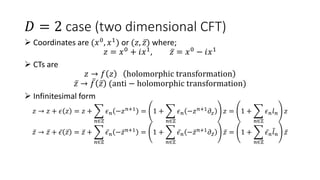
𝐷 = 2 case (two dimensional CFT)
 Coordinates are (𝑥0, 𝑥1) or (𝑧, 𝑧) where;
𝑧 = 𝑥0
+ 𝑖𝑥1
, 𝑧 = 𝑥0
− 𝑖𝑥1
 CTs are
𝑧 → 𝑓 𝑧 holomorphic transformation
𝑧 → 𝑓 𝑧 (anti − holomorphic transformation)
 Infinitesimal form
𝑧 → 𝑧 + 𝜖 𝑧 = 𝑧 +
𝑛∈ℤ
𝜖𝑛 −𝑧𝑛+1
= 1 +
𝑛∈ℤ
𝜖𝑛 −𝑧𝑛+1
𝜕𝑧 𝑧 = 1 +
𝑛∈ℤ
𝜖𝑛𝑙𝑛 𝑧
𝑧 → 𝑧 + 𝜖 𝑧 = 𝑧 +
𝑛∈ℤ
𝜖𝑛 −𝑧𝑛+1
= 1 +
𝑛∈ℤ
𝜖𝑛 −𝑧𝑛+1
𝜕𝑧 𝑧 = 1 +
𝑛∈ℤ
𝜖𝑛𝑙𝑛 𝑧
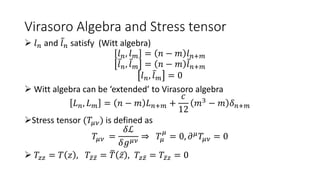
Virasoro Algebra and Stress tensor
 𝑙𝑛 and 𝑙𝑛 satisfy (Witt algebra)
𝑙𝑛, 𝑙𝑚 = 𝑛 − 𝑚 𝑙𝑛+𝑚
𝑙𝑛, 𝑙𝑚 = 𝑛 − 𝑚 𝑙𝑛+𝑚
𝑙𝑛, 𝑙𝑚 = 0
 Witt algebra can be ‘extended’ to Virasoro algebra
𝐿𝑛, 𝐿𝑚 = 𝑛 − 𝑚 𝐿𝑛+𝑚 +
𝑐
12
𝑚3
− 𝑚 𝛿𝑛+𝑚
Stress tensor (𝑇𝜇𝜈) is defined as
𝑇𝜇𝜈 =
𝛿ℒ
𝛿𝑔𝜇𝜈
⇒ 𝑇𝜇
𝜇
= 0, 𝜕𝜇
𝑇𝜇𝜈 = 0
 𝑇𝑧𝑧 = 𝑇 𝑧 , 𝑇𝑧𝑧 = 𝑇 𝑧 , 𝑇𝑧𝑧 = 𝑇𝑧𝑧 = 0
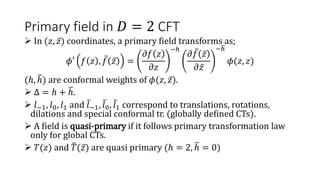
Primary field in 𝐷 = 2 CFT
 In (𝑧, 𝑧) coordinates, a primary field transforms as;
𝜙′ 𝑓 𝑧 , 𝑓 𝑧 =
𝜕𝑓 𝑧
𝜕𝑧
−ℎ
𝜕𝑓 𝑧
𝜕𝑧
−ℎ
𝜙(𝑧, 𝑧)
(ℎ, ℎ) are conformal weights of 𝜙(𝑧, 𝑧).
 Δ = ℎ + ℎ.
 𝑙−1, 𝑙0, 𝑙1 and 𝑙−1, 𝑙0, 𝑙1 correspond to translations, rotations,
dilations and special conformal tr. (globally defined CTs).
 A field is quasi-primary if it follows primary transformation law
only for global CTs.
 𝑇(𝑧) and 𝑇(𝑧) are quasi primary (ℎ = 2, ℎ = 0)
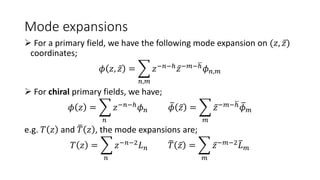
Mode expansions
 For a primary field, we have the following mode expansion on (𝑧, 𝑧)
coordinates;
𝜙 𝑧, 𝑧 =
𝑛,𝑚
𝑧−𝑛−ℎ𝑧−𝑚−ℎ𝜙𝑛,𝑚
 For chiral primary fields, we have;
𝜙 𝑧 =
𝑛
𝑧−𝑛−ℎ𝜙𝑛 𝜙 𝑧 =
𝑚
𝑧−𝑚−ℎ𝜙𝑚
e.g. 𝑇 𝑧 and 𝑇 𝑧 , the mode expansions are;
𝑇 𝑧 =
𝑛
𝑧−𝑛−2
𝐿𝑛 𝑇 𝑧 =
𝑚
𝑧−𝑚−2
𝐿𝑚
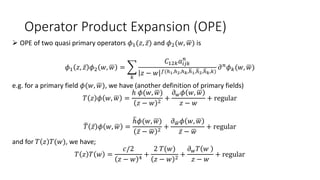
Operator Product Expansion (OPE)
 OPE of two quasi primary operators 𝜙1(𝑧, 𝑧) and 𝜙2(𝑤, 𝑤) is
𝜙1 𝑧, 𝑧 𝜙2 𝑤, 𝑤 =
𝑘
𝐶12𝑘𝑎𝑖𝑗𝑘
𝑛
𝑧 − 𝑤 𝑓(ℎ1,ℎ2,ℎ𝑘,ℎ1,ℎ2,ℎ𝑘,𝑘)
𝜕𝑛𝜙𝑘(𝑤, 𝑤)
e.g. for a primary field 𝜙(𝑤, 𝑤), we have (another definition of primary fields)
𝑇 𝑧 𝜙 𝑤, 𝑤 =
ℎ 𝜙(𝑤, 𝑤)
𝑧 − 𝑤 2
+
𝜕𝑤𝜙 𝑤, 𝑤
𝑧 − 𝑤
+ regular
𝑇 𝑧 𝜙 𝑤, 𝑤 =
ℎ𝜙(𝑤, 𝑤)
𝑧 − 𝑤 2
+
𝜕𝑤𝜙 𝑤, 𝑤
𝑧 − 𝑤
+ regular
and for 𝑇 𝑧 𝑇(𝑤), we have;
𝑇 𝑧 𝑇 𝑤 =
𝑐/2
𝑧 − 𝑤 4
+
2 𝑇(𝑤)
𝑧 − 𝑤 2
+
𝜕𝑤𝑇 𝑤
𝑧 − 𝑤
+ regular
Free boson 𝑋(𝑧, 𝑧)
 The free boson action is
𝑆 =
1
4𝜋
∫ 𝑑𝑧𝑑𝑧 𝜕𝑋. 𝜕𝑋
 Equation of motion is
𝜕𝜕𝑋 = 0 ⇒ 𝜕𝑗 𝑧 = 𝜕𝑗 𝑧 = 0
𝑗 𝑧 = 𝑖𝜕𝑋(𝑧, 𝑧)
𝑗 𝑧 = 𝑖𝜕𝑋(𝑧, 𝑧)
 ℎ 𝑋 = 0 and ℎ 𝑗 = ℎ 𝑗 = 1 (𝑗 and 𝑗 are primary fields)
𝑗 𝑧 =
𝑛
𝑧−𝑛−1𝑗𝑛 𝑗 𝑧 =
𝑚
𝑧−𝑚−1𝑗𝑚
 𝐿𝑛 and 𝑗𝑚’s are connected as
𝐿𝑛 =
𝑘≻−1
𝑗𝑛−𝑘𝑗𝑘 +
𝑘≤−1
𝑗𝑘𝑗𝑛−𝑘
𝑐 = 1 (by calculating [𝐿𝑛, 𝑗𝑚] and ⟨0|𝐿2𝐿−2|0⟩)
𝑋(𝑧, 𝑧) is expanded as
𝑋 𝑧, 𝑧 = 𝑥0 − 𝑖 𝑗0 ln 𝑧𝑧 + 𝑖
𝑛≠0
1
𝑛
𝑗𝑛𝑧−𝑛
+ 𝑗𝑛𝑧−𝑛
(𝑗0 = 𝑗0)
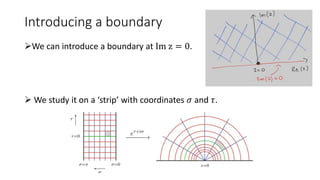
Introducing a boundary
We can introduce a boundary at Im z = 0.
 We study it on a ‘strip’ with coordinates 𝜎 and 𝜏.
Free boson on the strip
 For variation of action to vary, we have;
∫ 𝑑𝜏 𝜕𝜎𝑋 𝛿𝑋
𝜎=0
𝜎=𝜋
= 0 ⇒
𝜕𝜎𝑋
𝜎=0,𝜋
= 0 (Neumann)
𝛿𝑋
𝜎=0,𝜋
= 𝜕𝜏𝑋
𝜎=0,𝜋
= 0 (Dirichlet)
𝑗𝑛 − 𝑗𝑛 = 0 Neumann − Neumann 𝑗𝑛 + 𝑗𝑛 = 0 Dirichlet − Dirichlet [𝑛 ∈ ℤ]
𝑗𝑛 − 𝑗𝑛 = 0 Neumann − Dirichlet 𝑗𝑛 + 𝑗𝑛 = 0 Dirichlet − Neumann 𝑛 ∈ ℤ +
1
2
 We have 𝐿𝑛 = 𝐿𝑛 which implies 𝑇 𝑧 = 𝑇(𝑧).
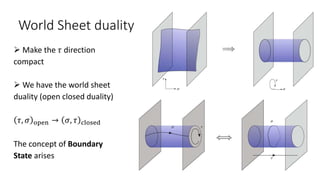
World Sheet duality
 Make the 𝜏 direction
compact
 We have the world sheet
duality (open closed duality)
𝜏, 𝜎 open → 𝜎, 𝜏 closed
The concept of Boundary
State arises
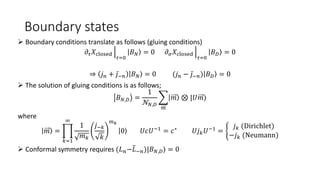
Boundary states
 Boundary conditions translate as follows (gluing conditions)
𝜕𝜏𝑋closed
𝜏=0
𝐵𝑁 = 0 𝜕𝜎𝑋closed
𝜏=0
𝐵𝐷 = 0
⇒ 𝑗𝑛 + 𝑗−𝑛 𝐵𝑁 = 0 (𝑗𝑛 − 𝑗−𝑛) 𝐵𝐷 = 0
 The solution of gluing conditions is as follows;
𝐵𝑁,𝐷 =
1
𝒩𝑁,𝐷
𝑚
𝑚 ⊗ |𝑈𝑚⟩
where
𝑚 =
𝑘=1
∞
1
𝑚𝑘
𝑗−𝑘
𝑘
𝑚𝑘
0 𝑈𝑐𝑈−1
= 𝑐∗
𝑈𝑗𝑘𝑈−1
=
𝑗𝑘 (Dirichlet)
−𝑗𝑘 (Neumann)
 Conformal symmetry requires (𝐿𝑛−𝐿−𝑛)|𝐵𝑁,𝐷⟩ = 0
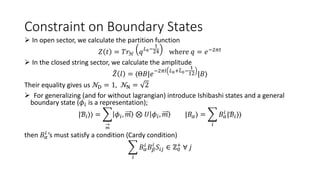
Constraint on Boundary States
 In open sector, we calculate the partition function
𝑍 𝑡 = 𝑇𝑟ℋ 𝑞𝐿0−
1
24 where 𝑞 = 𝑒−2𝜋𝑡
 In the closed string sector, we calculate the amplitude
𝑍 𝑙 = ⟨Θ𝐵|𝑒
−2𝜋𝑙 𝐿0+𝐿0−
1
12 |𝐵⟩
Their equality gives us 𝒩D = 1, 𝒩N = 2
 For generalizing (and for without lagrangian) introduce Ishibashi states and a general
boundary state (𝜙𝑖 is a representation);
|ℬ𝑖⟩⟩ =
→
𝑚
𝜙𝑖, 𝑚 ⊗ 𝑈 𝜙𝑖, 𝑚 |𝐵𝛼⟩ =
𝑖
𝐵𝛼
𝑖 |ℬ𝑖⟩⟩
then 𝐵𝛼
𝑖
’s must satisfy a condition (Cardy condition)
𝑖
𝐵𝛼
𝑖
𝐵𝛽
𝑖
𝑆𝑖𝑗 ∈ ℤ0
+
∀ 𝑗
Sewing constraints
 We can generalize to arbitrary surfaces
(Riemann surfaces) with boundaries and holes.
 We calculate the correlation functions
0 𝜙1 𝑥1 … 𝜙𝑛 𝑥𝑛 𝜓1 𝑦1 … 𝜓𝑚(𝑦𝑚)|0⟩
by chopping off the surface into parts to get
three and lesser point functions.
 The answer shouldn’t depend on chopping
and we have Sewing constraints.
e.g. the first constraint is
𝐶12𝑞𝐶34𝑞𝑀
1 4
2 3 𝑞𝑟
= 𝐶14𝑟𝐶23𝑟𝑀
1 4
2 3 𝑟𝑞
where the matrices are called fusion matrices.
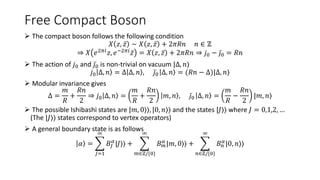
Free Compact Boson
 The compact boson follows the following condition
𝑋 𝑧, 𝑧 ∼ 𝑋 𝑧, 𝑧 + 2𝜋𝑅𝑛 𝑛 ∈ ℤ
⇒ 𝑋 𝑒2𝜋𝑖
𝑧, 𝑒−2𝜋𝑖
𝑧 = 𝑋 𝑧, 𝑧 + 2𝜋𝑅𝑛 ⇒ 𝑗0 − 𝑗0 = 𝑅𝑛
 The action of 𝑗0 and 𝑗0 is non-trivial on vacuum |Δ, 𝑛⟩
𝑗0 Δ, 𝑛 = Δ Δ, 𝑛 , 𝑗0 Δ, 𝑛 = (𝑅𝑛 − Δ)|Δ, 𝑛⟩
 Modular invariance gives
Δ =
𝑚
𝑅
+
𝑅𝑛
2
⇒ 𝑗0 Δ, 𝑛 =
𝑚
𝑅
+
𝑅𝑛
2
𝑚, 𝑛 , 𝑗0 Δ, 𝑛 =
𝑚
𝑅
−
𝑅𝑛
2
|𝑚, 𝑛⟩
 The possible Ishibashi states are |𝑚, 0⟩⟩, |0, 𝑛⟩⟩ and the states |𝐽⟩⟩ where 𝐽 = 0,1,2, …
(The |𝐽⟩⟩ states correspond to vertex operators)
 A general boundary state is as follows
𝛼 =
𝐽=1
∞
𝐵𝐽
𝛼
|𝐽⟩⟩ +
𝑚∈ℤ/{0}
∞
𝐵𝑚
𝛼
|𝑚, 0⟩⟩ +
𝑛∈ℤ/{0}
∞
𝐵𝑛
𝛼
|0, 𝑛⟩⟩
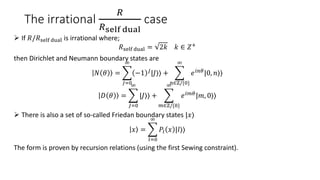
The irrational
𝑅
𝑅self dual
case
 If 𝑅/𝑅self dual is irrational where;
𝑅self dual = 2𝑘 𝑘 ∈ 𝑍+
then Dirichlet and Neumann boundary states are
𝑁 𝜃 =
𝐽=0
∞
−1 𝐽
|𝐽⟩⟩ +
𝑛∈ℤ/{0}
∞
𝑒𝑖𝑛𝜃
|0, 𝑛⟩⟩
𝐷 𝜃 =
𝐽=0
∞
|𝐽⟩⟩ +
𝑚∈ℤ/{0}
∞
𝑒𝑖𝑚𝜃
|𝑚, 0⟩⟩
 There is also a set of so-called Friedan boundary states |𝑥⟩
𝑥 =
𝑙=0
∞
𝑃𝑙 𝑥 |𝑙⟩⟩
The form is proven by recursion relations (using the first Sewing constraint).
Analogue of Cardy condition in
𝑅
𝑅self dual
case
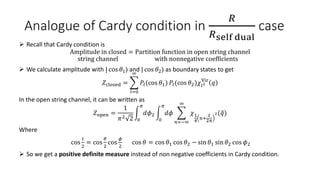
 Recall that Cardy condition is
Amplitude in closed = Partition function in open string channel
string channel with nonnegative coefficients
 We calculate amplitude with | cos 𝜃1⟩ and | cos 𝜃2⟩ as boundary states to get
𝑍closed =
𝑙=0
∞
𝑃𝑙(cos 𝜃1) 𝑃𝑙(cos 𝜃2)𝜒𝑙2
Vir
𝑞
In the open string channel, it can be written as
𝑍open =
1
𝜋2 2 0
𝜋
𝑑𝜙2
0
𝜋
𝑑𝜙
𝑛=−∞
∞
𝜒1
4
𝑛+
𝑡
2𝜋
2(𝑞)
Where
cos
𝑡
2
= cos
𝜃
2
cos
𝜙
2
cos 𝜃 = cos 𝜃1 cos 𝜃2 − sin 𝜃1 sin 𝜃2 cos 𝜙2
 So we get a positive definite measure instead of non negative coefficients in Cardy condition.
Questions
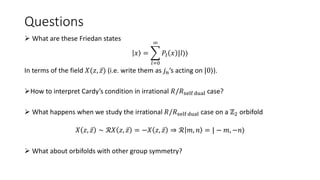
 What are these Friedan states
𝑥 =
𝑙=0
∞
𝑃𝑙 𝑥 |𝑙⟩⟩
In terms of the field 𝑋(𝑧, 𝑧) (i.e. write them as 𝑗𝑛’s acting on |0⟩).
How to interpret Cardy’s condition in irrational 𝑅/𝑅self dual case?
 What happens when we study the irrational 𝑅/𝑅self dual case on a ℤ2 orbifold
𝑋 𝑧, 𝑧 ∼ ℛ𝑋 𝑧, 𝑧 = −𝑋 𝑧, 𝑧 ⇒ ℛ 𝑚, 𝑛 = | − 𝑚, −𝑛⟩
 What about orbifolds with other group symmetry?
Thank you
for listening

Conformal Boundary conditions

  • 1.
    Conformal Boundary States forfree boson Hassaan Saleem
  • 2.
    What is QuantumField Theory (QFT)?  A quantum theory with local operators (fields) 𝜙(𝑥) as degrees of freedom.  Relativistic QFT is symmetric in spacetime translations, rotations and boosts. Rotational symmetry + Boost symmetry → Lorentz symmetry Translation symmetry + Lorentz symmetry → Poincare symmetry  Should have at least one vacuum (lowest energy state)  Can have internal (non spacetime) symmetries  Has a vacuum state |0⟩. Main objects of study are correlation functions ⟨0 𝜙1 𝑥1 … 𝜙𝑛 𝑥𝑛 0⟩
  • 3.
    Why study ConformalField Theory (CFT)?  CFTs can be made very rigorous.  Fixed Points in RG flow.  Extensive use in condensed matter physics (phase transitions and behaviour near criticality).  Super String Theory is a (super) conformal theory.
  • 4.
    What is CFT? Relativistic QFT + Additional spacetime symmetries (Conformal Transformations -or CT- in total)  Defining equation 𝑔𝛼𝛽(𝑥) → Ω2 𝑥 𝑔𝛼𝛽(𝑥)  These transformations preserve angles  For 𝐷 = 1, every transformation is conformal  For 𝐷 > 2, Poincare + Scale Transformation + Special Conformal 𝑥𝜇′ = 𝜆𝑥𝜇 (Scale Transformation) 𝑥𝜇′ 𝑥′2 = 𝑥𝜇 𝑥2 − 𝑏𝜇 Special Conformal 𝑥𝜇 → 𝑥𝜇 𝑥2 inversion
  • 5.
  • 6.
    Primary Fields  Afield 𝜙(𝑥) is primary if for 𝒙 → 𝒙′, the field transforms as; 𝜙′ 𝒙′ → 𝜕𝒙′ 𝜕𝒙 − Δ 𝐷 𝜙(𝒙) e.g. for dilations 𝒙 → 𝒙′ = 𝜆𝒙 𝜙′ 𝒙′ → 𝜆− Δ 𝐷𝜙(𝒙)  𝜆 is called the scaling dimension of the field.
  • 7.
    𝐷 = 2case (two dimensional CFT)  Coordinates are (𝑥0, 𝑥1) or (𝑧, 𝑧) where; 𝑧 = 𝑥0 + 𝑖𝑥1 , 𝑧 = 𝑥0 − 𝑖𝑥1  CTs are 𝑧 → 𝑓 𝑧 holomorphic transformation 𝑧 → 𝑓 𝑧 (anti − holomorphic transformation)  Infinitesimal form 𝑧 → 𝑧 + 𝜖 𝑧 = 𝑧 + 𝑛∈ℤ 𝜖𝑛 −𝑧𝑛+1 = 1 + 𝑛∈ℤ 𝜖𝑛 −𝑧𝑛+1 𝜕𝑧 𝑧 = 1 + 𝑛∈ℤ 𝜖𝑛𝑙𝑛 𝑧 𝑧 → 𝑧 + 𝜖 𝑧 = 𝑧 + 𝑛∈ℤ 𝜖𝑛 −𝑧𝑛+1 = 1 + 𝑛∈ℤ 𝜖𝑛 −𝑧𝑛+1 𝜕𝑧 𝑧 = 1 + 𝑛∈ℤ 𝜖𝑛𝑙𝑛 𝑧
  • 8.
    Virasoro Algebra andStress tensor  𝑙𝑛 and 𝑙𝑛 satisfy (Witt algebra) 𝑙𝑛, 𝑙𝑚 = 𝑛 − 𝑚 𝑙𝑛+𝑚 𝑙𝑛, 𝑙𝑚 = 𝑛 − 𝑚 𝑙𝑛+𝑚 𝑙𝑛, 𝑙𝑚 = 0  Witt algebra can be ‘extended’ to Virasoro algebra 𝐿𝑛, 𝐿𝑚 = 𝑛 − 𝑚 𝐿𝑛+𝑚 + 𝑐 12 𝑚3 − 𝑚 𝛿𝑛+𝑚 Stress tensor (𝑇𝜇𝜈) is defined as 𝑇𝜇𝜈 = 𝛿ℒ 𝛿𝑔𝜇𝜈 ⇒ 𝑇𝜇 𝜇 = 0, 𝜕𝜇 𝑇𝜇𝜈 = 0  𝑇𝑧𝑧 = 𝑇 𝑧 , 𝑇𝑧𝑧 = 𝑇 𝑧 , 𝑇𝑧𝑧 = 𝑇𝑧𝑧 = 0
  • 9.
    Primary field in𝐷 = 2 CFT  In (𝑧, 𝑧) coordinates, a primary field transforms as; 𝜙′ 𝑓 𝑧 , 𝑓 𝑧 = 𝜕𝑓 𝑧 𝜕𝑧 −ℎ 𝜕𝑓 𝑧 𝜕𝑧 −ℎ 𝜙(𝑧, 𝑧) (ℎ, ℎ) are conformal weights of 𝜙(𝑧, 𝑧).  Δ = ℎ + ℎ.  𝑙−1, 𝑙0, 𝑙1 and 𝑙−1, 𝑙0, 𝑙1 correspond to translations, rotations, dilations and special conformal tr. (globally defined CTs).  A field is quasi-primary if it follows primary transformation law only for global CTs.  𝑇(𝑧) and 𝑇(𝑧) are quasi primary (ℎ = 2, ℎ = 0)
  • 10.
    Mode expansions  Fora primary field, we have the following mode expansion on (𝑧, 𝑧) coordinates; 𝜙 𝑧, 𝑧 = 𝑛,𝑚 𝑧−𝑛−ℎ𝑧−𝑚−ℎ𝜙𝑛,𝑚  For chiral primary fields, we have; 𝜙 𝑧 = 𝑛 𝑧−𝑛−ℎ𝜙𝑛 𝜙 𝑧 = 𝑚 𝑧−𝑚−ℎ𝜙𝑚 e.g. 𝑇 𝑧 and 𝑇 𝑧 , the mode expansions are; 𝑇 𝑧 = 𝑛 𝑧−𝑛−2 𝐿𝑛 𝑇 𝑧 = 𝑚 𝑧−𝑚−2 𝐿𝑚
  • 11.
    Operator Product Expansion(OPE)  OPE of two quasi primary operators 𝜙1(𝑧, 𝑧) and 𝜙2(𝑤, 𝑤) is 𝜙1 𝑧, 𝑧 𝜙2 𝑤, 𝑤 = 𝑘 𝐶12𝑘𝑎𝑖𝑗𝑘 𝑛 𝑧 − 𝑤 𝑓(ℎ1,ℎ2,ℎ𝑘,ℎ1,ℎ2,ℎ𝑘,𝑘) 𝜕𝑛𝜙𝑘(𝑤, 𝑤) e.g. for a primary field 𝜙(𝑤, 𝑤), we have (another definition of primary fields) 𝑇 𝑧 𝜙 𝑤, 𝑤 = ℎ 𝜙(𝑤, 𝑤) 𝑧 − 𝑤 2 + 𝜕𝑤𝜙 𝑤, 𝑤 𝑧 − 𝑤 + regular 𝑇 𝑧 𝜙 𝑤, 𝑤 = ℎ𝜙(𝑤, 𝑤) 𝑧 − 𝑤 2 + 𝜕𝑤𝜙 𝑤, 𝑤 𝑧 − 𝑤 + regular and for 𝑇 𝑧 𝑇(𝑤), we have; 𝑇 𝑧 𝑇 𝑤 = 𝑐/2 𝑧 − 𝑤 4 + 2 𝑇(𝑤) 𝑧 − 𝑤 2 + 𝜕𝑤𝑇 𝑤 𝑧 − 𝑤 + regular
  • 12.
    Free boson 𝑋(𝑧,𝑧)  The free boson action is 𝑆 = 1 4𝜋 ∫ 𝑑𝑧𝑑𝑧 𝜕𝑋. 𝜕𝑋  Equation of motion is 𝜕𝜕𝑋 = 0 ⇒ 𝜕𝑗 𝑧 = 𝜕𝑗 𝑧 = 0 𝑗 𝑧 = 𝑖𝜕𝑋(𝑧, 𝑧) 𝑗 𝑧 = 𝑖𝜕𝑋(𝑧, 𝑧)  ℎ 𝑋 = 0 and ℎ 𝑗 = ℎ 𝑗 = 1 (𝑗 and 𝑗 are primary fields) 𝑗 𝑧 = 𝑛 𝑧−𝑛−1𝑗𝑛 𝑗 𝑧 = 𝑚 𝑧−𝑚−1𝑗𝑚  𝐿𝑛 and 𝑗𝑚’s are connected as 𝐿𝑛 = 𝑘≻−1 𝑗𝑛−𝑘𝑗𝑘 + 𝑘≤−1 𝑗𝑘𝑗𝑛−𝑘 𝑐 = 1 (by calculating [𝐿𝑛, 𝑗𝑚] and ⟨0|𝐿2𝐿−2|0⟩) 𝑋(𝑧, 𝑧) is expanded as 𝑋 𝑧, 𝑧 = 𝑥0 − 𝑖 𝑗0 ln 𝑧𝑧 + 𝑖 𝑛≠0 1 𝑛 𝑗𝑛𝑧−𝑛 + 𝑗𝑛𝑧−𝑛 (𝑗0 = 𝑗0)
  • 13.
    Introducing a boundary Wecan introduce a boundary at Im z = 0.  We study it on a ‘strip’ with coordinates 𝜎 and 𝜏.
  • 14.
    Free boson onthe strip  For variation of action to vary, we have; ∫ 𝑑𝜏 𝜕𝜎𝑋 𝛿𝑋 𝜎=0 𝜎=𝜋 = 0 ⇒ 𝜕𝜎𝑋 𝜎=0,𝜋 = 0 (Neumann) 𝛿𝑋 𝜎=0,𝜋 = 𝜕𝜏𝑋 𝜎=0,𝜋 = 0 (Dirichlet) 𝑗𝑛 − 𝑗𝑛 = 0 Neumann − Neumann 𝑗𝑛 + 𝑗𝑛 = 0 Dirichlet − Dirichlet [𝑛 ∈ ℤ] 𝑗𝑛 − 𝑗𝑛 = 0 Neumann − Dirichlet 𝑗𝑛 + 𝑗𝑛 = 0 Dirichlet − Neumann 𝑛 ∈ ℤ + 1 2  We have 𝐿𝑛 = 𝐿𝑛 which implies 𝑇 𝑧 = 𝑇(𝑧).
  • 15.
    World Sheet duality Make the 𝜏 direction compact  We have the world sheet duality (open closed duality) 𝜏, 𝜎 open → 𝜎, 𝜏 closed The concept of Boundary State arises
  • 16.
    Boundary states  Boundaryconditions translate as follows (gluing conditions) 𝜕𝜏𝑋closed 𝜏=0 𝐵𝑁 = 0 𝜕𝜎𝑋closed 𝜏=0 𝐵𝐷 = 0 ⇒ 𝑗𝑛 + 𝑗−𝑛 𝐵𝑁 = 0 (𝑗𝑛 − 𝑗−𝑛) 𝐵𝐷 = 0  The solution of gluing conditions is as follows; 𝐵𝑁,𝐷 = 1 𝒩𝑁,𝐷 𝑚 𝑚 ⊗ |𝑈𝑚⟩ where 𝑚 = 𝑘=1 ∞ 1 𝑚𝑘 𝑗−𝑘 𝑘 𝑚𝑘 0 𝑈𝑐𝑈−1 = 𝑐∗ 𝑈𝑗𝑘𝑈−1 = 𝑗𝑘 (Dirichlet) −𝑗𝑘 (Neumann)  Conformal symmetry requires (𝐿𝑛−𝐿−𝑛)|𝐵𝑁,𝐷⟩ = 0
  • 17.
    Constraint on BoundaryStates  In open sector, we calculate the partition function 𝑍 𝑡 = 𝑇𝑟ℋ 𝑞𝐿0− 1 24 where 𝑞 = 𝑒−2𝜋𝑡  In the closed string sector, we calculate the amplitude 𝑍 𝑙 = ⟨Θ𝐵|𝑒 −2𝜋𝑙 𝐿0+𝐿0− 1 12 |𝐵⟩ Their equality gives us 𝒩D = 1, 𝒩N = 2  For generalizing (and for without lagrangian) introduce Ishibashi states and a general boundary state (𝜙𝑖 is a representation); |ℬ𝑖⟩⟩ = → 𝑚 𝜙𝑖, 𝑚 ⊗ 𝑈 𝜙𝑖, 𝑚 |𝐵𝛼⟩ = 𝑖 𝐵𝛼 𝑖 |ℬ𝑖⟩⟩ then 𝐵𝛼 𝑖 ’s must satisfy a condition (Cardy condition) 𝑖 𝐵𝛼 𝑖 𝐵𝛽 𝑖 𝑆𝑖𝑗 ∈ ℤ0 + ∀ 𝑗
  • 18.
    Sewing constraints  Wecan generalize to arbitrary surfaces (Riemann surfaces) with boundaries and holes.  We calculate the correlation functions 0 𝜙1 𝑥1 … 𝜙𝑛 𝑥𝑛 𝜓1 𝑦1 … 𝜓𝑚(𝑦𝑚)|0⟩ by chopping off the surface into parts to get three and lesser point functions.  The answer shouldn’t depend on chopping and we have Sewing constraints. e.g. the first constraint is 𝐶12𝑞𝐶34𝑞𝑀 1 4 2 3 𝑞𝑟 = 𝐶14𝑟𝐶23𝑟𝑀 1 4 2 3 𝑟𝑞 where the matrices are called fusion matrices.
  • 19.
    Free Compact Boson The compact boson follows the following condition 𝑋 𝑧, 𝑧 ∼ 𝑋 𝑧, 𝑧 + 2𝜋𝑅𝑛 𝑛 ∈ ℤ ⇒ 𝑋 𝑒2𝜋𝑖 𝑧, 𝑒−2𝜋𝑖 𝑧 = 𝑋 𝑧, 𝑧 + 2𝜋𝑅𝑛 ⇒ 𝑗0 − 𝑗0 = 𝑅𝑛  The action of 𝑗0 and 𝑗0 is non-trivial on vacuum |Δ, 𝑛⟩ 𝑗0 Δ, 𝑛 = Δ Δ, 𝑛 , 𝑗0 Δ, 𝑛 = (𝑅𝑛 − Δ)|Δ, 𝑛⟩  Modular invariance gives Δ = 𝑚 𝑅 + 𝑅𝑛 2 ⇒ 𝑗0 Δ, 𝑛 = 𝑚 𝑅 + 𝑅𝑛 2 𝑚, 𝑛 , 𝑗0 Δ, 𝑛 = 𝑚 𝑅 − 𝑅𝑛 2 |𝑚, 𝑛⟩  The possible Ishibashi states are |𝑚, 0⟩⟩, |0, 𝑛⟩⟩ and the states |𝐽⟩⟩ where 𝐽 = 0,1,2, … (The |𝐽⟩⟩ states correspond to vertex operators)  A general boundary state is as follows 𝛼 = 𝐽=1 ∞ 𝐵𝐽 𝛼 |𝐽⟩⟩ + 𝑚∈ℤ/{0} ∞ 𝐵𝑚 𝛼 |𝑚, 0⟩⟩ + 𝑛∈ℤ/{0} ∞ 𝐵𝑛 𝛼 |0, 𝑛⟩⟩
  • 20.
    The irrational 𝑅 𝑅self dual case If 𝑅/𝑅self dual is irrational where; 𝑅self dual = 2𝑘 𝑘 ∈ 𝑍+ then Dirichlet and Neumann boundary states are 𝑁 𝜃 = 𝐽=0 ∞ −1 𝐽 |𝐽⟩⟩ + 𝑛∈ℤ/{0} ∞ 𝑒𝑖𝑛𝜃 |0, 𝑛⟩⟩ 𝐷 𝜃 = 𝐽=0 ∞ |𝐽⟩⟩ + 𝑚∈ℤ/{0} ∞ 𝑒𝑖𝑚𝜃 |𝑚, 0⟩⟩  There is also a set of so-called Friedan boundary states |𝑥⟩ 𝑥 = 𝑙=0 ∞ 𝑃𝑙 𝑥 |𝑙⟩⟩ The form is proven by recursion relations (using the first Sewing constraint).
  • 21.
    Analogue of Cardycondition in 𝑅 𝑅self dual case  Recall that Cardy condition is Amplitude in closed = Partition function in open string channel string channel with nonnegative coefficients  We calculate amplitude with | cos 𝜃1⟩ and | cos 𝜃2⟩ as boundary states to get 𝑍closed = 𝑙=0 ∞ 𝑃𝑙(cos 𝜃1) 𝑃𝑙(cos 𝜃2)𝜒𝑙2 Vir 𝑞 In the open string channel, it can be written as 𝑍open = 1 𝜋2 2 0 𝜋 𝑑𝜙2 0 𝜋 𝑑𝜙 𝑛=−∞ ∞ 𝜒1 4 𝑛+ 𝑡 2𝜋 2(𝑞) Where cos 𝑡 2 = cos 𝜃 2 cos 𝜙 2 cos 𝜃 = cos 𝜃1 cos 𝜃2 − sin 𝜃1 sin 𝜃2 cos 𝜙2  So we get a positive definite measure instead of non negative coefficients in Cardy condition.
  • 22.
    Questions  What arethese Friedan states 𝑥 = 𝑙=0 ∞ 𝑃𝑙 𝑥 |𝑙⟩⟩ In terms of the field 𝑋(𝑧, 𝑧) (i.e. write them as 𝑗𝑛’s acting on |0⟩). How to interpret Cardy’s condition in irrational 𝑅/𝑅self dual case?  What happens when we study the irrational 𝑅/𝑅self dual case on a ℤ2 orbifold 𝑋 𝑧, 𝑧 ∼ ℛ𝑋 𝑧, 𝑧 = −𝑋 𝑧, 𝑧 ⇒ ℛ 𝑚, 𝑛 = | − 𝑚, −𝑛⟩  What about orbifolds with other group symmetry?
  • 23.