An Outline of StringAn Outline of String
TheoryTheory
Miao Li
Institute of Theoretical
Physics
Beijing, China
Contents
I. Background
II. Elements of string theory
III. Branes in string theory
IV. Black holes in string theory-
holography-Maldacena’s conjecture
I. Background
1. The world viewed by a reductionist
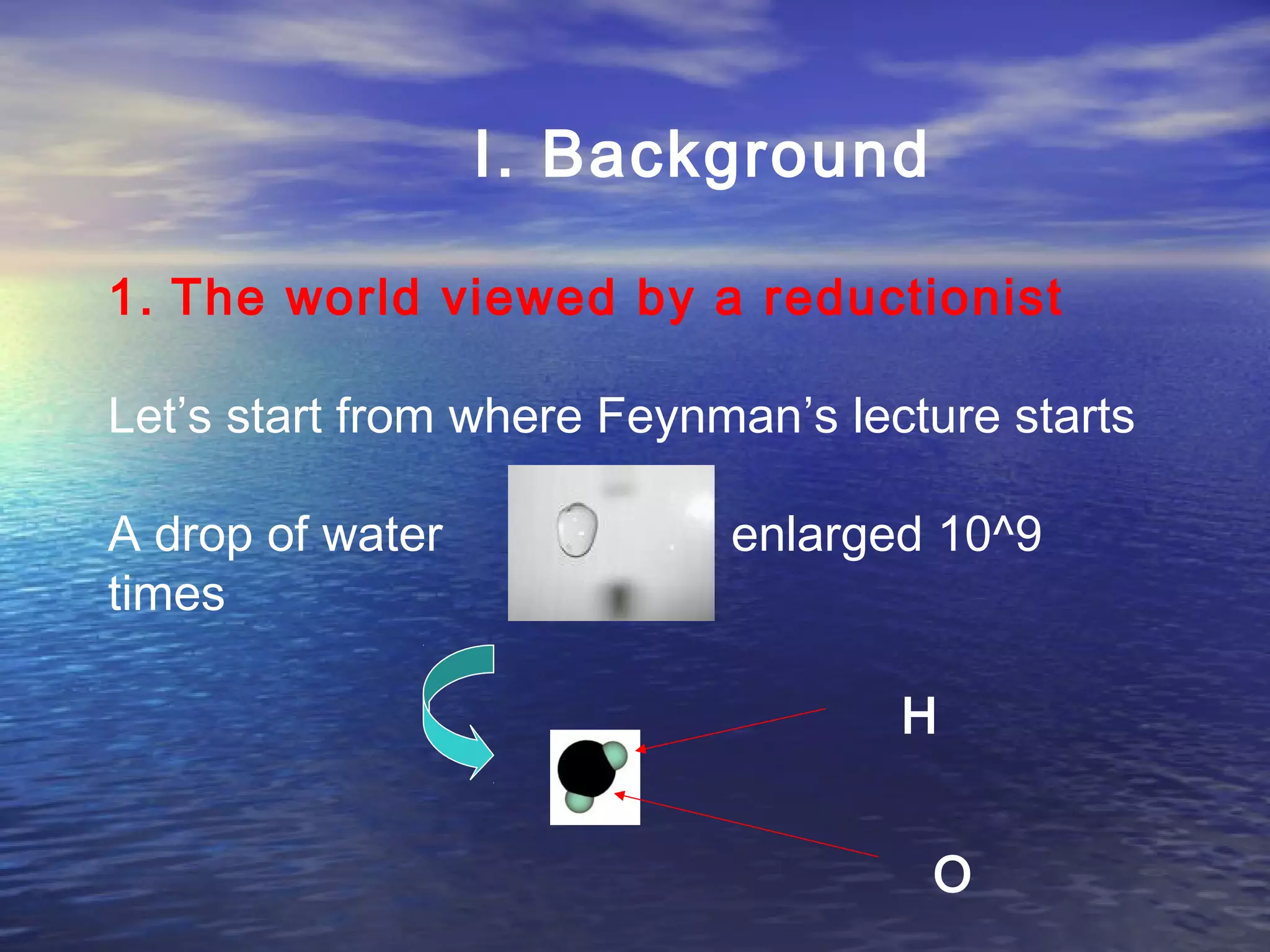
Let’s start from where Feynman’s lecture starts
A drop of water enlarged 10^9
times
H
O
Feynman was able to deduce a lot of
things
from a single sentence:
All forms of matter consist of atoms.
1. Qualitative properties of gas, liquid…
2. Evaporation, heat transport (to cool
your
Soup, blow it)
3. Understanding of sounds, waves…
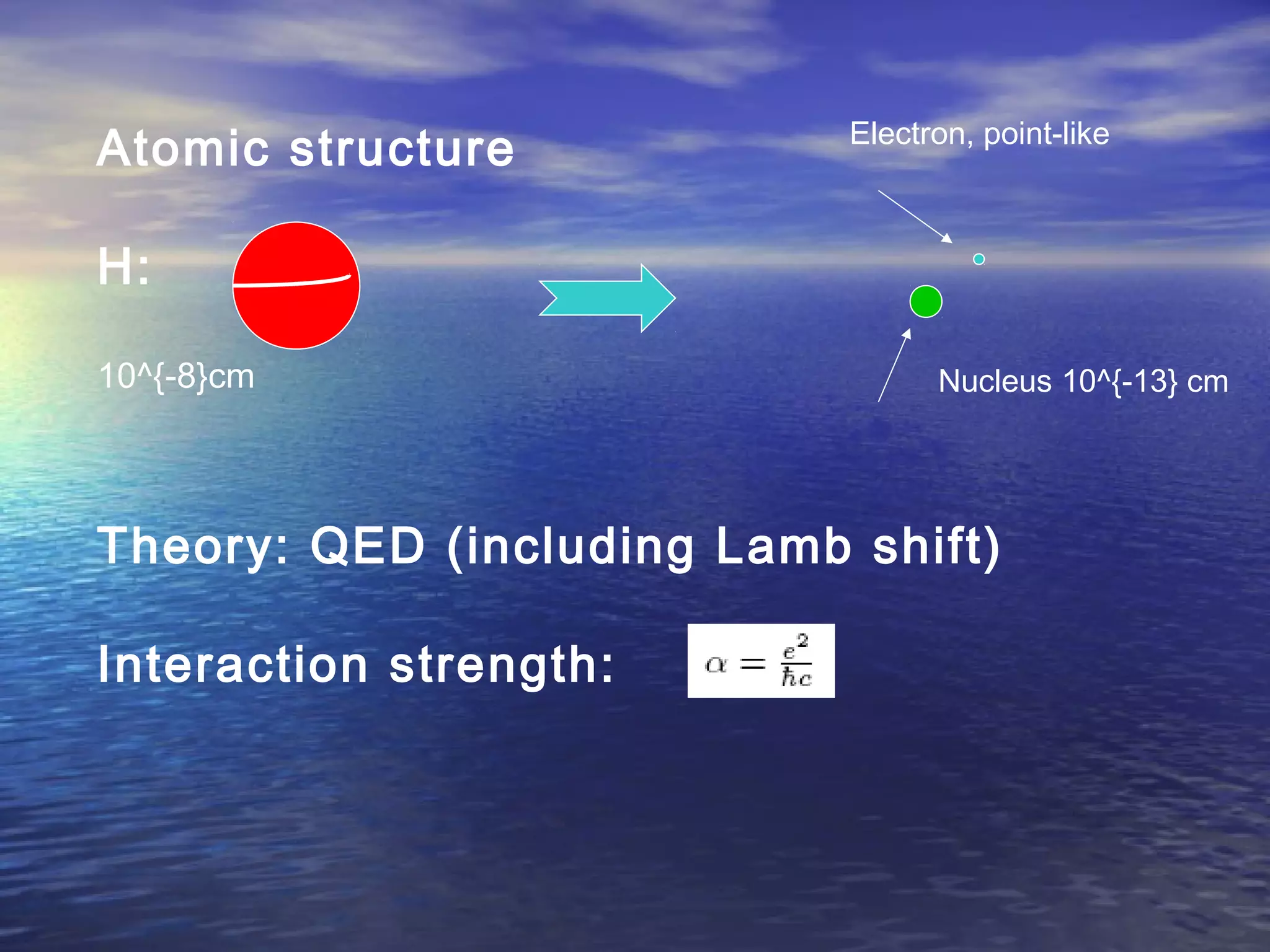
Atomic structure
H:
10^{-8}cm
Theory: QED (including Lamb shift)
Interaction strength:
Electron, point-like
Nucleus 10^{-13} cm
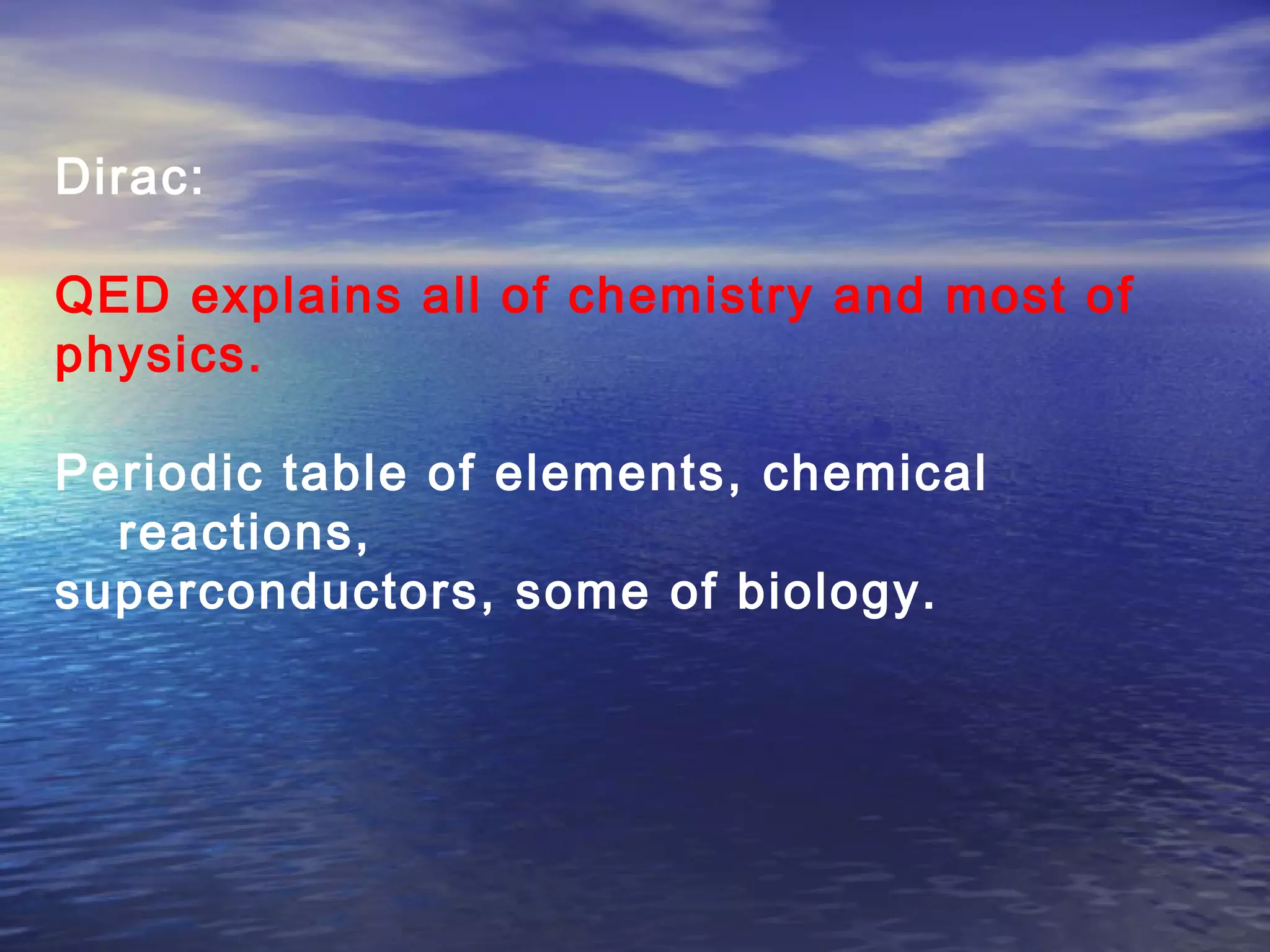
Dirac:
QED explains all of chemistry and most of
physics.
Periodic table of elements, chemical
reactions,
superconductors, some of biology.
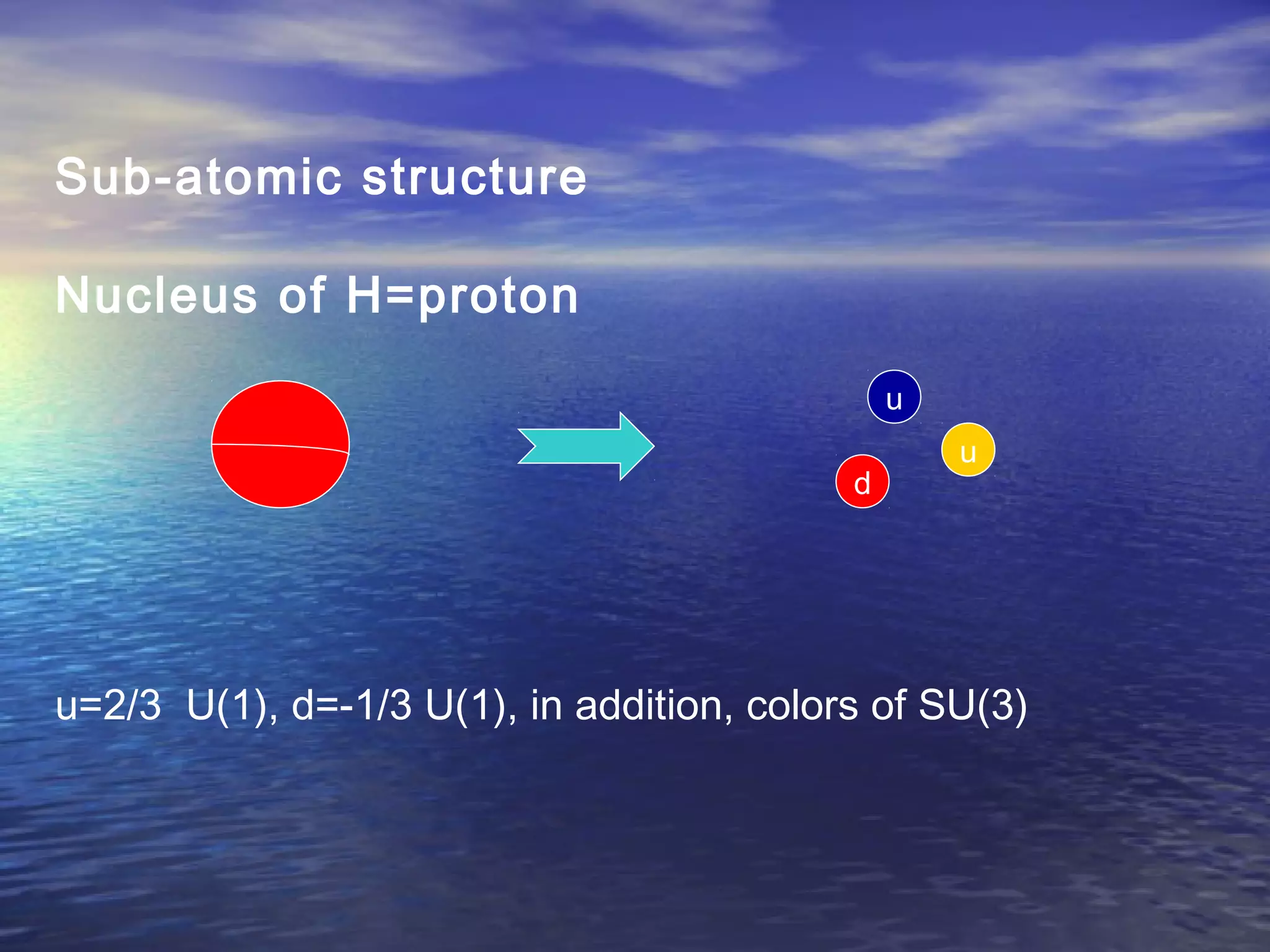
Sub-atomic structure
Nucleus of H=proton
u=2/3 U(1), d=-1/3 U(1), in addition, colors of SU(3)
u
u
d
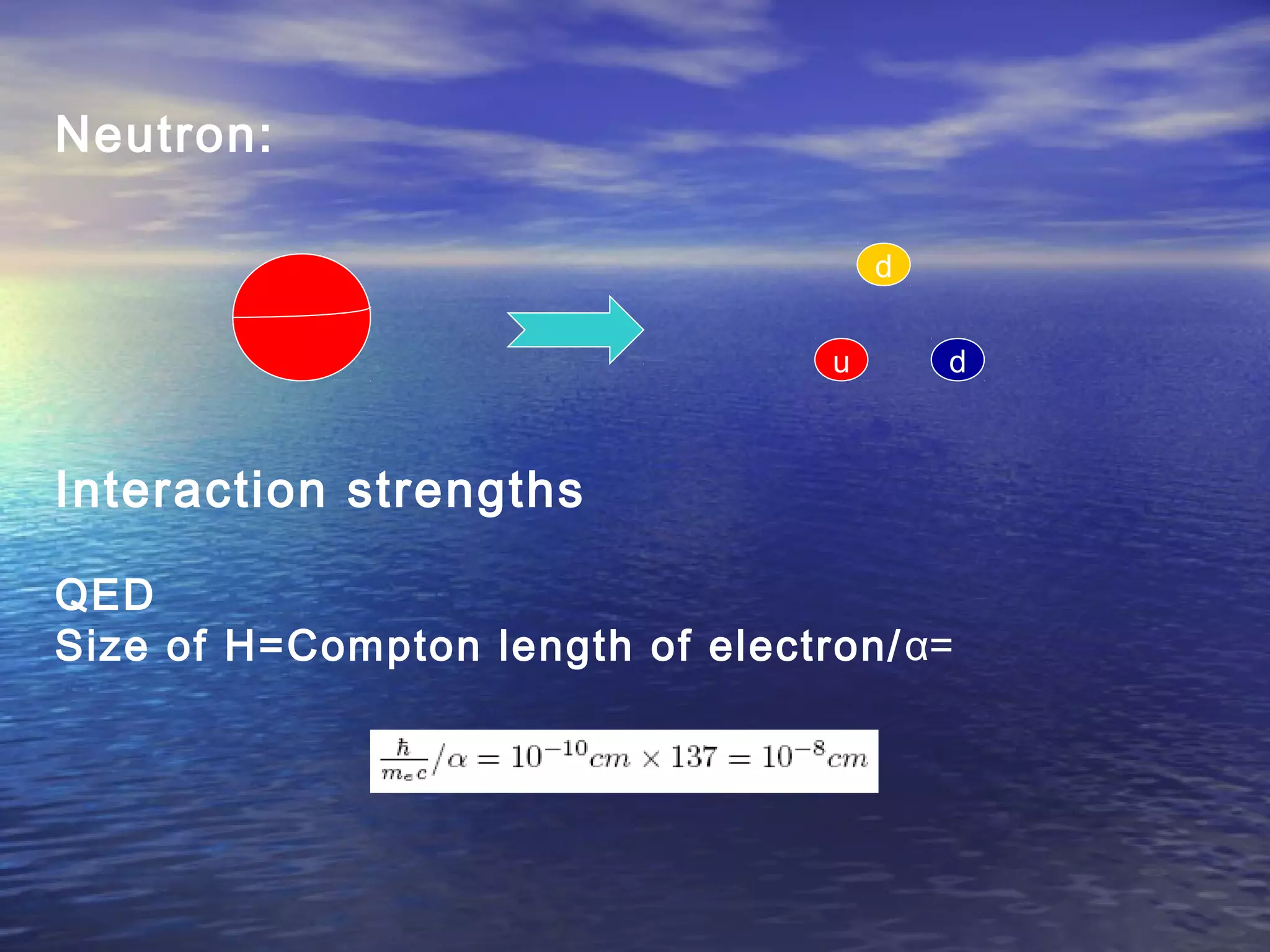
Neutron:
Interaction strengths
QED
Size of H=Compton length of electron/α=
d
u d
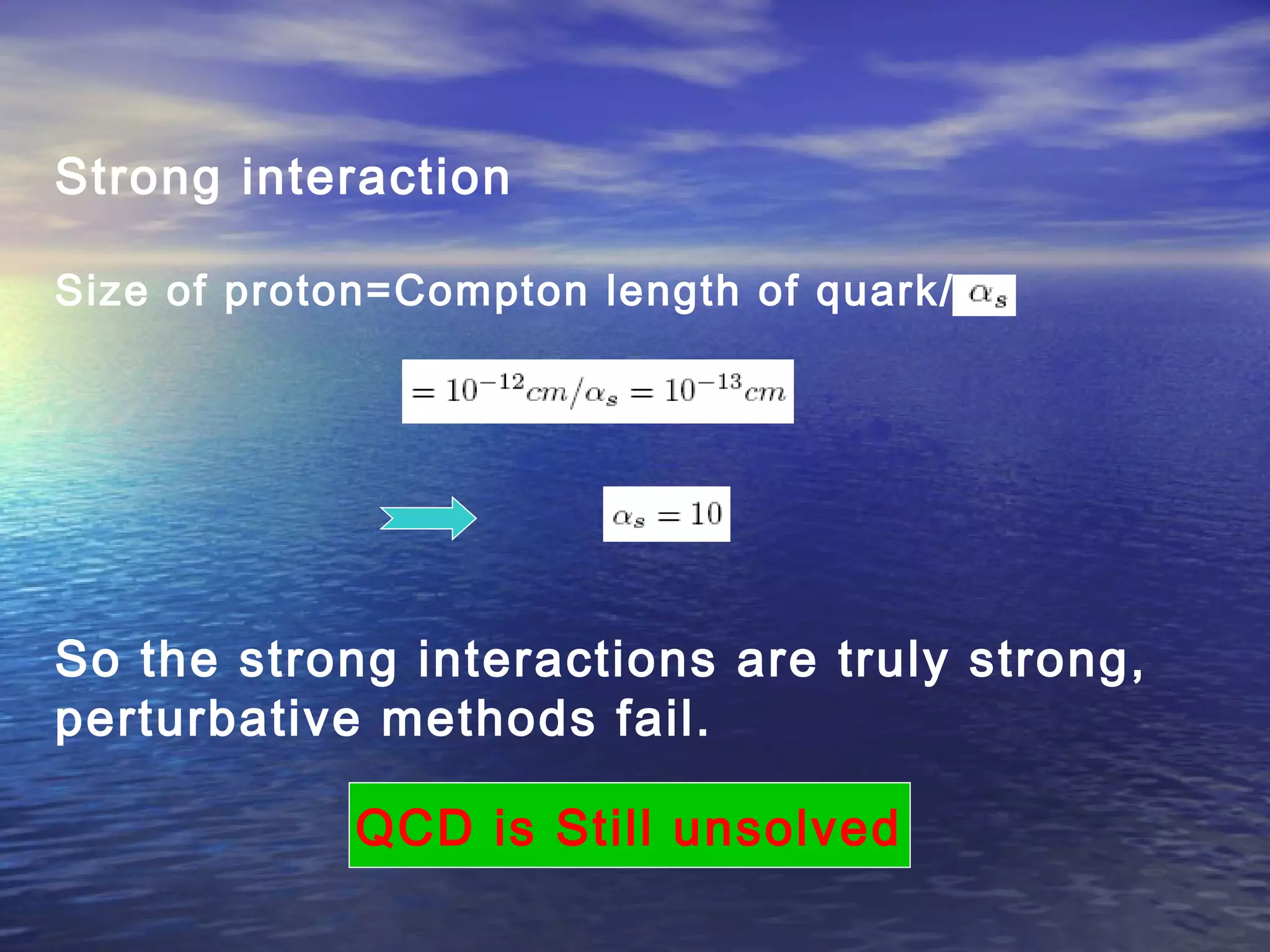
Strong interaction
Size of proton=Compton length of quark/
So the strong interactions are truly strong,
perturbative methods fail.
QCD is Still unsolved
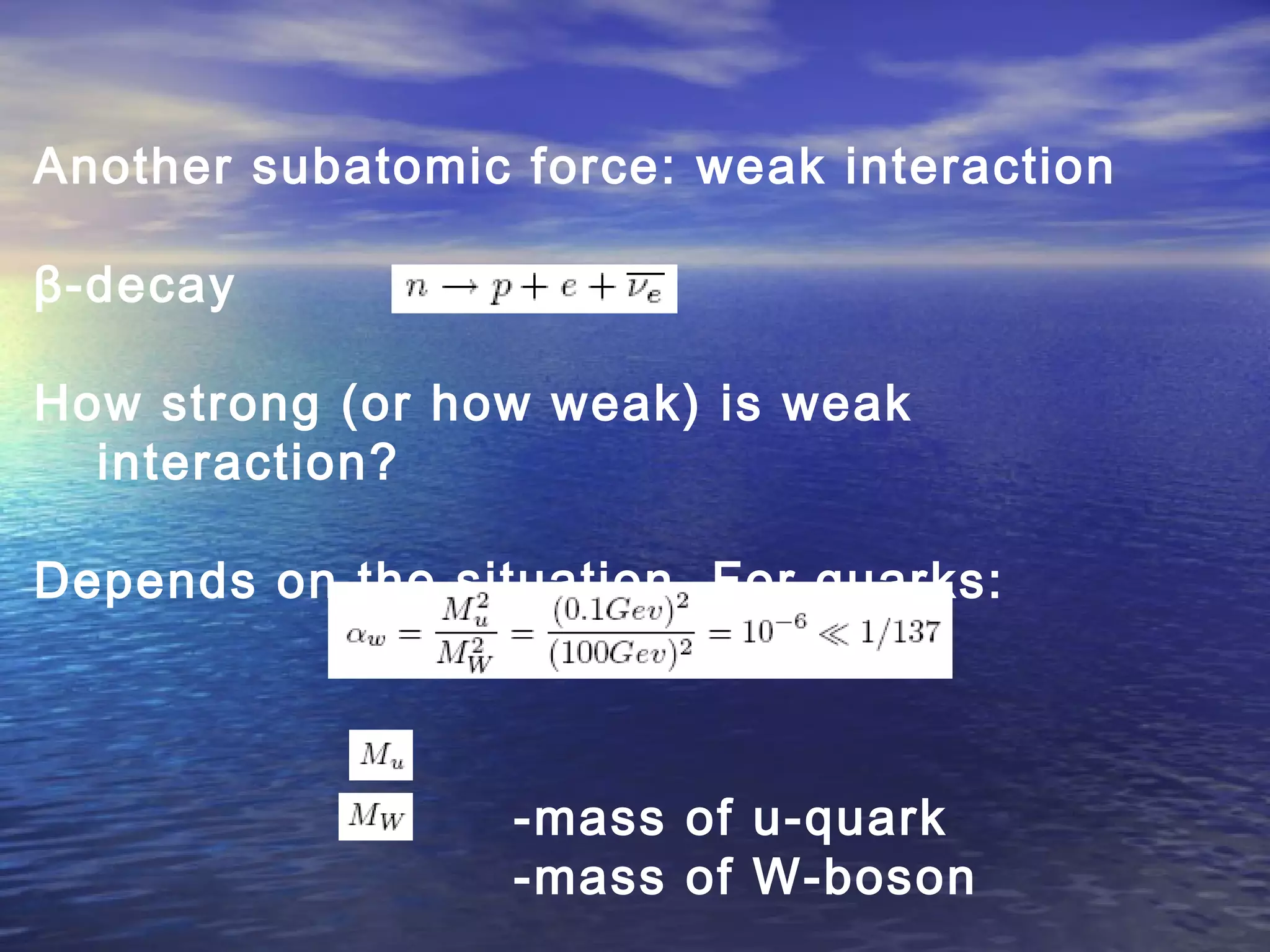
Another subatomic force: weak interaction
β-decay
How strong (or how weak) is weak
interaction?
Depends on the situation. For quarks:
-mass of u-quark
-mass of W-boson
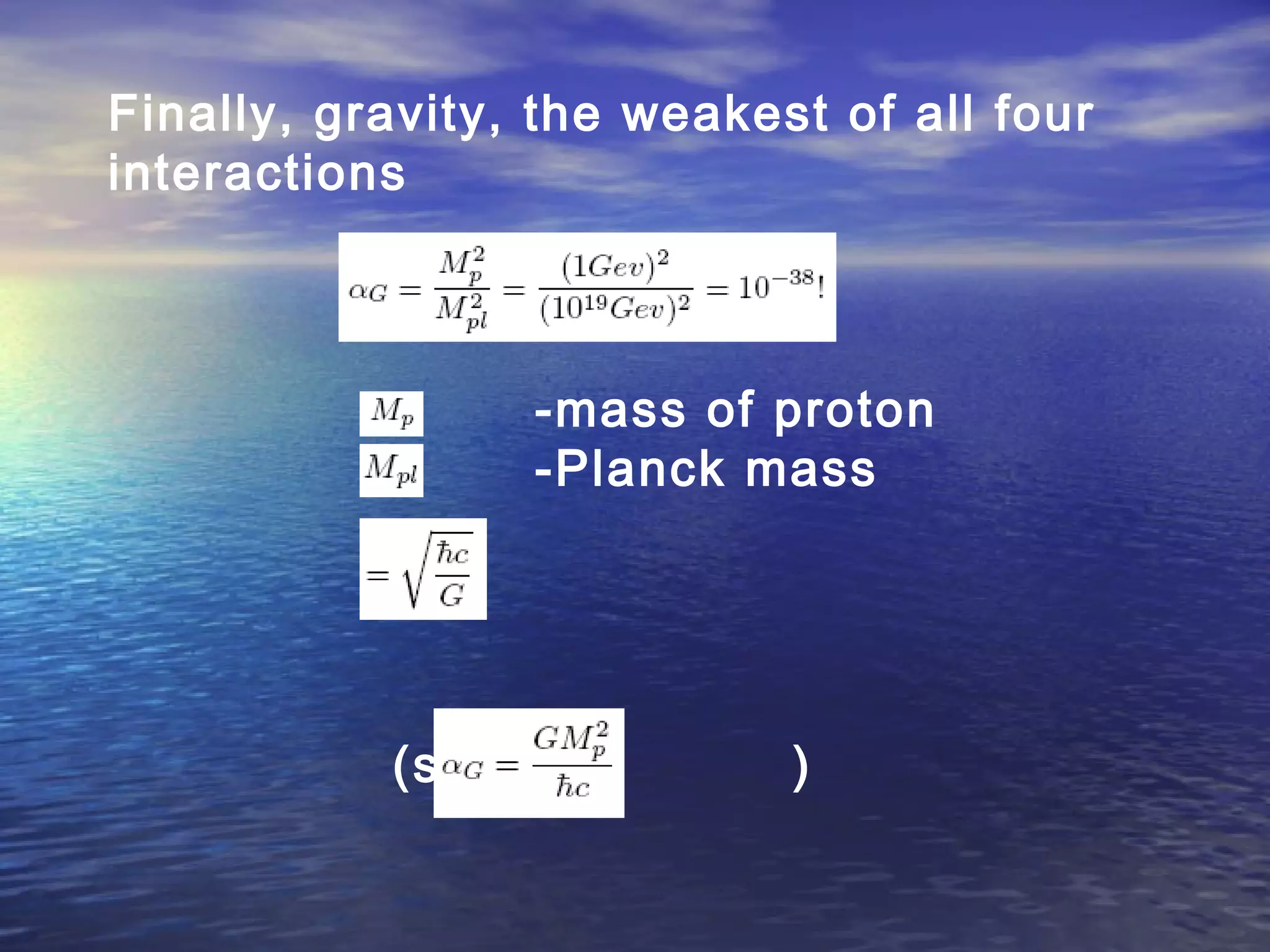
Finally, gravity, the weakest of all four
interactions
-mass of proton
-Planck mass
(so )
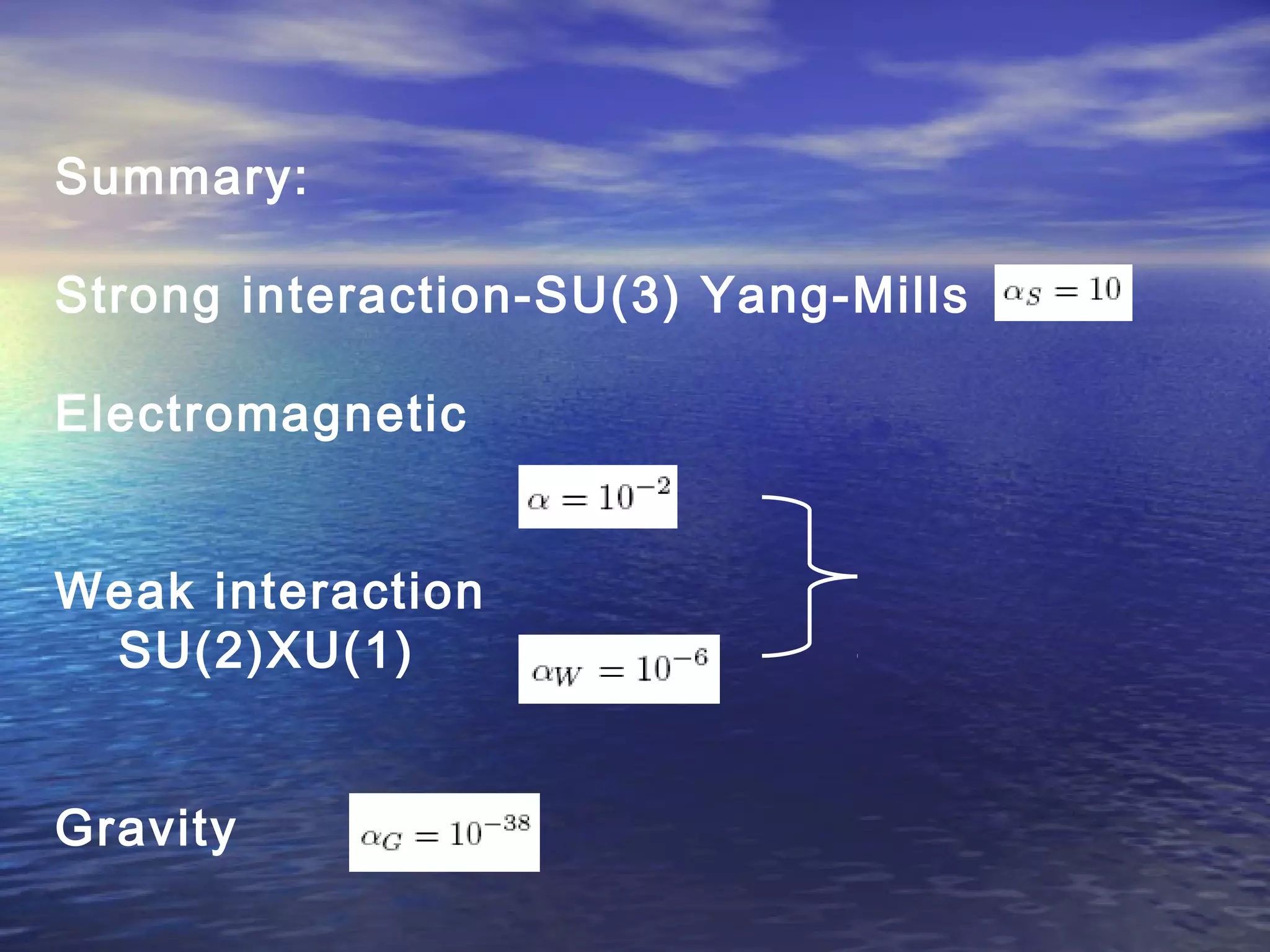
Summary:
Strong interaction-SU(3) Yang-Mills
Electromagnetic
Weak interaction
SU(2)XU(1)
Gravity
To asses the possibility of unification, let’s
Take a look at
2. A brief history of amalgamation of
physical
theories.
Movement of earthly bodies.
Movement of celestial bodies.
Newtonian mechanics + universal
gravitation.
17th
century.
Mechanics
Heat, thermodynamics
Atomic theory, statistical mechanics of
Maxwell, Boltzmann, Gibbs, 19th
century.
Electrodynamics
Magnetism
Light, X-rays, γ-rays
Faraday, Maxwell, 19th
century.
Quantum electrodynamics
Weak interaction
Semi-unification, Weinberg-Salam model.
The disparity between 10^{-2} and 10^{-6}
is solved by symmetry breaking in gauge
theory.
1960’s-1970’s
(`t Hooft, Veltman, Nobel prize in 1999, total
Five Nobel medals for this unification.)
Although eletro-weak, strong interaction
appear as different forces, they are
governed
by the same universal principle:
Quantum mechanics or better
Qantum field theory
valid up to
Further, there is evidence for unification of
3 forces:
(a) In 4 dimensions,
goes up with E
goes down with E
(b) runs as powers of E if there are large
compact dimensions ( )
3. Difficulty with gravity
Gravity, the first ever discovered interaction,
has resisted being put into the framework of
quantum field theory.
So, we have a great opportunity here!
Why gravity is different?
There are many aspects, here is a few.
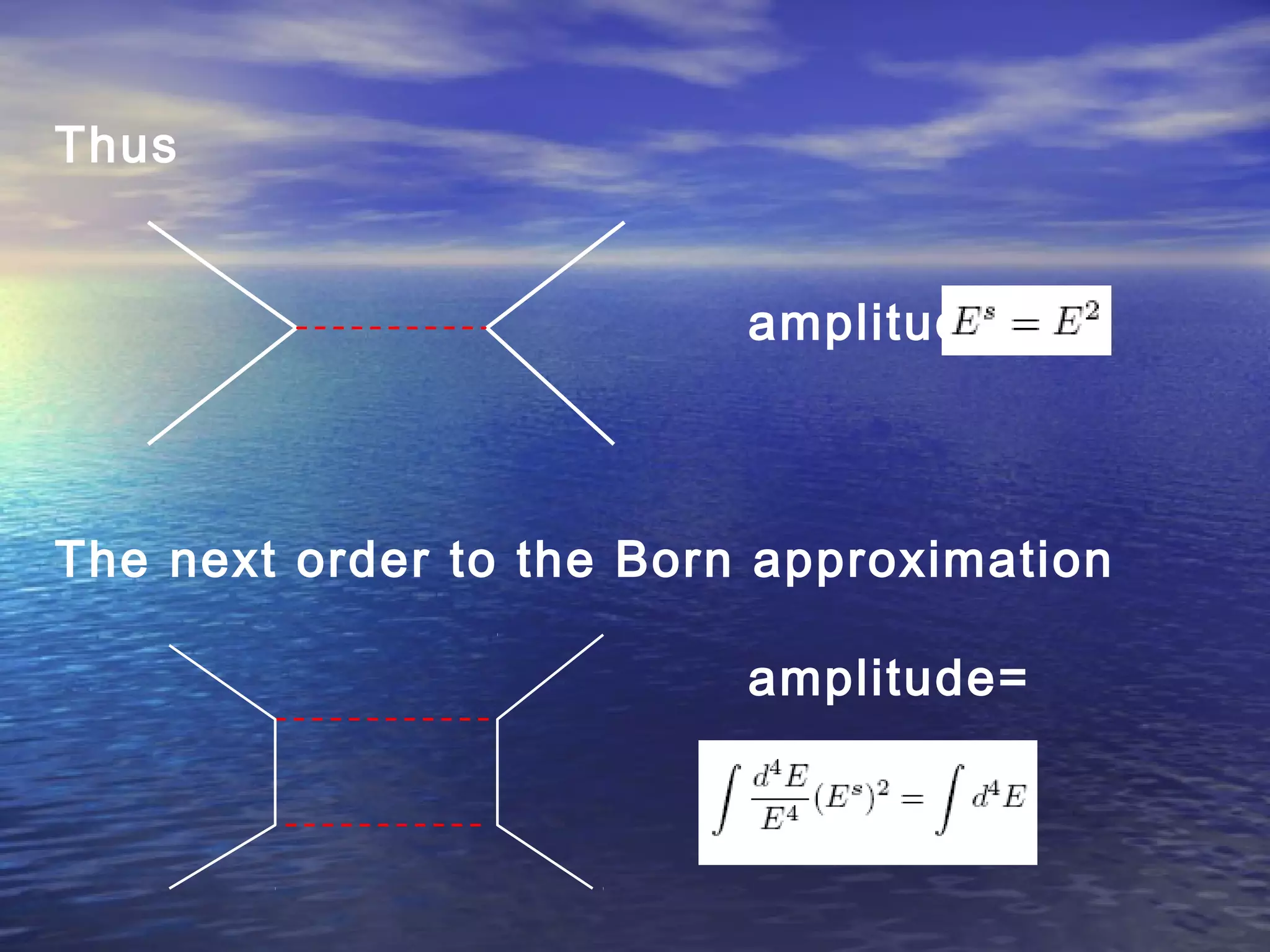
(a) The mediation particle has spin 2.
Thus
amplitude=
The next order to the Born approximation
amplitude=
(b) According to Einstein theory, gravity is
geometry. If geometry fluctuates violently,
causal structure is lost.
(c) The existence of black holes.
(c1) The failure of classical geometry.
singularity
(c2) A black hole has a finite entropy, or a
state of a black hole can not be specified
by
what is observed outside.
Hawking radiation, is quantum coherence
lost?
Curiously, the interaction strength at the
horizon is not .
The larger the BH, the weak the interaction.
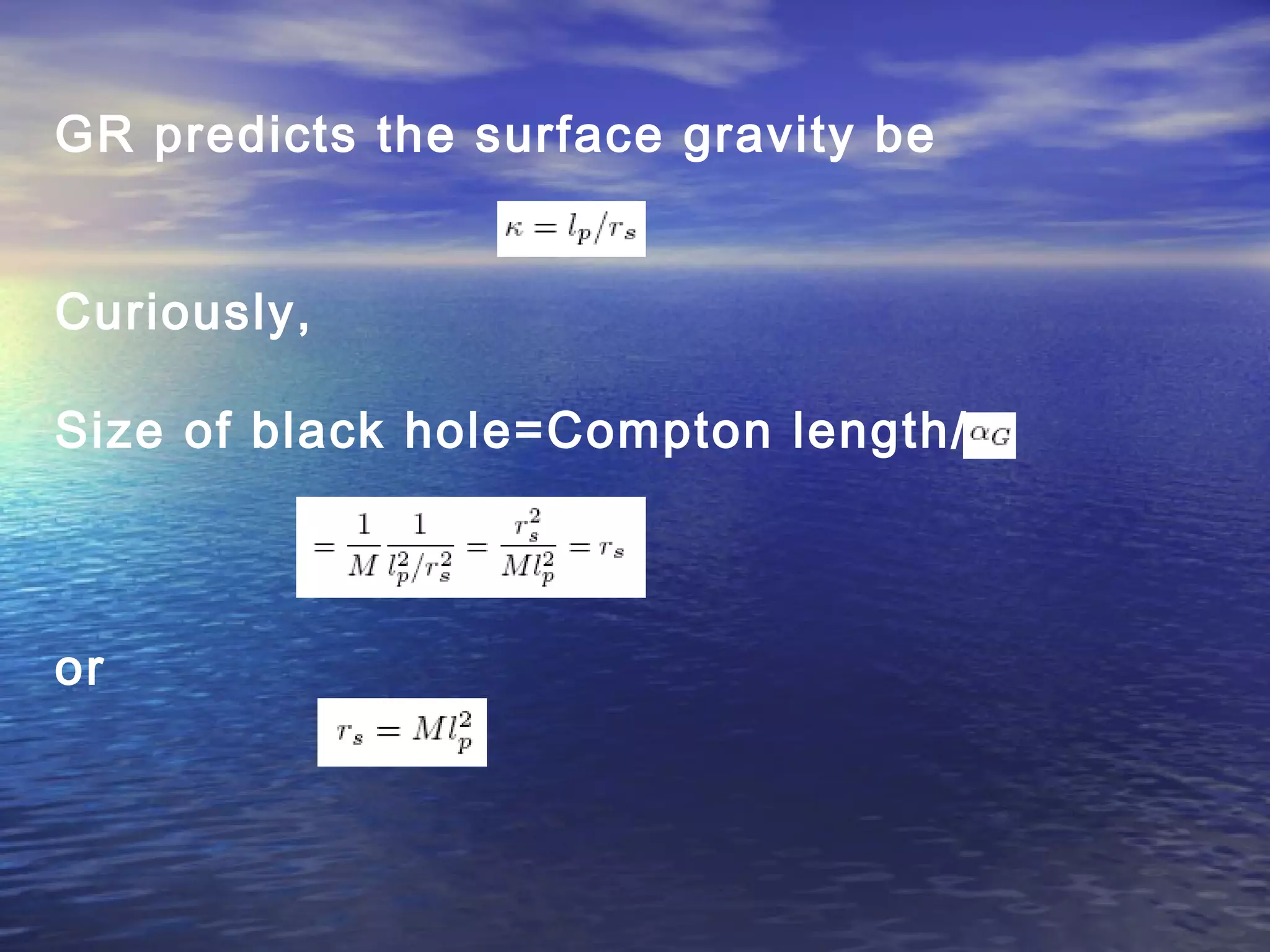
GR predicts the surface gravity be
Curiously,
Size of black hole=Compton length/
or
To summarize, the present day’s accepted
picture of our fundamental theory is
4. The emergence of string theory
A little history
Strong interaction is described by QCD,
however, the dual resonance model was
invented to describe strong interaction first,
and eventually became a candidate of theory
of quantum gravity.
Initially, there appeared infinitely many
resonant states ( π,ρ,ω…)
None of the resonant states appears more
fundamental than others. In calculating an
amplitude, we need to sum up all
intermediate
states:
π π π π
= Σ
n
π π π π
Denote this amplitude by A(s,t) :
(a)
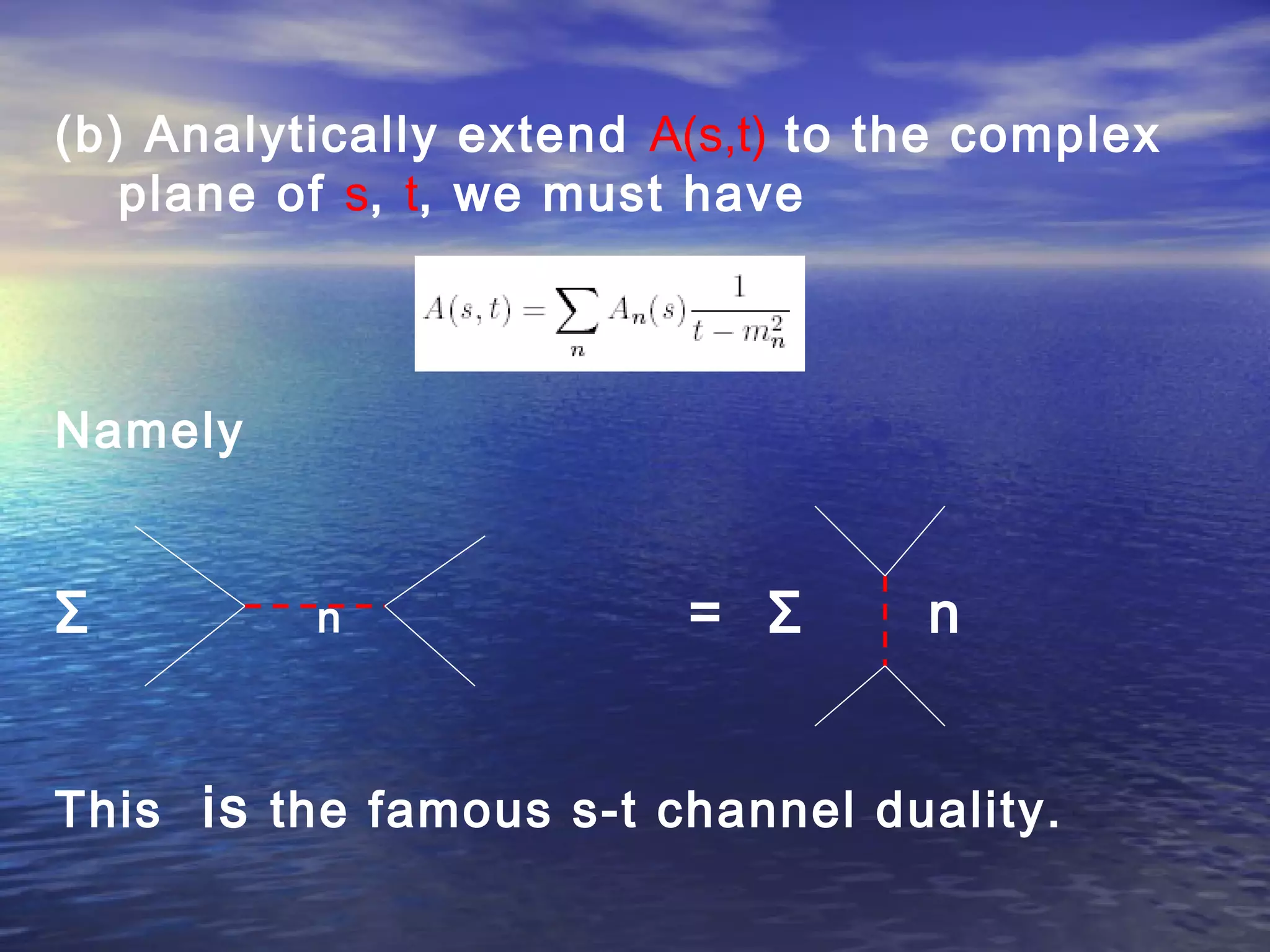
(b) Analytically extend A(s,t) to the complex
plane of s, t, we must have
Namely
Σ n = Σ n
This is the famous s-t channel duality.
A simple formula satisfying (a) and (b) is the
famous Veneziano amplitude
polynomial in t: Σ t^J, J-spin of the intermediate state
linear trajectory
This remarkable formula leads us to
String theory
For simplicity, consider open strings (to
which
Veneziano amplitude corresponds)
Ground state v=c
v=c
An excited state
v=c v=c
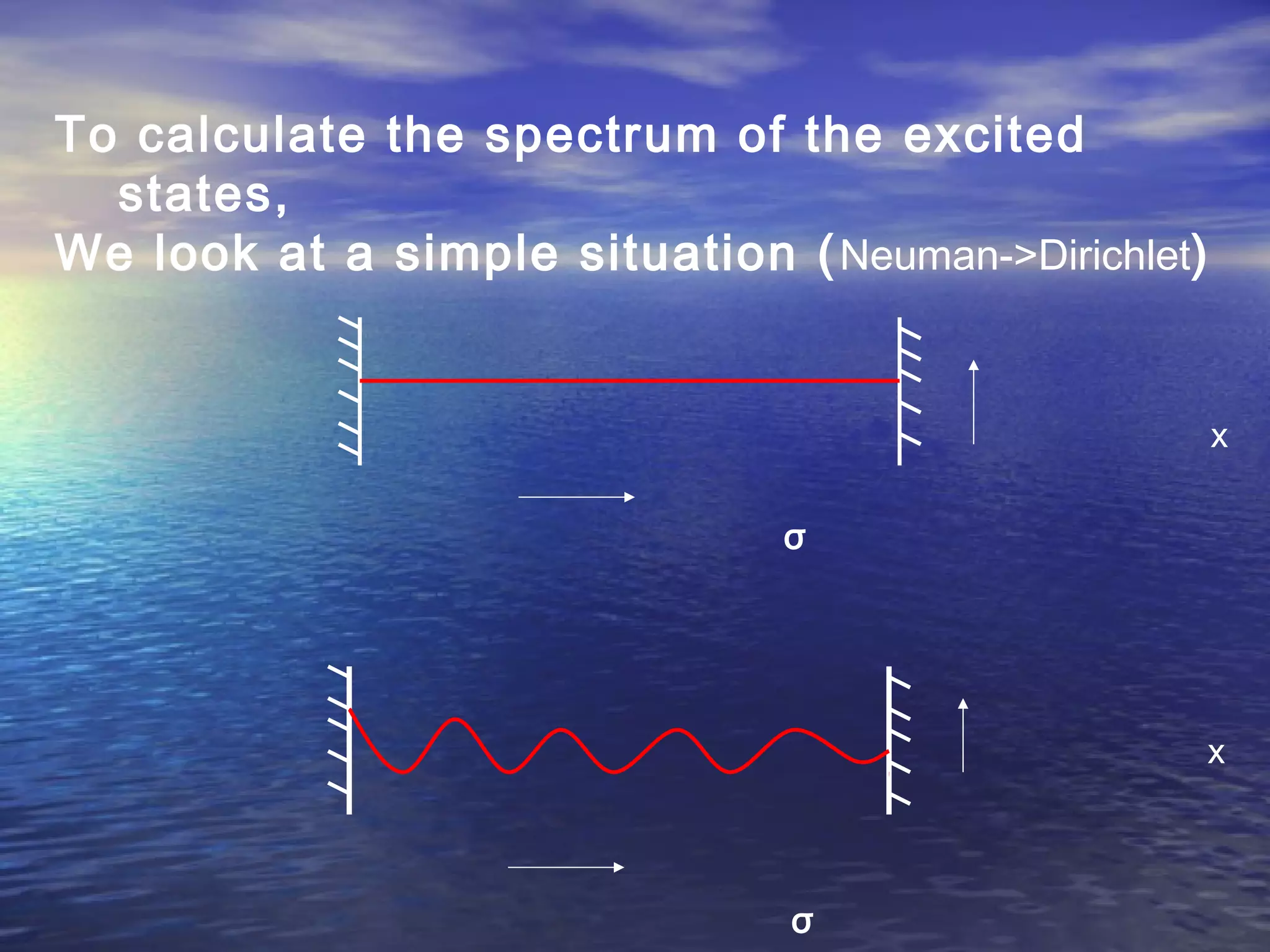
To calculate the spectrum of the excited
states,
We look at a simple situation (Neuman->Dirichlet)
x
σ
x
σ
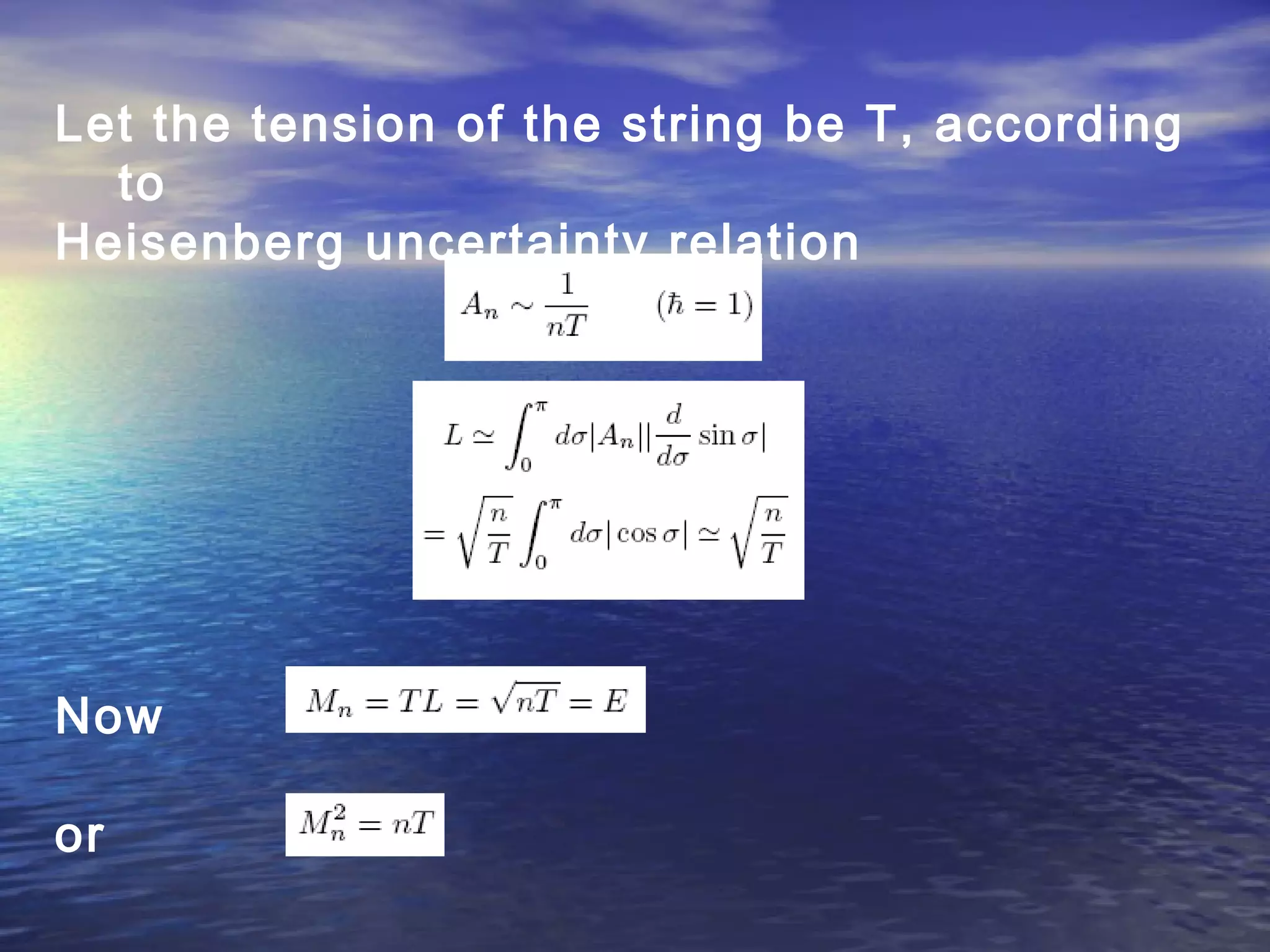
Let the tension of the string be T, according
to
Heisenberg uncertainty relation
Now
or
If , then
Casimir
effect
The above derivation ignores factors such
as
2’s, π’s. More generally, there can be
We discovered the linear trajectory.
Morals:
(a) There are infinitely many massive states resulting from a
single string (Q.M. is essential)
(b) If we have only “bosonic strings”, no internal colors, we
can have only integral spins.
spin 1: gauge bosons
spin 2: graviton
(c) To have a massless gauge boson, a=-1. To have a
massless graviton, a=-2 (need to use closed strings).
II. Elements of string theory
1. First quantized strings, Feynman rules
Particle analogue
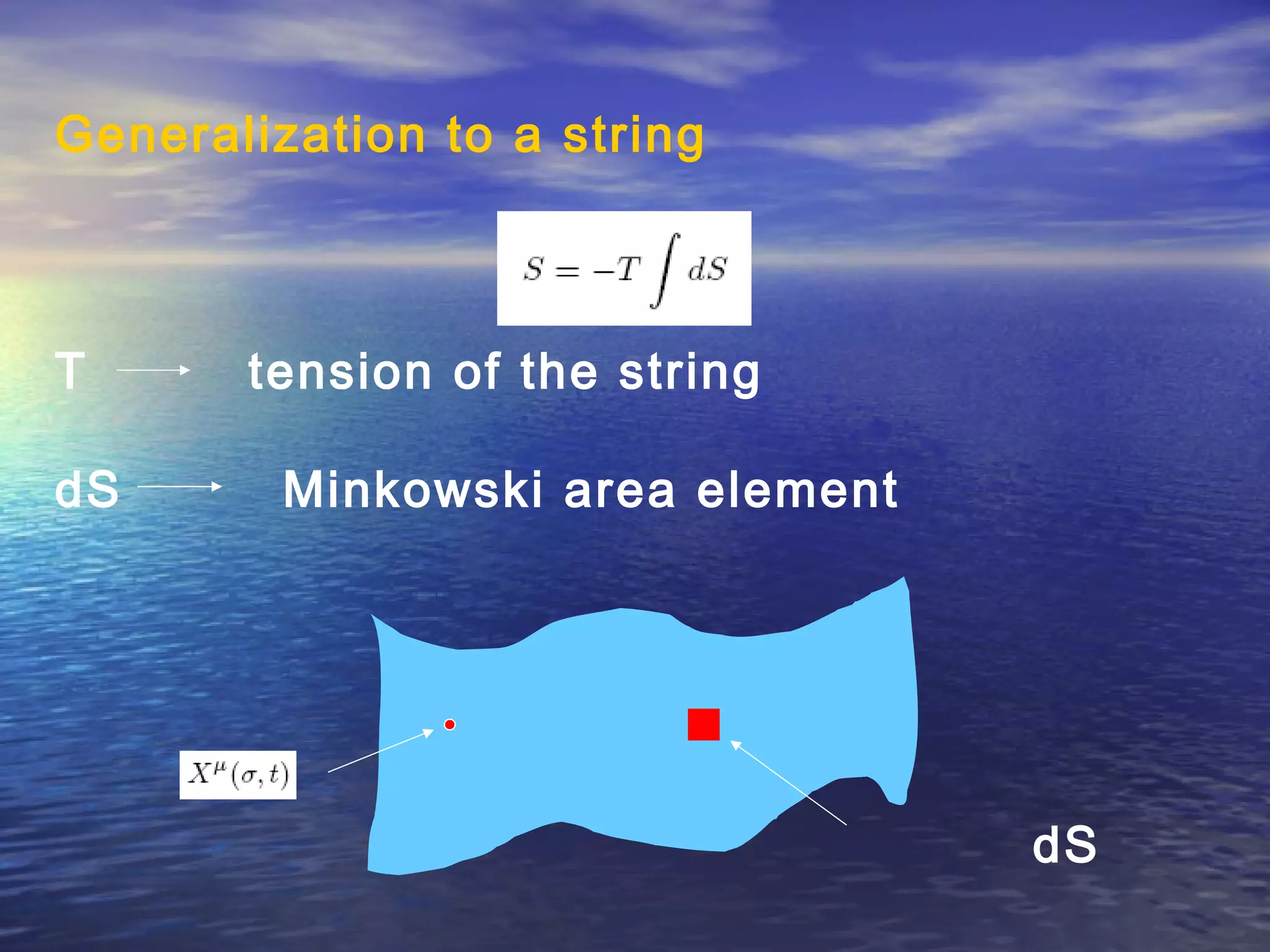
Action
A classical particle travels along the
shortest
path, while a quantum particle can travel
along different paths simultaneously, so we
would like to compute
Generalization to a string
T tension of the string
dS Minkowski area element
dS
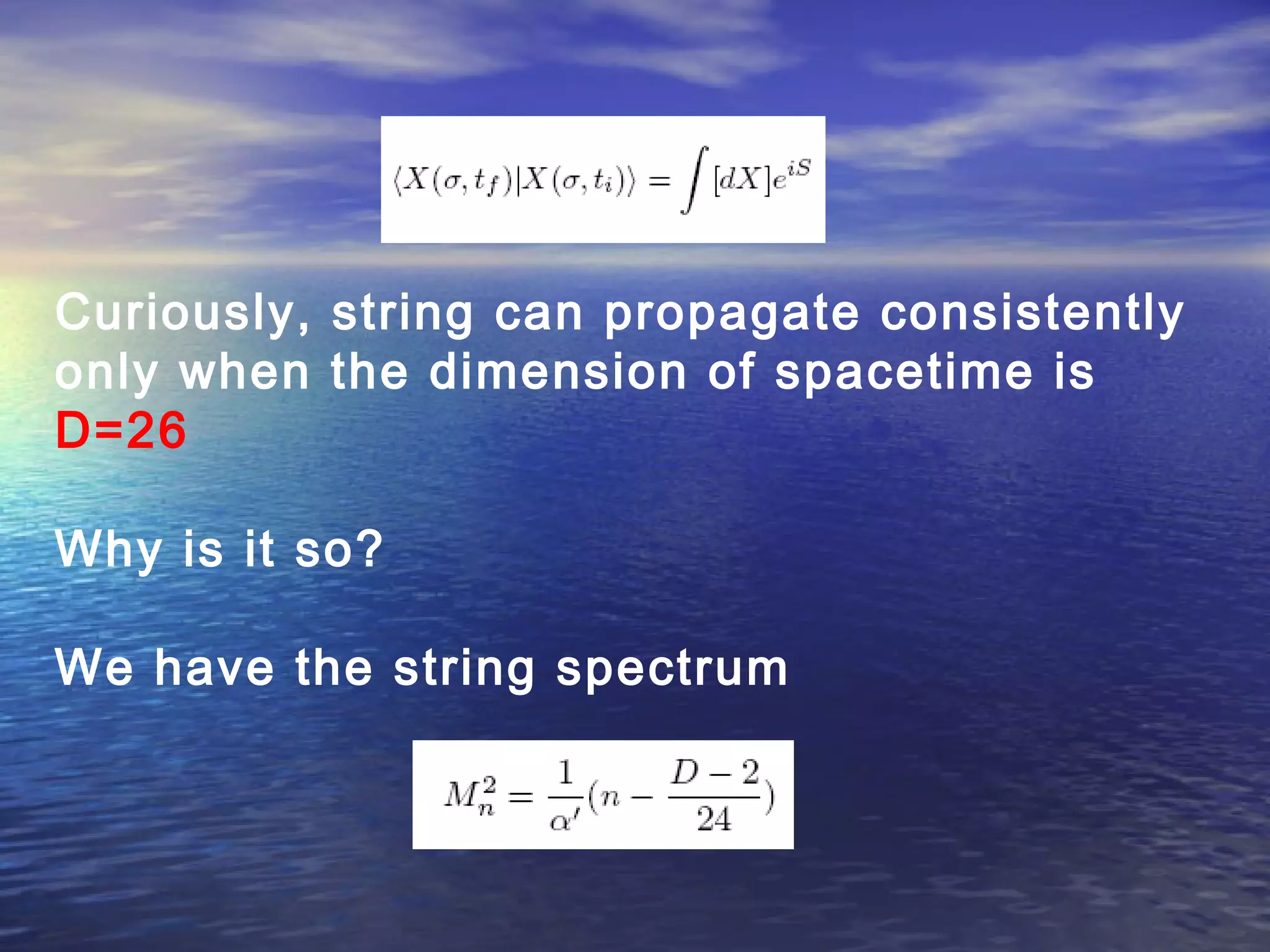
Curiously, string can propagate consistently
only when the dimension of spacetime is
D=26
Why is it so?
We have the string spectrum
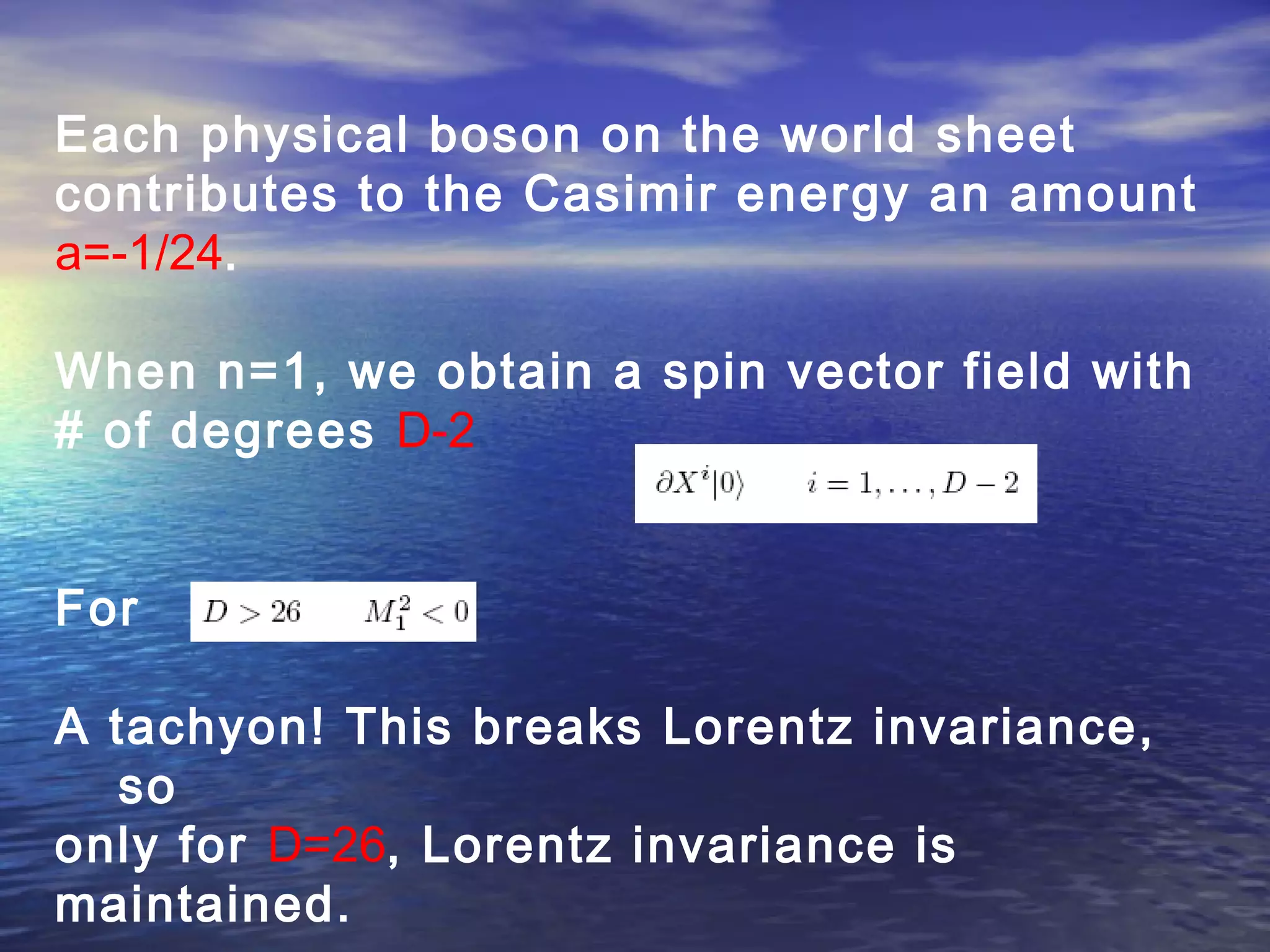
Each physical boson on the world sheet
contributes to the Casimir energy an amount
a=-1/24.
When n=1, we obtain a spin vector field with
# of degrees D-2
For
A tachyon! This breaks Lorentz invariance,
so
only for D=26, Lorentz invariance is
maintained.
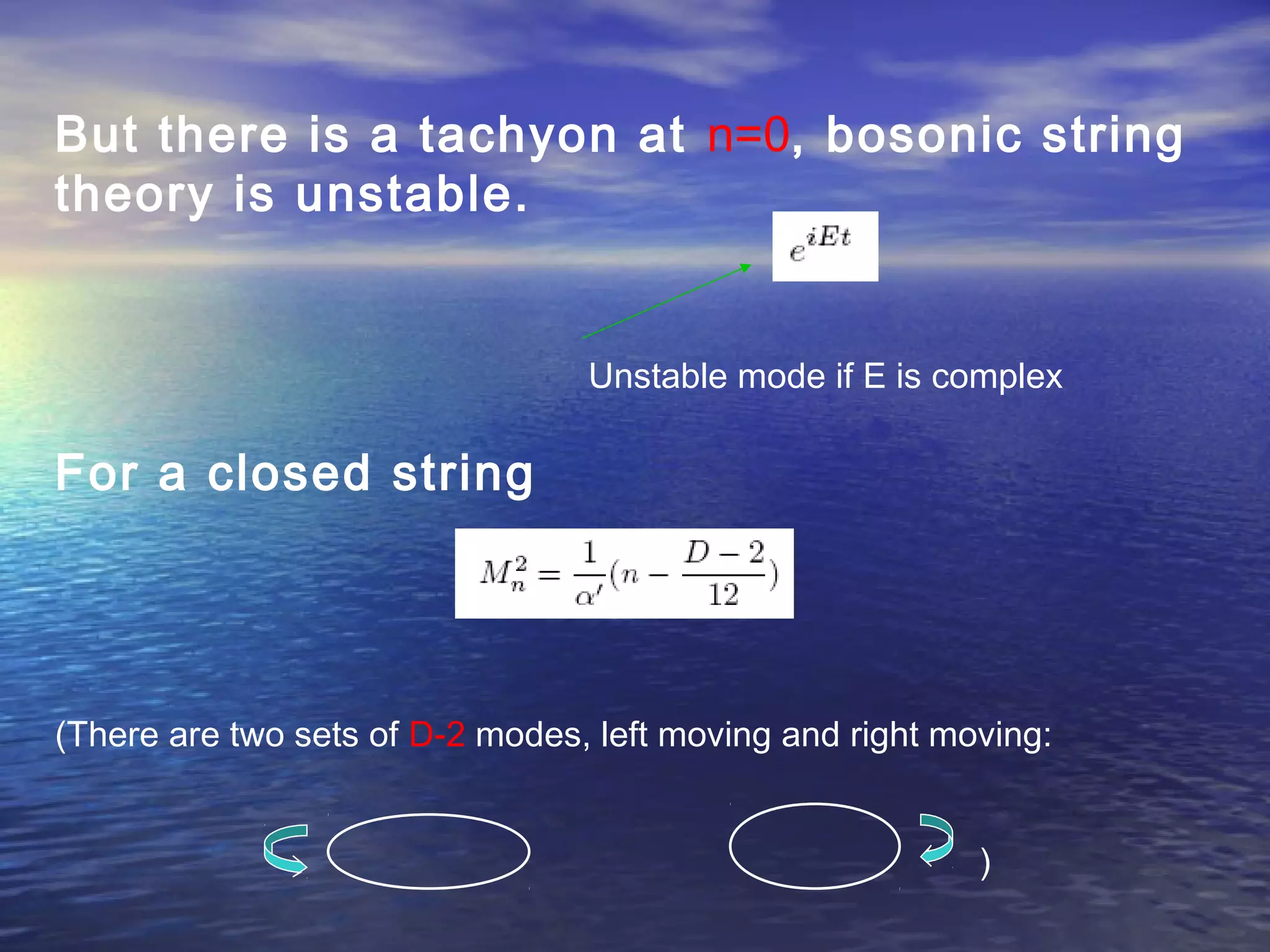
But there is a tachyon at n=0, bosonic string
theory is unstable.
Unstable mode if E is complex
For a closed string
(There are two sets of D-2 modes, left moving and right moving:
)
For n=2, we have a spin 2 particle, there are
however only ½ D(D-3) such states, it ought
to
be massless to respect Lorentz invariance,
again D=26.
Interactions
In case of particles, use Feynman diagram
to
describe physical process perturbatively:
+ +
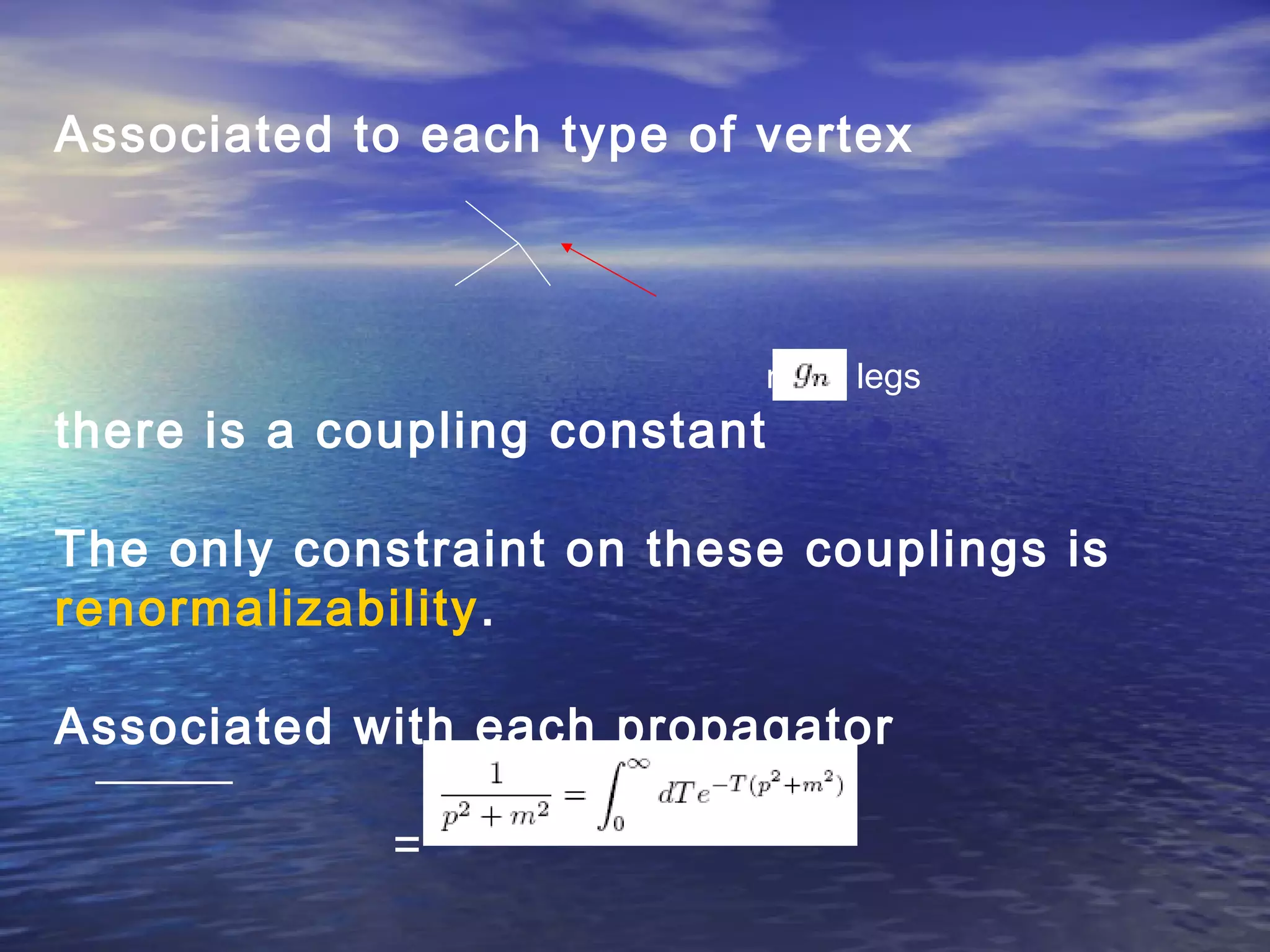
Associated to each type of vertex
more legs
there is a coupling constant
The only constraint on these couplings is
renormalizability.
Associated with each propagator
=
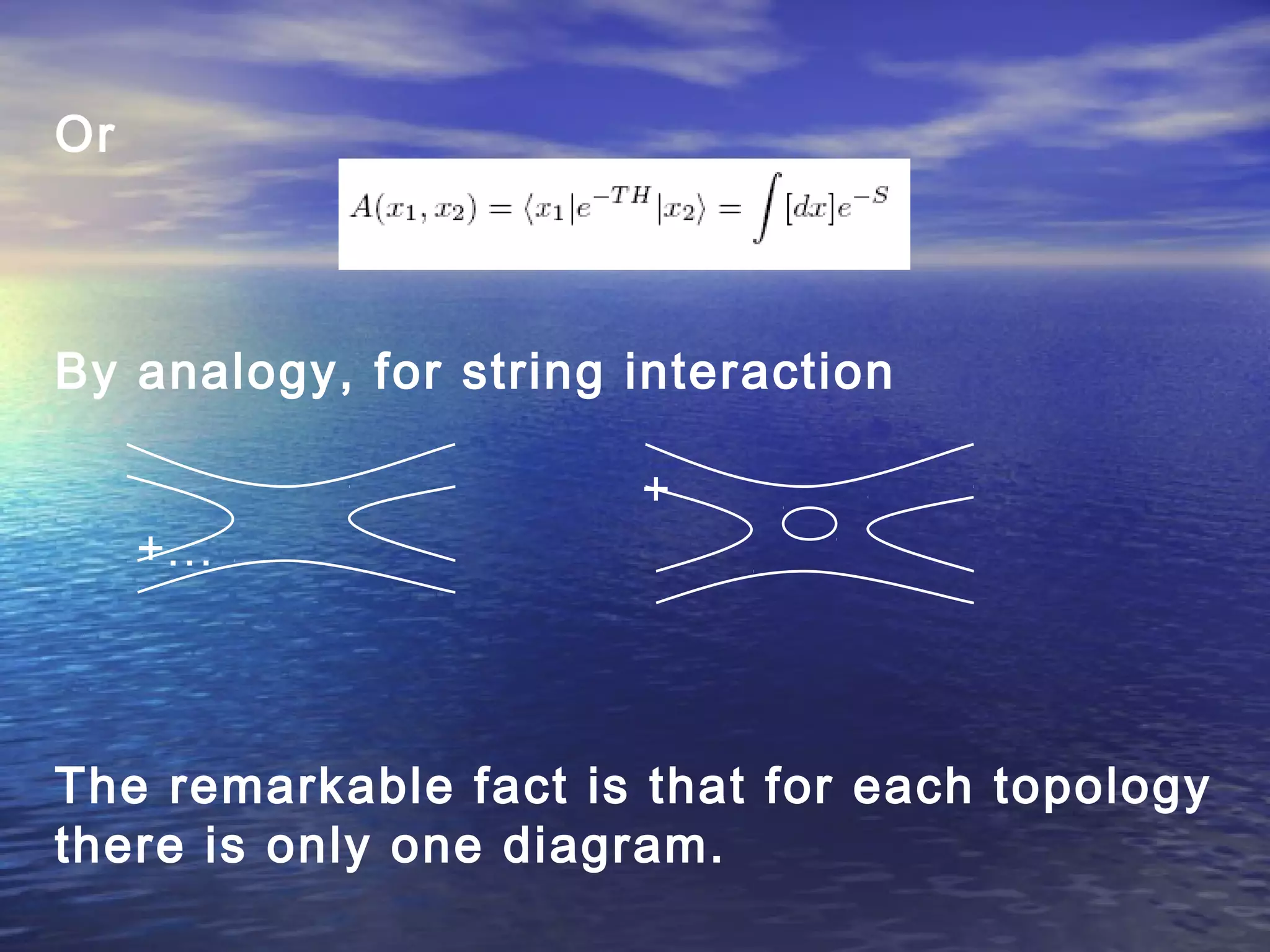
Or
By analogy, for string interaction
+
+…
The remarkable fact is that for each topology
there is only one diagram.
While for particles, this is not the case, for
example
=
+
+ +
+…
Surely, this is the origin of s-t channel
duality.
One can trace this back to the fact that there
is unique string interaction vertex:
=
Rejoining or splitting
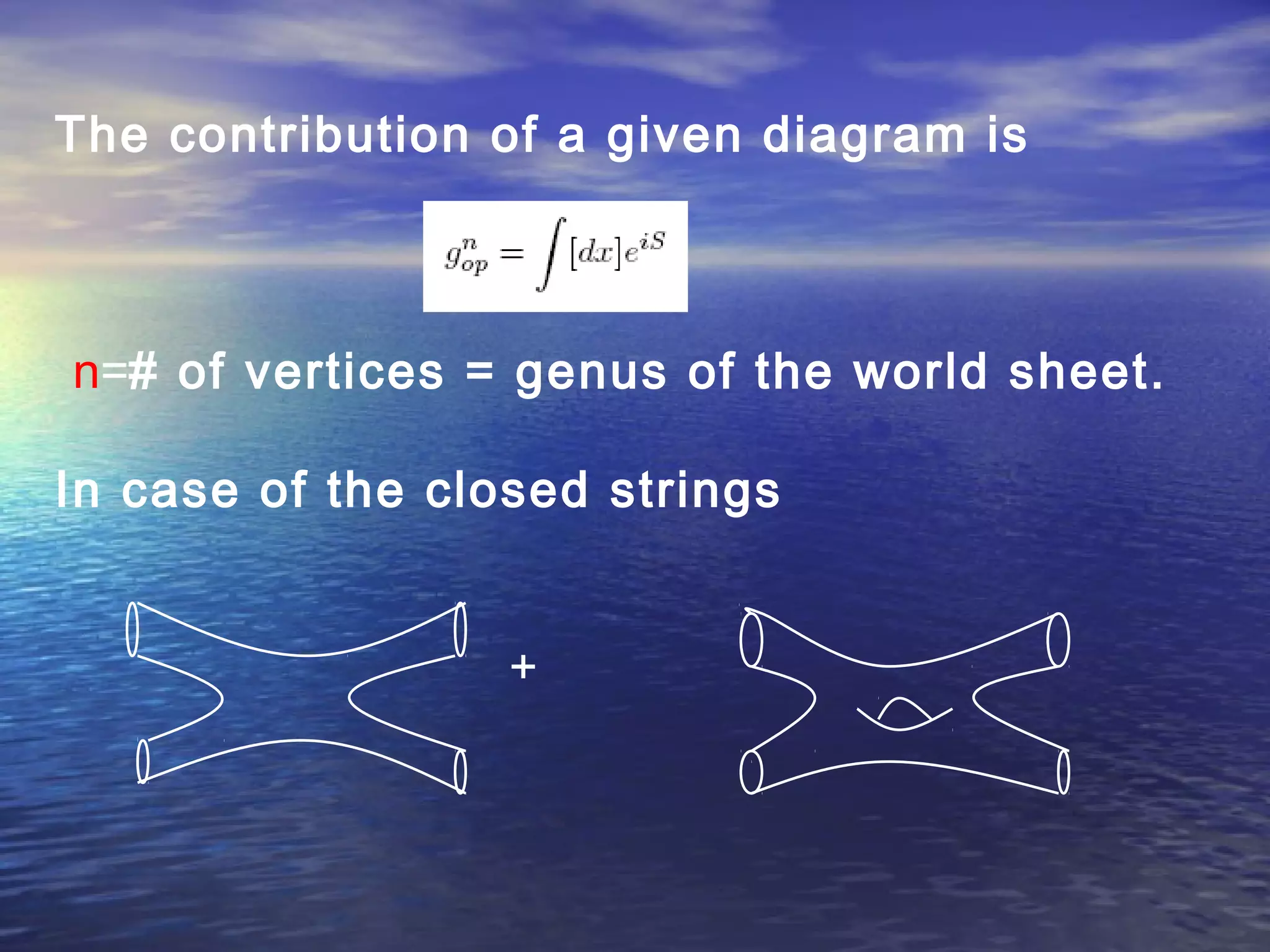
The contribution of a given diagram is
n=# of vertices = genus of the world sheet.
In case of the closed strings
+
Again, there is a unique diagram for each
topology, the vertex is also unique
=
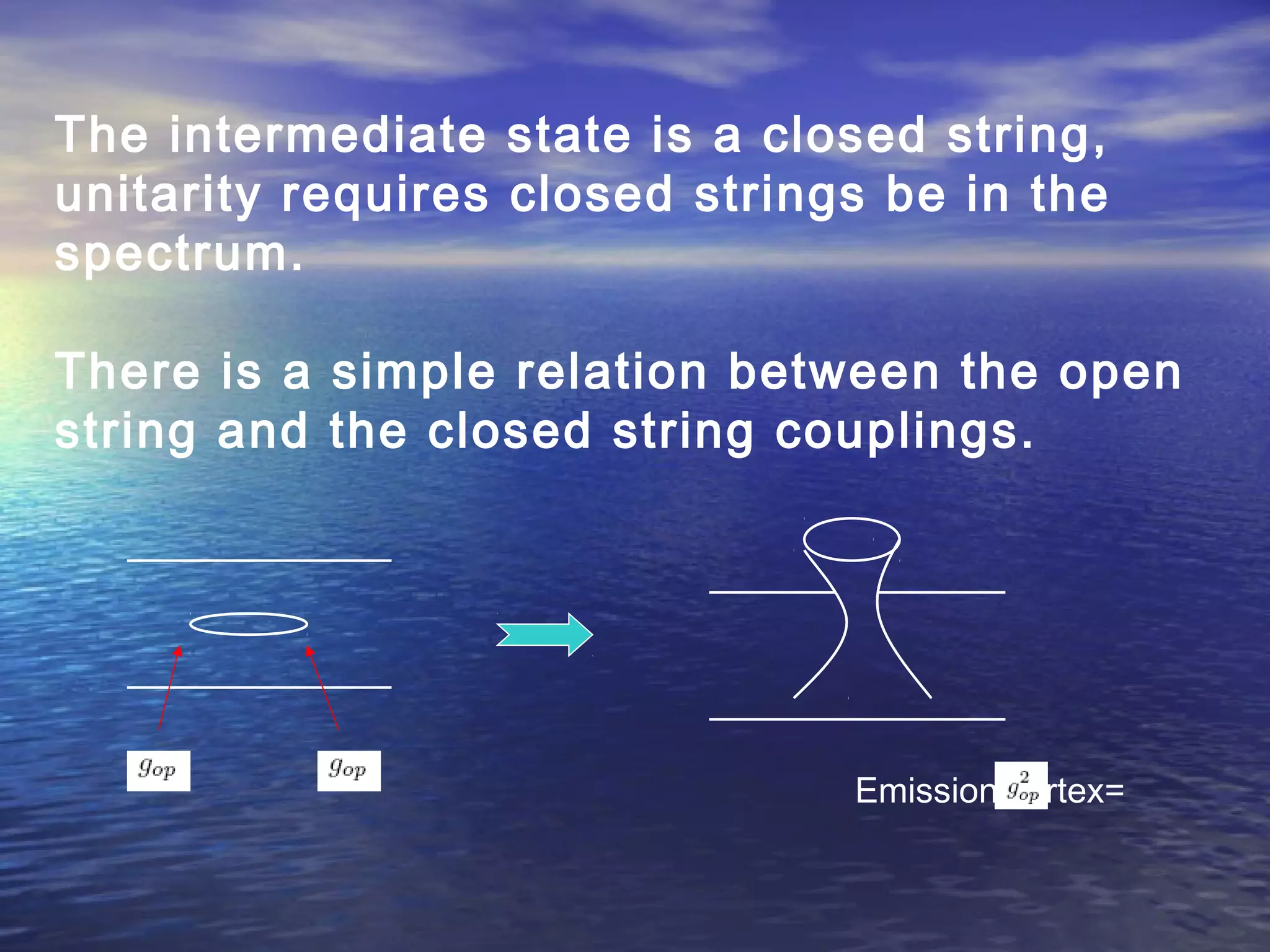
The open string theory must contain closed
Strings
=
The intermediate state is a closed string,
unitarity requires closed strings be in the
spectrum.
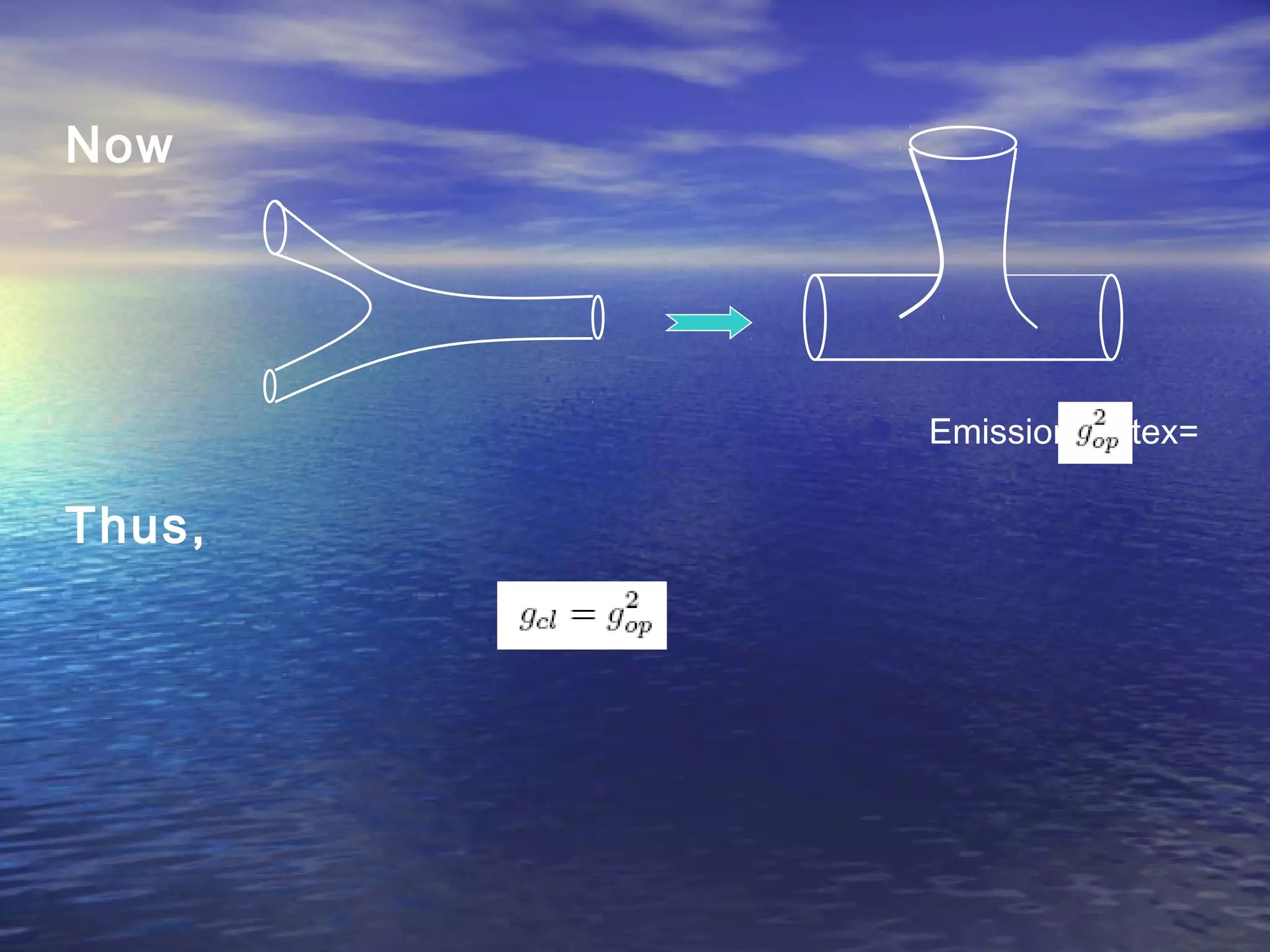
There is a simple relation between the open
string and the closed string couplings.
Emission vertex=
Now
Emission vertex=
Thus,
2. Gauge interaction and gravitation
= massless open strings
= massless closed strings
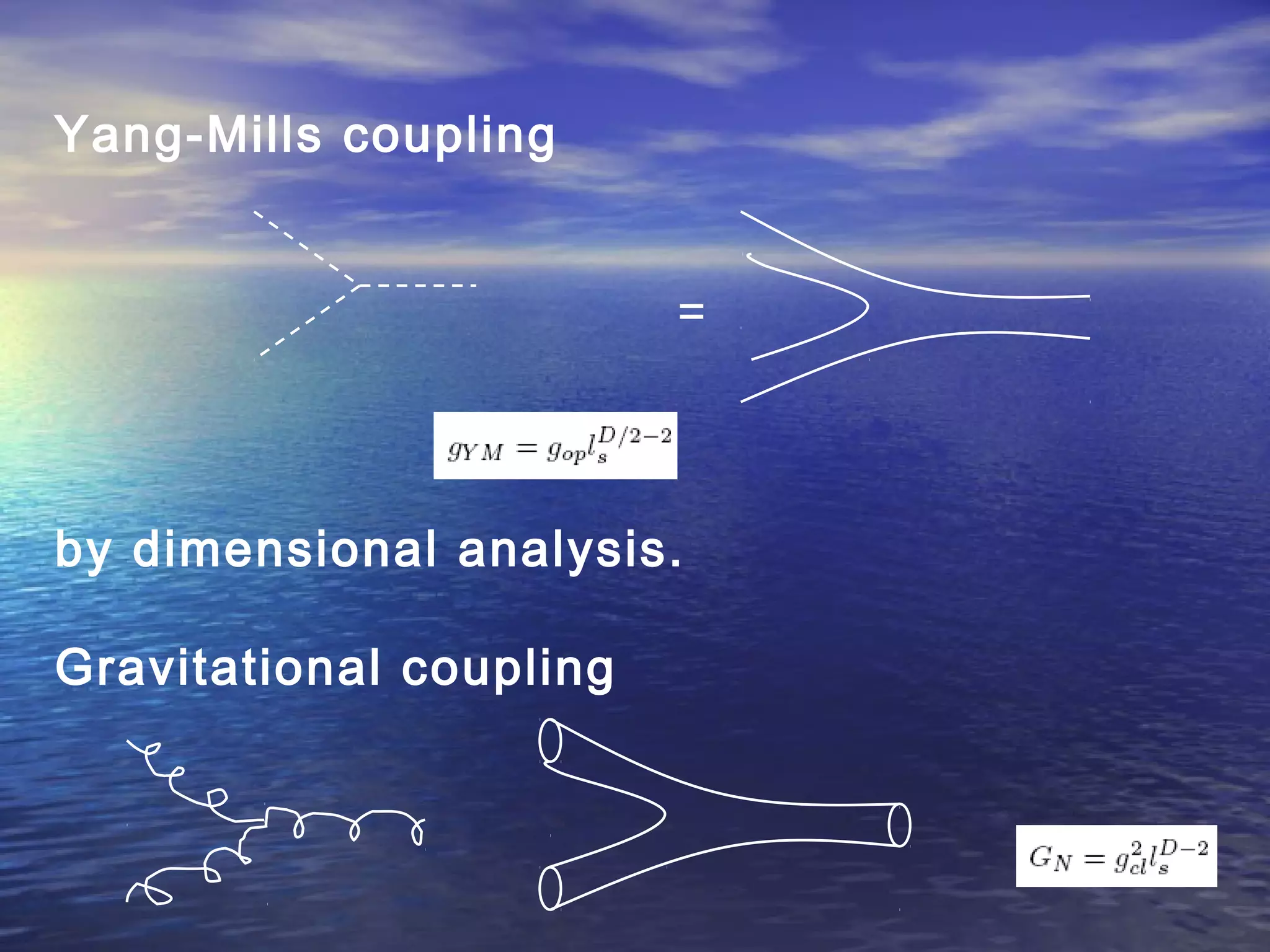
Define the string scale
Yang-Mills coupling
=
by dimensional analysis.
Gravitational coupling
So
If there is a compact space
D=4+d =volume of the compact space
We have
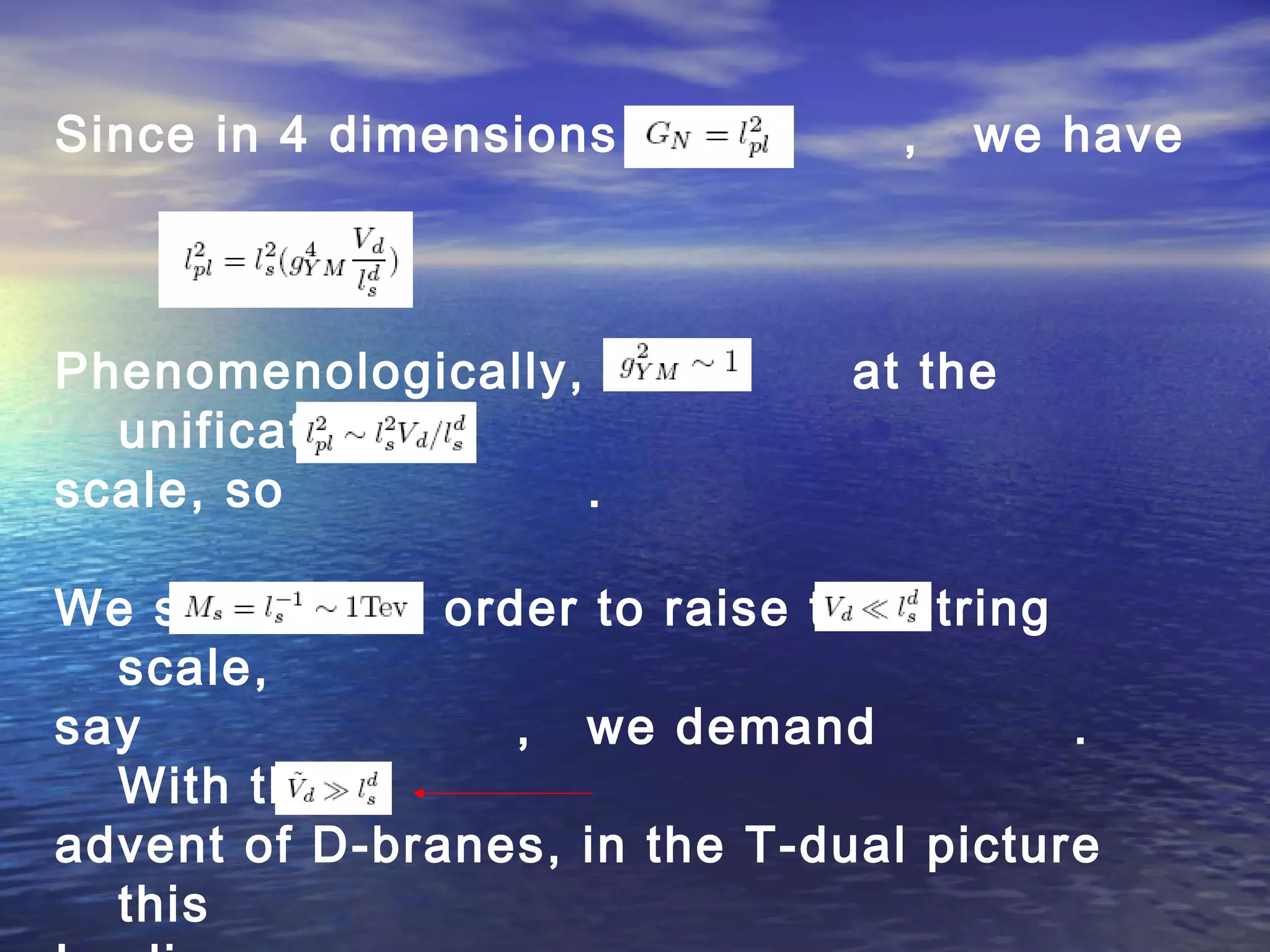
Since in 4 dimensions , we have
Phenomenologically, at the
unification
scale, so .
We see that in order to raise the string
scale,
say , we demand .
With the
advent of D-branes, in the T-dual picture
this
3. Introducing fermions, supersymmetry
In order to incorporate spin ½ etc into the
string spectrum, one is led to introducing
fermions living on the world sheet.
Again, the particle analogue is
The same as what Dirac did.
( )
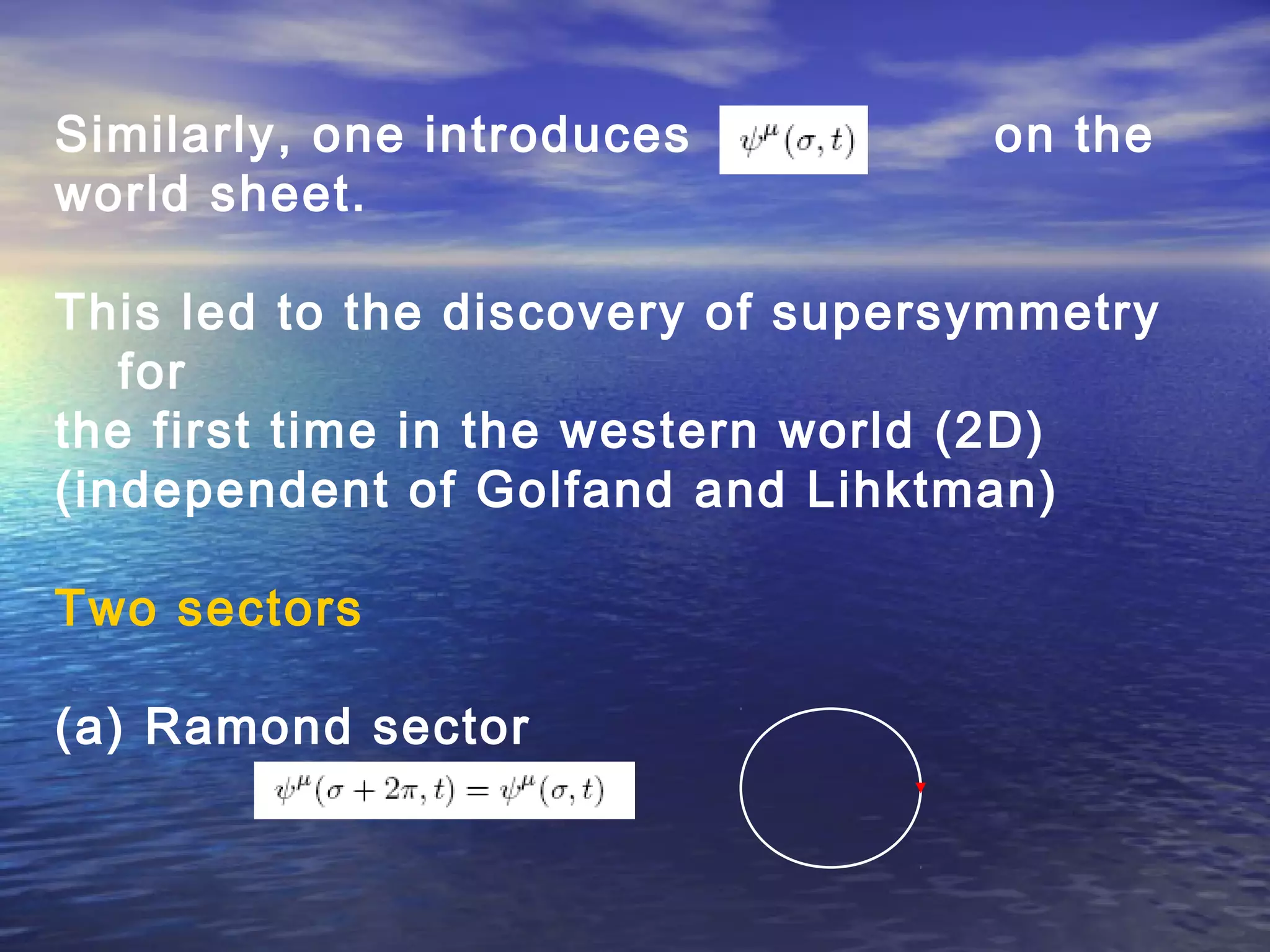
Similarly, one introduces on the
world sheet.
This led to the discovery of supersymmetry
for
the first time in the western world (2D)
(independent of Golfand and Lihktman)
Two sectors
(a) Ramond sector
(b) Neveu-Schwarz sector
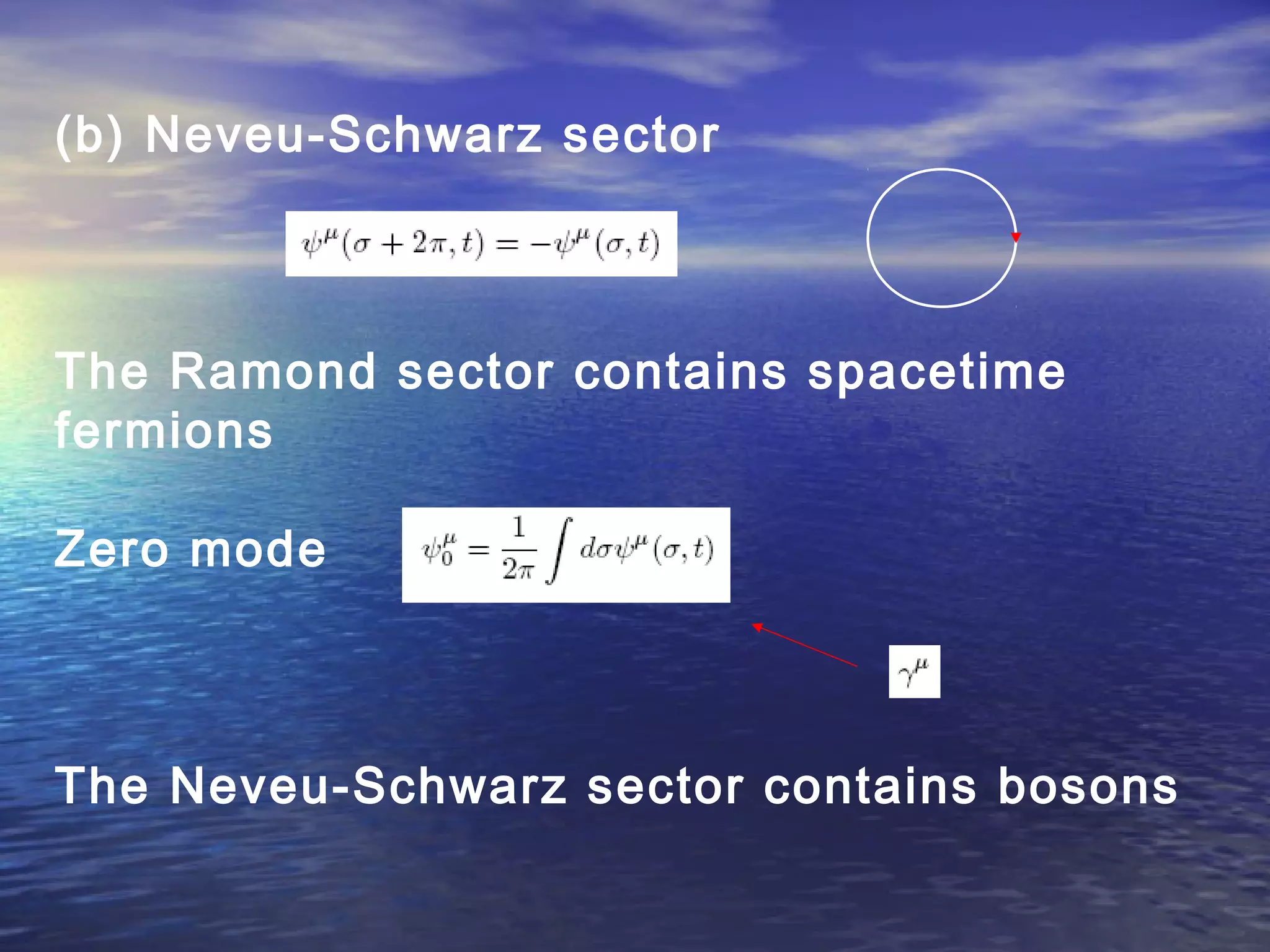
The Ramond sector contains spacetime
fermions
Zero mode
The Neveu-Schwarz sector contains bosons
Now the on-shell condition
is modified to (open string)
n-integer in R
sector
n-half integer in NS sector
D=10: NS: n=1/2, massless gauge bosons
R: n=0, massless fermions
8 bosons + 8 fermions
=supermultiplet
in 10D.
Spacetime supersymmetry is a
consequence.
In a way, we can say the following
(a) Bosonic strings are strings moving in the
ordinary spacetime , but quantum
mechanics disfavors pure bosons, they are
unstable.
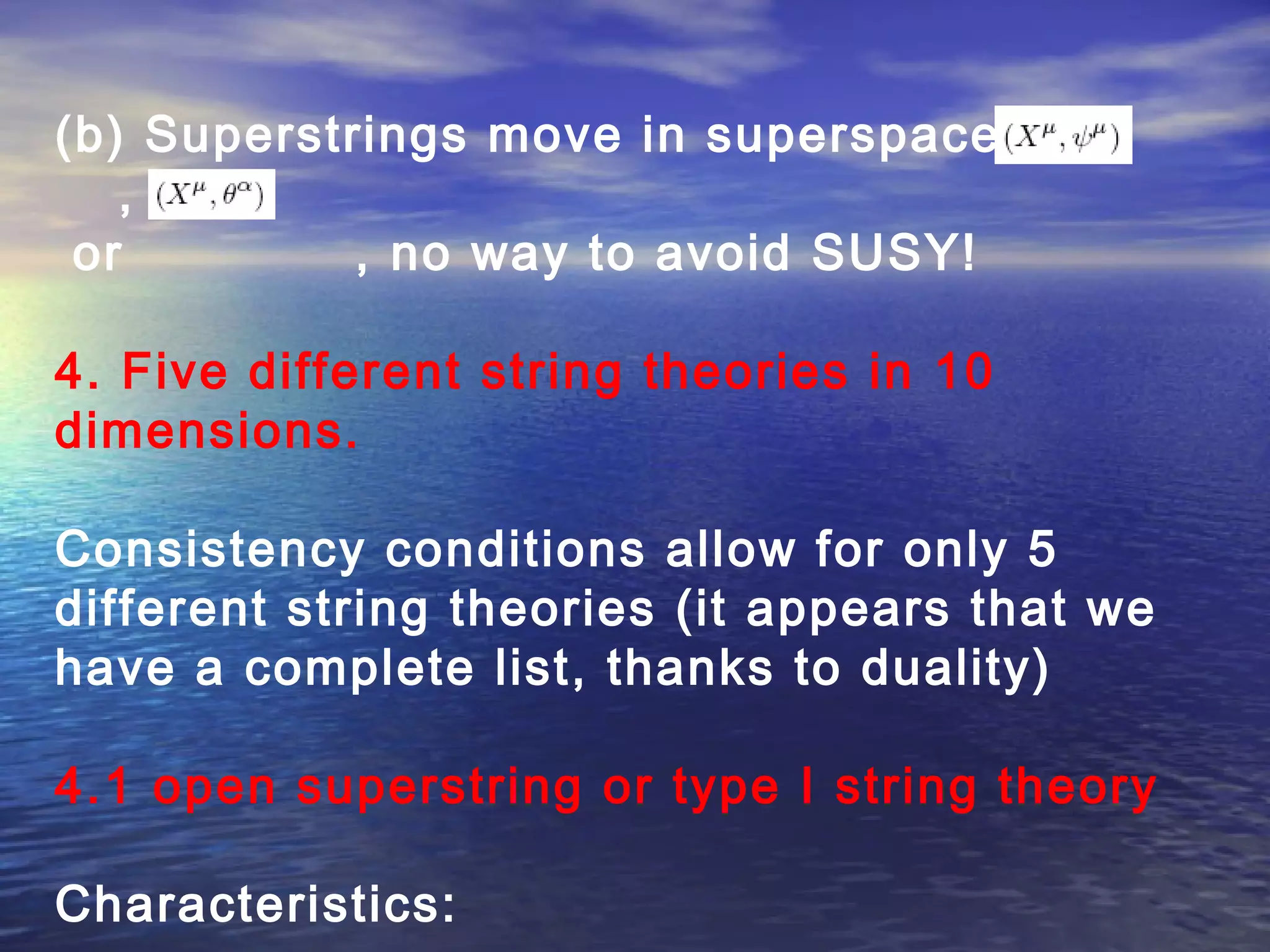
(b) Superstrings move in superspace
,
or , no way to avoid SUSY!
4. Five different string theories in 10
dimensions.
Consistency conditions allow for only 5
different string theories (it appears that we
have a complete list, thanks to duality)
4.1 open superstring or type I string theory
Characteristics:
(a) There are open strings, whose massless
modes are super Yang-Mills in 10D.
(b) As we said, there must be closed strings
(unitarity). The massless modes are N=1
SUGRA in 10D.
(c) One can associate a charge to an end of
an open string.
fundamental representation of G, anti-fundamental rep of G
Combined, they form the adjoint rep of G.
G can be U(N), Sp(N), SO(N).
For U(N), the two ends are different,
therefore
one may label the orientation of the string.
For Sp(N) and SO(N), the two ends are
identical,
thus the string is un-oriented.
(d) Further, anomaly cancellation
Type I theory is also chiral.
4.2 Closed superstring, type IIA
For a closed string: and
The left movers are independent of the right
movers.
or superposition of them.
two sets of
matrices.
Therefore, two basic choices
One choice:
chiral
anti-chiral
We have type IIA superstring theory, no
chirality. Thus, it appears that it has nothing
to do with the real world.
The massless modes = type IIA SUGRA.
4.3 Type IIB superstring theory
If
chiral
chiral
We have type IIB string theory, it is chiral.
Although type IIB theory is chiral, it has no
gauge group, it appears to be ruled out by
Nature too.
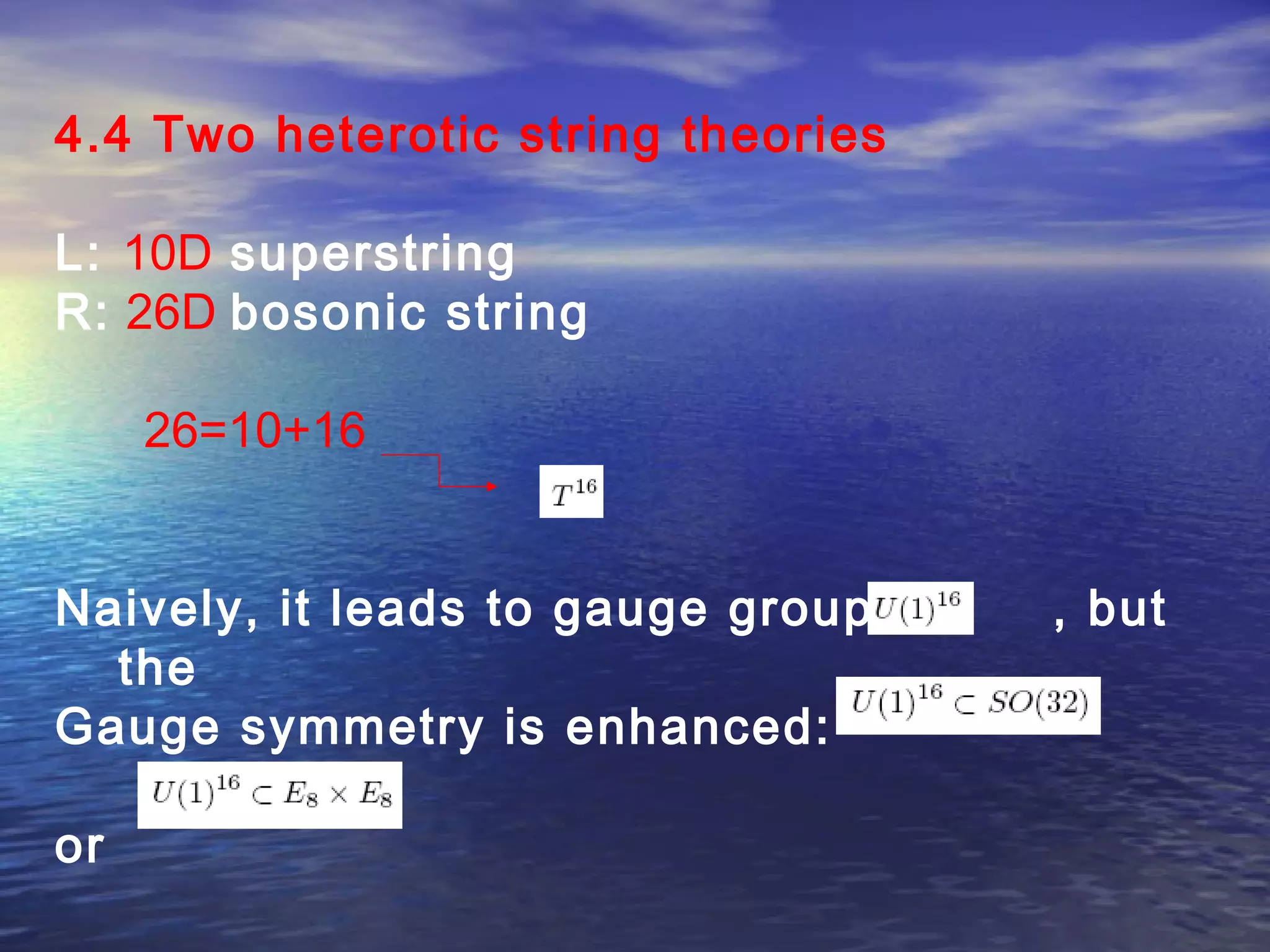
4.4 Two heterotic string theories
L: 10D superstring
R: 26D bosonic string
26=10+16
Naively, it leads to gauge group , but
the
Gauge symmetry is enhanced:
or
In the heterotic theory, there is only
one ,
the theory is chiral.
Remarkably, the low energy sector of the
SO(32) heterotic theory is identical to that of
type I theory, is this merely coincidence?
Some lessons we learned before the summer
of 1994:
1. String theory is remarkably rigid, it must have SUSY, it
must live in 10D. There are only 5 different theories. Even
the string coupling constant is dynamical.
2. It has too many consistent vacuum solutions, to pick up
one which describes our world, we have to develop
nonperturbative methods.
3. It tells us that some concepts of spacetime are illusion, for
instance T-duality tells us that a circle of radius R is
equivalent to a circle of radius 1/R (in string unit). Sometimes,
even spaces of different topologies are equivalent.
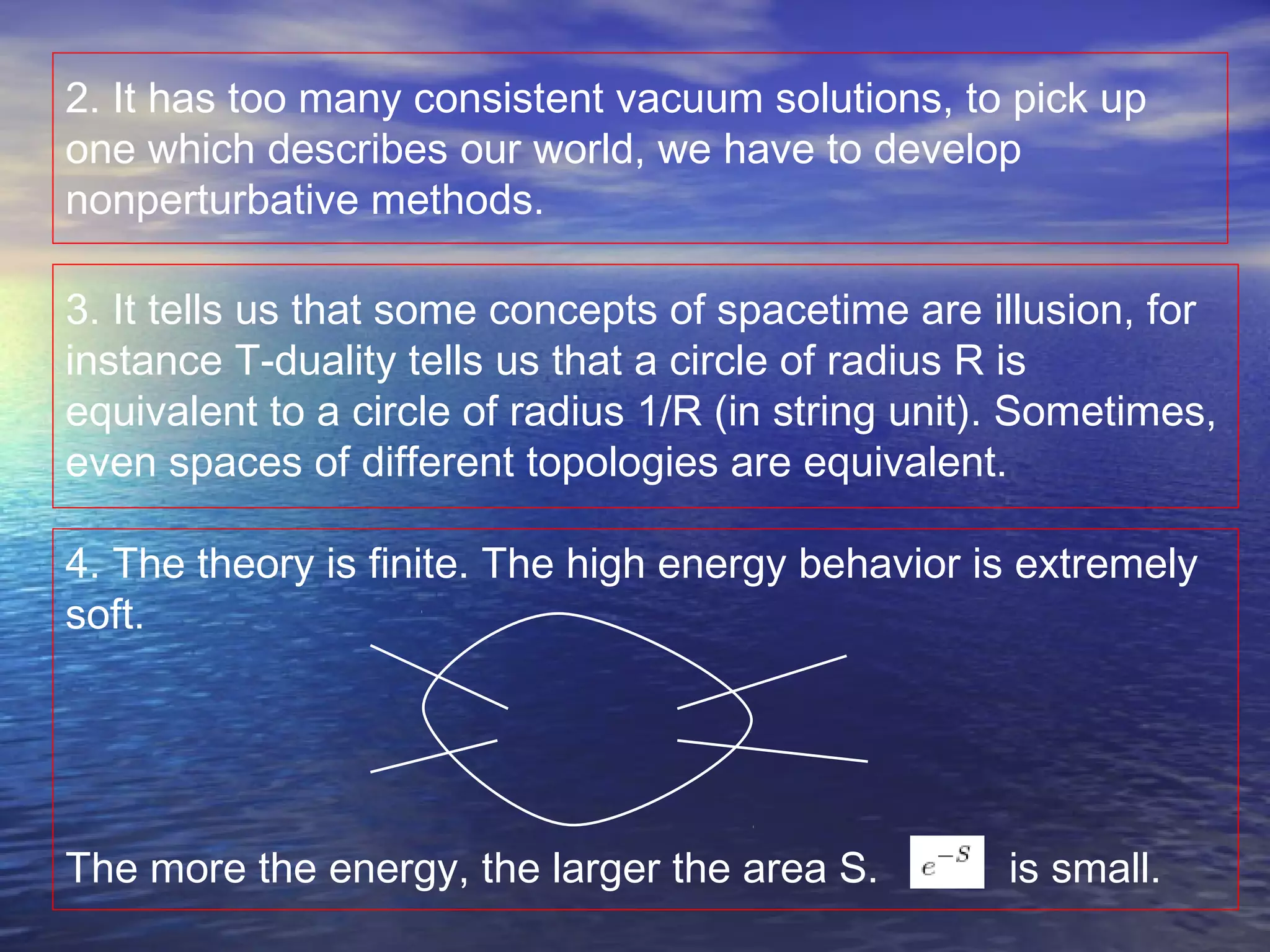
4. The theory is finite. The high energy behavior is extremely
soft.
The more the energy, the larger the area S. is small.
5. There are a lot of things unknown to us, we must be
modest (such as, what about the cosmological constant?)
What we could not do before 1994:
1. Any nonpertubative calculation.
2. What happens to black holes, what happens to
singularities.
3. No derivation of the standard model.
…
III. Branes in String/M theory
1. Why branes?
In the past, it was often asked that if one
can
replace particles by strings, why not other
branes such as membranes?
The answer to this question were always:
(a) We know how to quantize particles and
strings, while we inevitably end up with
inconsistency in quantizing other objects.
(b) Perturbative string theory is unitary, no
need to add to the spectrum other things.
Thus (a) and in particular (b) sounds like a
no-go theorem.
To avoid this no-go theorem, we need to
look
up no other than quantum field theory.
(a) In some QFT, there are solitons, these
objects can be quantized indirectly by
quantizing fluctuations of original fields in
the soliton background.
(b) A theory may be unitary perturbatively,
but nonperturbatively the S-matrix may not
be unitary (showing up in resummation of a
divergent series).
Such inconsistency arises in particular when
new stable particles exist, their masses are
heavy when g is small.
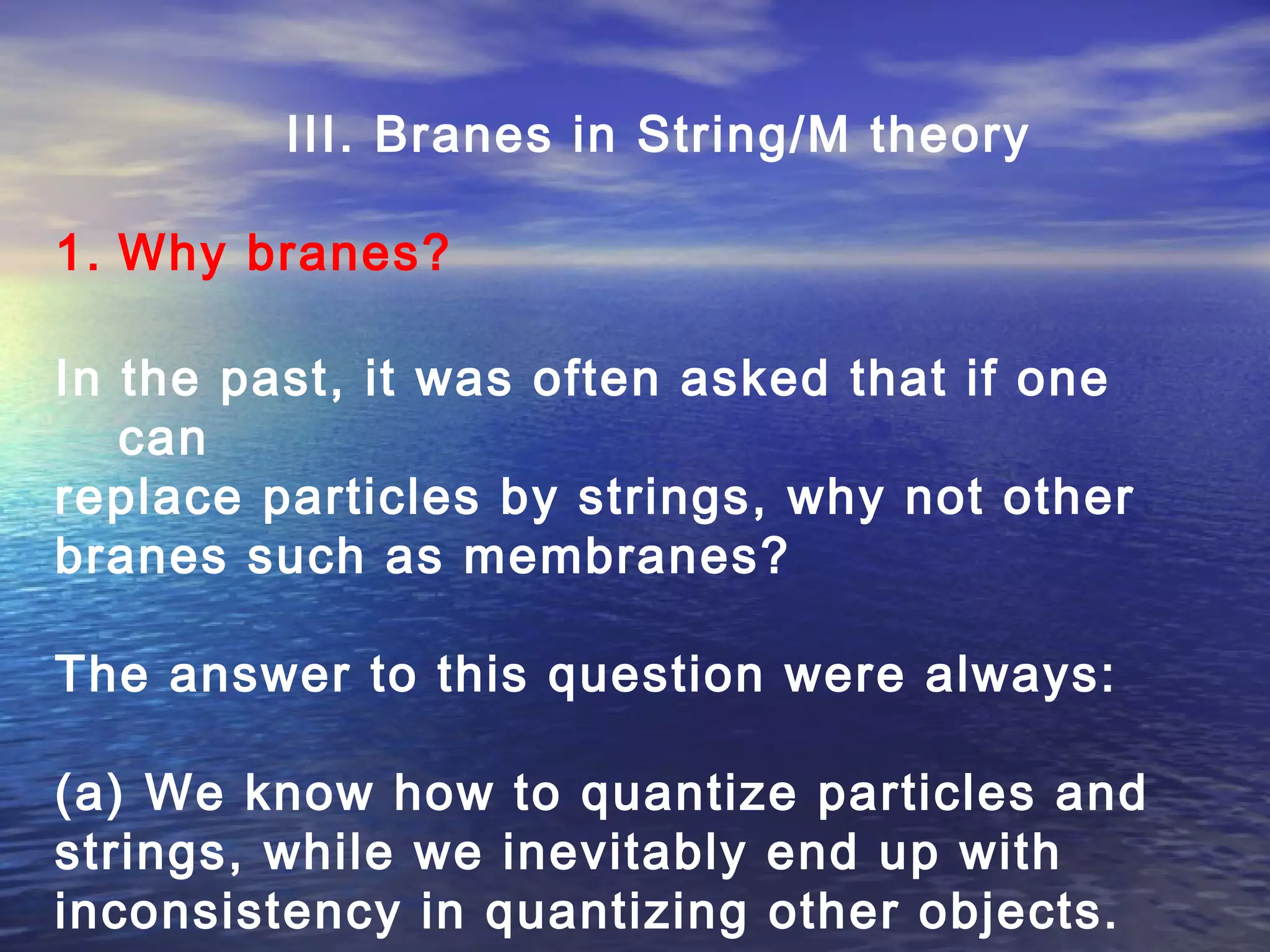
Some stable particles can be associated
with
conservation of charge.
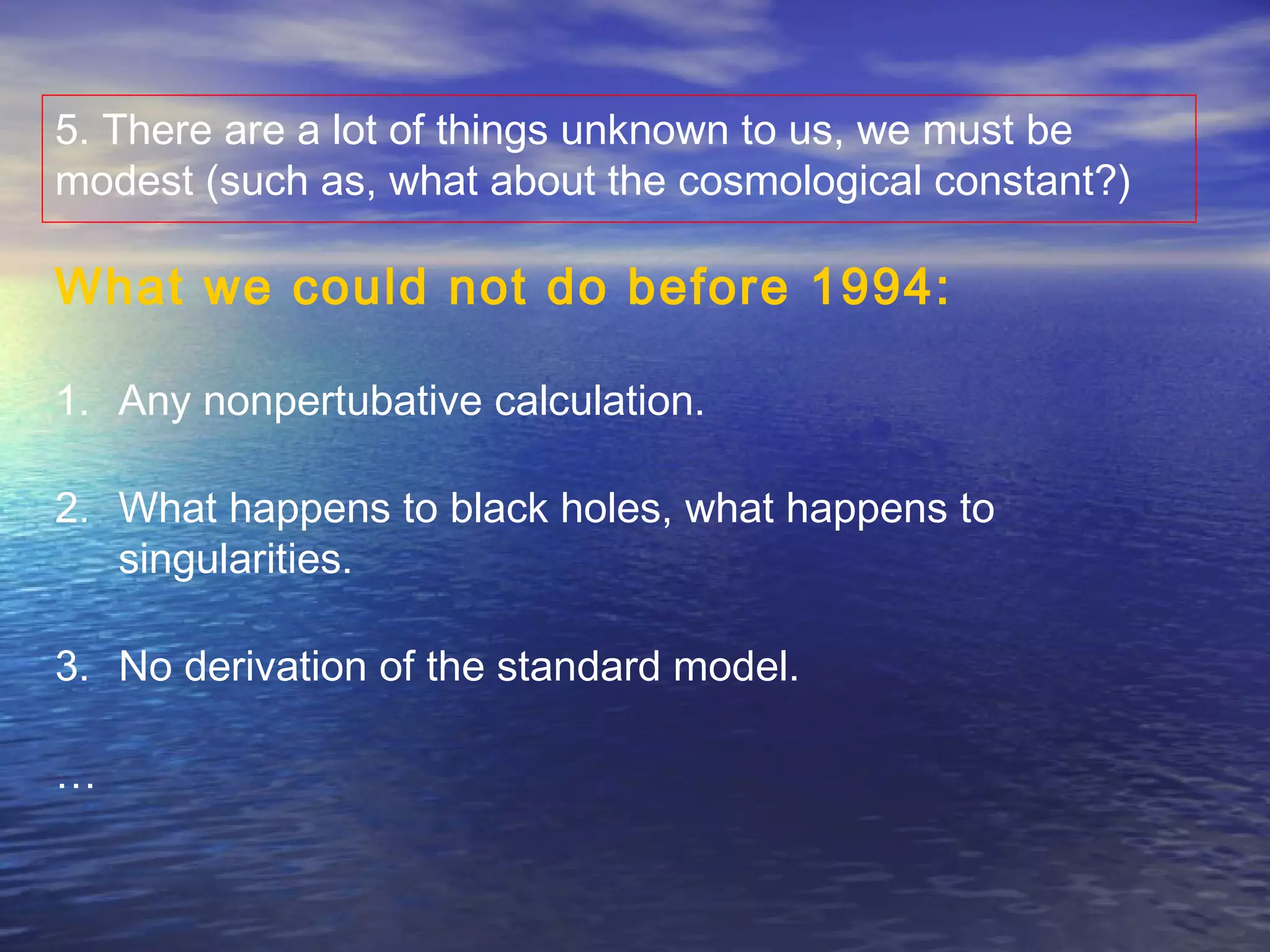
For example, when there is an Abelian
gauge
field
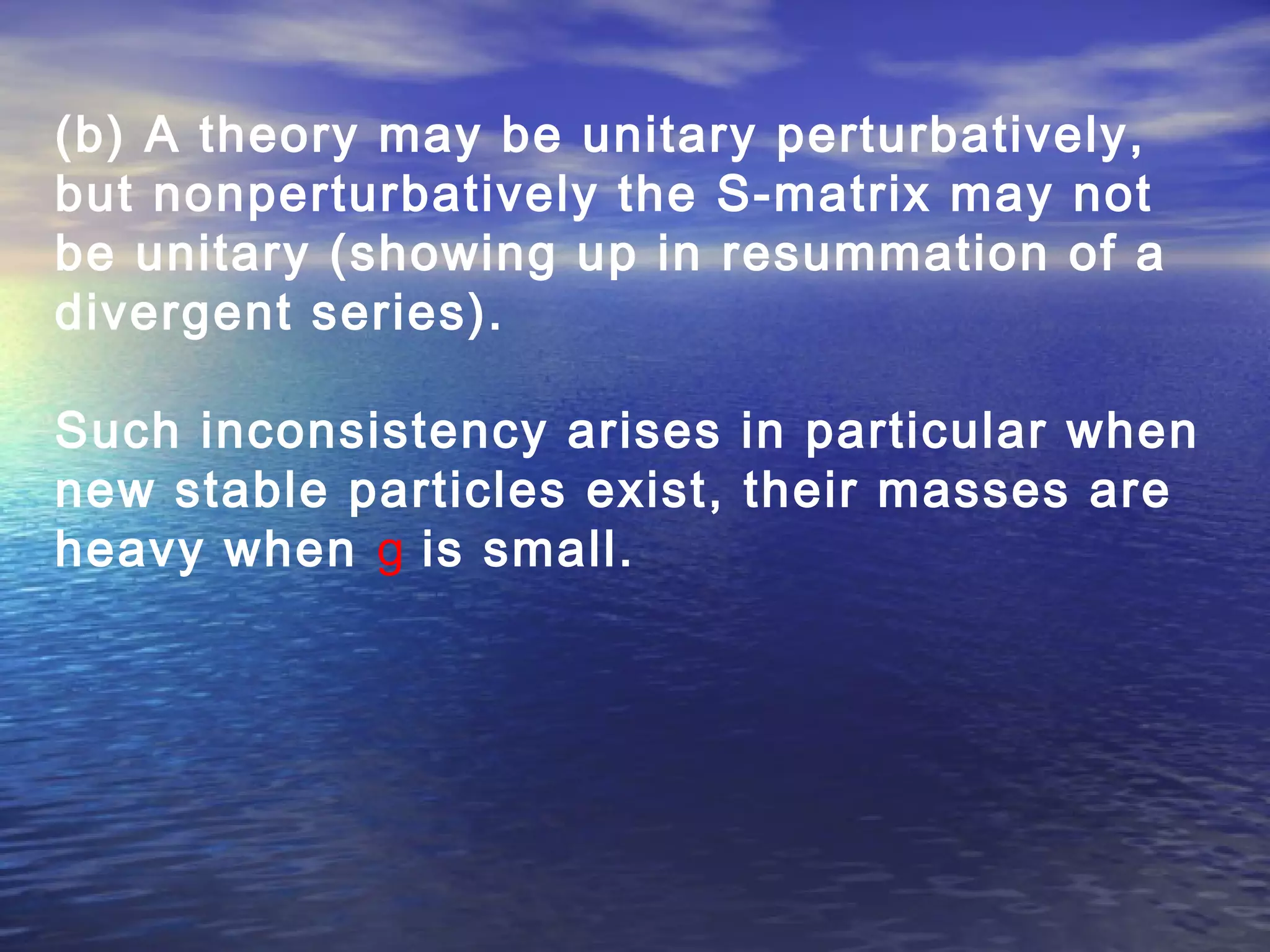
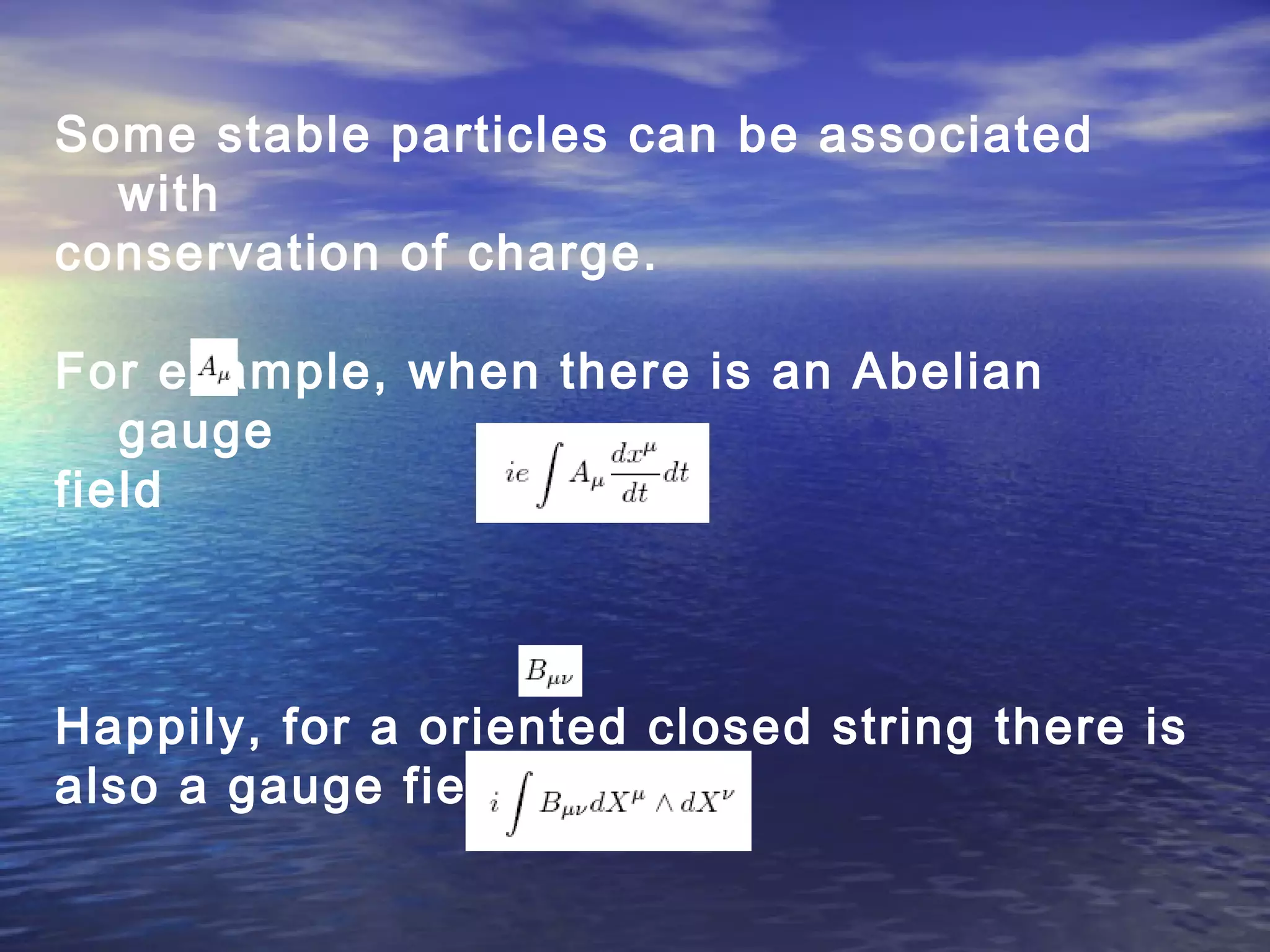
Happily, for a oriented closed string there is
also a gauge field
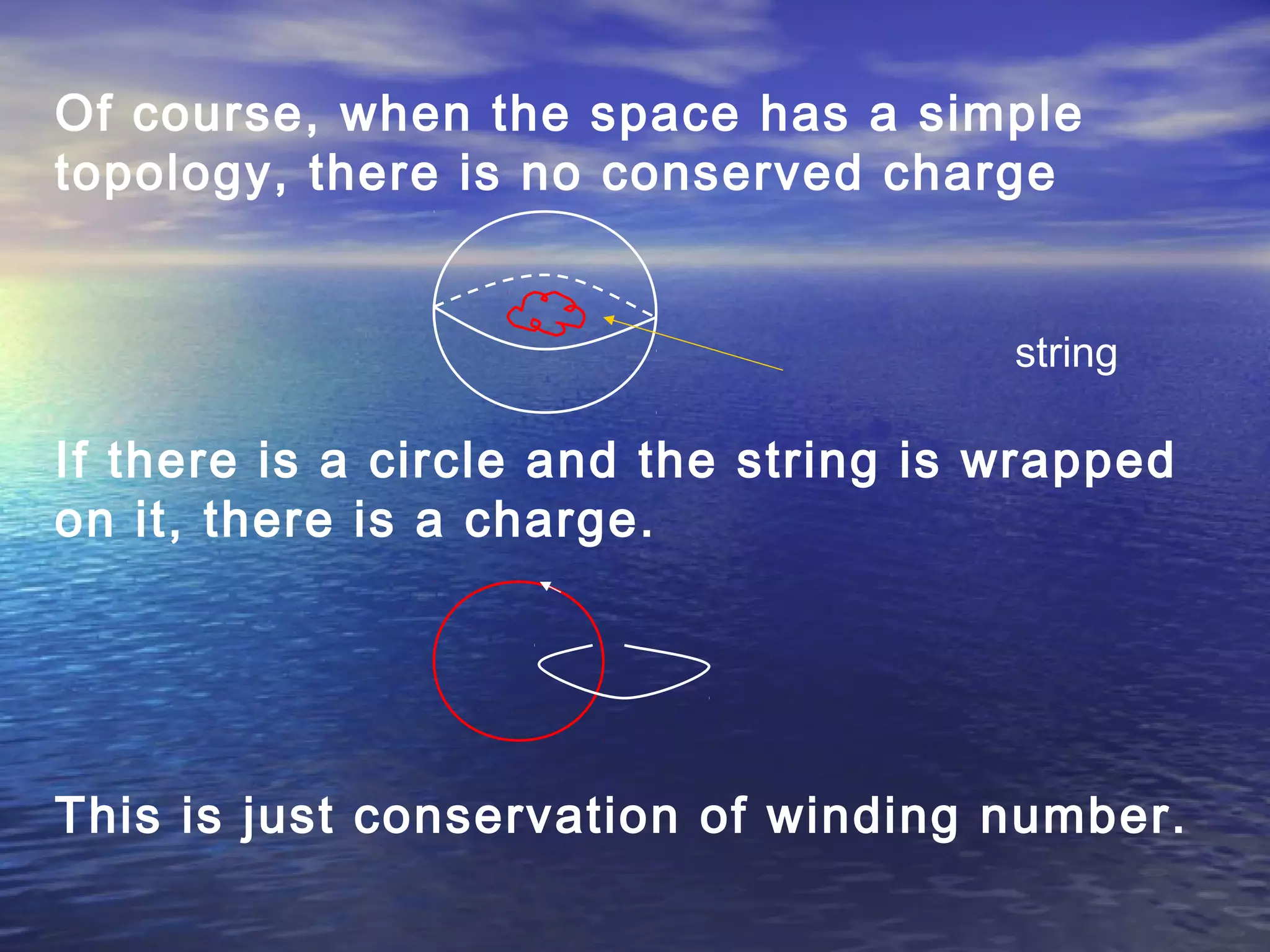
Of course, when the space has a simple
topology, there is no conserved charge
string
If there is a circle and the string is wrapped
on it, there is a charge.
This is just conservation of winding number.
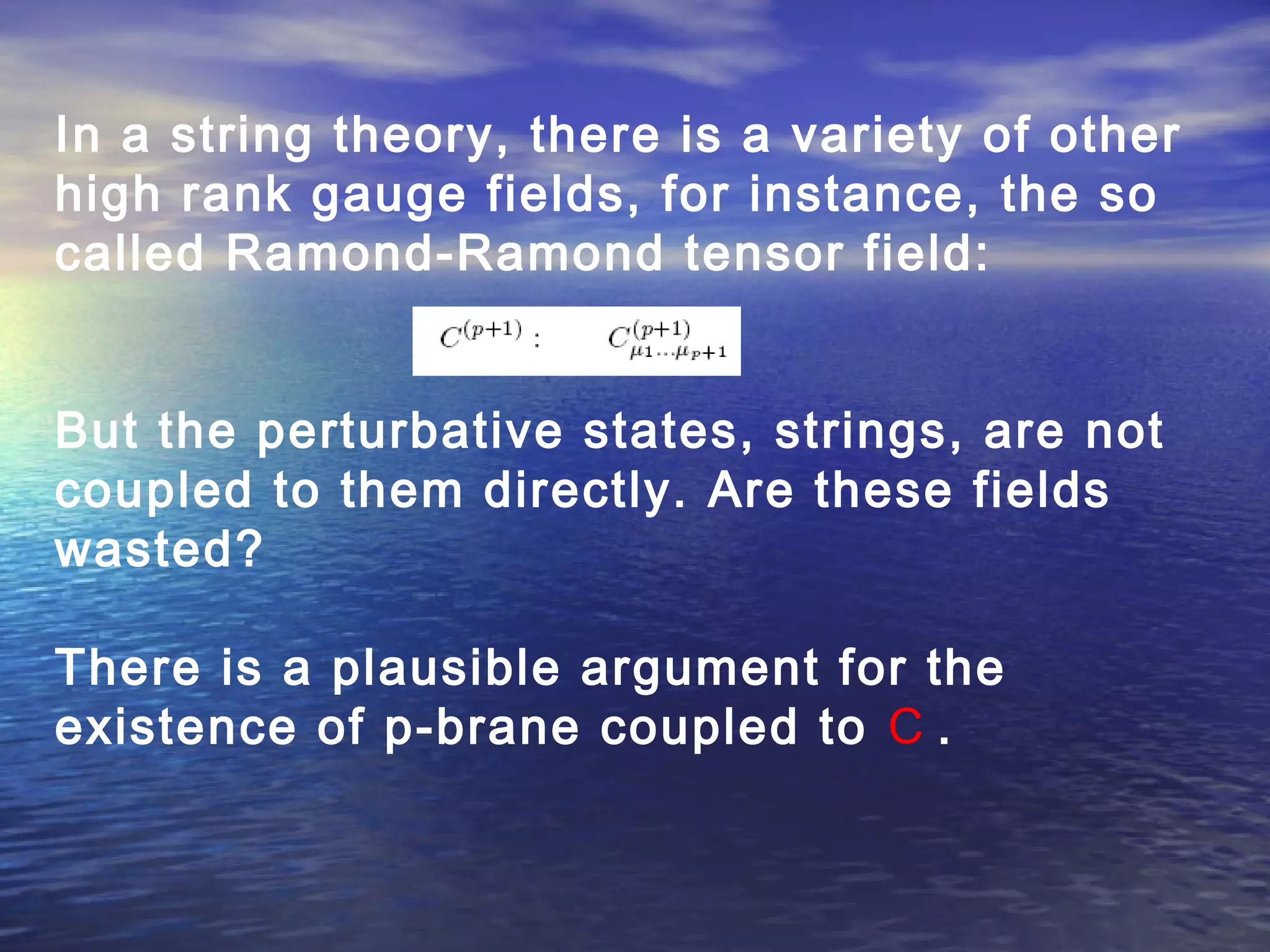
In a string theory, there is a variety of other
high rank gauge fields, for instance, the so
called Ramond-Ramond tensor field:
But the perturbative states, strings, are not
coupled to them directly. Are these fields
wasted?
There is a plausible argument for the
existence of p-brane coupled to C .
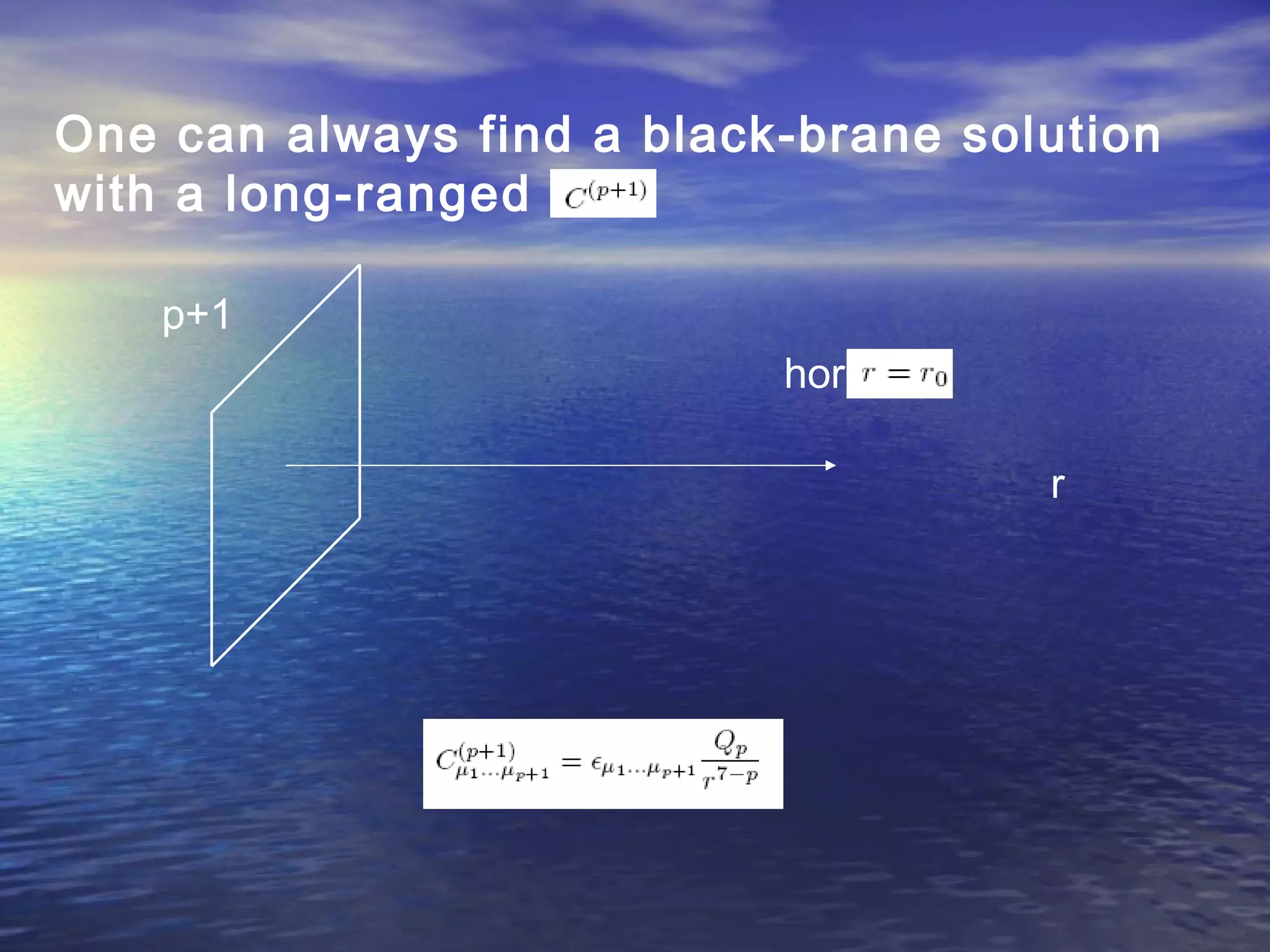
One can always find a black-brane solution
with a long-ranged
p+1
horizon
r
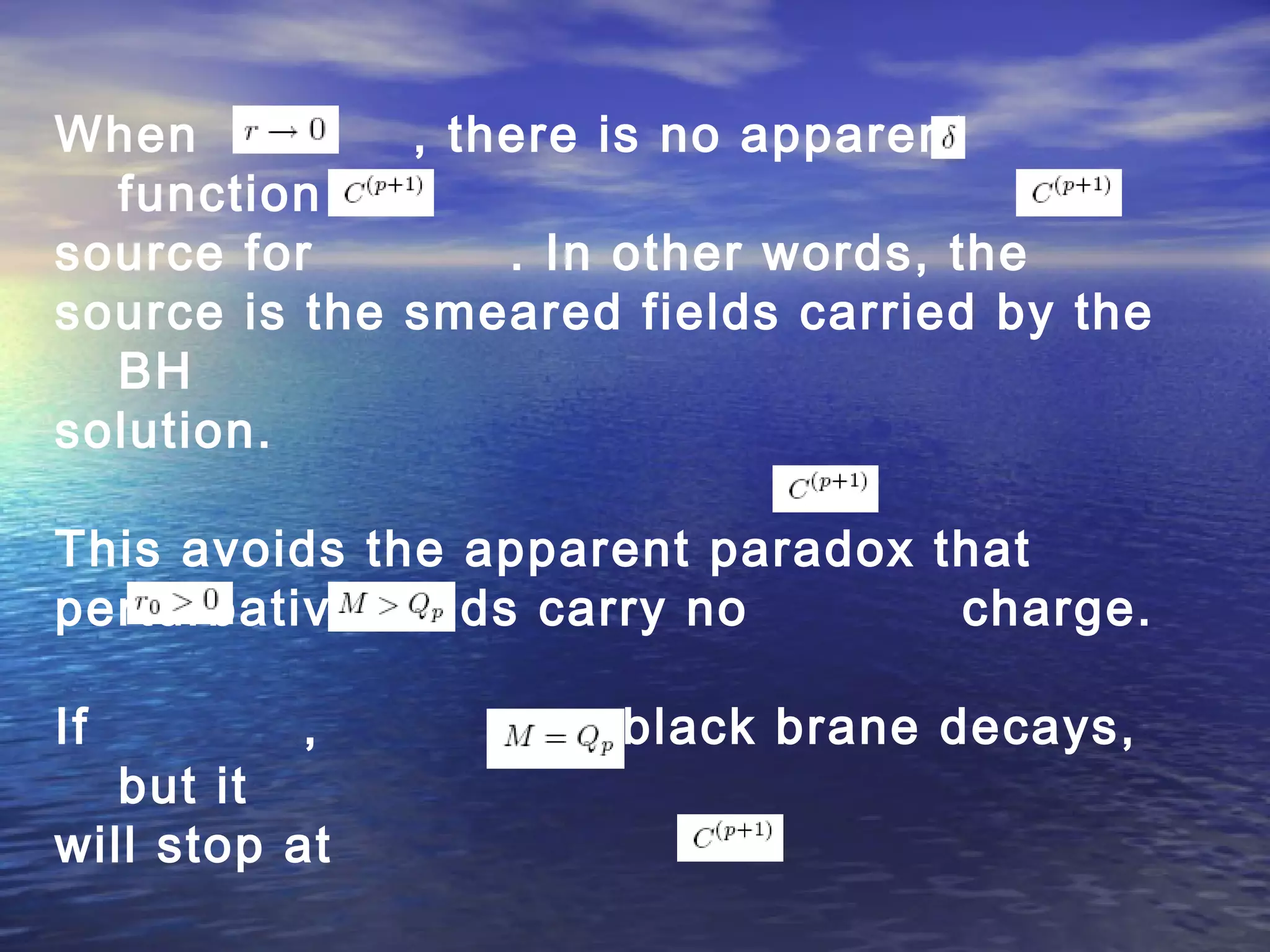
When , there is no apparent
function
source for . In other words, the
source is the smeared fields carried by the
BH
solution.
This avoids the apparent paradox that
perturbative fields carry no charge.
If , , black brane decays,
but it
will stop at
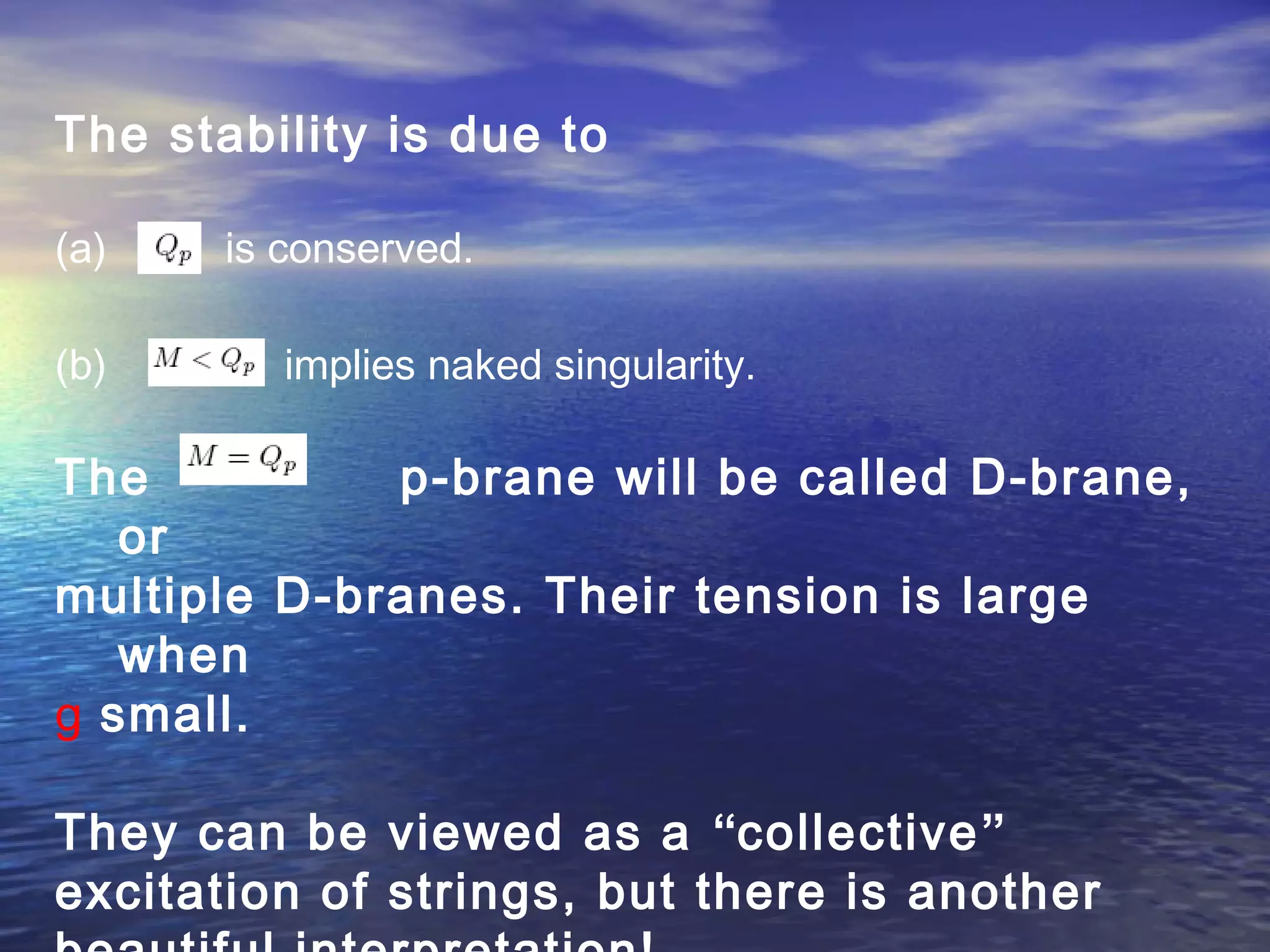
The stability is due to
(a) is conserved.
(b) implies naked singularity.
The p-brane will be called D-brane,
or
multiple D-branes. Their tension is large
when
g small.
They can be viewed as a “collective”
excitation of strings, but there is another
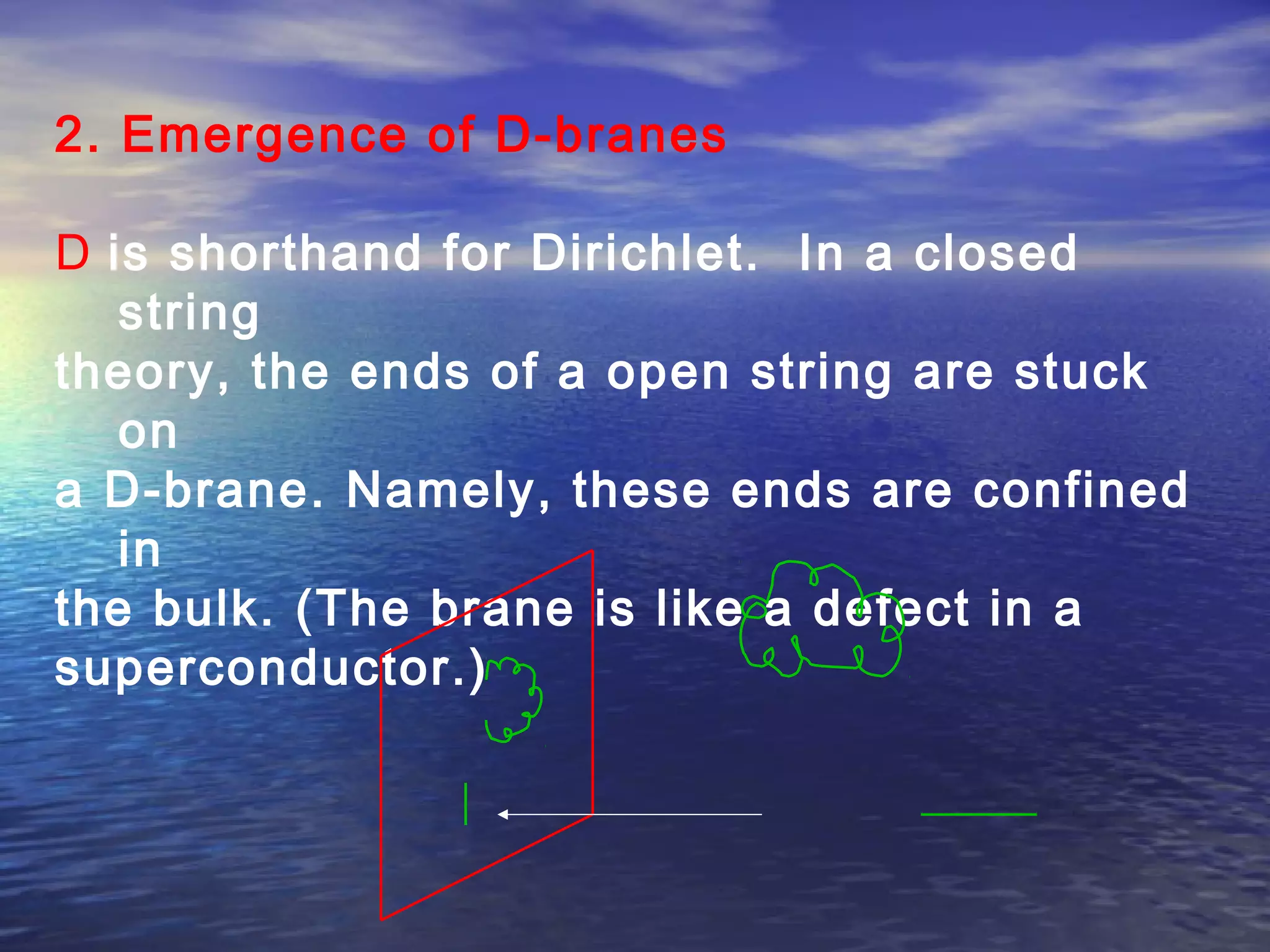
2. Emergence of D-branes
D is shorthand for Dirichlet. In a closed
string
theory, the ends of a open string are stuck
on
a D-brane. Namely, these ends are confined
in
the bulk. (The brane is like a defect in a
superconductor.)
We argued that there must be fundamental
branes saturating the BPS bound .
If is continuous, as the classical solution
suggests, we have the trouble for accounting
a continuous spectrum.
Fortunately, some time ago, it was proven
that must be quantized, according to a
generalized Dirac quantization condition.
Denote dual to
rank=8-p rank=p+2
Thus
Some unit
Both and are quantized.
We said that the microscopic description of
a
fundamental p-brane is D-brane. We now
follow the route that Polchinski originally
followed to see how this description
emerges
in string theory.
2.1 T-duality
To understand the logic behind D-branes, we
need to review T-duality.
There are waves on a circle:
There are also winding states on a circle:
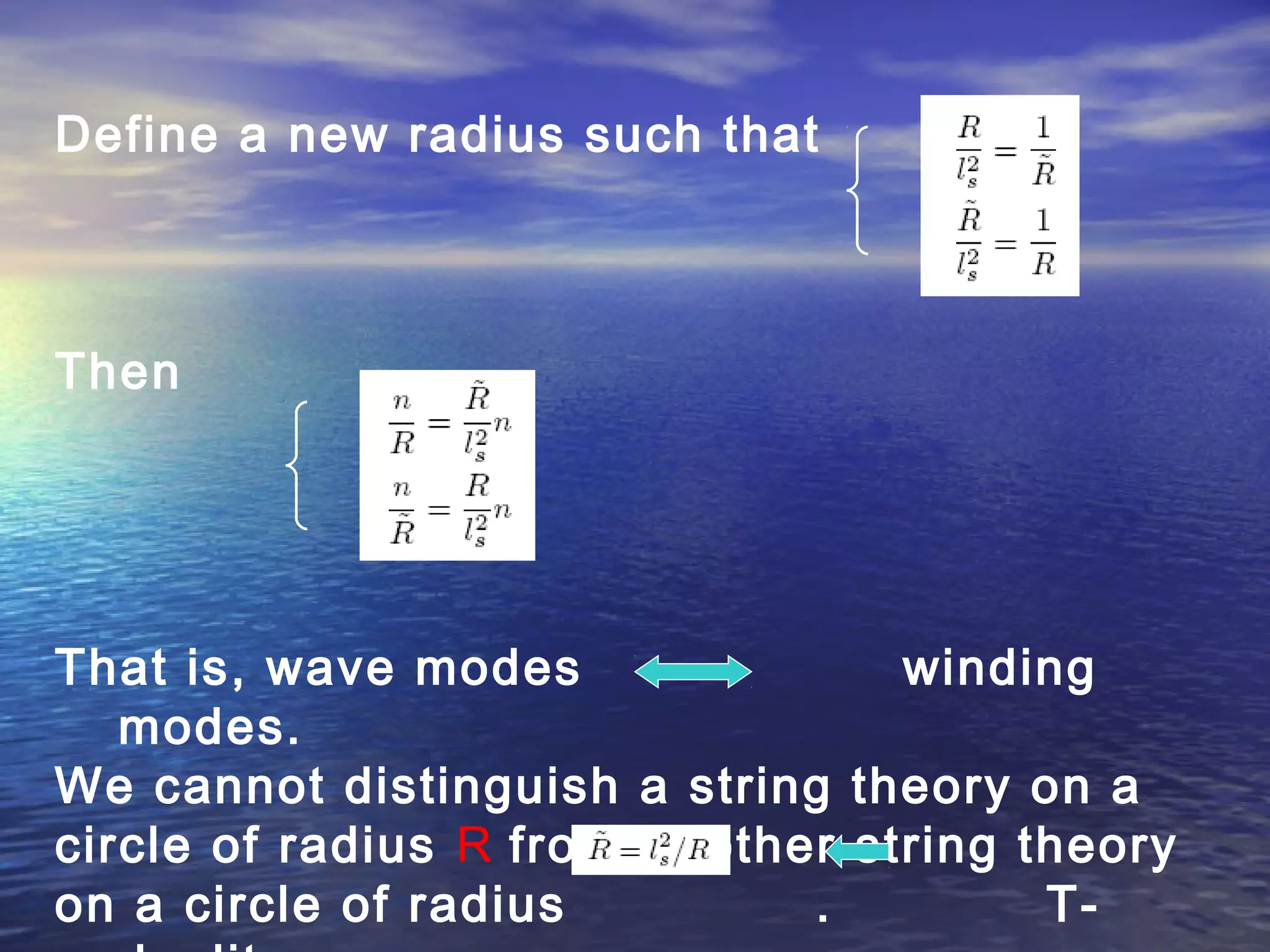
Define a new radius such that
Then
That is, wave modes winding
modes.
We cannot distinguish a string theory on a
circle of radius R from another string theory
on a circle of radius . T-
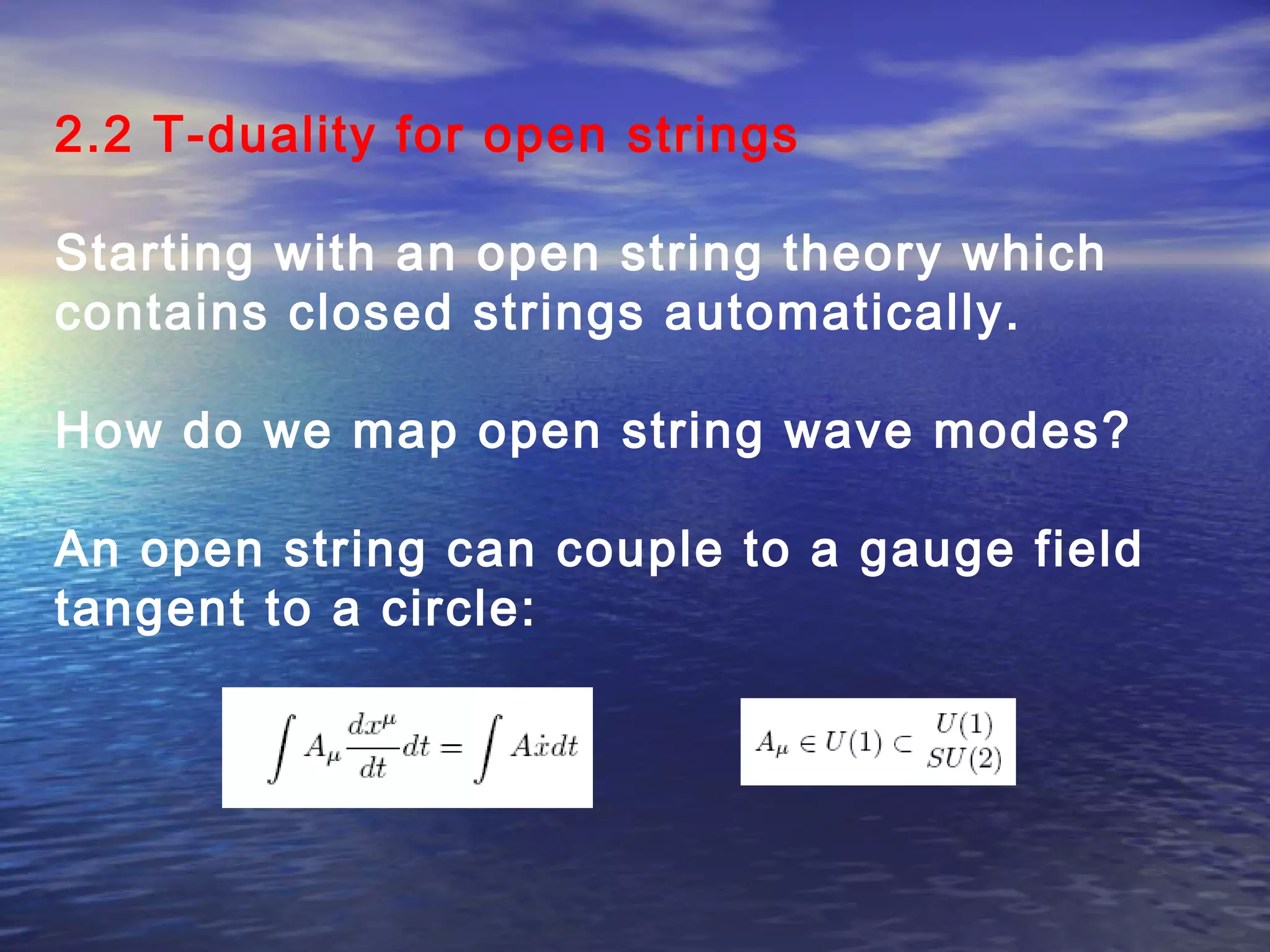
2.2 T-duality for open strings
Starting with an open string theory which
contains closed strings automatically.
How do we map open string wave modes?
An open string can couple to a gauge field
tangent to a circle:
if
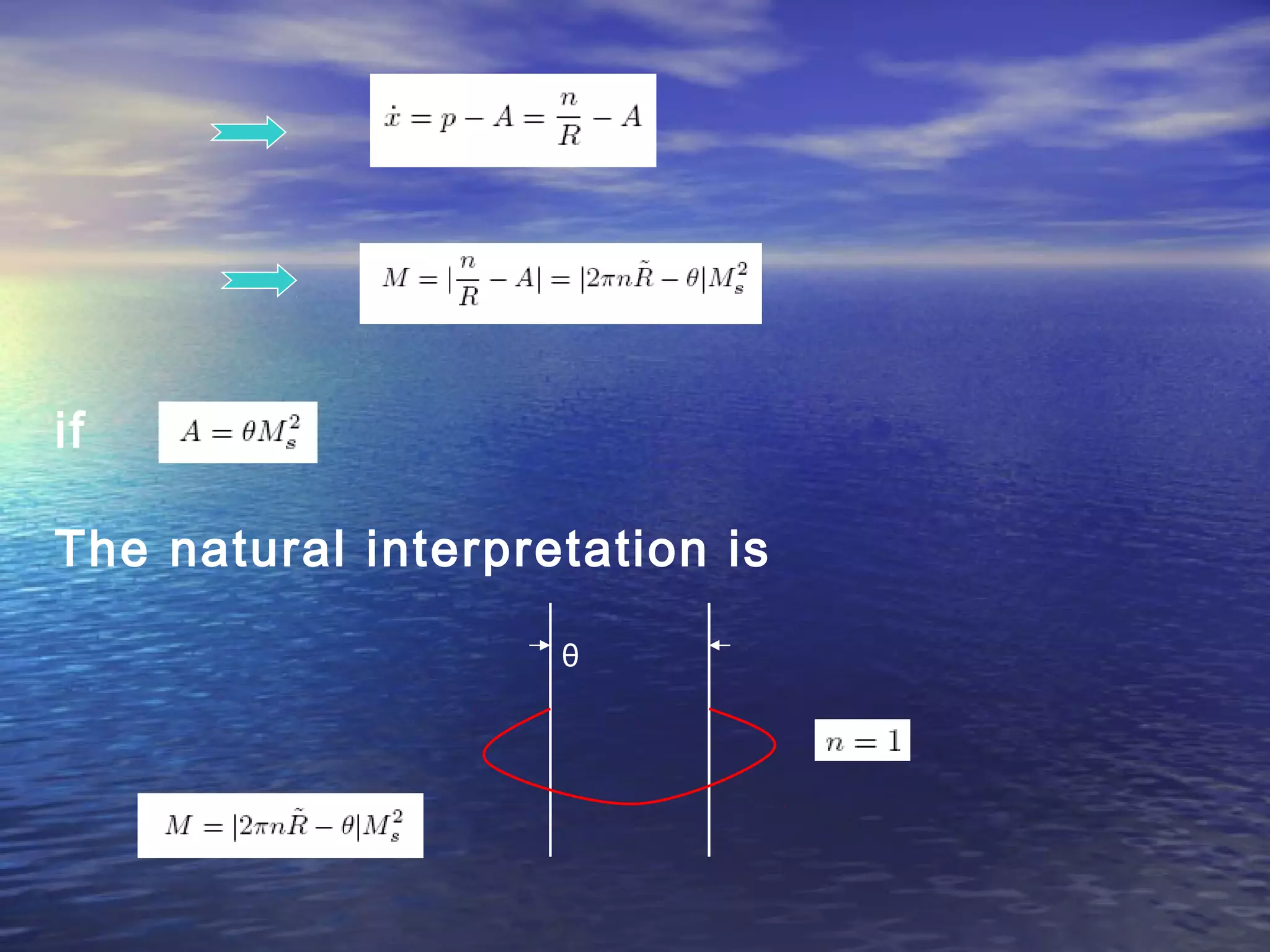
The natural interpretation is
θ
Thus, an open string wave mode is mapped
to
a winding mode with ends attached to
something: D-branes.
Boundary conditions on the ends of the
string
are Dirichlet. In the original theory
momentum is conserved, thus in the dual
theory winding number is conserved, the
ends
stick to branes.
In the original theory, winding is not
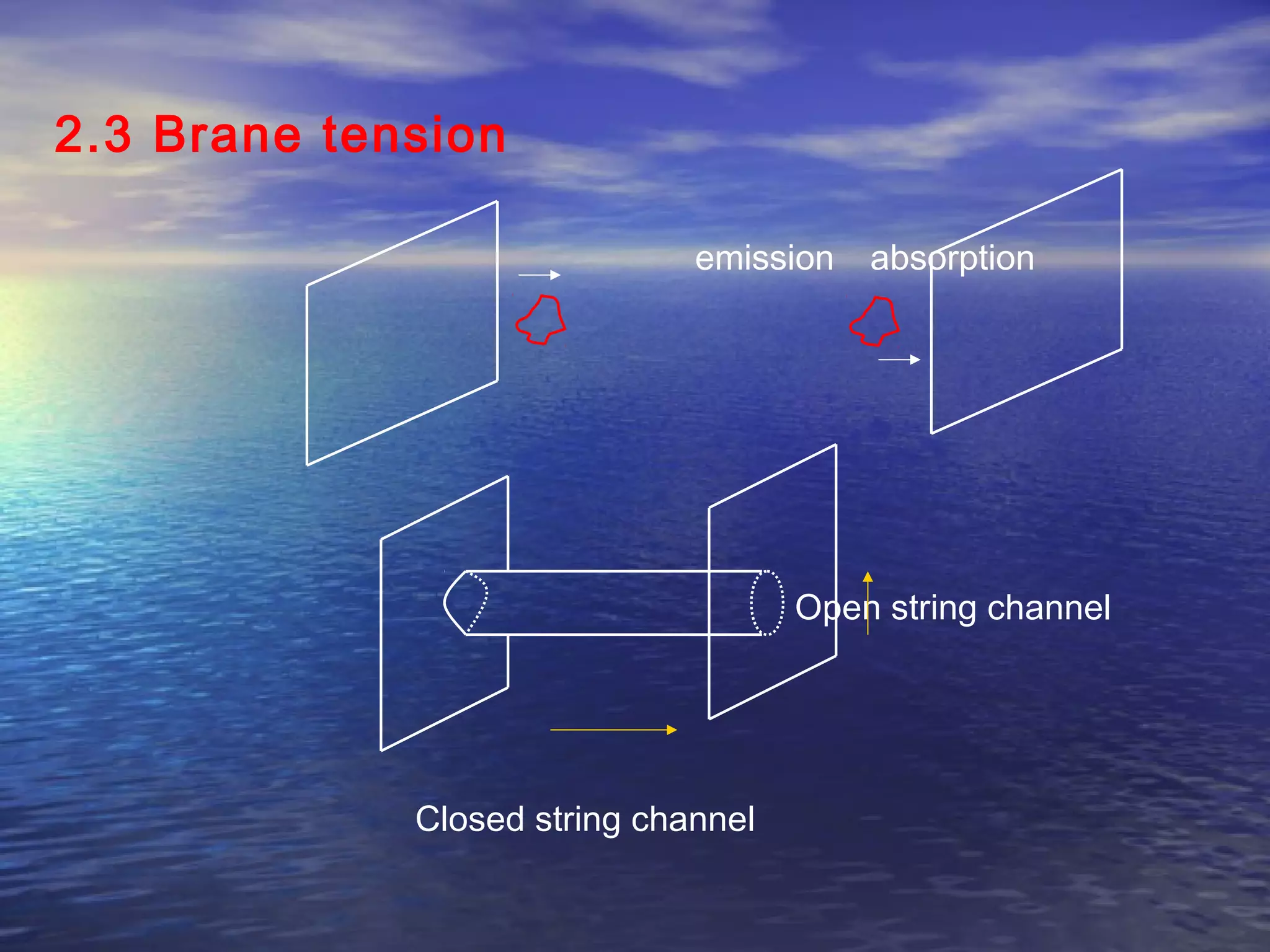
2.3 Brane tension
emission absorption
Open string channel
Closed string channel
The old idea of s-t channel duality:
=
one-loop tree-level
From the open string perspective, the
interaction between 2 D-branes :
Amplitude= vacuum fluctuations, independent of g
From the closed string perspective
amplitude =
But
Exact formula is
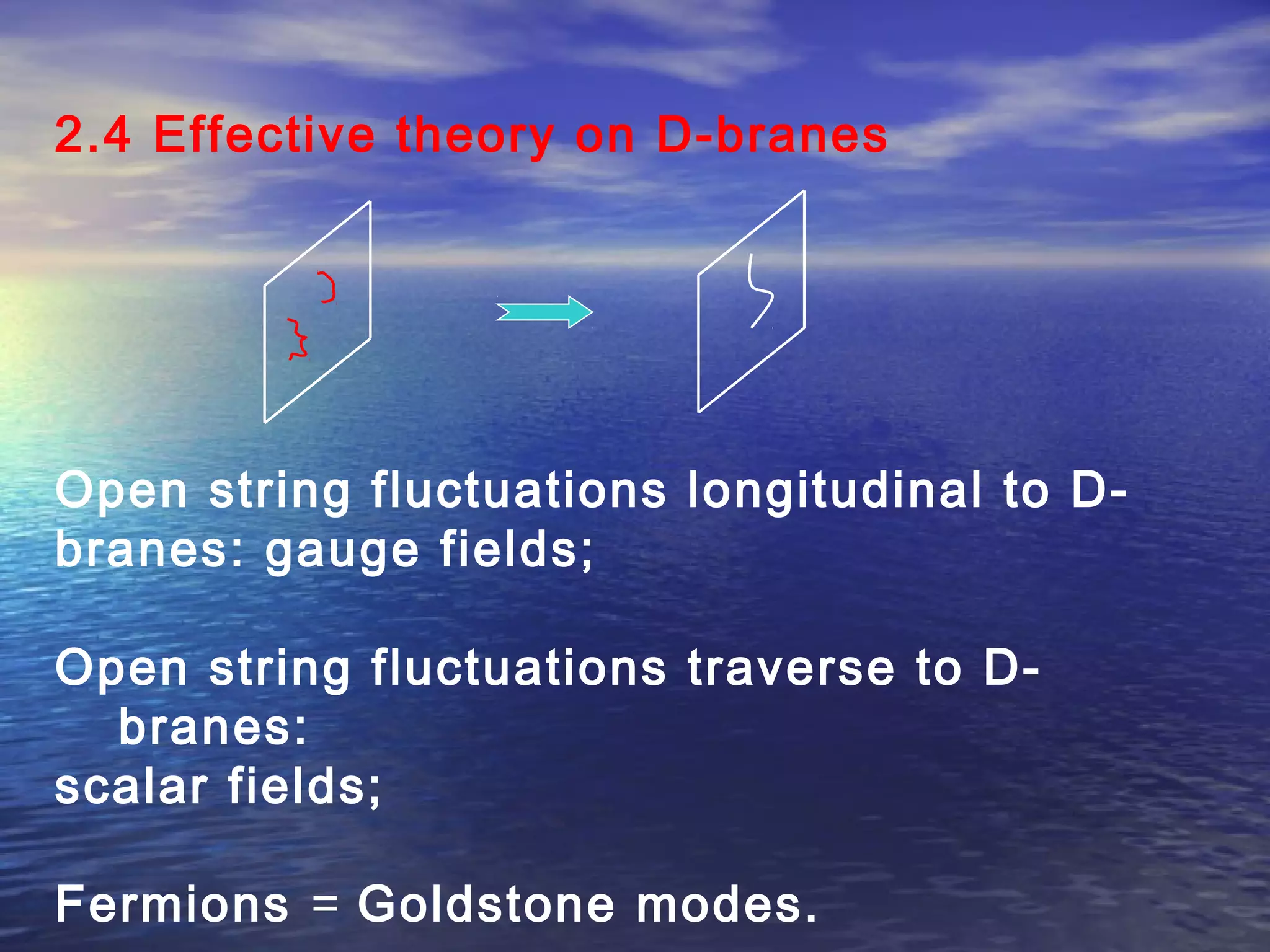
2.4 Effective theory on D-branes
Open string fluctuations longitudinal to D-
branes: gauge fields;
Open string fluctuations traverse to D-
branes:
scalar fields;
Fermions = Goldstone modes.
The position of a D-brane = vev of scalars
A geometric interpretation of the Higgs
mechanism:
massless
massive
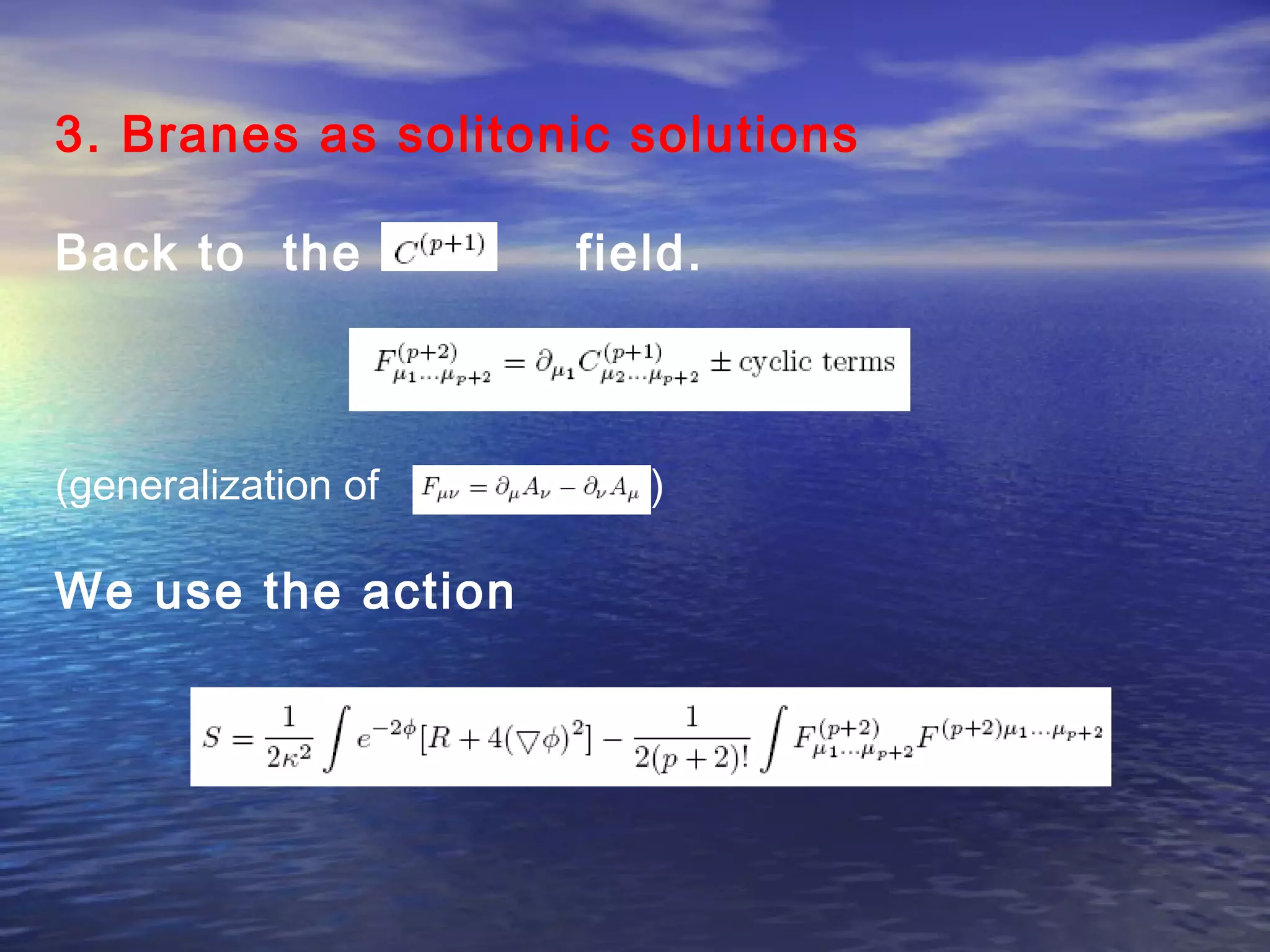
3. Branes as solitonic solutions
Back to the field.
(generalization of )
We use the action
Postulate a solution breaking
Breaking
Further,
The solution is
When r large
so
When r small
There is no pt-like source for . That is,
the
all non-linear structure of fields serve as a
smeared source-just like the monopole
solution in a broken gauge theory.
The mass, or rather the tension
While
It is interesting to note that there is a formal
horizon:
But there is no entropy
So this “black brane” is more or less a pure
state.
We know that it is the ground state of N
coincident D-branes.
4. Implications for string dualities
• In type IIA string theory, there is pt-
like
soliton with mass
so
How to understand the theory when
?
There is an additional circle of radius
so is a K-K mode of graviton.
• Type IIB theory, there is
D-string
Bound states of D-strings + F-strings:
(p,q)-dyonic strings. This is implied by the
SL(2,Z) duality.
• In type I theory, there is also
Another kind of D-string, this is the heterotic
string.
The list continues …
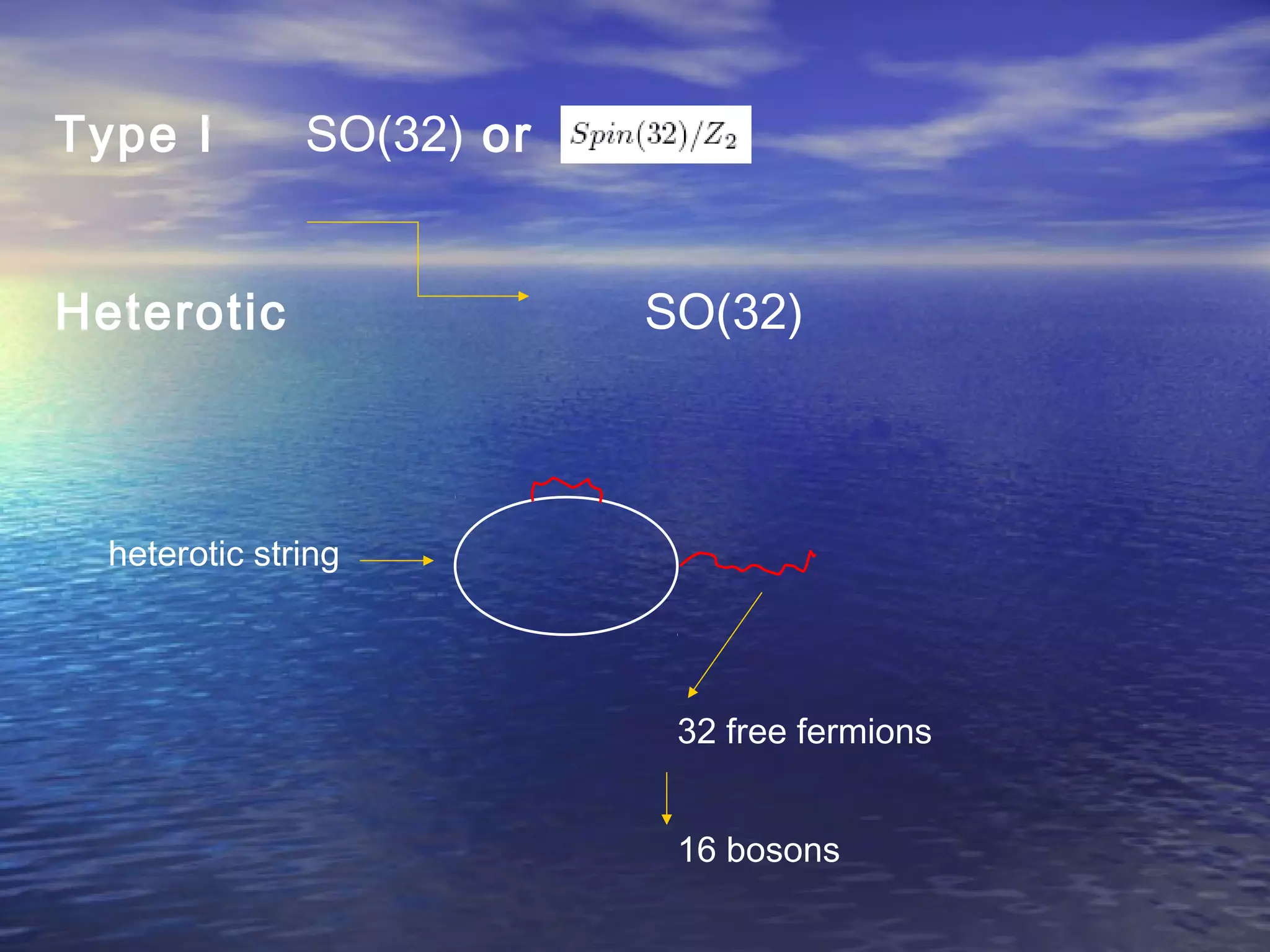
Type I SO(32) or
Heterotic SO(32)
heterotic string
32 free fermions
16 bosons
IV. Black holes in string theory
1. Basics
In real world, only a very massive collapsing
body can form a black hole
due to the fact that the basic matter
constituents are fermions.
Small black holes could (and perhaps did)
form in early universe.
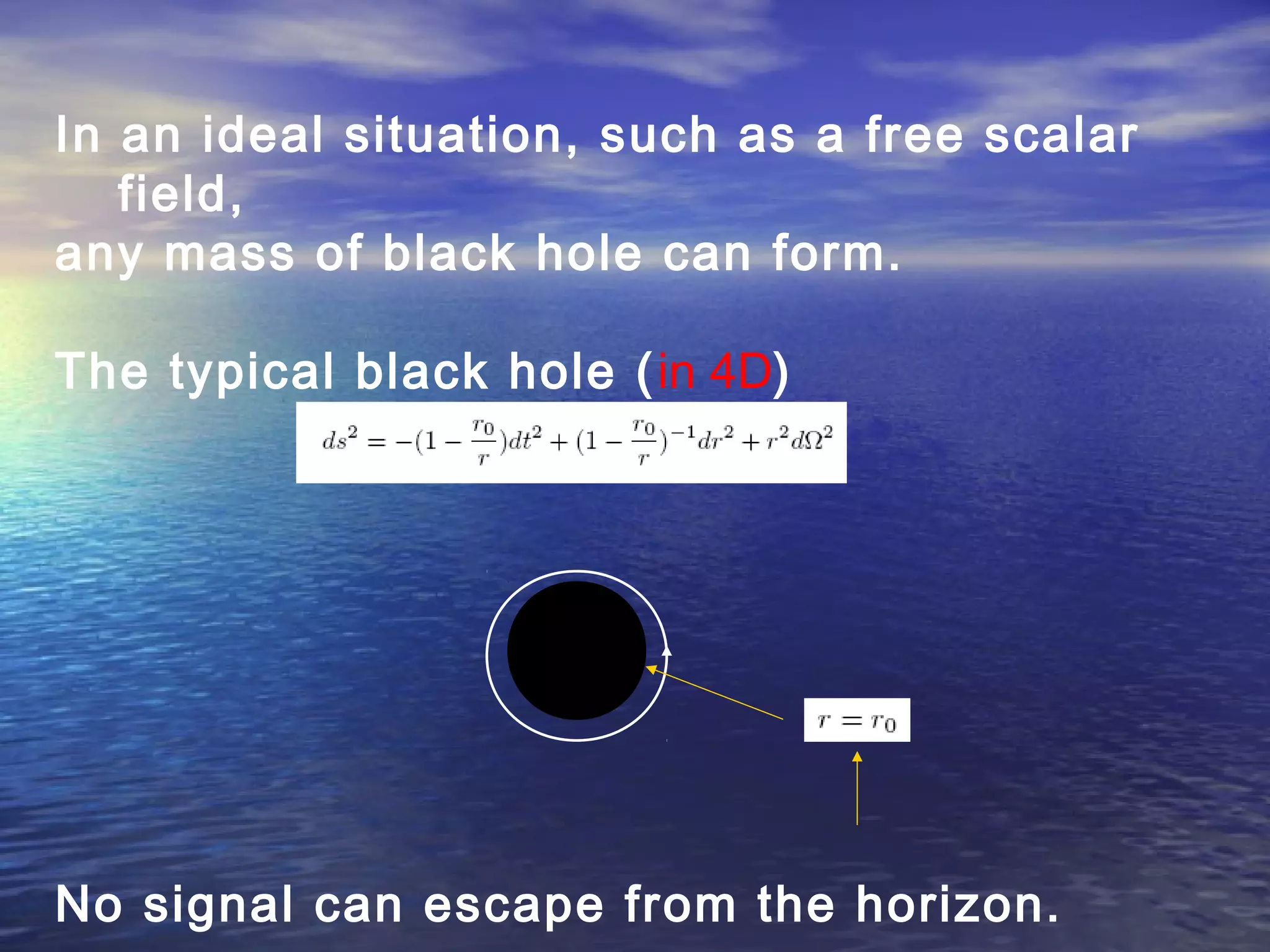
In an ideal situation, such as a free scalar
field,
any mass of black hole can form.
The typical black hole (in 4D)
No signal can escape from the horizon.
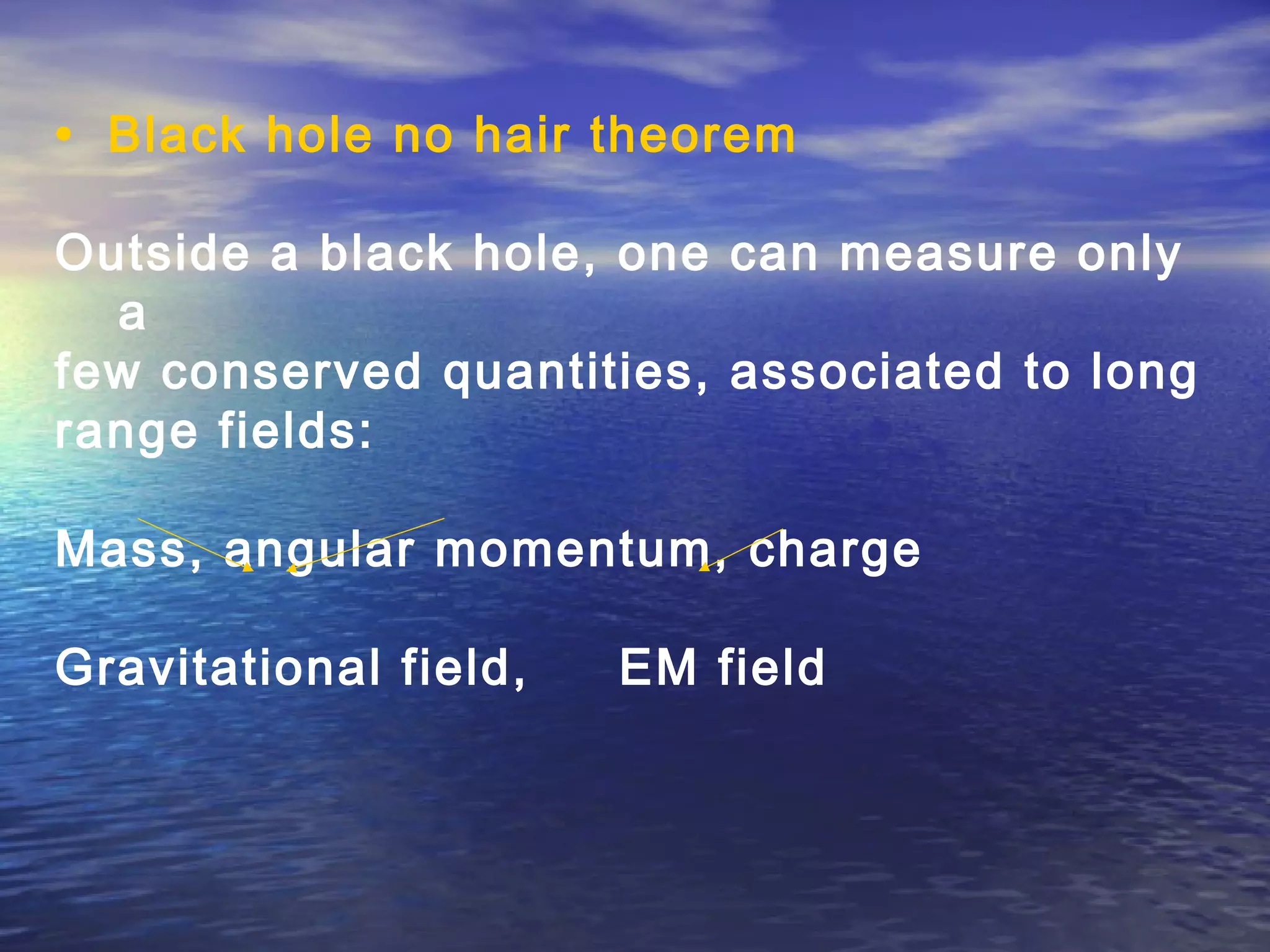
• Black hole no hair theorem
Outside a black hole, one can measure only
a
few conserved quantities, associated to long
range fields:
Mass, angular momentum, charge
Gravitational field, EM field
• Classical information loss
Black
hole
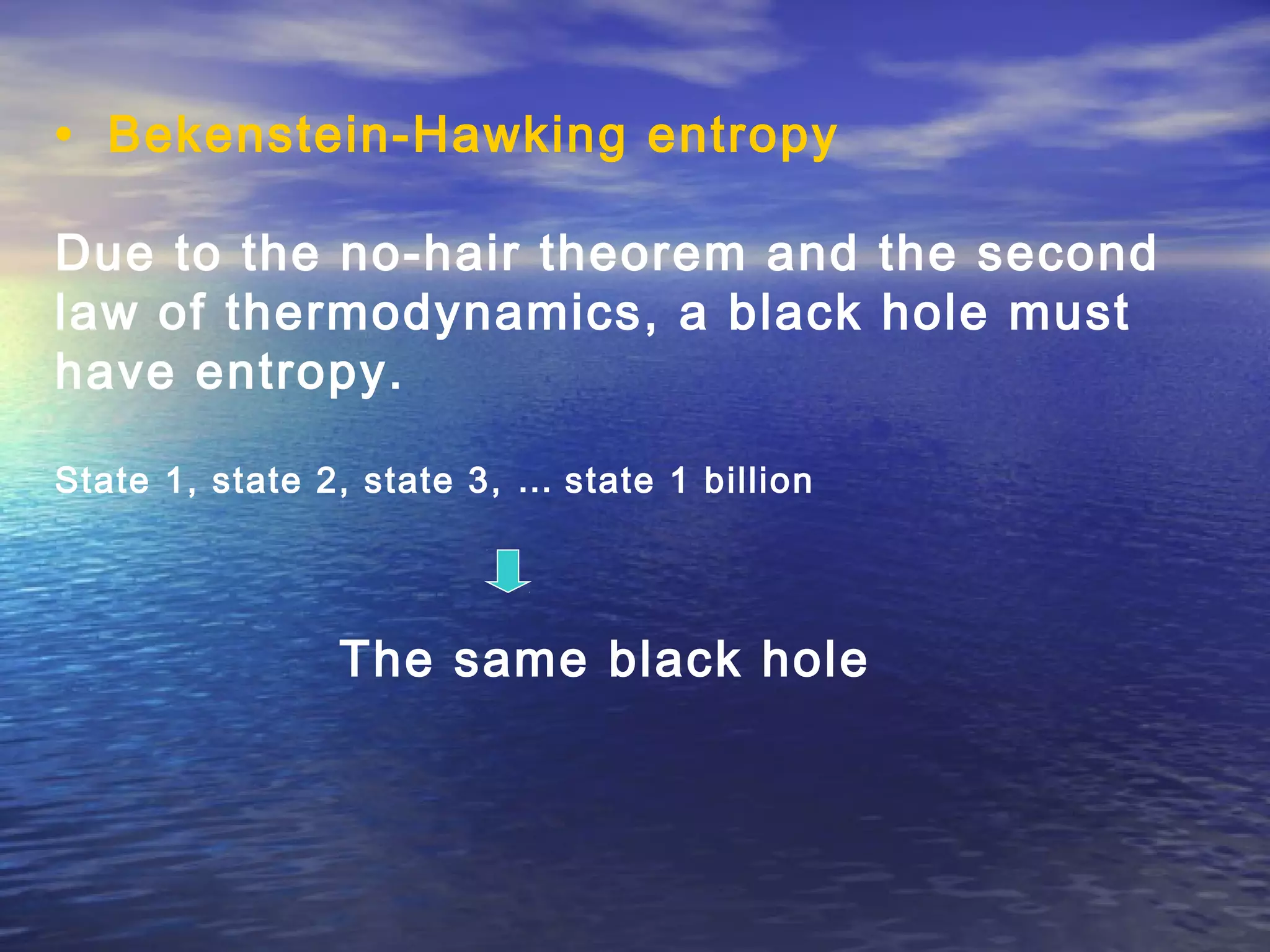
• Bekenstein-Hawking entropy
Due to the no-hair theorem and the second
law of thermodynamics, a black hole must
have entropy.
State 1, state 2, state 3, … state 1 billion
The same black hole
An interesting theorem proven in 60’s and
70’s:
A = area of black hole never decreases.
Thus, S of the black hole must be ~ A
So, Bekenstein reasoned
S=αA
But, what is α?
Bekenstein argued, using an infalling
massive
spin particle, that . This
differs
from the correct value ¼.
Hawking discovered Hawking radiation and
computed
Use
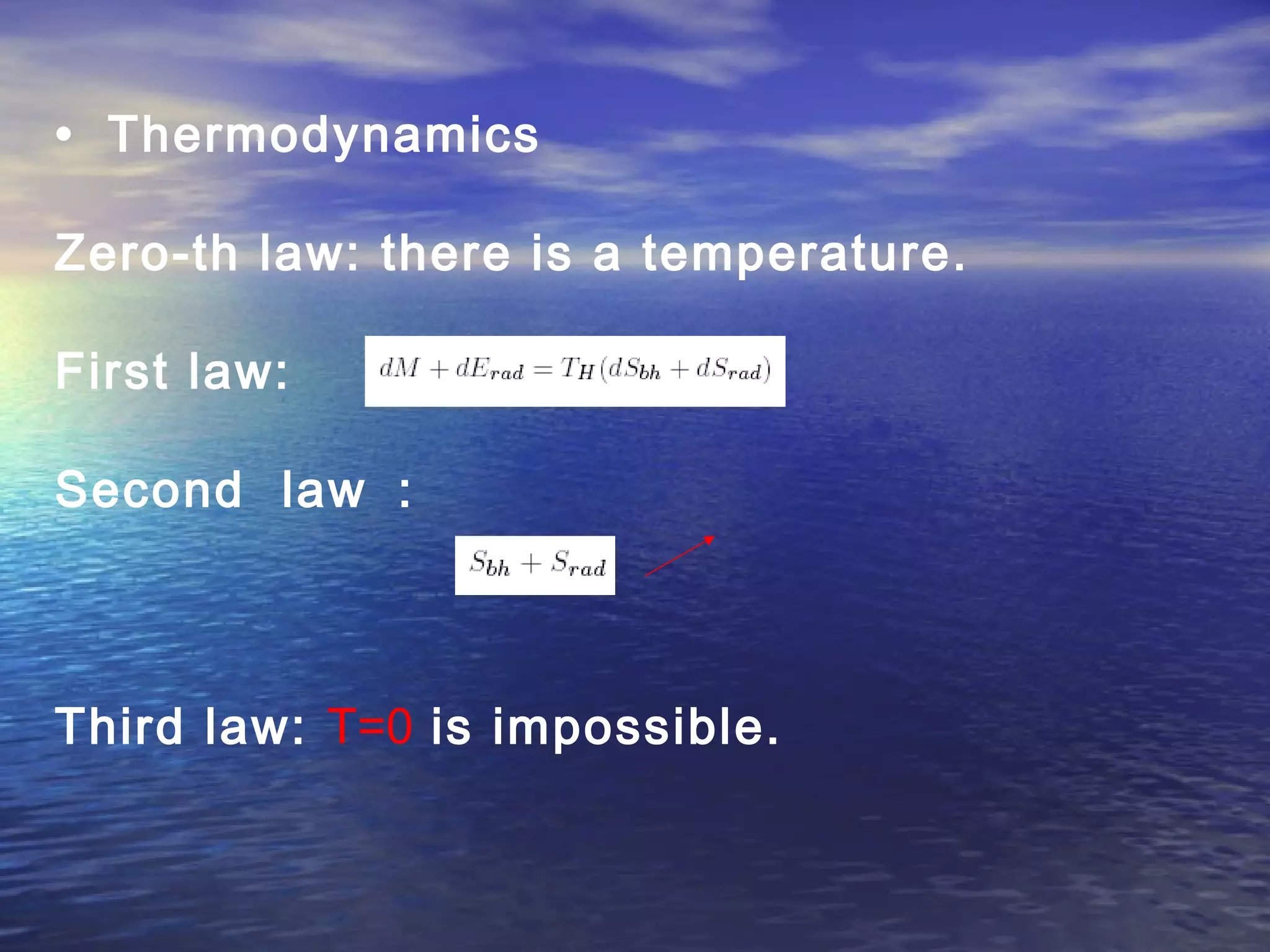
• Thermodynamics
Zero-th law: there is a temperature.
First law:
Second law :
Third law: T=0 is impossible.
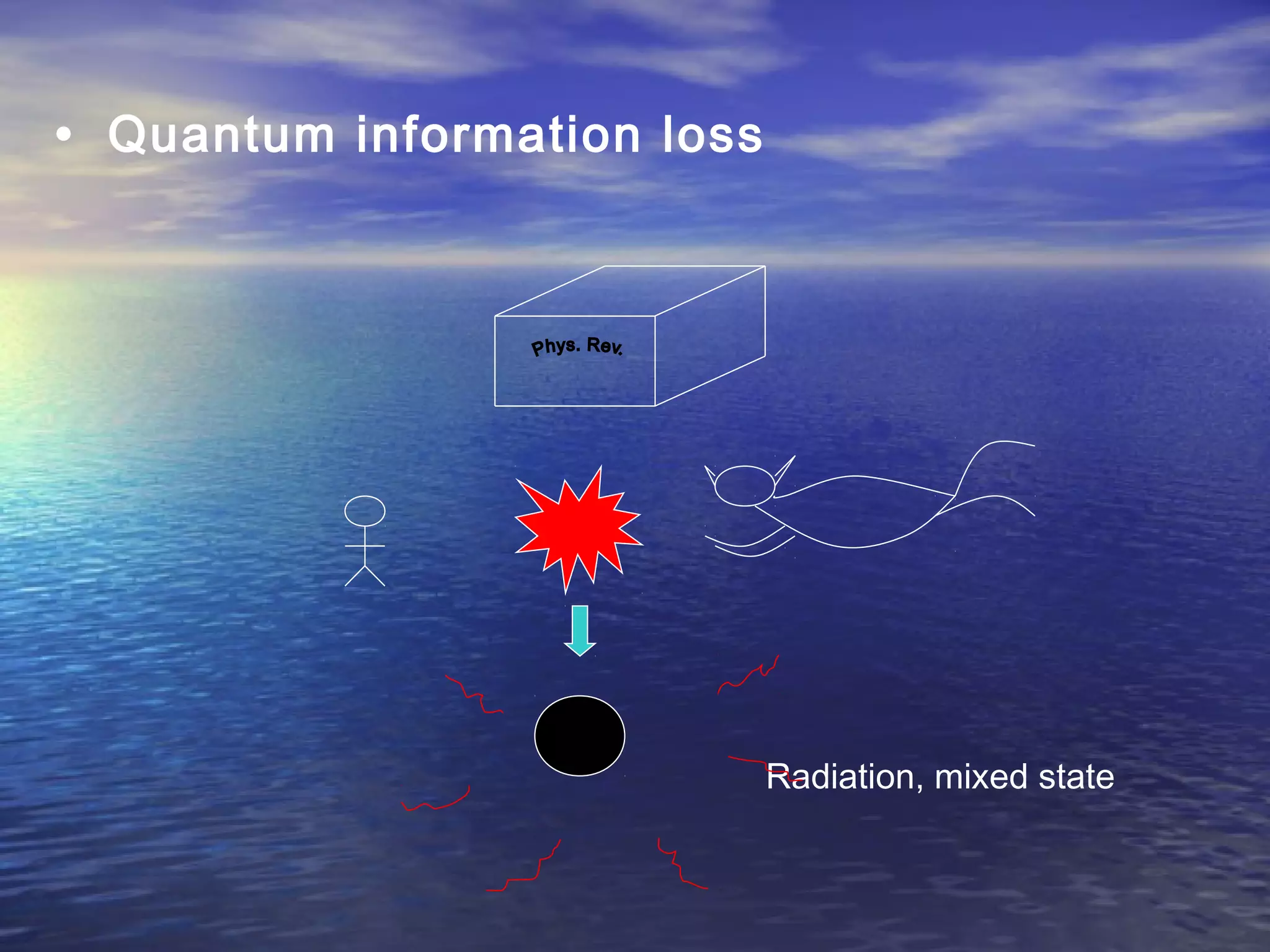
• Quantum information loss
Radiation, mixed state
2. Black holes in string theory
Pre D-brane era
Almost no string theorits believed in the
claim
of Hawking, that QM breaks down, and
Einstein wins anyway.
Perturbative string theory is important in
dealing with such a situation, to quote
Susskind:
String theory perhaps has to solve itself before solving the
information loss paradox-Scientific American.
There were a few proposals. An incomplete
list:
(a) It appears that some nonlocality must be involved in order
for the radiation carries away information. String theoy has
some nonlocality built in.
(b)
Strikingly similar to D-branes.
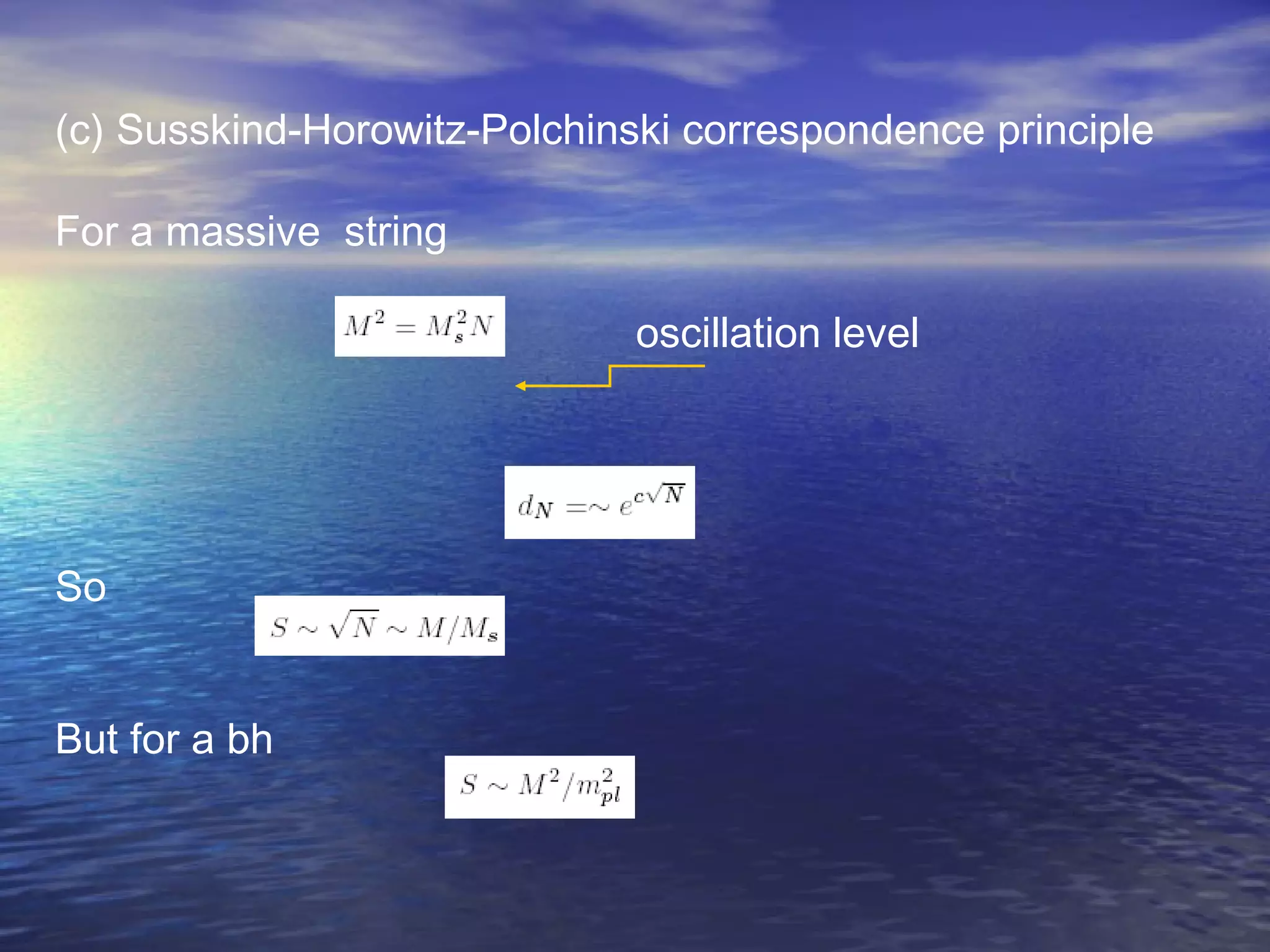
(c) Susskind-Horowitz-Polchinski correspondence principle
For a massive string
oscillation level
So
But for a bh
Horowitz-Polchinski suggested (post-D-
brane)
that in order to form a bh, G must be tuned
on.
But in 4D:
or
for
The correspondence point: for
we
have string and for we have a
Schematically
lng
BH phase
String phase
lnN
Phase transition line?
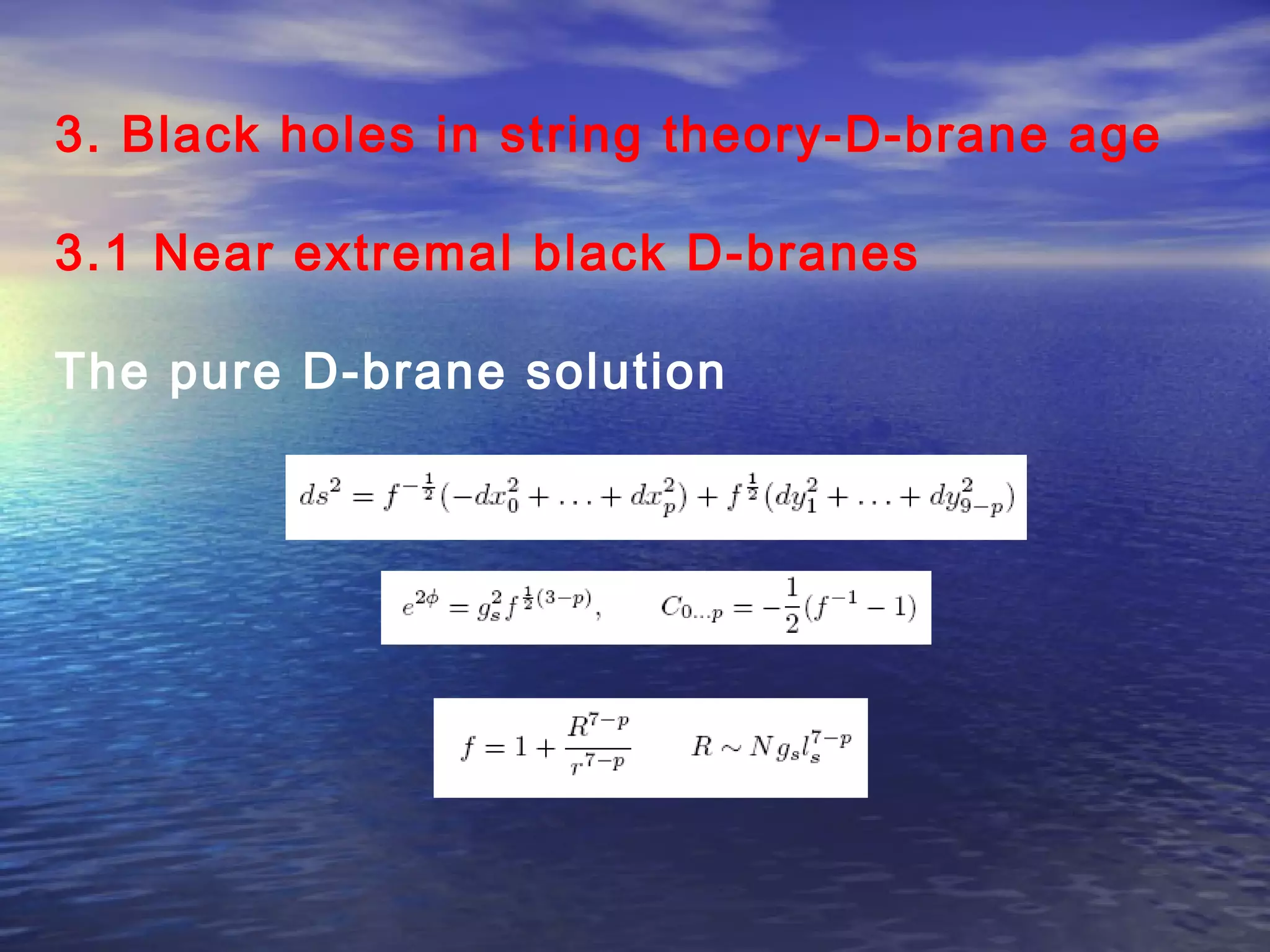
3. Black holes in string theory-D-brane age
3.1 Near extremal black D-branes
The pure D-brane solution
There is no entropy on the pure branes.
Exciting the branes
hot gas
Near extremal black brane
Thus
At the horizon
Horizon area =
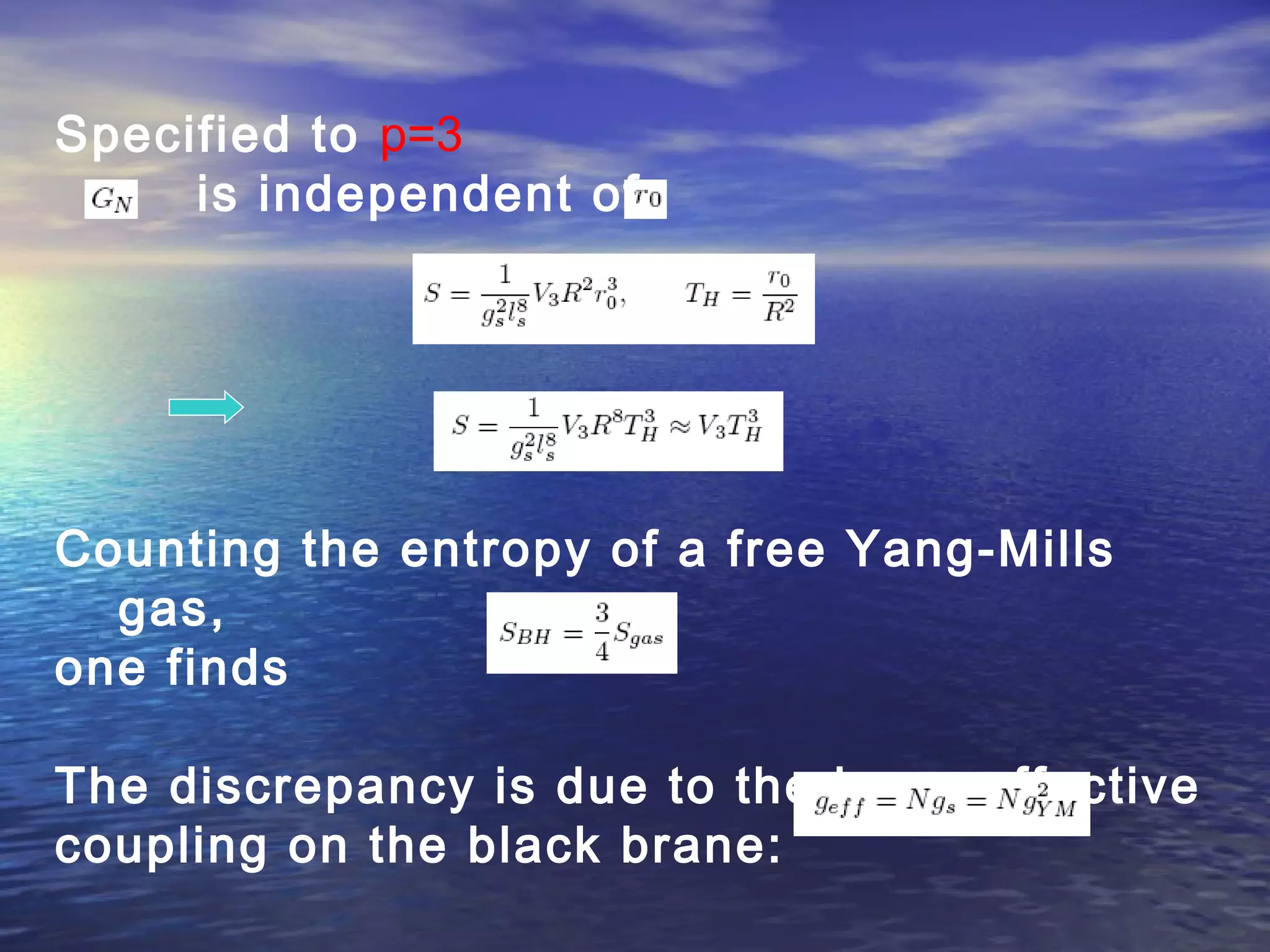
Specified to p=3
is independent of
Counting the entropy of a free Yang-Mills
gas,
one finds
The discrepancy is due to the large effective
coupling on the black brane:
p=3 is called non-dilaton black brane, since
In general
For 6>p>3, theories are sufficient complex.
For p=2, not much research exists
For p=1, Hashimoto-Izthaki
For p=0, ML
3.2 Extremal black holes (branes)
Strominger-Vafa
A black hole in 5D
T5: D5-
branes
waves
D1-branes T4
Physical picture:
D5-D1 open strings
species
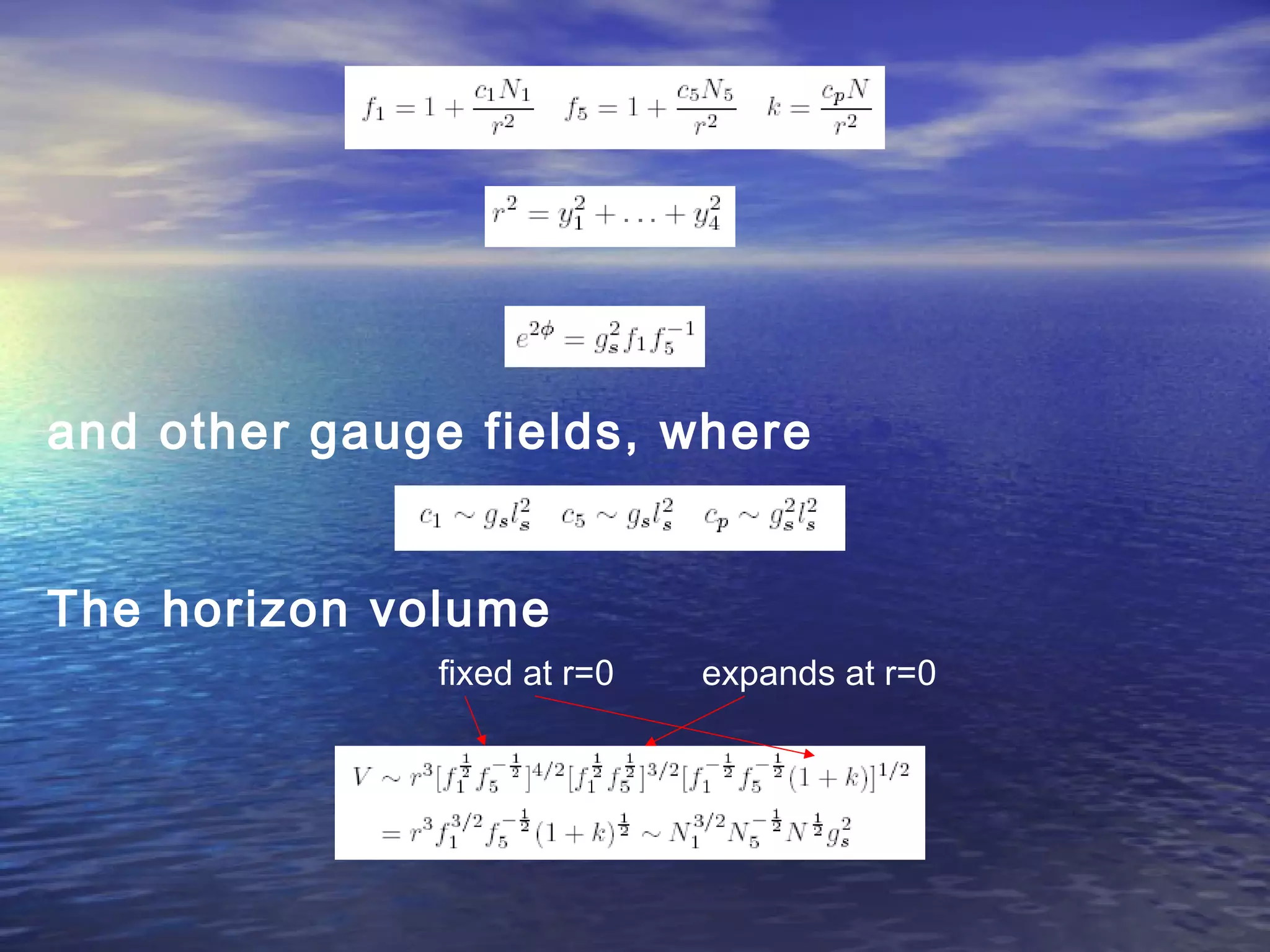
The classical solutions
and other gauge fields, where
The horizon volume
fixed at r=0 expands at r=0
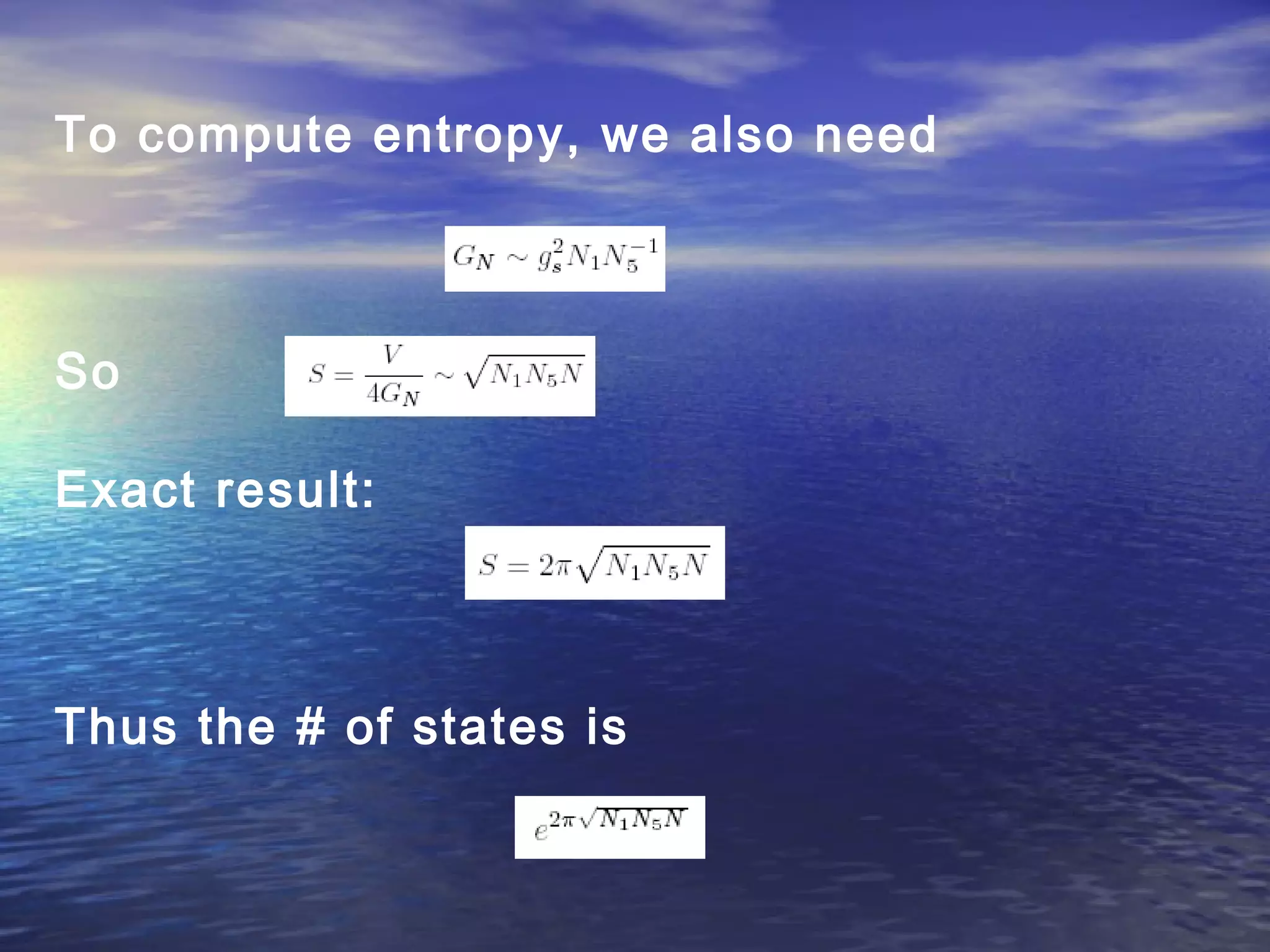
To compute entropy, we also need
So
Exact result:
Thus the # of states is
Microscopic origin:
A 1D gas of open strings
In the weak coupling limit:
For a boson or a fermion:
The exact formula (Cardy) is
For a boson c=1, for a fermion c=1/2. For the
system of the D1-D5 strings
This result is valid even in case of the large
:
by extrapolating BPS states.
Further develoments:
(a) 4 charged BH in 4D.
(b) Near extremal BH by adding left moving
modes.
(c) Hawking radiation.
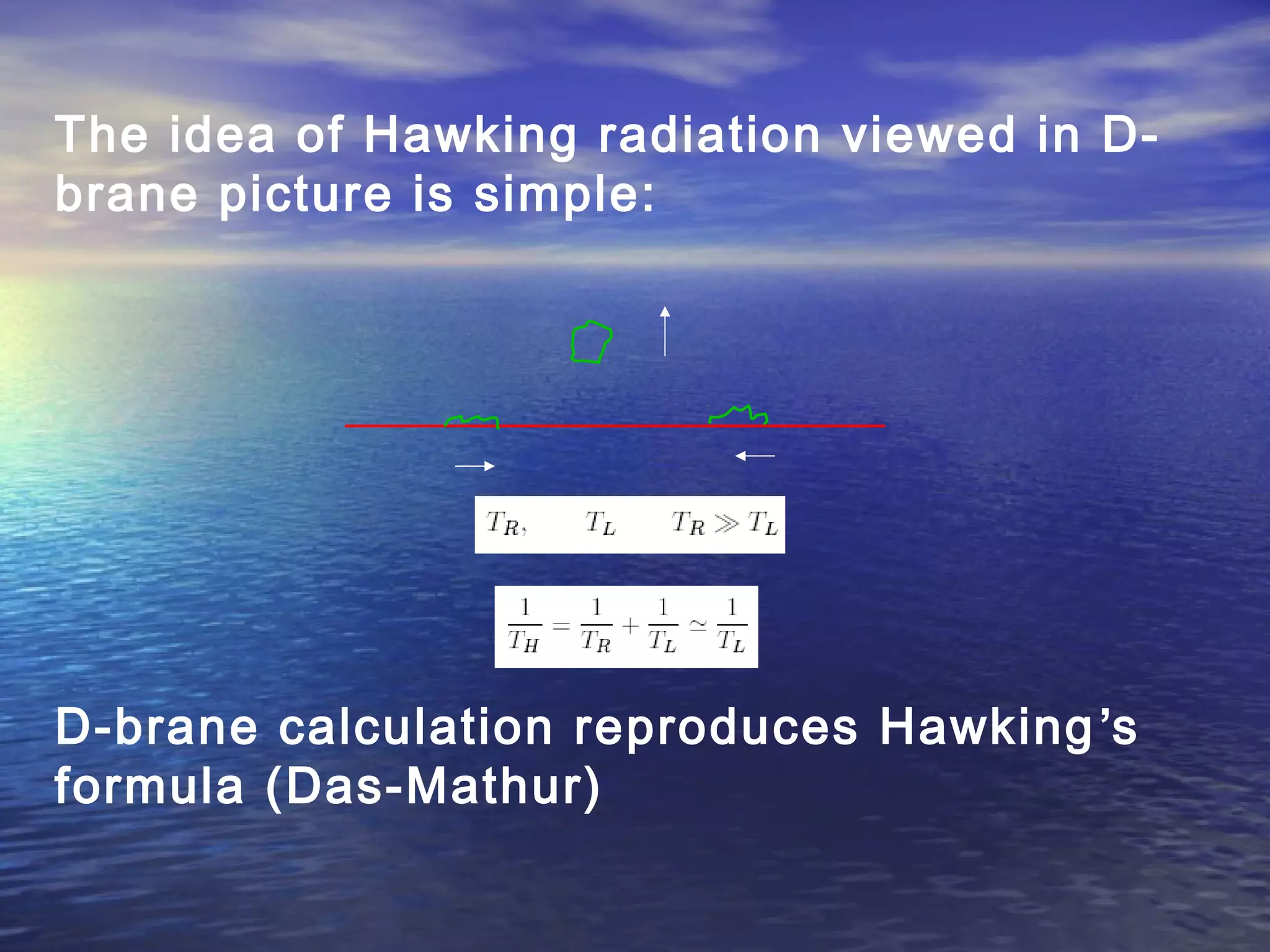
The idea of Hawking radiation viewed in D-
brane picture is simple:
D-brane calculation reproduces Hawking’s
formula (Das-Mathur)
(d) Grey-body factor
. .
Potential due to the background
Maldacena-Strominger, complete agreement.
Are there magic nonrenormalization
theorem?
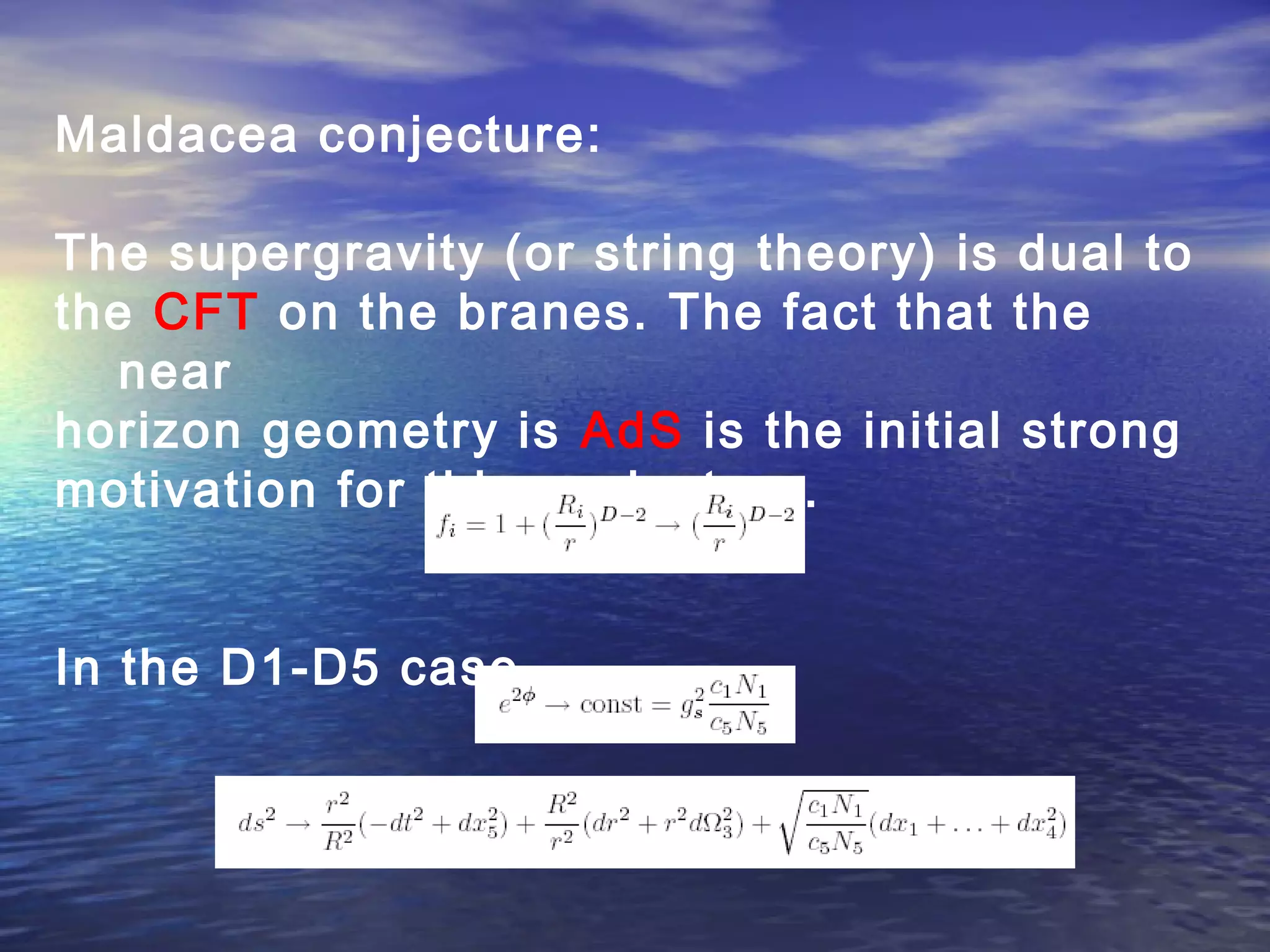
Maldacea conjecture:
The supergravity (or string theory) is dual to
the CFT on the branes. The fact that the
near
horizon geometry is AdS is the initial strong
motivation for this conjecture.
In the D1-D5 case
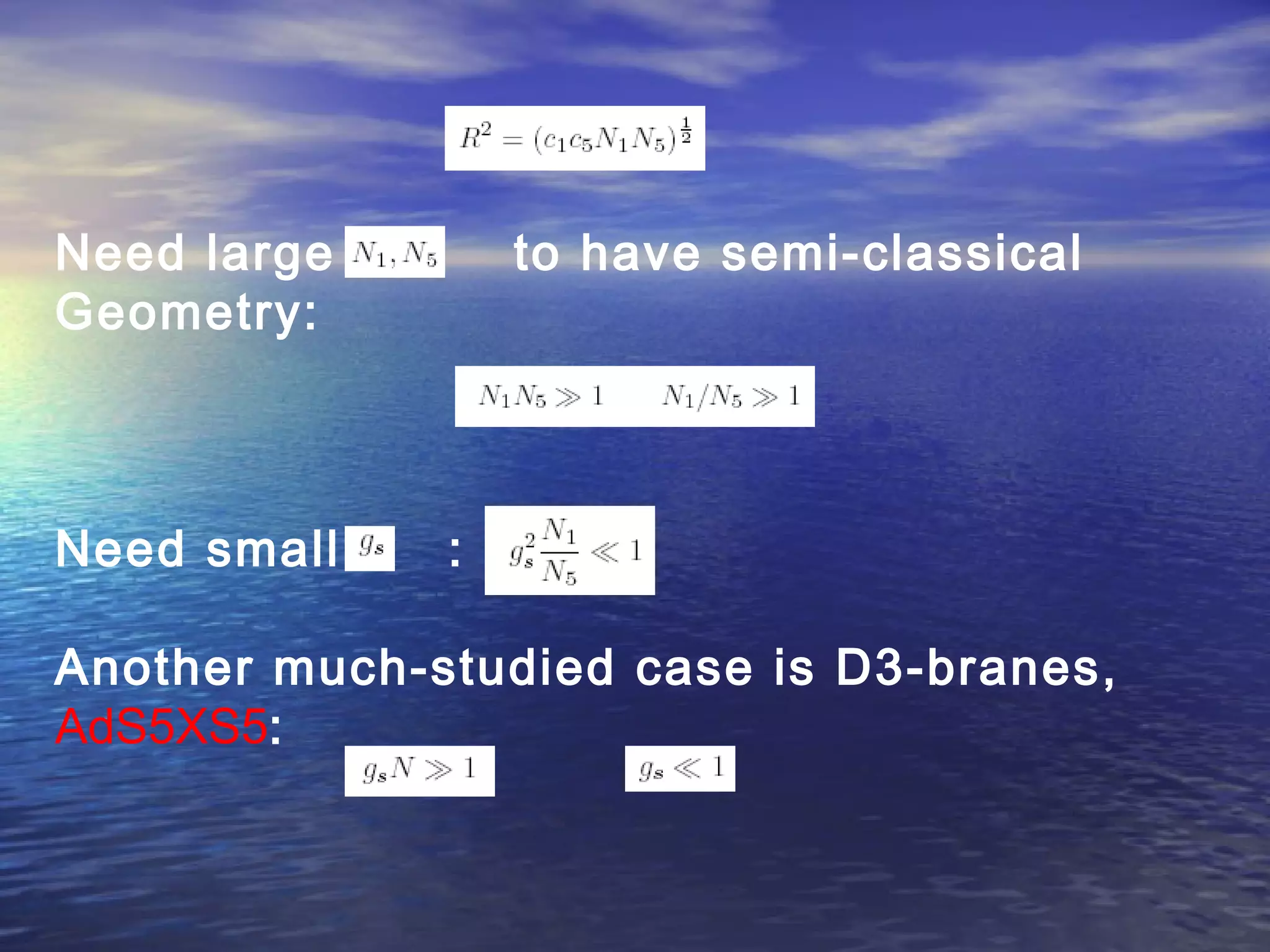
Need large to have semi-classical
Geometry:
Need small :
Another much-studied case is D3-branes,
AdS5XS5:
4. Beyond D-branes
4.1 Horowitz-Polchinski’s correspondence
Curvature ~
String states
or brane states BH’s
Entropy matches ~ O(1) coefficient.
No need of D-brane charges.
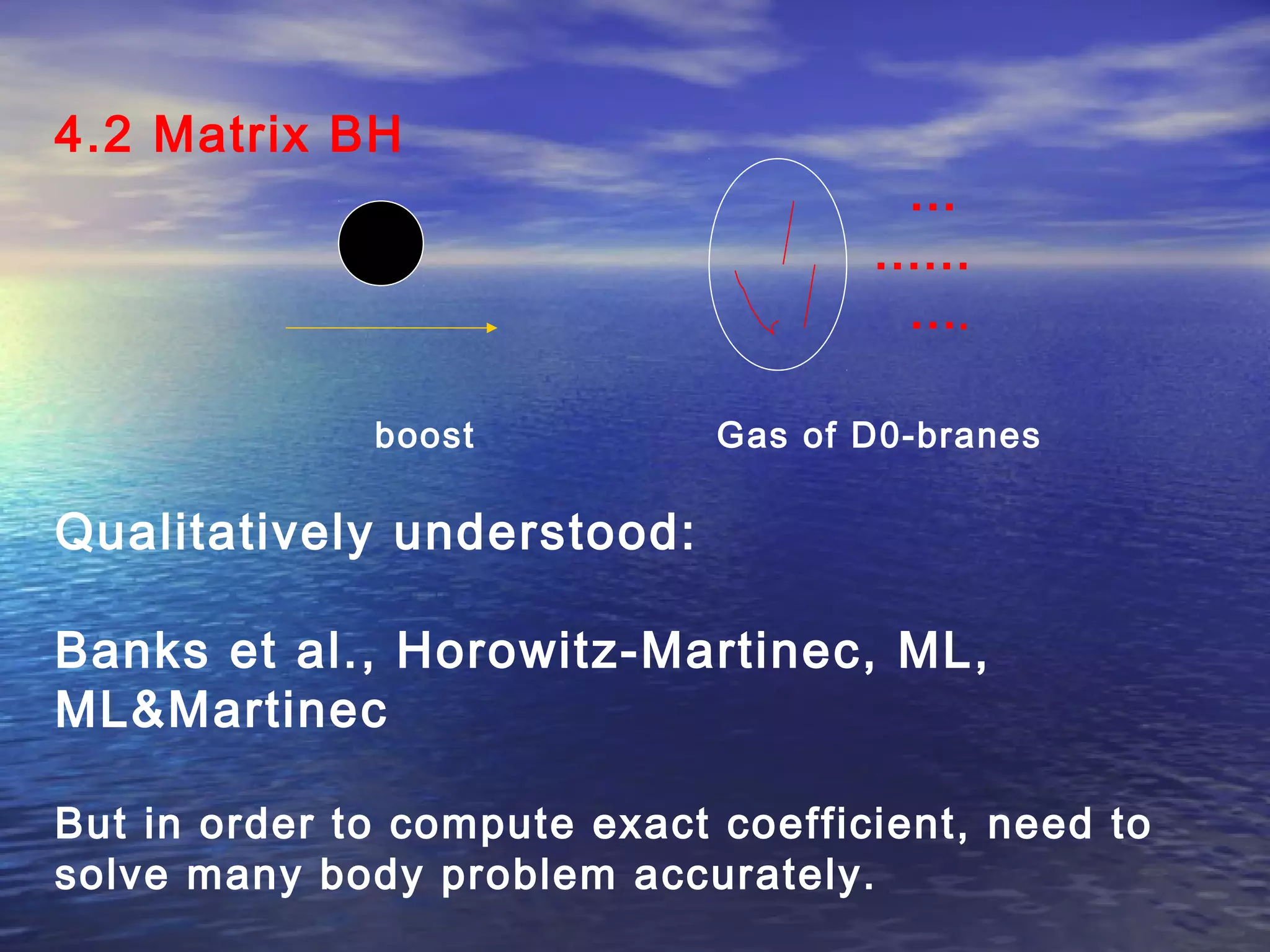
4.2 Matrix BH
…
……
….
boost Gas of D0-branes
Qualitatively understood:
Banks et al., Horowitz-Martinec, ML,
ML&Martinec
But in order to compute exact coefficient, need to
solve many body problem accurately.
4.3 AdS
Can study near extremal BH only ( c>0 ).
But provides an opportunity to study
formation and evaporation of BH accurately.
One may also study singularity.
Technically unlikely to be solved in the near
future.
Both 4.2 and 4.3 are under the influence of
D-
branes.
5. BH problem is unsolved
(a) Counting entropy for Schwarzschild BH
honestly, accurately.
(b) Dynamic process of formation of BH in
D-
brane picture or AdS/CFT , information
puzzle
(c) Counting entropy for near-extremal BH
accurately for p<3.
(d) For p=3, understand ¾.
(e) Prove the existence of gas BH
phase
transition.
(d) Matrix BH need to be studied further
……

Miao

  • 1.
    An Outline ofStringAn Outline of String TheoryTheory Miao Li Institute of Theoretical Physics Beijing, China
  • 2.
    Contents I. Background II. Elementsof string theory III. Branes in string theory IV. Black holes in string theory- holography-Maldacena’s conjecture
  • 3.
    I. Background 1. Theworld viewed by a reductionist Let’s start from where Feynman’s lecture starts A drop of water enlarged 10^9 times H O
  • 4.
    Feynman was ableto deduce a lot of things from a single sentence: All forms of matter consist of atoms. 1. Qualitative properties of gas, liquid… 2. Evaporation, heat transport (to cool your Soup, blow it) 3. Understanding of sounds, waves…
  • 5.
    Atomic structure H: 10^{-8}cm Theory: QED(including Lamb shift) Interaction strength: Electron, point-like Nucleus 10^{-13} cm
  • 6.
    Dirac: QED explains allof chemistry and most of physics. Periodic table of elements, chemical reactions, superconductors, some of biology.
  • 7.
    Sub-atomic structure Nucleus ofH=proton u=2/3 U(1), d=-1/3 U(1), in addition, colors of SU(3) u u d
  • 8.
    Neutron: Interaction strengths QED Size ofH=Compton length of electron/α= d u d
  • 9.
    Strong interaction Size ofproton=Compton length of quark/ So the strong interactions are truly strong, perturbative methods fail. QCD is Still unsolved
  • 10.
    Another subatomic force:weak interaction β-decay How strong (or how weak) is weak interaction? Depends on the situation. For quarks: -mass of u-quark -mass of W-boson
  • 11.
    Finally, gravity, theweakest of all four interactions -mass of proton -Planck mass (so )
  • 12.
  • 13.
    To asses thepossibility of unification, let’s Take a look at 2. A brief history of amalgamation of physical theories. Movement of earthly bodies. Movement of celestial bodies. Newtonian mechanics + universal gravitation. 17th century.
  • 14.
    Mechanics Heat, thermodynamics Atomic theory,statistical mechanics of Maxwell, Boltzmann, Gibbs, 19th century. Electrodynamics Magnetism Light, X-rays, γ-rays Faraday, Maxwell, 19th century.
  • 15.
    Quantum electrodynamics Weak interaction Semi-unification,Weinberg-Salam model. The disparity between 10^{-2} and 10^{-6} is solved by symmetry breaking in gauge theory. 1960’s-1970’s (`t Hooft, Veltman, Nobel prize in 1999, total Five Nobel medals for this unification.)
  • 16.
    Although eletro-weak, stronginteraction appear as different forces, they are governed by the same universal principle: Quantum mechanics or better Qantum field theory valid up to
  • 17.
    Further, there isevidence for unification of 3 forces: (a) In 4 dimensions, goes up with E goes down with E (b) runs as powers of E if there are large compact dimensions ( )
  • 18.
    3. Difficulty withgravity Gravity, the first ever discovered interaction, has resisted being put into the framework of quantum field theory. So, we have a great opportunity here! Why gravity is different? There are many aspects, here is a few. (a) The mediation particle has spin 2.
  • 19.
    Thus amplitude= The next orderto the Born approximation amplitude=
  • 20.
    (b) According toEinstein theory, gravity is geometry. If geometry fluctuates violently, causal structure is lost. (c) The existence of black holes. (c1) The failure of classical geometry. singularity
  • 21.
    (c2) A blackhole has a finite entropy, or a state of a black hole can not be specified by what is observed outside. Hawking radiation, is quantum coherence lost? Curiously, the interaction strength at the horizon is not . The larger the BH, the weak the interaction.
  • 22.
    GR predicts thesurface gravity be Curiously, Size of black hole=Compton length/ or
  • 23.
    To summarize, thepresent day’s accepted picture of our fundamental theory is
  • 24.
    4. The emergenceof string theory A little history Strong interaction is described by QCD, however, the dual resonance model was invented to describe strong interaction first, and eventually became a candidate of theory of quantum gravity. Initially, there appeared infinitely many resonant states ( π,ρ,ω…)
  • 25.
    None of theresonant states appears more fundamental than others. In calculating an amplitude, we need to sum up all intermediate states: π π π π = Σ n π π π π Denote this amplitude by A(s,t) : (a)
  • 26.
    (b) Analytically extendA(s,t) to the complex plane of s, t, we must have Namely Σ n = Σ n This is the famous s-t channel duality.
  • 27.
    A simple formulasatisfying (a) and (b) is the famous Veneziano amplitude polynomial in t: Σ t^J, J-spin of the intermediate state linear trajectory
  • 28.
    This remarkable formulaleads us to String theory For simplicity, consider open strings (to which Veneziano amplitude corresponds) Ground state v=c v=c An excited state v=c v=c
  • 29.
    To calculate thespectrum of the excited states, We look at a simple situation (Neuman->Dirichlet) x σ x σ
  • 30.
    Let the tensionof the string be T, according to Heisenberg uncertainty relation Now or
  • 31.
    If , then Casimir effect Theabove derivation ignores factors such as 2’s, π’s. More generally, there can be We discovered the linear trajectory.
  • 32.
    Morals: (a) There areinfinitely many massive states resulting from a single string (Q.M. is essential) (b) If we have only “bosonic strings”, no internal colors, we can have only integral spins. spin 1: gauge bosons spin 2: graviton (c) To have a massless gauge boson, a=-1. To have a massless graviton, a=-2 (need to use closed strings).
  • 33.
    II. Elements ofstring theory 1. First quantized strings, Feynman rules Particle analogue Action
  • 34.
    A classical particletravels along the shortest path, while a quantum particle can travel along different paths simultaneously, so we would like to compute
  • 35.
    Generalization to astring T tension of the string dS Minkowski area element dS
  • 36.
    Curiously, string canpropagate consistently only when the dimension of spacetime is D=26 Why is it so? We have the string spectrum
  • 37.
    Each physical bosonon the world sheet contributes to the Casimir energy an amount a=-1/24. When n=1, we obtain a spin vector field with # of degrees D-2 For A tachyon! This breaks Lorentz invariance, so only for D=26, Lorentz invariance is maintained.
  • 38.
    But there isa tachyon at n=0, bosonic string theory is unstable. Unstable mode if E is complex For a closed string (There are two sets of D-2 modes, left moving and right moving: )
  • 39.
    For n=2, wehave a spin 2 particle, there are however only ½ D(D-3) such states, it ought to be massless to respect Lorentz invariance, again D=26. Interactions In case of particles, use Feynman diagram to describe physical process perturbatively: + +
  • 40.
    Associated to eachtype of vertex more legs there is a coupling constant The only constraint on these couplings is renormalizability. Associated with each propagator =
  • 41.
    Or By analogy, forstring interaction + +… The remarkable fact is that for each topology there is only one diagram.
  • 42.
    While for particles,this is not the case, for example = + + + +…
  • 43.
    Surely, this isthe origin of s-t channel duality. One can trace this back to the fact that there is unique string interaction vertex: = Rejoining or splitting
  • 44.
    The contribution ofa given diagram is n=# of vertices = genus of the world sheet. In case of the closed strings +
  • 45.
    Again, there isa unique diagram for each topology, the vertex is also unique = The open string theory must contain closed Strings =
  • 46.
    The intermediate stateis a closed string, unitarity requires closed strings be in the spectrum. There is a simple relation between the open string and the closed string couplings. Emission vertex=
  • 47.
  • 48.
    2. Gauge interactionand gravitation = massless open strings = massless closed strings Define the string scale
  • 49.
    Yang-Mills coupling = by dimensionalanalysis. Gravitational coupling
  • 50.
    So If there isa compact space D=4+d =volume of the compact space We have
  • 51.
    Since in 4dimensions , we have Phenomenologically, at the unification scale, so . We see that in order to raise the string scale, say , we demand . With the advent of D-branes, in the T-dual picture this
  • 52.
    3. Introducing fermions,supersymmetry In order to incorporate spin ½ etc into the string spectrum, one is led to introducing fermions living on the world sheet. Again, the particle analogue is The same as what Dirac did. ( )
  • 53.
    Similarly, one introduceson the world sheet. This led to the discovery of supersymmetry for the first time in the western world (2D) (independent of Golfand and Lihktman) Two sectors (a) Ramond sector
  • 54.
    (b) Neveu-Schwarz sector TheRamond sector contains spacetime fermions Zero mode The Neveu-Schwarz sector contains bosons
  • 55.
    Now the on-shellcondition is modified to (open string) n-integer in R sector n-half integer in NS sector D=10: NS: n=1/2, massless gauge bosons R: n=0, massless fermions
  • 56.
    8 bosons +8 fermions =supermultiplet in 10D. Spacetime supersymmetry is a consequence. In a way, we can say the following (a) Bosonic strings are strings moving in the ordinary spacetime , but quantum mechanics disfavors pure bosons, they are unstable.
  • 57.
    (b) Superstrings movein superspace , or , no way to avoid SUSY! 4. Five different string theories in 10 dimensions. Consistency conditions allow for only 5 different string theories (it appears that we have a complete list, thanks to duality) 4.1 open superstring or type I string theory Characteristics:
  • 58.
    (a) There areopen strings, whose massless modes are super Yang-Mills in 10D. (b) As we said, there must be closed strings (unitarity). The massless modes are N=1 SUGRA in 10D. (c) One can associate a charge to an end of an open string. fundamental representation of G, anti-fundamental rep of G
  • 59.
    Combined, they formthe adjoint rep of G. G can be U(N), Sp(N), SO(N). For U(N), the two ends are different, therefore one may label the orientation of the string. For Sp(N) and SO(N), the two ends are identical, thus the string is un-oriented. (d) Further, anomaly cancellation
  • 60.
    Type I theoryis also chiral. 4.2 Closed superstring, type IIA For a closed string: and The left movers are independent of the right movers. or superposition of them.
  • 61.
    two sets of matrices. Therefore,two basic choices One choice: chiral anti-chiral We have type IIA superstring theory, no chirality. Thus, it appears that it has nothing to do with the real world. The massless modes = type IIA SUGRA.
  • 62.
    4.3 Type IIBsuperstring theory If chiral chiral We have type IIB string theory, it is chiral. Although type IIB theory is chiral, it has no gauge group, it appears to be ruled out by Nature too.
  • 63.
    4.4 Two heteroticstring theories L: 10D superstring R: 26D bosonic string 26=10+16 Naively, it leads to gauge group , but the Gauge symmetry is enhanced: or
  • 64.
    In the heterotictheory, there is only one , the theory is chiral. Remarkably, the low energy sector of the SO(32) heterotic theory is identical to that of type I theory, is this merely coincidence? Some lessons we learned before the summer of 1994: 1. String theory is remarkably rigid, it must have SUSY, it must live in 10D. There are only 5 different theories. Even the string coupling constant is dynamical.
  • 65.
    2. It hastoo many consistent vacuum solutions, to pick up one which describes our world, we have to develop nonperturbative methods. 3. It tells us that some concepts of spacetime are illusion, for instance T-duality tells us that a circle of radius R is equivalent to a circle of radius 1/R (in string unit). Sometimes, even spaces of different topologies are equivalent. 4. The theory is finite. The high energy behavior is extremely soft. The more the energy, the larger the area S. is small.
  • 66.
    5. There area lot of things unknown to us, we must be modest (such as, what about the cosmological constant?) What we could not do before 1994: 1. Any nonpertubative calculation. 2. What happens to black holes, what happens to singularities. 3. No derivation of the standard model. …
  • 67.
    III. Branes inString/M theory 1. Why branes? In the past, it was often asked that if one can replace particles by strings, why not other branes such as membranes? The answer to this question were always: (a) We know how to quantize particles and strings, while we inevitably end up with inconsistency in quantizing other objects.
  • 68.
    (b) Perturbative stringtheory is unitary, no need to add to the spectrum other things. Thus (a) and in particular (b) sounds like a no-go theorem. To avoid this no-go theorem, we need to look up no other than quantum field theory. (a) In some QFT, there are solitons, these objects can be quantized indirectly by quantizing fluctuations of original fields in the soliton background.
  • 69.
    (b) A theorymay be unitary perturbatively, but nonperturbatively the S-matrix may not be unitary (showing up in resummation of a divergent series). Such inconsistency arises in particular when new stable particles exist, their masses are heavy when g is small.
  • 70.
    Some stable particlescan be associated with conservation of charge. For example, when there is an Abelian gauge field Happily, for a oriented closed string there is also a gauge field
  • 71.
    Of course, whenthe space has a simple topology, there is no conserved charge string If there is a circle and the string is wrapped on it, there is a charge. This is just conservation of winding number.
  • 72.
    In a stringtheory, there is a variety of other high rank gauge fields, for instance, the so called Ramond-Ramond tensor field: But the perturbative states, strings, are not coupled to them directly. Are these fields wasted? There is a plausible argument for the existence of p-brane coupled to C .
  • 73.
    One can alwaysfind a black-brane solution with a long-ranged p+1 horizon r
  • 74.
    When , thereis no apparent function source for . In other words, the source is the smeared fields carried by the BH solution. This avoids the apparent paradox that perturbative fields carry no charge. If , , black brane decays, but it will stop at
  • 75.
    The stability isdue to (a) is conserved. (b) implies naked singularity. The p-brane will be called D-brane, or multiple D-branes. Their tension is large when g small. They can be viewed as a “collective” excitation of strings, but there is another
  • 76.
    2. Emergence ofD-branes D is shorthand for Dirichlet. In a closed string theory, the ends of a open string are stuck on a D-brane. Namely, these ends are confined in the bulk. (The brane is like a defect in a superconductor.)
  • 77.
    We argued thatthere must be fundamental branes saturating the BPS bound . If is continuous, as the classical solution suggests, we have the trouble for accounting a continuous spectrum. Fortunately, some time ago, it was proven that must be quantized, according to a generalized Dirac quantization condition.
  • 78.
    Denote dual to rank=8-prank=p+2 Thus Some unit Both and are quantized.
  • 79.
    We said thatthe microscopic description of a fundamental p-brane is D-brane. We now follow the route that Polchinski originally followed to see how this description emerges in string theory. 2.1 T-duality To understand the logic behind D-branes, we need to review T-duality.
  • 80.
    There are waveson a circle: There are also winding states on a circle:
  • 81.
    Define a newradius such that Then That is, wave modes winding modes. We cannot distinguish a string theory on a circle of radius R from another string theory on a circle of radius . T-
  • 82.
    2.2 T-duality foropen strings Starting with an open string theory which contains closed strings automatically. How do we map open string wave modes? An open string can couple to a gauge field tangent to a circle:
  • 83.
  • 84.
    Thus, an openstring wave mode is mapped to a winding mode with ends attached to something: D-branes. Boundary conditions on the ends of the string are Dirichlet. In the original theory momentum is conserved, thus in the dual theory winding number is conserved, the ends stick to branes. In the original theory, winding is not
  • 85.
    2.3 Brane tension emissionabsorption Open string channel Closed string channel
  • 86.
    The old ideaof s-t channel duality: = one-loop tree-level From the open string perspective, the interaction between 2 D-branes : Amplitude= vacuum fluctuations, independent of g
  • 87.
    From the closedstring perspective amplitude = But Exact formula is
  • 88.
    2.4 Effective theoryon D-branes Open string fluctuations longitudinal to D- branes: gauge fields; Open string fluctuations traverse to D- branes: scalar fields; Fermions = Goldstone modes.
  • 89.
    The position ofa D-brane = vev of scalars A geometric interpretation of the Higgs mechanism: massless massive
  • 90.
    3. Branes assolitonic solutions Back to the field. (generalization of ) We use the action
  • 91.
    Postulate a solutionbreaking Breaking
  • 92.
  • 93.
    When r large so Whenr small There is no pt-like source for . That is, the all non-linear structure of fields serve as a smeared source-just like the monopole solution in a broken gauge theory.
  • 94.
    The mass, orrather the tension While It is interesting to note that there is a formal horizon:
  • 95.
    But there isno entropy So this “black brane” is more or less a pure state. We know that it is the ground state of N coincident D-branes.
  • 96.
    4. Implications forstring dualities • In type IIA string theory, there is pt- like soliton with mass so How to understand the theory when ? There is an additional circle of radius so is a K-K mode of graviton.
  • 97.
    • Type IIBtheory, there is D-string Bound states of D-strings + F-strings: (p,q)-dyonic strings. This is implied by the SL(2,Z) duality. • In type I theory, there is also Another kind of D-string, this is the heterotic string. The list continues …
  • 98.
    Type I SO(32)or Heterotic SO(32) heterotic string 32 free fermions 16 bosons
  • 99.
    IV. Black holesin string theory 1. Basics In real world, only a very massive collapsing body can form a black hole due to the fact that the basic matter constituents are fermions. Small black holes could (and perhaps did) form in early universe.
  • 100.
    In an idealsituation, such as a free scalar field, any mass of black hole can form. The typical black hole (in 4D) No signal can escape from the horizon.
  • 101.
    • Black holeno hair theorem Outside a black hole, one can measure only a few conserved quantities, associated to long range fields: Mass, angular momentum, charge Gravitational field, EM field
  • 102.
  • 103.
    • Bekenstein-Hawking entropy Dueto the no-hair theorem and the second law of thermodynamics, a black hole must have entropy. State 1, state 2, state 3, … state 1 billion The same black hole
  • 104.
    An interesting theoremproven in 60’s and 70’s: A = area of black hole never decreases. Thus, S of the black hole must be ~ A So, Bekenstein reasoned S=αA But, what is α?
  • 105.
    Bekenstein argued, usingan infalling massive spin particle, that . This differs from the correct value ¼. Hawking discovered Hawking radiation and computed Use
  • 106.
    • Thermodynamics Zero-th law:there is a temperature. First law: Second law : Third law: T=0 is impossible.
  • 107.
    • Quantum informationloss Radiation, mixed state
  • 108.
    2. Black holesin string theory Pre D-brane era Almost no string theorits believed in the claim of Hawking, that QM breaks down, and Einstein wins anyway. Perturbative string theory is important in dealing with such a situation, to quote Susskind: String theory perhaps has to solve itself before solving the information loss paradox-Scientific American.
  • 109.
    There were afew proposals. An incomplete list: (a) It appears that some nonlocality must be involved in order for the radiation carries away information. String theoy has some nonlocality built in. (b) Strikingly similar to D-branes.
  • 110.
    (c) Susskind-Horowitz-Polchinski correspondenceprinciple For a massive string oscillation level So But for a bh
  • 111.
    Horowitz-Polchinski suggested (post-D- brane) thatin order to form a bh, G must be tuned on. But in 4D: or for The correspondence point: for we have string and for we have a
  • 112.
  • 113.
    3. Black holesin string theory-D-brane age 3.1 Near extremal black D-branes The pure D-brane solution
  • 114.
    There is noentropy on the pure branes. Exciting the branes hot gas
  • 115.
    Near extremal blackbrane Thus At the horizon Horizon area =
  • 116.
    Specified to p=3 isindependent of Counting the entropy of a free Yang-Mills gas, one finds The discrepancy is due to the large effective coupling on the black brane:
  • 117.
    p=3 is callednon-dilaton black brane, since In general For 6>p>3, theories are sufficient complex. For p=2, not much research exists For p=1, Hashimoto-Izthaki For p=0, ML
  • 118.
    3.2 Extremal blackholes (branes) Strominger-Vafa A black hole in 5D T5: D5- branes waves D1-branes T4
  • 119.
    Physical picture: D5-D1 openstrings species The classical solutions
  • 120.
    and other gaugefields, where The horizon volume fixed at r=0 expands at r=0
  • 121.
    To compute entropy,we also need So Exact result: Thus the # of states is
  • 122.
    Microscopic origin: A 1Dgas of open strings In the weak coupling limit: For a boson or a fermion:
  • 123.
    The exact formula(Cardy) is For a boson c=1, for a fermion c=1/2. For the system of the D1-D5 strings
  • 124.
    This result isvalid even in case of the large : by extrapolating BPS states. Further develoments: (a) 4 charged BH in 4D. (b) Near extremal BH by adding left moving modes. (c) Hawking radiation.
  • 125.
    The idea ofHawking radiation viewed in D- brane picture is simple: D-brane calculation reproduces Hawking’s formula (Das-Mathur)
  • 126.
    (d) Grey-body factor .. Potential due to the background Maldacena-Strominger, complete agreement. Are there magic nonrenormalization theorem?
  • 127.
    Maldacea conjecture: The supergravity(or string theory) is dual to the CFT on the branes. The fact that the near horizon geometry is AdS is the initial strong motivation for this conjecture. In the D1-D5 case
  • 128.
    Need large tohave semi-classical Geometry: Need small : Another much-studied case is D3-branes, AdS5XS5:
  • 129.
    4. Beyond D-branes 4.1Horowitz-Polchinski’s correspondence Curvature ~ String states or brane states BH’s Entropy matches ~ O(1) coefficient. No need of D-brane charges.
  • 130.
    4.2 Matrix BH … …… …. boostGas of D0-branes Qualitatively understood: Banks et al., Horowitz-Martinec, ML, ML&Martinec But in order to compute exact coefficient, need to solve many body problem accurately.
  • 131.
    4.3 AdS Can studynear extremal BH only ( c>0 ). But provides an opportunity to study formation and evaporation of BH accurately. One may also study singularity. Technically unlikely to be solved in the near future. Both 4.2 and 4.3 are under the influence of D- branes.
  • 132.
    5. BH problemis unsolved (a) Counting entropy for Schwarzschild BH honestly, accurately. (b) Dynamic process of formation of BH in D- brane picture or AdS/CFT , information puzzle (c) Counting entropy for near-extremal BH accurately for p<3. (d) For p=3, understand ¾.
  • 133.
    (e) Prove theexistence of gas BH phase transition. (d) Matrix BH need to be studied further ……