MATHEMETICAL
  FORMULATION OF
QUANTUM MECHANICS
Contents
• Quantum Mechanics
• Basic Principles of Quantum Mechanics
• Postulates of Quantum Mechanics : Analogy
  with Linear Algebra
• Schrödinger picture of quantum mechanics
• Summary
QUANTUM MECHANICS

 Branch of physics dealing with physical
  phenomena at microscopic scales, where the
  action is on the order of the Planck constant.

• The dual - particle-like and wave-like
  behaviour and interactions of energy and
  matter.
BASIC PRINCIPLES OF QUANTUM
              MECHANICS
1.   Physical States
2.   Physical Quantities
3.   Composition
4.   Dynamics
BASIC PRINCIPLES OF QUANTUM
             MECHANICS
• Physical States
  Every physical system is associated with a Hilbert
Space H.

  Every unit vector in the space corresponds to a
possible pure state of the system.

  The vector is represented by a function known as
the wave-function, or ψ-function.
BASIC PRINCIPLES OF QUANTUM
             MECHANICS
• Physical Quantities
  Hermitian operators in the Hilbert space
associated with a system.

   Their eigenvalues represent the possible
results of measurements of these quantities.
BASIC PRINCIPLES OF QUANTUM
             MECHANICS
• Composition
  The Hilbert space associated with a complex
system is the tensor product of those associated
with the simple system.
                     H1⊗H2
BASIC PRINCIPLES OF QUANTUM
              MECHANICS
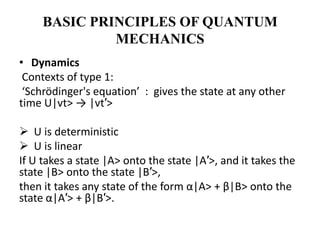
• Dynamics
 Contexts of type 1:
 ‘Schrödinger's equation’ : gives the state at any other
time U|vt> → |vt′>

 U is deterministic
 U is linear
If U takes a state |A> onto the state |A′>, and it takes the
state |B> onto the state |B′>,
then it takes any state of the form α|A> + β|B> onto the
state α|A′> + β|B′>.
BASIC PRINCIPLES OF QUANTUM
             MECHANICS
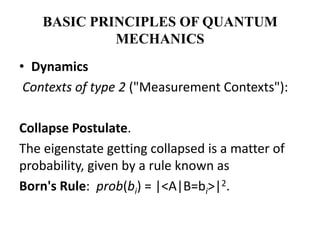
• Dynamics
 Contexts of type 2 ("Measurement Contexts"):

Collapse Postulate.
The eigenstate getting collapsed is a matter of
probability, given by a rule known as
Born's Rule: prob(bi) = |<A|B=bi>|2.
POSTULATES OF QUANTUM MECHANICS :
   ANALOGY WITH LINEAR ALGEBRA

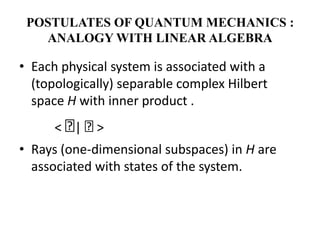
• Each physical system is associated with a
  (topologically) separable complex Hilbert
  space H with inner product .
      < ᵩᵩ
         | >
• Rays (one-dimensional subspaces) in H are
  associated with states of the system.
POSTULATES OF QUANTUM MECHANICS :
   ANALOGY WITH LINEAR ALGEBRA

• Physical observables are represented by
  Hermitian matrices on H.
The expected value (in the sense of probability
theory) of the observable A for the system in
state represented by the unit vector
       |ᵩ Є H
         >          is        < ᵩ |ᵩ
                                 |A >
• A has only discrete spectrum, the possible
  outcomes of measuring A are its eigenvalues.
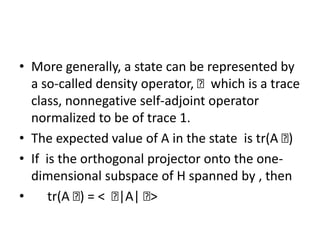
• More generally, a state can be represented by
  a so-called density operator, ᵩwhich is a trace
  class, nonnegative self-adjoint operator
  normalized to be of trace 1.
• The expected value of A in the state is tr(A ᵩ)
• If is the orthogonal projector onto the one-
  dimensional subspace of H spanned by , then
•     tr(A ᵩ = < ᵩ ᵩ
            )     |A| >
Schrödinger picture of quantum mechanics

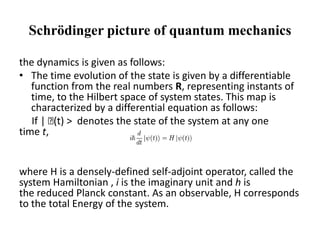
the dynamics is given as follows:
• The time evolution of the state is given by a differentiable
   function from the real numbers R, representing instants of
   time, to the Hilbert space of system states. This map is
   characterized by a differential equation as follows:
   If | ᵩ > denotes the state of the system at any one
         (t)
time t,


where H is a densely-defined self-adjoint operator, called the
system Hamiltonian , i is the imaginary unit and h is
the reduced Planck constant. As an observable, H corresponds
to the total Energy of the system.
Summary
Quantum system      ---   Mathematical Formulation

Possible states      --- Unit Vectors
State Space           --- Hilbert Space
Observable           --- Self- adjoint Linear Operator
Each eigenstate of an observable corresponds to an
eigenvector of the operator, and the associated
eigenvalue corresponds to the value of the observable
in that eigenstate.
THANKS


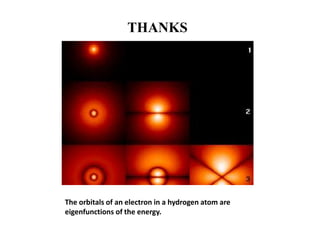
The orbitals of an electron in a hydrogen atom are
eigenfunctions of the energy.

Mathematical Formulation of Quantum Mechanics

  • 1.
    MATHEMETICAL FORMULATIONOF QUANTUM MECHANICS
  • 2.
    Contents • Quantum Mechanics •Basic Principles of Quantum Mechanics • Postulates of Quantum Mechanics : Analogy with Linear Algebra • Schrödinger picture of quantum mechanics • Summary
  • 3.
    QUANTUM MECHANICS  Branchof physics dealing with physical phenomena at microscopic scales, where the action is on the order of the Planck constant. • The dual - particle-like and wave-like behaviour and interactions of energy and matter.
  • 4.
    BASIC PRINCIPLES OFQUANTUM MECHANICS 1. Physical States 2. Physical Quantities 3. Composition 4. Dynamics
  • 5.
    BASIC PRINCIPLES OFQUANTUM MECHANICS • Physical States Every physical system is associated with a Hilbert Space H. Every unit vector in the space corresponds to a possible pure state of the system. The vector is represented by a function known as the wave-function, or ψ-function.
  • 6.
    BASIC PRINCIPLES OFQUANTUM MECHANICS • Physical Quantities Hermitian operators in the Hilbert space associated with a system. Their eigenvalues represent the possible results of measurements of these quantities.
  • 7.
    BASIC PRINCIPLES OFQUANTUM MECHANICS • Composition The Hilbert space associated with a complex system is the tensor product of those associated with the simple system. H1⊗H2
  • 8.
    BASIC PRINCIPLES OFQUANTUM MECHANICS • Dynamics Contexts of type 1: ‘Schrödinger's equation’ : gives the state at any other time U|vt> → |vt′>  U is deterministic  U is linear If U takes a state |A> onto the state |A′>, and it takes the state |B> onto the state |B′>, then it takes any state of the form α|A> + β|B> onto the state α|A′> + β|B′>.
  • 9.
    BASIC PRINCIPLES OFQUANTUM MECHANICS • Dynamics Contexts of type 2 ("Measurement Contexts"): Collapse Postulate. The eigenstate getting collapsed is a matter of probability, given by a rule known as Born's Rule: prob(bi) = |<A|B=bi>|2.
  • 10.
    POSTULATES OF QUANTUMMECHANICS : ANALOGY WITH LINEAR ALGEBRA • Each physical system is associated with a (topologically) separable complex Hilbert space H with inner product . < ᵩᵩ | > • Rays (one-dimensional subspaces) in H are associated with states of the system.
  • 11.
    POSTULATES OF QUANTUMMECHANICS : ANALOGY WITH LINEAR ALGEBRA • Physical observables are represented by Hermitian matrices on H. The expected value (in the sense of probability theory) of the observable A for the system in state represented by the unit vector |ᵩ Є H > is < ᵩ |ᵩ |A > • A has only discrete spectrum, the possible outcomes of measuring A are its eigenvalues.
  • 12.
    • More generally,a state can be represented by a so-called density operator, ᵩwhich is a trace class, nonnegative self-adjoint operator normalized to be of trace 1. • The expected value of A in the state is tr(A ᵩ) • If is the orthogonal projector onto the one- dimensional subspace of H spanned by , then • tr(A ᵩ = < ᵩ ᵩ ) |A| >
  • 13.
    Schrödinger picture ofquantum mechanics the dynamics is given as follows: • The time evolution of the state is given by a differentiable function from the real numbers R, representing instants of time, to the Hilbert space of system states. This map is characterized by a differential equation as follows: If | ᵩ > denotes the state of the system at any one (t) time t, where H is a densely-defined self-adjoint operator, called the system Hamiltonian , i is the imaginary unit and h is the reduced Planck constant. As an observable, H corresponds to the total Energy of the system.
  • 14.
    Summary Quantum system --- Mathematical Formulation Possible states --- Unit Vectors State Space --- Hilbert Space Observable --- Self- adjoint Linear Operator Each eigenstate of an observable corresponds to an eigenvector of the operator, and the associated eigenvalue corresponds to the value of the observable in that eigenstate.
  • 15.
    THANKS The orbitals ofan electron in a hydrogen atom are eigenfunctions of the energy.

Editor's Notes

  • #4 Planck&apos;s constant = 6.626068 × 10⁻³⁴ m2 kg / s
  • #6 A Hilbert space is an abstract vector space possessing the structure of an inner product that allows length and angle to be measured
  • #7  Hermitian matrix (or self-adjoint matrix) is a square matrix with complex entries that is equal to its own conjugate transpose – that is, the element in the i-th row and j-th column is equal to the complex conjugate of the element in the j-th row and i-th column, for all indices i and j[3 2+i][ 2-i 1 ]
  • #9 Given the state of a system at t and the forces and constraints to which it is subject, there is an equation, ‘Schrödinger&apos;s equation’, that gives the state at any other time U|vt&gt; -&gt; |vt′&gt;.[8] The important properties of U for our purposes are that it is deterministic, which is to say that it takes the state of a system at one time into a unique state at any other, and it is linear, which is to say that if it takes a state |A&gt; onto the state |A′&gt;, and it takes the state |B&gt; onto the state |B′&gt;, then it takes any state of the form α|A&gt; + β|B&gt; onto the state α|A′&gt; + β|B′&gt;.
  • #10  Carrying out a &quot;measurement&quot; of an observable B on a system in a state |A&gt; has the effect of collapsing the system into a B-eigenstate corresponding to the eigenvalue observed. This is known as the Collapse Postulate. Which particular B-eigenstate it collapses into is a matter of probability, and the probabilities are given by a rule known as Born&apos;sRule:prob(bi) = |&lt;A|B=bi&gt;|2.
  • #16  First few hydrogen atom orbitals; cross section showing color-coded probability density for different n=1,2,3 and l=&quot;s&quot;,&quot;p&quot;,&quot;d&quot;; note: m=0The picture shows the first few hydrogen atom orbitals (energy eigenfunctions). These are cross-sections of the probability density that are color-coded (black=zero density, white=highest density). The angular momentum quantum number l is denoted in each column, using the usual spectroscopic letter code (&quot;s&quot; means l=0; &quot;p&quot;: l=1; &quot;d&quot;: l=2). The main quantum number n (=1,2,3,...) is marked to the right of each row. For all pictures the magnetic quantum number m has been set to 0, and the cross-sectional plane is the x-z plane (z is the vertical axis). The probability density in three-dimensional space is obtained by rotating the one shown here around the z-axis.