Density
Functional
Theory
1998 Nobel Chemistry
Walter Kohn + John A. Pople
Presenter: Wei-Ting Chen
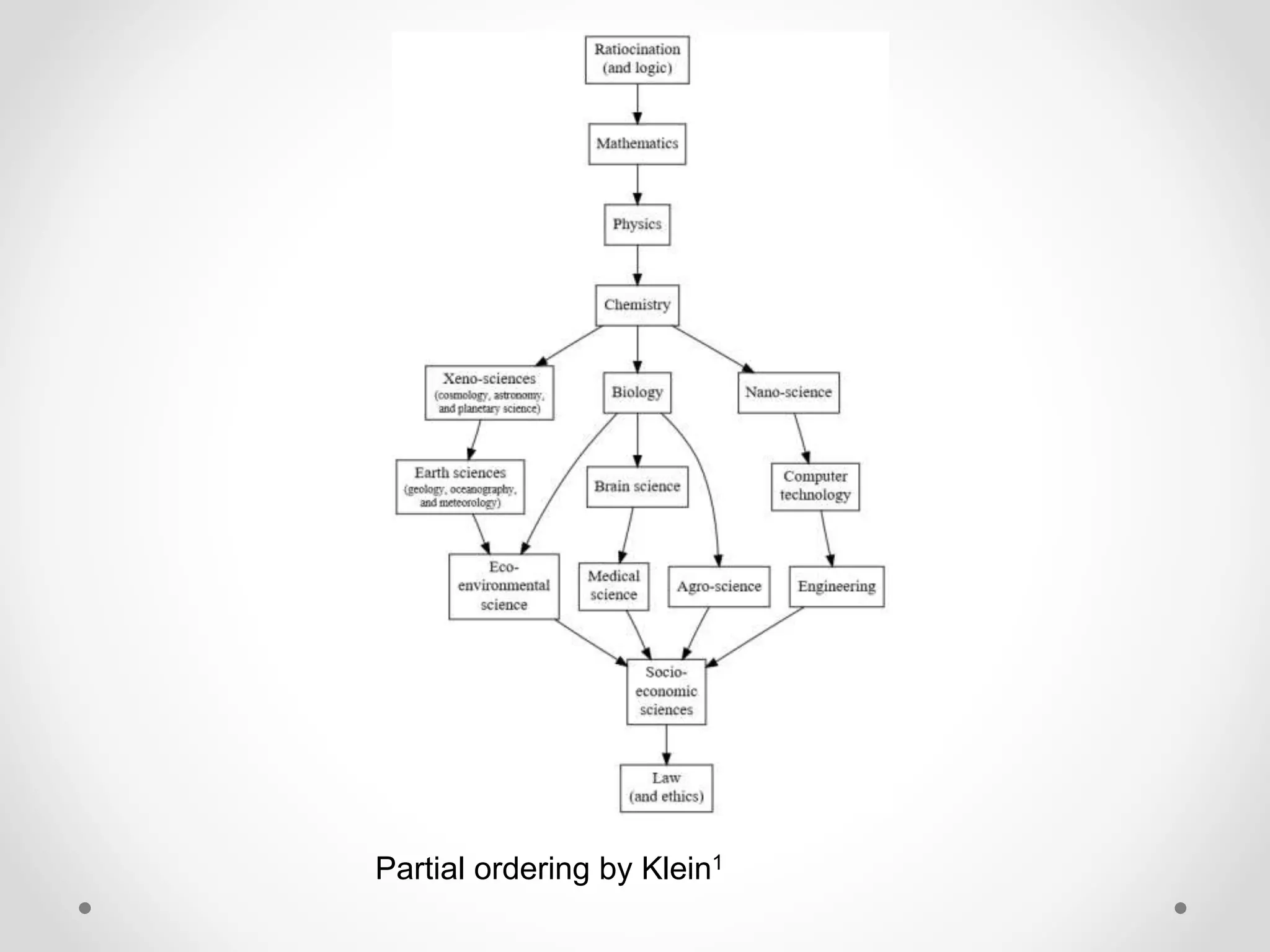
Partial ordering by Klein1
History
• Atomic chemistry 1800s
• Rutherford-Bohr model for quantum physical
interpretation with electron shells.
• Molecular orbital theory in 1933
• Early 1950’s computer development fueled
computational QM
Motivation
• Electron is the main factor for a lot of the properties of
matter
• Nanoscience, our device are scaling down
• DFT application saves experimental probing
• DFT was used in solid state physics since 1970s, but
has great potentials if applicable for chemistry
• Exact wave function solution is unsolvable for many
electron systems
Mathematical Model
• SE: Ĥψ= [T+V+U]ψ= Eψ
• T=e kinetic Energy
• V=e-N attraction
• Electron-electron interaction (U) prevents separation into
single particle wave function for exact solution
• (HK)DFT: E=Ê[ρ(→v)]
• Ê is a single unique functional, but probably extremely
complex
• Approximated functionals
Model cont’d
• Kohn-Sham DFT(KS-DFT)
• Estimating E with Hartree-Fock(HF) kinetic w/ orbital, e-
N, e-e Coulomb, and Exchange-Correlation
• Correlation is e-e interaction
• Exchange is electron exchange interaction
• Most DFT are similar in the first 3 major terms, usually
only Exchange-Correlation is case-specific
• Sometimes orbitals are avoided (usually not in Chem.)
Local Density Approximation
(LDA)
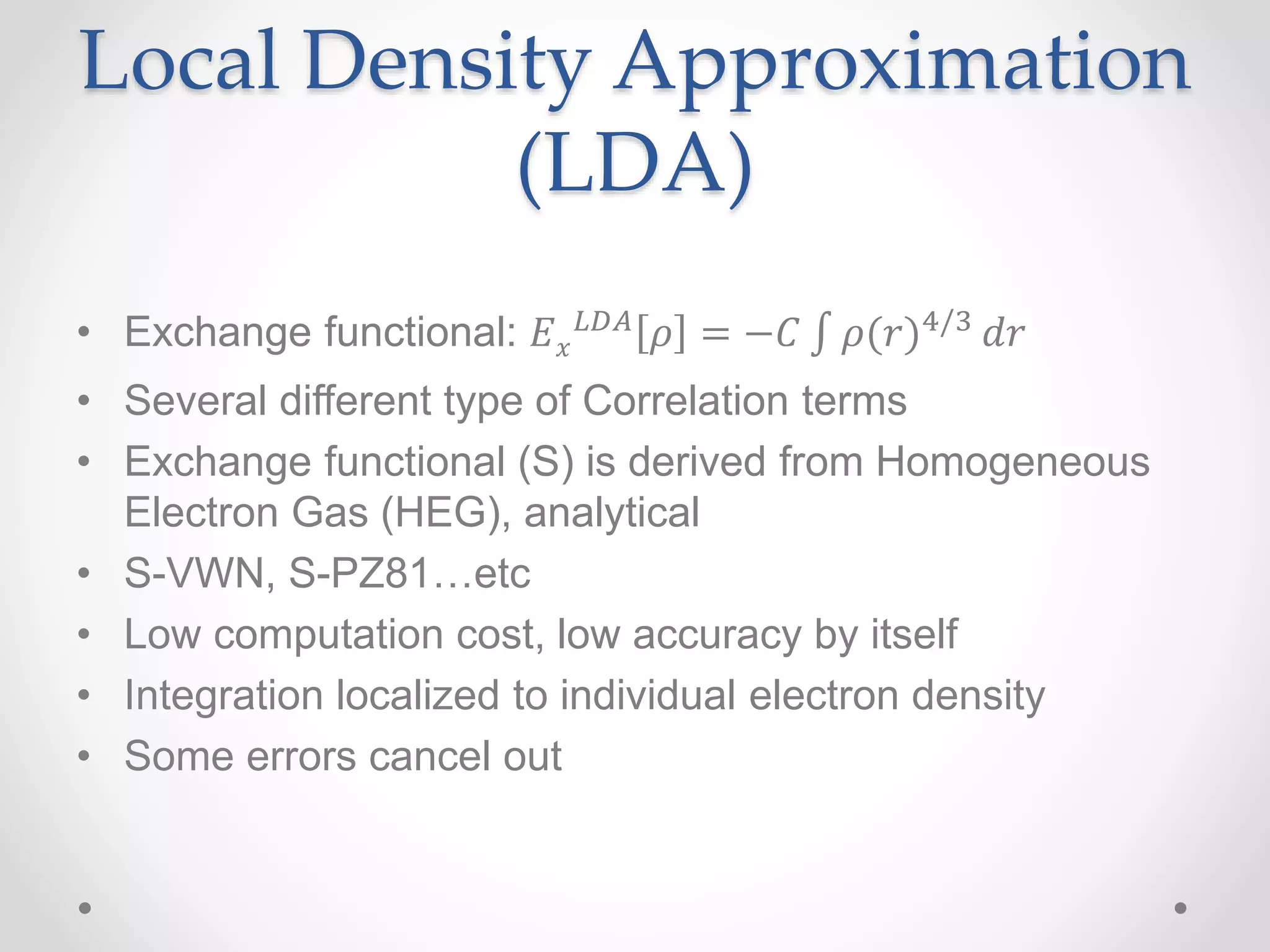
• Exchange functional: 𝐸 𝑥
𝐿𝐷𝐴 𝜌 = −𝐶 𝜌(𝑟)4/3 𝑑𝑟
• Several different type of Correlation terms
• Exchange functional (S) is derived from Homogeneous
Electron Gas (HEG), analytical
• S-VWN, S-PZ81…etc
• Low computation cost, low accuracy by itself
• Integration localized to individual electron density
• Some errors cancel out
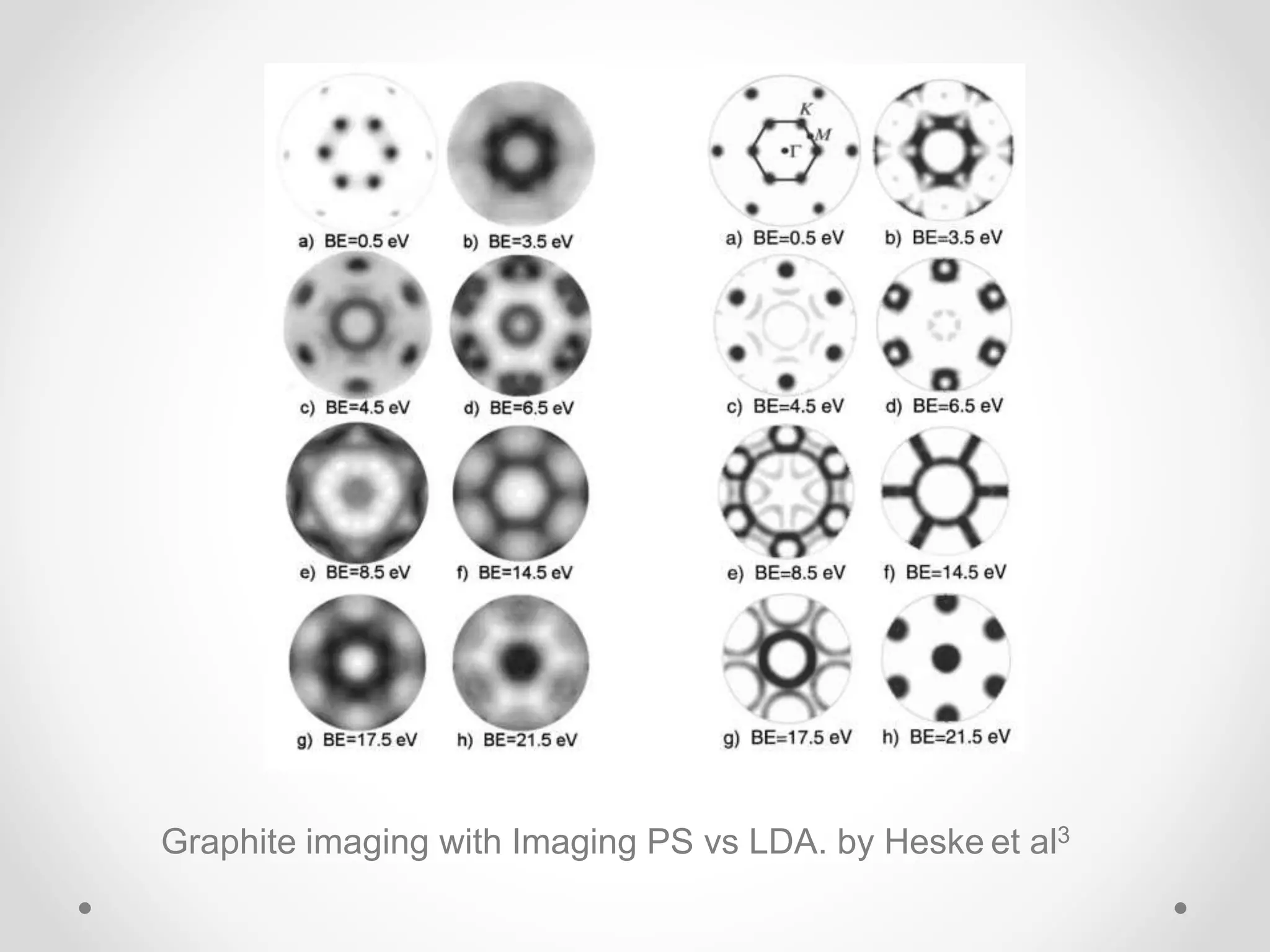
Graphite imaging with Imaging PS vs LDA. by Heske et al3
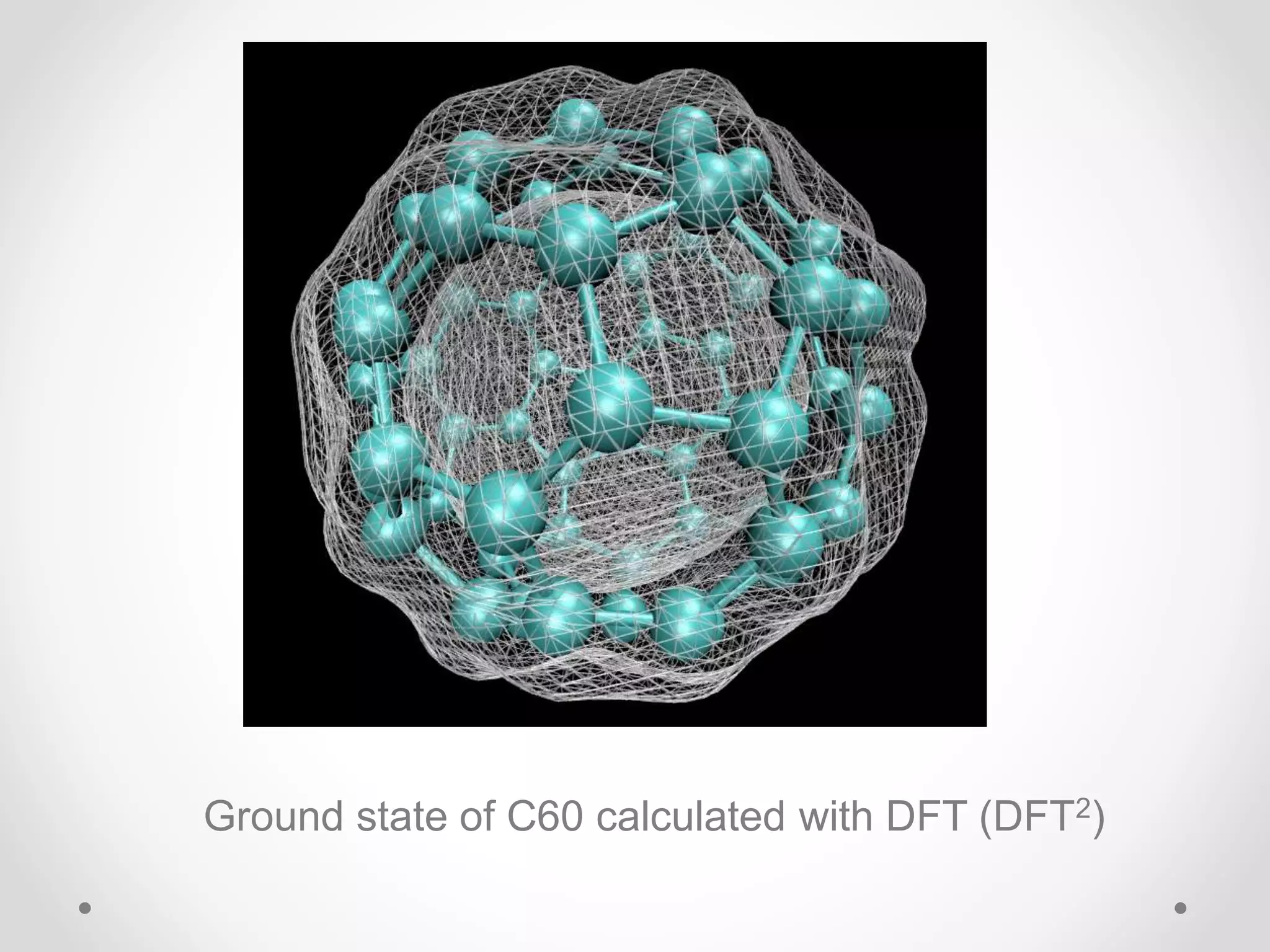
Ground state of C60 calculated with DFT (DFT2)
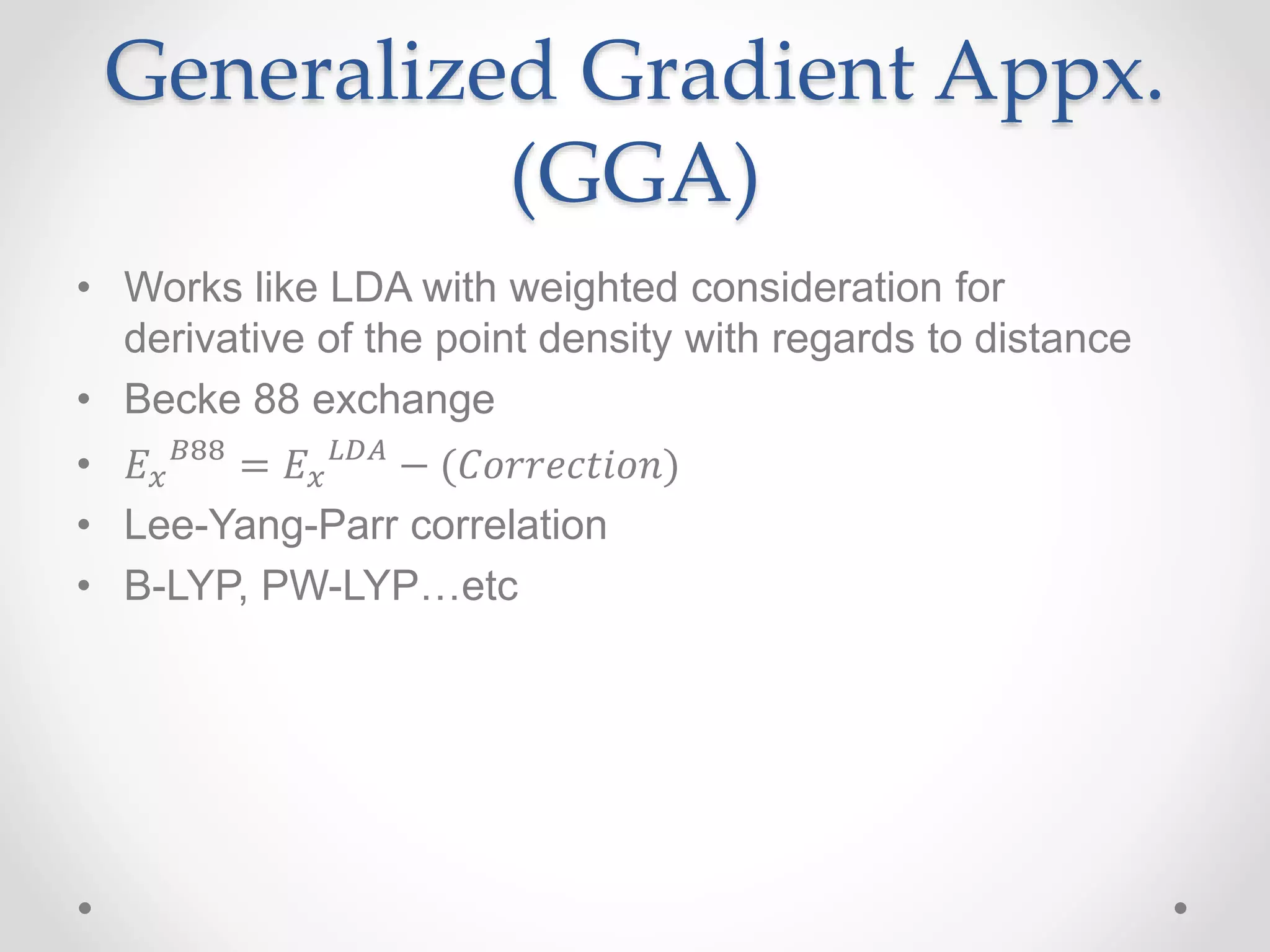
Generalized Gradient Appx.
(GGA)
• Works like LDA with weighted consideration for
derivative of the point density with regards to distance
• Becke 88 exchange
• 𝐸 𝑥
𝐵88
= 𝐸 𝑥
𝐿𝐷𝐴
− (𝐶𝑜𝑟𝑟𝑒𝑐𝑡𝑖𝑜𝑛)
• Lee-Yang-Parr correlation
• B-LYP, PW-LYP…etc
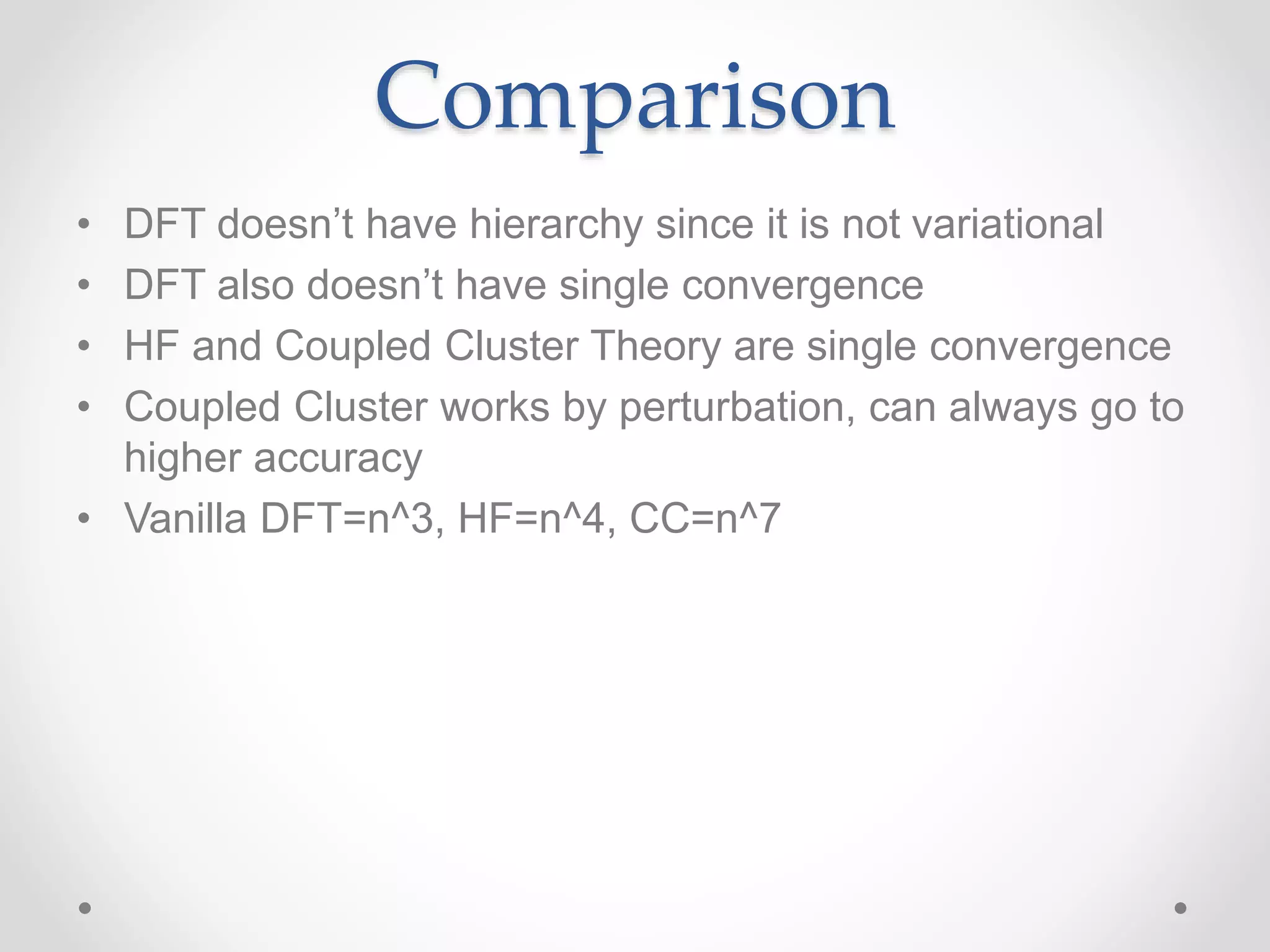
Comparison
• DFT doesn’t have hierarchy since it is not variational
• DFT also doesn’t have single convergence
• HF and Coupled Cluster Theory are single convergence
• Coupled Cluster works by perturbation, can always go to
higher accuracy
• Vanilla DFT=n^3, HF=n^4, CC=n^7
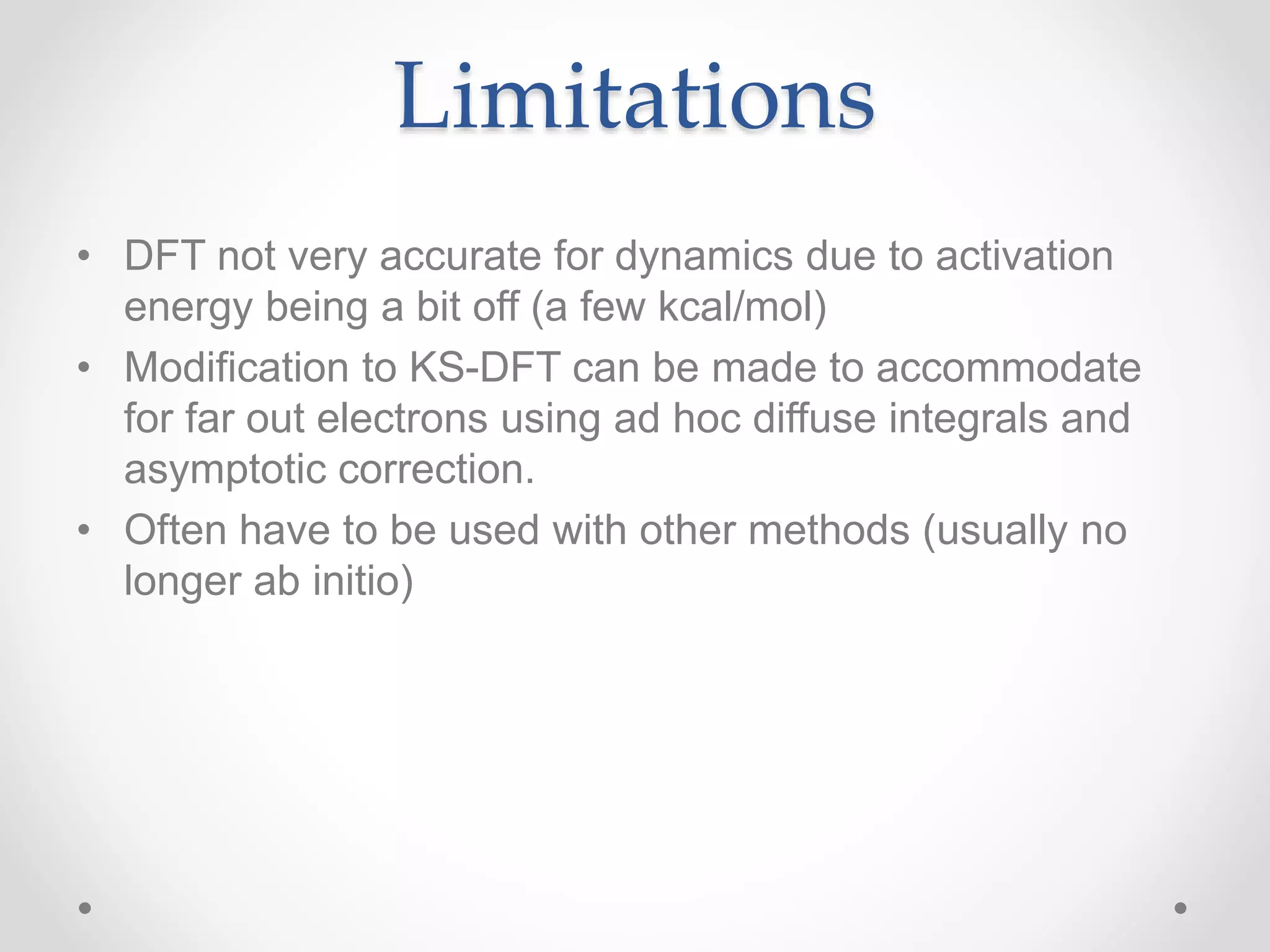
Limitations
• DFT not very accurate for dynamics due to activation
energy being a bit off (a few kcal/mol)
• Modification to KS-DFT can be made to accommodate
for far out electrons using ad hoc diffuse integrals and
asymptotic correction.
• Often have to be used with other methods (usually no
longer ab initio)
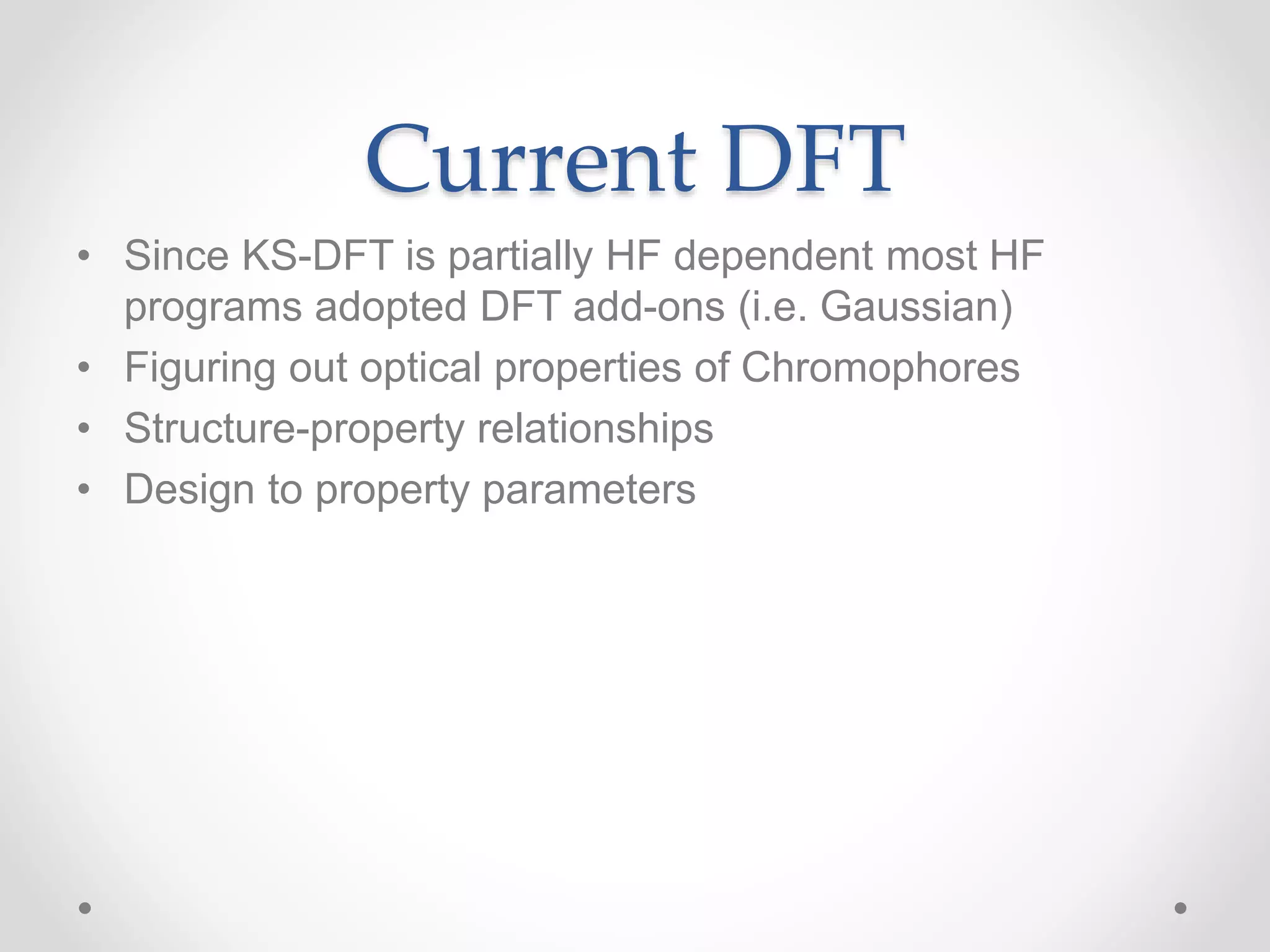
Current DFT
• Since KS-DFT is partially HF dependent most HF
programs adopted DFT add-ons (i.e. Gaussian)
• Figuring out optical properties of Chromophores
• Structure-property relationships
• Design to property parameters
Sources
1. ”Is chemistry ‘The Central Science’? How are different sciences related? Co-
citations, reductionism, emergence, and posets” Alexandru T. Balaban, Douglas J.
Klein Scientometrics 2006, 69, 615-637.
2. Density Functional Theory. (2015, September 22). Retrieved October 18, 2015, from
https://en.wikipedia.org/wiki/Density_functional_theory
3. Heske, C., Treusch, R., Himpsel, F., Kakar, S., Terminello, L., Weyer, H., & Shirley, E.
(1999). Band widening in graphite. Phys. Rev. B Physical Review B, 4680-4684.

Density Functional Theory

  • 1.
    Density Functional Theory 1998 Nobel Chemistry WalterKohn + John A. Pople Presenter: Wei-Ting Chen
  • 2.
  • 3.
    History • Atomic chemistry1800s • Rutherford-Bohr model for quantum physical interpretation with electron shells. • Molecular orbital theory in 1933 • Early 1950’s computer development fueled computational QM
  • 4.
    Motivation • Electron isthe main factor for a lot of the properties of matter • Nanoscience, our device are scaling down • DFT application saves experimental probing • DFT was used in solid state physics since 1970s, but has great potentials if applicable for chemistry • Exact wave function solution is unsolvable for many electron systems
  • 5.
    Mathematical Model • SE:Ĥψ= [T+V+U]ψ= Eψ • T=e kinetic Energy • V=e-N attraction • Electron-electron interaction (U) prevents separation into single particle wave function for exact solution • (HK)DFT: E=Ê[ρ(→v)] • Ê is a single unique functional, but probably extremely complex • Approximated functionals
  • 6.
    Model cont’d • Kohn-ShamDFT(KS-DFT) • Estimating E with Hartree-Fock(HF) kinetic w/ orbital, e- N, e-e Coulomb, and Exchange-Correlation • Correlation is e-e interaction • Exchange is electron exchange interaction • Most DFT are similar in the first 3 major terms, usually only Exchange-Correlation is case-specific • Sometimes orbitals are avoided (usually not in Chem.)
  • 7.
    Local Density Approximation (LDA) •Exchange functional: 𝐸 𝑥 𝐿𝐷𝐴 𝜌 = −𝐶 𝜌(𝑟)4/3 𝑑𝑟 • Several different type of Correlation terms • Exchange functional (S) is derived from Homogeneous Electron Gas (HEG), analytical • S-VWN, S-PZ81…etc • Low computation cost, low accuracy by itself • Integration localized to individual electron density • Some errors cancel out
  • 8.
    Graphite imaging withImaging PS vs LDA. by Heske et al3
  • 9.
    Ground state ofC60 calculated with DFT (DFT2)
  • 10.
    Generalized Gradient Appx. (GGA) •Works like LDA with weighted consideration for derivative of the point density with regards to distance • Becke 88 exchange • 𝐸 𝑥 𝐵88 = 𝐸 𝑥 𝐿𝐷𝐴 − (𝐶𝑜𝑟𝑟𝑒𝑐𝑡𝑖𝑜𝑛) • Lee-Yang-Parr correlation • B-LYP, PW-LYP…etc
  • 11.
    Comparison • DFT doesn’thave hierarchy since it is not variational • DFT also doesn’t have single convergence • HF and Coupled Cluster Theory are single convergence • Coupled Cluster works by perturbation, can always go to higher accuracy • Vanilla DFT=n^3, HF=n^4, CC=n^7
  • 12.
    Limitations • DFT notvery accurate for dynamics due to activation energy being a bit off (a few kcal/mol) • Modification to KS-DFT can be made to accommodate for far out electrons using ad hoc diffuse integrals and asymptotic correction. • Often have to be used with other methods (usually no longer ab initio)
  • 13.
    Current DFT • SinceKS-DFT is partially HF dependent most HF programs adopted DFT add-ons (i.e. Gaussian) • Figuring out optical properties of Chromophores • Structure-property relationships • Design to property parameters
  • 14.
    Sources 1. ”Is chemistry‘The Central Science’? How are different sciences related? Co- citations, reductionism, emergence, and posets” Alexandru T. Balaban, Douglas J. Klein Scientometrics 2006, 69, 615-637. 2. Density Functional Theory. (2015, September 22). Retrieved October 18, 2015, from https://en.wikipedia.org/wiki/Density_functional_theory 3. Heske, C., Treusch, R., Himpsel, F., Kakar, S., Terminello, L., Weyer, H., & Shirley, E. (1999). Band widening in graphite. Phys. Rev. B Physical Review B, 4680-4684.