2015 IEEE SoutheastCon Workshop:
Fully-Polarimetric Phased Array
Far Field Modeling
Joseph Hucks, Ph.D.
SAZE Technologies, LLC
www.sazetech.com
jhucks@sazetech.com
803.842.8818 (Cell)
1
Introduction
• The purpose of this workshop is to show how to create fully-polarimetric models of phased
array antennas in the electromagnetic (EM) far field.
• Definition of the Far Field: Rule of Thumb The far field of a radiating system is approximately
at distances 𝑟 > 2𝐷2
𝜆 from the center of the radiating system, where 𝐷 is its effective
diameter, taken to be its maximum diameter, and 𝜆 is the wavelength of the radiation.
This holds for radiating systems larger than half a wavelength.
For more information see http://en.wikipedia.org/wiki/Near_and_far_field.
• Simplifying Assumptions for our far field analysis
The angular dependencies of the EM fields are invariant of range
The electric and magnetic fields are of the form 𝑒−𝑗𝑘𝑟
𝑟 times functions of only angles, where 𝑘 =
2𝜋 𝜆 is the wavenumber. 𝐄 𝐹𝑎𝑟 𝐹𝑖𝑒𝑙𝑑 = 𝑒−𝑗𝑘𝑟
𝑟 𝐕(𝜃, 𝜙), 𝐕 has units of Volts, and is transverse, i.e.,
perpendicular to the radial direction.
The electric and magnetic fields due to the radiating system are orthogonal and transverse, i.e.,
perpendicular to the direction of propagation
The medium in which the EM waves propagate is homogeneous and isotropic
 Homogeneous means the medium’s properties don’t vary from point to point
 Isotropic means the medium’s properties are the same in every direction
• The simplifying assumptions above make ESA modeling quite simple, really
• Some mathematical results given are for future reference (FFR) only, and not meant to be
completely digested during the workshop, and will only be discussed in passing. These slides
are marked ‘FFR’ in the lower left-hand corner.
2
• Maxwell’s equations (see Jackson’s Classical Electrodynamics and Balanis’
Advanced Engineering Electromagnetics) in SI units
𝛁 ⋅ 𝐃 = ρ , 𝛁 × 𝐇 − 𝜕𝐃 𝜕𝑡 = 𝐉 , 𝛁 × 𝐄 + 𝜕𝐁 𝜕𝑡 = 0 , 𝛁 ⋅ 𝐁 = 0
 𝐃 is the electric flux density in Coulombs per square meter
 𝐁 is the magnetic flux density in Webers per square meter
ρ is the electric charge density in Coulombs per cubic meter
 𝐇 is the magnetic field intensity in Amperes per meter
 𝐉 is the electric current density in Amperes per square meter
 𝐄 is the electric field intensity in Volts per meter
Fictitious magnetic charge and current densities will be ignored here
In a homogeneous and isotropic medium, 𝐃 = ε𝐄 and 𝐁 = μ𝐇, where
ε is the permittivity of the medium in Farads per meter and
μ is the permeability of the medium in Henries per meter
In a vacuum, the exact values are
μ0 = 4𝜋 × 10−7
H m
 𝑐 = 1 μ0ε0 = 299,792,458 m/s exactly (meter was redefined in 1983 to make the speed of light
exact)
ε0 = 1 μ0 𝑐2
= 8.854187817620389 … × 10−12
F m
 𝑍0 = μ0 ε0 = 376.7303134617707 … Ω ≈ 377 Ω, the impedance of free space in Ohms
3
Review of Solutions to the
Time-Harmonic Maxwell’s Equations in the Far Field
for a Homogeneous and Isotropic Medium
FFR
The Time-Harmonic Maxwell Equations
• Assumes that all fields have exp(𝑗ω𝑡) time dependence ⇒ time
derivatives are replaced by factors of 𝑗𝜔 and fields by time-
independent complex phasors
• This allows analysis to be done at a single frequency 𝑓 = ω 2𝜋
• We will also assume for our analysis to follow that the medium is
homogeneous and isotropic (and also not time-varying)
• Maxwell’s Equations then become
𝛁 ⋅ 𝐄 = 𝜌 𝜖 , 𝛁 × 𝐇 − jωϵ 𝐄 = 𝐉 , 𝛁 × 𝐄 + 𝑗𝜔𝜇 𝐇 = 0 , 𝛁 ⋅ 𝐇 = 0
• In a vacuum, which will be our assumption for our analysis, the time-
harmonic Maxwell’s equations become
𝛁 ⋅ 𝐄 = 𝜌 𝜖0 , 𝛁 × 𝐇 − jωϵ0 𝐄 = 𝐉 , 𝛁 × 𝐄 + 𝑗𝜔𝜇0 𝐇 = 0 , 𝛁 ⋅ 𝐇 = 0
• Note that we have 𝜔 = 2𝜋𝑓, 𝑓𝜆 = 𝑐, 𝑘 = 2𝜋 𝜆 , 𝜔 𝑘 = 𝑐 if we are in
vacuum. If not, 𝑐 should be replaced by the speed of light in the medium
𝑣, and the frequency 𝑓 will not change but the wavelength will get
smaller since 𝑣 ≤ 𝑐.
4FFR
General Form of the Far Field Solution
• In the far field of a finite radiating system in a homogeneous and isotropic
medium, we have the general solution
• The 𝐗 𝑙𝑚(𝜃, 𝜙) are the Vector Spherical Harmonics (VSHs) of degree 𝑙 and order
𝑚, where 𝑙 = 1, 2, 3, … and 𝑚 = −𝑙, −𝑙 + 1, … , −1, 0, +1, … , +𝑙. There are 2𝑙 +
1 orders 𝑚 for each degree 𝑙. Note that the VSHs 𝐗 𝑙𝑚 are transverse, i.e., 𝐫 ⋅
𝐗 𝑙𝑚 = 0. Mnemonic: degree𝑙 and 𝑚order.
• There is not a lot of literature on the VSHs, had to derive many results.
• (𝜃, 𝜙) are the ordinary angles from spherical coordinates (see Jackson)
• 𝚱 𝑙𝑚 and 𝚲𝑙𝑚 are arbitrary complex coefficients
• The 𝑃𝑙
𝑚
are the Associated Legendre Polynomials
 Jackson, http://en.wikipedia.org/wiki/Associated_Legendre_polynomials
• The time-averaged Poynting vector is found from the electromagnetic phasors by
 𝐒 =
1
2
Re 𝐄 × 𝐇∗ =
𝐄 2
2𝑍
𝐫 =
1
𝑟2
𝐕 2
2𝑍
𝐫, i.e., the power flows radially outward
5
  ˆ)(coscot)(cosˆ)(coscsc
)!()1(4
)!)(12(
),(
ˆ
1
,]ˆ[
1
1


  m
l
m
l
m
l
mj
lm
l
l
lm
lmlmlmlm
jkr
PmPjPme
mlll
mll
Zr
e











 
θΧ
ErHXrXE
FFR
Vector Spherical Harmonics (VSHs)
6
  ˆ)(coscot)(cosˆ)(coscsc
)!()1(4
)!)(12(
),( 1


  m
l
m
l
m
l
mj
lm PmPjPme
mlll
mll



 
θΧ
The following relationships between the vector spherical harmonics for m hold:



  ml
m
lmlm
m
ml ,
11
, )1(,)1( ΧΧΧΧ
The vector spherical harmonics vanish for 0l or lm || :
lmorlforlm  ||00),( Χ
The vector spherical harmonics lmX and their cross products with the unit radial vector lmXrˆ obey the sum
rule [Jackson]

 
4
12
),(),(),(ˆ),(
2222 
  
l
XX
l
lm
lmlm
l
lm
lm
l
lm
lm XrX
and have the following orthogonality properties [Jackson]:
0sin)ˆ(,sin
2
0 0
2
0 0
   




  
 dddd lmmlmmlllmml XrXXX
FFR
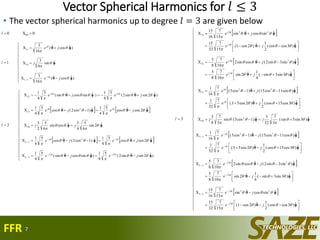
Vector Spherical Harmonics for 𝑙 ≤ 3
• The vector spherical harmonics up to degree 𝑙 = 3 are given below
7
00 00 l
















 )ˆcosˆ(
16
3
ˆsin
8
3
)ˆcosˆ(
16
3
1
1,1
10
11











je
j
je
l
j
j
θ
θ
   
   





























)ˆ2sinˆsin2(
5
8
1
)ˆsincosˆsin(
5
4
1
ˆ2cosˆcos
5
4
1ˆ)1cos2(ˆcos
5
4
1
ˆ2sin
6
5
4
3ˆcossin
6
5
2
3
ˆ2cosˆcos
5
4
1ˆ)1cos2(ˆcos
5
4
1
)ˆ2sinˆsin2(
5
8
1
)ˆsincosˆsin(
5
4
1
2
22
2,2
2
1,2
20
2
21
22
22





























jeje
jeje
jj
jeje
jeje
l
jj
jj
jj
jj
θθ
θθ
θθ
θθ
 
 
 
 
 
 














































































































ˆ)3coscos(
2
1ˆ)2cos1(
15
7
32
15
ˆsincosˆsin
15
7
16
15
ˆ)3sin3sin(
4
1ˆ2sin
10
7
8
5
ˆ)sin3sin2(ˆcossin2
10
7
8
5
ˆ)cos15cos(
2
1ˆ)2cos53(
7
32
1
ˆ)cos11cos15(ˆ)1cos5(
7
16
1
ˆ)3sin5sin(
7
32
3ˆ)1cos5(sin
3
73
ˆ)cos15cos(
2
1ˆ)2cos53(
7
32
1
ˆ)cos11cos15(ˆ)1cos5(
7
16
1
ˆ)3sin3sin(
4
1ˆ2sin
10
7
8
5
ˆ)sin3sin2(ˆcossin2
10
7
8
5
ˆ)3coscos(
2
1ˆ)2cos1(
15
7
32
15
ˆsincosˆsin
15
7
16
15
3
3
223
3,3
2
32
2,3
32
1,3
2
30
32
31
2
32
32
3
223
33








































je
je
je
je
je
je
jj
je
je
je
je
je
je
l
j
j
j
j
j
j
j
j
j
j
j
j
θ
θ
θ
θ
θ
θ
θ
θ
θ
θ
θ
θ
FFR
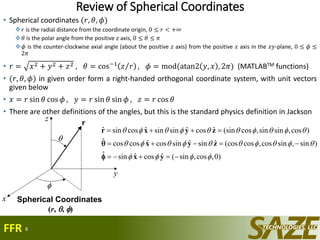
Review of Spherical Coordinates
• Spherical coordinates (𝑟, 𝜃, 𝜙)
𝑟 is the radial distance from the coordinate origin, 0 ≤ 𝑟 < +∞
𝜃 is the polar angle from the positive 𝑧 axis, 0 ≤ 𝜃 ≤ 𝜋
𝜙 is the counter-clockwise axial angle (about the positive 𝑧 axis) from the positive 𝑥 axis in the 𝑥𝑦-plane, 0 ≤ 𝜙 ≤
2𝜋
• 𝑟 = 𝑥2 + 𝑦2 + 𝑧2 , 𝜃 = cos−1
𝑧 𝑟 , 𝜙 = mod(atan2 𝑦, 𝑥 , 2𝜋) (MATLABTM functions)
• (𝑟, 𝜃, 𝜙) in given order form a right-handed orthogonal coordinate system, with unit vectors
given below
• 𝑥 = 𝑟 sin 𝜃 cos 𝜙 , 𝑦 = 𝑟 sin 𝜃 sin 𝜙 , 𝑧 = 𝑟 cos 𝜃
• There are other definitions of the angles, but this is the standard physics definition in Jackson
8
x
z
y


r
x
z
y


r
Spherical Coordinates
(r, , )
)0,cos,sin(ˆcosˆsinˆ
)sin,sincos,cos(cosˆsinˆsincosˆcoscosˆ
)cos,sinsin,cos(sinˆcosˆsinsinˆcossinˆ






yx
zyx
zyxr


FFR
Review of Spherical Harmonics (& Relation to VSHs)
9
The spherical harmonics are given by [Jackson]



 jmm
llm eP
ml
mll
Y )(cos
)!(4
)!)(12(
),(



The spherical harmonics for positive and negative m-values are related simply [Jackson]:
),()1(),(,  
  lm
m
ml YY
The spherical harmonics are normalized and orthogonal, in the following way [Jackson]:
mmlllmml YYdd 

   
 2
0 0
),(),(sin
The completeness relation is given by [Jackson]
)()cos(cos),(),(
0
  

 

l
l
lm
lmlm YY
The Xlm are the vector spherical harmonics, defined in Jackson as
)0(0
...),,3,2,1(),(
)1(
1
),(




l
lY
ll
lmlm  LX
L denotes the angular momentum operator, familiar from quantum mechanics:
 rL j
FFR
http://en.wikipedia.org/wiki/Spherical_harmonics
Kronecker delta
𝛿𝑖𝑗 = 1 if 𝑖 = 𝑗, 0 otherwise
(It is basically the identity matrix)
Review of the Associated Legendre Polynomials
• Associated Legendre Polynomials of Degree 𝑙 and Order 𝑚
10
For ...,3,2,1,0l and llllm ,1,...,0,...,1,  , the associated Legendre polynomials are given by the
following finite power series, derived from Rodrigues’ formula:
mkl
mlfloor
k
k
l
m
mm
l x
mklklk
klx
xP 


 

 2
]2/)([
0
2/2
)!2()!(!
)!22()1(
2
)1(
)1()(
The series above is valid for positive and negative integer values of m. The function floor(x) rounds the real
argument x down to the nearest integer less than or equal to x, and is a standard MATLABTM
function. The upper
sum limit prevents summation over terms that were differentiated away when the derivatives in Rodgrigues’ formula
were taken.
The associated Legendre polynomials vanish for lm || :
lmforxPm
l  ||0)(
The following relationships between the associated Legendre polynomials for integer m hold:
)(
)!(
)!(
)1()(,)(
)!(
)!(
)1()( xP
ml
ml
xPxP
ml
ml
xP m
l
mm
l
m
l
mm
l







FFR
http://en.wikipedia.org/wiki/Legendre_polynomials
http://en.wikipedia.org/wiki/Associated_Legendre_polynomials
Element Patterns
•Simple element patterns that are easy to compute in any
orientation are given
•The Ludwig-3 polarization basis is introduced
•Aperture field methods are briefly discussed
•Element patterns with constant Ludwig-3 polarization are
described
•We discuss how to use general element patterns
11
First Cut cos 𝑁
𝜃 Patterns
12
For a single element, we may model its transmitted electric field in the far field to good approximation
by a field of the following form
𝐄 =
𝑒−𝑗𝑘𝑟
𝑟
𝐕(𝜃, 𝜙) =
𝑒−𝑗𝑘𝑟
𝑟
𝑉0 cos 𝑁
𝜃 𝐩
In the above, 𝑉0 is given by
𝑉0 = (2𝑁 + 1) 𝑃𝑎𝑣𝑒 𝑍0 𝜋
and has units of voltage.
𝑃𝑎𝑣𝑒 is the time-averaged radiated power of the element, and 𝑍0 = 𝜇0 𝜀0 ~377 Ω is the impedance of
free space.
Here, 𝜃 is the angle from the element’s boresight direction, as if the element’s boresight is aligned with
the +𝑧 direction.
𝐩 is a unit Hermitian vector with 𝐩 𝐻
𝐩 = 1, expressed as a two-component unit vector in the Ludwig-3
polarization basis. It can be assumed to vary or be constant with direction, and can also contain any
overall weighting phase. Can replace 𝐩 by 1 or a phase factor for scalar EM approximation (E-field is
just a complex number then).
𝑃𝑎𝑣𝑒 contains any weighting amplitude. This assumes that the element only radiates in the forward
hemisphere, where 0 ≤ 𝜃 ≤ 𝜋 2.
There are no side- or back-lobes, only a mainlobe—this is usually OK if we are only interested in the
array pattern near the mainbeam or first few sidelobes.
𝑁, as we shall see on the next slide, is determined by the element’s Half Power BeamWidth (HPBW).
First Cut cos 𝑁
𝜃 Patterns
13
We note that the exponent 𝑁 is related to the Half Power BeamWidth (HPBW) by the following formula
𝑁 =
ln 2
2 ln cos ( 𝐻𝑃𝐵𝑊/2)
so that the HPBW may be specified instead of 𝑁.
HPBWs of the order of ~ 60° are in the right ballpark for X-Band elements.
If we use the HPBW approximation of the wavelength over the diameter, then for a small element the
diameter is approximately a wavelength, and we get 1 radian or ~ 57.3°.
We are mostly interested in the mainbeam and near sidelobe regions, where the element patterns are
fairly flat.
The cos 𝑁
𝜃 variation gives a somewhat realistic variation due to an element pattern.
Measured or modeled element patterns are often specified by their exponent 𝑁 or their HPBW (be
careful to find out whether the exponent applies to the E-field or power!).
Such element patterns were used by the presenter for many years to simulate ESAs and Phased Array
Fed Reflector antennas.
Note, however, that these patterns in general do not satisfy Maxwell’s equations.
Ludwig-3 Polarization Basis
•The problem with spherical coordinates
They go bad at 𝜃 = 0° (‘North Pole’) and 180° (‘South Pole’)
The 𝜃 and 𝜙 unit vectors are multiply-valued as a function of 𝜙
14
x
z
y


r
x
z
y


r
Spherical Coordinates
(r, , )
 = 0°
yx
zyx
ˆcosˆsinˆ
ˆsinˆsincosˆcoscosˆ






ˆ
ˆ
yx
yx
ˆcosˆsinˆ
ˆsinˆcosˆ






At North Pole:
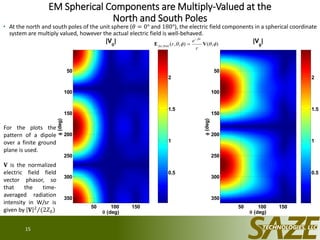
EM Spherical Components are Multiply-Valued at the
North and South Poles
• At the north and south poles of the unit sphere (𝜃 = 0° and 180°), the electric field components in a spherical coordinate
system are multiply valued, however the actual electric field is well-behaved.
15
 (deg)
(deg)
|V

|
50 100 150
50
100
150
200
250
300
350
0.5
1
1.5
2
 (deg)
(deg)
|V

|
50 100 150
50
100
150
200
250
300
350
0.5
1
1.5
2
),(),,(  VE
r
e
r
jkr
fieldfar


For the plots the
pattern of a dipole
over a finite ground
plane is used.
𝐕 is the normalized
electric field field
vector phasor, so
that the time-
averaged radiation
intensity in W/sr is
given by 𝐕 2
(2𝑍0)
Plots of Example Spherical and Rectangular Components at the Poles
16
The angular
components vary
sinusoidally with 𝜙
at the poles, while
the rectangular
components are
well defined.
0 50 100 150 200 250 300 350
0
0.5
1
1.5
2
2.5
3
|V|, |V|, |Vx| and |Vy| at  = 0 and 180 degrees
 (deg)
V

at  = 0 deg
V

at  = 0 deg
V

at  = 180 deg
V

at  = 180 deg
V
x
at  = 0 deg
V
y
at  = 0 deg
V
x
at  = 180 deg
V
y
at  = 180 deg
At the poles, the spherical angular components of the electric field are multiply valued,
but the rectangular components are well-behaved, as they must be. Note that the y
components vanish at the poles for this example.
Ludwig-3 Polarization
• Ludwig-3 polarization components are given by defining horizontal and vertical
components everywhere on the sphere by the same expression relating 𝐸 𝑥 , 𝐸 𝑦 to 𝐸 𝜃 , 𝐸 𝜙
at the north pole of the unit sphere (𝜃 = 0°):
• At the north pole, 𝐸ℎ = 𝐸 𝑥 and 𝐸 𝑣 = 𝐸 𝑦. The Ludwig-3 polarization components are
well-behaved at the north pole and the rest of the sphere, except at the south pole (𝜃 =
180°), where they break down.
• The Ludwig-3 unit polarization basis vectors are obtained by rotating the spherical unit
vectors by a clockwise angle 𝜙 about the outward radial direction on the unit sphere.
This counters the multiple-valuedness of the spherical unit vectors at the north pole,
yielding a set of unit vectors there that are constant as 𝜙 goes from 0° to 360°.
• The Ludwig-3 basis is very useful if the boresight of your antenna (or antenna elements) is
taken to be in the +𝑧 direction; the basis goes bad at the south pole, but this is often not
a direction of interest. If you use spherical components instead, you have to be very
careful near the poles to make sure and handle things correctly to avoid numerical
problems.
17













 










E
E
E
E
v
h
cossin
sincos
Spherical and Rectangular Bases
18
The spherical angle unit vectors are given by
yx
zyx
ˆcosˆsin)0,cos,sin(ˆ
ˆsinˆsincosˆcoscos)sin,sincos,cos(cosˆ






In the far field, the electric field E has only angular components, and their relationship to rectangular components is given by
zyx
zyxE
ˆ]0sin[ˆ]cossincos[ˆ]sincoscos[
ˆˆˆˆˆ),,(


 EEEEEE
EEEEEEEE zyxzyx

 
This relationship may be summarized in matrix form (with the spherical components converted to Ludwig-3 components in the last step):























































v
h
z
y
x
E
E
E
E
E
E
E










cossin
sincos
0sin
cossincos
sincoscos
0sin
cossincos
sincoscos
The spherical coordinate system becomes degenerate at the north and south poles ( = 0º and 180º, respectively). At the poles of the sphere, the
relationship above becomes (note that for a far field electric field, Ez = 0 at the poles, since the z component is longitudinal there)
  
 

18018000
cossin
sincos
,
cossin
sincos






































 

















E
E
E
E
E
E
E
E
y
x
y
x
The inverse relationships are given by

18018000
cossin
sincos
,
cossin
sincos























































y
x
y
x
E
E
E
E
E
E
E
E
which shows that E and E are multivalued at the poles as  varies from 0 to 180º, since physically the rectangular components must be well-
behaved everywhere.
Ludwig-3 Polarization Formulas
19
Ludwig-3 polarization components are given by defining the horizontal and vertical components to be given everywhere on the sphere by the same
expression as the rectangular components Ex and Ey are given in terms of E and E at the north pole:
  












 










E
E
E
E
v
h
cossin
sincos
At the north pole, Eh = Ex and Ev = Ey. The Ludwig-3 polarization components are well behaved at the north pole and the rest of the sphere except
the south pole, where they break down.
The spherical components may be given in terms of the Ludwig-3 components by using the inverse 2D rotation matrix to that above:





















v
h
E
E
E
E




cossin
sincos
Since the Ludwig-3 components hE and vE are well-behaved and constant at the north pole, we see that the spherical components E and E will
have a sinusoidal dependence on  there.
The Ludwig-3 unit polarization vectors can be shown to be given by
 
)ˆˆ(
ˆˆ1
ˆˆ
ˆ)ˆˆ(ˆ
cos1
)]ˆˆ(ˆ[ˆ
ˆ]sinsin[ˆ]sin)1(cos1[ˆ]sincos)1(cos[ˆ
)ˆˆ(
ˆˆ1
ˆˆ
ˆ)ˆˆ(ˆ
cos1
)]ˆˆ(ˆ[ˆ
ˆ]cossin[ˆ]sincos)1(cos[ˆ]cos)1(cos1[ˆ
2
2
zr
zr
yr
yzry
zryr
zyxv
zr
zr
xr
xzrx
zrxr
zyxh






































zr
y
zr
x




At the north pole ( = 0°), the factor )1(cos  vanishes and we see that xh ˆˆ  and yv ˆˆ  . At the south pole ( = 180°), the factor 2)1(cos  ,
and we see that hˆ and vˆ are multiply valued vector functions of . Thus the Ludwig-3 polarization basis is good everywhere on the sphere except
the south pole. It should be noted that the Ludwig-3 basis is not a coordinate (holonomic) basis, but is a non-coordinate (anholonomic) basis. 
  
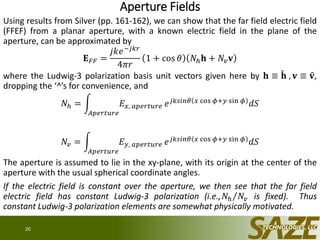
Aperture Fields
Using results from Silver (pp. 161-162), we can show that the far field electric field
(FFEF) from a planar aperture, with a known electric field in the plane of the
aperture, can be approximated by
𝐄 𝐹𝐹 =
𝑗𝑘𝑒−𝑗𝑘𝑟
4𝜋𝑟
1 + cos 𝜃 𝑁ℎ 𝐡 + 𝑁𝑣 𝐯
where the Ludwig-3 polarization basis unit vectors given here by 𝐡 ≡ 𝐡 , 𝐯 ≡ 𝐯,
dropping the ‘^’s for convenience, and
𝑁ℎ =
𝐴𝑝𝑒𝑟𝑡𝑢𝑟𝑒
𝐸 𝑥, 𝑎𝑝𝑒𝑟𝑡𝑢𝑟𝑒 𝑒 𝑗𝑘𝑠𝑖𝑛𝜃 𝑥 cos 𝜙+𝑦 sin 𝜙
𝑑𝑆
𝑁𝑣 =
𝐴𝑝𝑒𝑟𝑡𝑢𝑟𝑒
𝐸 𝑦, 𝑎𝑝𝑒𝑟𝑡𝑢𝑟𝑒 𝑒 𝑗𝑘𝑠𝑖𝑛𝜃 𝑥 cos 𝜙+𝑦 sin 𝜙 𝑑𝑆
The aperture is assumed to lie in the xy-plane, with its origin at the center of the
aperture with the usual spherical coordinate angles.
If the electric field is constant over the aperture, we then see that the far field
electric field has constant Ludwig-3 polarization (i.e., 𝑁ℎ 𝑁𝑣 is fixed). Thus
constant Ludwig-3 polarization elements are somewhat physically motivated.
20
Element Patterns with Constant Ludwig-3 Polarization
As a first approximation, we can model an element with polarization as having
constant Ludwig-3 polarization. We then have
𝐄 =
𝑒−𝑗𝑘𝑟
𝑟
𝑉0 cos 𝑁
𝜃 𝐩
where 𝐩 is a constant complex vector with unit Hermitian norm, i.e., as mentioned
before, 𝐩 𝐻
𝐩 = 1. We can now take
𝐩 = 𝛼𝐡 + 𝛽𝐯 with 𝛼 2 + 𝛽 2 = 1
Left-Handed Circular Polarization (LHCP) is given by 𝐩 =
1
2
(𝐡 + 𝑗𝐯)
Right-Handed Circular Polarization (RHCP) is given by 𝐩 =
1
2
(𝐡 − 𝑗𝐯)
Horizontal Polarization (H) is given by 𝐩 = 𝐡
Vertical Polarization (V) is given by 𝐩 = 𝐯
𝐩 can also contain an arbitrary phase
The 𝑥, 𝑦, 𝑧 coordinate system should be chosen so that horizontal and vertical
directions in the Ludwig-3 polarization basis generally correspond to the desired
directions—they won’t match actual vertical or horizontal everywhere.
21
General Element Patterns
• If one wishes to have more sophisticated and general element patterns, then
there are a few options that we will discuss here.
The first option would be to create your own pattern functions, analogous to the cos 𝑁 𝜃
patterns, but more complicated. If you have formulas for the element patterns, then you
could compute them in any direction.
Another option would to use measured or modeled patterns and interpolate them. You
would need values every degree or so over the unit sphere of direction space, at least in
the directions of interest.
It is more computationally intensive.
Have to be careful at the poles if using 𝐸 𝜃 and 𝐸 𝜙 components—recommend using Ludwig-3 basis.
Another option would be to model the element patterns with a finite Vector Spherical
Harmonics (VSH) expansion of low degree.
Measured or modeled element patterns could be fit with low degree (𝑙) VSH expansions—more
complicated patterns of electrically large complex antennas would probably require many terms for a
good fit. You will get better results fitting the elements rather than the whole antenna.
VSH fits can also be used to interpolate reasonable pattern values that satisfy Maxwell’s equations in
directions that numerical codes fail.
• Since we only usually care about the overall pattern near the mainbeam and first
few sidelobes, the element patterns just taper the array pattern slightly and
don’t usually have a big effect, so the simple cos 𝑁
𝜃 patterns are usually
sufficient.
22
Translations and Rotations—Rationale
•To model the far field electric field (FFEF) of an array, we
need to sum up the individual element patterns
•The element patterns will in general need to be translated to
the desired position and then rotated into the desired
orientation (or vice versa)
•Thus we need to know how the far field element patterns
are changed by translations and rotations
•The further apart we space the elements, the further out the
far field will be.
•We will first discuss the effect of translations on the element
patterns, and then the effects of rotations
23
Effects of Translations on the Far Field Pattern
• The Translation Factor
If the phase center of a radiating system with far field E-field 𝐄 is translated from
the origin to point 𝐚, then the new far field pattern is
𝐄′
= 𝑒 𝑗𝐤⋅𝐚
𝐄
𝑒 𝑗𝐤⋅𝐚
is the translation factor
It is angularly dependent, since the wave vector in spherical coordinates is given by
𝐤 = 𝑘 𝐫 =
2𝜋
𝜆
sin 𝜃 cos 𝜙 , sin 𝜃 sin 𝜙 , cos 𝜃
𝜆 is the wavelength at the frequency of interest, 𝑘 is the wavenumber.
𝐚 is a constant vector, pointing from the origin to the point where the radiating system
is translated (or from a different location to a new one).
It is assumed that the radiating system is only translated and not rotated, so that it
maintains its orientation (will treat rotations in next topic).
Also called the Array Factor for a single radiating element
24
a
x y
z
𝐄
𝐄′
Translation Factor—More Detail
25
The far field transmitted electric field of an element, subarray, or general radiating system with its phase
center at the origin of the coordinate system, chosen here to be at the overall antenna phase center for
convenience, is denoted by
0),(ˆ,),(
)exp(
),,( 

  VrVE
r
jkr
r
𝐕 is a transverse (perpendicular to the radial direction) vector function of the spherical angles 𝜃 and 𝜙,
gives the angular polarization pattern in the far field, and is independent of 𝑟, the distance from the
phase center of the radiating system to the far field point. In the above,  /2k is the wavenumber at
the frequency of interest. We are dealing with electric field phasors here, so the exp⁡( 𝑗𝜔𝑡) time
dependence has been factored out.
If the radiating system’s phase center is not at the overall phase center of the antenna, but translated (and
not rotated!) to a location ar  in the coordinate system centered on the overall antenna phase center,
then relative to this coordinate system, the effective pattern of the translated radiating system is
),()exp(
)exp(
),,()exp(),,(  VakEakE 

 j
r
jkr
rjr
k is the wave vector (pointing radially outwards),
)cos,sinsin,cos(sin
2
ˆ 


 rk k
We note that the effect of a translation of the radiating system’s phase center from the origin at the
overall phase center to ar  on the far field electric field (i.e., the radiation pattern) is equivalent to a
direction dependent phase shift of the electric field. This is similar and related to the effect of a spatial
or temporal translation on the Fourier transform of a function.
FFR
Translation Factor—Derivation
26
The result may be straightforwardly derived from
),(
)exp(
),,(  VE
r
rjk
r



with arr  and 22
2|||| arr  ararr and ||aa , and using the far field approximation that ar  .
Let us briefly go through the derivation. Since we are in the far field and assume that arr , , and r and r both point in very near the same
direction, we have that rr  , and r may be replaced by r in the denominator to good approximation:
),,()](exp[),(
)exp(
),(
)exp(
),,(  rrrkj
r
rkj
r
rkj
r EVVE 





Thus we need to merely approximate rr  in the far field where arr , . We have
ar
ar
ar
arar
ar
ar






 






 


















ˆ
ˆ
ˆ
2
2
1
1
ˆ
21
ˆ
21
21)2(
2/12/1
2
2
2/1
2
2
2
2/122
rr
r
rr
r
rr
r
a
r
rr
r
a
r
rrarrrr
so that
),,()exp(
),,()ˆexp(
),,()](exp[),,(



rj
rkj
rrrkjr
Eak
Ear
EE



which completes the proof. The ‘Array Factor’ )exp( ak j is an angular and frequency dependent phase term that multiplies the pattern of an element
or subarray at the origin to account for the translation of the radiating system’s phase center by a vector distance a .
FFR
Rotations of Far Field Patterns
• To find the far field electric field of a phased array, the elements need
to be translated and rotated into the proper positions and
orientations. We discuss how far field patterns are changed by
rotations, and discuss rotation matrices. We close this section with the
general formula for a rotated far field pattern.
27
Introduction to Rotation Matrices
• Active vs. Passive Rotations
• Geometric Derivation
• Component Form of a Rotation Matrix
Active vs. Passive Rotations
• Active rotations actually physically rotate something; the coordinate axes are fixed, but, for instance, a vector 𝐯 is
rotated by an angle 𝛼 about a unit vector axis 𝐞 (right hand rule applies: right thumb points in the direction of
the axis of rotation, and fingers curl in direction of rotation by angle 𝛼)—see figure on left below.
• Passive rotations are when physical vectors are unchanged but we wish to calculate a fixed vector 𝐯’s components
in a rotated coordinate system—see figure on right below.
• The active and passive rotation matrices are just inverses of each other. The inverse of a rotation matrix is just its
transpose since it is an orthogonal matrix: 𝐑𝐑 𝑇
= 𝐑 𝑇
𝐑 = 𝐈. We only consider proper rotations where det 𝐑 =
𝐑 = +1 , otherwise we would be including spatial inversions, where 𝑥, 𝑦, 𝑧 → −(𝑥, 𝑦, 𝑧)
• Reversing the axis or angle gives the inverse rotation; reversing both gives the same rotation.
28
𝑦
𝑥
𝐯
𝛼
𝐑 𝑎𝑐𝑡𝑖𝑣𝑒
( 𝐳, 20°)𝐯
𝑦
𝑥
𝐯
𝛼
𝑨𝒄𝒕𝒊𝒗𝒆 𝑹𝒐𝒕𝒂𝒕𝒊𝒐𝒏 𝒂𝒃𝒐𝒖𝒕 + 𝒛 𝒂𝒙𝒊𝒔 𝒃𝒚 𝒂𝒏𝒈𝒍𝒆 𝜶
𝐑 𝑎𝑐𝑡𝑖𝑣𝑒
𝐳, 20° 𝐯 𝑥
𝑷𝒂𝒔𝒔𝒊𝒗𝒆 𝑹𝒐𝒕𝒂𝒕𝒊𝒐𝒏 𝒂𝒃𝒐𝒖𝒕 + 𝒛 𝒂𝒙𝒊𝒔 𝒃𝒚 𝒂𝒏𝒈𝒍𝒆 𝜶
Geometric Derivation
• Derivation is for an active rotation matrix 𝐑
• The rotation does not change the component 𝐯∥ of the vector parallel to the axis
of rotation 𝐞, but rotates the perpendicular component 𝐯⊥ by an angle 𝛼 about
the axis (RH rule applies), in a plane perpendicular to the axis. 𝐯⊥ is like the x
axis in the perpendicular plane, and 𝐞 × 𝐯⊥ is like the y axis (see figure below).
29
𝐯 = 𝐈 − 𝐞𝐞 𝑇
+ 𝐞𝐞 𝑇
𝐯
= 𝐈 − 𝐞𝐞 𝑇 𝐯 + 𝐞𝐞 𝑇 𝐯
= 𝐯 − 𝐞 ⋅ 𝐯 𝐞 + 𝐞 ⋅ 𝐯 𝐞
≡ 𝐯⊥ + 𝐯∥
𝐑𝐯 = cos 𝛼 𝐯 + 1 − cos 𝛼 𝐞 ⋅ 𝐯 𝐯 + sin 𝛼 𝐞 × 𝐯
• Here we give the component forms of active and passive rotation matrices; can be found from
result on previous slide since vector 𝐯 is arbitrary
• Can switch between active and passive forms by changing sign of sin 𝛼
• Einstein Summation Convention used where repeated indices are summed over
• 𝜀𝑖𝑗𝑘 is the Levi-Civita symbol, which is +1 if 𝑖𝑗𝑘 is an even permutation of 123 (i.e., 𝑖𝑗𝑘 =
123, 231, 𝑜𝑟 312), −1 if an odd permutation of 123 (i.e., 𝑖𝑗𝑘 = 132, 321, 𝑜𝑟 213), and 0
otherwise
Component Form of a Rotation Matrix
30
1
sin)cos1(cos
)cos1(cossin)cos1(sin)cos1(
sin)cos1()cos1(cossin)cos1(
sin)cos1(sin)cos1()cos1(cos
),(
2
3
2
2
2
1
3
1
2
2
3132231
132
2
2321
231321
2
1

















eeeeee
eeeR
or
eeeeeee
eeeeeee
eeeeeee
i
iii
kijkjiijij
ee
eR





MatrixRotationPassive
1
sin)cos1(cos
)cos1(cossin)cos1(sin)cos1(
sin)cos1()cos1(cossin)cos1(
sin)cos1(sin)cos1()cos1(cos
),(
2
3
2
2
2
1
3
1
2
2
3132231
132
2
2321
231321
2
1

















eeeeee
eeeR
or
eeeeeee
eeeeeee
eeeeeee
i
iii
kijkjiijij
ee
eR





MatrixRotationActive
FFR
MATLABTM Function to Compute Active Rotation Matrix% % % J. Hucks, SAZE Technologies, LLC
%
% R=Rfromaxisangle(axis,alphadeg)
%
% This function computes the 3x3 real active rotation matrix given the axis
% of rotation and the rotation angle.
%
% axis is a 3x1 unit column vector with the x, y and z components of the
% axis of rotation. If it is not a unit vector, it is normalized, so it
% does not have to be a unit vector, but must be parallel to the axis of
% rotation.
%
% alphadeg is the real angle of the rotation in degrees, using the RH rule
% convention, where the right thumb points in the direction of the axis of
% rotation, and the fingers curl in the direction of the rotation (if the
% rotation angle is positive).
function R=Rfromaxisangle(axis,alphadeg)
% 1 degree in radians
deg=pi/180;
% Convert alphadeg to radians
alpha=alphadeg*deg;
% Make sure axis is a unit vector
e=axis/norm(axis);
% Separate out the components of e for computation to follow
e1=e(1); e2=e(2); e3=e(3);
% Define needed trig functions of alpha
ca=cos(alpha); sa=sin(alpha); omca=1-ca;
% Compute the 3x3 active rotation matrix R
R=[ ca+e1^2*omca e1*e2*omca-e3*sa e1*e3*omca+e2*sa;
e1*e2*omca+e3*sa ca+e2^2*omca e2*e3*omca-e1*sa;
e1*e3*omca-e2*sa e2*e3*omca+e1*sa ca+e3^2*omca ];
31
• Implements the formula from the previous slide for
computing an active rotation matrix by computing its
components
• Inputs are a unit vector giving the axis of rotation and an
angle in degrees giving the angle of rotation, with the
RH rule applying
• This function computes 1 active rotation matrix from a
single axis and angle of rotation
• To get a passive rotation matrix for the same axis and
angle, simply input the opposite axis or angle. Putting in
the opposite axis and opposite angle will give you the
same active rotation matrix.
• Can also use the alternative result for an active rotation
matrix
𝐑 = exp 𝛼
0 −𝑒3 𝑒2
𝑒3 0 −𝑒1
−𝑒2 𝑒1 0
• In the above, the MATLABTM matrix exponential function
expm function should be used, and not the element-by-
element exponential function exp; however, this
formulation is computationally more intensive and will
be less accurate due to slower convergence.
• Can use MATLABTM function logm, inverse of expm, to
solve for axis and angle of rotation of a rotation matrix.
• Rfromaxisangle is free to use and distribute with
attribution
FFR
• Note that if we form a 3 × 𝑁 matrix with 3D vectors in
its 𝑁 columns and multiply on the left by a 3 × 3
rotation matrix 𝐑, the resultant 3 × 𝑁 matrix is the
previous matrix with each column multiplied by 𝐑
 This can be useful in vectorizing code when we
are rotating many vectors simultaneously, all with
the same rotation matrix
General Formula for Rotated Far Field Pattern
• In the far field of any finite radiating system, the electric field is given by 𝐄 𝐹𝑎𝑟 𝐹𝑖𝑒𝑙𝑑 =
𝑒−𝑗𝑘𝑟
𝑟 𝐕 𝜃, 𝜙 , where 𝐫 ⋅ 𝐕 = 0 (the electric field is transverse)
• 𝐕 𝜃, 𝜙 = 𝑉𝜃 𝜃, 𝜙 𝛉 + 𝑉𝜙 𝜃, 𝜙 𝛟 = 𝑉ℎ 𝜃, 𝜙 𝐡 + 𝑉𝜙 𝜃, 𝜙 𝐯
• 𝐫 = 𝐫 𝜃, 𝜙 = (sin 𝜃 cos 𝜙 , sin 𝜃 sin 𝜙 , cos 𝜃)
• Can think of 𝐕 as a function of 𝐫, i.e., 𝐕 = 𝐕 𝐫
For convenience, let 𝐪 = 𝐫
• We wish to calculate this pattern in the Master Coordinate System (MCS) of the entire
phased array
• We assume the pattern is given in its own coordinate system
Typically the z axis for the pattern coordinate system is in its boresight
direction
• 𝐑 is the active rotation that rotates the element into its desired
orientation in the MCS
• If we wish to calculate 𝐕 in direction 𝐪 in the MCS, then we must
compute the pattern at 𝐑−1
𝐪 and then rotate the
polarization
• Thus we have
𝐕𝑟𝑜𝑡 = 𝐑𝐕 𝐑−1
𝐪 = 𝐑𝐕 𝐑 𝑇
𝐪
• The FFEF is obtained by multiplying the above by 𝑒−𝑗𝑘𝑟
𝑟
32
-0.4 -0.2 0 0.2 0.4 0.6
-0.4
-0.2
0
0.2
0.4
0.6
0.8
1
1.2
x
z
Nominal Pattern
Rotated Pattern
AoA
Transformations Between Unit Direction Vector 𝐪 and Spherical Angles
• The following formulas may be used to transform between a unit direction vector and the spherical angles
33
The spherical coordinate angles  and  can be easily expressed in terms of the unit vector q.
Below are formulas for the spherical angles in radians in terms of the rectangular components
of q.
)2),,(atan2(mod,)(cos 1
 xyz qqq  
The MATLABTM atan2 function takes values from  to  radians, whereas the angle  takes
values from  to  radians. Note that the y component comes first in the argument, which
differs from other definitions of the atan2 function in which the x component comes first. The
mod function is the standard MATLABTM function, the effect of which in the formula above is to
keep the angle  between  and  radians.
We may also write the relationships between q and the spherical coordinate angles  and  as



cos,sinsin,cossin
1
sin,
1
cos
1sin,cos
22
2






zyx
z
y
z
x
zz
qqq
q
q
q
q
qq
For reference, the spherical coordinate unit vectors are given by
)0,cos,sin(ˆ
)sin,cossin,cos(cosˆ
)cos,sinsin,sin(cosˆ







θ
r
FFR
Formula for the Far Field Electric Field of a General 3D Phased Array
• Putting things together, if we translate and rotate a radiating element, then the translated and
rotated 𝐕-field becomes
𝐕 𝐪 = exp 𝑗𝑘𝐪 ⋅ 𝐚 𝐑 𝐕 𝐑 𝑇
𝐪
• We note that the order of translation and rotation does not matter, i.e., translations and rotations
commute for our purposes.
 Note, however, that two rotations do not commute in 3 dimensions unless their axes of rotation are in the same or opposite
directions. Rotations in 2 dimensions commute, since they have a common axis of rotation, the z axis.
• Each element will have its own location and orientation, specified by 𝐚 and 𝐑, respectively, so all
that remains to compute the total 𝐕 and 𝐄 far fields is to simply sum over all of the elements with
arbitrary complex weights, to obtain the Grand Final Result
𝐕 𝑇𝑂𝑇 𝐪 =
𝑒𝑙𝑡𝑠
𝐶𝑒𝑙𝑡 exp 𝑗𝑘𝐪 ⋅ 𝐚 𝑒𝑙𝑡 𝐑 𝑒𝑙𝑡 𝐕𝑒𝑙𝑡 𝐑 𝑒𝑙𝑡
𝑇
𝐪
𝐄 𝑇𝑂𝑇 𝐪 =
𝑒−𝑗𝑘𝑟
𝑟
𝐕 𝑇𝑂𝑇 𝐪 =
𝑒−𝑗𝑘𝑟
𝑟 𝑒𝑙𝑡𝑠
𝐶𝑒𝑙𝑡 exp 𝑗𝑘𝐪 ⋅ 𝐚 𝑒𝑙𝑡 𝐑 𝑒𝑙𝑡 𝐕𝑒𝑙𝑡 𝐑 𝑒𝑙𝑡
𝑇
𝐪
• Each element has its own complex weight, location, orientation and pattern
• To compute complex or power patterns, choose a set of directions 𝐪. 1D sets of angles for cuts, 2D
sets for surfaces.
• To compute a certain polarization, take the Hermitian inner product of the field with the desired
unit Hermitian polarization vector, i.e., 𝐸 𝑝 = 𝐩 𝐻
𝐄 or 𝑉𝑝 = 𝐩 𝐻
𝐕 .
34
Special Cases of Phased Arrays
• Identical Elements in the Same Orientation
If all of the elements are identical and in the same orientation, then the pattern
functions 𝐕 and rotation matrices 𝐑 are all the same, so that we have
𝐕 𝑇𝑂𝑇 𝐪 =
𝑒𝑙𝑡𝑠
𝐶𝑒𝑙𝑡 exp 𝑗𝑘𝐪 ⋅ 𝐚 𝑒𝑙𝑡 𝐑 𝑒𝑙𝑡 𝐕𝑒𝑙𝑡 𝐑 𝑒𝑙𝑡
𝑇
𝐪
= 𝐑𝐕 𝐑 𝑇 𝐪
𝑒𝑙𝑡𝑠
𝐶𝑒𝑙𝑡 exp 𝑗𝑘𝐪 ⋅ 𝐚 𝑒𝑙𝑡
𝐑𝐕 𝐑 𝑇 𝐪 is the rotated common element pattern, and the sum is the overall
Array Factor.
Depending on the complex weights and element locations, it may be possible to
do the sum in closed form using the formula for the sum of a geometric series.
𝐶𝑒𝑙𝑡 contains any amplitude weights, phase shifts and time delays for
beamsteering and beamforming
The location of each element is arbitrary
The far field is determined by 𝑟 > 2𝐷2
𝜆 , where 𝐷 is the maximum diameter of
the total array
35
Special Cases of Phased Arrays
• Rectangular Planar Arrays
In this case, we assume that all of the elements lie in a plane, which we will take to be the xy-
plane, on an xy grid, with even spacings Δ𝑥 and Δ𝑦 in the x and y directions
We choose our origin to be at the geometric center of the elements, so that the locations of the
elements are at 𝑥 𝑚 = 𝑚 − (𝑀 + 1) 2 Δ𝑥 , 𝑦𝑛 = 𝑛 − (𝑁 + 1) 2 Δ𝑦 where the grid of
elements is 𝑀 × 𝑁, with 𝑚 = 1, … , 𝑀 and 𝑛 = 1, … , 𝑁. There are thus a total of 𝑀𝑁 elements.
The translation vectors are 𝐚 𝑚𝑛 = (𝑥 𝑚, 𝑦𝑛, 0)
The rotation matrices are all 𝐑 = 𝐈 since the elements are assumed nominally oriented with all
their boresights in the +𝑧 direction
If the element patterns are identical, then 𝐕𝑒𝑙𝑡 = 𝐕 for all elements
With these assumptions, the total 𝐕 field is
𝐕 𝑇𝑂𝑇 𝐪 = 𝐕 𝐪
𝑚=1
𝑀
𝑛=1
𝑵
𝐶 𝑚𝑛 𝑒 𝑗𝑘(𝑞 𝑥 𝑥 𝑚+𝑞 𝑦 𝑦 𝑛)
𝑞 𝑥 = sin 𝜃 cos 𝜙 , 𝑞 𝑦 = sin 𝜃 sin 𝜙 , 𝑞 𝑧 = cos 𝜃
The double sum is proportional to a 2D FFT of the complex weights
If 𝐶 𝑚𝑛 = 1, phased array is steered to boresight and double sum can be evaluated in closed
form
Get grating lobes if element spacing is greater than 𝜆 2
• Can also do triangular arrays, where the lines of elements are staggered
36
Conformal Arrays
• 2D Surfaces in 3D
We consider conformal arrays which are elements placed on curved 2D surfaces in 3D
We can parametrize the surface with two parameters (𝑢, 𝑣) with a 3D vector function
𝐗 𝑢, 𝑣 = (𝑥 𝑢, 𝑣 , 𝑦 𝑢, 𝑣 , 𝑧 𝑢, 𝑣 ) (see Lipshutz)
 𝑢 and 𝑣 are intrinsic coordinates in the surface
 This is a more general formulation than surfaces of the type 𝑧 = 𝑓(𝑥, 𝑦), which is called a Monge Patch
For a Monge Patch, 𝑢 = 𝑥, 𝑣 = 𝑦 and 𝑧 𝑢, 𝑣 = 𝑓 𝑢, 𝑣 = 𝑓(𝑥, 𝑦), but we cannot have two 𝑧 values for
one set of 𝑥, 𝑦 values
The more general formulation allows more types of surfaces and fold-overs
 𝑢 and 𝑣 do not have to be orthogonal coordinates, but it makes things simpler if they are
• Parametrization and Surface Fitting from Metrology Measurements
The surface on which a conformal array lies may deform due to mechanical or thermal
stresses
An onboard metrology system can measure the positions of targets or nodes, and use this
data to do a best fit surface for the array, and hence deduce the locations of the elements
The intrinsic coordinates (𝑢, 𝑣) of an element should not change under the deformation
(see demo on next slide), however the surface fitting will result in new 𝑥(𝑢, 𝑣), 𝑦(𝑢, 𝑣) and
𝑧(𝑢, 𝑣) functions, giving the new location (and also orientation, as we shall see) of the
elements.
37
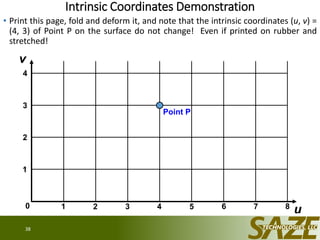
Intrinsic Coordinates Demonstration
• Print this page, fold and deform it, and note that the intrinsic coordinates (u, v) =
(4, 3) of Point P on the surface do not change! Even if printed on rubber and
stretched!
38
u
v
0 1 2 3 4 5 6 7 8
1
2
3
4
Point P
Conformal Arrays: Basic Differential Geometry
• Tangent Vectors
The surface 𝐗(𝑢, 𝑣) has two tangent vectors
𝐗 𝑢 𝑢, 𝑣 = 𝜕 𝐗(𝑢, 𝑣) 𝜕𝑢 , 𝐗 𝑣 𝑢, 𝑣 = 𝜕 𝐗(𝑢, 𝑣) 𝜕𝑣
The vectors are tangent because they are the coordinate difference between two points
on the surface divided by the parameter difference, in the limit the parameter difference
goes to zero
We can construct two unit vectors that are tangent to the surface
𝐮 =
𝐗 𝑢
𝐗 𝑢
, 𝐯 =
𝐗 𝑣
𝐗 𝑣
• Surface Normal
A unit normal to the surface can be computed by taking the vector cross product of the
two tangent vectors and normalizing
𝐧 =
𝐗 𝑢 × 𝐗 𝑣
𝐗 𝑢 × 𝐗 𝑣
39
• Surface Area Element
We can compute a differential surface area element on the surface by computing the cross
product of two sides of an infinitesimal parallelogram in the tangent plane at a point on
the surface (the magnitude of the cross product of two vectors is the area of the
parallelogram formed by them)
𝑑𝑆 = 𝐗 𝑢 𝑑𝑢 × 𝐗 𝑣 𝑑𝑣 = 𝐗 𝑢 × 𝐗 𝑣 𝑑𝑢𝑑𝑣
Conformal Arrays: Surface Area Element
40
𝐗 𝑢 𝑑𝑢
𝐗 𝑣 𝑑𝑣
𝑑𝑆
Specification of Element Orientation
• The unit tangent vectors 𝐮 and 𝐯 are not orthogonal in general, however the unit
surface normal 𝐧 is orthogonal to both
• We can align the x axis of an element with the unit vector 𝐮 at its phase center
position on the surface, and its unit boresight direction 𝐛 with the unit surface
normal.
• The y axis of the element is then aligned with 𝐛 × 𝐮.
• This will work in the general case.
• We can then compute the Ludwig-3 basis vectors and its polarization for the
element in a given direction, and then rotate the result to the MCS
• The rotation matrix for the element is 𝐑 = 𝐮 𝐛 × 𝐮 𝐛 if the components of
𝐮 and 𝐛 are in the MCS
41
𝐮
𝐯
𝐛 = 𝐧
𝐛 × 𝐮
(x)
(y)
(z)
Surface Fitting
• The standard and general way to describe a 2D surface in three dimensions is to parametrize
the points on the surface by two parameters, intrinsic to the surface, which we will call u and
v.
In many cases, we can define u and v to be the unperturbed/ideal x and y coordinates of the surface
of interest, before any deformations.
It is an important point to understand that the u and v coordinates of a point on the surface are
independent of any deformation, and do not change as the surface deforms. They are like ‘addresses’
for the points.
• We can write the 3D coordinates of the points on the surface as functions of u and v: x(u, v),
y(u, v), z(u, v) | Example: x = x, y = y, z = f (x,y)
• To fit the surface, we assume that x, y and z can be accurately represented by a finite series in
a set of arbitrary basis functions f1(u, v), … , fNbasis(u, v), which can be bipolynomials, bicubic B-
splines, etc., in u and v
• In terms of the fit coefficients C, which are constants for a given surface, we can write the
expansions for x, y and z as
42
),(),(),(),(
),(),(),(),(
),(),(),(),(
3,223113
2,222112
1,221111
vufCvufCvufCvuz
vufCvufCvufCvuy
vufCvufCvufCvux
NbasisNbasis
NbasisNbasis
NbasisNbasis






FFR
Surface Fitting: Matrix Formulation
• Rearranging terms, the relation on the previous slide can be written in matrix
form, X = UC:
• For an arbitrary number Npts of points, X = UC becomes
• The coefficients C then determine x, y and z anywhere on the surface, as a
function of u and v.
x, y, and z coordinates, surface normals and other quantities can then be easily computed.
43
  

  




  

3,,
),(),(),(
),(),(),(
),(),(),(
3,
3,2,1,
232221
131211
21
22222221
11112111
222
111















































Nbasis
CCC
CCC
CCC
NbasisNpts
vufvufvuf
vufvufvuf
vufvufvuf
Npts
zyx
zyx
zyx
NbasisNbasisNbasisNptsNptsNbasisNptsNptsNptsNpts
Nbasis
Nbasis
NptsNptsNpts
CUX
   
  
  


3,
1,
),(),(),(
31,
3,2,1,
232221
131211
21



















Nbasis
CCC
CCC
CCC
Nbasis
vufvufvufzyx
NbasisNbasisNbasis
Nbasis
C
UX
FFR
Surface Fitting: Example Quadratic Fit
•Example: quadratic (2nd order) biTaylor fit with 4 points (or
nodes)
X is 4x3, U is 4x6, C is 6x3
44


















































636261
535251
434241
333231
232221
131211
2
444
2
444
2
333
2
333
2
222
2
222
2
111
2
111
444
333
222
111
1
1
1
1
CCC
CCC
CCC
CCC
CCC
CCC
vvuuvu
vvuuvu
vvuuvu
vvuuvu
zyx
zyx
zyx
zyx
X = U C
FFR
Surface Fitting: Nodes, Estimated Surface and Errors
• To find the best fit coefficients C in a least squares sense, we solve for C using the Moore-
Penrose pseudoinverse and estimated coordinate data at nodes (pre-established points) on
the surface. We write
• The least squares best fit solution to the above equation is given by multiplying both sides on
the left by the Moore-Penrose pseudoinverse of Unodes (denoted by a ‘+’ superscript)
In general Unodes is not a square matrix
Note that pinv is a built-in MATLABTM function, like the usual matrix inverse inv. It is a generalization
of the usual matrix inverse to non-square matrices, and when used yields a least squares solution
• The fit coordinates at the nodes are given by
• The fit error is given by
• If the u and v values of arbitrary points on the surface are put into the matrix U, then the x, y
and z coordinates are estimated as
45
fitnodesnodes CUX 
nodesnodesnodesnodesfit pinv XUXUC  )()(
fitnodesfit CUX 
nodesfitnodesnodesfit XCUXXX 
fitptsest CUX 
FFR
Surface Fitting EM Applications
•Can be used to fit reflector and feed surfaces using
metrology and/or photogrammetry data
•Can be used to interpolate and clean up modeled patterns
from a finite number of points:
Points with numerical glitches are removed, remaining points in a
small neighborhood are fit, and then fit is used to interpolate
pattern at missing points
•Can be used to fit measured data and improve calibration
46FFR
Beam Steering and Forming, Compensation
• Phase Control
Phase Shifters
Phase shifters can be used to steer the beam, by changing the phase of each element so that their
contributions sum coherently in the desired direction
If the 𝐕 field in the desired direction of an element is given by 𝐕𝑠𝑡𝑒𝑒𝑟 = 𝐕 𝐪 𝑠𝑡𝑒𝑒𝑟 and 𝐩 𝑠𝑡𝑒𝑒𝑟 is the unit
polarization vector in the direction of the polarization that we wish to maximize, then we have for a
given element that
𝑉𝑝,𝑠𝑡𝑒𝑒𝑟 = 𝐩 𝑠𝑡𝑒𝑒𝑟
𝐻
𝐕𝑠𝑡𝑒𝑒𝑟 = 𝜌𝑒 𝑗𝜒
, where 𝜌 = 𝑉𝑝,𝑠𝑡𝑒𝑒𝑟 is the magnitude and 𝜒 is the phase of
𝑉𝑝,𝑠𝑡𝑒𝑒𝑟
If we apply a phase factor of 𝑒−𝑗𝜒 𝑒𝑙𝑡 to each element, then in the steering direction 𝑉𝑝 will be real and
maximized, and the beam will be steered
If all of the element patterns have the same phase, then we can steer the beam by applying a phase
factor that cancels the array factor for each element
There are other figures of merit that can be maximized, such as total power in a given direction, but we
will not consider them here
Phase shifters are usually quantized to a finite number of bits—usually 3 or 4 bits are sufficient for
beamsteering
Time Delay
Variable Time Delay (VTD) units can be used instead or in conjunction with phase shifters—VTDs for the
main correction and phase shifters for the residual
A time delay of 𝜏 corresponds to a phase factor of 𝑒−𝑗2𝜋𝑓𝜏
in the frequency domain
 𝜏 can be chosen to give the proper phase at the center frequency
VTDs give better phase control over wider bandwidths, and can keep the mainbeam in the same
direction for all frequencies in band
47
Beam Steering and Forming, Compensation
• Amplitude Control
Amplitude weights are applied to the elements for beamforming, in order to control
sidelobes, beamwidth, etc.
Weights that can be used are
Taylor weighting to control the sidelobe levels out to a specified number of sidelobes
Uniform, Hamming, Raised Cosine, Dolph-Chebyshev, Bayliss, Cosine Squared, etc.
Aperture tapers to control sidelobes (less sidelobe ‘ringing’)
• Polarization Control
If we have dual-polarization (dual-pol) elements, where we can control two independent
polarizations for a single element (like crossed dipoles with independent terminals and
phase and amplitude control), then we can turn the polarization as well as the phase and
amplitude knobs to maximize the gain in a given direction, or do other types of
beamforming
• Compensation
With an onboard metrology system, estimated deformed element locations and
orientations can be found via surface fitting of the array, and the proper beamforming
phases and magnitudes, different from those for the undeformed antenna, can be applied.
48
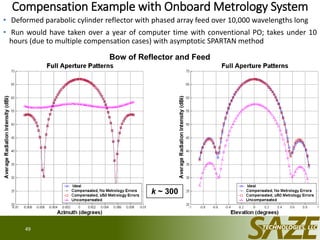
Compensation Example with Onboard Metrology System
• Deformed parabolic cylinder reflector with phased array feed over 10,000 wavelengths long
• Run would have taken over a year of computer time with conventional PO; takes under 10
hours (due to multiple compensation cases) with asymptotic SPARTAN method
49
Bow of Reflector and Feed
k ~ 300
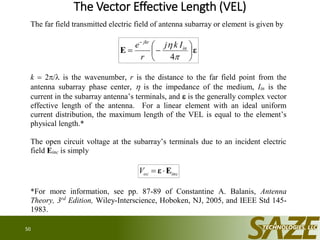
The Vector Effective Length (VEL)
50
The far field transmitted electric field of antenna subarray or element is given by
εE 









4
in
jkr
Ikj
r
e
k  2/ is the wavenumber, r is the distance to the far field point from the
antenna subarray phase center,  is the impedance of the medium, Iin is the
current in the subarray antenna’s terminals, and  is the generally complex vector
effective length of the antenna. For a linear element with an ideal uniform
current distribution, the maximum length of the VEL is equal to the element’s
physical length.*
The open circuit voltage at the subarray’s terminals due to an incident electric
field Einc is simply

  incocV Eε
*For more information, see pp. 87-89 of Constantine A. Balanis, Antenna
Theory, 3rd
Edition, Wiley-Interscience, Hoboken, NJ, 2005, and IEEE Std 145-
1983.
Signal Reception and the Vector Effective Length (VEL)
• The voltage received by an antenna is equal to the dot product of its VEL with the incident electric field:
𝑣 𝑅𝑥 = 𝒍 𝑒𝑓𝑓 ⋅ 𝐄𝑖𝑛𝑐
• The Vector Effective Length (VEL) for each element can be determined by the following reasoning.
• The length of the VEL is the square root of the effective area of the element (Ulaby): 𝒍 𝑒𝑓𝑓 = 𝐴 𝑒𝑓𝑓
• The directivity is given by 𝐷 = 4𝜋𝐴 𝑒𝑓𝑓 𝜆2
=
𝑟2 𝐄 2 (2𝑍0)
𝑃 𝑎𝑣𝑒 (4𝜋)
(we ignore system losses and take gain to be equal to
directivity here)
• Putting everything together and leaving the algebra to the reader, we find that for 𝐄 =
𝑒−𝑗𝑘𝑟
𝑟
𝑉0 cos 𝑁
𝜃 𝐩
𝐴 𝑒𝑓𝑓 = 𝜆2
2𝑁 + 1 2𝜋 cos2𝑁
𝜃 , 𝒍 𝑒𝑓𝑓 = 𝜆 2𝑁 + 1 (2𝜋) cos 𝑁
𝜃 𝐩
• One might think that the VEL would be proportional to the conjugate polarization 𝐩∗
, however this is not the
case.
 Since incoming RHCP radiation has components like LHCP in an outwards pointing polarization basis, you want the VEL to
have components like RHCP to maximize the inner product for the received voltage, which is a normal dot product and not a
Hermitian inner product as one might expect.
 This is a subtle point. Recall that 𝐩 is a unit Hermitian vector, so it does not effect the magnitude of the VEL.
• The total VEL of an array is the sum of each element’s VEL multiplied by the element’s complex receive weight
51
Closing Remarks
• We have covered all of the tools necessary to create basic fully-polarimetric
phased array models
• The individual who masters the material in this workshop will be able to
successfully create polarimetric models of arbitrary phased arrays, but it may
take additional study to fill in any gaps in understanding
• Once all the simplifying assumptions and approximations are made, polarimetric
modeling of a phased array is surprisingly simple—one doesn’t even really need
to understand EM, but a certain level of mathematical maturity is required
• A number of the slides are for future reference (marked FFR) and not intended to
be fully digested during the presentation
• Wikipedia can be a good starting point for many topics, and has many good
entries on special functions like the associated Legendre polynomials and the
spherical harmonics
• A number of the results were derived by the presenter and are not generally
available elsewhere
52
References and Suggestions for Further Reading
• J. D. Jackson, Classical Electrodynamics, 3rd Ed., New York: Wiley, 1998.
• S. Silver, Ed., Microwave Antenna Theory and Design, London:
IEEE/Peter Peregrinus, Ltd., 1997.
• M. M. Lipschutz, Differential Geometry, New York: McGraw-Hill, 1969.
• C. A. Balanis, Antenna Theory, 3rd Edition, Hoboken, NJ: Wiley-
Interscience, 2005.
• C. A. Balanis, Advanced Engineering Electromagnetics, New York: John
Wiley & Sons, 1989.
• Ulaby, Fawwaz T., and Elachi, editors, Radar Polarimetry for Geoscience
Applications, Artech House, Norwood, MA, 1990.
• IEEE Std 145-1983, available at:
http://ieeexplore.ieee.org/xpls/abs_all.jsp?arnumber=30651
• http://en.wikipedia.org/wiki/Associated_Legendre_polynomials
• http://en.wikipedia.org/wiki/Spherical_harmonics
53
Acknowledgments
•I would like to thank Max Scharrenbroich, Toby Aylesbury,
Michael Zatman, and Jason Eicke of SAZE Technologies, LLC
for sponsoring this workshop. I am grateful to John Shipley,
Dan Kane, Steve Brown and Jeff Philo of Harris Corporation,
Chris Bailey of GTRI, and Glenn Van Blaricum of Toyon
Research Corporation for discussions related to the subject
matter.
54

Fully-Polarimetric_Phased_Array_Far_Field_Modeling_2015SECONWorkshop_JHucks

  • 1.
    2015 IEEE SoutheastConWorkshop: Fully-Polarimetric Phased Array Far Field Modeling Joseph Hucks, Ph.D. SAZE Technologies, LLC www.sazetech.com jhucks@sazetech.com 803.842.8818 (Cell) 1
  • 2.
    Introduction • The purposeof this workshop is to show how to create fully-polarimetric models of phased array antennas in the electromagnetic (EM) far field. • Definition of the Far Field: Rule of Thumb The far field of a radiating system is approximately at distances 𝑟 > 2𝐷2 𝜆 from the center of the radiating system, where 𝐷 is its effective diameter, taken to be its maximum diameter, and 𝜆 is the wavelength of the radiation. This holds for radiating systems larger than half a wavelength. For more information see http://en.wikipedia.org/wiki/Near_and_far_field. • Simplifying Assumptions for our far field analysis The angular dependencies of the EM fields are invariant of range The electric and magnetic fields are of the form 𝑒−𝑗𝑘𝑟 𝑟 times functions of only angles, where 𝑘 = 2𝜋 𝜆 is the wavenumber. 𝐄 𝐹𝑎𝑟 𝐹𝑖𝑒𝑙𝑑 = 𝑒−𝑗𝑘𝑟 𝑟 𝐕(𝜃, 𝜙), 𝐕 has units of Volts, and is transverse, i.e., perpendicular to the radial direction. The electric and magnetic fields due to the radiating system are orthogonal and transverse, i.e., perpendicular to the direction of propagation The medium in which the EM waves propagate is homogeneous and isotropic  Homogeneous means the medium’s properties don’t vary from point to point  Isotropic means the medium’s properties are the same in every direction • The simplifying assumptions above make ESA modeling quite simple, really • Some mathematical results given are for future reference (FFR) only, and not meant to be completely digested during the workshop, and will only be discussed in passing. These slides are marked ‘FFR’ in the lower left-hand corner. 2
  • 3.
    • Maxwell’s equations(see Jackson’s Classical Electrodynamics and Balanis’ Advanced Engineering Electromagnetics) in SI units 𝛁 ⋅ 𝐃 = ρ , 𝛁 × 𝐇 − 𝜕𝐃 𝜕𝑡 = 𝐉 , 𝛁 × 𝐄 + 𝜕𝐁 𝜕𝑡 = 0 , 𝛁 ⋅ 𝐁 = 0  𝐃 is the electric flux density in Coulombs per square meter  𝐁 is the magnetic flux density in Webers per square meter ρ is the electric charge density in Coulombs per cubic meter  𝐇 is the magnetic field intensity in Amperes per meter  𝐉 is the electric current density in Amperes per square meter  𝐄 is the electric field intensity in Volts per meter Fictitious magnetic charge and current densities will be ignored here In a homogeneous and isotropic medium, 𝐃 = ε𝐄 and 𝐁 = μ𝐇, where ε is the permittivity of the medium in Farads per meter and μ is the permeability of the medium in Henries per meter In a vacuum, the exact values are μ0 = 4𝜋 × 10−7 H m  𝑐 = 1 μ0ε0 = 299,792,458 m/s exactly (meter was redefined in 1983 to make the speed of light exact) ε0 = 1 μ0 𝑐2 = 8.854187817620389 … × 10−12 F m  𝑍0 = μ0 ε0 = 376.7303134617707 … Ω ≈ 377 Ω, the impedance of free space in Ohms 3 Review of Solutions to the Time-Harmonic Maxwell’s Equations in the Far Field for a Homogeneous and Isotropic Medium FFR
  • 4.
    The Time-Harmonic MaxwellEquations • Assumes that all fields have exp(𝑗ω𝑡) time dependence ⇒ time derivatives are replaced by factors of 𝑗𝜔 and fields by time- independent complex phasors • This allows analysis to be done at a single frequency 𝑓 = ω 2𝜋 • We will also assume for our analysis to follow that the medium is homogeneous and isotropic (and also not time-varying) • Maxwell’s Equations then become 𝛁 ⋅ 𝐄 = 𝜌 𝜖 , 𝛁 × 𝐇 − jωϵ 𝐄 = 𝐉 , 𝛁 × 𝐄 + 𝑗𝜔𝜇 𝐇 = 0 , 𝛁 ⋅ 𝐇 = 0 • In a vacuum, which will be our assumption for our analysis, the time- harmonic Maxwell’s equations become 𝛁 ⋅ 𝐄 = 𝜌 𝜖0 , 𝛁 × 𝐇 − jωϵ0 𝐄 = 𝐉 , 𝛁 × 𝐄 + 𝑗𝜔𝜇0 𝐇 = 0 , 𝛁 ⋅ 𝐇 = 0 • Note that we have 𝜔 = 2𝜋𝑓, 𝑓𝜆 = 𝑐, 𝑘 = 2𝜋 𝜆 , 𝜔 𝑘 = 𝑐 if we are in vacuum. If not, 𝑐 should be replaced by the speed of light in the medium 𝑣, and the frequency 𝑓 will not change but the wavelength will get smaller since 𝑣 ≤ 𝑐. 4FFR
  • 5.
    General Form ofthe Far Field Solution • In the far field of a finite radiating system in a homogeneous and isotropic medium, we have the general solution • The 𝐗 𝑙𝑚(𝜃, 𝜙) are the Vector Spherical Harmonics (VSHs) of degree 𝑙 and order 𝑚, where 𝑙 = 1, 2, 3, … and 𝑚 = −𝑙, −𝑙 + 1, … , −1, 0, +1, … , +𝑙. There are 2𝑙 + 1 orders 𝑚 for each degree 𝑙. Note that the VSHs 𝐗 𝑙𝑚 are transverse, i.e., 𝐫 ⋅ 𝐗 𝑙𝑚 = 0. Mnemonic: degree𝑙 and 𝑚order. • There is not a lot of literature on the VSHs, had to derive many results. • (𝜃, 𝜙) are the ordinary angles from spherical coordinates (see Jackson) • 𝚱 𝑙𝑚 and 𝚲𝑙𝑚 are arbitrary complex coefficients • The 𝑃𝑙 𝑚 are the Associated Legendre Polynomials  Jackson, http://en.wikipedia.org/wiki/Associated_Legendre_polynomials • The time-averaged Poynting vector is found from the electromagnetic phasors by  𝐒 = 1 2 Re 𝐄 × 𝐇∗ = 𝐄 2 2𝑍 𝐫 = 1 𝑟2 𝐕 2 2𝑍 𝐫, i.e., the power flows radially outward 5   ˆ)(coscot)(cosˆ)(coscsc )!()1(4 )!)(12( ),( ˆ 1 ,]ˆ[ 1 1     m l m l m l mj lm l l lm lmlmlmlm jkr PmPjPme mlll mll Zr e              θΧ ErHXrXE FFR
  • 6.
    Vector Spherical Harmonics(VSHs) 6   ˆ)(coscot)(cosˆ)(coscsc )!()1(4 )!)(12( ),( 1     m l m l m l mj lm PmPjPme mlll mll      θΧ The following relationships between the vector spherical harmonics for m hold:      ml m lmlm m ml , 11 , )1(,)1( ΧΧΧΧ The vector spherical harmonics vanish for 0l or lm || : lmorlforlm  ||00),( Χ The vector spherical harmonics lmX and their cross products with the unit radial vector lmXrˆ obey the sum rule [Jackson]    4 12 ),(),(),(ˆ),( 2222     l XX l lm lmlm l lm lm l lm lm XrX and have the following orthogonality properties [Jackson]: 0sin)ˆ(,sin 2 0 0 2 0 0             dddd lmmlmmlllmml XrXXX FFR
  • 7.
    Vector Spherical Harmonicsfor 𝑙 ≤ 3 • The vector spherical harmonics up to degree 𝑙 = 3 are given below 7 00 00 l                  )ˆcosˆ( 16 3 ˆsin 8 3 )ˆcosˆ( 16 3 1 1,1 10 11            je j je l j j θ θ                                      )ˆ2sinˆsin2( 5 8 1 )ˆsincosˆsin( 5 4 1 ˆ2cosˆcos 5 4 1ˆ)1cos2(ˆcos 5 4 1 ˆ2sin 6 5 4 3ˆcossin 6 5 2 3 ˆ2cosˆcos 5 4 1ˆ)1cos2(ˆcos 5 4 1 )ˆ2sinˆsin2( 5 8 1 )ˆsincosˆsin( 5 4 1 2 22 2,2 2 1,2 20 2 21 22 22                              jeje jeje jj jeje jeje l jj jj jj jj θθ θθ θθ θθ                                                                                                                           ˆ)3coscos( 2 1ˆ)2cos1( 15 7 32 15 ˆsincosˆsin 15 7 16 15 ˆ)3sin3sin( 4 1ˆ2sin 10 7 8 5 ˆ)sin3sin2(ˆcossin2 10 7 8 5 ˆ)cos15cos( 2 1ˆ)2cos53( 7 32 1 ˆ)cos11cos15(ˆ)1cos5( 7 16 1 ˆ)3sin5sin( 7 32 3ˆ)1cos5(sin 3 73 ˆ)cos15cos( 2 1ˆ)2cos53( 7 32 1 ˆ)cos11cos15(ˆ)1cos5( 7 16 1 ˆ)3sin3sin( 4 1ˆ2sin 10 7 8 5 ˆ)sin3sin2(ˆcossin2 10 7 8 5 ˆ)3coscos( 2 1ˆ)2cos1( 15 7 32 15 ˆsincosˆsin 15 7 16 15 3 3 223 3,3 2 32 2,3 32 1,3 2 30 32 31 2 32 32 3 223 33                                         je je je je je je jj je je je je je je l j j j j j j j j j j j j θ θ θ θ θ θ θ θ θ θ θ θ FFR
  • 8.
    Review of SphericalCoordinates • Spherical coordinates (𝑟, 𝜃, 𝜙) 𝑟 is the radial distance from the coordinate origin, 0 ≤ 𝑟 < +∞ 𝜃 is the polar angle from the positive 𝑧 axis, 0 ≤ 𝜃 ≤ 𝜋 𝜙 is the counter-clockwise axial angle (about the positive 𝑧 axis) from the positive 𝑥 axis in the 𝑥𝑦-plane, 0 ≤ 𝜙 ≤ 2𝜋 • 𝑟 = 𝑥2 + 𝑦2 + 𝑧2 , 𝜃 = cos−1 𝑧 𝑟 , 𝜙 = mod(atan2 𝑦, 𝑥 , 2𝜋) (MATLABTM functions) • (𝑟, 𝜃, 𝜙) in given order form a right-handed orthogonal coordinate system, with unit vectors given below • 𝑥 = 𝑟 sin 𝜃 cos 𝜙 , 𝑦 = 𝑟 sin 𝜃 sin 𝜙 , 𝑧 = 𝑟 cos 𝜃 • There are other definitions of the angles, but this is the standard physics definition in Jackson 8 x z y   r x z y   r Spherical Coordinates (r, , ) )0,cos,sin(ˆcosˆsinˆ )sin,sincos,cos(cosˆsinˆsincosˆcoscosˆ )cos,sinsin,cos(sinˆcosˆsinsinˆcossinˆ       yx zyx zyxr   FFR
  • 9.
    Review of SphericalHarmonics (& Relation to VSHs) 9 The spherical harmonics are given by [Jackson]     jmm llm eP ml mll Y )(cos )!(4 )!)(12( ),(    The spherical harmonics for positive and negative m-values are related simply [Jackson]: ),()1(),(,     lm m ml YY The spherical harmonics are normalized and orthogonal, in the following way [Jackson]: mmlllmml YYdd        2 0 0 ),(),(sin The completeness relation is given by [Jackson] )()cos(cos),(),( 0        l l lm lmlm YY The Xlm are the vector spherical harmonics, defined in Jackson as )0(0 ...),,3,2,1(),( )1( 1 ),(     l lY ll lmlm  LX L denotes the angular momentum operator, familiar from quantum mechanics:  rL j FFR http://en.wikipedia.org/wiki/Spherical_harmonics Kronecker delta 𝛿𝑖𝑗 = 1 if 𝑖 = 𝑗, 0 otherwise (It is basically the identity matrix)
  • 10.
    Review of theAssociated Legendre Polynomials • Associated Legendre Polynomials of Degree 𝑙 and Order 𝑚 10 For ...,3,2,1,0l and llllm ,1,...,0,...,1,  , the associated Legendre polynomials are given by the following finite power series, derived from Rodrigues’ formula: mkl mlfloor k k l m mm l x mklklk klx xP        2 ]2/)([ 0 2/2 )!2()!(! )!22()1( 2 )1( )1()( The series above is valid for positive and negative integer values of m. The function floor(x) rounds the real argument x down to the nearest integer less than or equal to x, and is a standard MATLABTM function. The upper sum limit prevents summation over terms that were differentiated away when the derivatives in Rodgrigues’ formula were taken. The associated Legendre polynomials vanish for lm || : lmforxPm l  ||0)( The following relationships between the associated Legendre polynomials for integer m hold: )( )!( )!( )1()(,)( )!( )!( )1()( xP ml ml xPxP ml ml xP m l mm l m l mm l        FFR http://en.wikipedia.org/wiki/Legendre_polynomials http://en.wikipedia.org/wiki/Associated_Legendre_polynomials
  • 11.
    Element Patterns •Simple elementpatterns that are easy to compute in any orientation are given •The Ludwig-3 polarization basis is introduced •Aperture field methods are briefly discussed •Element patterns with constant Ludwig-3 polarization are described •We discuss how to use general element patterns 11
  • 12.
    First Cut cos𝑁 𝜃 Patterns 12 For a single element, we may model its transmitted electric field in the far field to good approximation by a field of the following form 𝐄 = 𝑒−𝑗𝑘𝑟 𝑟 𝐕(𝜃, 𝜙) = 𝑒−𝑗𝑘𝑟 𝑟 𝑉0 cos 𝑁 𝜃 𝐩 In the above, 𝑉0 is given by 𝑉0 = (2𝑁 + 1) 𝑃𝑎𝑣𝑒 𝑍0 𝜋 and has units of voltage. 𝑃𝑎𝑣𝑒 is the time-averaged radiated power of the element, and 𝑍0 = 𝜇0 𝜀0 ~377 Ω is the impedance of free space. Here, 𝜃 is the angle from the element’s boresight direction, as if the element’s boresight is aligned with the +𝑧 direction. 𝐩 is a unit Hermitian vector with 𝐩 𝐻 𝐩 = 1, expressed as a two-component unit vector in the Ludwig-3 polarization basis. It can be assumed to vary or be constant with direction, and can also contain any overall weighting phase. Can replace 𝐩 by 1 or a phase factor for scalar EM approximation (E-field is just a complex number then). 𝑃𝑎𝑣𝑒 contains any weighting amplitude. This assumes that the element only radiates in the forward hemisphere, where 0 ≤ 𝜃 ≤ 𝜋 2. There are no side- or back-lobes, only a mainlobe—this is usually OK if we are only interested in the array pattern near the mainbeam or first few sidelobes. 𝑁, as we shall see on the next slide, is determined by the element’s Half Power BeamWidth (HPBW).
  • 13.
    First Cut cos𝑁 𝜃 Patterns 13 We note that the exponent 𝑁 is related to the Half Power BeamWidth (HPBW) by the following formula 𝑁 = ln 2 2 ln cos ( 𝐻𝑃𝐵𝑊/2) so that the HPBW may be specified instead of 𝑁. HPBWs of the order of ~ 60° are in the right ballpark for X-Band elements. If we use the HPBW approximation of the wavelength over the diameter, then for a small element the diameter is approximately a wavelength, and we get 1 radian or ~ 57.3°. We are mostly interested in the mainbeam and near sidelobe regions, where the element patterns are fairly flat. The cos 𝑁 𝜃 variation gives a somewhat realistic variation due to an element pattern. Measured or modeled element patterns are often specified by their exponent 𝑁 or their HPBW (be careful to find out whether the exponent applies to the E-field or power!). Such element patterns were used by the presenter for many years to simulate ESAs and Phased Array Fed Reflector antennas. Note, however, that these patterns in general do not satisfy Maxwell’s equations.
  • 14.
    Ludwig-3 Polarization Basis •Theproblem with spherical coordinates They go bad at 𝜃 = 0° (‘North Pole’) and 180° (‘South Pole’) The 𝜃 and 𝜙 unit vectors are multiply-valued as a function of 𝜙 14 x z y   r x z y   r Spherical Coordinates (r, , )  = 0° yx zyx ˆcosˆsinˆ ˆsinˆsincosˆcoscosˆ       ˆ ˆ yx yx ˆcosˆsinˆ ˆsinˆcosˆ       At North Pole:
  • 15.
    EM Spherical Componentsare Multiply-Valued at the North and South Poles • At the north and south poles of the unit sphere (𝜃 = 0° and 180°), the electric field components in a spherical coordinate system are multiply valued, however the actual electric field is well-behaved. 15  (deg) (deg) |V  | 50 100 150 50 100 150 200 250 300 350 0.5 1 1.5 2  (deg) (deg) |V  | 50 100 150 50 100 150 200 250 300 350 0.5 1 1.5 2 ),(),,(  VE r e r jkr fieldfar   For the plots the pattern of a dipole over a finite ground plane is used. 𝐕 is the normalized electric field field vector phasor, so that the time- averaged radiation intensity in W/sr is given by 𝐕 2 (2𝑍0)
  • 16.
    Plots of ExampleSpherical and Rectangular Components at the Poles 16 The angular components vary sinusoidally with 𝜙 at the poles, while the rectangular components are well defined. 0 50 100 150 200 250 300 350 0 0.5 1 1.5 2 2.5 3 |V|, |V|, |Vx| and |Vy| at  = 0 and 180 degrees  (deg) V  at  = 0 deg V  at  = 0 deg V  at  = 180 deg V  at  = 180 deg V x at  = 0 deg V y at  = 0 deg V x at  = 180 deg V y at  = 180 deg At the poles, the spherical angular components of the electric field are multiply valued, but the rectangular components are well-behaved, as they must be. Note that the y components vanish at the poles for this example.
  • 17.
    Ludwig-3 Polarization • Ludwig-3polarization components are given by defining horizontal and vertical components everywhere on the sphere by the same expression relating 𝐸 𝑥 , 𝐸 𝑦 to 𝐸 𝜃 , 𝐸 𝜙 at the north pole of the unit sphere (𝜃 = 0°): • At the north pole, 𝐸ℎ = 𝐸 𝑥 and 𝐸 𝑣 = 𝐸 𝑦. The Ludwig-3 polarization components are well-behaved at the north pole and the rest of the sphere, except at the south pole (𝜃 = 180°), where they break down. • The Ludwig-3 unit polarization basis vectors are obtained by rotating the spherical unit vectors by a clockwise angle 𝜙 about the outward radial direction on the unit sphere. This counters the multiple-valuedness of the spherical unit vectors at the north pole, yielding a set of unit vectors there that are constant as 𝜙 goes from 0° to 360°. • The Ludwig-3 basis is very useful if the boresight of your antenna (or antenna elements) is taken to be in the +𝑧 direction; the basis goes bad at the south pole, but this is often not a direction of interest. If you use spherical components instead, you have to be very careful near the poles to make sure and handle things correctly to avoid numerical problems. 17                          E E E E v h cossin sincos
  • 18.
    Spherical and RectangularBases 18 The spherical angle unit vectors are given by yx zyx ˆcosˆsin)0,cos,sin(ˆ ˆsinˆsincosˆcoscos)sin,sincos,cos(cosˆ       In the far field, the electric field E has only angular components, and their relationship to rectangular components is given by zyx zyxE ˆ]0sin[ˆ]cossincos[ˆ]sincoscos[ ˆˆˆˆˆ),,(    EEEEEE EEEEEEEE zyxzyx    This relationship may be summarized in matrix form (with the spherical components converted to Ludwig-3 components in the last step):                                                        v h z y x E E E E E E E           cossin sincos 0sin cossincos sincoscos 0sin cossincos sincoscos The spherical coordinate system becomes degenerate at the north and south poles ( = 0º and 180º, respectively). At the poles of the sphere, the relationship above becomes (note that for a far field electric field, Ez = 0 at the poles, since the z component is longitudinal there)       18018000 cossin sincos , cossin sincos                                                          E E E E E E E E y x y x The inverse relationships are given by  18018000 cossin sincos , cossin sincos                                                        y x y x E E E E E E E E which shows that E and E are multivalued at the poles as  varies from 0 to 180º, since physically the rectangular components must be well- behaved everywhere.
  • 19.
    Ludwig-3 Polarization Formulas 19 Ludwig-3polarization components are given by defining the horizontal and vertical components to be given everywhere on the sphere by the same expression as the rectangular components Ex and Ey are given in terms of E and E at the north pole:                            E E E E v h cossin sincos At the north pole, Eh = Ex and Ev = Ey. The Ludwig-3 polarization components are well behaved at the north pole and the rest of the sphere except the south pole, where they break down. The spherical components may be given in terms of the Ludwig-3 components by using the inverse 2D rotation matrix to that above:                      v h E E E E     cossin sincos Since the Ludwig-3 components hE and vE are well-behaved and constant at the north pole, we see that the spherical components E and E will have a sinusoidal dependence on  there. The Ludwig-3 unit polarization vectors can be shown to be given by   )ˆˆ( ˆˆ1 ˆˆ ˆ)ˆˆ(ˆ cos1 )]ˆˆ(ˆ[ˆ ˆ]sinsin[ˆ]sin)1(cos1[ˆ]sincos)1(cos[ˆ )ˆˆ( ˆˆ1 ˆˆ ˆ)ˆˆ(ˆ cos1 )]ˆˆ(ˆ[ˆ ˆ]cossin[ˆ]sincos)1(cos[ˆ]cos)1(cos1[ˆ 2 2 zr zr yr yzry zryr zyxv zr zr xr xzrx zrxr zyxh                                       zr y zr x     At the north pole ( = 0°), the factor )1(cos  vanishes and we see that xh ˆˆ  and yv ˆˆ  . At the south pole ( = 180°), the factor 2)1(cos  , and we see that hˆ and vˆ are multiply valued vector functions of . Thus the Ludwig-3 polarization basis is good everywhere on the sphere except the south pole. It should be noted that the Ludwig-3 basis is not a coordinate (holonomic) basis, but is a non-coordinate (anholonomic) basis.    
  • 20.
    Aperture Fields Using resultsfrom Silver (pp. 161-162), we can show that the far field electric field (FFEF) from a planar aperture, with a known electric field in the plane of the aperture, can be approximated by 𝐄 𝐹𝐹 = 𝑗𝑘𝑒−𝑗𝑘𝑟 4𝜋𝑟 1 + cos 𝜃 𝑁ℎ 𝐡 + 𝑁𝑣 𝐯 where the Ludwig-3 polarization basis unit vectors given here by 𝐡 ≡ 𝐡 , 𝐯 ≡ 𝐯, dropping the ‘^’s for convenience, and 𝑁ℎ = 𝐴𝑝𝑒𝑟𝑡𝑢𝑟𝑒 𝐸 𝑥, 𝑎𝑝𝑒𝑟𝑡𝑢𝑟𝑒 𝑒 𝑗𝑘𝑠𝑖𝑛𝜃 𝑥 cos 𝜙+𝑦 sin 𝜙 𝑑𝑆 𝑁𝑣 = 𝐴𝑝𝑒𝑟𝑡𝑢𝑟𝑒 𝐸 𝑦, 𝑎𝑝𝑒𝑟𝑡𝑢𝑟𝑒 𝑒 𝑗𝑘𝑠𝑖𝑛𝜃 𝑥 cos 𝜙+𝑦 sin 𝜙 𝑑𝑆 The aperture is assumed to lie in the xy-plane, with its origin at the center of the aperture with the usual spherical coordinate angles. If the electric field is constant over the aperture, we then see that the far field electric field has constant Ludwig-3 polarization (i.e., 𝑁ℎ 𝑁𝑣 is fixed). Thus constant Ludwig-3 polarization elements are somewhat physically motivated. 20
  • 21.
    Element Patterns withConstant Ludwig-3 Polarization As a first approximation, we can model an element with polarization as having constant Ludwig-3 polarization. We then have 𝐄 = 𝑒−𝑗𝑘𝑟 𝑟 𝑉0 cos 𝑁 𝜃 𝐩 where 𝐩 is a constant complex vector with unit Hermitian norm, i.e., as mentioned before, 𝐩 𝐻 𝐩 = 1. We can now take 𝐩 = 𝛼𝐡 + 𝛽𝐯 with 𝛼 2 + 𝛽 2 = 1 Left-Handed Circular Polarization (LHCP) is given by 𝐩 = 1 2 (𝐡 + 𝑗𝐯) Right-Handed Circular Polarization (RHCP) is given by 𝐩 = 1 2 (𝐡 − 𝑗𝐯) Horizontal Polarization (H) is given by 𝐩 = 𝐡 Vertical Polarization (V) is given by 𝐩 = 𝐯 𝐩 can also contain an arbitrary phase The 𝑥, 𝑦, 𝑧 coordinate system should be chosen so that horizontal and vertical directions in the Ludwig-3 polarization basis generally correspond to the desired directions—they won’t match actual vertical or horizontal everywhere. 21
  • 22.
    General Element Patterns •If one wishes to have more sophisticated and general element patterns, then there are a few options that we will discuss here. The first option would be to create your own pattern functions, analogous to the cos 𝑁 𝜃 patterns, but more complicated. If you have formulas for the element patterns, then you could compute them in any direction. Another option would to use measured or modeled patterns and interpolate them. You would need values every degree or so over the unit sphere of direction space, at least in the directions of interest. It is more computationally intensive. Have to be careful at the poles if using 𝐸 𝜃 and 𝐸 𝜙 components—recommend using Ludwig-3 basis. Another option would be to model the element patterns with a finite Vector Spherical Harmonics (VSH) expansion of low degree. Measured or modeled element patterns could be fit with low degree (𝑙) VSH expansions—more complicated patterns of electrically large complex antennas would probably require many terms for a good fit. You will get better results fitting the elements rather than the whole antenna. VSH fits can also be used to interpolate reasonable pattern values that satisfy Maxwell’s equations in directions that numerical codes fail. • Since we only usually care about the overall pattern near the mainbeam and first few sidelobes, the element patterns just taper the array pattern slightly and don’t usually have a big effect, so the simple cos 𝑁 𝜃 patterns are usually sufficient. 22
  • 23.
    Translations and Rotations—Rationale •Tomodel the far field electric field (FFEF) of an array, we need to sum up the individual element patterns •The element patterns will in general need to be translated to the desired position and then rotated into the desired orientation (or vice versa) •Thus we need to know how the far field element patterns are changed by translations and rotations •The further apart we space the elements, the further out the far field will be. •We will first discuss the effect of translations on the element patterns, and then the effects of rotations 23
  • 24.
    Effects of Translationson the Far Field Pattern • The Translation Factor If the phase center of a radiating system with far field E-field 𝐄 is translated from the origin to point 𝐚, then the new far field pattern is 𝐄′ = 𝑒 𝑗𝐤⋅𝐚 𝐄 𝑒 𝑗𝐤⋅𝐚 is the translation factor It is angularly dependent, since the wave vector in spherical coordinates is given by 𝐤 = 𝑘 𝐫 = 2𝜋 𝜆 sin 𝜃 cos 𝜙 , sin 𝜃 sin 𝜙 , cos 𝜃 𝜆 is the wavelength at the frequency of interest, 𝑘 is the wavenumber. 𝐚 is a constant vector, pointing from the origin to the point where the radiating system is translated (or from a different location to a new one). It is assumed that the radiating system is only translated and not rotated, so that it maintains its orientation (will treat rotations in next topic). Also called the Array Factor for a single radiating element 24 a x y z 𝐄 𝐄′
  • 25.
    Translation Factor—More Detail 25 Thefar field transmitted electric field of an element, subarray, or general radiating system with its phase center at the origin of the coordinate system, chosen here to be at the overall antenna phase center for convenience, is denoted by 0),(ˆ,),( )exp( ),,(     VrVE r jkr r 𝐕 is a transverse (perpendicular to the radial direction) vector function of the spherical angles 𝜃 and 𝜙, gives the angular polarization pattern in the far field, and is independent of 𝑟, the distance from the phase center of the radiating system to the far field point. In the above,  /2k is the wavenumber at the frequency of interest. We are dealing with electric field phasors here, so the exp⁡( 𝑗𝜔𝑡) time dependence has been factored out. If the radiating system’s phase center is not at the overall phase center of the antenna, but translated (and not rotated!) to a location ar  in the coordinate system centered on the overall antenna phase center, then relative to this coordinate system, the effective pattern of the translated radiating system is ),()exp( )exp( ),,()exp(),,(  VakEakE    j r jkr rjr k is the wave vector (pointing radially outwards), )cos,sinsin,cos(sin 2 ˆ     rk k We note that the effect of a translation of the radiating system’s phase center from the origin at the overall phase center to ar  on the far field electric field (i.e., the radiation pattern) is equivalent to a direction dependent phase shift of the electric field. This is similar and related to the effect of a spatial or temporal translation on the Fourier transform of a function. FFR
  • 26.
    Translation Factor—Derivation 26 The resultmay be straightforwardly derived from ),( )exp( ),,(  VE r rjk r    with arr  and 22 2|||| arr  ararr and ||aa , and using the far field approximation that ar  . Let us briefly go through the derivation. Since we are in the far field and assume that arr , , and r and r both point in very near the same direction, we have that rr  , and r may be replaced by r in the denominator to good approximation: ),,()](exp[),( )exp( ),( )exp( ),,(  rrrkj r rkj r rkj r EVVE       Thus we need to merely approximate rr  in the far field where arr , . We have ar ar ar arar ar ar                                   ˆ ˆ ˆ 2 2 1 1 ˆ 21 ˆ 21 21)2( 2/12/1 2 2 2/1 2 2 2 2/122 rr r rr r rr r a r rr r a r rrarrrr so that ),,()exp( ),,()ˆexp( ),,()](exp[),,(    rj rkj rrrkjr Eak Ear EE    which completes the proof. The ‘Array Factor’ )exp( ak j is an angular and frequency dependent phase term that multiplies the pattern of an element or subarray at the origin to account for the translation of the radiating system’s phase center by a vector distance a . FFR
  • 27.
    Rotations of FarField Patterns • To find the far field electric field of a phased array, the elements need to be translated and rotated into the proper positions and orientations. We discuss how far field patterns are changed by rotations, and discuss rotation matrices. We close this section with the general formula for a rotated far field pattern. 27 Introduction to Rotation Matrices • Active vs. Passive Rotations • Geometric Derivation • Component Form of a Rotation Matrix
  • 28.
    Active vs. PassiveRotations • Active rotations actually physically rotate something; the coordinate axes are fixed, but, for instance, a vector 𝐯 is rotated by an angle 𝛼 about a unit vector axis 𝐞 (right hand rule applies: right thumb points in the direction of the axis of rotation, and fingers curl in direction of rotation by angle 𝛼)—see figure on left below. • Passive rotations are when physical vectors are unchanged but we wish to calculate a fixed vector 𝐯’s components in a rotated coordinate system—see figure on right below. • The active and passive rotation matrices are just inverses of each other. The inverse of a rotation matrix is just its transpose since it is an orthogonal matrix: 𝐑𝐑 𝑇 = 𝐑 𝑇 𝐑 = 𝐈. We only consider proper rotations where det 𝐑 = 𝐑 = +1 , otherwise we would be including spatial inversions, where 𝑥, 𝑦, 𝑧 → −(𝑥, 𝑦, 𝑧) • Reversing the axis or angle gives the inverse rotation; reversing both gives the same rotation. 28 𝑦 𝑥 𝐯 𝛼 𝐑 𝑎𝑐𝑡𝑖𝑣𝑒 ( 𝐳, 20°)𝐯 𝑦 𝑥 𝐯 𝛼 𝑨𝒄𝒕𝒊𝒗𝒆 𝑹𝒐𝒕𝒂𝒕𝒊𝒐𝒏 𝒂𝒃𝒐𝒖𝒕 + 𝒛 𝒂𝒙𝒊𝒔 𝒃𝒚 𝒂𝒏𝒈𝒍𝒆 𝜶 𝐑 𝑎𝑐𝑡𝑖𝑣𝑒 𝐳, 20° 𝐯 𝑥 𝑷𝒂𝒔𝒔𝒊𝒗𝒆 𝑹𝒐𝒕𝒂𝒕𝒊𝒐𝒏 𝒂𝒃𝒐𝒖𝒕 + 𝒛 𝒂𝒙𝒊𝒔 𝒃𝒚 𝒂𝒏𝒈𝒍𝒆 𝜶
  • 29.
    Geometric Derivation • Derivationis for an active rotation matrix 𝐑 • The rotation does not change the component 𝐯∥ of the vector parallel to the axis of rotation 𝐞, but rotates the perpendicular component 𝐯⊥ by an angle 𝛼 about the axis (RH rule applies), in a plane perpendicular to the axis. 𝐯⊥ is like the x axis in the perpendicular plane, and 𝐞 × 𝐯⊥ is like the y axis (see figure below). 29 𝐯 = 𝐈 − 𝐞𝐞 𝑇 + 𝐞𝐞 𝑇 𝐯 = 𝐈 − 𝐞𝐞 𝑇 𝐯 + 𝐞𝐞 𝑇 𝐯 = 𝐯 − 𝐞 ⋅ 𝐯 𝐞 + 𝐞 ⋅ 𝐯 𝐞 ≡ 𝐯⊥ + 𝐯∥ 𝐑𝐯 = cos 𝛼 𝐯 + 1 − cos 𝛼 𝐞 ⋅ 𝐯 𝐯 + sin 𝛼 𝐞 × 𝐯
  • 30.
    • Here wegive the component forms of active and passive rotation matrices; can be found from result on previous slide since vector 𝐯 is arbitrary • Can switch between active and passive forms by changing sign of sin 𝛼 • Einstein Summation Convention used where repeated indices are summed over • 𝜀𝑖𝑗𝑘 is the Levi-Civita symbol, which is +1 if 𝑖𝑗𝑘 is an even permutation of 123 (i.e., 𝑖𝑗𝑘 = 123, 231, 𝑜𝑟 312), −1 if an odd permutation of 123 (i.e., 𝑖𝑗𝑘 = 132, 321, 𝑜𝑟 213), and 0 otherwise Component Form of a Rotation Matrix 30 1 sin)cos1(cos )cos1(cossin)cos1(sin)cos1( sin)cos1()cos1(cossin)cos1( sin)cos1(sin)cos1()cos1(cos ),( 2 3 2 2 2 1 3 1 2 2 3132231 132 2 2321 231321 2 1                  eeeeee eeeR or eeeeeee eeeeeee eeeeeee i iii kijkjiijij ee eR      MatrixRotationPassive 1 sin)cos1(cos )cos1(cossin)cos1(sin)cos1( sin)cos1()cos1(cossin)cos1( sin)cos1(sin)cos1()cos1(cos ),( 2 3 2 2 2 1 3 1 2 2 3132231 132 2 2321 231321 2 1                  eeeeee eeeR or eeeeeee eeeeeee eeeeeee i iii kijkjiijij ee eR      MatrixRotationActive FFR
  • 31.
    MATLABTM Function toCompute Active Rotation Matrix% % % J. Hucks, SAZE Technologies, LLC % % R=Rfromaxisangle(axis,alphadeg) % % This function computes the 3x3 real active rotation matrix given the axis % of rotation and the rotation angle. % % axis is a 3x1 unit column vector with the x, y and z components of the % axis of rotation. If it is not a unit vector, it is normalized, so it % does not have to be a unit vector, but must be parallel to the axis of % rotation. % % alphadeg is the real angle of the rotation in degrees, using the RH rule % convention, where the right thumb points in the direction of the axis of % rotation, and the fingers curl in the direction of the rotation (if the % rotation angle is positive). function R=Rfromaxisangle(axis,alphadeg) % 1 degree in radians deg=pi/180; % Convert alphadeg to radians alpha=alphadeg*deg; % Make sure axis is a unit vector e=axis/norm(axis); % Separate out the components of e for computation to follow e1=e(1); e2=e(2); e3=e(3); % Define needed trig functions of alpha ca=cos(alpha); sa=sin(alpha); omca=1-ca; % Compute the 3x3 active rotation matrix R R=[ ca+e1^2*omca e1*e2*omca-e3*sa e1*e3*omca+e2*sa; e1*e2*omca+e3*sa ca+e2^2*omca e2*e3*omca-e1*sa; e1*e3*omca-e2*sa e2*e3*omca+e1*sa ca+e3^2*omca ]; 31 • Implements the formula from the previous slide for computing an active rotation matrix by computing its components • Inputs are a unit vector giving the axis of rotation and an angle in degrees giving the angle of rotation, with the RH rule applying • This function computes 1 active rotation matrix from a single axis and angle of rotation • To get a passive rotation matrix for the same axis and angle, simply input the opposite axis or angle. Putting in the opposite axis and opposite angle will give you the same active rotation matrix. • Can also use the alternative result for an active rotation matrix 𝐑 = exp 𝛼 0 −𝑒3 𝑒2 𝑒3 0 −𝑒1 −𝑒2 𝑒1 0 • In the above, the MATLABTM matrix exponential function expm function should be used, and not the element-by- element exponential function exp; however, this formulation is computationally more intensive and will be less accurate due to slower convergence. • Can use MATLABTM function logm, inverse of expm, to solve for axis and angle of rotation of a rotation matrix. • Rfromaxisangle is free to use and distribute with attribution FFR • Note that if we form a 3 × 𝑁 matrix with 3D vectors in its 𝑁 columns and multiply on the left by a 3 × 3 rotation matrix 𝐑, the resultant 3 × 𝑁 matrix is the previous matrix with each column multiplied by 𝐑  This can be useful in vectorizing code when we are rotating many vectors simultaneously, all with the same rotation matrix
  • 32.
    General Formula forRotated Far Field Pattern • In the far field of any finite radiating system, the electric field is given by 𝐄 𝐹𝑎𝑟 𝐹𝑖𝑒𝑙𝑑 = 𝑒−𝑗𝑘𝑟 𝑟 𝐕 𝜃, 𝜙 , where 𝐫 ⋅ 𝐕 = 0 (the electric field is transverse) • 𝐕 𝜃, 𝜙 = 𝑉𝜃 𝜃, 𝜙 𝛉 + 𝑉𝜙 𝜃, 𝜙 𝛟 = 𝑉ℎ 𝜃, 𝜙 𝐡 + 𝑉𝜙 𝜃, 𝜙 𝐯 • 𝐫 = 𝐫 𝜃, 𝜙 = (sin 𝜃 cos 𝜙 , sin 𝜃 sin 𝜙 , cos 𝜃) • Can think of 𝐕 as a function of 𝐫, i.e., 𝐕 = 𝐕 𝐫 For convenience, let 𝐪 = 𝐫 • We wish to calculate this pattern in the Master Coordinate System (MCS) of the entire phased array • We assume the pattern is given in its own coordinate system Typically the z axis for the pattern coordinate system is in its boresight direction • 𝐑 is the active rotation that rotates the element into its desired orientation in the MCS • If we wish to calculate 𝐕 in direction 𝐪 in the MCS, then we must compute the pattern at 𝐑−1 𝐪 and then rotate the polarization • Thus we have 𝐕𝑟𝑜𝑡 = 𝐑𝐕 𝐑−1 𝐪 = 𝐑𝐕 𝐑 𝑇 𝐪 • The FFEF is obtained by multiplying the above by 𝑒−𝑗𝑘𝑟 𝑟 32 -0.4 -0.2 0 0.2 0.4 0.6 -0.4 -0.2 0 0.2 0.4 0.6 0.8 1 1.2 x z Nominal Pattern Rotated Pattern AoA
  • 33.
    Transformations Between UnitDirection Vector 𝐪 and Spherical Angles • The following formulas may be used to transform between a unit direction vector and the spherical angles 33 The spherical coordinate angles  and  can be easily expressed in terms of the unit vector q. Below are formulas for the spherical angles in radians in terms of the rectangular components of q. )2),,(atan2(mod,)(cos 1  xyz qqq   The MATLABTM atan2 function takes values from  to  radians, whereas the angle  takes values from  to  radians. Note that the y component comes first in the argument, which differs from other definitions of the atan2 function in which the x component comes first. The mod function is the standard MATLABTM function, the effect of which in the formula above is to keep the angle  between  and  radians. We may also write the relationships between q and the spherical coordinate angles  and  as    cos,sinsin,cossin 1 sin, 1 cos 1sin,cos 22 2       zyx z y z x zz qqq q q q q qq For reference, the spherical coordinate unit vectors are given by )0,cos,sin(ˆ )sin,cossin,cos(cosˆ )cos,sinsin,sin(cosˆ        θ r FFR
  • 34.
    Formula for theFar Field Electric Field of a General 3D Phased Array • Putting things together, if we translate and rotate a radiating element, then the translated and rotated 𝐕-field becomes 𝐕 𝐪 = exp 𝑗𝑘𝐪 ⋅ 𝐚 𝐑 𝐕 𝐑 𝑇 𝐪 • We note that the order of translation and rotation does not matter, i.e., translations and rotations commute for our purposes.  Note, however, that two rotations do not commute in 3 dimensions unless their axes of rotation are in the same or opposite directions. Rotations in 2 dimensions commute, since they have a common axis of rotation, the z axis. • Each element will have its own location and orientation, specified by 𝐚 and 𝐑, respectively, so all that remains to compute the total 𝐕 and 𝐄 far fields is to simply sum over all of the elements with arbitrary complex weights, to obtain the Grand Final Result 𝐕 𝑇𝑂𝑇 𝐪 = 𝑒𝑙𝑡𝑠 𝐶𝑒𝑙𝑡 exp 𝑗𝑘𝐪 ⋅ 𝐚 𝑒𝑙𝑡 𝐑 𝑒𝑙𝑡 𝐕𝑒𝑙𝑡 𝐑 𝑒𝑙𝑡 𝑇 𝐪 𝐄 𝑇𝑂𝑇 𝐪 = 𝑒−𝑗𝑘𝑟 𝑟 𝐕 𝑇𝑂𝑇 𝐪 = 𝑒−𝑗𝑘𝑟 𝑟 𝑒𝑙𝑡𝑠 𝐶𝑒𝑙𝑡 exp 𝑗𝑘𝐪 ⋅ 𝐚 𝑒𝑙𝑡 𝐑 𝑒𝑙𝑡 𝐕𝑒𝑙𝑡 𝐑 𝑒𝑙𝑡 𝑇 𝐪 • Each element has its own complex weight, location, orientation and pattern • To compute complex or power patterns, choose a set of directions 𝐪. 1D sets of angles for cuts, 2D sets for surfaces. • To compute a certain polarization, take the Hermitian inner product of the field with the desired unit Hermitian polarization vector, i.e., 𝐸 𝑝 = 𝐩 𝐻 𝐄 or 𝑉𝑝 = 𝐩 𝐻 𝐕 . 34
  • 35.
    Special Cases ofPhased Arrays • Identical Elements in the Same Orientation If all of the elements are identical and in the same orientation, then the pattern functions 𝐕 and rotation matrices 𝐑 are all the same, so that we have 𝐕 𝑇𝑂𝑇 𝐪 = 𝑒𝑙𝑡𝑠 𝐶𝑒𝑙𝑡 exp 𝑗𝑘𝐪 ⋅ 𝐚 𝑒𝑙𝑡 𝐑 𝑒𝑙𝑡 𝐕𝑒𝑙𝑡 𝐑 𝑒𝑙𝑡 𝑇 𝐪 = 𝐑𝐕 𝐑 𝑇 𝐪 𝑒𝑙𝑡𝑠 𝐶𝑒𝑙𝑡 exp 𝑗𝑘𝐪 ⋅ 𝐚 𝑒𝑙𝑡 𝐑𝐕 𝐑 𝑇 𝐪 is the rotated common element pattern, and the sum is the overall Array Factor. Depending on the complex weights and element locations, it may be possible to do the sum in closed form using the formula for the sum of a geometric series. 𝐶𝑒𝑙𝑡 contains any amplitude weights, phase shifts and time delays for beamsteering and beamforming The location of each element is arbitrary The far field is determined by 𝑟 > 2𝐷2 𝜆 , where 𝐷 is the maximum diameter of the total array 35
  • 36.
    Special Cases ofPhased Arrays • Rectangular Planar Arrays In this case, we assume that all of the elements lie in a plane, which we will take to be the xy- plane, on an xy grid, with even spacings Δ𝑥 and Δ𝑦 in the x and y directions We choose our origin to be at the geometric center of the elements, so that the locations of the elements are at 𝑥 𝑚 = 𝑚 − (𝑀 + 1) 2 Δ𝑥 , 𝑦𝑛 = 𝑛 − (𝑁 + 1) 2 Δ𝑦 where the grid of elements is 𝑀 × 𝑁, with 𝑚 = 1, … , 𝑀 and 𝑛 = 1, … , 𝑁. There are thus a total of 𝑀𝑁 elements. The translation vectors are 𝐚 𝑚𝑛 = (𝑥 𝑚, 𝑦𝑛, 0) The rotation matrices are all 𝐑 = 𝐈 since the elements are assumed nominally oriented with all their boresights in the +𝑧 direction If the element patterns are identical, then 𝐕𝑒𝑙𝑡 = 𝐕 for all elements With these assumptions, the total 𝐕 field is 𝐕 𝑇𝑂𝑇 𝐪 = 𝐕 𝐪 𝑚=1 𝑀 𝑛=1 𝑵 𝐶 𝑚𝑛 𝑒 𝑗𝑘(𝑞 𝑥 𝑥 𝑚+𝑞 𝑦 𝑦 𝑛) 𝑞 𝑥 = sin 𝜃 cos 𝜙 , 𝑞 𝑦 = sin 𝜃 sin 𝜙 , 𝑞 𝑧 = cos 𝜃 The double sum is proportional to a 2D FFT of the complex weights If 𝐶 𝑚𝑛 = 1, phased array is steered to boresight and double sum can be evaluated in closed form Get grating lobes if element spacing is greater than 𝜆 2 • Can also do triangular arrays, where the lines of elements are staggered 36
  • 37.
    Conformal Arrays • 2DSurfaces in 3D We consider conformal arrays which are elements placed on curved 2D surfaces in 3D We can parametrize the surface with two parameters (𝑢, 𝑣) with a 3D vector function 𝐗 𝑢, 𝑣 = (𝑥 𝑢, 𝑣 , 𝑦 𝑢, 𝑣 , 𝑧 𝑢, 𝑣 ) (see Lipshutz)  𝑢 and 𝑣 are intrinsic coordinates in the surface  This is a more general formulation than surfaces of the type 𝑧 = 𝑓(𝑥, 𝑦), which is called a Monge Patch For a Monge Patch, 𝑢 = 𝑥, 𝑣 = 𝑦 and 𝑧 𝑢, 𝑣 = 𝑓 𝑢, 𝑣 = 𝑓(𝑥, 𝑦), but we cannot have two 𝑧 values for one set of 𝑥, 𝑦 values The more general formulation allows more types of surfaces and fold-overs  𝑢 and 𝑣 do not have to be orthogonal coordinates, but it makes things simpler if they are • Parametrization and Surface Fitting from Metrology Measurements The surface on which a conformal array lies may deform due to mechanical or thermal stresses An onboard metrology system can measure the positions of targets or nodes, and use this data to do a best fit surface for the array, and hence deduce the locations of the elements The intrinsic coordinates (𝑢, 𝑣) of an element should not change under the deformation (see demo on next slide), however the surface fitting will result in new 𝑥(𝑢, 𝑣), 𝑦(𝑢, 𝑣) and 𝑧(𝑢, 𝑣) functions, giving the new location (and also orientation, as we shall see) of the elements. 37
  • 38.
    Intrinsic Coordinates Demonstration •Print this page, fold and deform it, and note that the intrinsic coordinates (u, v) = (4, 3) of Point P on the surface do not change! Even if printed on rubber and stretched! 38 u v 0 1 2 3 4 5 6 7 8 1 2 3 4 Point P
  • 39.
    Conformal Arrays: BasicDifferential Geometry • Tangent Vectors The surface 𝐗(𝑢, 𝑣) has two tangent vectors 𝐗 𝑢 𝑢, 𝑣 = 𝜕 𝐗(𝑢, 𝑣) 𝜕𝑢 , 𝐗 𝑣 𝑢, 𝑣 = 𝜕 𝐗(𝑢, 𝑣) 𝜕𝑣 The vectors are tangent because they are the coordinate difference between two points on the surface divided by the parameter difference, in the limit the parameter difference goes to zero We can construct two unit vectors that are tangent to the surface 𝐮 = 𝐗 𝑢 𝐗 𝑢 , 𝐯 = 𝐗 𝑣 𝐗 𝑣 • Surface Normal A unit normal to the surface can be computed by taking the vector cross product of the two tangent vectors and normalizing 𝐧 = 𝐗 𝑢 × 𝐗 𝑣 𝐗 𝑢 × 𝐗 𝑣 39
  • 40.
    • Surface AreaElement We can compute a differential surface area element on the surface by computing the cross product of two sides of an infinitesimal parallelogram in the tangent plane at a point on the surface (the magnitude of the cross product of two vectors is the area of the parallelogram formed by them) 𝑑𝑆 = 𝐗 𝑢 𝑑𝑢 × 𝐗 𝑣 𝑑𝑣 = 𝐗 𝑢 × 𝐗 𝑣 𝑑𝑢𝑑𝑣 Conformal Arrays: Surface Area Element 40 𝐗 𝑢 𝑑𝑢 𝐗 𝑣 𝑑𝑣 𝑑𝑆
  • 41.
    Specification of ElementOrientation • The unit tangent vectors 𝐮 and 𝐯 are not orthogonal in general, however the unit surface normal 𝐧 is orthogonal to both • We can align the x axis of an element with the unit vector 𝐮 at its phase center position on the surface, and its unit boresight direction 𝐛 with the unit surface normal. • The y axis of the element is then aligned with 𝐛 × 𝐮. • This will work in the general case. • We can then compute the Ludwig-3 basis vectors and its polarization for the element in a given direction, and then rotate the result to the MCS • The rotation matrix for the element is 𝐑 = 𝐮 𝐛 × 𝐮 𝐛 if the components of 𝐮 and 𝐛 are in the MCS 41 𝐮 𝐯 𝐛 = 𝐧 𝐛 × 𝐮 (x) (y) (z)
  • 42.
    Surface Fitting • Thestandard and general way to describe a 2D surface in three dimensions is to parametrize the points on the surface by two parameters, intrinsic to the surface, which we will call u and v. In many cases, we can define u and v to be the unperturbed/ideal x and y coordinates of the surface of interest, before any deformations. It is an important point to understand that the u and v coordinates of a point on the surface are independent of any deformation, and do not change as the surface deforms. They are like ‘addresses’ for the points. • We can write the 3D coordinates of the points on the surface as functions of u and v: x(u, v), y(u, v), z(u, v) | Example: x = x, y = y, z = f (x,y) • To fit the surface, we assume that x, y and z can be accurately represented by a finite series in a set of arbitrary basis functions f1(u, v), … , fNbasis(u, v), which can be bipolynomials, bicubic B- splines, etc., in u and v • In terms of the fit coefficients C, which are constants for a given surface, we can write the expansions for x, y and z as 42 ),(),(),(),( ),(),(),(),( ),(),(),(),( 3,223113 2,222112 1,221111 vufCvufCvufCvuz vufCvufCvufCvuy vufCvufCvufCvux NbasisNbasis NbasisNbasis NbasisNbasis       FFR
  • 43.
    Surface Fitting: MatrixFormulation • Rearranging terms, the relation on the previous slide can be written in matrix form, X = UC: • For an arbitrary number Npts of points, X = UC becomes • The coefficients C then determine x, y and z anywhere on the surface, as a function of u and v. x, y, and z coordinates, surface normals and other quantities can then be easily computed. 43                3,, ),(),(),( ),(),(),( ),(),(),( 3, 3,2,1, 232221 131211 21 22222221 11112111 222 111                                                Nbasis CCC CCC CCC NbasisNpts vufvufvuf vufvufvuf vufvufvuf Npts zyx zyx zyx NbasisNbasisNbasisNptsNptsNbasisNptsNptsNptsNpts Nbasis Nbasis NptsNptsNpts CUX             3, 1, ),(),(),( 31, 3,2,1, 232221 131211 21                    Nbasis CCC CCC CCC Nbasis vufvufvufzyx NbasisNbasisNbasis Nbasis C UX FFR
  • 44.
    Surface Fitting: ExampleQuadratic Fit •Example: quadratic (2nd order) biTaylor fit with 4 points (or nodes) X is 4x3, U is 4x6, C is 6x3 44                                                   636261 535251 434241 333231 232221 131211 2 444 2 444 2 333 2 333 2 222 2 222 2 111 2 111 444 333 222 111 1 1 1 1 CCC CCC CCC CCC CCC CCC vvuuvu vvuuvu vvuuvu vvuuvu zyx zyx zyx zyx X = U C FFR
  • 45.
    Surface Fitting: Nodes,Estimated Surface and Errors • To find the best fit coefficients C in a least squares sense, we solve for C using the Moore- Penrose pseudoinverse and estimated coordinate data at nodes (pre-established points) on the surface. We write • The least squares best fit solution to the above equation is given by multiplying both sides on the left by the Moore-Penrose pseudoinverse of Unodes (denoted by a ‘+’ superscript) In general Unodes is not a square matrix Note that pinv is a built-in MATLABTM function, like the usual matrix inverse inv. It is a generalization of the usual matrix inverse to non-square matrices, and when used yields a least squares solution • The fit coordinates at the nodes are given by • The fit error is given by • If the u and v values of arbitrary points on the surface are put into the matrix U, then the x, y and z coordinates are estimated as 45 fitnodesnodes CUX  nodesnodesnodesnodesfit pinv XUXUC  )()( fitnodesfit CUX  nodesfitnodesnodesfit XCUXXX  fitptsest CUX  FFR
  • 46.
    Surface Fitting EMApplications •Can be used to fit reflector and feed surfaces using metrology and/or photogrammetry data •Can be used to interpolate and clean up modeled patterns from a finite number of points: Points with numerical glitches are removed, remaining points in a small neighborhood are fit, and then fit is used to interpolate pattern at missing points •Can be used to fit measured data and improve calibration 46FFR
  • 47.
    Beam Steering andForming, Compensation • Phase Control Phase Shifters Phase shifters can be used to steer the beam, by changing the phase of each element so that their contributions sum coherently in the desired direction If the 𝐕 field in the desired direction of an element is given by 𝐕𝑠𝑡𝑒𝑒𝑟 = 𝐕 𝐪 𝑠𝑡𝑒𝑒𝑟 and 𝐩 𝑠𝑡𝑒𝑒𝑟 is the unit polarization vector in the direction of the polarization that we wish to maximize, then we have for a given element that 𝑉𝑝,𝑠𝑡𝑒𝑒𝑟 = 𝐩 𝑠𝑡𝑒𝑒𝑟 𝐻 𝐕𝑠𝑡𝑒𝑒𝑟 = 𝜌𝑒 𝑗𝜒 , where 𝜌 = 𝑉𝑝,𝑠𝑡𝑒𝑒𝑟 is the magnitude and 𝜒 is the phase of 𝑉𝑝,𝑠𝑡𝑒𝑒𝑟 If we apply a phase factor of 𝑒−𝑗𝜒 𝑒𝑙𝑡 to each element, then in the steering direction 𝑉𝑝 will be real and maximized, and the beam will be steered If all of the element patterns have the same phase, then we can steer the beam by applying a phase factor that cancels the array factor for each element There are other figures of merit that can be maximized, such as total power in a given direction, but we will not consider them here Phase shifters are usually quantized to a finite number of bits—usually 3 or 4 bits are sufficient for beamsteering Time Delay Variable Time Delay (VTD) units can be used instead or in conjunction with phase shifters—VTDs for the main correction and phase shifters for the residual A time delay of 𝜏 corresponds to a phase factor of 𝑒−𝑗2𝜋𝑓𝜏 in the frequency domain  𝜏 can be chosen to give the proper phase at the center frequency VTDs give better phase control over wider bandwidths, and can keep the mainbeam in the same direction for all frequencies in band 47
  • 48.
    Beam Steering andForming, Compensation • Amplitude Control Amplitude weights are applied to the elements for beamforming, in order to control sidelobes, beamwidth, etc. Weights that can be used are Taylor weighting to control the sidelobe levels out to a specified number of sidelobes Uniform, Hamming, Raised Cosine, Dolph-Chebyshev, Bayliss, Cosine Squared, etc. Aperture tapers to control sidelobes (less sidelobe ‘ringing’) • Polarization Control If we have dual-polarization (dual-pol) elements, where we can control two independent polarizations for a single element (like crossed dipoles with independent terminals and phase and amplitude control), then we can turn the polarization as well as the phase and amplitude knobs to maximize the gain in a given direction, or do other types of beamforming • Compensation With an onboard metrology system, estimated deformed element locations and orientations can be found via surface fitting of the array, and the proper beamforming phases and magnitudes, different from those for the undeformed antenna, can be applied. 48
  • 49.
    Compensation Example withOnboard Metrology System • Deformed parabolic cylinder reflector with phased array feed over 10,000 wavelengths long • Run would have taken over a year of computer time with conventional PO; takes under 10 hours (due to multiple compensation cases) with asymptotic SPARTAN method 49 Bow of Reflector and Feed k ~ 300
  • 50.
    The Vector EffectiveLength (VEL) 50 The far field transmitted electric field of antenna subarray or element is given by εE           4 in jkr Ikj r e k  2/ is the wavenumber, r is the distance to the far field point from the antenna subarray phase center,  is the impedance of the medium, Iin is the current in the subarray antenna’s terminals, and  is the generally complex vector effective length of the antenna. For a linear element with an ideal uniform current distribution, the maximum length of the VEL is equal to the element’s physical length.* The open circuit voltage at the subarray’s terminals due to an incident electric field Einc is simply    incocV Eε *For more information, see pp. 87-89 of Constantine A. Balanis, Antenna Theory, 3rd Edition, Wiley-Interscience, Hoboken, NJ, 2005, and IEEE Std 145- 1983.
  • 51.
    Signal Reception andthe Vector Effective Length (VEL) • The voltage received by an antenna is equal to the dot product of its VEL with the incident electric field: 𝑣 𝑅𝑥 = 𝒍 𝑒𝑓𝑓 ⋅ 𝐄𝑖𝑛𝑐 • The Vector Effective Length (VEL) for each element can be determined by the following reasoning. • The length of the VEL is the square root of the effective area of the element (Ulaby): 𝒍 𝑒𝑓𝑓 = 𝐴 𝑒𝑓𝑓 • The directivity is given by 𝐷 = 4𝜋𝐴 𝑒𝑓𝑓 𝜆2 = 𝑟2 𝐄 2 (2𝑍0) 𝑃 𝑎𝑣𝑒 (4𝜋) (we ignore system losses and take gain to be equal to directivity here) • Putting everything together and leaving the algebra to the reader, we find that for 𝐄 = 𝑒−𝑗𝑘𝑟 𝑟 𝑉0 cos 𝑁 𝜃 𝐩 𝐴 𝑒𝑓𝑓 = 𝜆2 2𝑁 + 1 2𝜋 cos2𝑁 𝜃 , 𝒍 𝑒𝑓𝑓 = 𝜆 2𝑁 + 1 (2𝜋) cos 𝑁 𝜃 𝐩 • One might think that the VEL would be proportional to the conjugate polarization 𝐩∗ , however this is not the case.  Since incoming RHCP radiation has components like LHCP in an outwards pointing polarization basis, you want the VEL to have components like RHCP to maximize the inner product for the received voltage, which is a normal dot product and not a Hermitian inner product as one might expect.  This is a subtle point. Recall that 𝐩 is a unit Hermitian vector, so it does not effect the magnitude of the VEL. • The total VEL of an array is the sum of each element’s VEL multiplied by the element’s complex receive weight 51
  • 52.
    Closing Remarks • Wehave covered all of the tools necessary to create basic fully-polarimetric phased array models • The individual who masters the material in this workshop will be able to successfully create polarimetric models of arbitrary phased arrays, but it may take additional study to fill in any gaps in understanding • Once all the simplifying assumptions and approximations are made, polarimetric modeling of a phased array is surprisingly simple—one doesn’t even really need to understand EM, but a certain level of mathematical maturity is required • A number of the slides are for future reference (marked FFR) and not intended to be fully digested during the presentation • Wikipedia can be a good starting point for many topics, and has many good entries on special functions like the associated Legendre polynomials and the spherical harmonics • A number of the results were derived by the presenter and are not generally available elsewhere 52
  • 53.
    References and Suggestionsfor Further Reading • J. D. Jackson, Classical Electrodynamics, 3rd Ed., New York: Wiley, 1998. • S. Silver, Ed., Microwave Antenna Theory and Design, London: IEEE/Peter Peregrinus, Ltd., 1997. • M. M. Lipschutz, Differential Geometry, New York: McGraw-Hill, 1969. • C. A. Balanis, Antenna Theory, 3rd Edition, Hoboken, NJ: Wiley- Interscience, 2005. • C. A. Balanis, Advanced Engineering Electromagnetics, New York: John Wiley & Sons, 1989. • Ulaby, Fawwaz T., and Elachi, editors, Radar Polarimetry for Geoscience Applications, Artech House, Norwood, MA, 1990. • IEEE Std 145-1983, available at: http://ieeexplore.ieee.org/xpls/abs_all.jsp?arnumber=30651 • http://en.wikipedia.org/wiki/Associated_Legendre_polynomials • http://en.wikipedia.org/wiki/Spherical_harmonics 53
  • 54.
    Acknowledgments •I would liketo thank Max Scharrenbroich, Toby Aylesbury, Michael Zatman, and Jason Eicke of SAZE Technologies, LLC for sponsoring this workshop. I am grateful to John Shipley, Dan Kane, Steve Brown and Jeff Philo of Harris Corporation, Chris Bailey of GTRI, and Glenn Van Blaricum of Toyon Research Corporation for discussions related to the subject matter. 54