1/14/2015 1
STRESS
MANAGEMENT
Gaurav Kumar
(Apagen Solutions Pvt. Ltd.)
1/14/2015 2
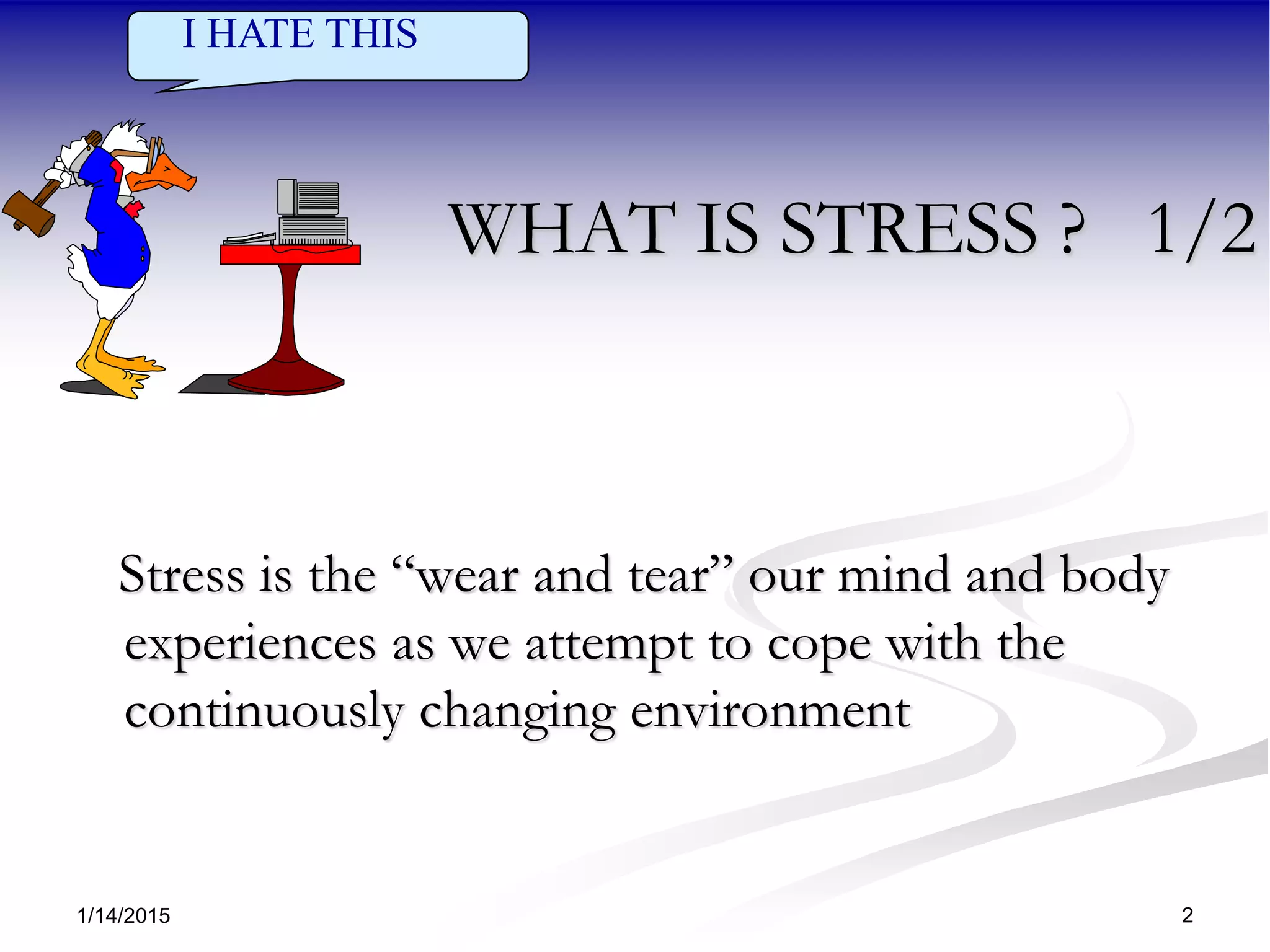
WHAT IS STRESS ? 1/2
Stress is the “wear and tear” our mind and body
experiences as we attempt to cope with the
continuously changing environment
I HATE THIS
1/14/2015 3
The non-specific response of the body to any
demand made upon it
WHAT IS STRESS ? 2/2
1/14/2015 4
Equation
S = P > R
Stress occurs when the pressure is greater than the
resource
1/14/2015 5
STRESS FEELINGS
 Worry
 Tense
 Tired
 Frightened
 Depressed
 Anxious
 Anger
Hey when
will this stop?
1/14/2015 6
Physical Stress: It is most common in human
beings caused by heavy work pressure or illness,
(no time to relax) which prevents us to work up
to our potential.
Concept of Stress 1/2
1/14/2015 7
Psychological Stress: There are several reasons
associated with psychological stress like family
problems, strenuous relationship at work place,
monotony in job, role ambiguity and conflict, less
wages and benefits, emotional break up etc.
Concept of Stress 2/2
1/14/2015 8
What causes stress?
1/14/2015 9
Stressors
They are defined as the external demands of life or
the internal attitudes and thoughts that require an
individual to adapt ….
1/14/2015 10
TYPES OF STRESSORS
 External
 Internal
1/14/2015 11
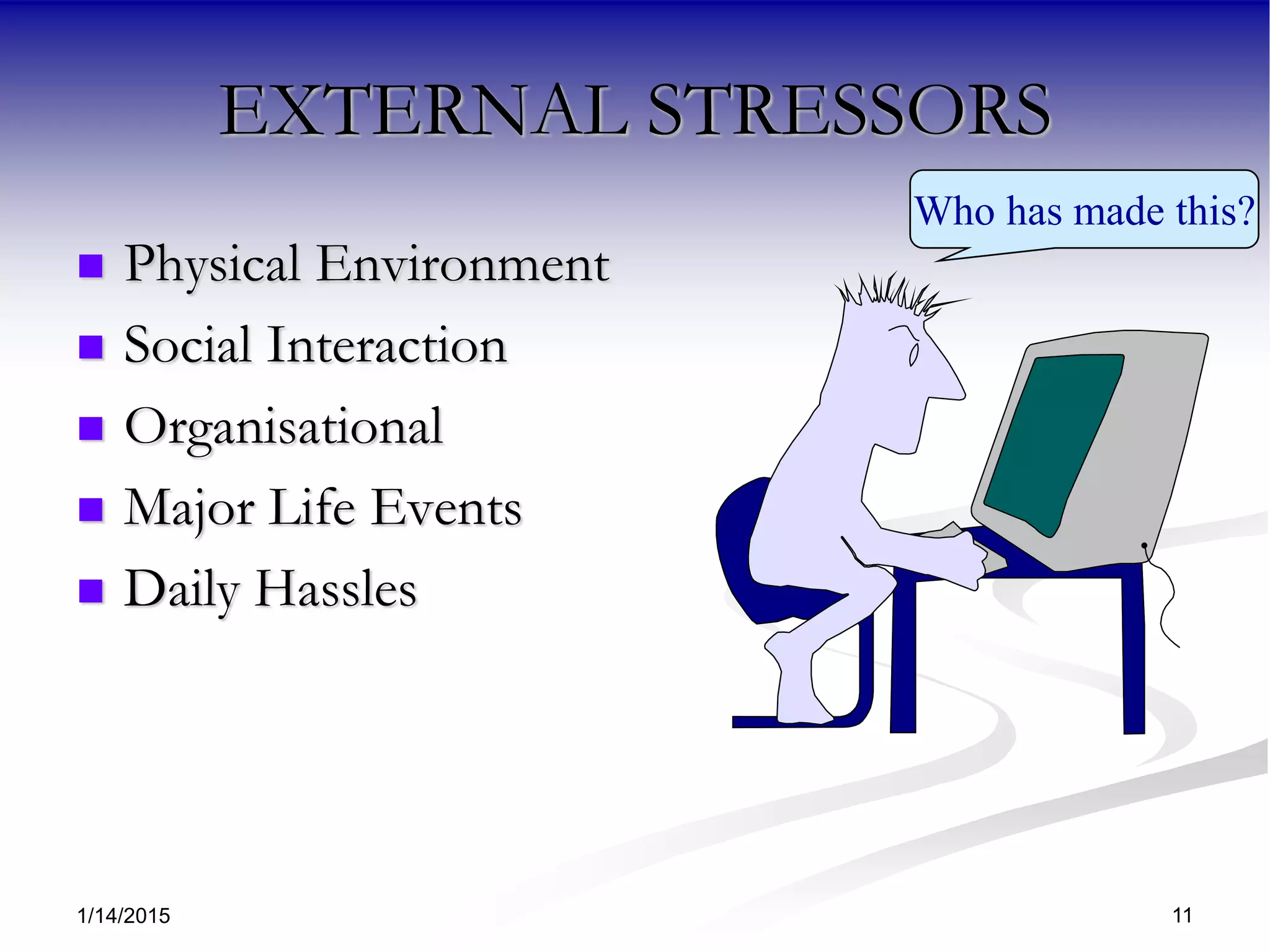
EXTERNAL STRESSORS
 Physical Environment
 Social Interaction
 Organisational
 Major Life Events
 Daily Hassles
Who has made this?
1/14/2015 12
INTERNAL STRESSORS
 Lifestyle choices
 Negative self - talk
 Mind traps
 Personality traits
1/14/2015 13
Types of Stress 1/2
Eustress
Healthy essential stress produced, for example, by
joy, or by any other kind of positive impulse,
sensible recreational activities, sports, hobbies etc.
The word eu is derived from Greek which means
good. Therefore Eustress in literary sense means
good stress.
1/14/2015 14
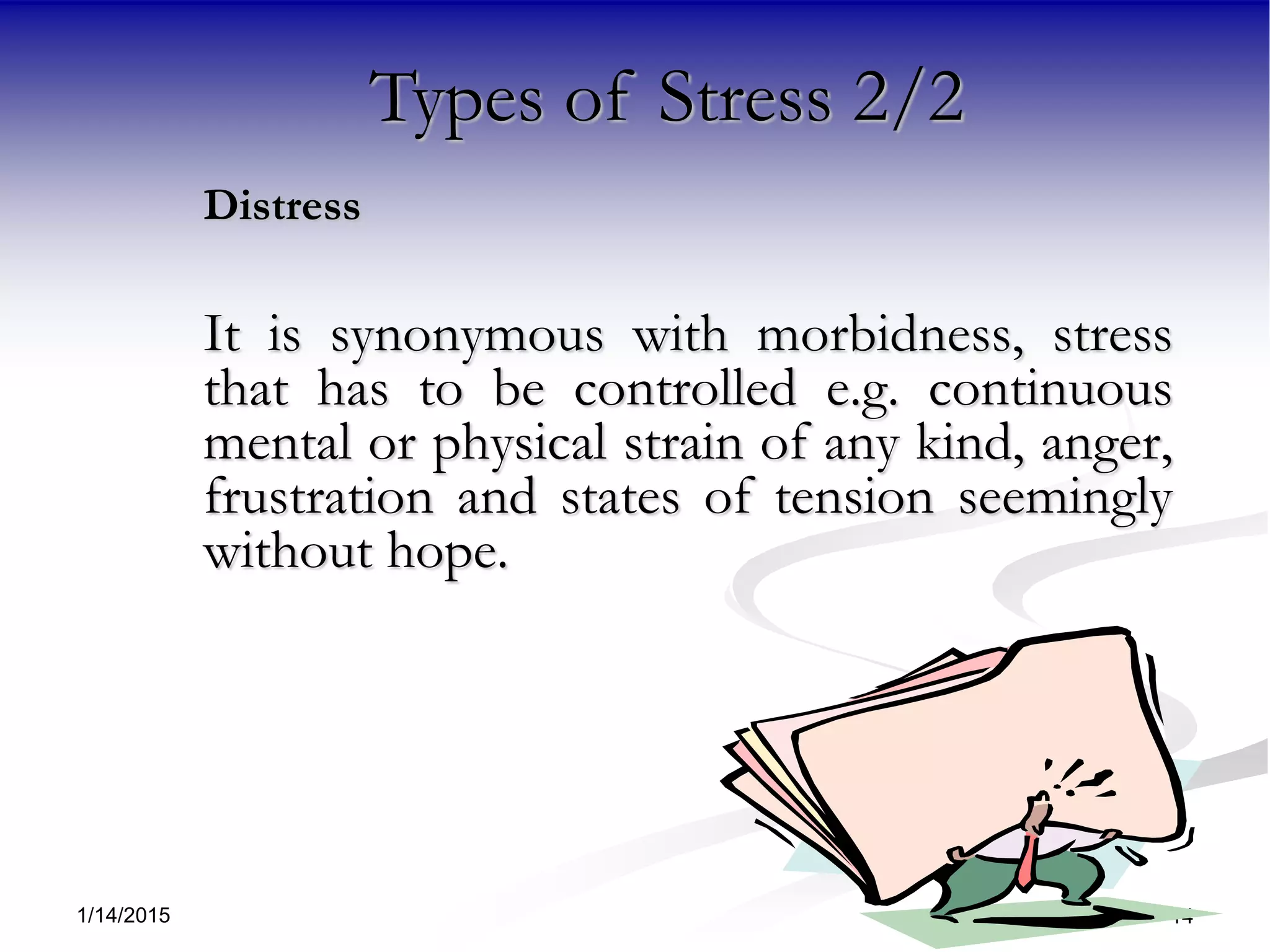
Distress
It is synonymous with morbidness, stress
that has to be controlled e.g. continuous
mental or physical strain of any kind, anger,
frustration and states of tension seemingly
without hope.
Types of Stress 2/2
1/14/2015 15
The Stress Response
1930’s
Dr. Hans Selye Dr. Walter Cannon
‘Flight or Fight Response’
1/14/2015 16
Stages of stress
1/14/2015 17
ALARM STAGE
As you begin to experience a stressful event or
perceive something to be stressful psychological
changes occur in your body. This experience or
perception disrupts your body’s normal balance
and immediately your body begins to respond to
the stressor(s) as effectively as possible.
1/14/2015 18
EXAMPLES
 Cardiac - increased heart rate
 Respiratory - increased respiration
 Skin - decreased temperature
 Hormonal - increased stimulation of
adrenal genes which produce an adrenal
rush.
1/14/2015 19
RESISTANCE STAGE
During this stage your body tries to cope or
adapt to the stressors by beginning a process of
repairing any damage the stressor has caused.
Your friends, family or co-workers may notice
changes in you before you do so it is important
to examine their feedback to make sure you do
not reach overload.
1/14/2015 20
EXAMPLES
 Behavior indicators include: lack of enthusiasm
for family, school, work or life in general,
withdrawal, change in eating habits, insomnia,
hypersomnia, anger, fatigue.
 Cognitive Indicators include: poor problem
solving, confusion, nightmares, hyper-vigilance.
1/14/2015 21
EXHAUSTION STAGE
During this stage the stressor is
not being managed effectively
and the body and mind are not
able to repair the damage.
1/14/2015 22
EXAMPLES
Digestive disorders, withdrawal, headaches,
tension, insomnia, loss of temper.
1/14/2015 23
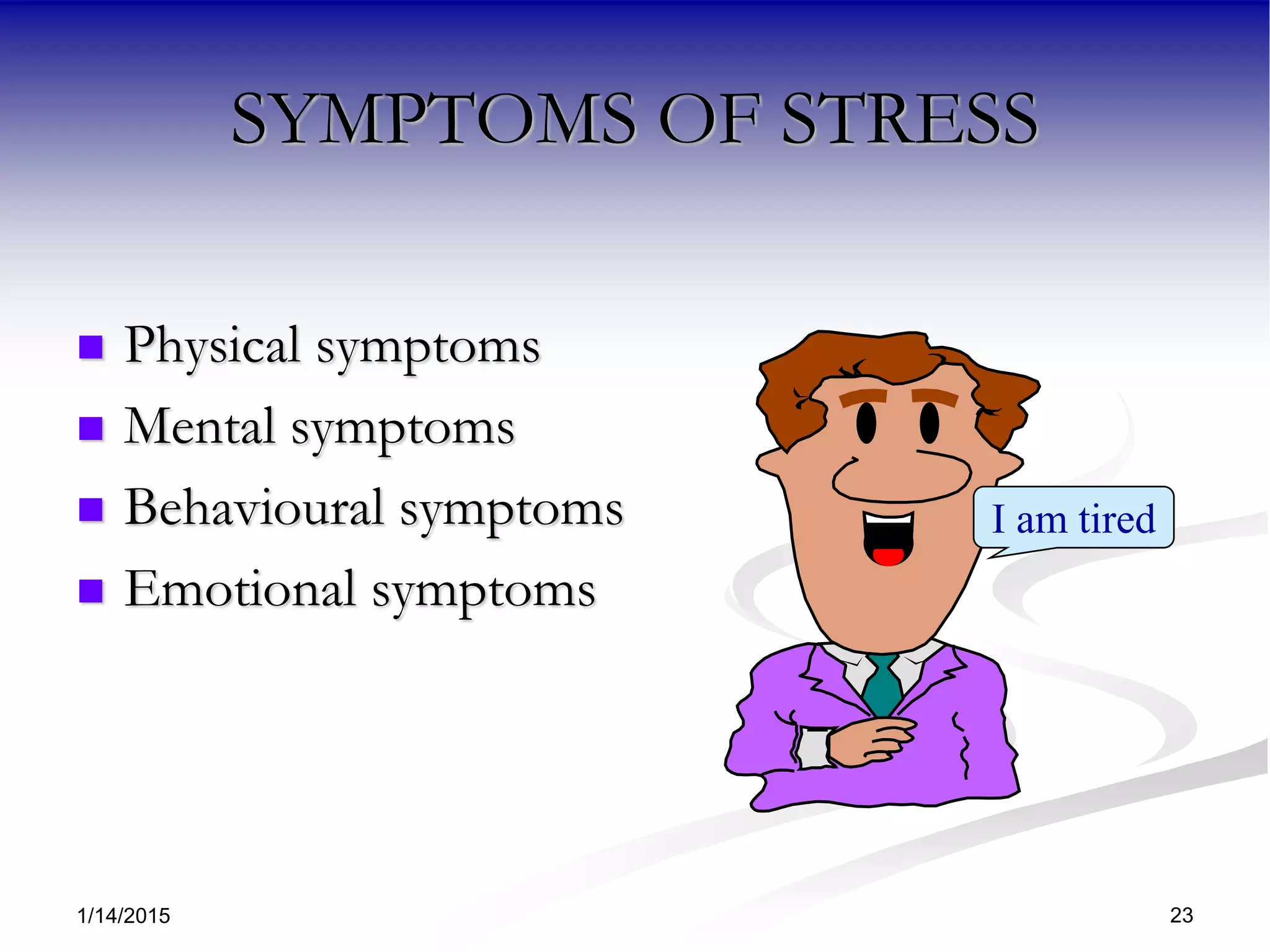
SYMPTOMS OF STRESS
 Physical symptoms
 Mental symptoms
 Behavioural symptoms
 Emotional symptoms
I am tired
1/14/2015 24
PHYSICAL SYMPTOMS
 Sleep pattern changes
 Fatigue
 Digestion changes
 Headaches
 Aches and pains
 Infections
 Indigestion
 Dizziness
 Fainting
 Sweating & trembling
 Tingling hands & feet
 Breathlessness
 Palpitations
 Missed heartbeats
1/14/2015 25
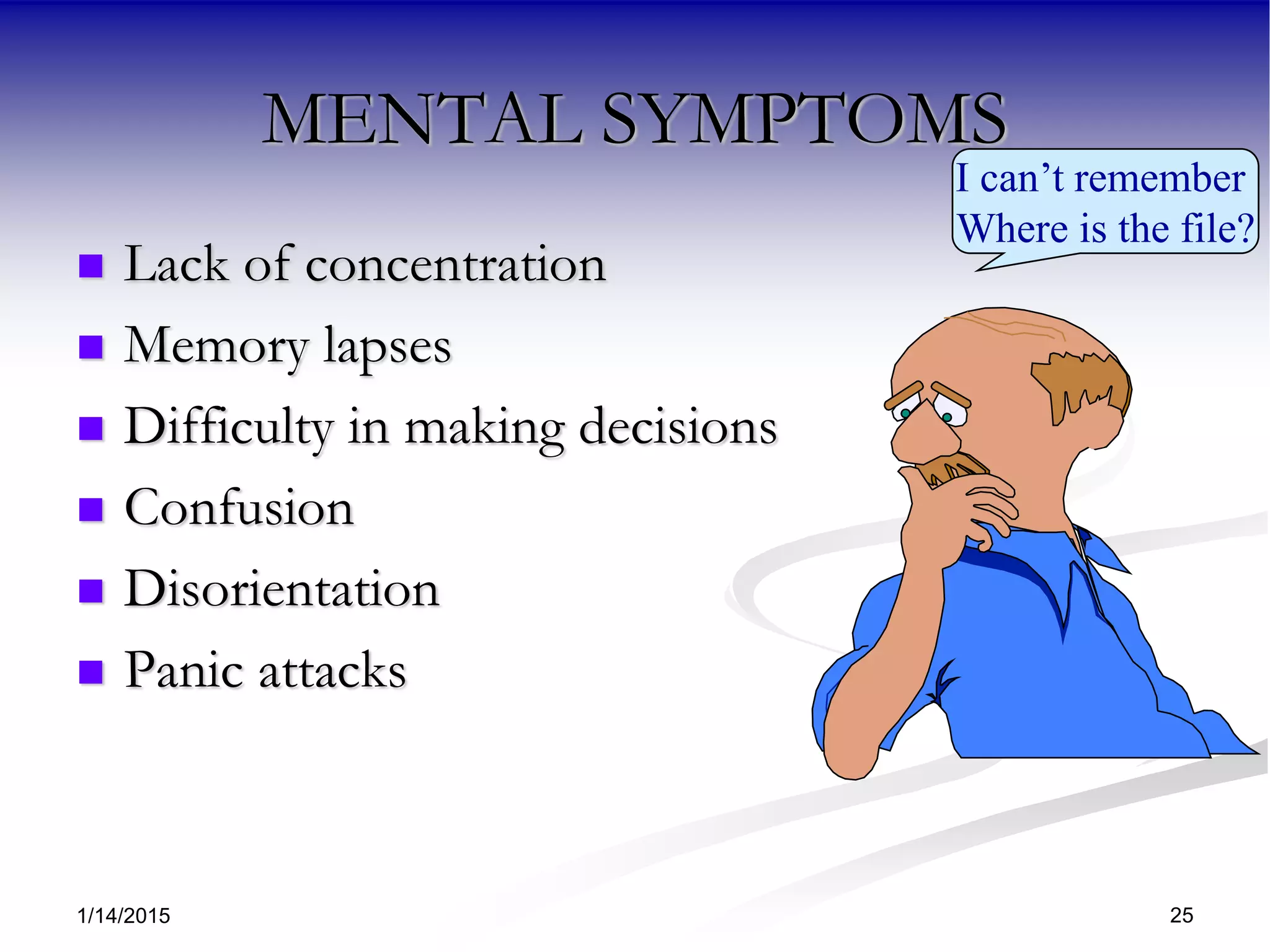
MENTAL SYMPTOMS
 Lack of concentration
 Memory lapses
 Difficulty in making decisions
 Confusion
 Disorientation
 Panic attacks
I can’t remember
Where is the file?
1/14/2015 26
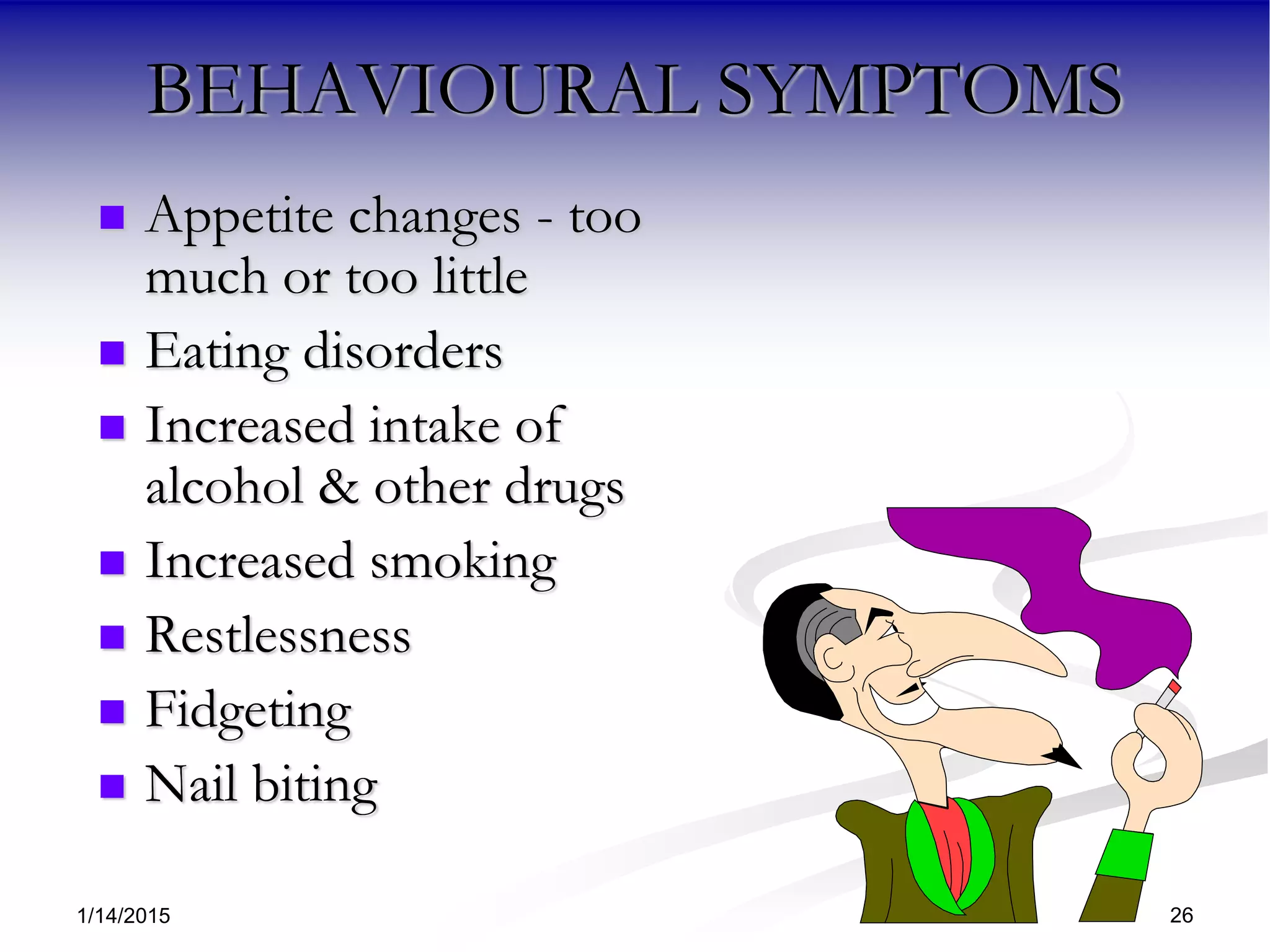
BEHAVIOURAL SYMPTOMS
 Appetite changes - too
much or too little
 Eating disorders
 Increased intake of
alcohol & other drugs
 Increased smoking
 Restlessness
 Fidgeting
 Nail biting
1/14/2015 27
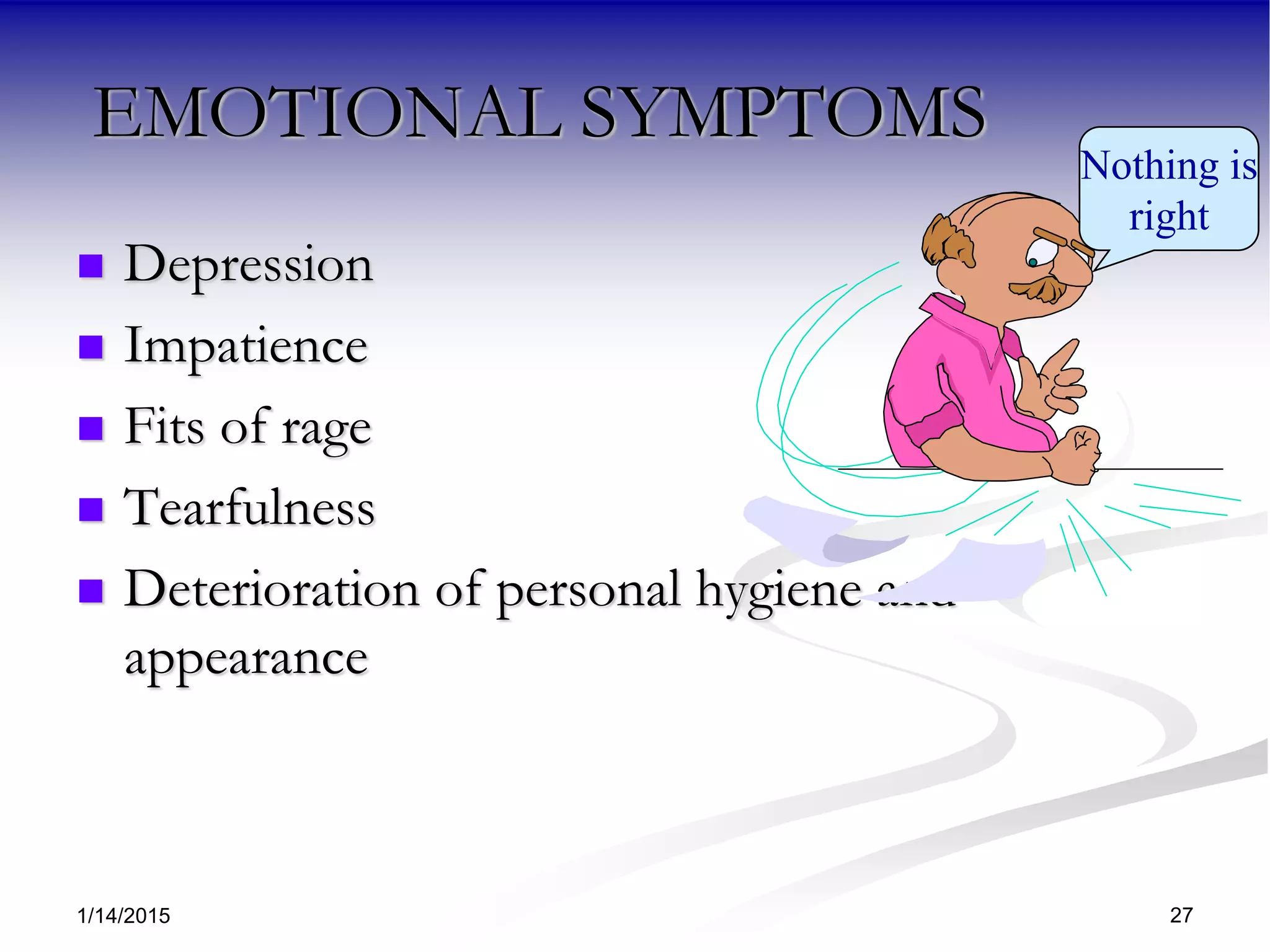
EMOTIONAL SYMPTOMS
 Depression
 Impatience
 Fits of rage
 Tearfulness
 Deterioration of personal hygiene and
appearance
Nothing is
right
1/14/2015 28
Optimal Level of Stress
Everyone is different, with unique
perceptions of, and reactions to, events.
There is no single level of stress that is
optimal for all people. Some are more
sensitive owing to experiences in childhood,
the influence of teachers, parents and
religion etc.
1/14/2015 29
What to do with stress?
1/14/2015 30
STRESS CONTROL
A B C STRATEGY
1/14/2015 31
ABC STRATEGY 1/3
A = AWARENESS
What causes you stress?
How do you react?
1/14/2015 32
ABC STRATEGY 2/3
B = BALANCE
There is a fine line between positive / negative
stress
How much can you cope with before it
becomes negative ?
1/14/2015 33
ABC STRATEGY 3/3
C = CONTROL
What can you do to help yourself combat the
negative effects of stress ?
1/14/2015 34
Stress Management Techniques
 Change your thinking
 Change your behaviour
 Change your lifestyle
1/14/2015 35
Alternatives
 Conventional Medicine
 Counselling & psychotherapy
 Relaxation
 Meditation
 Massage
 Yoga
 Music
 Movies
 Long drive
 Gardening
 Reiki
 Anger Management
 Time Management
 Money Management
 Many more………….
1/14/2015 36
Remember
“Stress is minimal among those
who look upon problems as
opportunities to overcome
adversity and to gain new
experience”
1/14/2015 37
Wish you a stress free life…
www.apagen.com

Stressmanagement orientation

  • 1.
  • 2.
    1/14/2015 2 WHAT ISSTRESS ? 1/2 Stress is the “wear and tear” our mind and body experiences as we attempt to cope with the continuously changing environment I HATE THIS
  • 3.
    1/14/2015 3 The non-specificresponse of the body to any demand made upon it WHAT IS STRESS ? 2/2
  • 4.
    1/14/2015 4 Equation S =P > R Stress occurs when the pressure is greater than the resource
  • 5.
    1/14/2015 5 STRESS FEELINGS Worry  Tense  Tired  Frightened  Depressed  Anxious  Anger Hey when will this stop?
  • 6.
    1/14/2015 6 Physical Stress:It is most common in human beings caused by heavy work pressure or illness, (no time to relax) which prevents us to work up to our potential. Concept of Stress 1/2
  • 7.
    1/14/2015 7 Psychological Stress:There are several reasons associated with psychological stress like family problems, strenuous relationship at work place, monotony in job, role ambiguity and conflict, less wages and benefits, emotional break up etc. Concept of Stress 2/2
  • 8.
  • 9.
    1/14/2015 9 Stressors They aredefined as the external demands of life or the internal attitudes and thoughts that require an individual to adapt ….
  • 10.
    1/14/2015 10 TYPES OFSTRESSORS  External  Internal
  • 11.
    1/14/2015 11 EXTERNAL STRESSORS Physical Environment  Social Interaction  Organisational  Major Life Events  Daily Hassles Who has made this?
  • 12.
    1/14/2015 12 INTERNAL STRESSORS Lifestyle choices  Negative self - talk  Mind traps  Personality traits
  • 13.
    1/14/2015 13 Types ofStress 1/2 Eustress Healthy essential stress produced, for example, by joy, or by any other kind of positive impulse, sensible recreational activities, sports, hobbies etc. The word eu is derived from Greek which means good. Therefore Eustress in literary sense means good stress.
  • 14.
    1/14/2015 14 Distress It issynonymous with morbidness, stress that has to be controlled e.g. continuous mental or physical strain of any kind, anger, frustration and states of tension seemingly without hope. Types of Stress 2/2
  • 15.
    1/14/2015 15 The StressResponse 1930’s Dr. Hans Selye Dr. Walter Cannon ‘Flight or Fight Response’
  • 16.
  • 17.
    1/14/2015 17 ALARM STAGE Asyou begin to experience a stressful event or perceive something to be stressful psychological changes occur in your body. This experience or perception disrupts your body’s normal balance and immediately your body begins to respond to the stressor(s) as effectively as possible.
  • 18.
    1/14/2015 18 EXAMPLES  Cardiac- increased heart rate  Respiratory - increased respiration  Skin - decreased temperature  Hormonal - increased stimulation of adrenal genes which produce an adrenal rush.
  • 19.
    1/14/2015 19 RESISTANCE STAGE Duringthis stage your body tries to cope or adapt to the stressors by beginning a process of repairing any damage the stressor has caused. Your friends, family or co-workers may notice changes in you before you do so it is important to examine their feedback to make sure you do not reach overload.
  • 20.
    1/14/2015 20 EXAMPLES  Behaviorindicators include: lack of enthusiasm for family, school, work or life in general, withdrawal, change in eating habits, insomnia, hypersomnia, anger, fatigue.  Cognitive Indicators include: poor problem solving, confusion, nightmares, hyper-vigilance.
  • 21.
    1/14/2015 21 EXHAUSTION STAGE Duringthis stage the stressor is not being managed effectively and the body and mind are not able to repair the damage.
  • 22.
    1/14/2015 22 EXAMPLES Digestive disorders,withdrawal, headaches, tension, insomnia, loss of temper.
  • 23.
    1/14/2015 23 SYMPTOMS OFSTRESS  Physical symptoms  Mental symptoms  Behavioural symptoms  Emotional symptoms I am tired
  • 24.
    1/14/2015 24 PHYSICAL SYMPTOMS Sleep pattern changes  Fatigue  Digestion changes  Headaches  Aches and pains  Infections  Indigestion  Dizziness  Fainting  Sweating & trembling  Tingling hands & feet  Breathlessness  Palpitations  Missed heartbeats
  • 25.
    1/14/2015 25 MENTAL SYMPTOMS Lack of concentration  Memory lapses  Difficulty in making decisions  Confusion  Disorientation  Panic attacks I can’t remember Where is the file?
  • 26.
    1/14/2015 26 BEHAVIOURAL SYMPTOMS Appetite changes - too much or too little  Eating disorders  Increased intake of alcohol & other drugs  Increased smoking  Restlessness  Fidgeting  Nail biting
  • 27.
    1/14/2015 27 EMOTIONAL SYMPTOMS Depression  Impatience  Fits of rage  Tearfulness  Deterioration of personal hygiene and appearance Nothing is right
  • 28.
    1/14/2015 28 Optimal Levelof Stress Everyone is different, with unique perceptions of, and reactions to, events. There is no single level of stress that is optimal for all people. Some are more sensitive owing to experiences in childhood, the influence of teachers, parents and religion etc.
  • 29.
    1/14/2015 29 What todo with stress?
  • 30.
  • 31.
    1/14/2015 31 ABC STRATEGY1/3 A = AWARENESS What causes you stress? How do you react?
  • 32.
    1/14/2015 32 ABC STRATEGY2/3 B = BALANCE There is a fine line between positive / negative stress How much can you cope with before it becomes negative ?
  • 33.
    1/14/2015 33 ABC STRATEGY3/3 C = CONTROL What can you do to help yourself combat the negative effects of stress ?
  • 34.
    1/14/2015 34 Stress ManagementTechniques  Change your thinking  Change your behaviour  Change your lifestyle
  • 35.
    1/14/2015 35 Alternatives  ConventionalMedicine  Counselling & psychotherapy  Relaxation  Meditation  Massage  Yoga  Music  Movies  Long drive  Gardening  Reiki  Anger Management  Time Management  Money Management  Many more………….
  • 36.
    1/14/2015 36 Remember “Stress isminimal among those who look upon problems as opportunities to overcome adversity and to gain new experience”
  • 37.
    1/14/2015 37 Wish youa stress free life… www.apagen.com