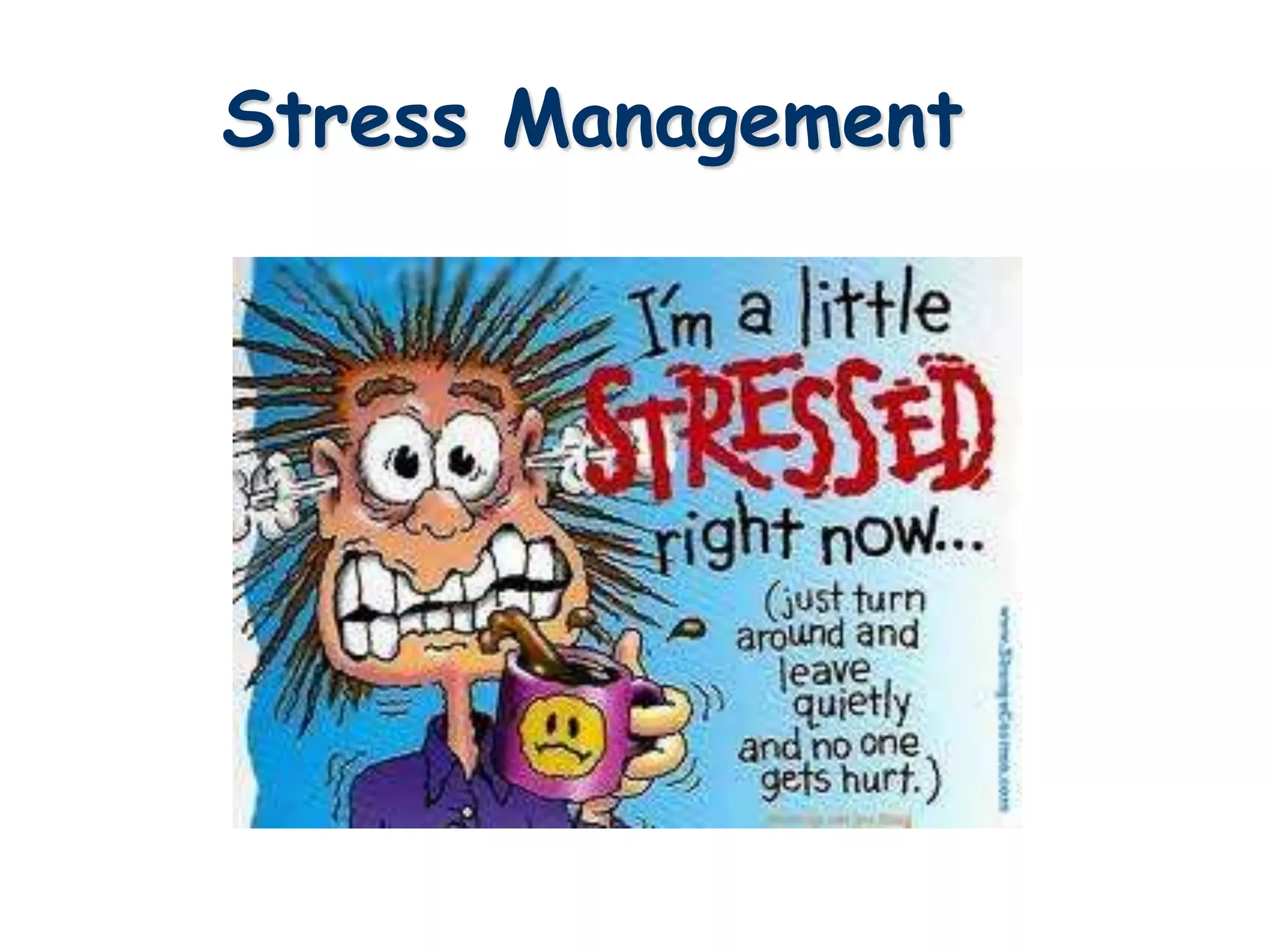
Stress Management
1.What is STRESS?
 2. WHY is learning about it important for
my life?
 3. How do I know I am stressed?
 4. What do you do currently to manage
your stressors?
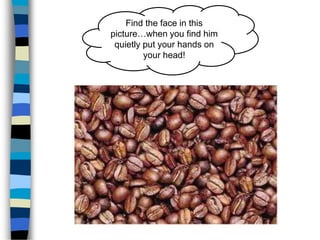
Find the face in this
picture…when you find him
quietly put your hands on
your head!
Stress Management
1.)How does stress influence our mood
and our behavior?
2.)How does a persons’ perception of
something influence their level of
stress?
3.)What do people do to relieve stress?
4.)Can we control our stress levels?
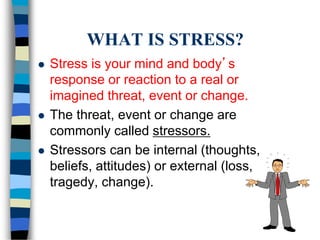
WHAT IS STRESS?
 Stress is your mind and body’s
response or reaction to a real or
imagined threat, event or change.
 The threat, event or change are
commonly called stressors.
 Stressors can be internal (thoughts,
beliefs, attitudes) or external (loss,
tragedy, change).
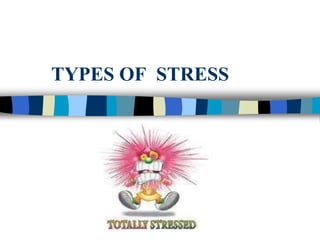
TYPES OF STRESS
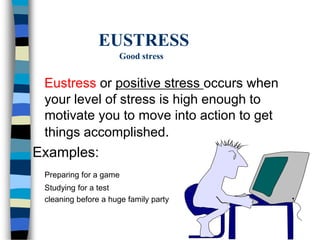
EUSTRESS
Good stress
Eustress or positive stress occurs when
your level of stress is high enough to
motivate you to move into action to get
things accomplished.
Examples:
Preparing for a game
Studying for a test
cleaning before a huge family party
DISTRESS
Distress or negative stress occurs when
your level of stress is either too high or too
low and your body and/or mind begin to
respond negatively to the stressors.
Examples:
*Car accident
*get into a fight
*find out a boyfriend
or girlfriend cheated on you
4 STAGES OF STRESS
1.) ALARM STAGE
 As you begin to experience a
stressful event or perceive
something to be stressful,
psychological changes occur in
your body. (positive or negative pictures come to your
mind)
 This experience or perception
disrupts your body’s normal
balance and immediately your
body begins to respond to the
stressor(s) as effectively as
possible.
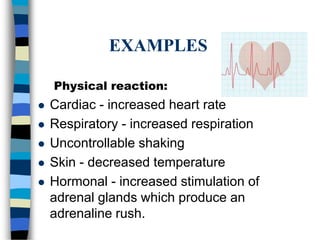
EXAMPLES
Physical reaction:
 Cardiac - increased heart rate
 Respiratory - increased respiration
 Uncontrollable shaking
 Skin - decreased temperature
 Hormonal - increased stimulation of
adrenal glands which produce an
adrenaline rush.
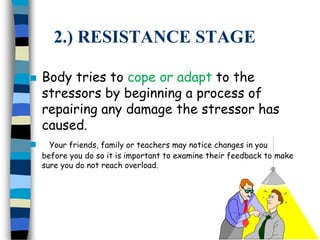
2.) RESISTANCE STAGE
 Body tries to cope or adapt to the
stressors by beginning a process of
repairing any damage the stressor has
caused.
 Your friends, family or teachers may notice changes in you
before you do so it is important to examine their feedback to make
sure you do not reach overload.
EXAMPLES
 Behavior indicators include: lack of
enthusiasm for family, school, work or
life in general, withdrawal, change in
eating habits, insomnia, hypersomnia,
anger, fatigue.
 Cognitive Indicators include: poor
problem solving, confusion, nightmares,
hyper-vigilance.
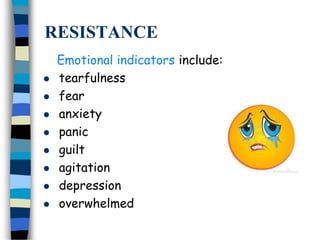
RESISTANCE
Emotional indicators include:
 tearfulness
 fear
 anxiety
 panic
 guilt
 agitation
 depression
 overwhelmed
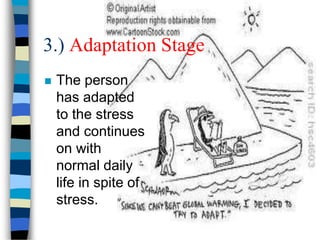
3.) Adaptation Stage
 The person
has adapted
to the stress
and continues
on with
normal daily
life in spite of
stress.
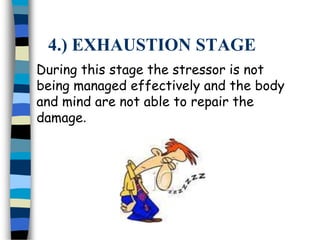
4.) EXHAUSTION STAGE
During this stage the stressor is not
being managed effectively and the body
and mind are not able to repair the
damage.
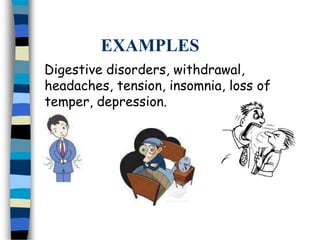
EXAMPLES
Digestive disorders, withdrawal,
headaches, tension, insomnia, loss of
temper, depression.
Common causes of stress
 Role Conflicts - being an athlete, a kid,
trying to be a mature adult
 Imbalance – Too much work not
enough play and vice versa
 Life Changes – new job, moving,
marriage, divorce,
Common causes of stress
 Self Talk- Negative thought patterns “I can’t do it”
 Expectations – From ourselves and/or others Too
High or Too LOW
 Poor quality relationships- with family or
friends
 Time pressures – due dates
 Lack of meaning or purpose – Those
who think they have no goals
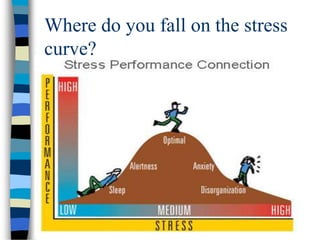
Where do you fall on the stress
curve?
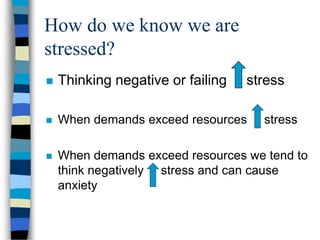
How do we know we are
stressed?
 Thinking negative or failing stress
 When demands exceed resources stress
 When demands exceed resources we tend to
think negatively stress and can cause
anxiety
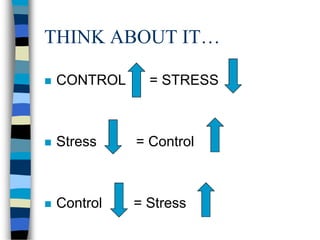
THINK ABOUT IT…
 CONTROL = STRESS
 Stress = Control
 Control = Stress
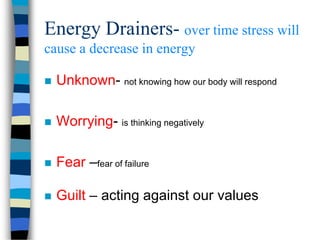
Energy Drainers- over time stress will
cause a decrease in energy
 Unknown- not knowing how our body will respond
 Worrying- is thinking negatively
 Fear –fear of failure
 Guilt – acting against our values
YOU ARE IN CONTROL -
DISTRESS RELIEF
STRATEGIES
• Feeling good about yourself can be an
effective buffer against stress.
Eliminate unnecessary worries.
• Most worries are either passed on to
us by another or fabricated in our
imagination.
How do we manage stress (cope
with stressful situations)
effectively?
How can we manage stress in a
positive way?
 Give problems time
 Use help when you need it
 If you need help ASK !!
 Remember there is always a solution to
a problem…ALWAYS!!!
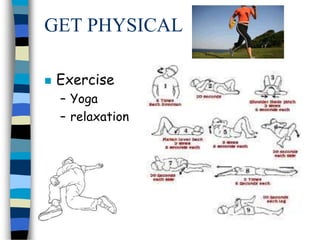
GET PHYSICAL
 Exercise
– Yoga
– relaxation
GET MENTAL
 Count to 10
 Control your
thoughts
 Say something
positive to yourself
about yourself
Talk to a counselor
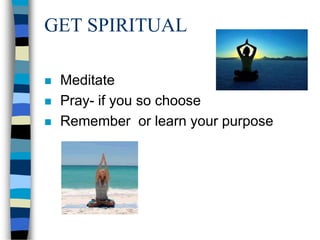
GET SPIRITUAL
 Meditate
 Pray- if you so choose
 Remember or learn your purpose
USE YOUR BODY AND MIND
TOGETHER
 Take a break
 Get hug therapy
 Try progressive relaxation
 Try yoga
 Try aroma therapy
 Laugh
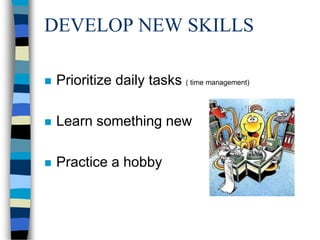
DEVELOP NEW SKILLS
 Prioritize daily tasks ( time management)
 Learn something new
 Practice a hobby
MORE STRATEGIES
 “What is Stress” Web Site. http//www.teachhealth.com
 How to reduce and relieve stress “Web Site. http//www.family.com
 “Stress Relievers” Web Site. http//www.residentassistant.com
 “Massage” Downing, G. (1972). Massage Book. New York: Random
House.
 “Aromatherapy” Web Site.
http//www/aromaweb.com/articles/wharoma.as
 “Yoga” Web Site. http//www.kevala.co.uk/yoga/overview.htr

stress.ppt

  • 1.
  • 2.
    1.What is STRESS? 2. WHY is learning about it important for my life?  3. How do I know I am stressed?  4. What do you do currently to manage your stressors?
  • 3.
    Find the facein this picture…when you find him quietly put your hands on your head!
  • 4.
    Stress Management 1.)How doesstress influence our mood and our behavior? 2.)How does a persons’ perception of something influence their level of stress? 3.)What do people do to relieve stress? 4.)Can we control our stress levels?
  • 5.
    WHAT IS STRESS? Stress is your mind and body’s response or reaction to a real or imagined threat, event or change.  The threat, event or change are commonly called stressors.  Stressors can be internal (thoughts, beliefs, attitudes) or external (loss, tragedy, change).
  • 6.
  • 7.
    EUSTRESS Good stress Eustress orpositive stress occurs when your level of stress is high enough to motivate you to move into action to get things accomplished. Examples: Preparing for a game Studying for a test cleaning before a huge family party
  • 8.
    DISTRESS Distress or negativestress occurs when your level of stress is either too high or too low and your body and/or mind begin to respond negatively to the stressors. Examples: *Car accident *get into a fight *find out a boyfriend or girlfriend cheated on you
  • 9.
  • 10.
    1.) ALARM STAGE As you begin to experience a stressful event or perceive something to be stressful, psychological changes occur in your body. (positive or negative pictures come to your mind)  This experience or perception disrupts your body’s normal balance and immediately your body begins to respond to the stressor(s) as effectively as possible.
  • 11.
    EXAMPLES Physical reaction:  Cardiac- increased heart rate  Respiratory - increased respiration  Uncontrollable shaking  Skin - decreased temperature  Hormonal - increased stimulation of adrenal glands which produce an adrenaline rush.
  • 12.
    2.) RESISTANCE STAGE Body tries to cope or adapt to the stressors by beginning a process of repairing any damage the stressor has caused.  Your friends, family or teachers may notice changes in you before you do so it is important to examine their feedback to make sure you do not reach overload.
  • 13.
    EXAMPLES  Behavior indicatorsinclude: lack of enthusiasm for family, school, work or life in general, withdrawal, change in eating habits, insomnia, hypersomnia, anger, fatigue.  Cognitive Indicators include: poor problem solving, confusion, nightmares, hyper-vigilance.
  • 14.
    RESISTANCE Emotional indicators include: tearfulness  fear  anxiety  panic  guilt  agitation  depression  overwhelmed
  • 15.
    3.) Adaptation Stage The person has adapted to the stress and continues on with normal daily life in spite of stress.
  • 16.
    4.) EXHAUSTION STAGE Duringthis stage the stressor is not being managed effectively and the body and mind are not able to repair the damage.
  • 17.
    EXAMPLES Digestive disorders, withdrawal, headaches,tension, insomnia, loss of temper, depression.
  • 18.
    Common causes ofstress  Role Conflicts - being an athlete, a kid, trying to be a mature adult  Imbalance – Too much work not enough play and vice versa  Life Changes – new job, moving, marriage, divorce,
  • 19.
    Common causes ofstress  Self Talk- Negative thought patterns “I can’t do it”  Expectations – From ourselves and/or others Too High or Too LOW  Poor quality relationships- with family or friends  Time pressures – due dates  Lack of meaning or purpose – Those who think they have no goals
  • 20.
    Where do youfall on the stress curve?
  • 21.
    How do weknow we are stressed?  Thinking negative or failing stress  When demands exceed resources stress  When demands exceed resources we tend to think negatively stress and can cause anxiety
  • 22.
    THINK ABOUT IT… CONTROL = STRESS  Stress = Control  Control = Stress
  • 23.
    Energy Drainers- overtime stress will cause a decrease in energy  Unknown- not knowing how our body will respond  Worrying- is thinking negatively  Fear –fear of failure  Guilt – acting against our values
  • 24.
    YOU ARE INCONTROL - DISTRESS RELIEF STRATEGIES • Feeling good about yourself can be an effective buffer against stress. Eliminate unnecessary worries. • Most worries are either passed on to us by another or fabricated in our imagination.
  • 25.
    How do wemanage stress (cope with stressful situations) effectively?
  • 26.
    How can wemanage stress in a positive way?  Give problems time  Use help when you need it  If you need help ASK !!  Remember there is always a solution to a problem…ALWAYS!!!
  • 27.
    GET PHYSICAL  Exercise –Yoga – relaxation
  • 28.
    GET MENTAL  Countto 10  Control your thoughts  Say something positive to yourself about yourself Talk to a counselor
  • 29.
    GET SPIRITUAL  Meditate Pray- if you so choose  Remember or learn your purpose
  • 30.
    USE YOUR BODYAND MIND TOGETHER  Take a break  Get hug therapy  Try progressive relaxation  Try yoga  Try aroma therapy  Laugh
  • 31.
    DEVELOP NEW SKILLS Prioritize daily tasks ( time management)  Learn something new  Practice a hobby
  • 32.
    MORE STRATEGIES  “Whatis Stress” Web Site. http//www.teachhealth.com  How to reduce and relieve stress “Web Site. http//www.family.com  “Stress Relievers” Web Site. http//www.residentassistant.com  “Massage” Downing, G. (1972). Massage Book. New York: Random House.  “Aromatherapy” Web Site. http//www/aromaweb.com/articles/wharoma.as  “Yoga” Web Site. http//www.kevala.co.uk/yoga/overview.htr