Positive Psychology II – The Sequel
Peter Gowers
IT Supervisor, and
amateur positive
psychology student
Positive
Psychology recap
 “Scientific Study of optimal human functioning that aims
to discover and promote the factors that allow
individuals and communities to thrive” Martin Seligman,
founder of PP
 Reaction to Normal Psychology
 Positive Psychology looks to help people nurture talent
and improve normal lives
 A very large collection of loosely coupled positive
constructs.
 Data Driven – large Studies
 Happiness - Paradox of rising Expectations
Martin Seligman
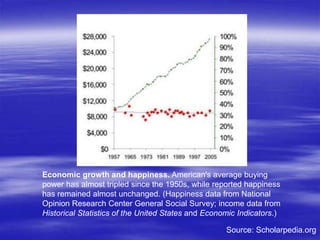
Economic growth and happiness. American's average buying
power has almost tripled since the 1950s, while reported happiness
has remained almost unchanged. (Happiness data from National
Opinion Research Center General Social Survey; income data from
Historical Statistics of the United States and Economic Indicators.)
Source: Scholarpedia.org
Today - 2 Very different approaches
to Happiness
 Savouring - Awareness of pleasure and of
the deliberate conscious attention to the
experience of pleasure.
 Flow – When does time stop for you?
Doing something you never want to end?
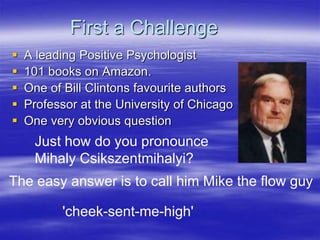
First a Challenge
 A leading Positive Psychologist
 101 books on Amazon.
 One of Bill Clintons favourite authors
 Professor at the University of Chicago
 One very obvious question
Just how do you pronounce
Mihaly Csikszentmihalyi?
The easy answer is to call him Mike the flow guy
'cheek-sent-me-high'
Some Quotes by Mike
“For too Long psychology had been focused almost
exclusively on the shadows of human existence”
“A joyful life is an individual creation that can’t be copied
from a recipe”
“People who learn to control inner experience will be able
to determine the quality of their lives, which is as close as
any of us can come to being happy.”
Mihaly Csikszentmihalyi
Flow
 Do you ever feel one of the following:
– “In the zone”, “on the ball”, “in the groove”
– “In the moment”
– A difficult task becomes effortless
– Time seems to pass very quickly
– You faced a big challenge but actually enjoyed the
task
Flow is the state in which people are so involved in
an activity, that nothing else seems to matter; the
experience itself is so enjoyable that people will do it
even at great cost, for the shear sake of doing it.
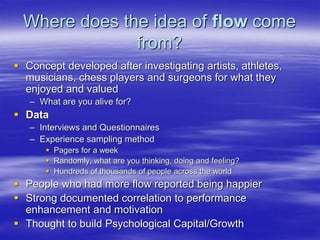
Where does the idea of flow come
from?
 Concept developed after investigating artists, athletes,
musicians, chess players and surgeons for what they
enjoyed and valued
– What are you alive for?
 Data
– Interviews and Questionnaires
– Experience sampling method
 Pagers for a week
 Randomly, what are you thinking, doing and feeling?
 Hundreds of thousands of people across the world
 People who had more flow reported being happier
 Strong documented correlation to performance
enhancement and motivation
 Thought to build Psychological Capital/Growth
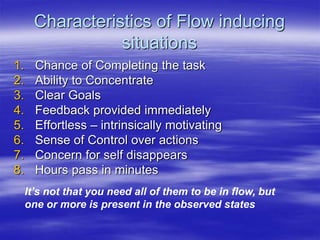
Characteristics of Flow inducing
situations
1. Chance of Completing the task
2. Ability to Concentrate
3. Clear Goals
4. Feedback provided immediately
5. Effortless – intrinsically motivating
6. Sense of Control over actions
7. Concern for self disappears
8. Hours pass in minutes
It’s not that you need all of them to be in flow, but
one or more is present in the observed states
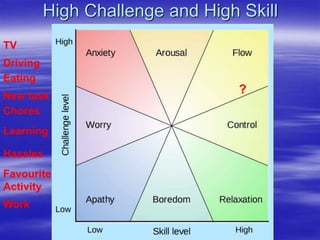
High Challenge and High Skill
TV
Driving
Eating
New task
Favourite
Activity
Chores
Learning
Hassles
Work
?
Work
“It does not seem to be true that work
necessarily needs to be unpleasant. It may
always have to be hard, or at least harder
than doing nothing at all. But there is ample
evidence that work can be enjoyable, and
that indeed, it is often the most enjoyable
part of life.”
Mihaly Csikszentmihalyi
The Paradox of Work and Leisure
 Work reports 54% flow vs Leisure at 18%
 People describe some of their most positive
experiences doing their job
 People report low moods during Leisure
time
 And Yet:
– They say they would prefer not to be working
and want more leisure time
– Maybe we need to improve our leisure and
think more about our perception of work
“Wherever the goal is to
increase the quality of life, flow
can point the way.”
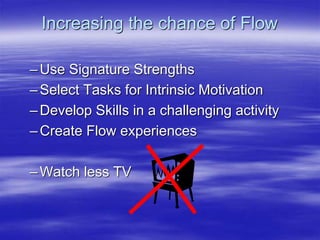
Increasing the chance of Flow
–Use Signature Strengths
–Select Tasks for Intrinsic Motivation
–Develop Skills in a challenging activity
–Create Flow experiences
–Watch less TV
Savouring
“Savouring is the capacity to attend to,
appreciate, and enhance the positive
experiences in one’s life.”
(Bryant, 2007)
 A state when we’re aware of pleasure with
conscious attention to experience, almost
the opposite of flow.
How do we cope?
 Faced with a negative event we can cope by:
– Active problem solving
– Social Support
– Cognitive Reappraisal
– Formal Help Seeking
– Prayer
– Wishful thinking
– Escape/Avoidance
 But how do we cope with a positive event?
– The process, not the outcome
– Normal coping will not maximise the benefit
– Coping is about moderating the quality of negative
experiences, Savouring is about moderating the
quality of positive experiences
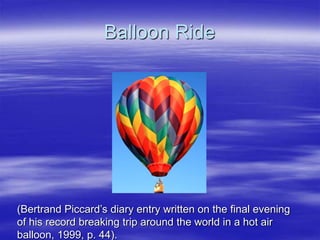
Balloon Ride
(Bertrand Piccard’s diary entry written on the final evening
of his record breaking trip around the world in a hot air
balloon, 1999, p. 44).
Savouring
An example of savouring
“During the last night, I savour once more the intimate
relationship we have established with our planet.
Shivering in the pilot’s seat, I have the feeling I have left
the capsule to fly under the stars that have swallowed
our balloon. I feel so privileged that I want to enjoy every
second of this air world. During our three weeks of flight,
protected by our high-tech cocoon, we have flown over
millions of people suffering on this earth… why are we so
lucky?... very shortly after daybreak, [our balloon] will
land in the Egyptian sand, Brian and I will be lifted away
from the desert by helicopter, and we will immediately
need to find words to satisfy the public’s curiosity. But
right now, muffled in my down jacket, I let the cold bite of
the night remind me that I have not yet landed, that I am
still living one of the most beautiful moments of my life.
The only way I can make this instant last will be to share
it with others…”
(Bertrand Piccard’s diary entry written on the final evening of his record
breaking trip around the world in a hot air balloon, 1999, p. 44).
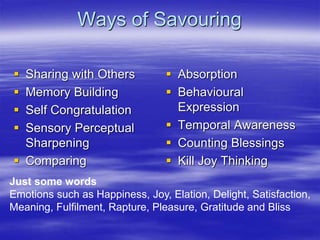
Ways of Savouring
 Sharing with Others
 Memory Building
 Self Congratulation
 Sensory Perceptual
Sharpening
 Comparing
 Absorption
 Behavioural
Expression
 Temporal Awareness
 Counting Blessings
 Kill Joy Thinking
Just some words
Emotions such as Happiness, Joy, Elation, Delight, Satisfaction,
Meaning, Fulfilment, Rapture, Pleasure, Gratitude and Bliss
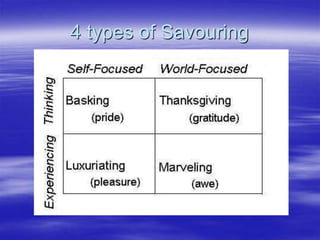
4 types of Savouring
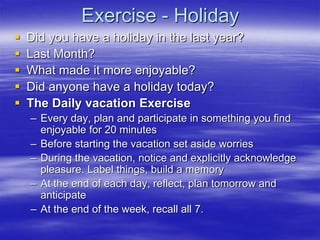
Exercise - Holiday
 Did you have a holiday in the last year?
 Last Month?
 What made it more enjoyable?
 Did anyone have a holiday today?
 The Daily vacation Exercise
– Every day, plan and participate in something you find
enjoyable for 20 minutes
– Before starting the vacation set aside worries
– During the vacation, notice and explicitly acknowledge
pleasure. Label things, build a memory
– At the end of each day, reflect, plan tomorrow and
anticipate
– At the end of the week, recall all 7.
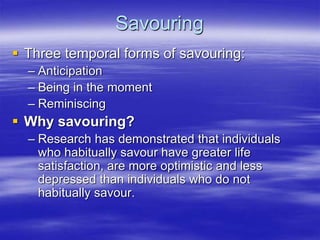
Savouring
 Three temporal forms of savouring:
– Anticipation
– Being in the moment
– Reminiscing
 Why savouring?
– Research has demonstrated that individuals
who habitually savour have greater life
satisfaction, are more optimistic and less
depressed than individuals who do not
habitually savour.
Increase Savouring
 Social Support
 Writing
 Downward Hedonic Contrast
 Humour
 Spirituality and Religion
 Awareness of the fleetingness of existence.
And Finally
 Prolong the Experience
 Intensify the Experience
 Shift Gears to Savouring
 And don’t forget your flow
Any Questions?
(Difficult ones very much welcome)
Thank You!
References
 Savoring: A New Model of Positive Experience - Paperback (11 Aug
2006) by Fred B. Bryant and Joseph Veroff
 Flow: The Psychology of Optimal Experience (P.S.) by Mihaly
Csikszentmihalyi (Paperback - 1 Jul 2008)
 Finding Flow: The Psychology of Engagement with Everyday Life
(MasterMinds) by Mihaly Csikszentmihalyi (Paperback - 16 Mar 1998)
 A Primer in Positive Psychology by Christopher Peterson (Paperback -
17 Aug 2006)
 Positive Psychology: The Science of Happiness and Human Strengths
(Paperback) by Alan Carr Routledge; 1 edition (4 Dec 2003) ISBN-13:
978-1583919910
 Authentic Happiness: Using the New Positive Psychology to Realise
Your Potential for Lasting Fulfilment (Paperback) by Martin E.P.
Seligman Nicholas Brealey Publishing (6 Mar 2003) ISBN-13: 978-
1857883299
 http://www.ted.com/talks/mihaly_csikszentmihalyi_on_flow.html
 http://positivepsychology.org.uk/

Positive Psychology 2

  • 1.
    Positive Psychology II– The Sequel Peter Gowers IT Supervisor, and amateur positive psychology student
  • 2.
    Positive Psychology recap  “ScientificStudy of optimal human functioning that aims to discover and promote the factors that allow individuals and communities to thrive” Martin Seligman, founder of PP  Reaction to Normal Psychology  Positive Psychology looks to help people nurture talent and improve normal lives  A very large collection of loosely coupled positive constructs.  Data Driven – large Studies  Happiness - Paradox of rising Expectations Martin Seligman
  • 3.
    Economic growth andhappiness. American's average buying power has almost tripled since the 1950s, while reported happiness has remained almost unchanged. (Happiness data from National Opinion Research Center General Social Survey; income data from Historical Statistics of the United States and Economic Indicators.) Source: Scholarpedia.org
  • 4.
    Today - 2Very different approaches to Happiness  Savouring - Awareness of pleasure and of the deliberate conscious attention to the experience of pleasure.  Flow – When does time stop for you? Doing something you never want to end?
  • 5.
    First a Challenge A leading Positive Psychologist  101 books on Amazon.  One of Bill Clintons favourite authors  Professor at the University of Chicago  One very obvious question Just how do you pronounce Mihaly Csikszentmihalyi? The easy answer is to call him Mike the flow guy 'cheek-sent-me-high'
  • 6.
    Some Quotes byMike “For too Long psychology had been focused almost exclusively on the shadows of human existence” “A joyful life is an individual creation that can’t be copied from a recipe” “People who learn to control inner experience will be able to determine the quality of their lives, which is as close as any of us can come to being happy.” Mihaly Csikszentmihalyi
  • 7.
    Flow  Do youever feel one of the following: – “In the zone”, “on the ball”, “in the groove” – “In the moment” – A difficult task becomes effortless – Time seems to pass very quickly – You faced a big challenge but actually enjoyed the task Flow is the state in which people are so involved in an activity, that nothing else seems to matter; the experience itself is so enjoyable that people will do it even at great cost, for the shear sake of doing it.
  • 8.
    Where does theidea of flow come from?  Concept developed after investigating artists, athletes, musicians, chess players and surgeons for what they enjoyed and valued – What are you alive for?  Data – Interviews and Questionnaires – Experience sampling method  Pagers for a week  Randomly, what are you thinking, doing and feeling?  Hundreds of thousands of people across the world  People who had more flow reported being happier  Strong documented correlation to performance enhancement and motivation  Thought to build Psychological Capital/Growth
  • 9.
    Characteristics of Flowinducing situations 1. Chance of Completing the task 2. Ability to Concentrate 3. Clear Goals 4. Feedback provided immediately 5. Effortless – intrinsically motivating 6. Sense of Control over actions 7. Concern for self disappears 8. Hours pass in minutes It’s not that you need all of them to be in flow, but one or more is present in the observed states
  • 10.
    High Challenge andHigh Skill TV Driving Eating New task Favourite Activity Chores Learning Hassles Work ?
  • 11.
    Work “It does notseem to be true that work necessarily needs to be unpleasant. It may always have to be hard, or at least harder than doing nothing at all. But there is ample evidence that work can be enjoyable, and that indeed, it is often the most enjoyable part of life.” Mihaly Csikszentmihalyi
  • 12.
    The Paradox ofWork and Leisure  Work reports 54% flow vs Leisure at 18%  People describe some of their most positive experiences doing their job  People report low moods during Leisure time  And Yet: – They say they would prefer not to be working and want more leisure time – Maybe we need to improve our leisure and think more about our perception of work
  • 13.
    “Wherever the goalis to increase the quality of life, flow can point the way.”
  • 14.
    Increasing the chanceof Flow –Use Signature Strengths –Select Tasks for Intrinsic Motivation –Develop Skills in a challenging activity –Create Flow experiences –Watch less TV
  • 15.
    Savouring “Savouring is thecapacity to attend to, appreciate, and enhance the positive experiences in one’s life.” (Bryant, 2007)  A state when we’re aware of pleasure with conscious attention to experience, almost the opposite of flow.
  • 16.
    How do wecope?  Faced with a negative event we can cope by: – Active problem solving – Social Support – Cognitive Reappraisal – Formal Help Seeking – Prayer – Wishful thinking – Escape/Avoidance  But how do we cope with a positive event? – The process, not the outcome – Normal coping will not maximise the benefit – Coping is about moderating the quality of negative experiences, Savouring is about moderating the quality of positive experiences
  • 17.
    Balloon Ride (Bertrand Piccard’sdiary entry written on the final evening of his record breaking trip around the world in a hot air balloon, 1999, p. 44).
  • 18.
    Savouring An example ofsavouring “During the last night, I savour once more the intimate relationship we have established with our planet. Shivering in the pilot’s seat, I have the feeling I have left the capsule to fly under the stars that have swallowed our balloon. I feel so privileged that I want to enjoy every second of this air world. During our three weeks of flight, protected by our high-tech cocoon, we have flown over millions of people suffering on this earth… why are we so lucky?... very shortly after daybreak, [our balloon] will land in the Egyptian sand, Brian and I will be lifted away from the desert by helicopter, and we will immediately need to find words to satisfy the public’s curiosity. But right now, muffled in my down jacket, I let the cold bite of the night remind me that I have not yet landed, that I am still living one of the most beautiful moments of my life. The only way I can make this instant last will be to share it with others…” (Bertrand Piccard’s diary entry written on the final evening of his record breaking trip around the world in a hot air balloon, 1999, p. 44).
  • 19.
    Ways of Savouring Sharing with Others  Memory Building  Self Congratulation  Sensory Perceptual Sharpening  Comparing  Absorption  Behavioural Expression  Temporal Awareness  Counting Blessings  Kill Joy Thinking Just some words Emotions such as Happiness, Joy, Elation, Delight, Satisfaction, Meaning, Fulfilment, Rapture, Pleasure, Gratitude and Bliss
  • 20.
    4 types ofSavouring
  • 21.
    Exercise - Holiday Did you have a holiday in the last year?  Last Month?  What made it more enjoyable?  Did anyone have a holiday today?  The Daily vacation Exercise – Every day, plan and participate in something you find enjoyable for 20 minutes – Before starting the vacation set aside worries – During the vacation, notice and explicitly acknowledge pleasure. Label things, build a memory – At the end of each day, reflect, plan tomorrow and anticipate – At the end of the week, recall all 7.
  • 23.
    Savouring  Three temporalforms of savouring: – Anticipation – Being in the moment – Reminiscing  Why savouring? – Research has demonstrated that individuals who habitually savour have greater life satisfaction, are more optimistic and less depressed than individuals who do not habitually savour.
  • 24.
    Increase Savouring  SocialSupport  Writing  Downward Hedonic Contrast  Humour  Spirituality and Religion  Awareness of the fleetingness of existence.
  • 25.
    And Finally  Prolongthe Experience  Intensify the Experience  Shift Gears to Savouring  And don’t forget your flow
  • 26.
    Any Questions? (Difficult onesvery much welcome) Thank You!
  • 27.
    References  Savoring: ANew Model of Positive Experience - Paperback (11 Aug 2006) by Fred B. Bryant and Joseph Veroff  Flow: The Psychology of Optimal Experience (P.S.) by Mihaly Csikszentmihalyi (Paperback - 1 Jul 2008)  Finding Flow: The Psychology of Engagement with Everyday Life (MasterMinds) by Mihaly Csikszentmihalyi (Paperback - 16 Mar 1998)  A Primer in Positive Psychology by Christopher Peterson (Paperback - 17 Aug 2006)  Positive Psychology: The Science of Happiness and Human Strengths (Paperback) by Alan Carr Routledge; 1 edition (4 Dec 2003) ISBN-13: 978-1583919910  Authentic Happiness: Using the New Positive Psychology to Realise Your Potential for Lasting Fulfilment (Paperback) by Martin E.P. Seligman Nicholas Brealey Publishing (6 Mar 2003) ISBN-13: 978- 1857883299  http://www.ted.com/talks/mihaly_csikszentmihalyi_on_flow.html  http://positivepsychology.org.uk/