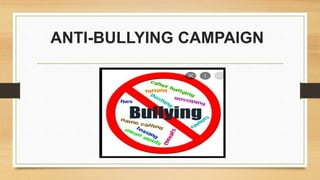
ANTI-BULLYING CAMPAIGN
What is BULLYING?
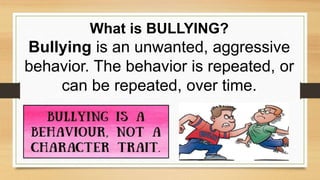
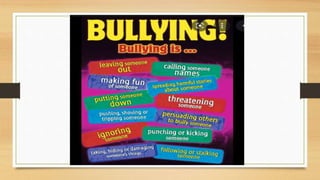
Bullying is an unwanted, aggressive
behavior. The behavior is repeated, or
can be repeated, over time.
Who is a bully?
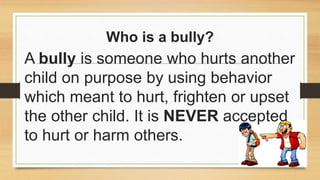
A bully is someone who hurts another
child on purpose by using behavior
which meant to hurt, frighten or upset
the other child. It is NEVER accepted
to hurt or harm others.
When is it Bullying?
•Several
•Times
•On
•Purpose
This school promises to
always treat bullying
seriously. You have the
right to feel happy and
safe at TNHS.
When someone says or does
something unintentionally hurtful
and he/she does it once, that’s
RUDE.
When someone says or does
something intentionally hurtful
and he/she does it once, that’s
MEAN.
When someone says or does something
intentionally hurtful and he/she keeps
doing it even when you tell him/her to
stop or you show him/ her that you are
upset, that’s BULLYING.
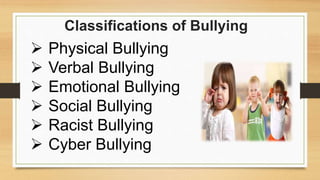
Classifications of Bullying
 Physical Bullying
 Verbal Bullying
 Emotional Bullying
 Social Bullying
 Racist Bullying
 Cyber Bullying
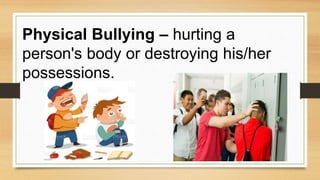
Physical Bullying – hurting a
person's body or destroying his/her
possessions.
*Hitting/kicking/pinching
*Spitting
*Tripping/pushing
*Taking or breaking someone's
things
*Making mean or rude hand
gestures
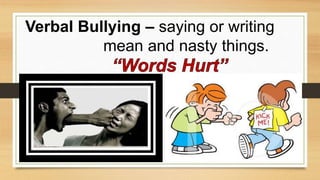
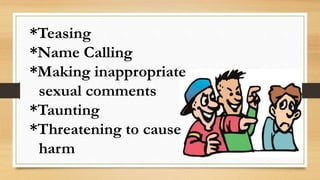
Verbal Bullying – saying or writing
mean and nasty things.
*Teasing
*Name Calling
*Making inappropriate
sexual comments
*Taunting
*Threatening to cause
harm
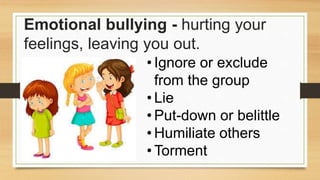
Emotional bullying - hurting your
feelings, leaving you out.
• Ignore or exclude
from the group
• Lie
• Put-down or belittle
• Humiliate others
• Torment
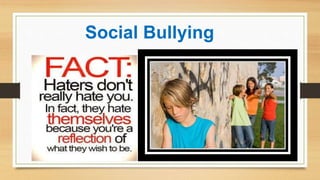
Social Bullying
Social Bullying - sometimes referred
to as a relational bullying – hurting
someone's reputation or relationships.
*telling other children not to be
friends with someone
*spreading rumors about someone
*embarrassing someone in public
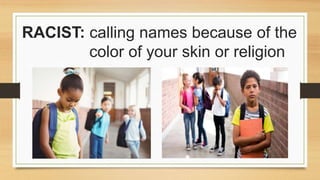
RACIST: calling names because of the
color of your skin or religion
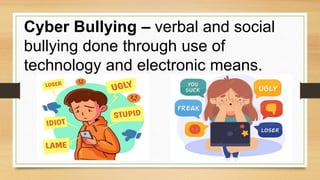
Cyber Bullying – verbal and social
bullying done through use of
technology and electronic means.
What will happen if you bully?
•You must take responsibility for your
action and accept the sanctions given.
•You need to take steps to repair the
harm you have caused.
•You need to talk to an adult about your
worries and concerns.
Who can I tell?
•Any trusted adult in the school (e.g. your
teacher, your subject teachers, the
principal, the guidance counselor, or any
school personnel)
•An adult at home (parents, older siblings
or a friend)
If you are being bullied…
Start Telling Other People
RULES AGAINST BULLYING
•We will not bully others!
•We will try to help students who are bullied!
•We will include students who are left out!
•If we know someone is being bullied, we
will tell an adult!
DISCIPLINARY MEASURES
Social Bullying and Cyber Bullying
First Offense: Individual verbal warning with
conference with subject teacher or adviser
Second Offense: Conference with parents and
signing of probation contract
Third Offense: Suspension
DISCIPLINARY MEASURES
Physical Bullying
First Offense: Signing of Probation Contract
Second Offense: Suspension
Third Offense: Dismissal
The same disciplinary measures can be imposed to
other forms of misbehavior related to bullying that
create conflict with fellow student.
Anti-Bullying Commitment
Everyone has the right to feel physically and
emotionally safe. I will do everything I can
personally, as a member of my school’s community,
to create and preserve a physically and emotionally
safe environment.
I commit that I will NOT bully my peers. When I
witness bullying, I will report it to an adult.
Signing of ANTI-BULLYING
COMMITMENT BOARD
Signing of ANTI-BULLYING
COMMITMENT BOARD
Answer the following: ½ crosswise
1. What is bullying?
2. Who is a bully?
3. When is it a bullying?
4. What will you do if you are bullied?
5-6. In school, who are the persons who can tell if you
are being bullied? Give 2 persons.
7. At home, give 1 person you can tell that you are
bullied.
8-19. What are the 6 classifications of bullying. Give 1
example each. Ex. 8. Physical Bullying, 9. Hitting
ANTI-BULLYING-CAMPAIGN.pptx

ANTI-BULLYING-CAMPAIGN.pptx

  • 2.
  • 4.
    What is BULLYING? Bullyingis an unwanted, aggressive behavior. The behavior is repeated, or can be repeated, over time.
  • 5.
    Who is abully? A bully is someone who hurts another child on purpose by using behavior which meant to hurt, frighten or upset the other child. It is NEVER accepted to hurt or harm others.
  • 6.
    When is itBullying? •Several •Times •On •Purpose This school promises to always treat bullying seriously. You have the right to feel happy and safe at TNHS.
  • 7.
    When someone saysor does something unintentionally hurtful and he/she does it once, that’s RUDE.
  • 8.
    When someone saysor does something intentionally hurtful and he/she does it once, that’s MEAN.
  • 9.
    When someone saysor does something intentionally hurtful and he/she keeps doing it even when you tell him/her to stop or you show him/ her that you are upset, that’s BULLYING.
  • 10.
    Classifications of Bullying Physical Bullying  Verbal Bullying  Emotional Bullying  Social Bullying  Racist Bullying  Cyber Bullying
  • 11.
    Physical Bullying –hurting a person's body or destroying his/her possessions.
  • 12.
    *Hitting/kicking/pinching *Spitting *Tripping/pushing *Taking or breakingsomeone's things *Making mean or rude hand gestures
  • 13.
    Verbal Bullying –saying or writing mean and nasty things.
  • 14.
    *Teasing *Name Calling *Making inappropriate sexualcomments *Taunting *Threatening to cause harm
  • 15.
    Emotional bullying -hurting your feelings, leaving you out. • Ignore or exclude from the group • Lie • Put-down or belittle • Humiliate others • Torment
  • 16.
  • 17.
    Social Bullying -sometimes referred to as a relational bullying – hurting someone's reputation or relationships. *telling other children not to be friends with someone *spreading rumors about someone *embarrassing someone in public
  • 18.
    RACIST: calling namesbecause of the color of your skin or religion
  • 19.
    Cyber Bullying –verbal and social bullying done through use of technology and electronic means.
  • 21.
    What will happenif you bully? •You must take responsibility for your action and accept the sanctions given. •You need to take steps to repair the harm you have caused. •You need to talk to an adult about your worries and concerns.
  • 22.
    Who can Itell? •Any trusted adult in the school (e.g. your teacher, your subject teachers, the principal, the guidance counselor, or any school personnel) •An adult at home (parents, older siblings or a friend)
  • 23.
    If you arebeing bullied… Start Telling Other People
  • 24.
    RULES AGAINST BULLYING •Wewill not bully others! •We will try to help students who are bullied! •We will include students who are left out! •If we know someone is being bullied, we will tell an adult!
  • 25.
    DISCIPLINARY MEASURES Social Bullyingand Cyber Bullying First Offense: Individual verbal warning with conference with subject teacher or adviser Second Offense: Conference with parents and signing of probation contract Third Offense: Suspension
  • 26.
    DISCIPLINARY MEASURES Physical Bullying FirstOffense: Signing of Probation Contract Second Offense: Suspension Third Offense: Dismissal The same disciplinary measures can be imposed to other forms of misbehavior related to bullying that create conflict with fellow student.
  • 28.
    Anti-Bullying Commitment Everyone hasthe right to feel physically and emotionally safe. I will do everything I can personally, as a member of my school’s community, to create and preserve a physically and emotionally safe environment. I commit that I will NOT bully my peers. When I witness bullying, I will report it to an adult.
  • 29.
  • 30.
  • 31.
    Answer the following:½ crosswise 1. What is bullying? 2. Who is a bully? 3. When is it a bullying? 4. What will you do if you are bullied? 5-6. In school, who are the persons who can tell if you are being bullied? Give 2 persons. 7. At home, give 1 person you can tell that you are bullied. 8-19. What are the 6 classifications of bullying. Give 1 example each. Ex. 8. Physical Bullying, 9. Hitting