Orientation
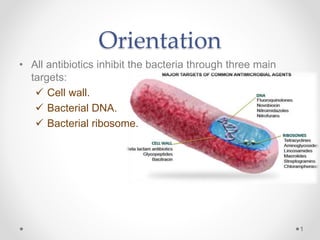
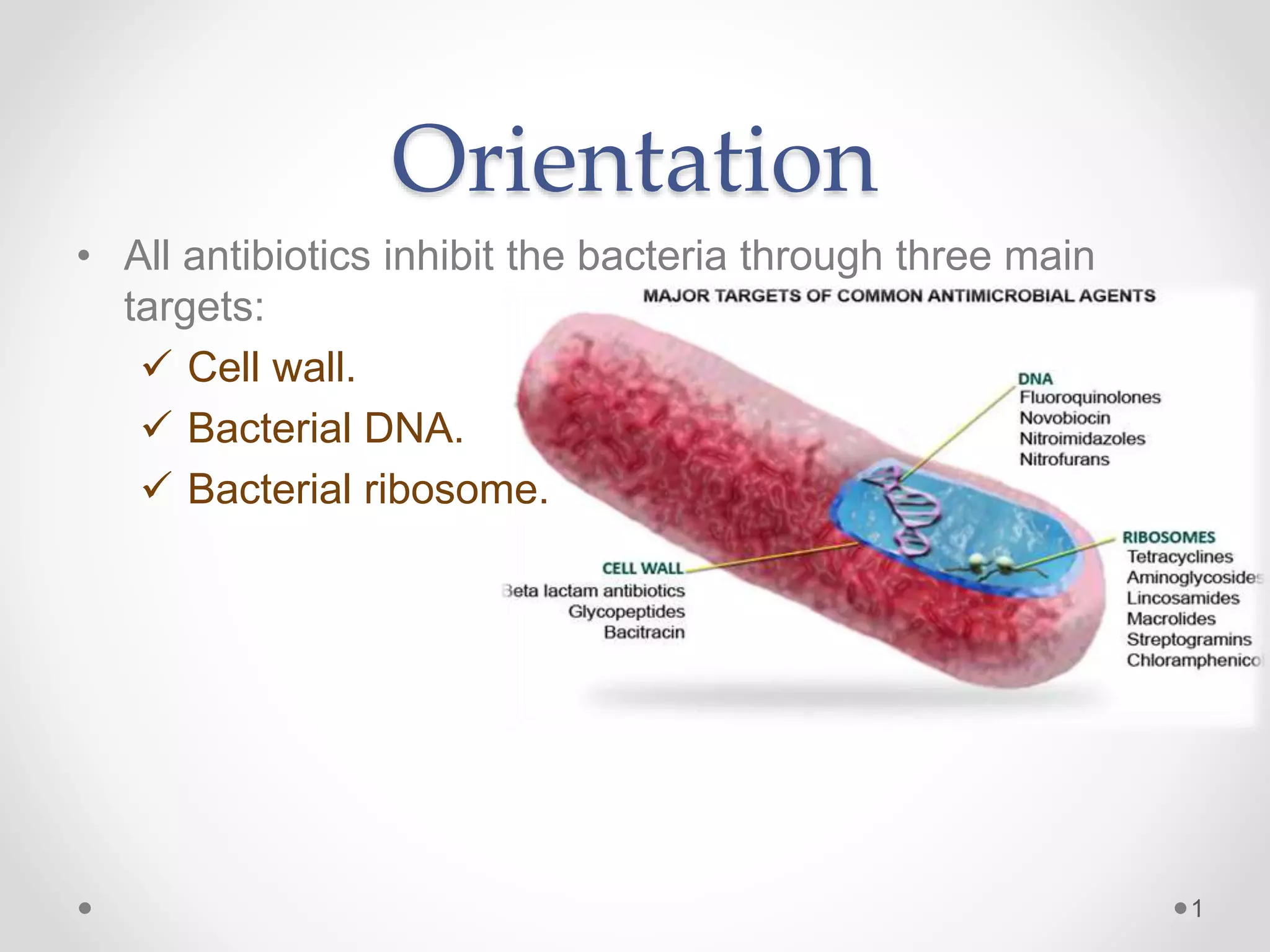
• All antibiotics inhibit the bacteria through three main
targets:
 Cell wall.
 Bacterial DNA.
 Bacterial ribosome.
1
2
Introduction
• What are streptogramins?
• Classification.
• Mechanism of action.
• When to use them?
• What problems patient may face ?
• Precautions should be taken in mind .
3
What are streptogramins?
• The streptogramin antibiotics :
Natural cyclic peptide antibiotics produced by
certain sub-species of Streptomyces.
Structurally related to macrolides and
lincosamides.
Strepogramins abstract Date of access 27/3/2012
http://dx.doi.org/10.2174/1389450023347678 4
What are streptogramins?
(cont.)
• The streptogramin antibiotics :
 Discovered over 40 years ago.
 The agent received accelerated
approval by the FDA in late 1999[1]!!
5
[1]Koda-Kimble, Mary Anne; Young, Lloyd Yee; Alldredge, Brian K.; Corelli, Robin L.; Guglielmo, B. Joseph;
Kradjan, Wayne A.; Williams, Bradley R.; Applied Therapeutics: The Clinical Use Of Drugs, Lippincott
Williams & Wilkins.; Philadelphia; 9th Edition,2009 ; P.59p20.
Streptogramins
classes
6
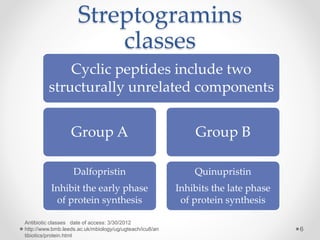
Cyclic peptides include two
structurally unrelated components
Group A
Dalfopristin
Inhibit the early phase
of protein synthesis
Group B
Quinupristin
Inhibits the late phase
of protein synthesis
Antibiotic classes date of access: 3/30/2012
http://www.bmb.leeds.ac.uk/mbiology/ug/ugteach/icu8/an
tibiotics/protein.html
Mechanism of action
7
• The individual components are bacteriostatic.
• Their combination synergistically is bactericidal
combination.
• Quinupristin/dalfopristin are available in combination of
3:7 ratio respectively[1] .
• Combination is concentration dependent mechanism
with a long post-antibiotic effect.
[1]Sean C Sweetman; Martindale, The complete drug reference; Pharmaceutical Press;
London , ,Chicago; Thirty-sixth edition; 2009; vol. 1; page 322
Mechanism of action
(cont.)
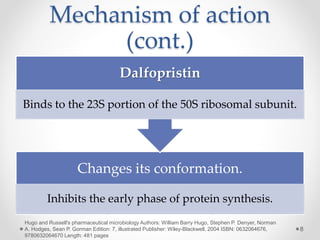
Changes its conformation.
Inhibits the early phase of protein synthesis.
Dalfopristin
Binds to the 23S portion of the 50S ribosomal subunit.
8
Hugo and Russell's pharmaceutical microbiology Authors: William Barry Hugo, Stephen P. Denyer, Norman
A. Hodges, Sean P. Gorman Edition: 7, illustrated Publisher: Wiley-Blackwell, 2004 ISBN: 0632064676,
9780632064670 Length: 481 pages
Mechanism of action
(cont.)
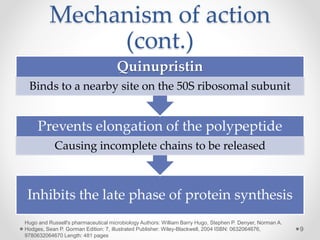
Inhibits the late phase of protein synthesis
Prevents elongation of the polypeptide
Causing incomplete chains to be released
Quinupristin
Binds to a nearby site on the 50S ribosomal subunit
9
Hugo and Russell's pharmaceutical microbiology Authors: William Barry Hugo, Stephen P. Denyer, Norman A.
Hodges, Sean P. Gorman Edition: 7, illustrated Publisher: Wiley-Blackwell, 2004 ISBN: 0632064676,
9780632064670 Length: 481 pages
In market !!
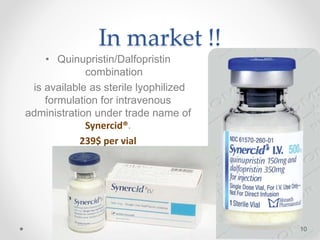
• Quinupristin/Dalfopristin
combination
is available as sterile lyophilized
formulation for intravenous
administration under trade name of
Synercid®.
239$ per vial
10
Therapeutic indications
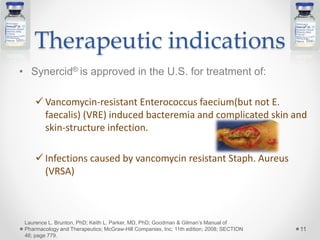
• Synercid® is approved in the U.S. for treatment of:
 Vancomycin-resistant Enterococcus faecium(but not E.
faecalis) (VRE) induced bacteremia and complicated skin and
skin-structure infection.
 Infections caused by vancomycin resistant Staph. Aureus
(VRSA)
11
Laurence L. Brunton, PhD; Keith L. Parker, MD, PhD; Goodman & Gilman’s Manual of
Pharmacology and Therapeutics; McGraw-Hill Companies, Inc; 11th edition; 2008; SECTION
46; page 779.
Therapeutic indications
(cont.)
• In Europe, it is also approved for treatment of:
 Nosocomial pneumonia and infections
caused by methicillin-resistant strains
of S. aureus.
• Used for patients with vancomycin-resistant enterococcal
endocarditis[1] .
12
[1] Koda-Kimble, Mary Anne; Young, Lloyd Yee; Alldredge, Brian K.; Corelli, Robin L.; Guglielmo, B.
Joseph; Kradjan, Wayne A.; Williams, Bradley R.; Applied Therapeutics: The Clinical Use Of Drugs,
Lippincott Williams & Wilkins.; Philadelphia; 9th Edition ,2009; P.59p20 .
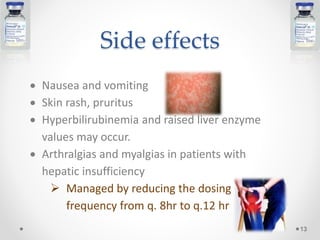
Side effects
 Nausea and vomiting
 Skin rash, pruritus
 Hyperbilirubinemia and raised liver enzyme
values may occur.
 Arthralgias and myalgias in patients with
hepatic insufficiency
 Managed by reducing the dosing
frequency from q. 8hr to q.12 hr
13
Side effects (cont.)
 Pain and phlebitis at the infusion site are most
common & minimized by[1]:
 Infusion through a central venous catheter.
 Dilution of preparation to 500-750ml solution
with D5W .
 Increase infusion duration
to 60 minutes.
14
[1]Sean C Sweetman; Martindale, The complete drug reference; Pharmaceutical Press;
London , ,Chicago; Thirty-sixth edition; 2009; vol. 1; page 322.
Side effects (cont.)
 Pain and phlebitis at the infusion site are most
common & minimized by[1]:
 The vein should be flushed with D5W after each
infusion.
 Note that saline is in
compatible with Synercid®.
15
[1]Sean C Sweetman; Martindale, The complete drug reference; Pharmaceutical Press;
London , ,Chicago; Thirty-sixth edition; 2009; vol. 1; page 322.
Precautions
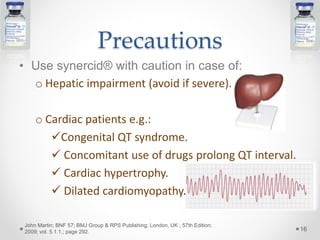
• Use synercid® with caution in case of:
o Hepatic impairment (avoid if severe).
o Cardiac patients e.g.:
Congenital QT syndrome.
 Concomitant use of drugs prolong QT interval.
 Cardiac hypertrophy.
 Dilated cardiomyopathy.
16
John Martin; BNF 57; BMJ Group & RPS Publishing; London, UK ; 57th Edition;
2009; vol. 5.1.1.; page 292.
Precautions (cont.)
• Use synercid® with caution in case of:
o Hypokalaemia, hypomagnesaemia, brady-cardia.
o Synercid® is pregnancy category B by FDA[1] .
17
[1] pregnancy & reproductive studies date of access: 3/30/2012
http://www.drugs.com/pro/synercid.html
Conclusion
• Streptogramins are class of natural cyclic
peptide antibiotics produced by certain sub-
species of Streptomyces .
• They are 2 classes A & B.
• They inhibit bacterial protein
synthesis by interfering 50S
ribosomal binding sites.
18
• Commercially available product is mixture of
both Quinupristin/dalfopristin.
• Combination for bactericidal effect.
• Considered as the last resort against VRSA,
VRE induced bacteremia ,endocarditis, ….etc.
Conclusion (cont.)
19
• Most common side effect is the phlebitis and the pain
during infusion.
 Dilution of the solution and vein flushing by D5W are
most effective management.
• Use with caution in case of hepatic impairment, cardiac
arrhythmias.
• Synercid® is pregnancy category B drug.
Conclusion (cont.)
20
Thank you
21
Kind regards

streptogramin final

  • 1.
    Orientation • All antibioticsinhibit the bacteria through three main targets:  Cell wall.  Bacterial DNA.  Bacterial ribosome. 1
  • 2.
  • 3.
    Introduction • What arestreptogramins? • Classification. • Mechanism of action. • When to use them? • What problems patient may face ? • Precautions should be taken in mind . 3
  • 4.
    What are streptogramins? •The streptogramin antibiotics : Natural cyclic peptide antibiotics produced by certain sub-species of Streptomyces. Structurally related to macrolides and lincosamides. Strepogramins abstract Date of access 27/3/2012 http://dx.doi.org/10.2174/1389450023347678 4
  • 5.
    What are streptogramins? (cont.) •The streptogramin antibiotics :  Discovered over 40 years ago.  The agent received accelerated approval by the FDA in late 1999[1]!! 5 [1]Koda-Kimble, Mary Anne; Young, Lloyd Yee; Alldredge, Brian K.; Corelli, Robin L.; Guglielmo, B. Joseph; Kradjan, Wayne A.; Williams, Bradley R.; Applied Therapeutics: The Clinical Use Of Drugs, Lippincott Williams & Wilkins.; Philadelphia; 9th Edition,2009 ; P.59p20.
  • 6.
    Streptogramins classes 6 Cyclic peptides includetwo structurally unrelated components Group A Dalfopristin Inhibit the early phase of protein synthesis Group B Quinupristin Inhibits the late phase of protein synthesis Antibiotic classes date of access: 3/30/2012 http://www.bmb.leeds.ac.uk/mbiology/ug/ugteach/icu8/an tibiotics/protein.html
  • 7.
    Mechanism of action 7 •The individual components are bacteriostatic. • Their combination synergistically is bactericidal combination. • Quinupristin/dalfopristin are available in combination of 3:7 ratio respectively[1] . • Combination is concentration dependent mechanism with a long post-antibiotic effect. [1]Sean C Sweetman; Martindale, The complete drug reference; Pharmaceutical Press; London , ,Chicago; Thirty-sixth edition; 2009; vol. 1; page 322
  • 8.
    Mechanism of action (cont.) Changesits conformation. Inhibits the early phase of protein synthesis. Dalfopristin Binds to the 23S portion of the 50S ribosomal subunit. 8 Hugo and Russell's pharmaceutical microbiology Authors: William Barry Hugo, Stephen P. Denyer, Norman A. Hodges, Sean P. Gorman Edition: 7, illustrated Publisher: Wiley-Blackwell, 2004 ISBN: 0632064676, 9780632064670 Length: 481 pages
  • 9.
    Mechanism of action (cont.) Inhibitsthe late phase of protein synthesis Prevents elongation of the polypeptide Causing incomplete chains to be released Quinupristin Binds to a nearby site on the 50S ribosomal subunit 9 Hugo and Russell's pharmaceutical microbiology Authors: William Barry Hugo, Stephen P. Denyer, Norman A. Hodges, Sean P. Gorman Edition: 7, illustrated Publisher: Wiley-Blackwell, 2004 ISBN: 0632064676, 9780632064670 Length: 481 pages
  • 10.
    In market !! •Quinupristin/Dalfopristin combination is available as sterile lyophilized formulation for intravenous administration under trade name of Synercid®. 239$ per vial 10
  • 11.
    Therapeutic indications • Synercid®is approved in the U.S. for treatment of:  Vancomycin-resistant Enterococcus faecium(but not E. faecalis) (VRE) induced bacteremia and complicated skin and skin-structure infection.  Infections caused by vancomycin resistant Staph. Aureus (VRSA) 11 Laurence L. Brunton, PhD; Keith L. Parker, MD, PhD; Goodman & Gilman’s Manual of Pharmacology and Therapeutics; McGraw-Hill Companies, Inc; 11th edition; 2008; SECTION 46; page 779.
  • 12.
    Therapeutic indications (cont.) • InEurope, it is also approved for treatment of:  Nosocomial pneumonia and infections caused by methicillin-resistant strains of S. aureus. • Used for patients with vancomycin-resistant enterococcal endocarditis[1] . 12 [1] Koda-Kimble, Mary Anne; Young, Lloyd Yee; Alldredge, Brian K.; Corelli, Robin L.; Guglielmo, B. Joseph; Kradjan, Wayne A.; Williams, Bradley R.; Applied Therapeutics: The Clinical Use Of Drugs, Lippincott Williams & Wilkins.; Philadelphia; 9th Edition ,2009; P.59p20 .
  • 13.
    Side effects  Nauseaand vomiting  Skin rash, pruritus  Hyperbilirubinemia and raised liver enzyme values may occur.  Arthralgias and myalgias in patients with hepatic insufficiency  Managed by reducing the dosing frequency from q. 8hr to q.12 hr 13
  • 14.
    Side effects (cont.) Pain and phlebitis at the infusion site are most common & minimized by[1]:  Infusion through a central venous catheter.  Dilution of preparation to 500-750ml solution with D5W .  Increase infusion duration to 60 minutes. 14 [1]Sean C Sweetman; Martindale, The complete drug reference; Pharmaceutical Press; London , ,Chicago; Thirty-sixth edition; 2009; vol. 1; page 322.
  • 15.
    Side effects (cont.) Pain and phlebitis at the infusion site are most common & minimized by[1]:  The vein should be flushed with D5W after each infusion.  Note that saline is in compatible with Synercid®. 15 [1]Sean C Sweetman; Martindale, The complete drug reference; Pharmaceutical Press; London , ,Chicago; Thirty-sixth edition; 2009; vol. 1; page 322.
  • 16.
    Precautions • Use synercid®with caution in case of: o Hepatic impairment (avoid if severe). o Cardiac patients e.g.: Congenital QT syndrome.  Concomitant use of drugs prolong QT interval.  Cardiac hypertrophy.  Dilated cardiomyopathy. 16 John Martin; BNF 57; BMJ Group & RPS Publishing; London, UK ; 57th Edition; 2009; vol. 5.1.1.; page 292.
  • 17.
    Precautions (cont.) • Usesynercid® with caution in case of: o Hypokalaemia, hypomagnesaemia, brady-cardia. o Synercid® is pregnancy category B by FDA[1] . 17 [1] pregnancy & reproductive studies date of access: 3/30/2012 http://www.drugs.com/pro/synercid.html
  • 18.
    Conclusion • Streptogramins areclass of natural cyclic peptide antibiotics produced by certain sub- species of Streptomyces . • They are 2 classes A & B. • They inhibit bacterial protein synthesis by interfering 50S ribosomal binding sites. 18
  • 19.
    • Commercially availableproduct is mixture of both Quinupristin/dalfopristin. • Combination for bactericidal effect. • Considered as the last resort against VRSA, VRE induced bacteremia ,endocarditis, ….etc. Conclusion (cont.) 19
  • 20.
    • Most commonside effect is the phlebitis and the pain during infusion.  Dilution of the solution and vein flushing by D5W are most effective management. • Use with caution in case of hepatic impairment, cardiac arrhythmias. • Synercid® is pregnancy category B drug. Conclusion (cont.) 20
  • 21.

Editor's Notes

  • #12 Treatment of patients with serious or life-threatening infections caused by vancomycin-resistant Enterococcus faecium (VRE) bacteremia vancomycin-resistant Enterococcus faecium VRE (but not E. faecalis), VRSA