1
 Chest pain caused by transient myocardial
ischemia due to an imbalance between
 Myocardial oxygen supply
 Myocardial oxygen demand
2
3
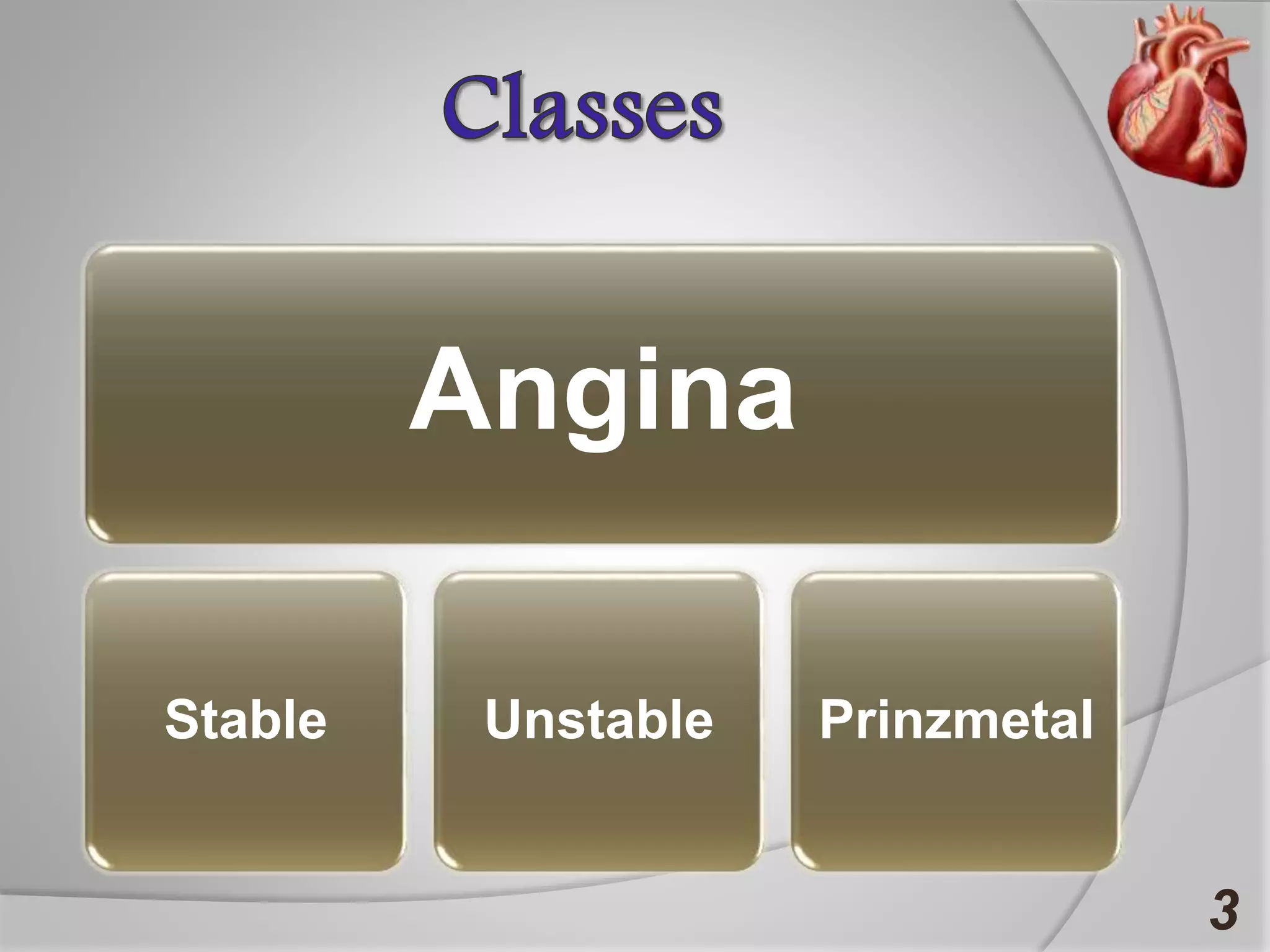
Angina
Stable Unstable Prinzmetal
 Stable angina:
 Most common type of angina
 Common in smokers, hypertensive patients
4
 Unstable angina:
 Less common than stable angina
 can occur at any time, during
○ strenuous exercise
○ Rest
 Urgent condition and can progress to
heart attack
5
 Prinzmetal Angina
 vasospasm occurs
○ Narrowing of the coronaries
○ No buildup of fatty deposits in the artery walls
 Experienced at night, which can be
disruptive to sleep
6
7
 Coronaries narrow
by plaque lead to
stable angina
 Clot formation
lead to
unstable angina
Video
8
 videoWhat Causes Angina -
presentation.wmv
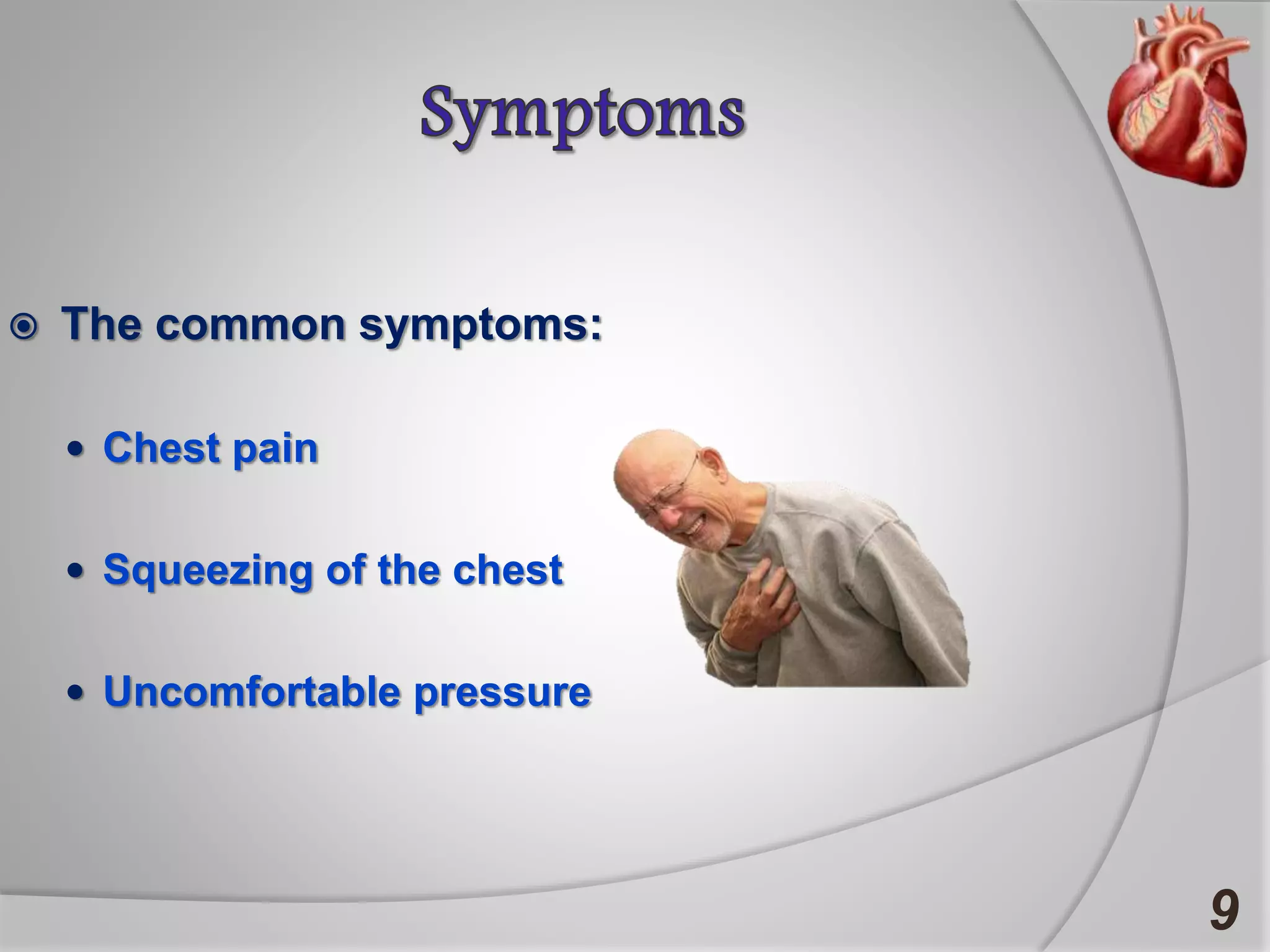
 The common symptoms:
 Chest pain
 Squeezing of the chest
 Uncomfortable pressure
9
 Chest pain that may spread to :
○ Left shoulders
○ Neck
○ Arms
○ Jaws
 The pain is milder when leaning forward
10
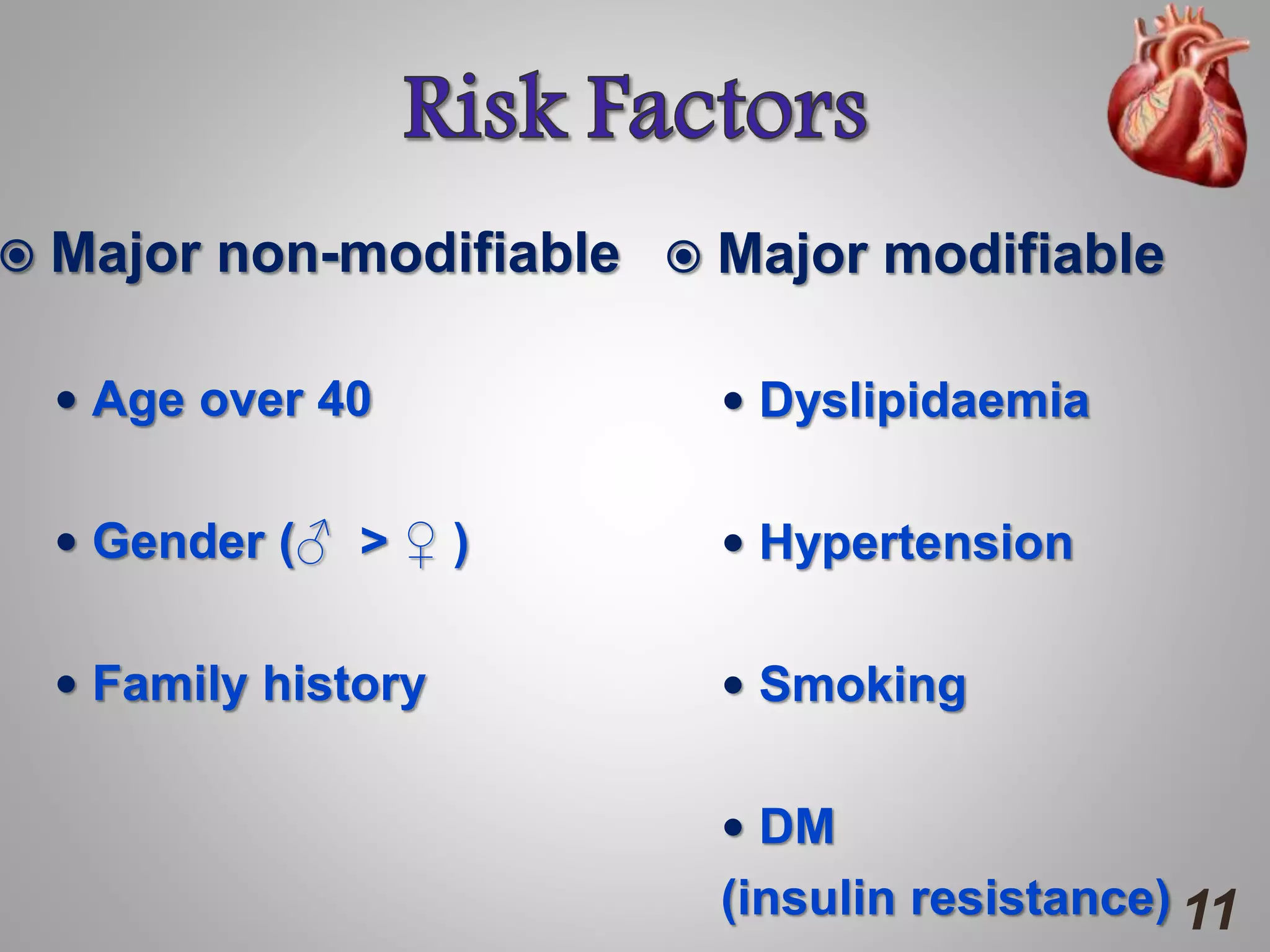
 Major non-modifiable
 Age over 40
 Gender (♂ > ♀ )
 Family history
 Major modifiable
 Dyslipidaemia
 Hypertension
 Smoking
 DM
(insulin resistance) 11
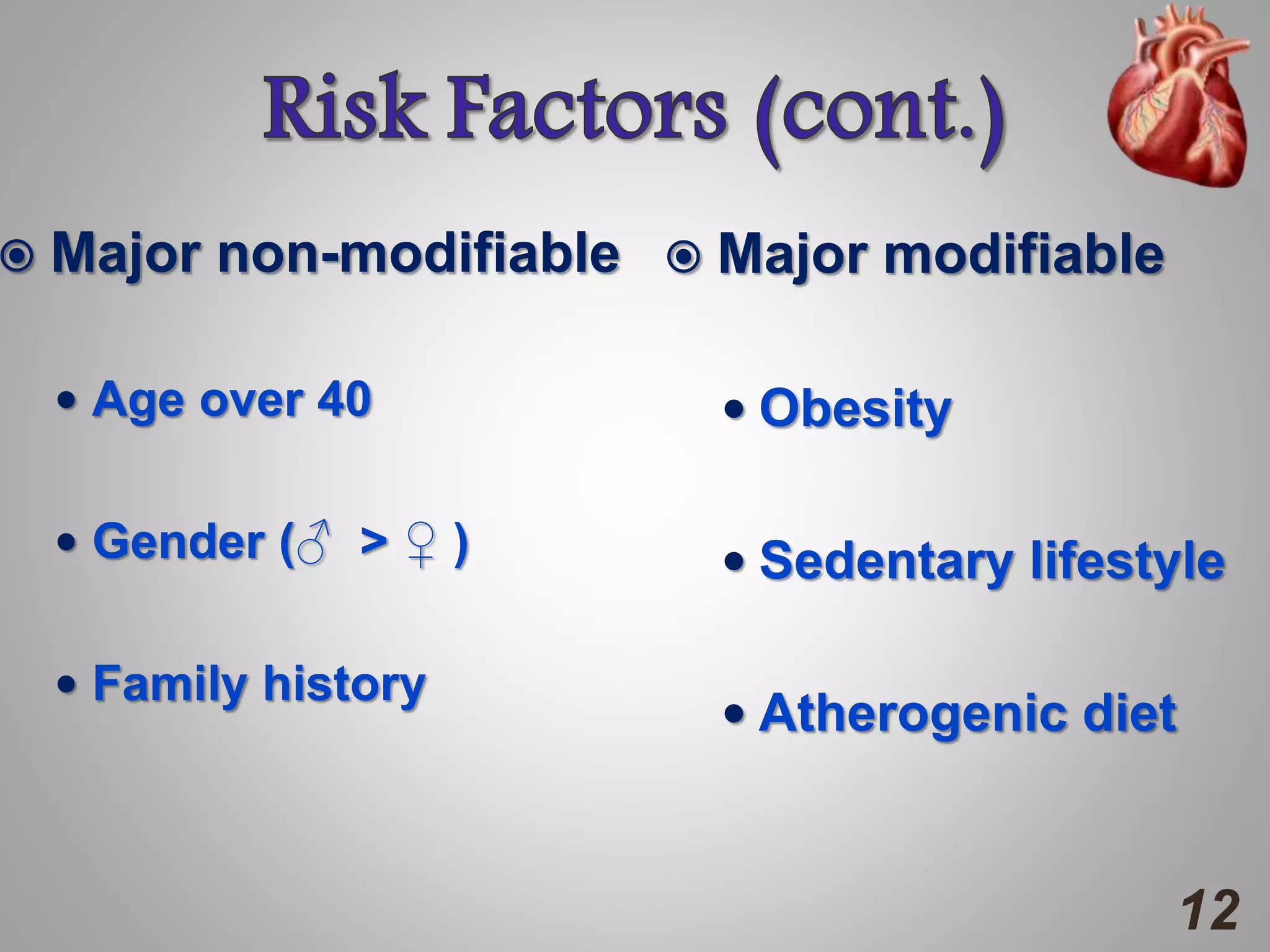
 Major non-modifiable
 Age over 40
 Gender (♂ > ♀ )
 Family history
 Major modifiable
 Obesity
 Sedentary lifestyle
 Atherogenic diet
12
 Minor Controllable
○ Lack of exercise
○ Personality
○ Extreme temperatures
○ Emotional Stress
○ Alcohol Abuse
13
 ≥ 3 CAD risk factors
(↑cholesterol, DM , smoking , HTN).
 Prior CAD (cath stenosis ≥ 50%).
 ≥ 2 anginal events----- ≤ 24 hours.
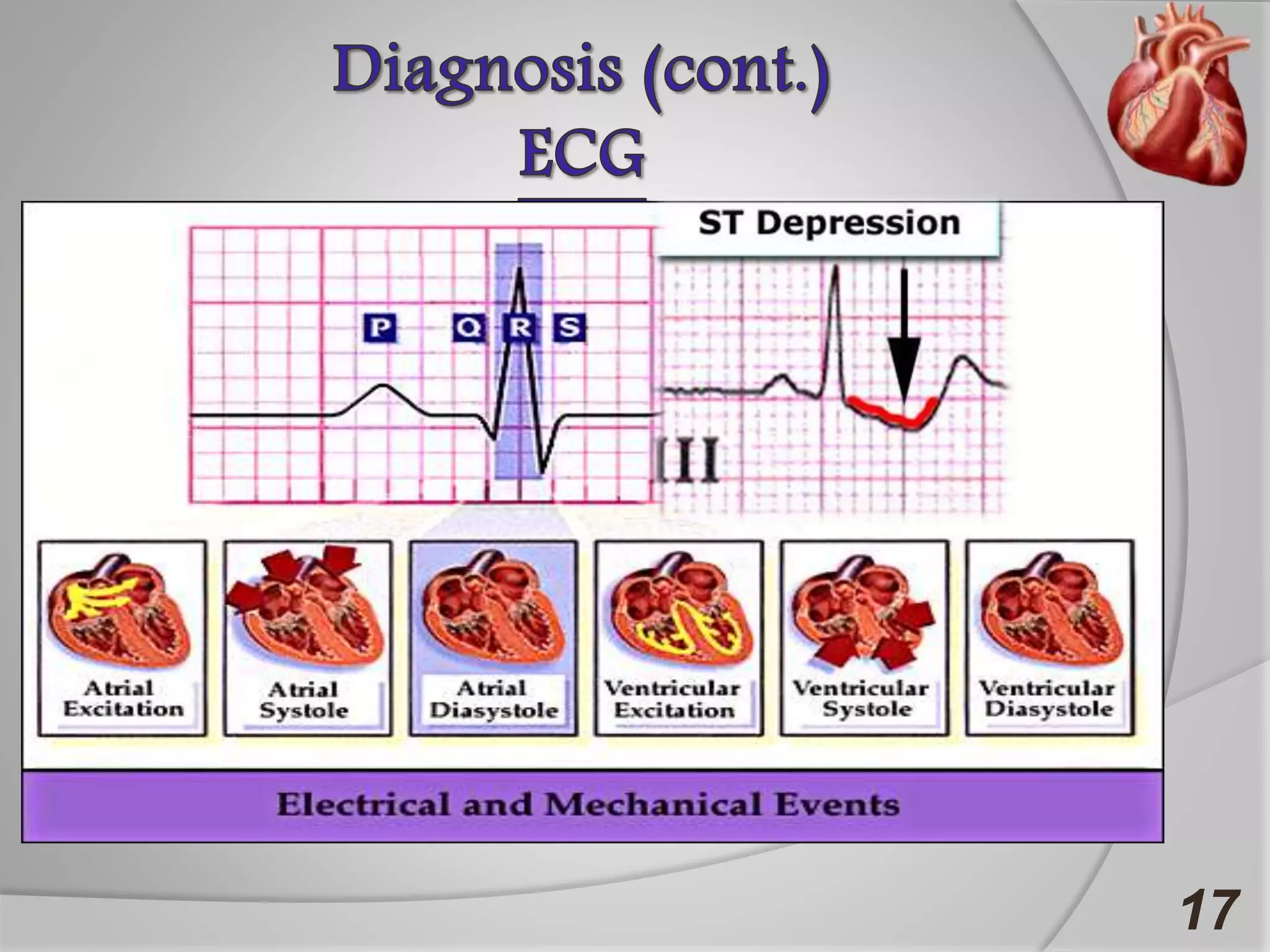
 ST segment deviation.
14
 ECG ------ non-invasive (85% accurate).
 Exercise stress test with ECG .
 Holter monitoring (24 hrs ambulatory ECG).
 Cardiac catheterization
 Diagnostic
 Therapeutic
15
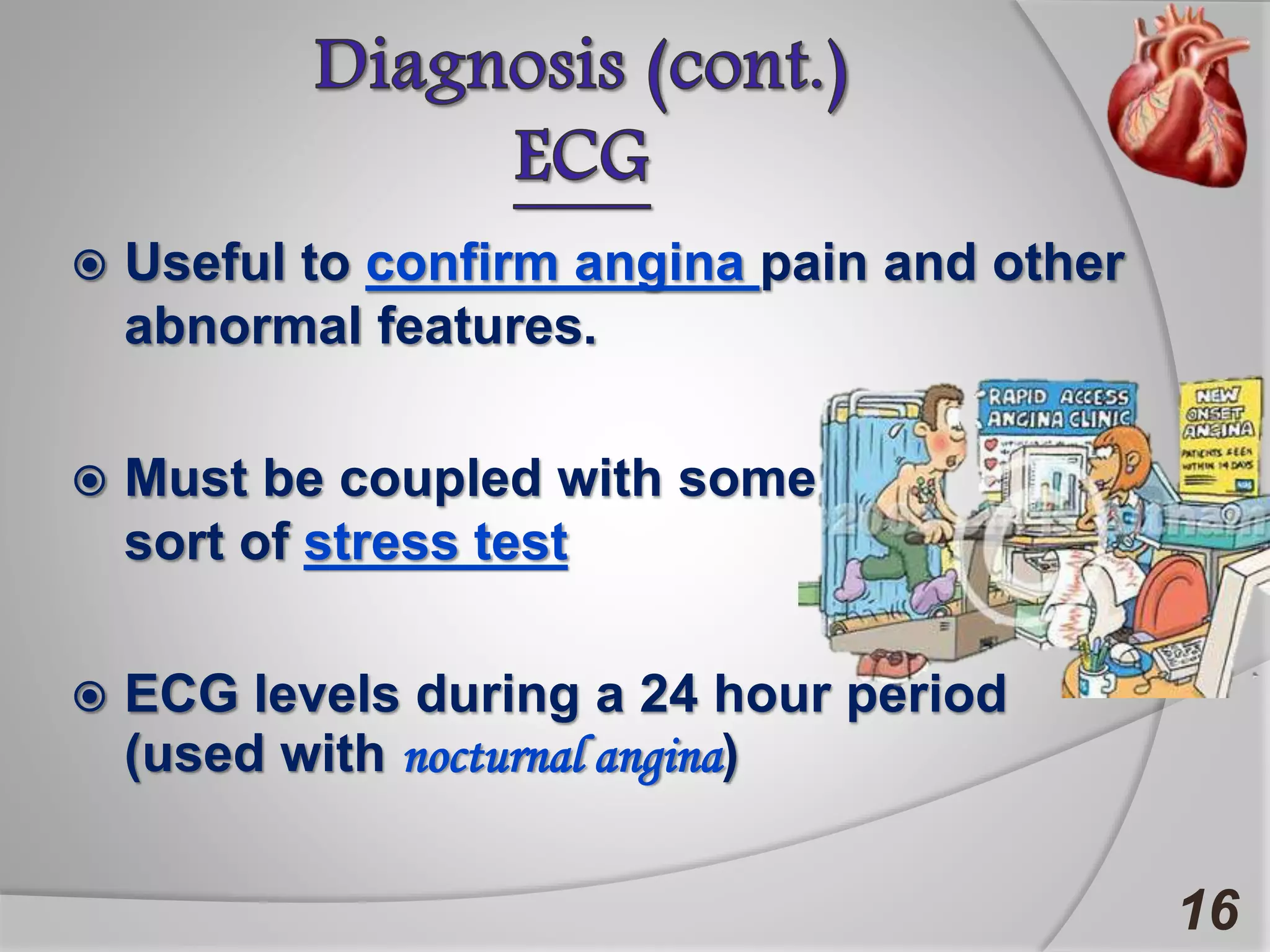
 Useful to confirm angina pain and other
abnormal features.
 Must be coupled with some
sort of stress test
 ECG levels during a 24 hour period
(used with nocturnal angina)
16
17
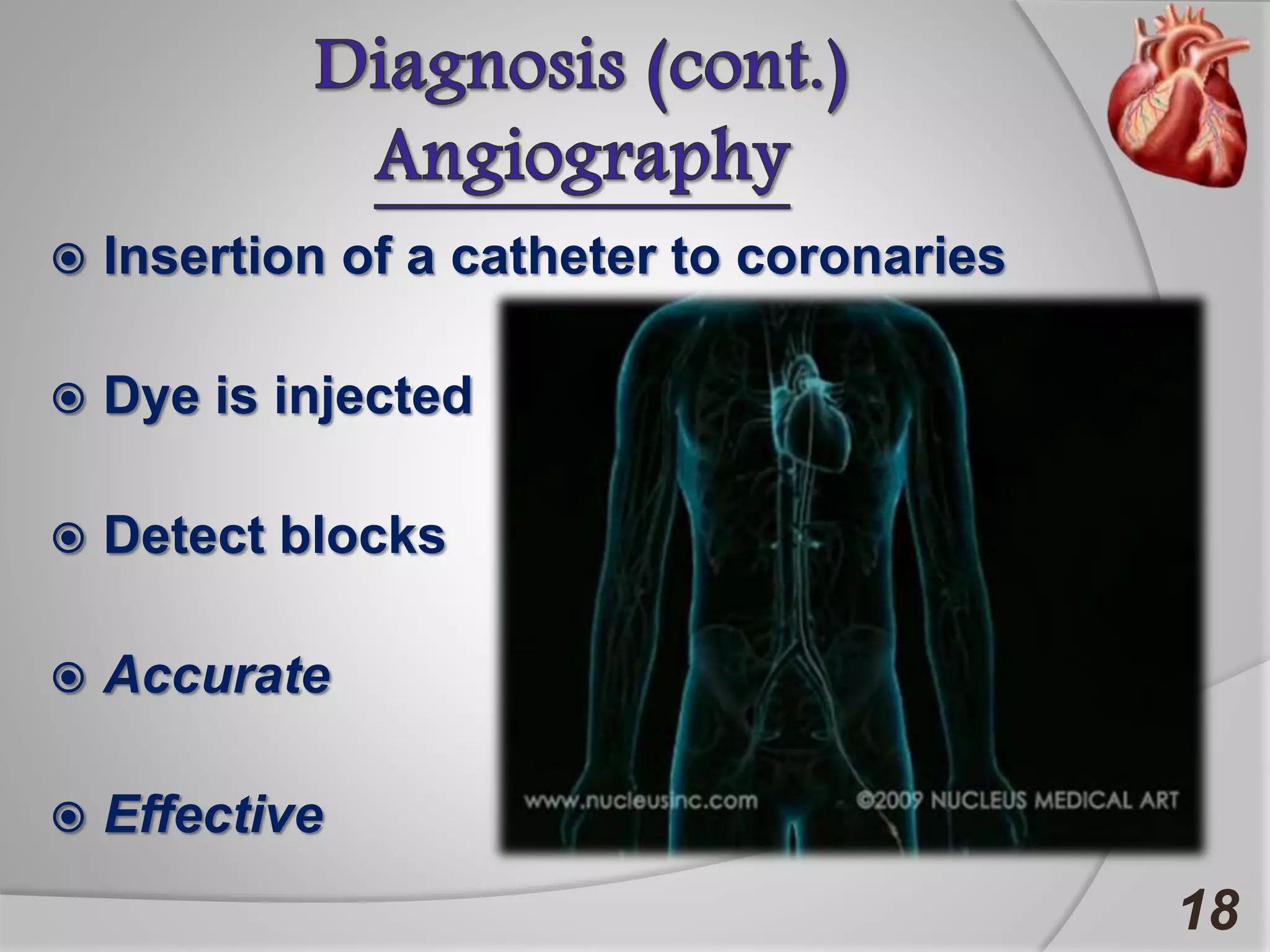
 Insertion of a catheter to coronaries
 Dye is injected
 Detect blocks
 Accurate
 Effective
18
19
×Exclude people from treatment based
on their age.
20
×Investigate/treat symptoms
differently in men and women in
different ethnic groups.
21
×Offer vitamin or fish oil supplements
22
×Offer TENS, EECP or acupuncture
• TENS Transcutaneous electrical nerve stimulation
• EECP Enhanced External counter pulsation
23
×Routinely offer drugs for 2ry
prevention of CVD to people with
suspected cardiac syndrome X
Cardiac syndrome X is angina (chest pain) with
signs associated with decreased blood flow to
heart tissue but with normal coronary arteries
24
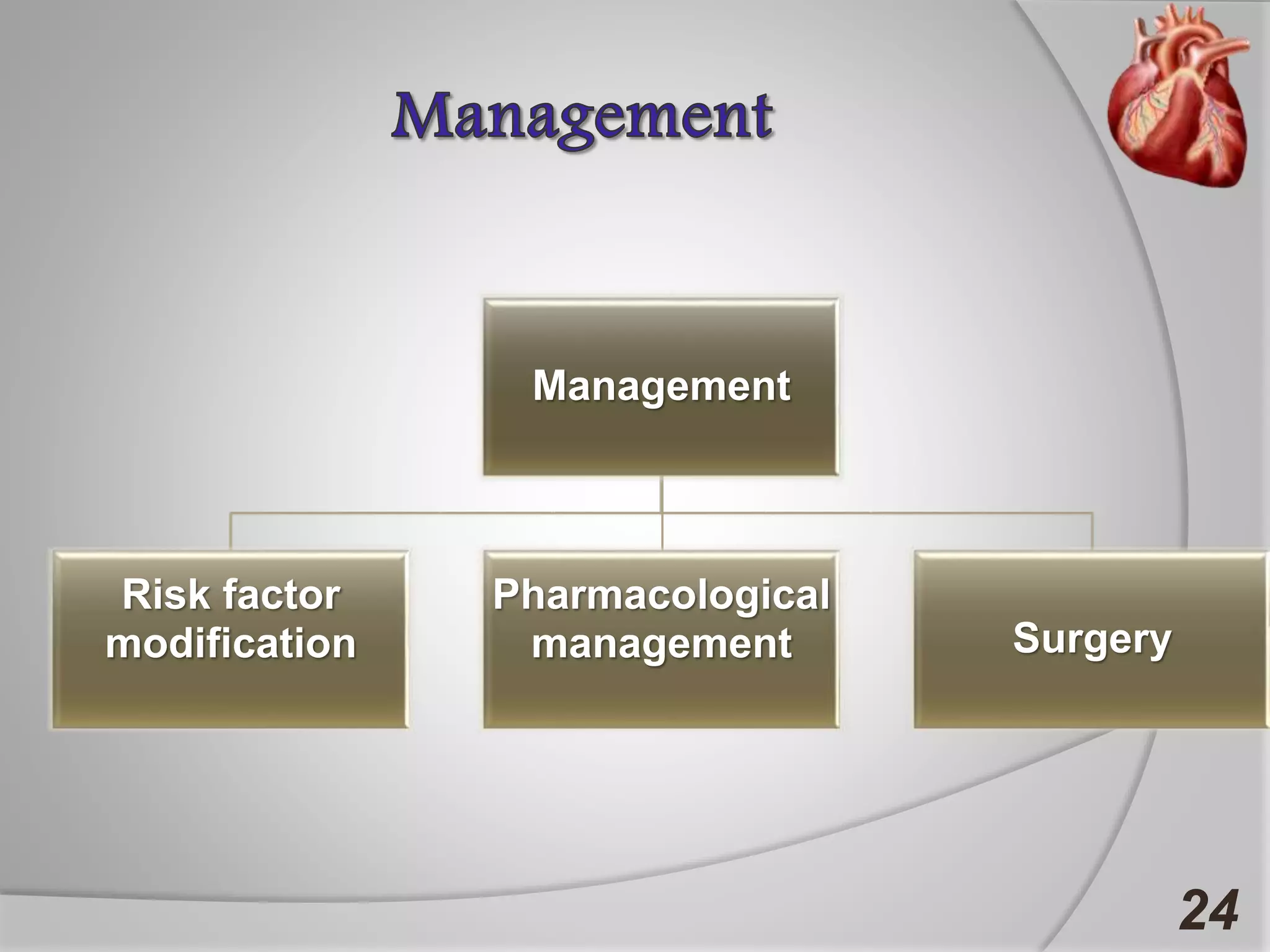
Management
Risk factor
modification
Pharmacological
management Surgery
25
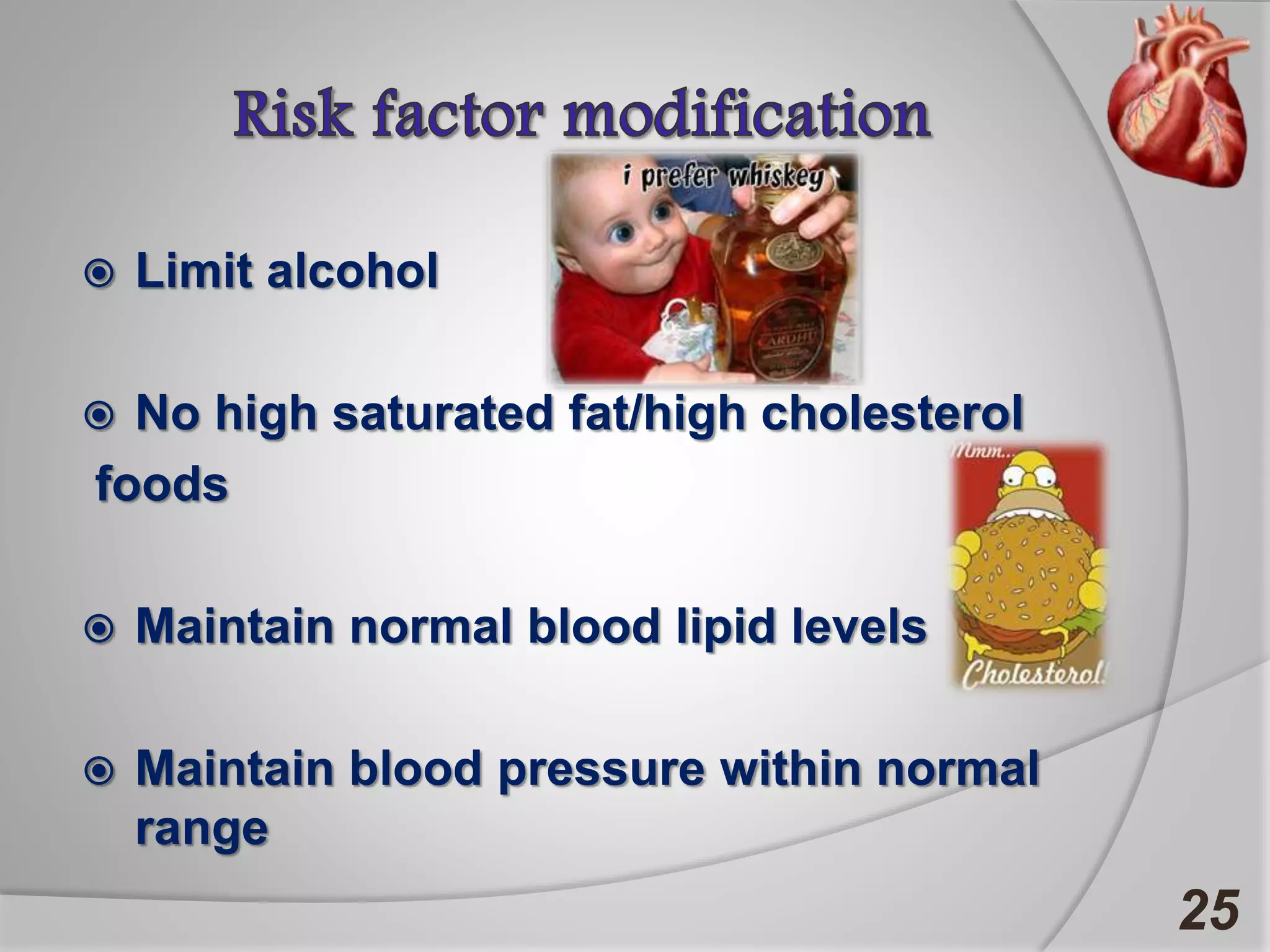
 Limit alcohol
 No high saturated fat/high cholesterol
foods
 Maintain normal blood lipid levels
 Maintain blood pressure within normal
range
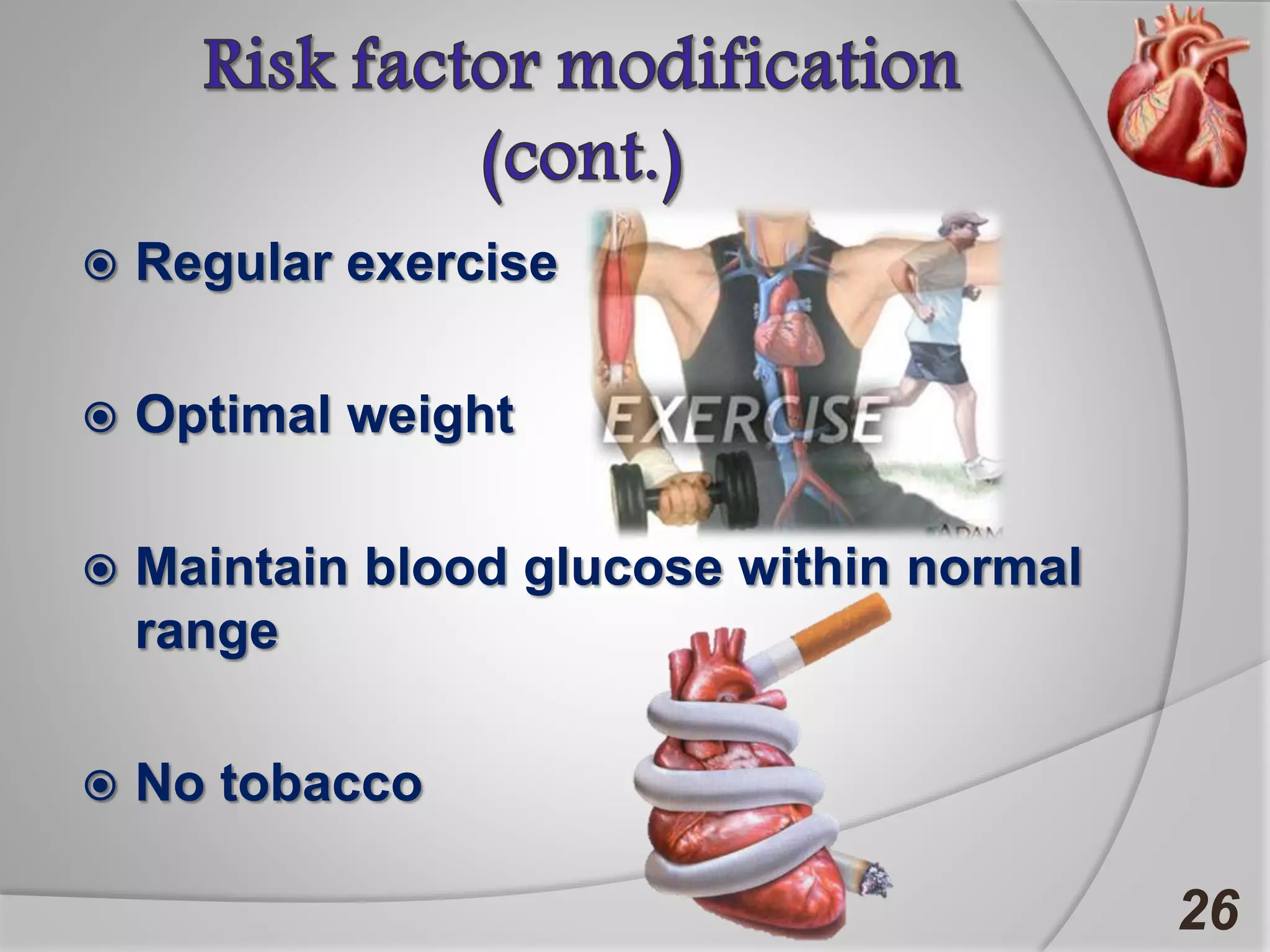
 Regular exercise
 Optimal weight
 Maintain blood glucose within normal
range
 No tobacco
26
 Pharmacological Management
include:
 Beta blockers
 calcium channel blockers
 Nitrates
27
 Pharmacological Management
include:
 Antiplatelets
 Other agents
28
29
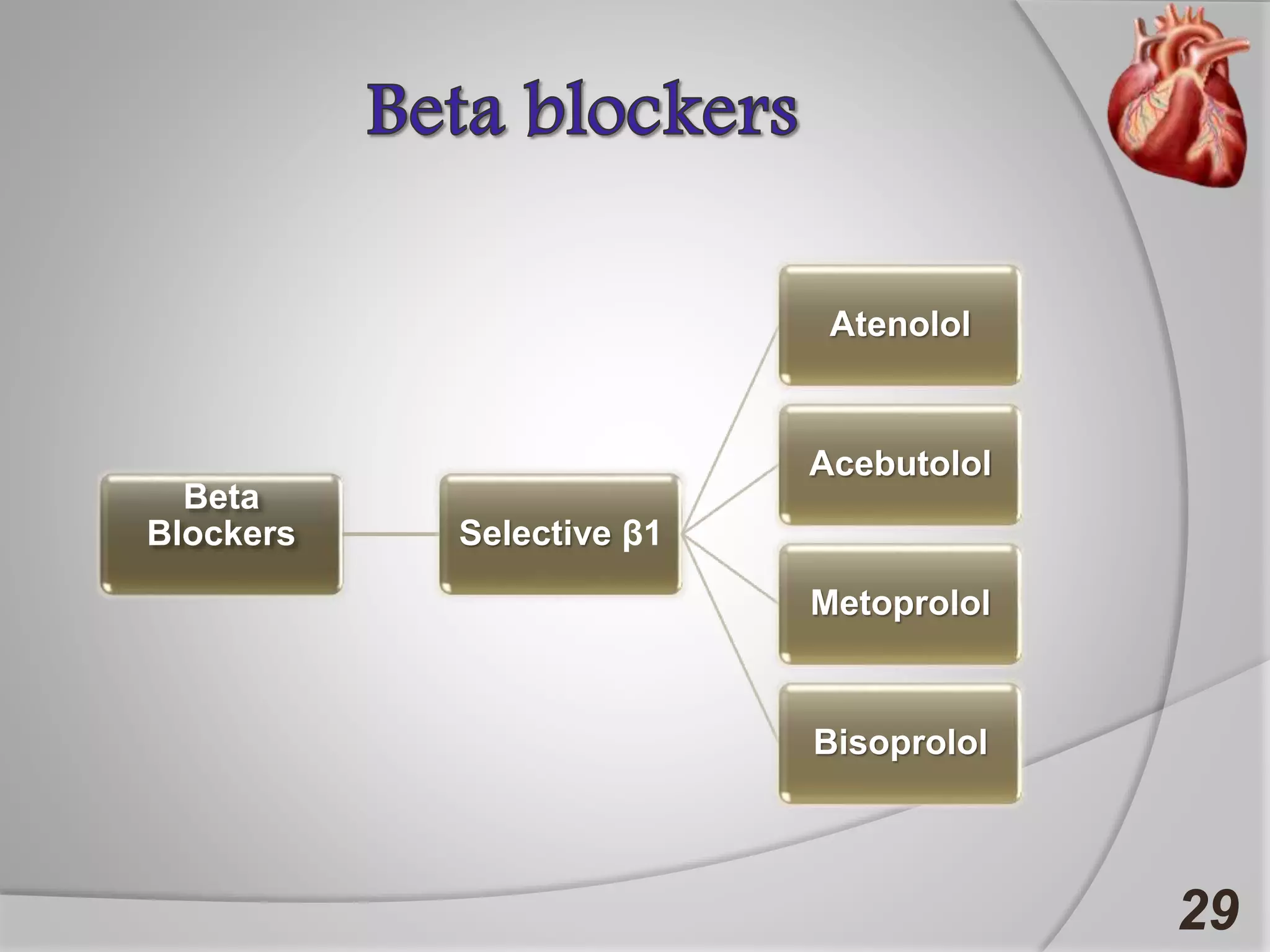
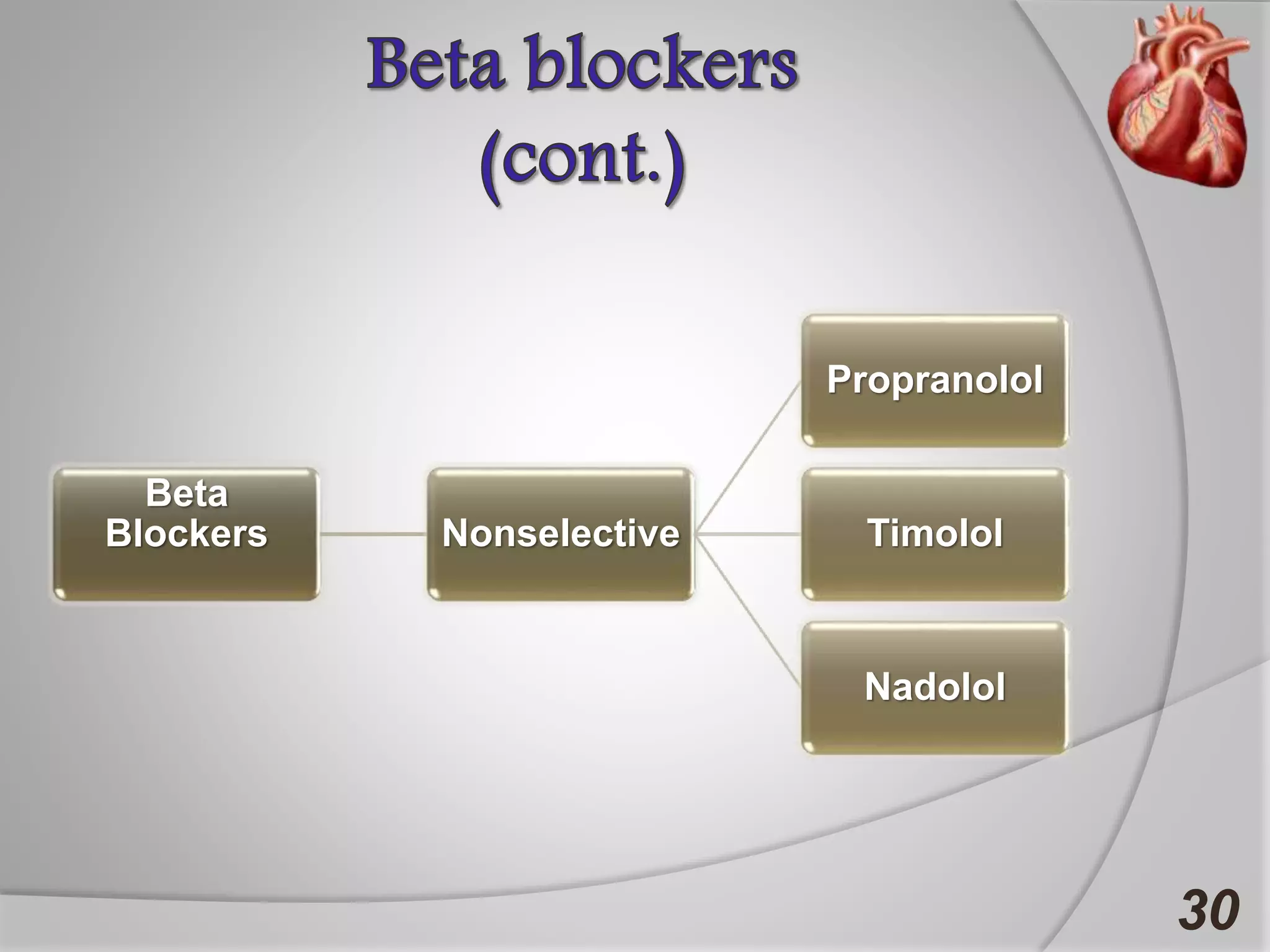
Beta
Blockers Selective β1
Atenolol
Acebutolol
Metoprolol
Bisoprolol
30
Beta
Blockers Nonselective
Propranolol
Timolol
Nadolol
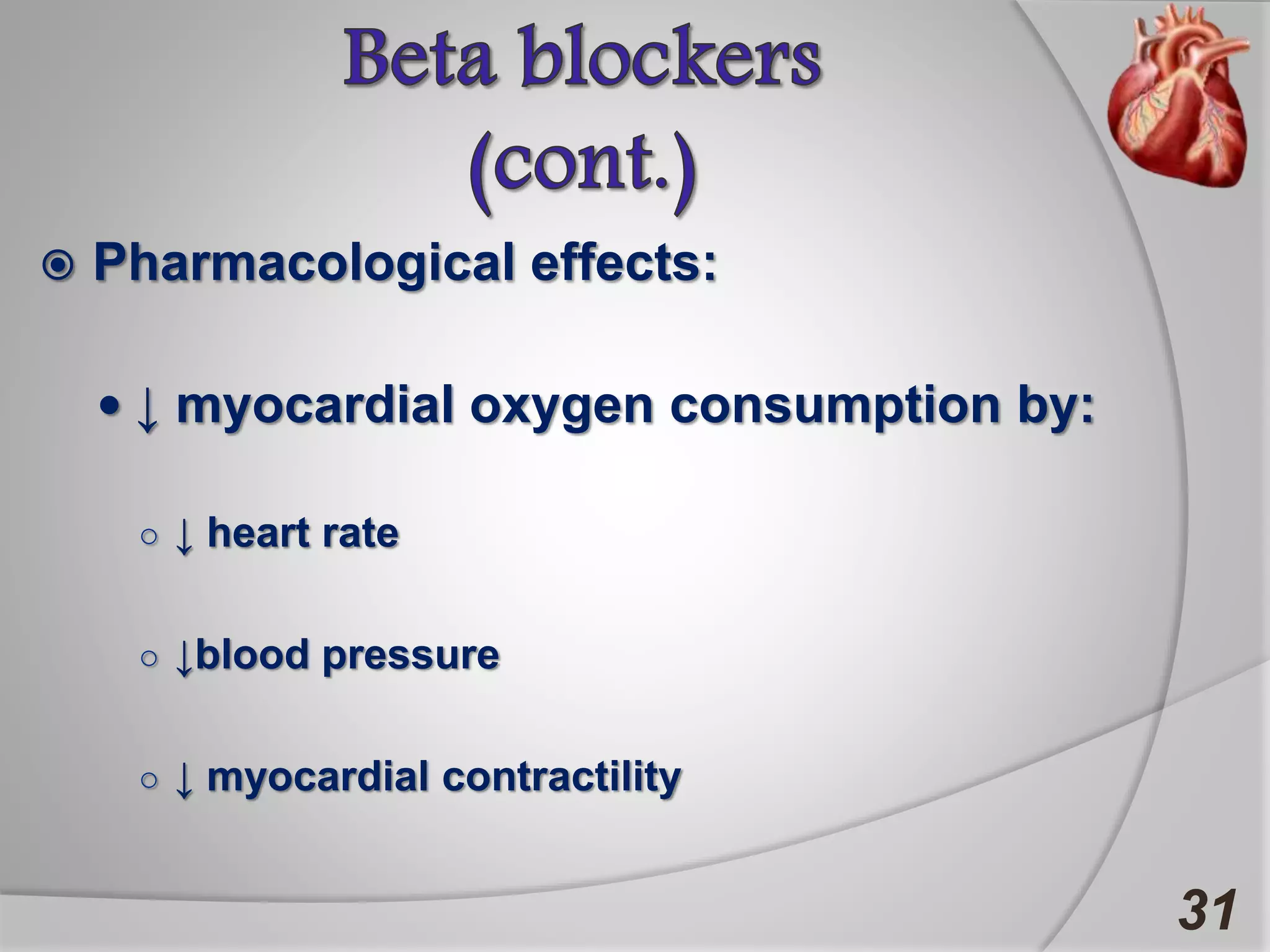
 Pharmacological effects:
 ↓ myocardial oxygen consumption by:
○ ↓ heart rate
○ ↓blood pressure
○ ↓ myocardial contractility
31
32
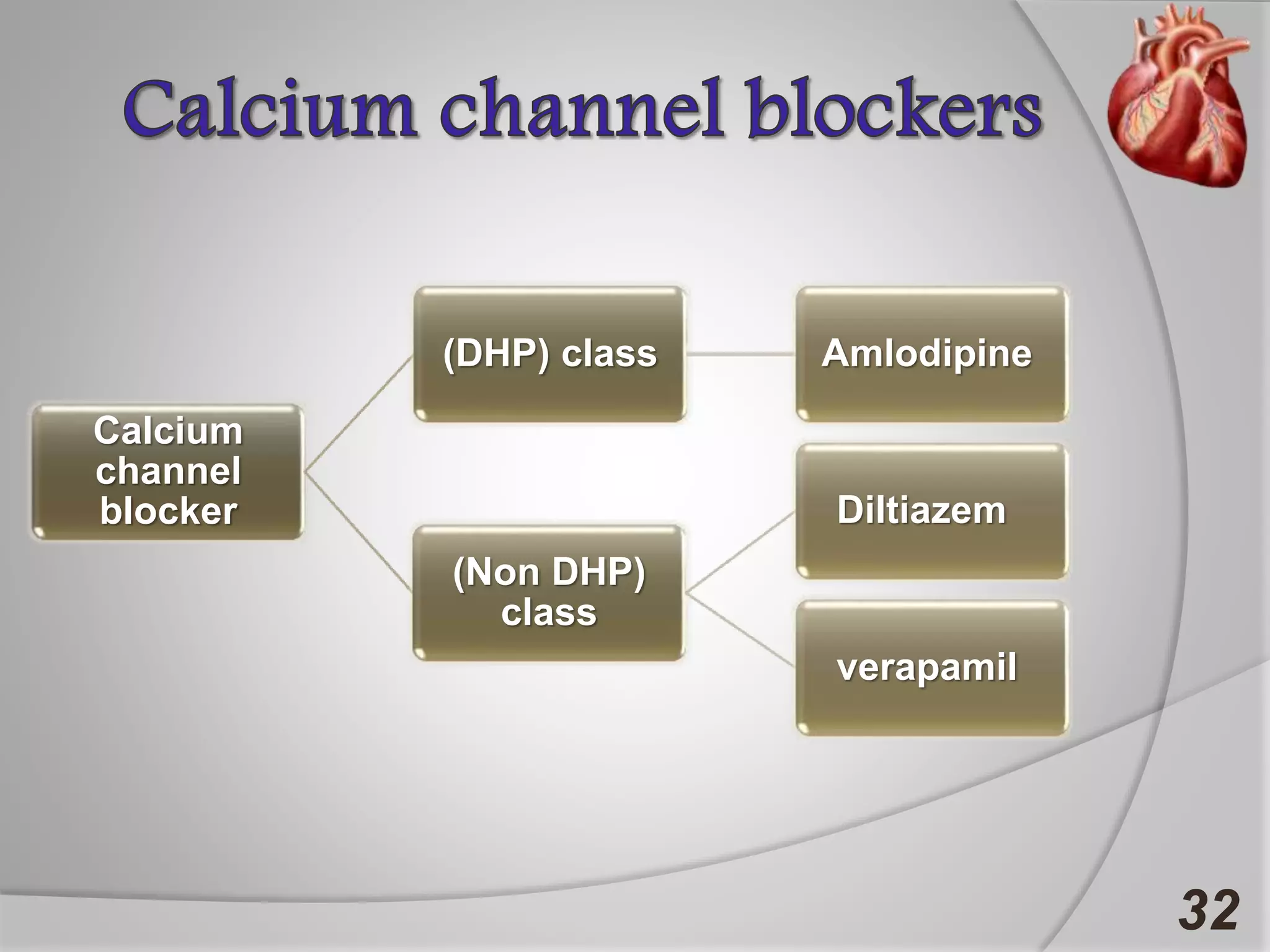
Calcium
channel
blocker
(DHP) class Amlodipine
(Non DHP)
class
Diltiazem
verapamil
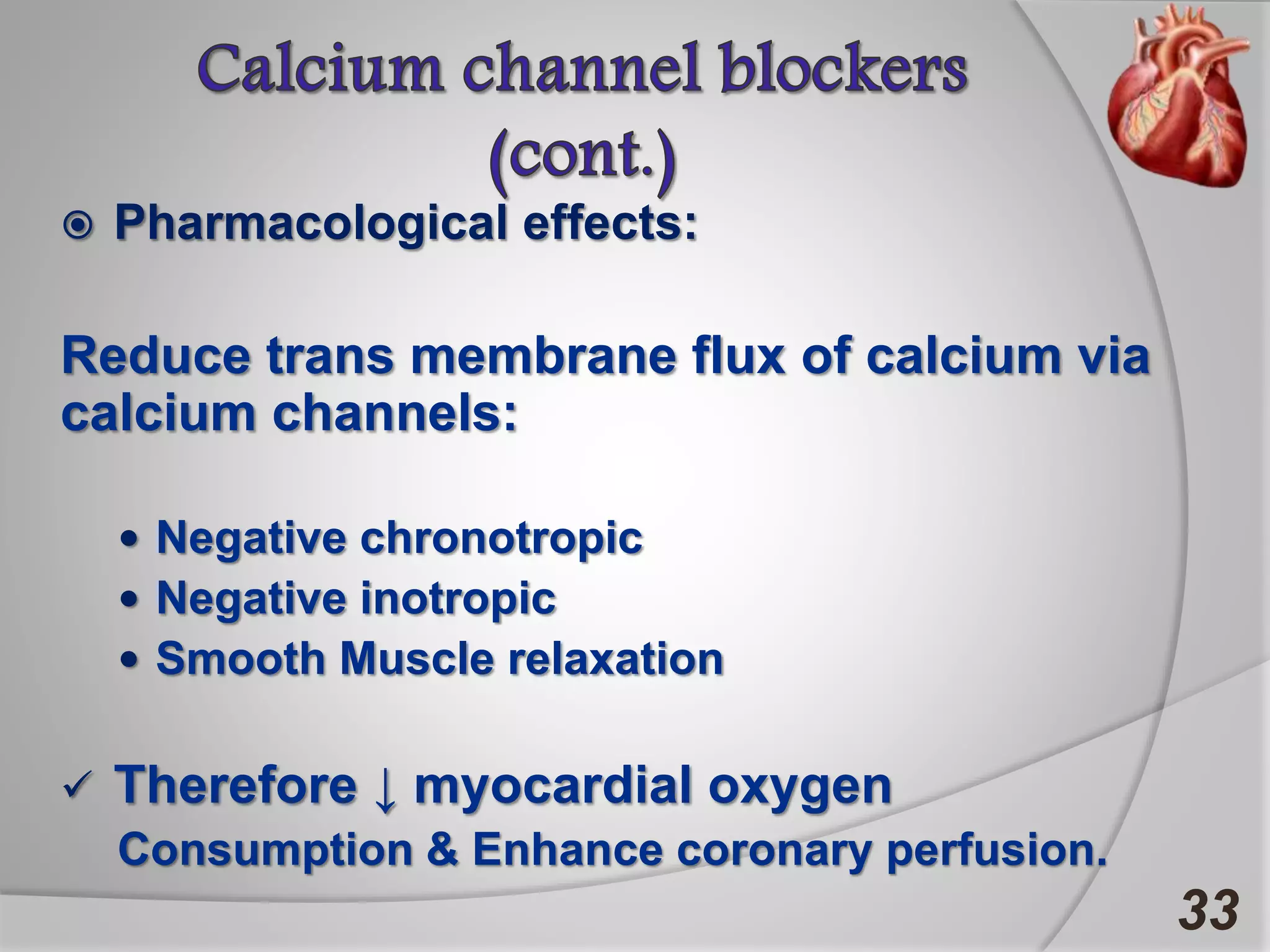
 Pharmacological effects:
Reduce trans membrane flux of calcium via
calcium channels:
 Negative chronotropic
 Negative inotropic
 Smooth Muscle relaxation
 Therefore ↓ myocardial oxygen
Consumption & Enhance coronary perfusion.
33
34
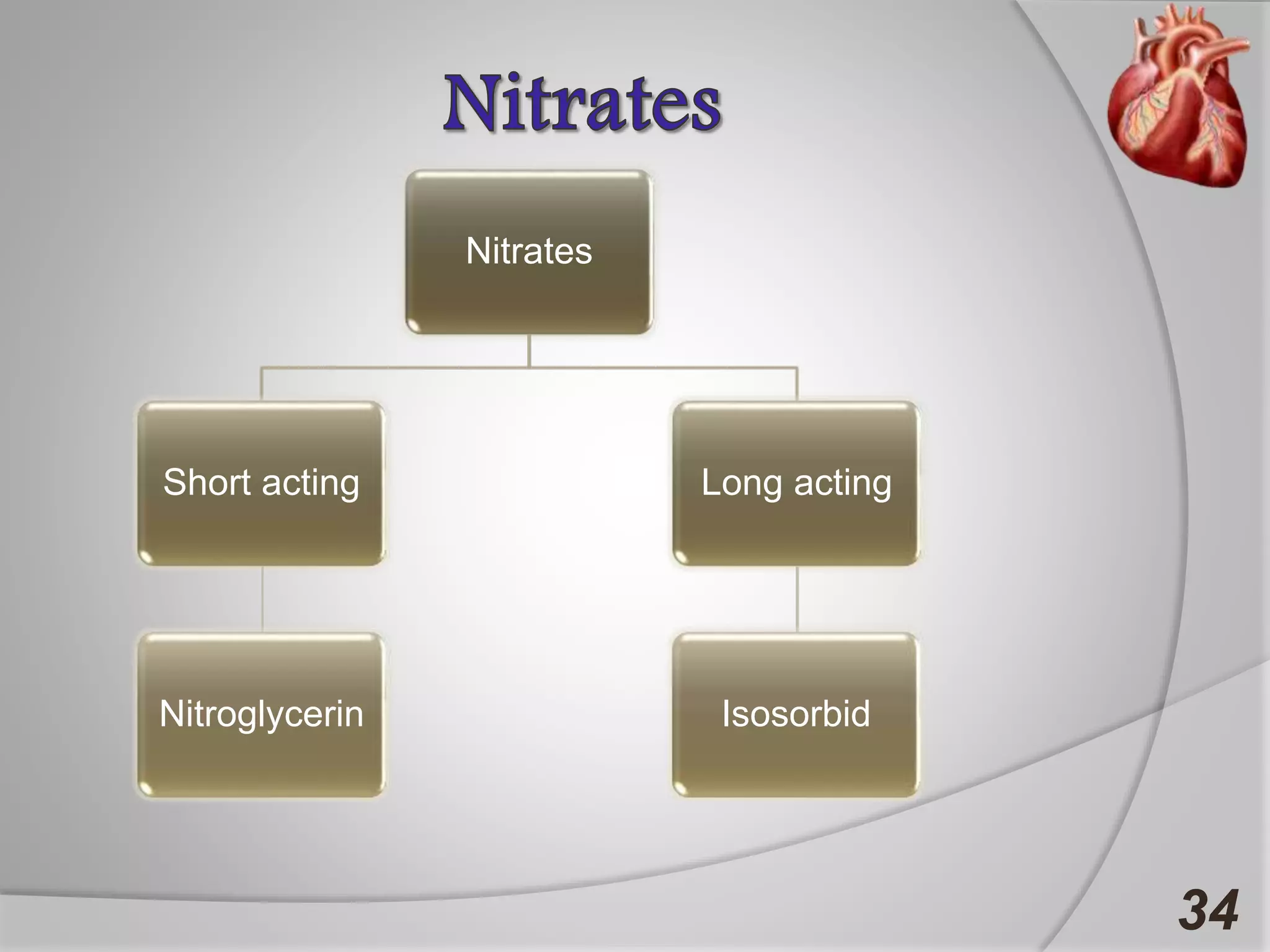
Nitrates
Short acting
Nitroglycerin
Long acting
Isosorbid
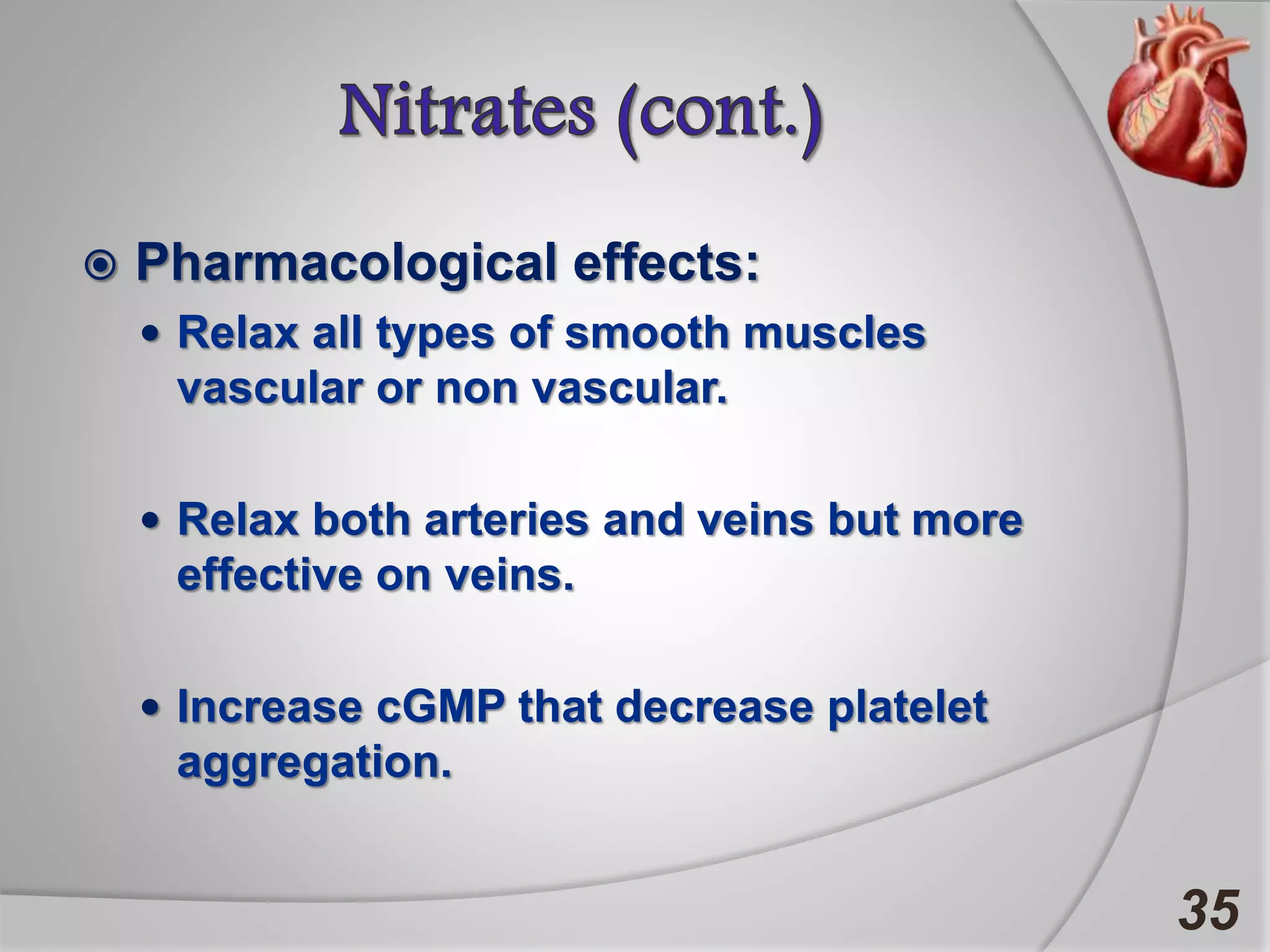
 Pharmacological effects:
 Relax all types of smooth muscles
vascular or non vascular.
 Relax both arteries and veins but more
effective on veins.
 Increase cGMP that decrease platelet
aggregation.
35
36
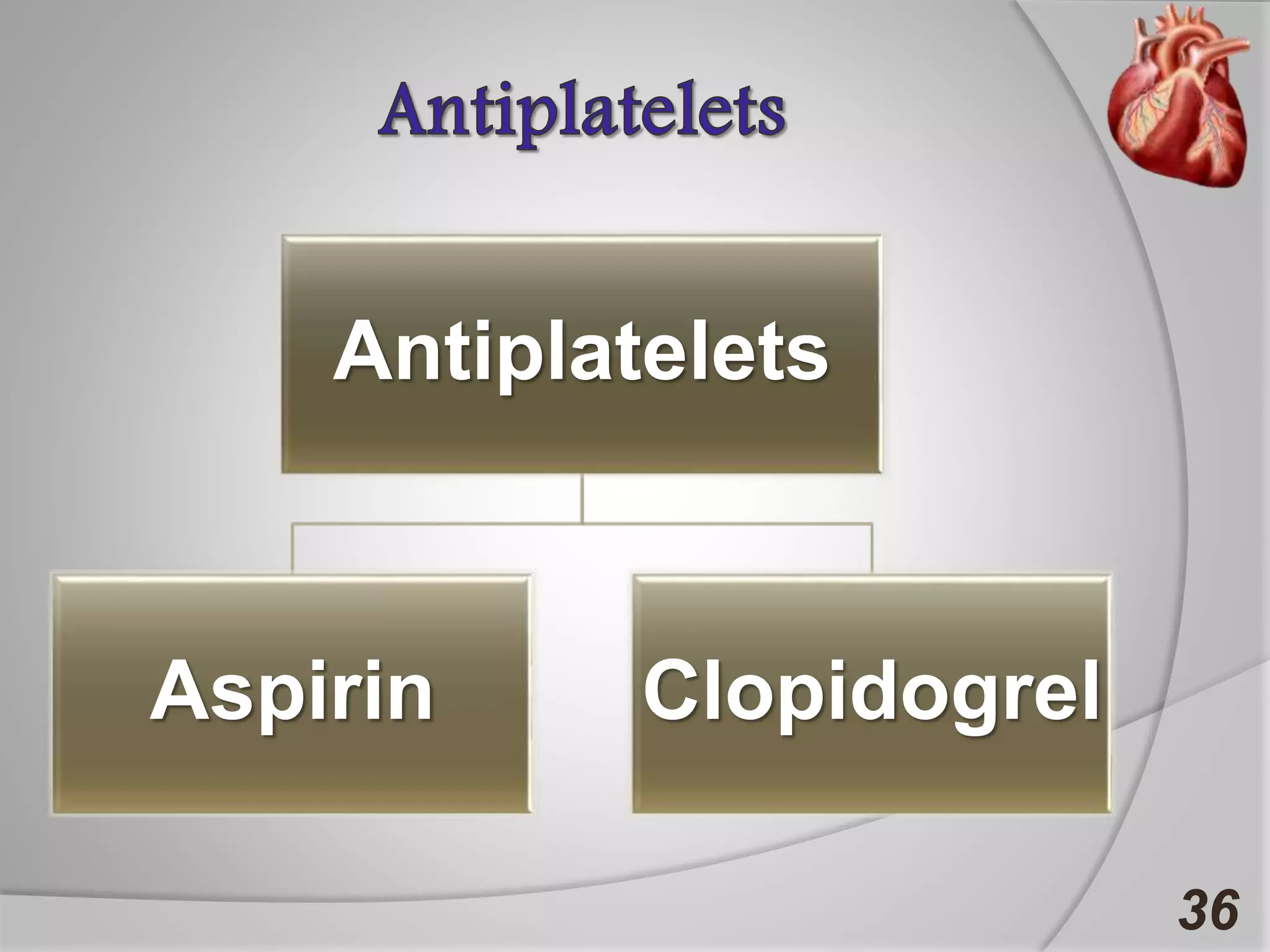
Antiplatelets
Aspirin Clopidogrel
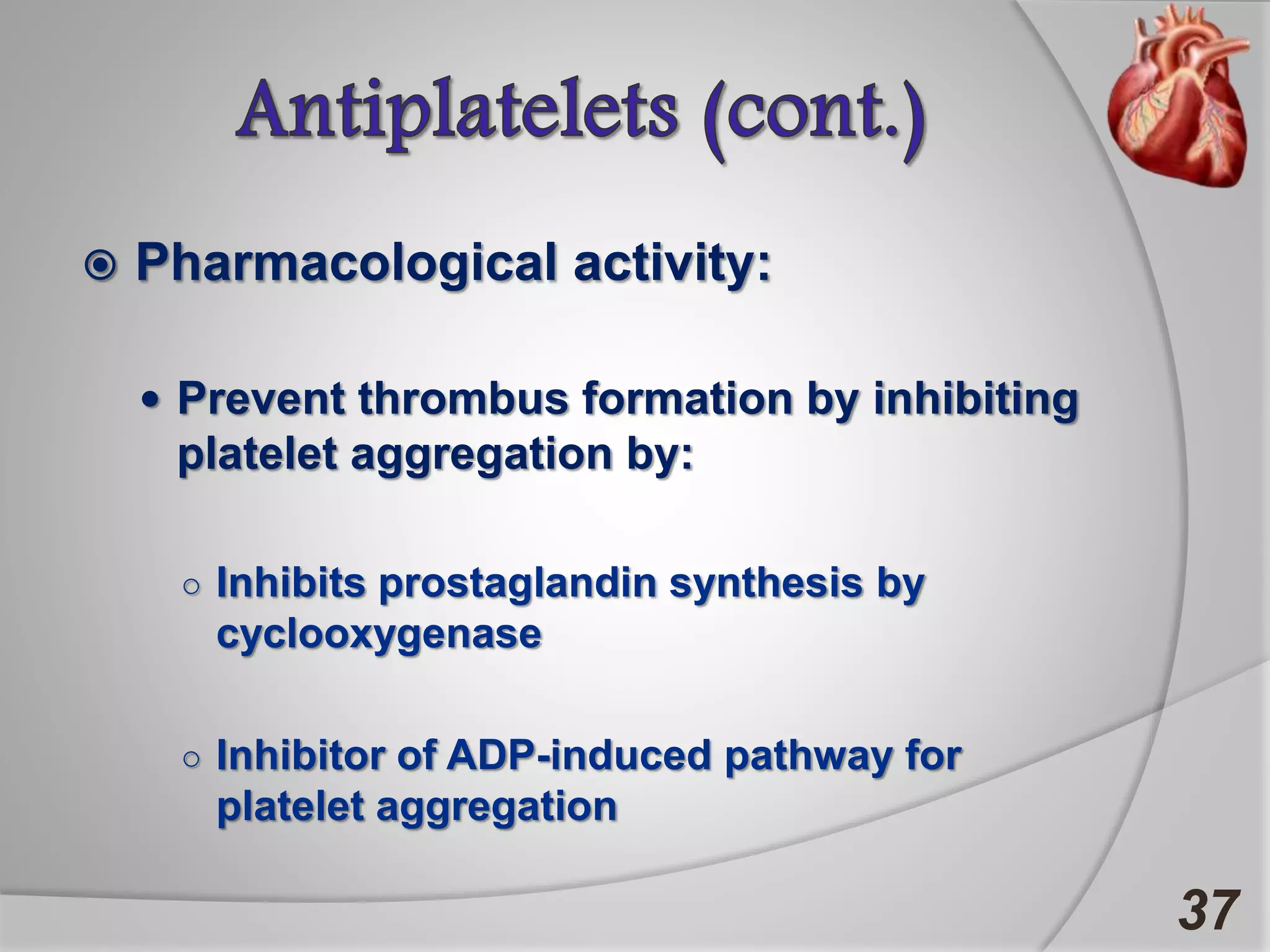
 Pharmacological activity:
 Prevent thrombus formation by inhibiting
platelet aggregation by:
○ Inhibits prostaglandin synthesis by
cyclooxygenase
○ Inhibitor of ADP-induced pathway for
platelet aggregation
37
 Ranolazine
 Inhibits fatty acid oxidation
 Inhibits late sodium current into
myocardial cells
 Prolongs QT interval
38
 Ranolazine
 Indicated for chronic angina unresponsive to
other antianginal treatments.
 Does not reduce blood pressure or heart rate
 Therefore ↓ myocardial oxygen
Consumption and maintain perfusion
39
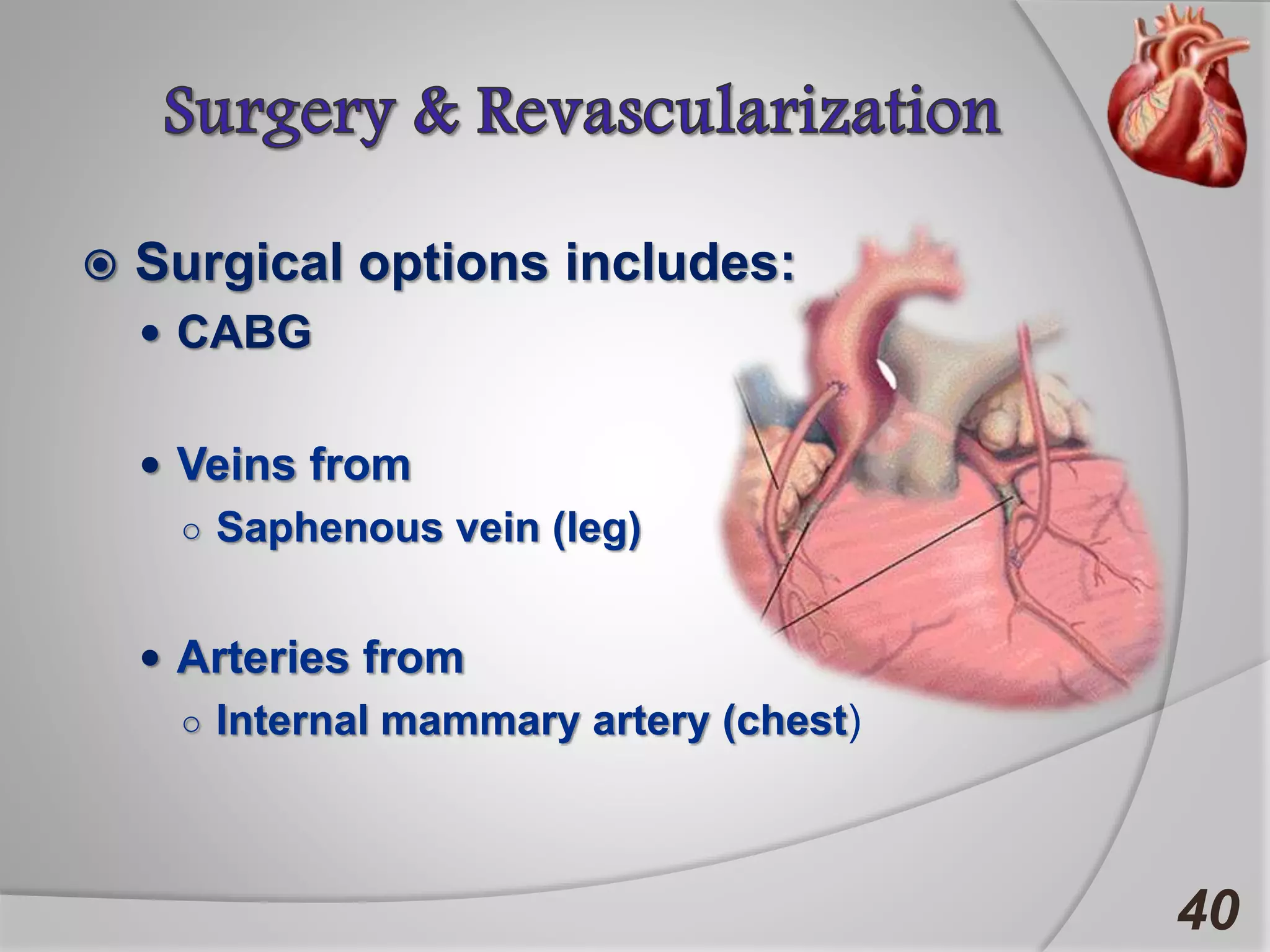
 Surgical options includes:
 CABG
 Veins from
○ Saphenous vein (leg)
 Arteries from
○ Internal mammary artery (chest)
40
 Surgical options inlcludes:
 PCI
o Use balloon
o Use stent
41
PCI Percutaneous coronary
intervention
 Angina condition can progress to
myocardial infarction MI
 MI includes permanant necrosis in the
tissue of myocardium
 Patient non responsive to NTG
 Don’t give more than 3 NTG sublingual
pills
42
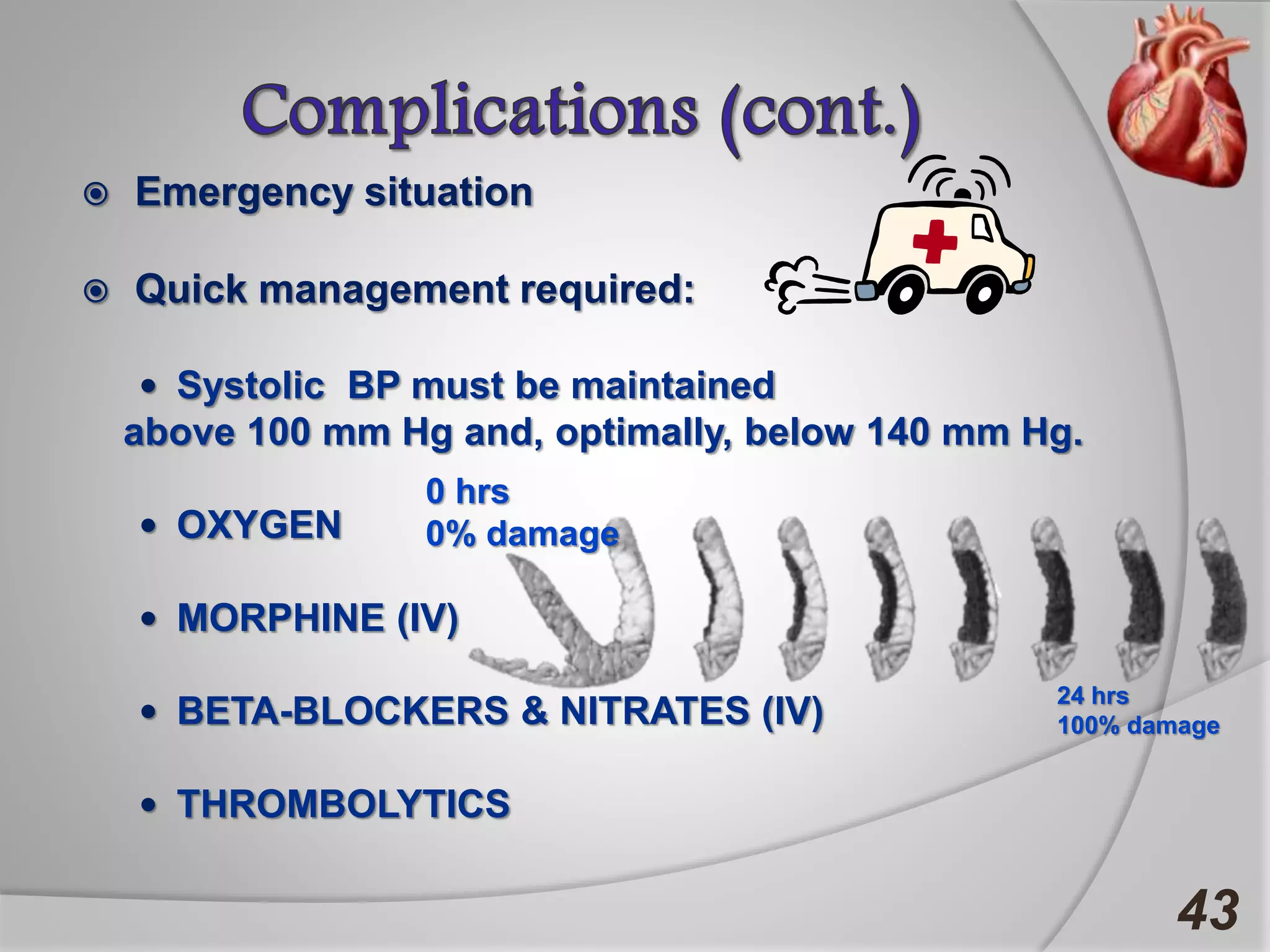
 Emergency situation
 Quick management required:
 Systolic BP must be maintained
above 100 mm Hg and, optimally, below 140 mm Hg.
 OXYGEN
 MORPHINE (IV)
 BETA-BLOCKERS & NITRATES (IV)
 THROMBOLYTICS
43
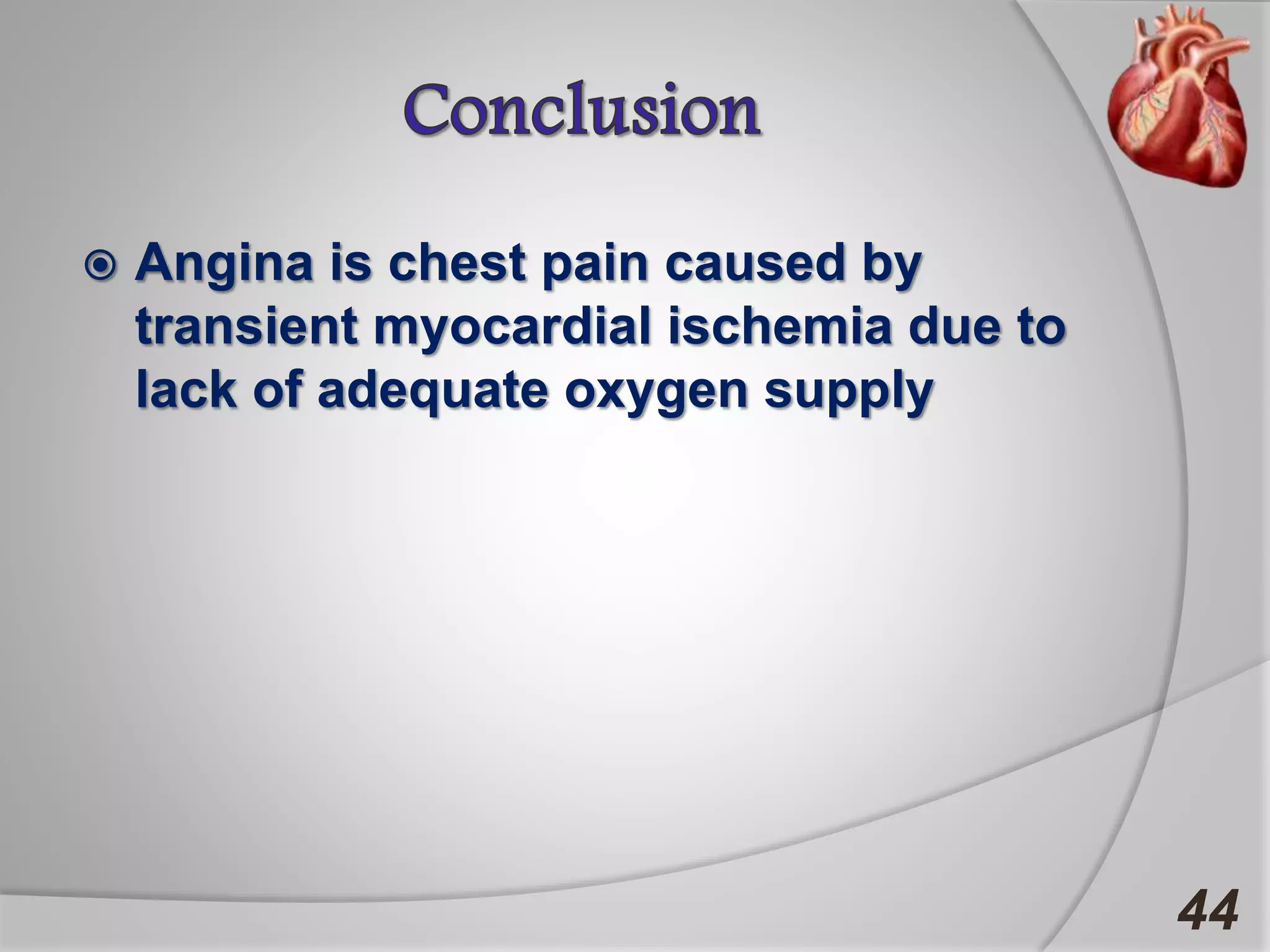
0 hrs
0% damage
24 hrs
100% damage
 Angina is chest pain caused by
transient myocardial ischemia due to
lack of adequate oxygen supply
44
45
Angina
Stable Unstable Prinzmetal
 Angina occurs due to narrowing of
the coronary arteries by:
 Spasm
 Plaque
 formation
46
 Angina caused by:
 Smoking
 Sedentary life
 Unhealthy foods
 Alcohol abuse
47
 Angina is presented mainly as:
 Chest pain that may spread to :
○ Left shoulders
○ Neck
○ Arms
○ Jaws
48
 Angina can be diagnosed by:
 ECG (stress)
 Coronary angiography
49
50
DON’T Offer TENS, EECP or
acupuncture
51
×Offer vitamin or fish oil supplements
52
DON’T Routinely offer drugs for 2ry
prevention to patient with suspected
cardiac syndrome X
53
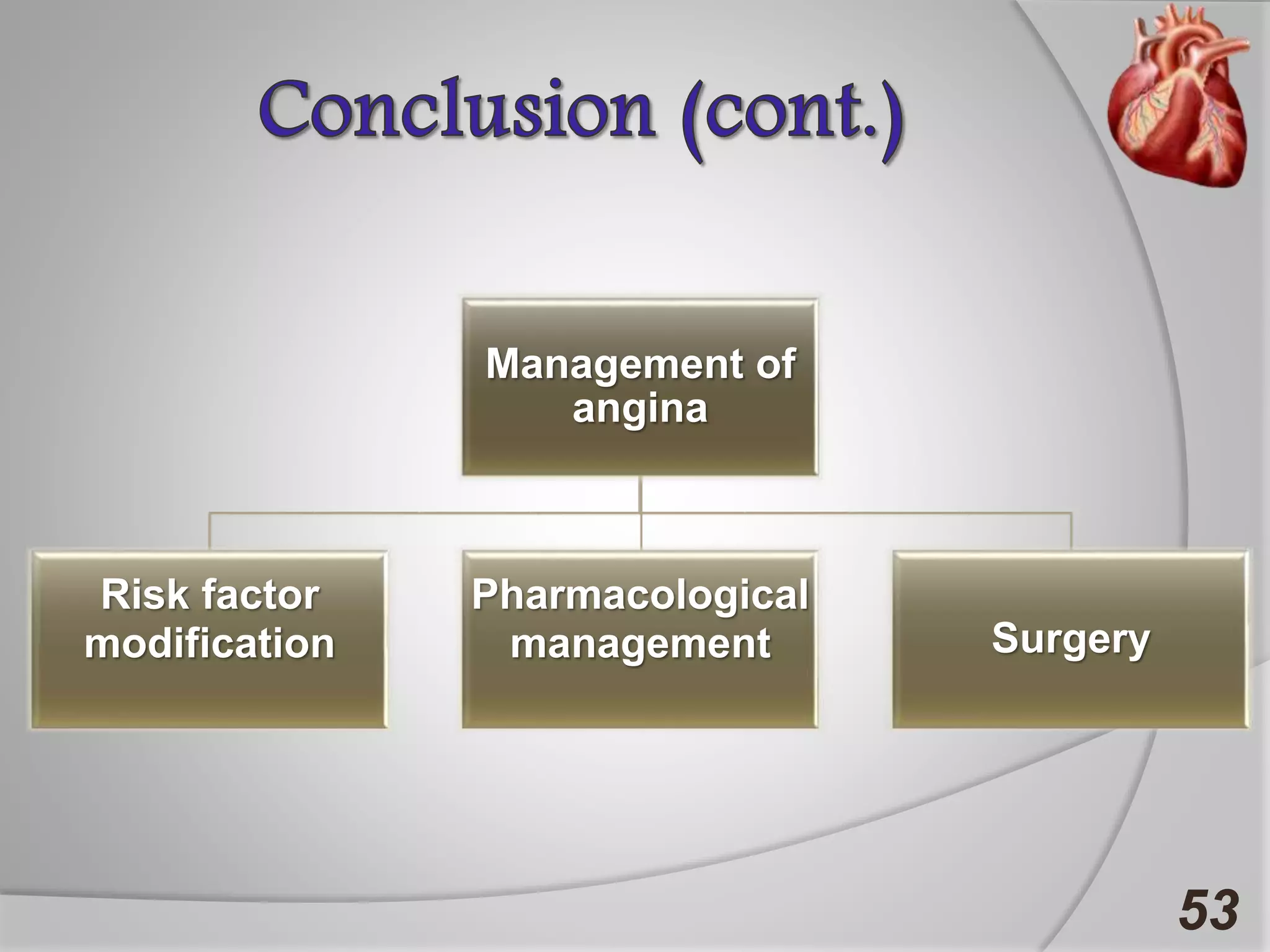
Management of
angina
Risk factor
modification
Pharmacological
management Surgery
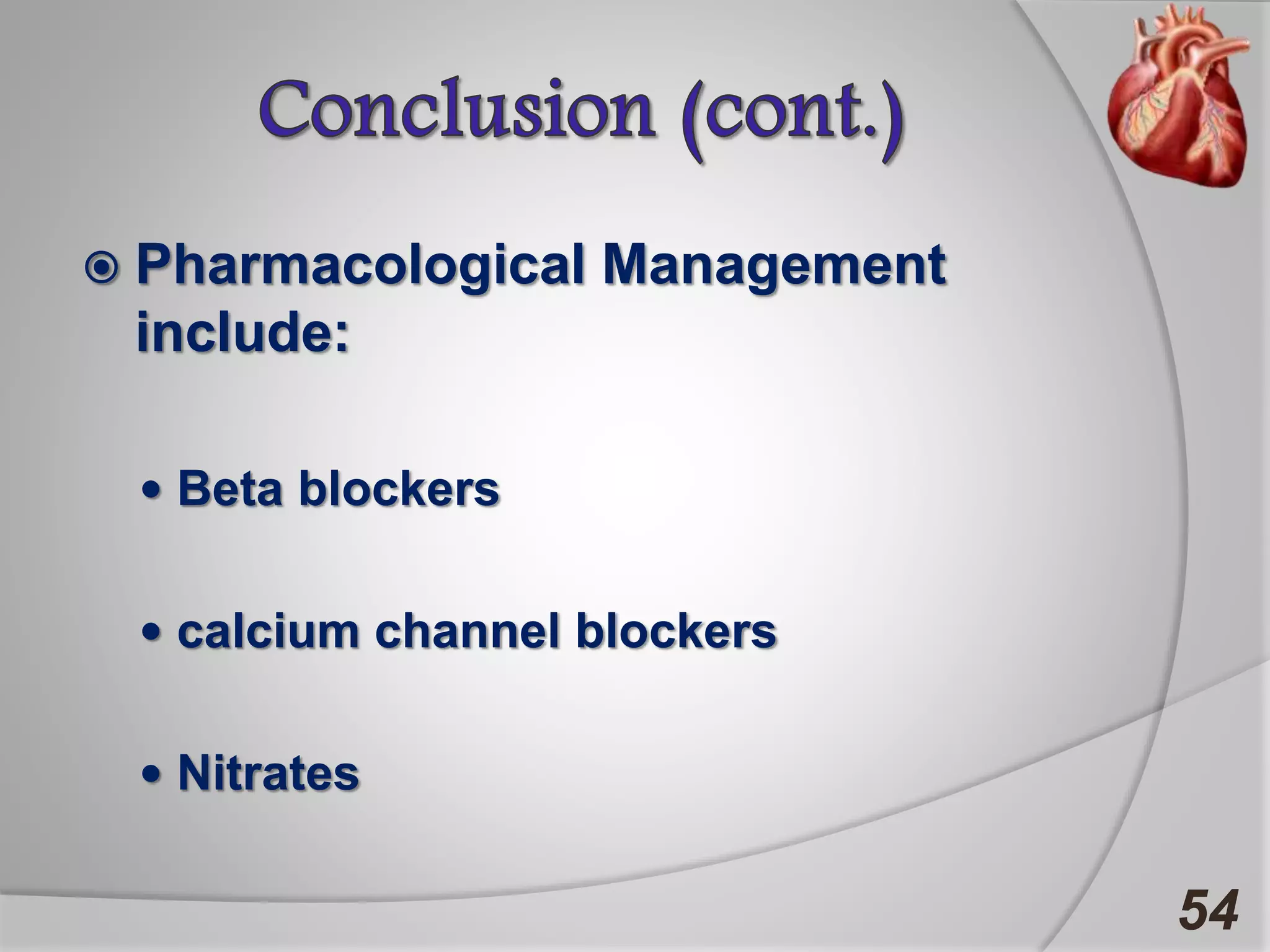
 Pharmacological Management
include:
 Beta blockers
 calcium channel blockers
 Nitrates
54
 Pharmacological Management
include:
 Antiplatelets
 Other agents (e.g. Ranolazine )
55
 Risk factor modification is the most
important
 No smoking
 Limit alcohol
 No high saturated fat/high cholesterol foods
 Maintain normal blood lipid levels
 Maintain blood pressure within normal range 56

angina presentation

Editor's Notes

  • #2 Angina
  • #10 Angina itself is a symptom Heavy pressure squeezing