STRATEGIC WORKFORCE PLANNING (SWP)
AND HRM METRICS MASTERCLASS
CHARLES COTTER Ph.D. candidate, MBA, B.A (Hons), B.A
www.slideshare.net/CharlesCotter
PEERMONT METCOURT SUITES BOARDROOM, EMPEROR’S PALACE
18-20 OCTOBER 2017
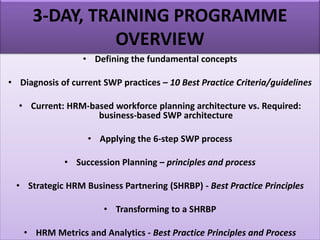
• Defining the fundamental concepts
• Diagnosis of current SWP practices – 10 Best Practice Criteria/guidelines
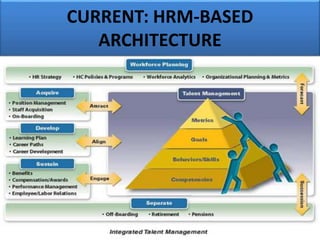
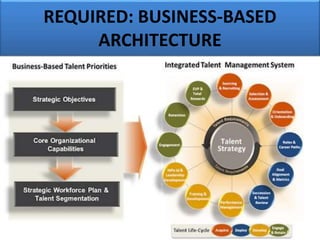
• Current: HRM-based workforce planning architecture vs. Required:
business-based SWP architecture
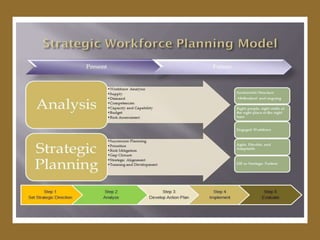
• Applying the 6-step SWP process
• Succession Planning – principles and process
• Strategic HRM Business Partnering (SHRBP) - Best Practice Principles
• Transforming to a SHRBP
• HRM Metrics and Analytics - Best Practice Principles and Process
3-DAY, TRAINING PROGRAMME
OVERVIEW
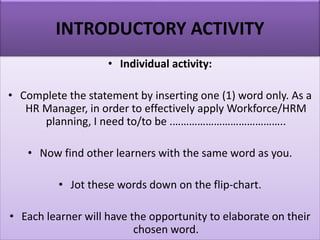
• Individual activity:
• Complete the statement by inserting one (1) word only. As a
HR Manager, in order to effectively apply Workforce/HRM
planning, I need to/to be .…………………………………..
• Now find other learners with the same word as you.
• Jot these words down on the flip-chart.
• Each learner will have the opportunity to elaborate on their
chosen word.
INTRODUCTORY ACTIVITY
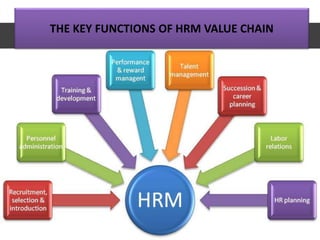
THE KEY FUNCTIONS OF HRM VALUE CHAIN
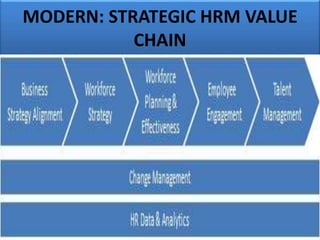
MODERN: STRATEGIC HRM VALUE
CHAIN
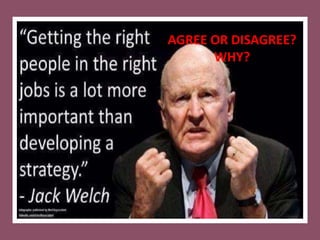
AGREE OR DISAGREE?
WHY?
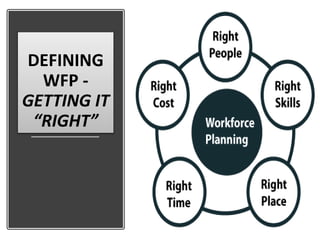
DEFINING
WFP -
GETTING IT
“RIGHT”
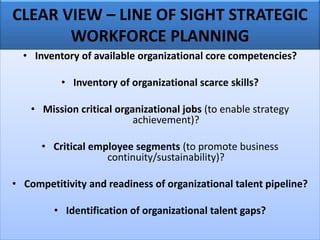
CLEAR VIEW – LINE OF SIGHT STRATEGIC
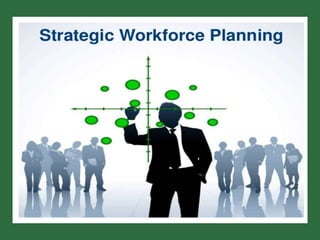
WORKFORCE PLANNING
• Inventory of available organizational core competencies?
• Inventory of organizational scarce skills?
• Mission critical organizational jobs (to enable strategy
achievement)?
• Critical employee segments (to promote business
continuity/sustainability)?
• Competitivity and readiness of organizational talent pipeline?
• Identification of organizational talent gaps?
CURRENT: HRM-BASED
ARCHITECTURE
REQUIRED: BUSINESS-BASED
ARCHITECTURE
• #1: Aligned with the organization’s strategic business plans and priorities.
• #2: Future-focused, adopting a strategic, medium to long-term forward-
looking approach.
• #3: Pro-active, sensitive and responsive to (internal and external)
environmental change and trends.
• #4: Provides accurate and reliable (clear view) talent
planning/management information for the organization e.g. available core
competencies; scarce skills; critical jobs and employee segments and
talent gaps.
• #5: Collaborative, well coordinated and partnering effort (HRM has co-
opted business partners e.g. line managers to the process).
DIAGNOSIS: 10 BEST PRACTICE
GUIDELINES FOR EFFECTIVE SWP
• #6: Integrated (bundled) with other HRM value chain processes e.g. Recruitment,
Succession Planning, Retention and Leadership Development.
• #7: Generates meaningful business intelligence for the organization which
shapes, informs and influences business planning and supports strategic decision-
making.
• #8: Integrates both scientific (HRM metrics, predictive analytics and strategy
maps) with artistic (planning) principles.
• #9: Dynamic - regularly and systematically monitored, reviewed, evaluated and
adapted (committed to continuous improvement processes).
• #10: Yields a positive ROI, with tangible/demonstrable outcomes and impact for
the organization i.e. creates sustainable HCM competitive advantages

DIAGNOSIS: 10 BEST PRACTICE
GUIDELINES FOR EFFECTIVE SWP
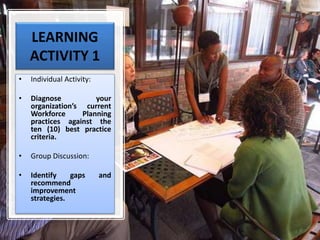
LEARNING
ACTIVITY 1
• Individual Activity:
• Diagnose your
organization’s current
Workforce Planning
practices against the
ten (10) best practice
criteria.
• Group Discussion:
• Identify gaps and
recommend
improvement
strategies.
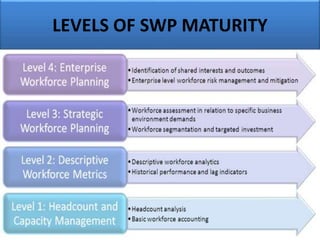
LEVELS OF SWP MATURITY
LEARNING
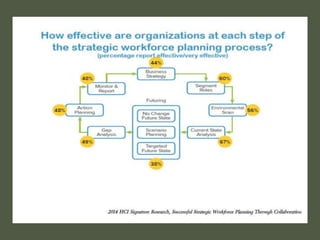
ACTIVITY 2
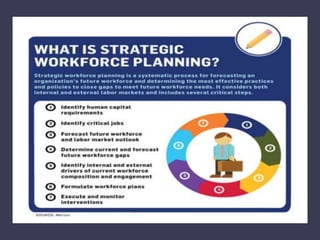
• Group Discussion:
• By referring to the
illustration of the
strategic workforce
planning process,
evaluate the efficiency
and effectiveness of
each process step.
• Identify areas of
improvement (gaps)
and recommend how
HRM can enhance
performance and value
add.
THE NATURE OF THE BUSINESS
ENVIRONMENT – V-U-C-A
LEARNING
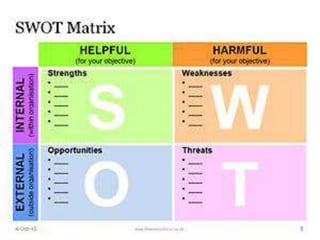
ACTIVITY 3
• Group Discussion:
• By utilizing a SWOT
Analysis Matrix, perform
an environmental
scan/analysis of both the
internal and external
environments for your
organization.
• Internally, identify
organizational strengths
and weaknesses and
externally identify
opportunities and threats.
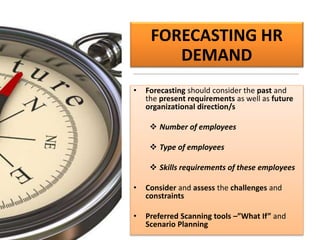
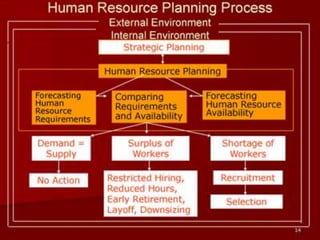
FORECASTING HR
DEMAND
• Forecasting should consider the past and
the present requirements as well as future
organizational direction/s
 Number of employees
 Type of employees
 Skills requirements of these employees
• Consider and assess the challenges and
constraints
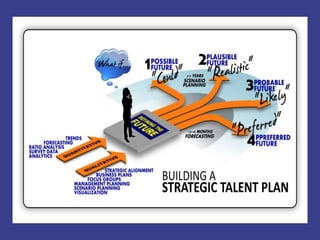
• Preferred Scanning tools –”What If” and
Scenario Planning
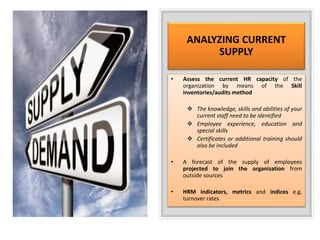
• Assess the current HR capacity of the
organization by means of the Skill
inventories/audits method
 The knowledge, skills and abilities of your
current staff need to be identified
 Employee experience, education and
special skills
 Certificates or additional training should
also be included
• A forecast of the supply of employees
projected to join the organization from
outside sources
• HRM indicators, metrics and indices e.g.
turnover rates
ANALYZING CURRENT
SUPPLY
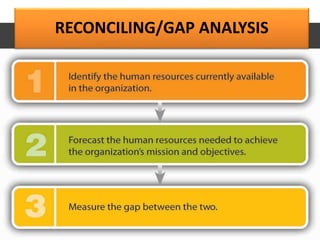
RECONCILING/GAP ANALYSIS
LEARNING
ACTIVITY 4
• Group Discussion:
• Apply steps 2, 3 and 4 of the
Workforce/HR Planning
process in the context of
your organization.
 Step 2: Forecasting Human
Resource Demand
 Step 3: Analyzing Supply
 Step 4: Reconciling
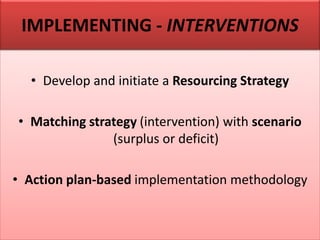
• Develop and initiate a Resourcing Strategy
• Matching strategy (intervention) with scenario
(surplus or deficit)
• Action plan-based implementation methodology
IMPLEMENTING - INTERVENTIONS
• There are five HR strategies for meeting your
organization's needs in the future:
Restructuring strategies
Training and development strategies
Recruitment strategies
Outsourcing strategies
Collaboration strategies
HR ACTION PLANS
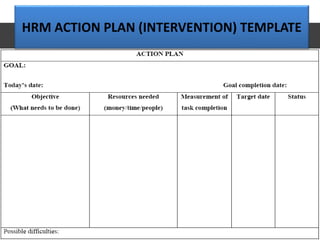
HRM ACTION PLAN (INTERVENTION) TEMPLATE
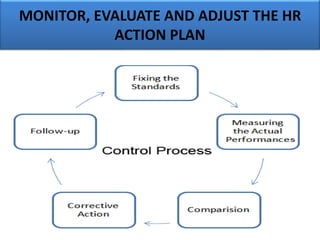
MONITOR, EVALUATE AND ADJUST THE HR
ACTION PLAN
LEARNING
ACTIVITY 5
• Group Discussion:
• Apply steps 5-6 of the
Workforce/HR Planning
process in the context of
your organization.
 Step 5: Developing SHRM
Action Plan
 Prioritize these HR Action
Plans.
 Step 6: Monitor, Evaluate
and Adjust the HRM Action
Plan
• According to HR Future
Magazine, "39% of
employees are concerned
about losing knowledge as
their older colleagues retire,
implying that succession
planning should be top of
the HRM agenda."
SUCCESSION
PLANNING STATISTIC
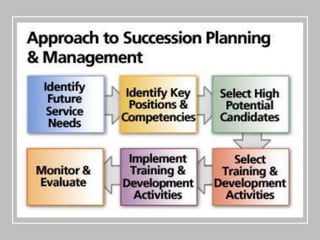
• Succession planning is the identification and development of
potential successors for key positions in an organization, through
a systematic evaluation process and possible training or
mentoring.
• Succession planning and management involves an integrated,
systematic approach to identify, develop and retain talent for key
positions and areas in line with current and projected business
objectives.
• Succession Planning is "a means of identifying critical
management positions, starting at the levels of project manager
and supervisor and extending up to the highest position in the
organization.”
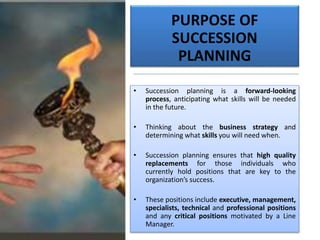
PURPOSE OF
SUCCESSION
PLANNING
• Succession planning is a forward-looking
process, anticipating what skills will be needed
in the future.
• Thinking about the business strategy and
determining what skills you will need when.
• Succession planning ensures that high quality
replacements for those individuals who
currently hold positions that are key to the
organization’s success.
• These positions include executive, management,
specialists, technical and professional positions
and any critical positions motivated by a Line
Manager.
• Succession planning is about filling the organization's
talent pipeline and building internal bench strength.
• It is about leveraging the talent that the organization
already possesses by developing it to full potential.
• The focus is on developing employees so that the
organization has a pool of qualified candidates who
are ready to compete for key positions and areas when
they become vacant.
OBJECTIVES OF SUCCESSION PLANNING
MENTORING AND COACHING
• Mentorship is a personal development relationship in which a
more experienced or more knowledgeable person helps to
guide a less experienced or less knowledgeable person.
• However, true mentoring is more than just answering
occasional questions or providing ad hoc help. It is about an
ongoing relationship of learning, dialogue and challenge.
• Coaching, is a teaching, training or development process via
which an individual is supported while achieving a specific
personal or professional result or goal.
• Coaching is an ongoing leadership, mentorship or guidance to
assist an individual to increase the level of their skills.
MODELS OF
SUCCESSION
PLANNING
• Short-term planning or
emergency replacements
• Long-term planning or
managing talent
• Combination of above
plans
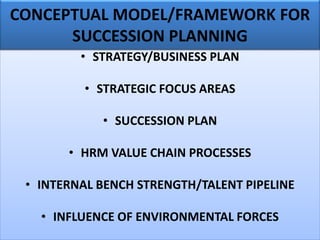
• STRATEGY/BUSINESS PLAN
• STRATEGIC FOCUS AREAS
• SUCCESSION PLAN
• HRM VALUE CHAIN PROCESSES
• INTERNAL BENCH STRENGTH/TALENT PIPELINE
• INFLUENCE OF ENVIRONMENTAL FORCES
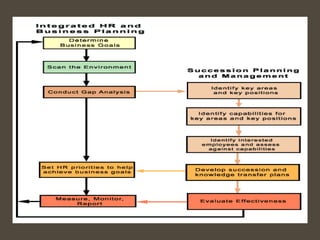
CONCEPTUAL MODEL/FRAMEWORK FOR
SUCCESSION PLANNING
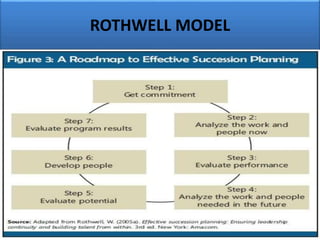
ROTHWELL MODEL
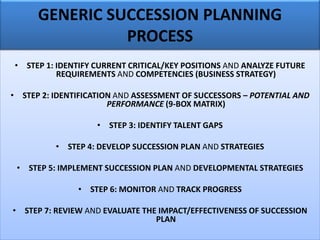
• STEP 1: IDENTIFY CURRENT CRITICAL/KEY POSITIONS AND ANALYZE FUTURE
REQUIREMENTS AND COMPETENCIES (BUSINESS STRATEGY)
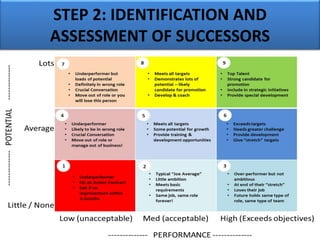
• STEP 2: IDENTIFICATION AND ASSESSMENT OF SUCCESSORS – POTENTIAL AND
PERFORMANCE (9-BOX MATRIX)
• STEP 3: IDENTIFY TALENT GAPS
• STEP 4: DEVELOP SUCCESSION PLAN AND STRATEGIES
• STEP 5: IMPLEMENT SUCCESSION PLAN AND DEVELOPMENTAL STRATEGIES
• STEP 6: MONITOR AND TRACK PROGRESS
• STEP 7: REVIEW AND EVALUATE THE IMPACT/EFFECTIVENESS OF SUCCESSION
PLAN
GENERIC SUCCESSION PLANNING
PROCESS
STEP 2: IDENTIFICATION AND
ASSESSMENT OF SUCCESSORS
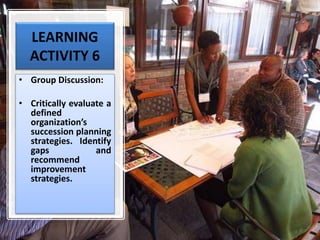
LEARNING
ACTIVITY 6
• Group Discussion:
• Critically evaluate a
defined
organization’s
succession planning
strategies. Identify
gaps and
recommend
improvement
strategies.
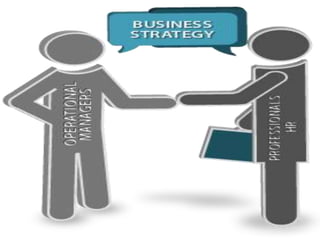
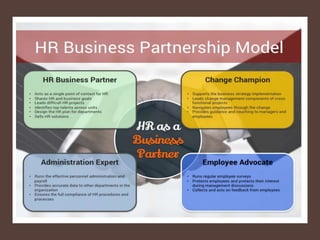
DEFINING HR BUSINESS PARTNERING
• Partnership: A relationship between individuals or groups
characterized by mutual co-operation and responsibility, for the
achievement of a specified shared goal.
• HR business partners are HR professionals who work closely with
an organization’s senior leaders in order to develop an HR agenda
that closely supports the overall aims of the organization. The
process of alignment is known as HR business partnering.
• Strategic business partners: A long-term relationship (alliance) to
achieve defined objectives common to all partners.
• In the context of strategic human resource management, the HR
function and activities are intended to ensure the organization's
financial success and prosperity (business continuity).
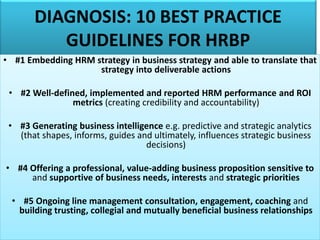
DIAGNOSIS: 10 BEST PRACTICE
GUIDELINES FOR HRBP
• #1 Embedding HRM strategy in business strategy and able to translate that
strategy into deliverable actions
• #2 Well-defined, implemented and reported HRM performance and ROI
metrics (creating credibility and accountability)
• #3 Generating business intelligence e.g. predictive and strategic analytics
(that shapes, informs, guides and ultimately, influences strategic business
decisions)
• #4 Offering a professional, value-adding business proposition sensitive to
and supportive of business needs, interests and strategic priorities
• #5 Ongoing line management consultation, engagement, coaching and
building trusting, collegial and mutually beneficial business relationships
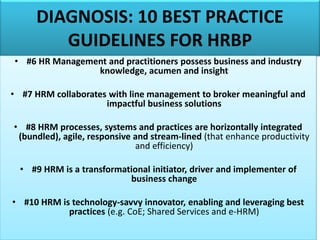
DIAGNOSIS: 10 BEST PRACTICE
GUIDELINES FOR HRBP
• #6 HR Management and practitioners possess business and industry
knowledge, acumen and insight
• #7 HRM collaborates with line management to broker meaningful and
impactful business solutions
• #8 HRM processes, systems and practices are horizontally integrated
(bundled), agile, responsive and stream-lined (that enhance productivity
and efficiency)
• #9 HRM is a transformational initiator, driver and implementer of
business change
• #10 HRM is technology-savvy innovator, enabling and leveraging best
practices (e.g. CoE; Shared Services and e-HRM)
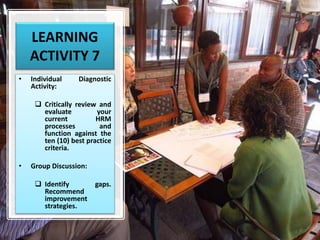
LEARNING
ACTIVITY 7
• Individual Diagnostic
Activity:
 Critically review and
evaluate your
current HRM
processes and
function against the
ten (10) best practice
criteria.
• Group Discussion:
 Identify gaps.
Recommend
improvement
strategies.
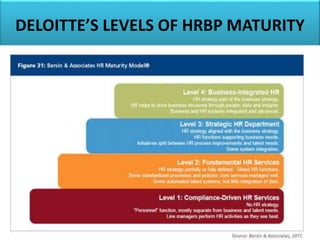
DELOITTE’S LEVELS OF HRBP MATURITY
HRBP CRITICAL SUCCESS FACTORS
• Strategic focus and thrust (on issues that contribute to business growth and
competitiveness)
• Adopting a “big picture” perspective (regarding the organization’s priorities
and goals)
• Having personal impact and credibility (to influence key decision-makers)
• Adopting an Key Account Management, (internal) client-centric approach
• Possessing a set of value-adding skills and knowledge (customers and
business)
• Being a diplomat and negotiator (in harmonizing the HRM agenda with
business needs)
EXPECTATIONS AND PRIORITIES OF BUSINESS
EXECUTIVES
• CEO’s expect the Human Resources function to play a
much more active and participatory role in enabling
business strategies.
• Senior business leaders consider talent to be perhaps
the critical factor in the push for sustainable growth
and the need to manage new opportunities and risks
in a more complex and interdependent world.
• According to The Conference Board CEO Challenge
(2013), Human Capital is rated 10% higher than
operational excellence as a major challenge for
businesses.
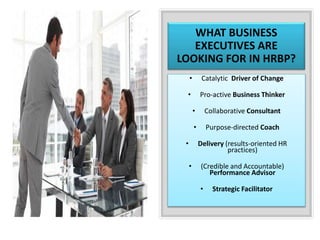
WHAT BUSINESS
EXECUTIVES ARE
LOOKING FOR IN HRBP?
• Catalytic Driver of Change
• Pro-active Business Thinker
• Collaborative Consultant
• Purpose-directed Coach
• Delivery (results-oriented HR
practices)
• (Credible and Accountable)
Performance Advisor
• Strategic Facilitator
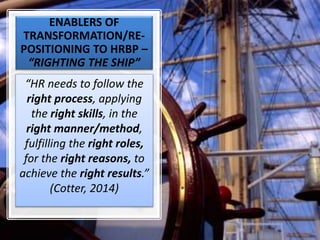
ENABLERS OF
TRANSFORMATION/RE-
POSITIONING TO HRBP –
“RIGHTING THE SHIP”
“HR needs to follow the
right process, applying
the right skills, in the
right manner/method,
fulfilling the right roles,
for the right reasons, to
achieve the right results.”
(Cotter, 2014)
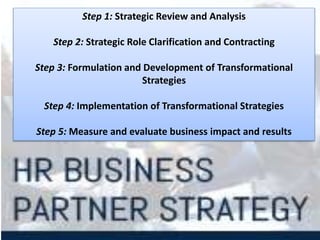
Step 1: Strategic Review and Analysis
Step 2: Strategic Role Clarification and Contracting
Step 3: Formulation and Development of Transformational
Strategies
Step 4: Implementation of Transformational Strategies
Step 5: Measure and evaluate business impact and results
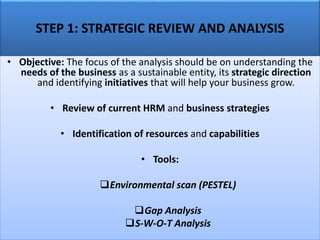
STEP 1: STRATEGIC REVIEW AND ANALYSIS
• Objective: The focus of the analysis should be on understanding the
needs of the business as a sustainable entity, its strategic direction
and identifying initiatives that will help your business grow.
• Review of current HRM and business strategies
• Identification of resources and capabilities
• Tools:
Environmental scan (PESTEL)
Gap Analysis
S-W-O-T Analysis
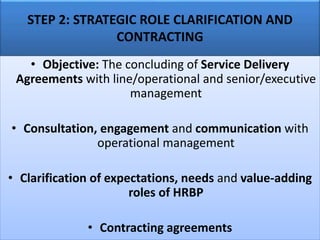
STEP 2: STRATEGIC ROLE CLARIFICATION AND
CONTRACTING
• Objective: The concluding of Service Delivery
Agreements with line/operational and senior/executive
management
• Consultation, engagement and communication with
operational management
• Clarification of expectations, needs and value-adding
roles of HRBP
• Contracting agreements
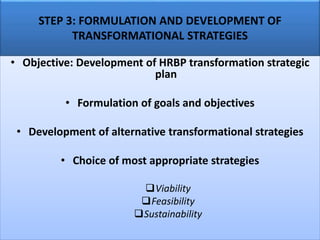
STEP 3: FORMULATION AND DEVELOPMENT OF
TRANSFORMATIONAL STRATEGIES
• Objective: Development of HRBP transformation strategic
plan
• Formulation of goals and objectives
• Development of alternative transformational strategies
• Choice of most appropriate strategies
Viability
Feasibility
Sustainability
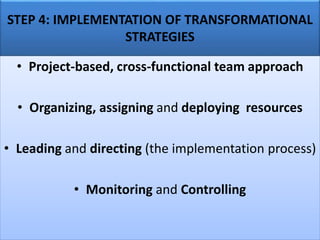
STEP 4: IMPLEMENTATION OF TRANSFORMATIONAL
STRATEGIES
• Project-based, cross-functional team approach
• Organizing, assigning and deploying resources
• Leading and directing (the implementation process)
• Monitoring and Controlling
STEP 5: MEASURE AND EVALUATE BUSINESS IMPACT
AND RESULTS
• Measure and calculate the ROI
• Amend and review strategies (remediation action)
• Report back to business partners (to demonstrate
transparency and accountability)
• Aspire to continuous improvement processes
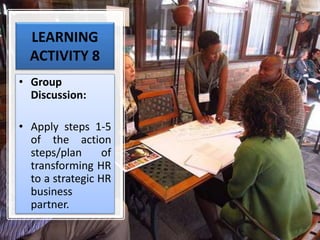
LEARNING
ACTIVITY 8
• Group
Discussion:
• Apply steps 1-5
of the action
steps/plan of
transforming HR
to a strategic HR
business
partner.
YES OR NO?
WHY?
• What type of HRM Metrics does your organization currently
utilize?
• Describe the organizational impact, level of maturity and
credibility of these HRM Metrics
• What does your organizational HRM Metrics architecture look
like?
• What is the current degree of HRM practitioner competency
of HRM metrics/analytics?
• Review the benefits of HR Metrics. Is there a business case for
applying HR Metrics?
HRM ANALYTICS TASK TEAM – 2017?
• Metrics are simply measurements. Metrics track activity, but don’t
necessarily show a causal relationship.
• HRM Metrics - Measurements used to determine the value and
effectiveness of HR strategies.
• Differentiation between People and HR Measures
• Human capital analytics examine the effect of HRM metrics
on organizational performance. In more general terms, analytics look
for patterns of similarity between metrics. By using analytics over
time, HRM can become predictive.
• Measures - #1 HRM measure?
DEFINING THE FUNDAMENTAL
CONCEPTS
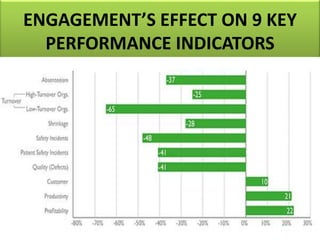
ENGAGEMENT’S EFFECT ON 9 KEY
PERFORMANCE INDICATORS
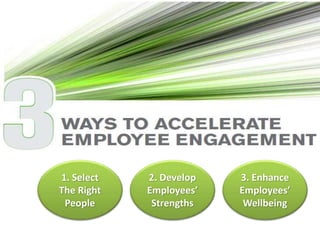
1. Select
The Right
People
2. Develop
Employees’
Strengths
3. Enhance
Employees’
Wellbeing
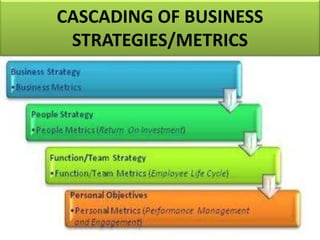
CASCADING OF BUSINESS
STRATEGIES/METRICS
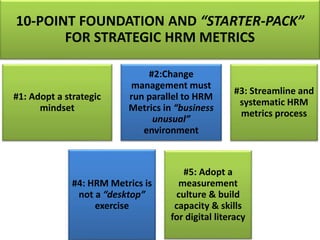
10-POINT FOUNDATION AND “STARTER-PACK”
FOR STRATEGIC HRM METRICS
#1: Adopt a strategic
mindset
#2:Change
management must
run parallel to HRM
Metrics in “business
unusual”
environment
#3: Streamline and
systematic HRM
metrics process
#4: HRM Metrics is
not a “desktop”
exercise
#5: Adopt a
measurement
culture & build
capacity & skills
for digital literacy
10-POINT FOUNDATION AND “STARTER-PACK”
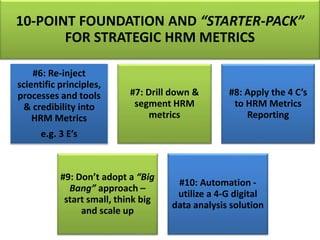
FOR STRATEGIC HRM METRICS
#6: Re-inject
scientific principles,
processes and tools
& credibility into
HRM Metrics
e.g. 3 E’s
#7: Drill down &
segment HRM
metrics
#8: Apply the 4 C’s
to HRM Metrics
Reporting
#9: Don’t adopt a “Big
Bang” approach –
start small, think big
and scale up
#10: Automation -
utilize a 4-G digital
data analysis solution
THE FUTURE OF HRM METRICS &
ANALYTICS?
“HRM will have to migrate from the
fundamentals of people science to the
complexities of data science.”
LEARNING
ACTIVITY 9
• Individual activity:
• Please rate your
organization’s current
degree of compliance on a
10-point scale (with range
of 1 = absolutely non-
compliant and 10 = 100%
compliant)
• Group Discussion:
• Identify gaps and
recommend improvement
strategies.
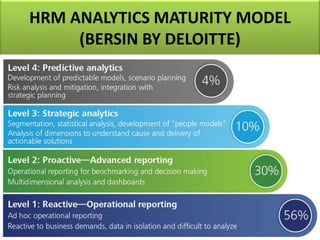
HRM ANALYTICS MATURITY MODEL
(BERSIN BY DELOITTE)
HRM ANALYTICS PROCESS
5-STEP HRM ANALYTICS PROCESS
• Step 1: Identify where HRM can make a strategic impact in
the organization
• Step 2: Develop appropriate metrics around these areas
• Step 3: Obtain data relating to relevant metrics
• Step 4: Draw out insight from the data
• Step 5: Project and take action to communicate metrics and
related insights information to provide a robust basis for
strategic change and improvement
THE 5 E’s OF HRM
ANALYTICS
• Exploration
• Examination
• Extraction
• Evaluation
• Extrapolation
STEP 1: IDENTIFYING WHERE HRM CAN MAKE A STRATEGIC
IMPACT (EXPLORATION)
• This process step focuses on determining the areas where
HRM can make a strategic impact within the organizational
context.
• It enables HRM management team to identify priority areas
for measurement which are aligned with organizational
goals and strategies.
• Identify capability opportunities or problem areas from a
business partner perspective.
• Sources for information collection, retrieval and analysis.
SOURCES FOR INFORMATION COLLECTION,
RETRIEVAL AND ANALYSIS
• Employee and management surveys and interviews (for
employee contentment, communications, rewards system)
• Performance appraisals (to measure productivity,
attendance)
• HRM records (to track communications, turnover, recruiting
efficiency, retention, promotions, and succession planning)
• Employee files (to research productivity, attendance, training)
STEP 1: EXPLORATION
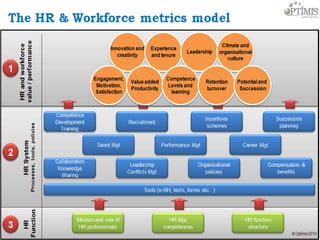
• A critical first step is to ensure that HRM is measuring the right things.
• The design and development of relevant HR metrics requires reflection
and discussion in order to determine what it takes for the organization to
succeed and to understand how HR can add value.
• Identify organizational burning issues
• Three issues underpin effective measurement (CIPD, 2011):
 Aligning measurement with goals
 Take a business partner perspective
 Adding value by focusing on building capability
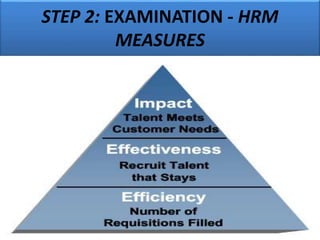
STEP 2: SELECTING APPROPRIATE METRICS FROM WHICH
ORGANIZATIONAL INSIGHTS CAN BE DRAWN
(EXAMINATION)
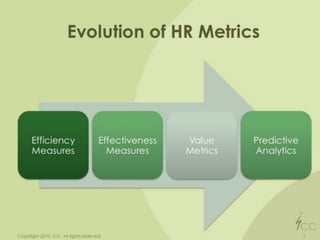
• HRM Measures:
Efficiency (10%)
Effectiveness (20%)
Impact (70%)
• Categories of HRM Metrics:
First Tier (most valued)
Second Tier (lesser valued)
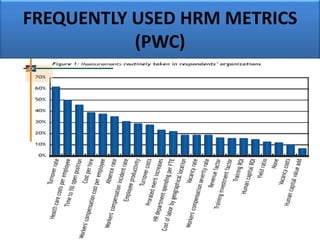
• Commonly used HRM Metrics
STEP 2: EXAMINATION - HRM
MEASURES
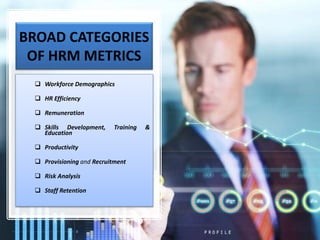
BROAD CATEGORIES
OF HRM METRICS
 Workforce Demographics
 HR Efficiency
 Remuneration
 Skills Development, Training &
Education
 Productivity
 Provisioning and Recruitment
 Risk Analysis
 Staff Retention
FREQUENTLY USED HRM METRICS
(PWC)
10
TYPICAL STATISTICS OBTAINED IN COMPILING HRM METRICS
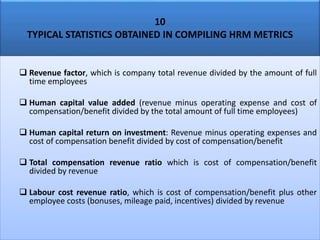
 Revenue factor, which is company total revenue divided by the amount of full
time employees
 Human capital value added (revenue minus operating expense and cost of
compensation/benefit divided by the total amount of full time employees)
 Human capital return on investment: Revenue minus operating expenses and
cost of compensation benefit divided by cost of compensation/benefit
 Total compensation revenue ratio which is cost of compensation/benefit
divided by revenue
 Labour cost revenue ratio, which is cost of compensation/benefit plus other
employee costs (bonuses, mileage paid, incentives) divided by revenue
10
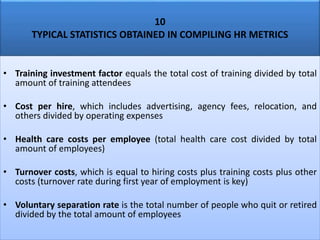
TYPICAL STATISTICS OBTAINED IN COMPILING HR METRICS
• Training investment factor equals the total cost of training divided by total
amount of training attendees
• Cost per hire, which includes advertising, agency fees, relocation, and
others divided by operating expenses
• Health care costs per employee (total health care cost divided by total
amount of employees)
• Turnover costs, which is equal to hiring costs plus training costs plus other
costs (turnover rate during first year of employment is key)
• Voluntary separation rate is the total number of people who quit or retired
divided by the total amount of employees
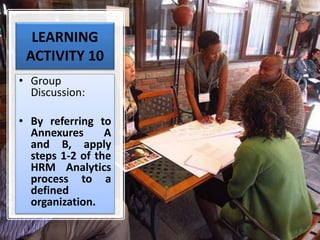
LEARNING
ACTIVITY 10
• Group
Discussion:
• By referring to
Annexures A
and B, apply
steps 1-2 of the
HRM Analytics
process to a
defined
organization.
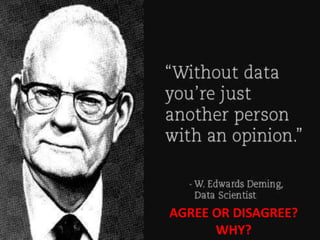
AGREE OR DISAGREE?
WHY?
STEP 3: OBTAIN DATA RELATING TO RELEVANT
METRICS (EXTRACTION)
• The top performing companies were using a variety of
drilled-down metrics, having the people to analyze them, and
communicating them effectively.
• This process step focuses on how HRM can most effectively
communicate the insights drawn from metrics to inform
action and hence enable HRM to deliver maximum strategic
impact.
• Effective decision-making, based on robust measures and
metrics, therefore, requires HR professionals to think
carefully about the relationships that need to be established
to enable appropriate information-sharing of these insights.
STEP 3: EXTRACTION – PROCESS STEPS
• #1: There is the initial “harvesting” or gathering of unstructured
data from the web.
• #2: The normalization stage—preparing harvested data for
analysis. Normally, a relational database such as MySQL is used,
but NoSQL can also be used.
• #3: The data is given additional structure with metadata, or
tagging. Analytics can then be presented through a dashboard.
• The process of collecting and updating the data from the myriad of
internet sources has to be automated. Advanced Programming
Interfaces (APIs) can enable different digital platforms to share
dynamic data and feed it into other applications, such as a
company’s own database.
STEP 3: EXTRACTION – CHALLENGES
CONFRONTED
• Struggling to use unstructured data
• Difficulty tying talent acquisition data to business results
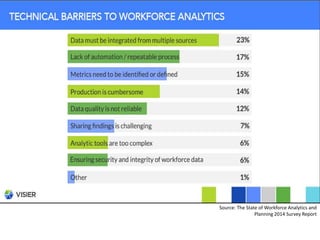
• Problems with storing, retrieving and integrating data
• There is rarely a systematic approach to integrating disparate systems. Legacy data systems
often don’t talk to each other. There are missing links between ATS and HRIS systems.
• The data exchange is often clumsy at best, requiring rekeying of data and manual
interventions.
• The successful transfer of data from multiple sources, such as an ATS, a recruiting site or a
social network with an HRIS System is the most problematic part.
• Failure to get the most of ATS
Source: The State of Workforce Analytics and
Planning 2014 Survey Report
Source: The State of Workforce Analytics and
Planning 2014 Survey Report
STEP 4: DRAWING OUT INSIGHTS
FROM DATA (EVALUATION)
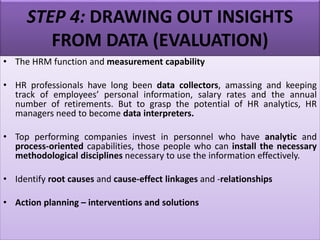
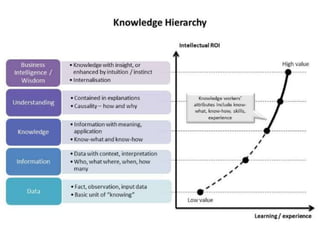
• The HRM function and measurement capability
• HR professionals have long been data collectors, amassing and keeping
track of employees’ personal information, salary rates and the annual
number of retirements. But to grasp the potential of HR analytics, HR
managers need to become data interpreters.
• Top performing companies invest in personnel who have analytic and
process-oriented capabilities, those people who can install the necessary
methodological disciplines necessary to use the information effectively.
• Identify root causes and cause-effect linkages and -relationships
• Action planning – interventions and solutions
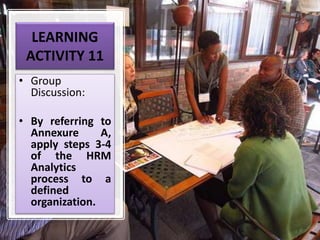
LEARNING
ACTIVITY 11
• Group
Discussion:
• By referring to
Annexure A,
apply steps 3-4
of the HRM
Analytics
process to a
defined
organization.
STEP 5: PROJECT AND TAKE ACTION TO COMMUNICATE METRICS AND RELATED
INSIGHTS INFORMATION TO PROVIDE A ROBUST BASIS FOR STRATEGIC CHANGE AND
IMPROVEMENT (EXTRAPOLATION)
• Projection of data – forecasting (PREDICTIVE ANALYTICS)
• To communicate HRM Analytics, tell a story (NARRATIVE)
• “Data is abundant, but if you don’t give it context, it’s just a
bunch of numbers.”
• Internal benchmarks (to compare their business units to others in
the organization)
• Support comes after results are delivered, not before. “It really
comes back to how credible you are. You get buy-in when you
show up repeatedly with accurate numbers and you can relate the
story to how the company’s performing.”
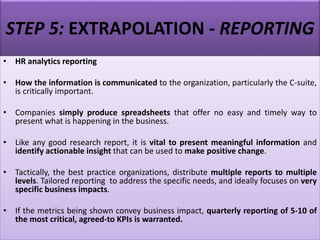
STEP 5: EXTRAPOLATION - REPORTING
• HR analytics reporting
• How the information is communicated to the organization, particularly the C-suite,
is critically important.
• Companies simply produce spreadsheets that offer no easy and timely way to
present what is happening in the business.
• Like any good research report, it is vital to present meaningful information and
identify actionable insight that can be used to make positive change.
• Tactically, the best practice organizations, distribute multiple reports to multiple
levels. Tailored reporting to address the specific needs, and ideally focuses on very
specific business impacts.
• If the metrics being shown convey business impact, quarterly reporting of 5-10 of
the most critical, agreed-to KPIs is warranted.
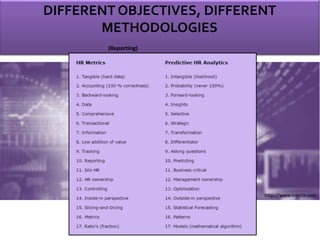
DIFFERENT OBJECTIVES, DIFFERENT
METHODOLOGIES
http://www.inostix.com
(Reporting)
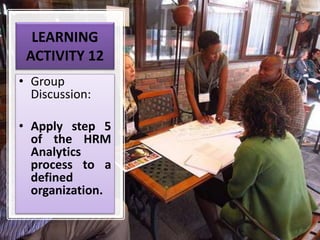
LEARNING
ACTIVITY 12
• Group
Discussion:
• Apply step 5
of the HRM
Analytics
process to a
defined
organization.
CONCLUSION
• Key points
• Summary
• Questions
• Training Administration
CONTACT DETAILS
• Charles Cotter
• (+27) 84 562 9446
• charlescot@polka.co.za
• LinkedIn
• Twitter: @Charles_Cotter
• http://www.slideshare.net/CharlesCotter

Strategic Workforce Planning_Succession Planning_HRBP_HRM Metrics

  • 1.
    STRATEGIC WORKFORCE PLANNING(SWP) AND HRM METRICS MASTERCLASS CHARLES COTTER Ph.D. candidate, MBA, B.A (Hons), B.A www.slideshare.net/CharlesCotter PEERMONT METCOURT SUITES BOARDROOM, EMPEROR’S PALACE 18-20 OCTOBER 2017
  • 2.
    • Defining thefundamental concepts • Diagnosis of current SWP practices – 10 Best Practice Criteria/guidelines • Current: HRM-based workforce planning architecture vs. Required: business-based SWP architecture • Applying the 6-step SWP process • Succession Planning – principles and process • Strategic HRM Business Partnering (SHRBP) - Best Practice Principles • Transforming to a SHRBP • HRM Metrics and Analytics - Best Practice Principles and Process 3-DAY, TRAINING PROGRAMME OVERVIEW
  • 3.
    • Individual activity: •Complete the statement by inserting one (1) word only. As a HR Manager, in order to effectively apply Workforce/HRM planning, I need to/to be .………………………………….. • Now find other learners with the same word as you. • Jot these words down on the flip-chart. • Each learner will have the opportunity to elaborate on their chosen word. INTRODUCTORY ACTIVITY
  • 4.
    THE KEY FUNCTIONSOF HRM VALUE CHAIN
  • 6.
  • 8.
  • 10.
  • 14.
    CLEAR VIEW –LINE OF SIGHT STRATEGIC WORKFORCE PLANNING • Inventory of available organizational core competencies? • Inventory of organizational scarce skills? • Mission critical organizational jobs (to enable strategy achievement)? • Critical employee segments (to promote business continuity/sustainability)? • Competitivity and readiness of organizational talent pipeline? • Identification of organizational talent gaps?
  • 15.
  • 16.
  • 17.
    • #1: Alignedwith the organization’s strategic business plans and priorities. • #2: Future-focused, adopting a strategic, medium to long-term forward- looking approach. • #3: Pro-active, sensitive and responsive to (internal and external) environmental change and trends. • #4: Provides accurate and reliable (clear view) talent planning/management information for the organization e.g. available core competencies; scarce skills; critical jobs and employee segments and talent gaps. • #5: Collaborative, well coordinated and partnering effort (HRM has co- opted business partners e.g. line managers to the process). DIAGNOSIS: 10 BEST PRACTICE GUIDELINES FOR EFFECTIVE SWP
  • 18.
    • #6: Integrated(bundled) with other HRM value chain processes e.g. Recruitment, Succession Planning, Retention and Leadership Development. • #7: Generates meaningful business intelligence for the organization which shapes, informs and influences business planning and supports strategic decision- making. • #8: Integrates both scientific (HRM metrics, predictive analytics and strategy maps) with artistic (planning) principles. • #9: Dynamic - regularly and systematically monitored, reviewed, evaluated and adapted (committed to continuous improvement processes). • #10: Yields a positive ROI, with tangible/demonstrable outcomes and impact for the organization i.e. creates sustainable HCM competitive advantages DIAGNOSIS: 10 BEST PRACTICE GUIDELINES FOR EFFECTIVE SWP
  • 19.
    LEARNING ACTIVITY 1 • IndividualActivity: • Diagnose your organization’s current Workforce Planning practices against the ten (10) best practice criteria. • Group Discussion: • Identify gaps and recommend improvement strategies.
  • 20.
    LEVELS OF SWPMATURITY
  • 22.
    LEARNING ACTIVITY 2 • GroupDiscussion: • By referring to the illustration of the strategic workforce planning process, evaluate the efficiency and effectiveness of each process step. • Identify areas of improvement (gaps) and recommend how HRM can enhance performance and value add.
  • 24.
    THE NATURE OFTHE BUSINESS ENVIRONMENT – V-U-C-A
  • 26.
    LEARNING ACTIVITY 3 • GroupDiscussion: • By utilizing a SWOT Analysis Matrix, perform an environmental scan/analysis of both the internal and external environments for your organization. • Internally, identify organizational strengths and weaknesses and externally identify opportunities and threats.
  • 27.
    FORECASTING HR DEMAND • Forecastingshould consider the past and the present requirements as well as future organizational direction/s  Number of employees  Type of employees  Skills requirements of these employees • Consider and assess the challenges and constraints • Preferred Scanning tools –”What If” and Scenario Planning
  • 29.
    • Assess thecurrent HR capacity of the organization by means of the Skill inventories/audits method  The knowledge, skills and abilities of your current staff need to be identified  Employee experience, education and special skills  Certificates or additional training should also be included • A forecast of the supply of employees projected to join the organization from outside sources • HRM indicators, metrics and indices e.g. turnover rates ANALYZING CURRENT SUPPLY
  • 30.
  • 31.
    LEARNING ACTIVITY 4 • GroupDiscussion: • Apply steps 2, 3 and 4 of the Workforce/HR Planning process in the context of your organization.  Step 2: Forecasting Human Resource Demand  Step 3: Analyzing Supply  Step 4: Reconciling
  • 33.
    • Develop andinitiate a Resourcing Strategy • Matching strategy (intervention) with scenario (surplus or deficit) • Action plan-based implementation methodology IMPLEMENTING - INTERVENTIONS
  • 34.
    • There arefive HR strategies for meeting your organization's needs in the future: Restructuring strategies Training and development strategies Recruitment strategies Outsourcing strategies Collaboration strategies HR ACTION PLANS
  • 35.
    HRM ACTION PLAN(INTERVENTION) TEMPLATE
  • 36.
    MONITOR, EVALUATE ANDADJUST THE HR ACTION PLAN
  • 37.
    LEARNING ACTIVITY 5 • GroupDiscussion: • Apply steps 5-6 of the Workforce/HR Planning process in the context of your organization.  Step 5: Developing SHRM Action Plan  Prioritize these HR Action Plans.  Step 6: Monitor, Evaluate and Adjust the HRM Action Plan
  • 39.
    • According toHR Future Magazine, "39% of employees are concerned about losing knowledge as their older colleagues retire, implying that succession planning should be top of the HRM agenda." SUCCESSION PLANNING STATISTIC
  • 40.
    • Succession planningis the identification and development of potential successors for key positions in an organization, through a systematic evaluation process and possible training or mentoring. • Succession planning and management involves an integrated, systematic approach to identify, develop and retain talent for key positions and areas in line with current and projected business objectives. • Succession Planning is "a means of identifying critical management positions, starting at the levels of project manager and supervisor and extending up to the highest position in the organization.”
  • 41.
    PURPOSE OF SUCCESSION PLANNING • Successionplanning is a forward-looking process, anticipating what skills will be needed in the future. • Thinking about the business strategy and determining what skills you will need when. • Succession planning ensures that high quality replacements for those individuals who currently hold positions that are key to the organization’s success. • These positions include executive, management, specialists, technical and professional positions and any critical positions motivated by a Line Manager.
  • 42.
    • Succession planningis about filling the organization's talent pipeline and building internal bench strength. • It is about leveraging the talent that the organization already possesses by developing it to full potential. • The focus is on developing employees so that the organization has a pool of qualified candidates who are ready to compete for key positions and areas when they become vacant. OBJECTIVES OF SUCCESSION PLANNING
  • 43.
    MENTORING AND COACHING •Mentorship is a personal development relationship in which a more experienced or more knowledgeable person helps to guide a less experienced or less knowledgeable person. • However, true mentoring is more than just answering occasional questions or providing ad hoc help. It is about an ongoing relationship of learning, dialogue and challenge. • Coaching, is a teaching, training or development process via which an individual is supported while achieving a specific personal or professional result or goal. • Coaching is an ongoing leadership, mentorship or guidance to assist an individual to increase the level of their skills.
  • 44.
    MODELS OF SUCCESSION PLANNING • Short-termplanning or emergency replacements • Long-term planning or managing talent • Combination of above plans
  • 45.
    • STRATEGY/BUSINESS PLAN •STRATEGIC FOCUS AREAS • SUCCESSION PLAN • HRM VALUE CHAIN PROCESSES • INTERNAL BENCH STRENGTH/TALENT PIPELINE • INFLUENCE OF ENVIRONMENTAL FORCES CONCEPTUAL MODEL/FRAMEWORK FOR SUCCESSION PLANNING
  • 47.
  • 48.
    • STEP 1:IDENTIFY CURRENT CRITICAL/KEY POSITIONS AND ANALYZE FUTURE REQUIREMENTS AND COMPETENCIES (BUSINESS STRATEGY) • STEP 2: IDENTIFICATION AND ASSESSMENT OF SUCCESSORS – POTENTIAL AND PERFORMANCE (9-BOX MATRIX) • STEP 3: IDENTIFY TALENT GAPS • STEP 4: DEVELOP SUCCESSION PLAN AND STRATEGIES • STEP 5: IMPLEMENT SUCCESSION PLAN AND DEVELOPMENTAL STRATEGIES • STEP 6: MONITOR AND TRACK PROGRESS • STEP 7: REVIEW AND EVALUATE THE IMPACT/EFFECTIVENESS OF SUCCESSION PLAN GENERIC SUCCESSION PLANNING PROCESS
  • 49.
    STEP 2: IDENTIFICATIONAND ASSESSMENT OF SUCCESSORS
  • 50.
    LEARNING ACTIVITY 6 • GroupDiscussion: • Critically evaluate a defined organization’s succession planning strategies. Identify gaps and recommend improvement strategies.
  • 52.
    DEFINING HR BUSINESSPARTNERING • Partnership: A relationship between individuals or groups characterized by mutual co-operation and responsibility, for the achievement of a specified shared goal. • HR business partners are HR professionals who work closely with an organization’s senior leaders in order to develop an HR agenda that closely supports the overall aims of the organization. The process of alignment is known as HR business partnering. • Strategic business partners: A long-term relationship (alliance) to achieve defined objectives common to all partners. • In the context of strategic human resource management, the HR function and activities are intended to ensure the organization's financial success and prosperity (business continuity).
  • 54.
    DIAGNOSIS: 10 BESTPRACTICE GUIDELINES FOR HRBP • #1 Embedding HRM strategy in business strategy and able to translate that strategy into deliverable actions • #2 Well-defined, implemented and reported HRM performance and ROI metrics (creating credibility and accountability) • #3 Generating business intelligence e.g. predictive and strategic analytics (that shapes, informs, guides and ultimately, influences strategic business decisions) • #4 Offering a professional, value-adding business proposition sensitive to and supportive of business needs, interests and strategic priorities • #5 Ongoing line management consultation, engagement, coaching and building trusting, collegial and mutually beneficial business relationships
  • 55.
    DIAGNOSIS: 10 BESTPRACTICE GUIDELINES FOR HRBP • #6 HR Management and practitioners possess business and industry knowledge, acumen and insight • #7 HRM collaborates with line management to broker meaningful and impactful business solutions • #8 HRM processes, systems and practices are horizontally integrated (bundled), agile, responsive and stream-lined (that enhance productivity and efficiency) • #9 HRM is a transformational initiator, driver and implementer of business change • #10 HRM is technology-savvy innovator, enabling and leveraging best practices (e.g. CoE; Shared Services and e-HRM)
  • 56.
    LEARNING ACTIVITY 7 • IndividualDiagnostic Activity:  Critically review and evaluate your current HRM processes and function against the ten (10) best practice criteria. • Group Discussion:  Identify gaps. Recommend improvement strategies.
  • 57.
  • 58.
    HRBP CRITICAL SUCCESSFACTORS • Strategic focus and thrust (on issues that contribute to business growth and competitiveness) • Adopting a “big picture” perspective (regarding the organization’s priorities and goals) • Having personal impact and credibility (to influence key decision-makers) • Adopting an Key Account Management, (internal) client-centric approach • Possessing a set of value-adding skills and knowledge (customers and business) • Being a diplomat and negotiator (in harmonizing the HRM agenda with business needs)
  • 59.
    EXPECTATIONS AND PRIORITIESOF BUSINESS EXECUTIVES • CEO’s expect the Human Resources function to play a much more active and participatory role in enabling business strategies. • Senior business leaders consider talent to be perhaps the critical factor in the push for sustainable growth and the need to manage new opportunities and risks in a more complex and interdependent world. • According to The Conference Board CEO Challenge (2013), Human Capital is rated 10% higher than operational excellence as a major challenge for businesses.
  • 60.
    WHAT BUSINESS EXECUTIVES ARE LOOKINGFOR IN HRBP? • Catalytic Driver of Change • Pro-active Business Thinker • Collaborative Consultant • Purpose-directed Coach • Delivery (results-oriented HR practices) • (Credible and Accountable) Performance Advisor • Strategic Facilitator
  • 62.
    ENABLERS OF TRANSFORMATION/RE- POSITIONING TOHRBP – “RIGHTING THE SHIP” “HR needs to follow the right process, applying the right skills, in the right manner/method, fulfilling the right roles, for the right reasons, to achieve the right results.” (Cotter, 2014)
  • 64.
    Step 1: StrategicReview and Analysis Step 2: Strategic Role Clarification and Contracting Step 3: Formulation and Development of Transformational Strategies Step 4: Implementation of Transformational Strategies Step 5: Measure and evaluate business impact and results
  • 65.
    STEP 1: STRATEGICREVIEW AND ANALYSIS • Objective: The focus of the analysis should be on understanding the needs of the business as a sustainable entity, its strategic direction and identifying initiatives that will help your business grow. • Review of current HRM and business strategies • Identification of resources and capabilities • Tools: Environmental scan (PESTEL) Gap Analysis S-W-O-T Analysis
  • 66.
    STEP 2: STRATEGICROLE CLARIFICATION AND CONTRACTING • Objective: The concluding of Service Delivery Agreements with line/operational and senior/executive management • Consultation, engagement and communication with operational management • Clarification of expectations, needs and value-adding roles of HRBP • Contracting agreements
  • 67.
    STEP 3: FORMULATIONAND DEVELOPMENT OF TRANSFORMATIONAL STRATEGIES • Objective: Development of HRBP transformation strategic plan • Formulation of goals and objectives • Development of alternative transformational strategies • Choice of most appropriate strategies Viability Feasibility Sustainability
  • 68.
    STEP 4: IMPLEMENTATIONOF TRANSFORMATIONAL STRATEGIES • Project-based, cross-functional team approach • Organizing, assigning and deploying resources • Leading and directing (the implementation process) • Monitoring and Controlling
  • 69.
    STEP 5: MEASUREAND EVALUATE BUSINESS IMPACT AND RESULTS • Measure and calculate the ROI • Amend and review strategies (remediation action) • Report back to business partners (to demonstrate transparency and accountability) • Aspire to continuous improvement processes
  • 71.
    LEARNING ACTIVITY 8 • Group Discussion: •Apply steps 1-5 of the action steps/plan of transforming HR to a strategic HR business partner.
  • 72.
  • 73.
    • What typeof HRM Metrics does your organization currently utilize? • Describe the organizational impact, level of maturity and credibility of these HRM Metrics • What does your organizational HRM Metrics architecture look like? • What is the current degree of HRM practitioner competency of HRM metrics/analytics? • Review the benefits of HR Metrics. Is there a business case for applying HR Metrics?
  • 74.
    HRM ANALYTICS TASKTEAM – 2017?
  • 75.
    • Metrics aresimply measurements. Metrics track activity, but don’t necessarily show a causal relationship. • HRM Metrics - Measurements used to determine the value and effectiveness of HR strategies. • Differentiation between People and HR Measures • Human capital analytics examine the effect of HRM metrics on organizational performance. In more general terms, analytics look for patterns of similarity between metrics. By using analytics over time, HRM can become predictive. • Measures - #1 HRM measure? DEFINING THE FUNDAMENTAL CONCEPTS
  • 76.
    ENGAGEMENT’S EFFECT ON9 KEY PERFORMANCE INDICATORS
  • 77.
    1. Select The Right People 2.Develop Employees’ Strengths 3. Enhance Employees’ Wellbeing
  • 79.
  • 80.
    10-POINT FOUNDATION AND“STARTER-PACK” FOR STRATEGIC HRM METRICS #1: Adopt a strategic mindset #2:Change management must run parallel to HRM Metrics in “business unusual” environment #3: Streamline and systematic HRM metrics process #4: HRM Metrics is not a “desktop” exercise #5: Adopt a measurement culture & build capacity & skills for digital literacy
  • 81.
    10-POINT FOUNDATION AND“STARTER-PACK” FOR STRATEGIC HRM METRICS #6: Re-inject scientific principles, processes and tools & credibility into HRM Metrics e.g. 3 E’s #7: Drill down & segment HRM metrics #8: Apply the 4 C’s to HRM Metrics Reporting #9: Don’t adopt a “Big Bang” approach – start small, think big and scale up #10: Automation - utilize a 4-G digital data analysis solution
  • 82.
    THE FUTURE OFHRM METRICS & ANALYTICS? “HRM will have to migrate from the fundamentals of people science to the complexities of data science.”
  • 83.
    LEARNING ACTIVITY 9 • Individualactivity: • Please rate your organization’s current degree of compliance on a 10-point scale (with range of 1 = absolutely non- compliant and 10 = 100% compliant) • Group Discussion: • Identify gaps and recommend improvement strategies.
  • 84.
    HRM ANALYTICS MATURITYMODEL (BERSIN BY DELOITTE)
  • 85.
  • 86.
    5-STEP HRM ANALYTICSPROCESS • Step 1: Identify where HRM can make a strategic impact in the organization • Step 2: Develop appropriate metrics around these areas • Step 3: Obtain data relating to relevant metrics • Step 4: Draw out insight from the data • Step 5: Project and take action to communicate metrics and related insights information to provide a robust basis for strategic change and improvement
  • 87.
    THE 5 E’sOF HRM ANALYTICS • Exploration • Examination • Extraction • Evaluation • Extrapolation
  • 88.
    STEP 1: IDENTIFYINGWHERE HRM CAN MAKE A STRATEGIC IMPACT (EXPLORATION) • This process step focuses on determining the areas where HRM can make a strategic impact within the organizational context. • It enables HRM management team to identify priority areas for measurement which are aligned with organizational goals and strategies. • Identify capability opportunities or problem areas from a business partner perspective. • Sources for information collection, retrieval and analysis.
  • 89.
    SOURCES FOR INFORMATIONCOLLECTION, RETRIEVAL AND ANALYSIS • Employee and management surveys and interviews (for employee contentment, communications, rewards system) • Performance appraisals (to measure productivity, attendance) • HRM records (to track communications, turnover, recruiting efficiency, retention, promotions, and succession planning) • Employee files (to research productivity, attendance, training)
  • 90.
    STEP 1: EXPLORATION •A critical first step is to ensure that HRM is measuring the right things. • The design and development of relevant HR metrics requires reflection and discussion in order to determine what it takes for the organization to succeed and to understand how HR can add value. • Identify organizational burning issues • Three issues underpin effective measurement (CIPD, 2011):  Aligning measurement with goals  Take a business partner perspective  Adding value by focusing on building capability
  • 92.
    STEP 2: SELECTINGAPPROPRIATE METRICS FROM WHICH ORGANIZATIONAL INSIGHTS CAN BE DRAWN (EXAMINATION) • HRM Measures: Efficiency (10%) Effectiveness (20%) Impact (70%) • Categories of HRM Metrics: First Tier (most valued) Second Tier (lesser valued) • Commonly used HRM Metrics
  • 93.
    STEP 2: EXAMINATION- HRM MEASURES
  • 94.
    BROAD CATEGORIES OF HRMMETRICS  Workforce Demographics  HR Efficiency  Remuneration  Skills Development, Training & Education  Productivity  Provisioning and Recruitment  Risk Analysis  Staff Retention
  • 95.
    FREQUENTLY USED HRMMETRICS (PWC)
  • 96.
    10 TYPICAL STATISTICS OBTAINEDIN COMPILING HRM METRICS  Revenue factor, which is company total revenue divided by the amount of full time employees  Human capital value added (revenue minus operating expense and cost of compensation/benefit divided by the total amount of full time employees)  Human capital return on investment: Revenue minus operating expenses and cost of compensation benefit divided by cost of compensation/benefit  Total compensation revenue ratio which is cost of compensation/benefit divided by revenue  Labour cost revenue ratio, which is cost of compensation/benefit plus other employee costs (bonuses, mileage paid, incentives) divided by revenue
  • 97.
    10 TYPICAL STATISTICS OBTAINEDIN COMPILING HR METRICS • Training investment factor equals the total cost of training divided by total amount of training attendees • Cost per hire, which includes advertising, agency fees, relocation, and others divided by operating expenses • Health care costs per employee (total health care cost divided by total amount of employees) • Turnover costs, which is equal to hiring costs plus training costs plus other costs (turnover rate during first year of employment is key) • Voluntary separation rate is the total number of people who quit or retired divided by the total amount of employees
  • 98.
    LEARNING ACTIVITY 10 • Group Discussion: •By referring to Annexures A and B, apply steps 1-2 of the HRM Analytics process to a defined organization.
  • 99.
  • 100.
    STEP 3: OBTAINDATA RELATING TO RELEVANT METRICS (EXTRACTION) • The top performing companies were using a variety of drilled-down metrics, having the people to analyze them, and communicating them effectively. • This process step focuses on how HRM can most effectively communicate the insights drawn from metrics to inform action and hence enable HRM to deliver maximum strategic impact. • Effective decision-making, based on robust measures and metrics, therefore, requires HR professionals to think carefully about the relationships that need to be established to enable appropriate information-sharing of these insights.
  • 101.
    STEP 3: EXTRACTION– PROCESS STEPS • #1: There is the initial “harvesting” or gathering of unstructured data from the web. • #2: The normalization stage—preparing harvested data for analysis. Normally, a relational database such as MySQL is used, but NoSQL can also be used. • #3: The data is given additional structure with metadata, or tagging. Analytics can then be presented through a dashboard. • The process of collecting and updating the data from the myriad of internet sources has to be automated. Advanced Programming Interfaces (APIs) can enable different digital platforms to share dynamic data and feed it into other applications, such as a company’s own database.
  • 102.
    STEP 3: EXTRACTION– CHALLENGES CONFRONTED • Struggling to use unstructured data • Difficulty tying talent acquisition data to business results • Problems with storing, retrieving and integrating data • There is rarely a systematic approach to integrating disparate systems. Legacy data systems often don’t talk to each other. There are missing links between ATS and HRIS systems. • The data exchange is often clumsy at best, requiring rekeying of data and manual interventions. • The successful transfer of data from multiple sources, such as an ATS, a recruiting site or a social network with an HRIS System is the most problematic part. • Failure to get the most of ATS
  • 103.
    Source: The Stateof Workforce Analytics and Planning 2014 Survey Report
  • 104.
    Source: The Stateof Workforce Analytics and Planning 2014 Survey Report
  • 105.
    STEP 4: DRAWINGOUT INSIGHTS FROM DATA (EVALUATION) • The HRM function and measurement capability • HR professionals have long been data collectors, amassing and keeping track of employees’ personal information, salary rates and the annual number of retirements. But to grasp the potential of HR analytics, HR managers need to become data interpreters. • Top performing companies invest in personnel who have analytic and process-oriented capabilities, those people who can install the necessary methodological disciplines necessary to use the information effectively. • Identify root causes and cause-effect linkages and -relationships • Action planning – interventions and solutions
  • 107.
    LEARNING ACTIVITY 11 • Group Discussion: •By referring to Annexure A, apply steps 3-4 of the HRM Analytics process to a defined organization.
  • 108.
    STEP 5: PROJECTAND TAKE ACTION TO COMMUNICATE METRICS AND RELATED INSIGHTS INFORMATION TO PROVIDE A ROBUST BASIS FOR STRATEGIC CHANGE AND IMPROVEMENT (EXTRAPOLATION) • Projection of data – forecasting (PREDICTIVE ANALYTICS) • To communicate HRM Analytics, tell a story (NARRATIVE) • “Data is abundant, but if you don’t give it context, it’s just a bunch of numbers.” • Internal benchmarks (to compare their business units to others in the organization) • Support comes after results are delivered, not before. “It really comes back to how credible you are. You get buy-in when you show up repeatedly with accurate numbers and you can relate the story to how the company’s performing.”
  • 109.
    STEP 5: EXTRAPOLATION- REPORTING • HR analytics reporting • How the information is communicated to the organization, particularly the C-suite, is critically important. • Companies simply produce spreadsheets that offer no easy and timely way to present what is happening in the business. • Like any good research report, it is vital to present meaningful information and identify actionable insight that can be used to make positive change. • Tactically, the best practice organizations, distribute multiple reports to multiple levels. Tailored reporting to address the specific needs, and ideally focuses on very specific business impacts. • If the metrics being shown convey business impact, quarterly reporting of 5-10 of the most critical, agreed-to KPIs is warranted.
  • 110.
  • 111.
    LEARNING ACTIVITY 12 • Group Discussion: •Apply step 5 of the HRM Analytics process to a defined organization.
  • 112.
    CONCLUSION • Key points •Summary • Questions • Training Administration
  • 113.
    CONTACT DETAILS • CharlesCotter • (+27) 84 562 9446 • charlescot@polka.co.za • LinkedIn • Twitter: @Charles_Cotter • http://www.slideshare.net/CharlesCotter