STRATEGIC WORKFORCE PLANNING
.
Strategic Workforce Planning
• First component of HRM strategy
• All other functional HR activities are derived from
& flow out of HRP process
• Basis in considerations of future HR requirements
in light of present HR capabilities & capacities
• Proactive in anticipating & preparing flexible
responses to changing HR requirements
• Both internal & external focus
Strategic Workforce Planning
• Goes beyond simple hiring & firing
• Involves planning for deployment of human
capital in line with organization &/or business unit
strategy
• May involve:
– Reassignment
– Training & development
– Outsourcing
– Using temporary help or outside contractors
• Needs as much flexibility as possible
Key Objectives
• Prevent overstaffing & understaffing
• Ensure organization has right employees
with right skills in right places at right times
• Ensure organization is responsive to
changes in environment
• Provide direction & coherence to all HR
activities & systems
• Unite perspectives of line & staff managers
Types of Planning
• Aggregate Planning
– Anticipating needs for groups of employees in
specific, usually lower level jobs & general skills
employees will need to ensure sustained high
performance
• Succession Planning
– Focuses on ensuring key critical management
positions in organization remain filled with
individuals who provide best fit
Aggregate Planning
• Forecasting demand
– Considers firm’s strategic plan’s effects on increases or
decreases in demand for products or services
– Assumptions on which forecast is predicated should be
written down & revisited when conditions change
– Unit forecasting (bottom-up planning) involves “point of
contact” estimation of future demand for employees
– Top-down forecasting involves senior managers allocating a
fixed payroll budget across organizational hierarchy
– Demand for employee skills requirements must also be
considered
Aggregate Planning
• Forecasting supply
– The level and quantities of abilities, skills &
experiences can be determined using Skills
Inventory.
– Annually updated human resource information
system (HRIS) is dynamic source of HR information
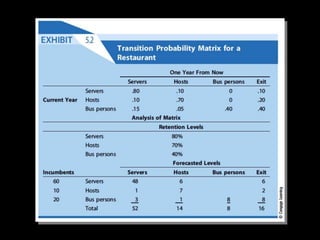
– Markov analysis can be used to create transition
probability matrix that predicts mobility of
employees within organization
Strategies for Managing Shortages
• Recruit new
permanent employees
• Offer incentives to
postpone retirement
• Rehire retirees part-
time
• Attempt to reduce
turnover
• Work current staff
overtime
• Subcontract work out
• Hire temporary
employees
• Redesign job
processes so fewer
employees are needed
Strategies for Managing Surpluses
• Hiring freezes
• Do not replace those
who leave
• Offer early retirement
incentives
• Reduce work hours
• Voluntary severance
leaves of absence
• Across-the-board pay
cuts
• Layoffs
• Reduce outsourced
work
• Employee training
• Switch to variable pay
plan
• Expand operations
Succession Planning
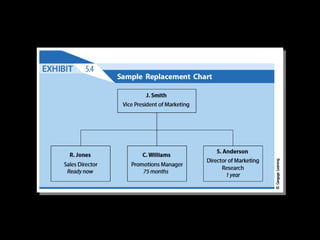
• Involves identifying key management positions
the organization cannot afford to have vacant
• Purposes of succession planning
– Facilitates transition when employee leaves
– Identifies development needs of high-potential employees &
assists in career planning
• Many organizations fail to implement succession
planning effectively
– Qualified successors may seek external career
advancement opportunities if succession is not forthcoming
Guidelines for Effective Succession Planning
• Tie into organization’s strategy (and modified accordingly)
• Monitor the progress and measure outcomes of succession
planning initiatives
• Ensure that all HR functions that impact the succession
plan are iterated and working in tandem
• Ensure centralized coordination of succession planning
• Engage and involve managers throughout the organization
Reading 5.1
Designing Succession Planning: Lessons from the Industry
Leaders
Typically organization have utilized one of three approaches
to managing diversity
• an assimilation view that downplays differences;
• an access view that focuses on building diversity in order
to gain access to ethnic consumer groups;
• an integrated view that emphasizes uniform performance
standards, personal
• development, openness, acceptance of constructive
conflict, empowerment, egalitarianism, and a
nonbureaucratic structure that encourages challenges to the
status quo
Reading 5.1
Designing Succession Planning: Lessons from the Industry
Leaders
• An integrated approach combined with a culture of inclusiveness are
needed to ensure diverse succession planning.
• Commitment from and direct involvement by the CEO and senior
leadership team are mandatory for diverse succession planning
• Employees should be encouraged to look upward in the organizational
hierarchy to indentify people who are like themselves
• Specific programs which target women and minorities are needed to
bring about change in the status quo as they may not see people like
themselves in positions higher than the one they hold
Reading 5.1
Designing Succession Planning: Lessons from the Industry
Leaders
• Cross-race mentoring requires that mentors have
skills related to understanding diversity
• Cross-gender relationships need to be carefully
managed to prevent any perceptions of
impropriety
• Organization’s such as Denny’s have made
thresholds of representation of minorities and
women in management a key component of
executives’ annual bonuses
Reading 5.2
The Annual HR Strategic Planning Process: Design and Facilitation
Lessons from Corning Incorporated Human Resources
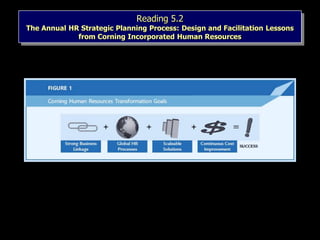
As part of the planning process, four transformation
goals were developed which guide the
organization’s growth (see Figure 1)
Reading 5.2
The Annual HR Strategic Planning Process: Design and Facilitation Lessons
from Corning Incorporated Human Resources
Reading 5.2
The Annual HR Strategic Planning Process: Design and Facilitation Lessons
from Corning Incorporated Human Resources
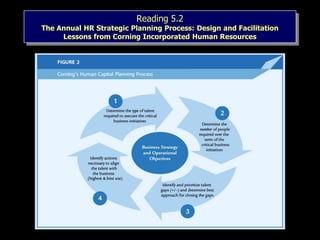
These goals resulted in a four-step process which gave
business unit generalists comment tools land
language for translating strategies into action steps
for talent development and allow consistency and
comparison for prioritization across business lines
(see Figure 2)
Reading 5.2
The Annual HR Strategic Planning Process: Design and Facilitation
Lessons from Corning Incorporated Human Resources
Reading 5.2
The Annual HR Strategic Planning Process: Design and Facilitation
Lessons from Corning Incorporated Human Resources
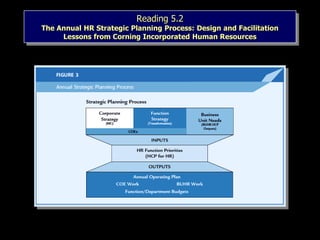
Corning’s annual strategic planning process for HR brings
together several key components including:
• corporate strategy and the implications of that strategy for
HR
• HR function strategy including the strategic direction for
each of the COEs
• the outputs of the Human Capital Planning process for
each of the business units, which is essentially the HR
implications of each of their business strategies
(see figure 3)
Reading 5.2
The Annual HR Strategic Planning Process: Design and Facilitation
Lessons from Corning Incorporated Human Resources

503556171-Jeffrey-a-Mello-4e-Chapter-5-Strategic-Workforce-Planning.ppt

  • 1.
  • 2.
    Strategic Workforce Planning •First component of HRM strategy • All other functional HR activities are derived from & flow out of HRP process • Basis in considerations of future HR requirements in light of present HR capabilities & capacities • Proactive in anticipating & preparing flexible responses to changing HR requirements • Both internal & external focus
  • 3.
    Strategic Workforce Planning •Goes beyond simple hiring & firing • Involves planning for deployment of human capital in line with organization &/or business unit strategy • May involve: – Reassignment – Training & development – Outsourcing – Using temporary help or outside contractors • Needs as much flexibility as possible
  • 4.
    Key Objectives • Preventoverstaffing & understaffing • Ensure organization has right employees with right skills in right places at right times • Ensure organization is responsive to changes in environment • Provide direction & coherence to all HR activities & systems • Unite perspectives of line & staff managers
  • 5.
    Types of Planning •Aggregate Planning – Anticipating needs for groups of employees in specific, usually lower level jobs & general skills employees will need to ensure sustained high performance • Succession Planning – Focuses on ensuring key critical management positions in organization remain filled with individuals who provide best fit
  • 6.
    Aggregate Planning • Forecastingdemand – Considers firm’s strategic plan’s effects on increases or decreases in demand for products or services – Assumptions on which forecast is predicated should be written down & revisited when conditions change – Unit forecasting (bottom-up planning) involves “point of contact” estimation of future demand for employees – Top-down forecasting involves senior managers allocating a fixed payroll budget across organizational hierarchy – Demand for employee skills requirements must also be considered
  • 7.
    Aggregate Planning • Forecastingsupply – The level and quantities of abilities, skills & experiences can be determined using Skills Inventory. – Annually updated human resource information system (HRIS) is dynamic source of HR information – Markov analysis can be used to create transition probability matrix that predicts mobility of employees within organization
  • 9.
    Strategies for ManagingShortages • Recruit new permanent employees • Offer incentives to postpone retirement • Rehire retirees part- time • Attempt to reduce turnover • Work current staff overtime • Subcontract work out • Hire temporary employees • Redesign job processes so fewer employees are needed
  • 10.
    Strategies for ManagingSurpluses • Hiring freezes • Do not replace those who leave • Offer early retirement incentives • Reduce work hours • Voluntary severance leaves of absence • Across-the-board pay cuts • Layoffs • Reduce outsourced work • Employee training • Switch to variable pay plan • Expand operations
  • 11.
    Succession Planning • Involvesidentifying key management positions the organization cannot afford to have vacant • Purposes of succession planning – Facilitates transition when employee leaves – Identifies development needs of high-potential employees & assists in career planning • Many organizations fail to implement succession planning effectively – Qualified successors may seek external career advancement opportunities if succession is not forthcoming
  • 13.
    Guidelines for EffectiveSuccession Planning • Tie into organization’s strategy (and modified accordingly) • Monitor the progress and measure outcomes of succession planning initiatives • Ensure that all HR functions that impact the succession plan are iterated and working in tandem • Ensure centralized coordination of succession planning • Engage and involve managers throughout the organization
  • 15.
    Reading 5.1 Designing SuccessionPlanning: Lessons from the Industry Leaders Typically organization have utilized one of three approaches to managing diversity • an assimilation view that downplays differences; • an access view that focuses on building diversity in order to gain access to ethnic consumer groups; • an integrated view that emphasizes uniform performance standards, personal • development, openness, acceptance of constructive conflict, empowerment, egalitarianism, and a nonbureaucratic structure that encourages challenges to the status quo
  • 16.
    Reading 5.1 Designing SuccessionPlanning: Lessons from the Industry Leaders • An integrated approach combined with a culture of inclusiveness are needed to ensure diverse succession planning. • Commitment from and direct involvement by the CEO and senior leadership team are mandatory for diverse succession planning • Employees should be encouraged to look upward in the organizational hierarchy to indentify people who are like themselves • Specific programs which target women and minorities are needed to bring about change in the status quo as they may not see people like themselves in positions higher than the one they hold
  • 17.
    Reading 5.1 Designing SuccessionPlanning: Lessons from the Industry Leaders • Cross-race mentoring requires that mentors have skills related to understanding diversity • Cross-gender relationships need to be carefully managed to prevent any perceptions of impropriety • Organization’s such as Denny’s have made thresholds of representation of minorities and women in management a key component of executives’ annual bonuses
  • 18.
    Reading 5.2 The AnnualHR Strategic Planning Process: Design and Facilitation Lessons from Corning Incorporated Human Resources As part of the planning process, four transformation goals were developed which guide the organization’s growth (see Figure 1)
  • 19.
    Reading 5.2 The AnnualHR Strategic Planning Process: Design and Facilitation Lessons from Corning Incorporated Human Resources
  • 20.
    Reading 5.2 The AnnualHR Strategic Planning Process: Design and Facilitation Lessons from Corning Incorporated Human Resources These goals resulted in a four-step process which gave business unit generalists comment tools land language for translating strategies into action steps for talent development and allow consistency and comparison for prioritization across business lines (see Figure 2)
  • 21.
    Reading 5.2 The AnnualHR Strategic Planning Process: Design and Facilitation Lessons from Corning Incorporated Human Resources
  • 22.
    Reading 5.2 The AnnualHR Strategic Planning Process: Design and Facilitation Lessons from Corning Incorporated Human Resources Corning’s annual strategic planning process for HR brings together several key components including: • corporate strategy and the implications of that strategy for HR • HR function strategy including the strategic direction for each of the COEs • the outputs of the Human Capital Planning process for each of the business units, which is essentially the HR implications of each of their business strategies (see figure 3)
  • 23.
    Reading 5.2 The AnnualHR Strategic Planning Process: Design and Facilitation Lessons from Corning Incorporated Human Resources