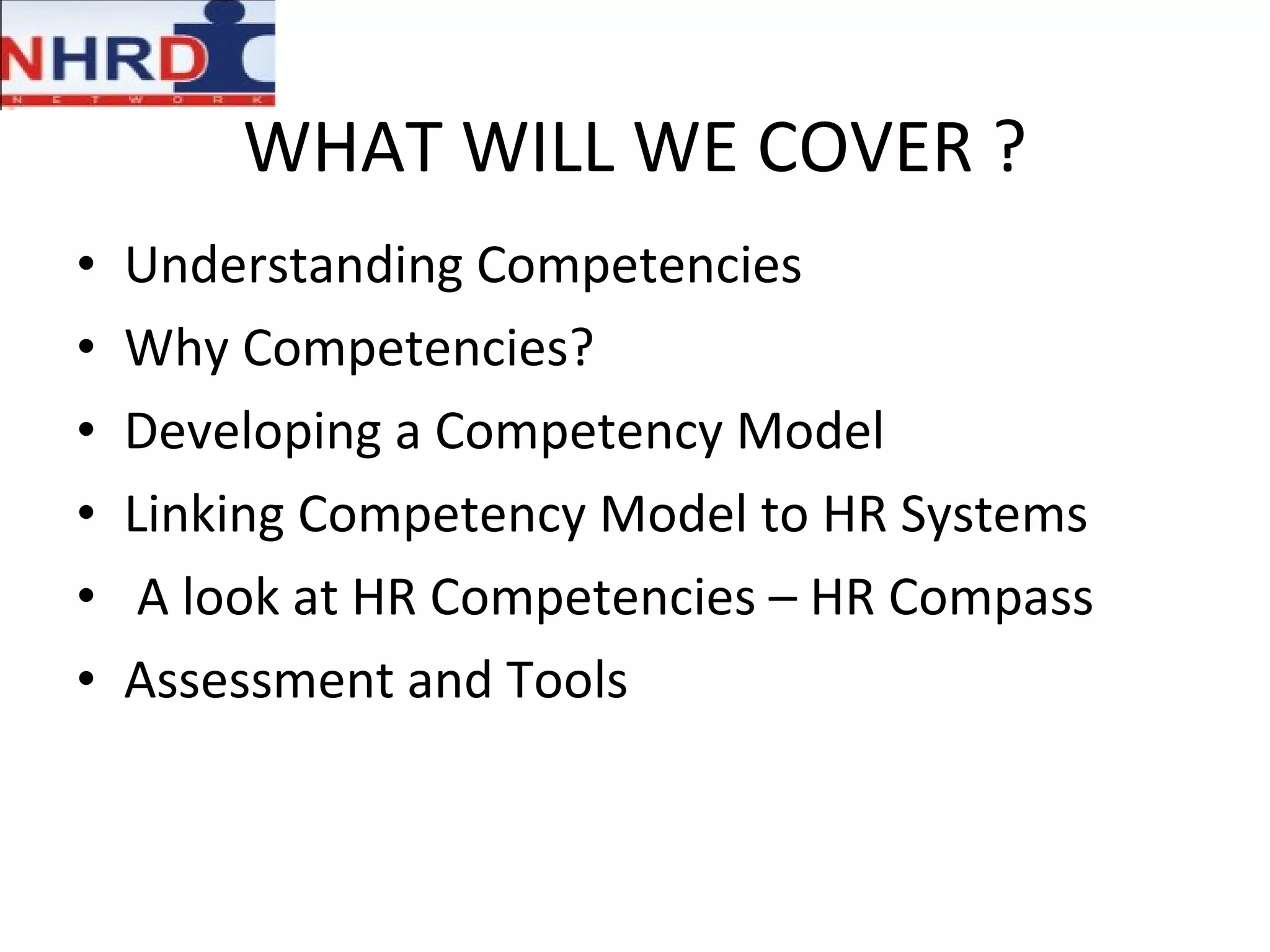
Competencies : Concept and Framework
WHAT WILL WE COVER ? Understanding Competencies Why Competencies? Developing a Competency Model Linking Competency Model to HR Systems A look at HR Competencies – HR Compass Assessment and Tools
Understanding Competencies
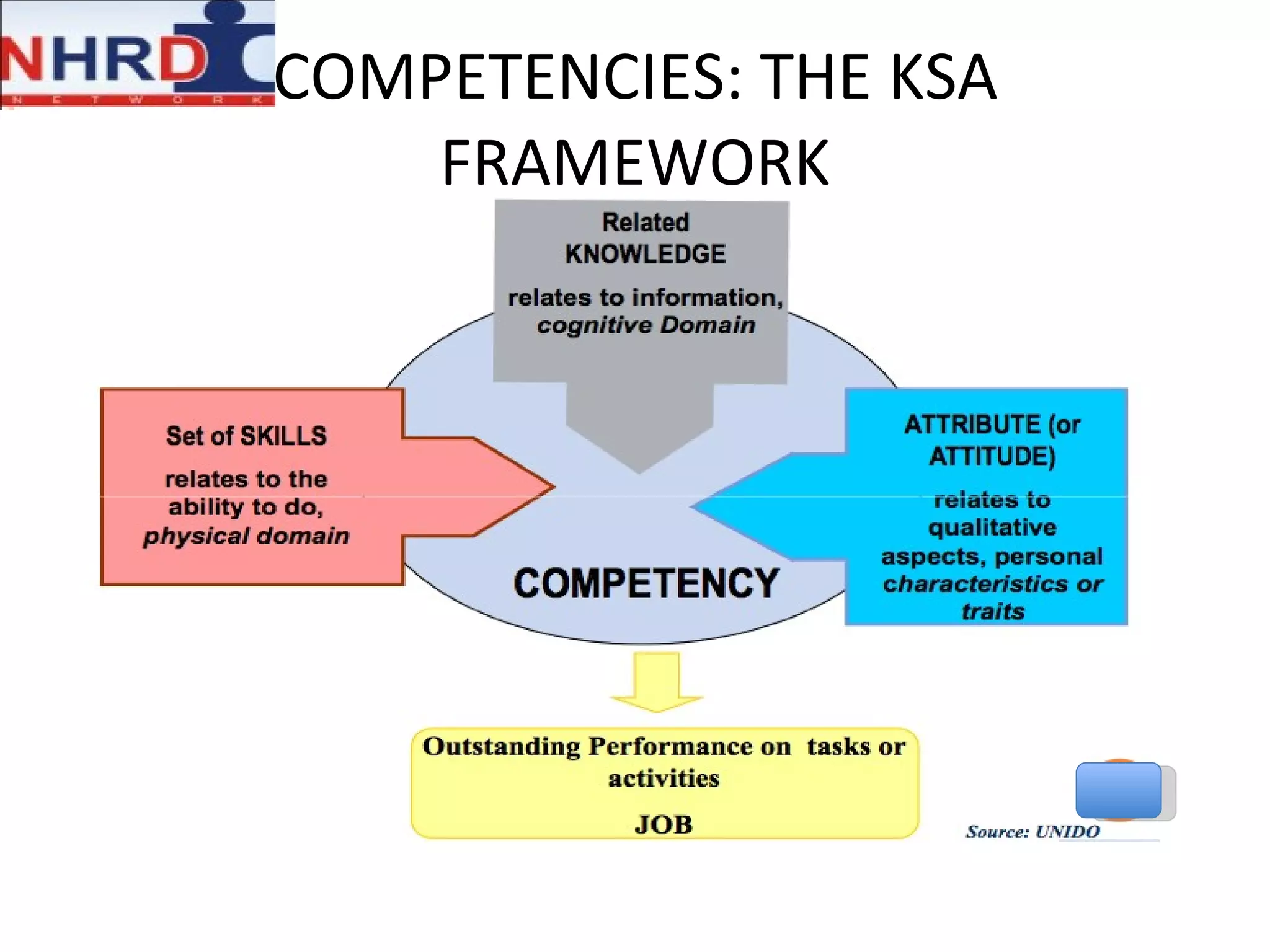
SOME DEFINITIONS OF COMPETENCIES Competency is an underlying characteristic of an employee (i.e., a motive, trait, skill, aspects of one’s self-image, social role, or a body of knowledge) which results in effective and/or superior performance. (Prof. Boyatzis, 1982) A Competency is a set of skills, related knowledge and attributes that allow an individual to successfully perform a task or an activity within a specific function or job. (UNIDO, 2002) Competencies are coachable, observable, measurable, and critical to successful individual or corporation performance.
COMPETENCIES: THE KSA FRAMEWORK
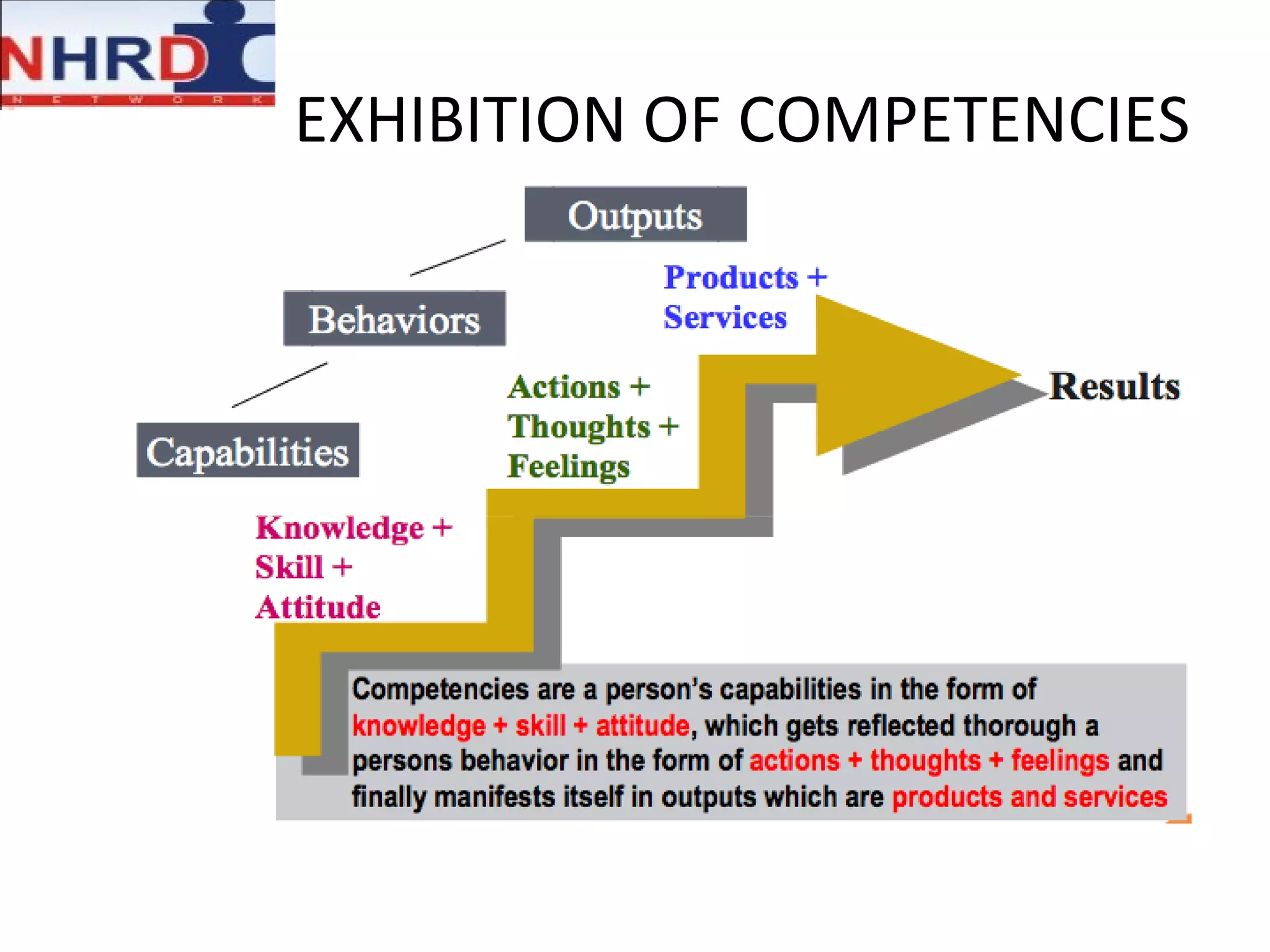
EXHIBITION OF COMPETENCIES
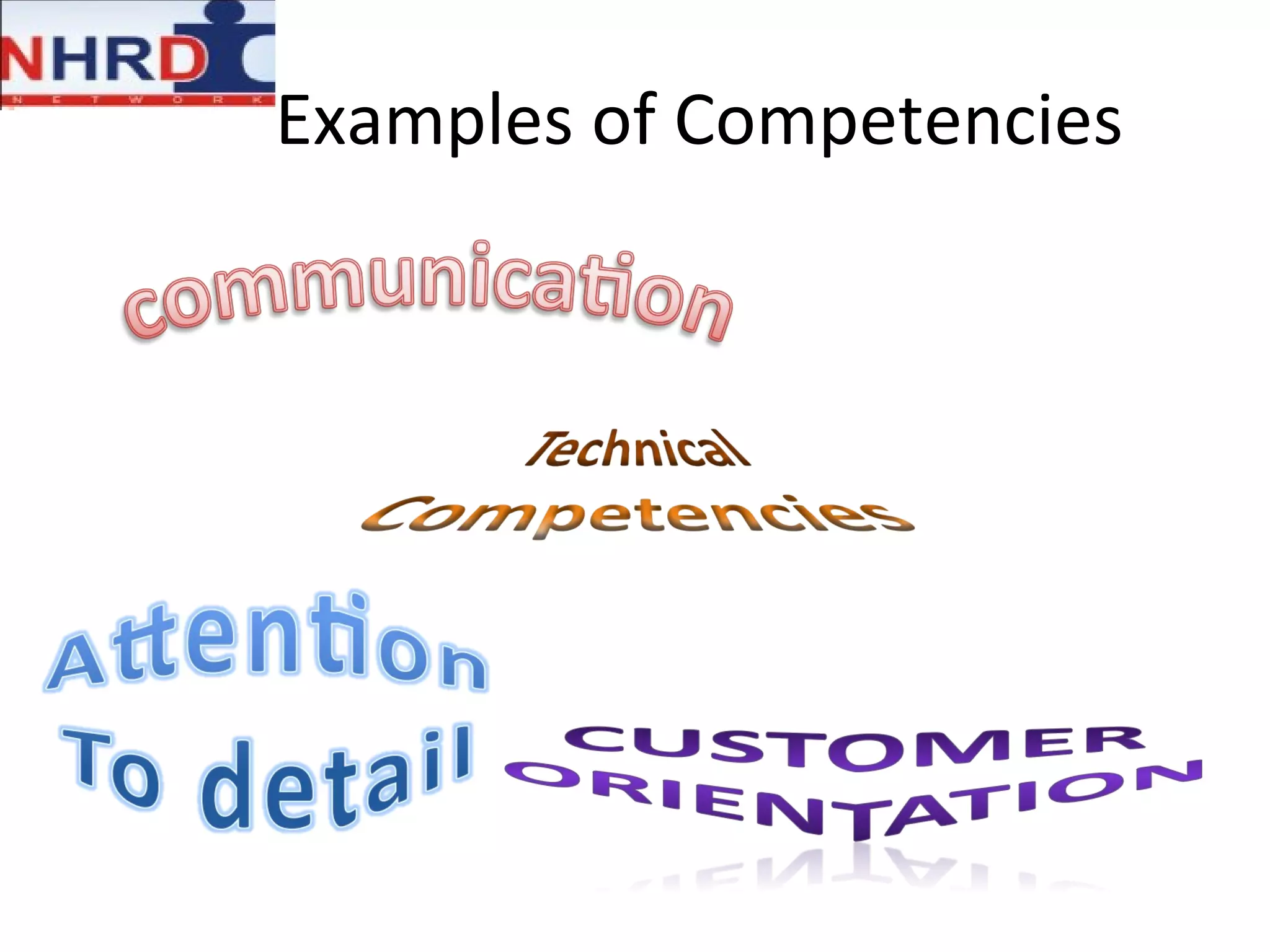
Examples of Competencies
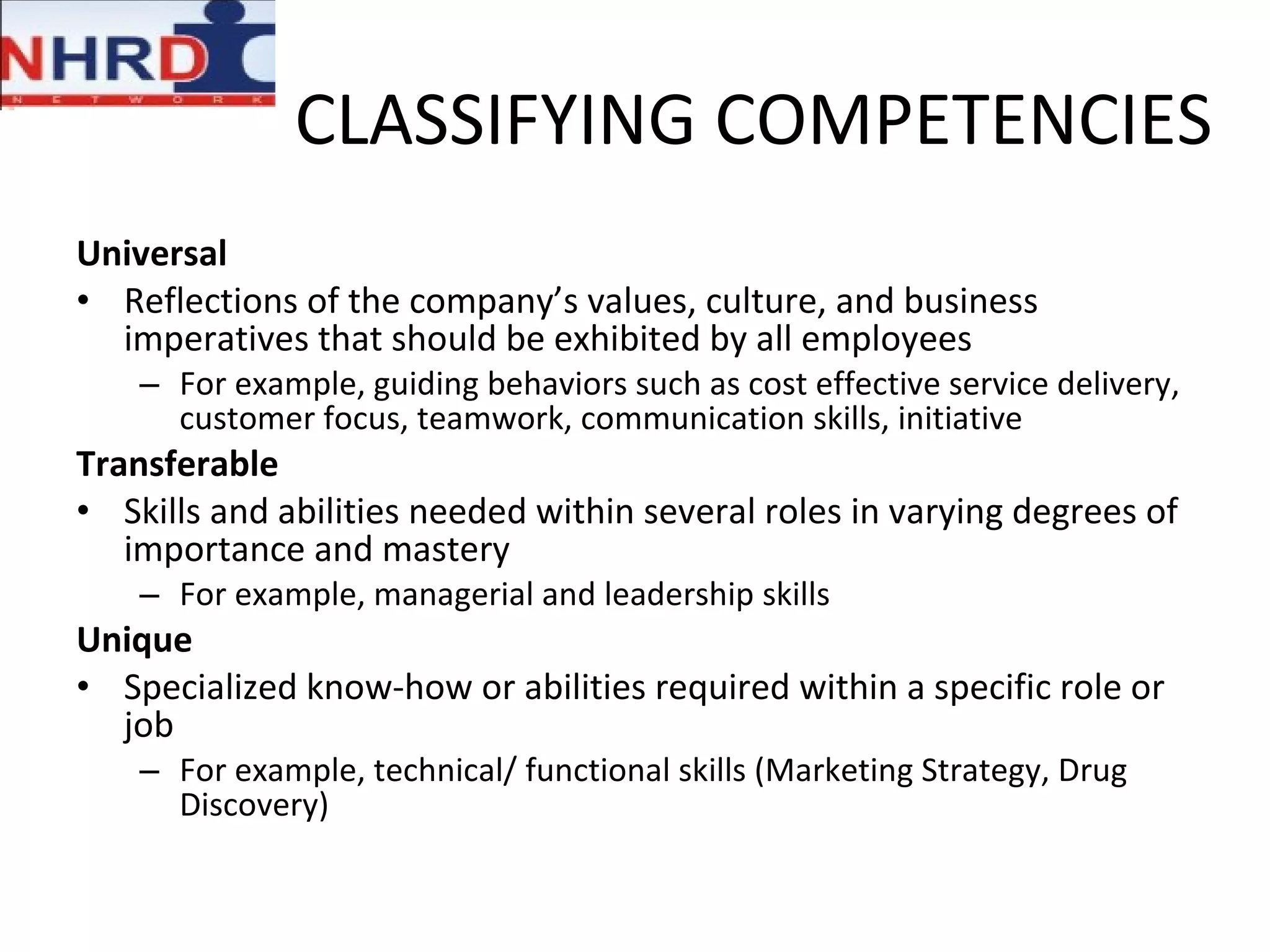
CLASSIFYING COMPETENCIES Universal  Reflections of the company’s values, culture, and business imperatives that should be exhibited by all employees  For example, guiding behaviors such as cost effective service delivery, customer focus, teamwork, communication skills, initiative Transferable  Skills and abilities needed within several roles in varying degrees of importance and mastery  For example, managerial and leadership skills Unique  Specialized know-how or abilities required within a specific role or job  For example, technical/ functional skills (Marketing Strategy, Drug Discovery)
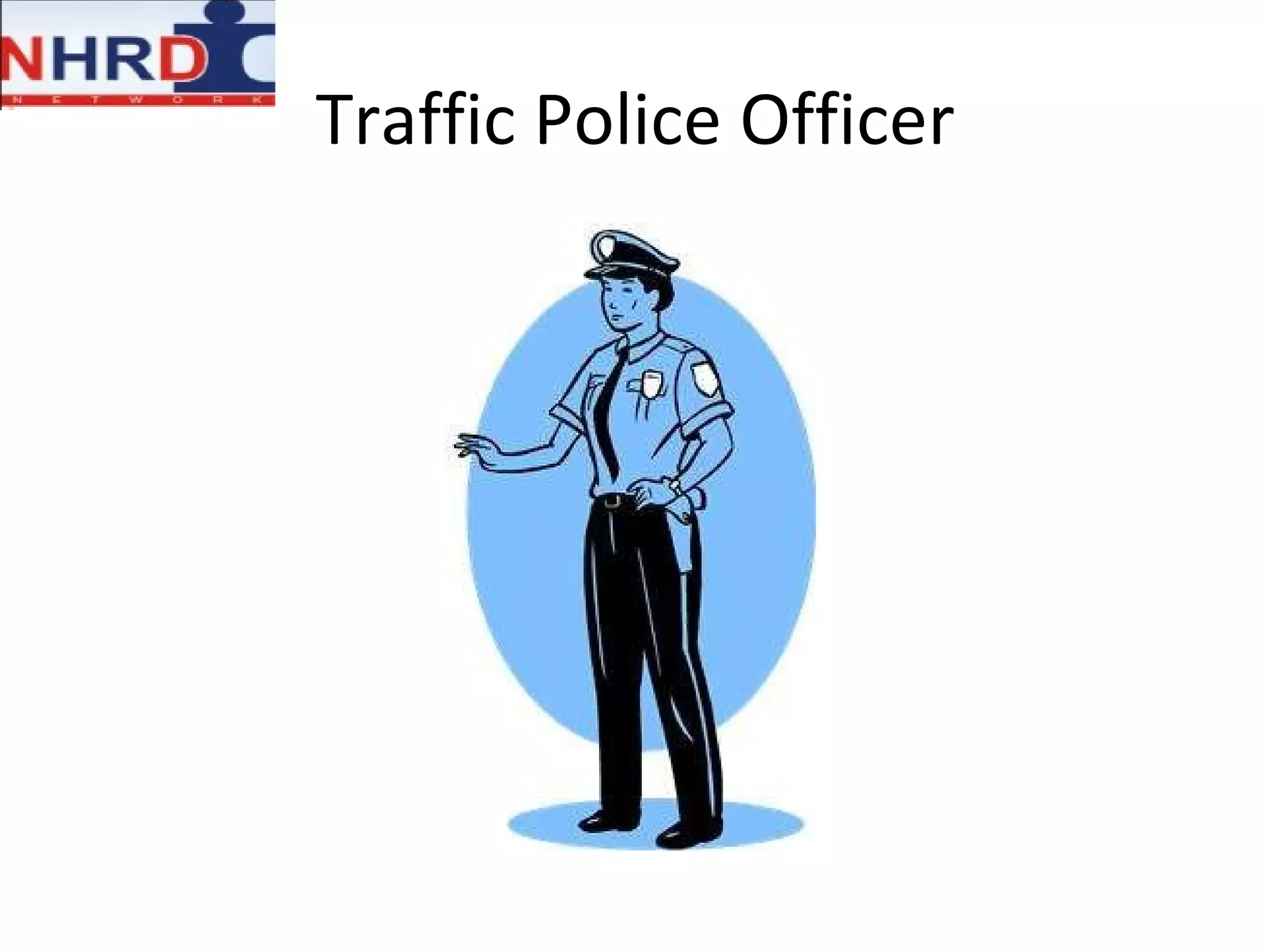
Traffic Police Officer
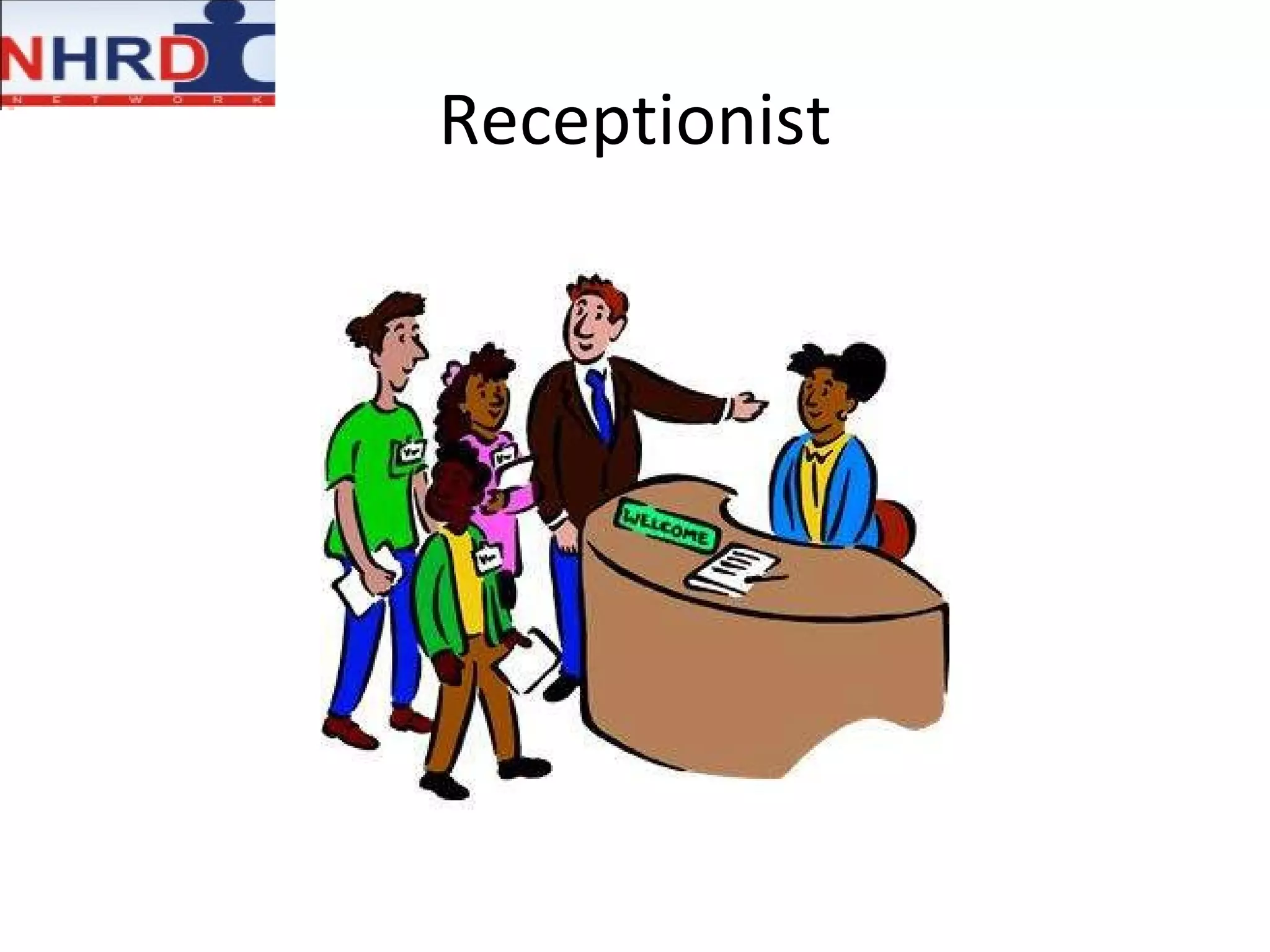
Receptionist
IMPORTANCE OF COMPETENCIES Tool to meet Business Results Set performance expectations establishing common criteria for  hiring,  training,  measuring, and  rewarding people with the right capabilities to  help the company gain competitive advantage
IMPORTANCE OF COMPETENCIES Remind employees how they do things is as important as what they do Reward the person, not the job  Identify gaps between current capabilities and future requirements Focus training and development efforts on areas with greatest need and/or impact Facilitate organizational change and building desired culture
Developing a Competency Model
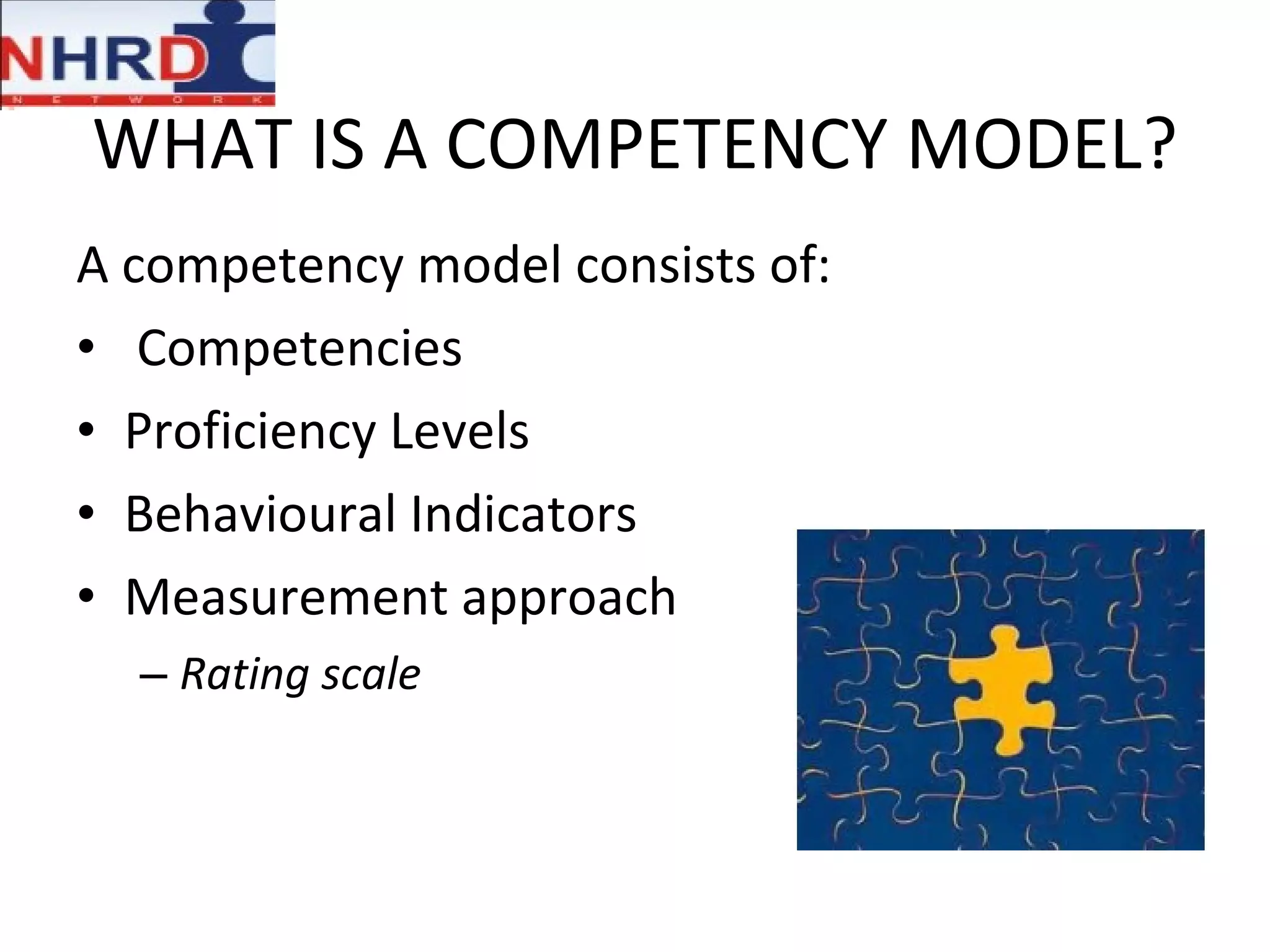
WHAT IS A COMPETENCY MODEL? A competency model consists of: Competencies  Proficiency Levels  Behavioural Indicators  Measurement approach Rating scale
 
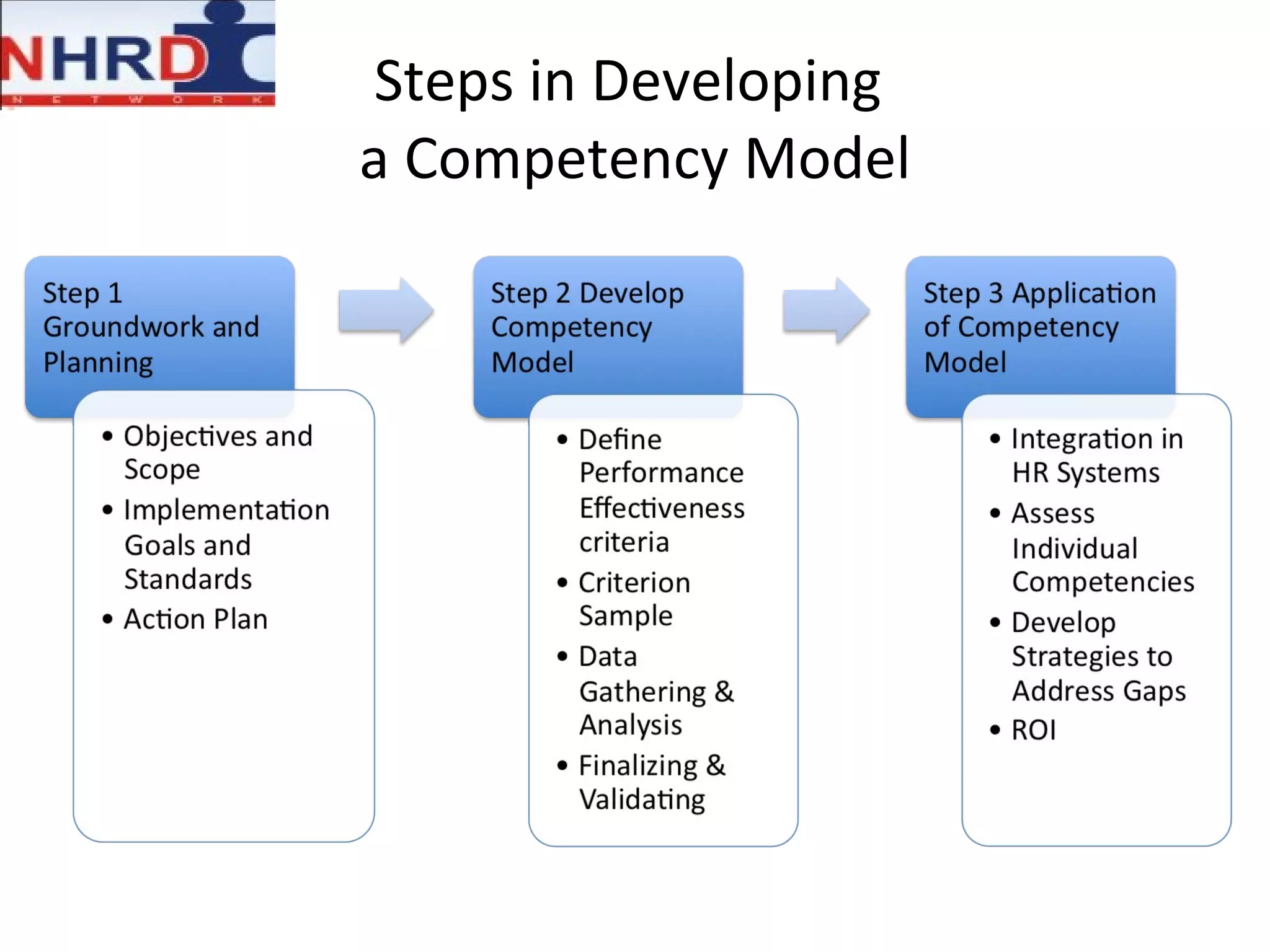
Steps in Developing  a Competency Model
TEA BREAK
A Look at HR Competencies – the HR COMPASS
LET’S DISCUSS AN HR POSITION......  WHAT ARE THE EXPECTED OUTPUTS (KRA’S) OF THE JOB ?  WHAT ARE THE EXPECTED BEHAVIORS THAT WILL LEAD TO SUCCESSFUL DELIVERY OF THE EXPECTED OUTPUTS ? WHAT KNOWLEDGE, SKILL & ABILITY WILL THIS POSITION NEED IN ORDER TO BE SUCCESSFUL ?
Competencies ? Situation 1 You are on tour far away from home. You get a phone call from your mother stating that the wash basin tap is broken and water is flowing. It is likely to flood into the room since the drain is also partially clogged. What will be your responses? What are the relevant competencies?
Competencies ? Situation 2 – Your close relative is admitted at hospital for a surgery in the eyes. After consulting several doctors, you have to finally zero down on a doctor to perform the surgery. Is there any competency required What are the 3 important competencies which you will look at?
Competencies ? Situation 3 You have been recruited by a CEO of a Organization as only HR professional which has 100 employees.  This Organization is highly power intensive and has a 66 KV substation. You have an Electrical Engineer named Ramu, who is with your organization for the last 15 years.  He takes care of the substation and all High voltage installations. Ramu is leaving the job. You have identified another candidate along with your CEO, who has committed to join on 1 March 2010. On 15 Feb 2010, the candidate informs that he is not joining.  What will be your actions What are the relevant competencies
Competencies in HR? Are there any competencies required for HR Professionals? Is there any competency required for Time Office personnel? Is there any competency required for person who is responsible for Personal files? What are the competencies required for the HR person responsible for  Recruitment Training Performance Management Compensation & benefits etc
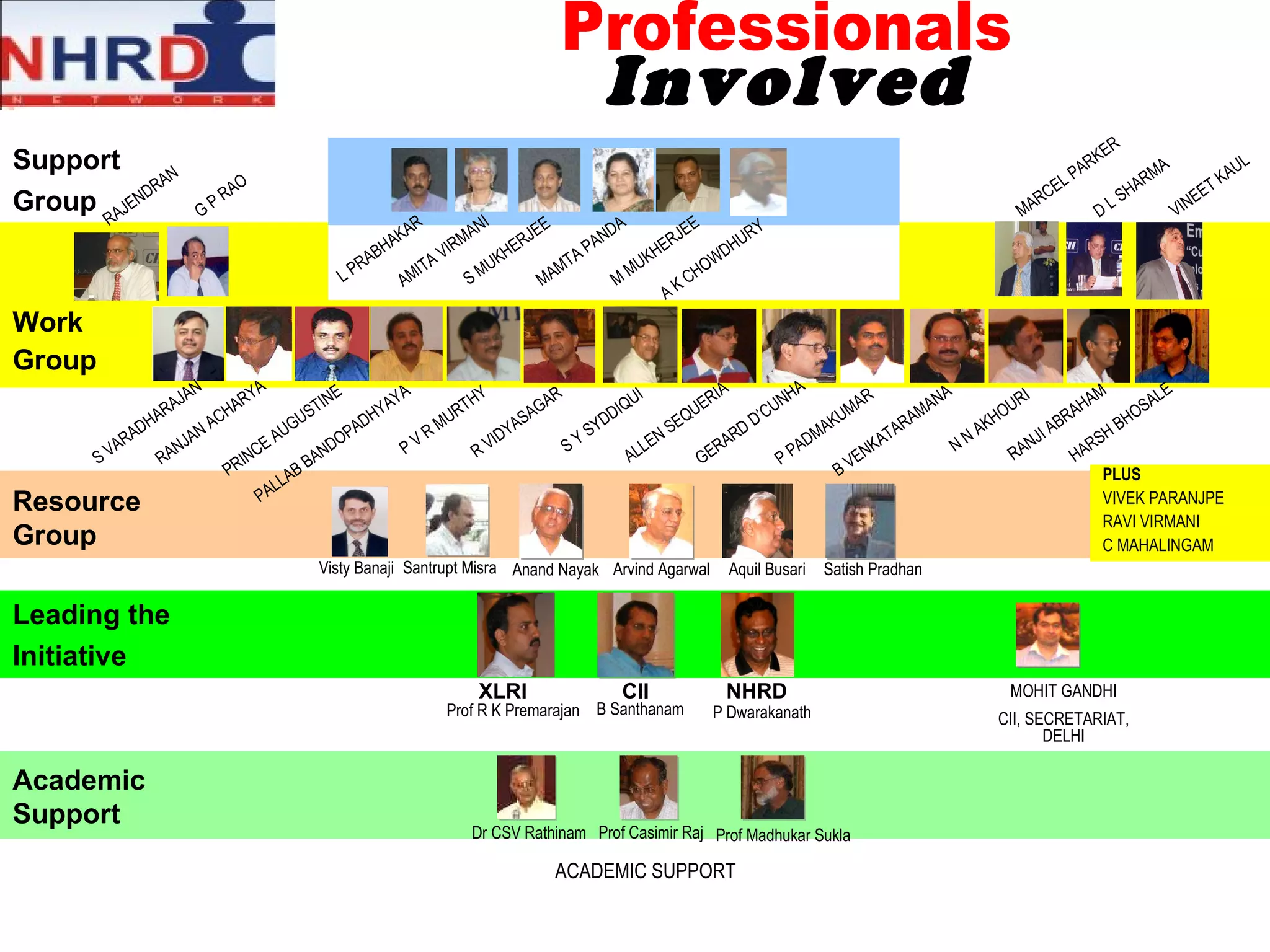
Involved Professionals NHRD CII XLRI ACADEMIC SUPPORT Dr CSV Rathinam Prof Casimir Raj Prof Madhukar Sukla MOHIT GANDHI CII, SECRETARIAT, DELHI Prof R K Premarajan B Santhanam P Dwarakanath Satish Pradhan Aquil Busari Arvind Agarwal Anand Nayak Santrupt Misra Visty Banaji PLUS VIVEK PARANJPE RAVI VIRMANI C MAHALINGAM S VARADHARAJAN RANJAN ACHARYA R VIDYASAGAR PALLAB BANDOPADHYAYA P V R MURTHY PRINCE AUGUSTINE S Y SYDDIQUI ALLEN SEQUERIA RANJI ABRAHAM GERARD D’CUNHA P PADMAKUMAR B VENKATARAMANA N N AKHOURI HARSH BHOSALE L PRABHAKAR AMITA VIRMANI MAMTA PANDA M MUKHERJEE S MUKHERJEE A K CHOWDHURY Resource Group Work Group Leading the  Initiative Support Group Academic Support VINEET KAUL D L SHARMA MARCEL PARKER G P RAO RAJENDRAN
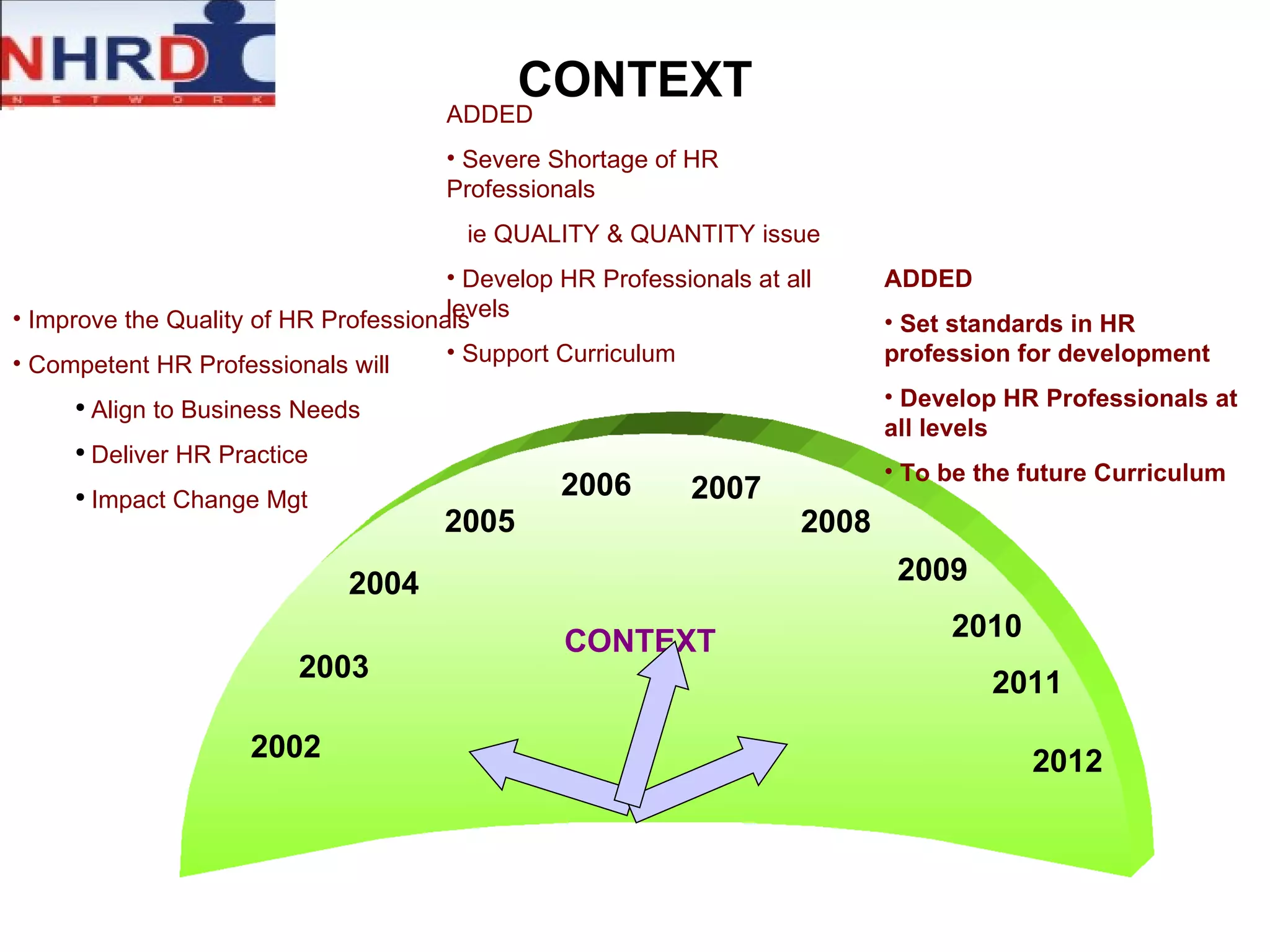
CONTEXT CONTEXT 2002 Improve the Quality of HR Professionals Competent HR Professionals will Align to Business Needs Deliver HR Practice Impact Change Mgt 2003 2004 2005 2006 2007 2008 ADDED Severe Shortage of HR Professionals ie QUALITY & QUANTITY issue Develop HR Professionals at all levels Support Curriculum 2009 2010 2011 2012 ADDED Set standards in HR profession for development Develop HR Professionals at all levels To be the future Curriculum
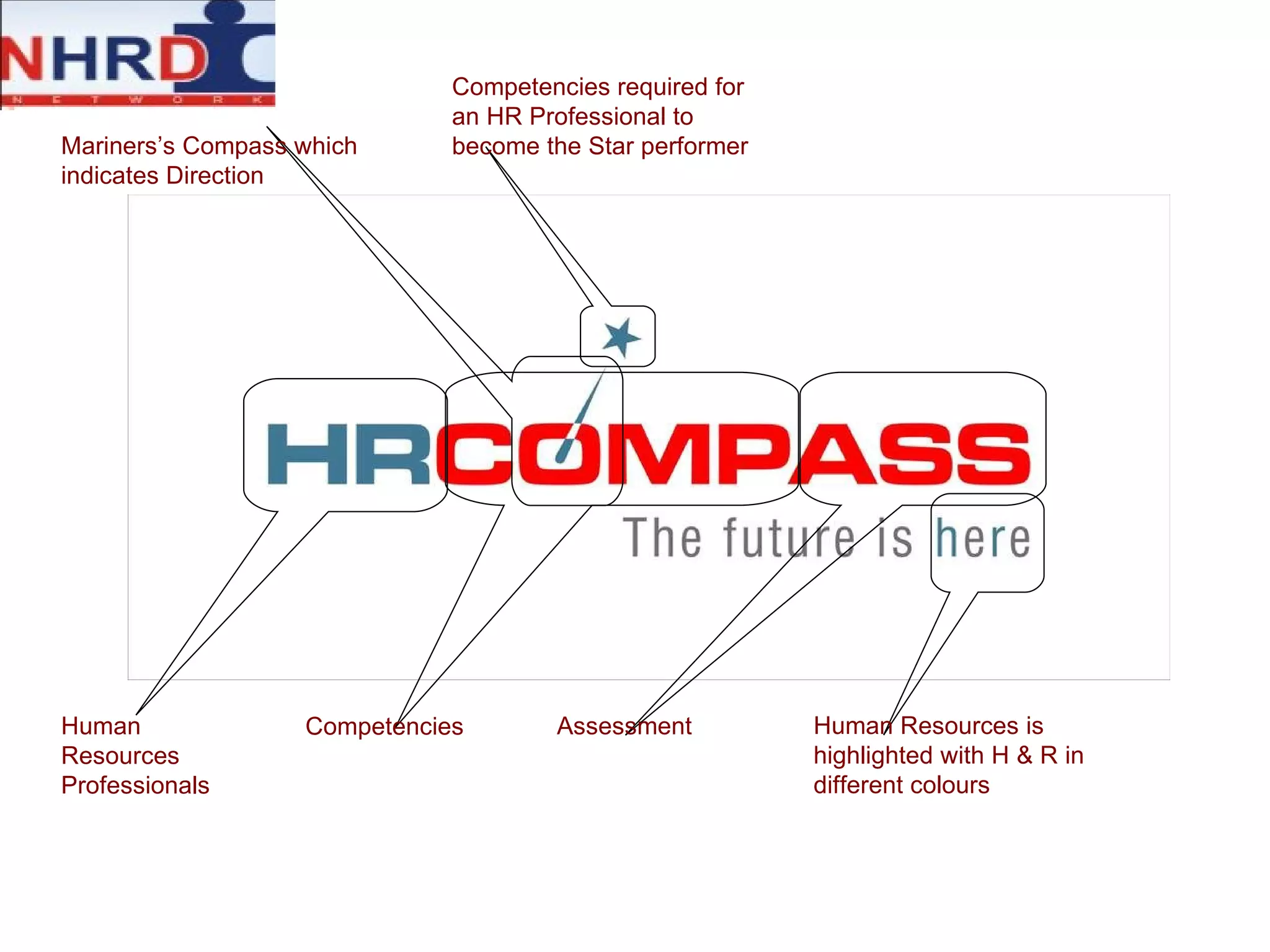
Human Resources Professionals Competencies Assessment Human Resources is highlighted with H & R in different colours Mariners’s Compass which indicates Direction Competencies required for an HR Professional to become the Star performer
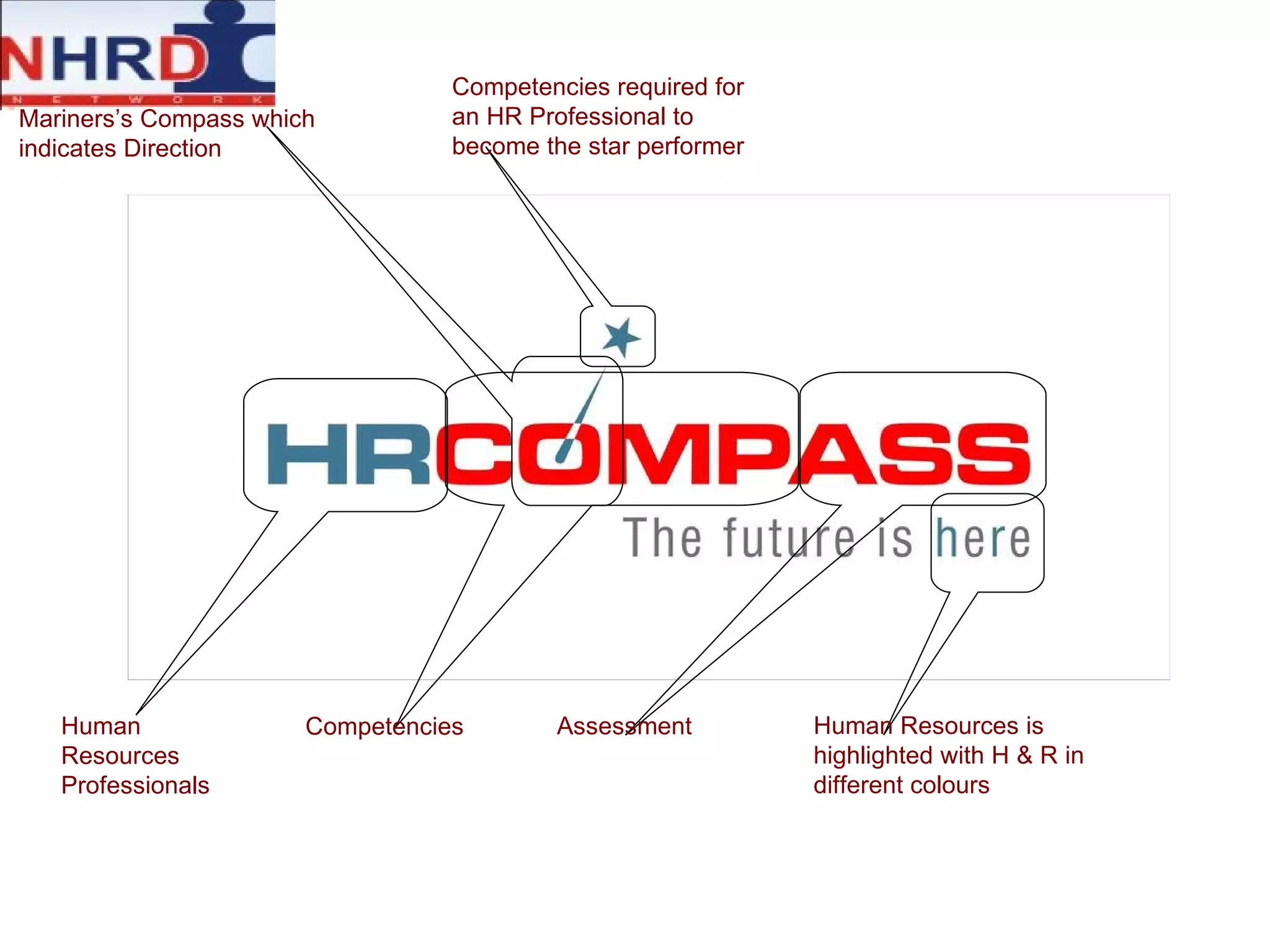
Human Resources Professionals Competencies Assessment Human Resources is highlighted with H & R in different colours Mariners’s Compass which indicates Direction Competencies required for an HR Professional to become the star performer
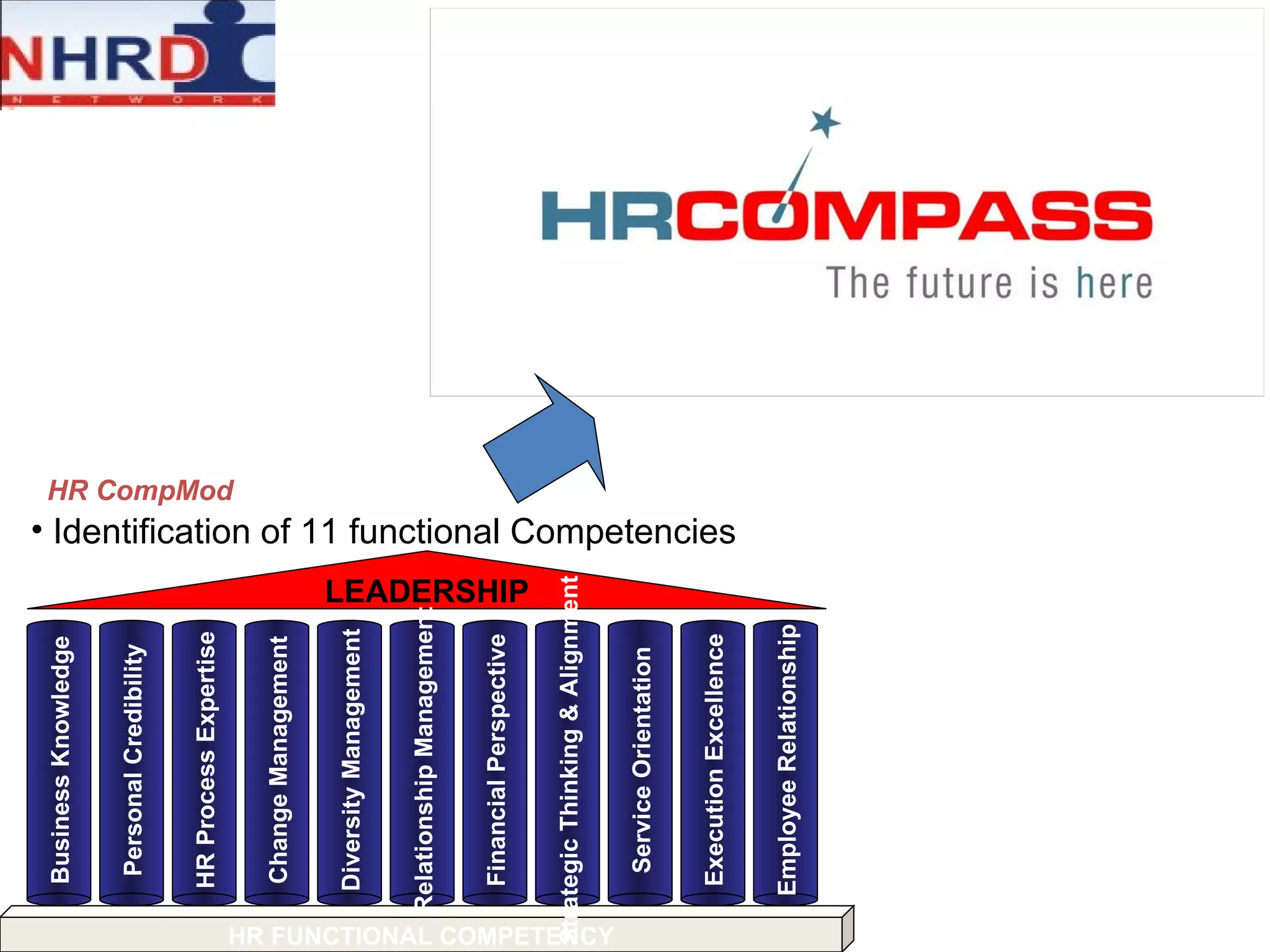
HR FUNCTIONAL COMPETENCY Identification of 11 functional Competencies Business Knowledge LEADERSHIP Personal Credibility HR Process Expertise Change Management Diversity Management Relationship Management Financial Perspective Strategic Thinking & Alignment Execution Excellence Service Orientation Employee Relationship HR CompMod
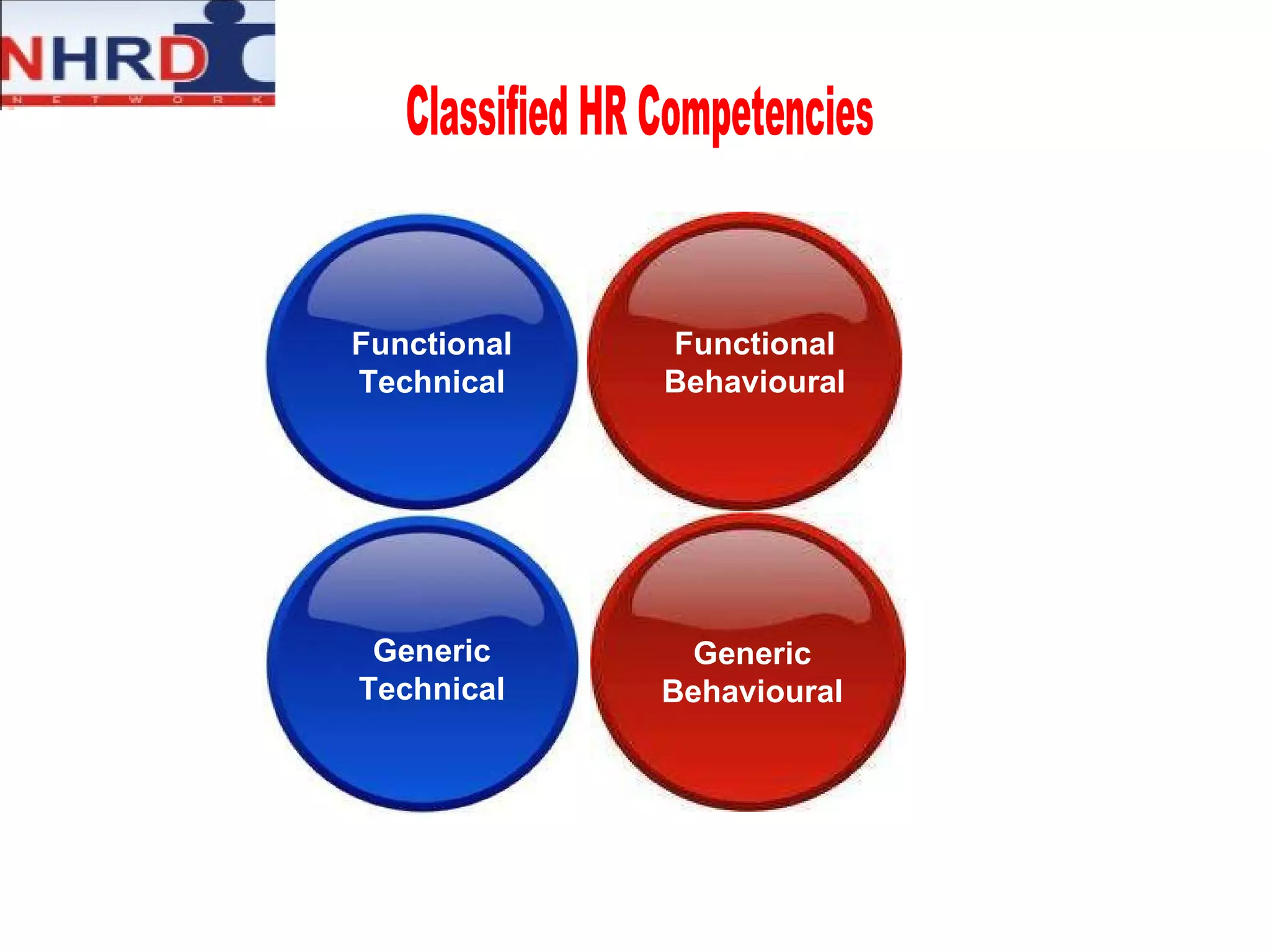
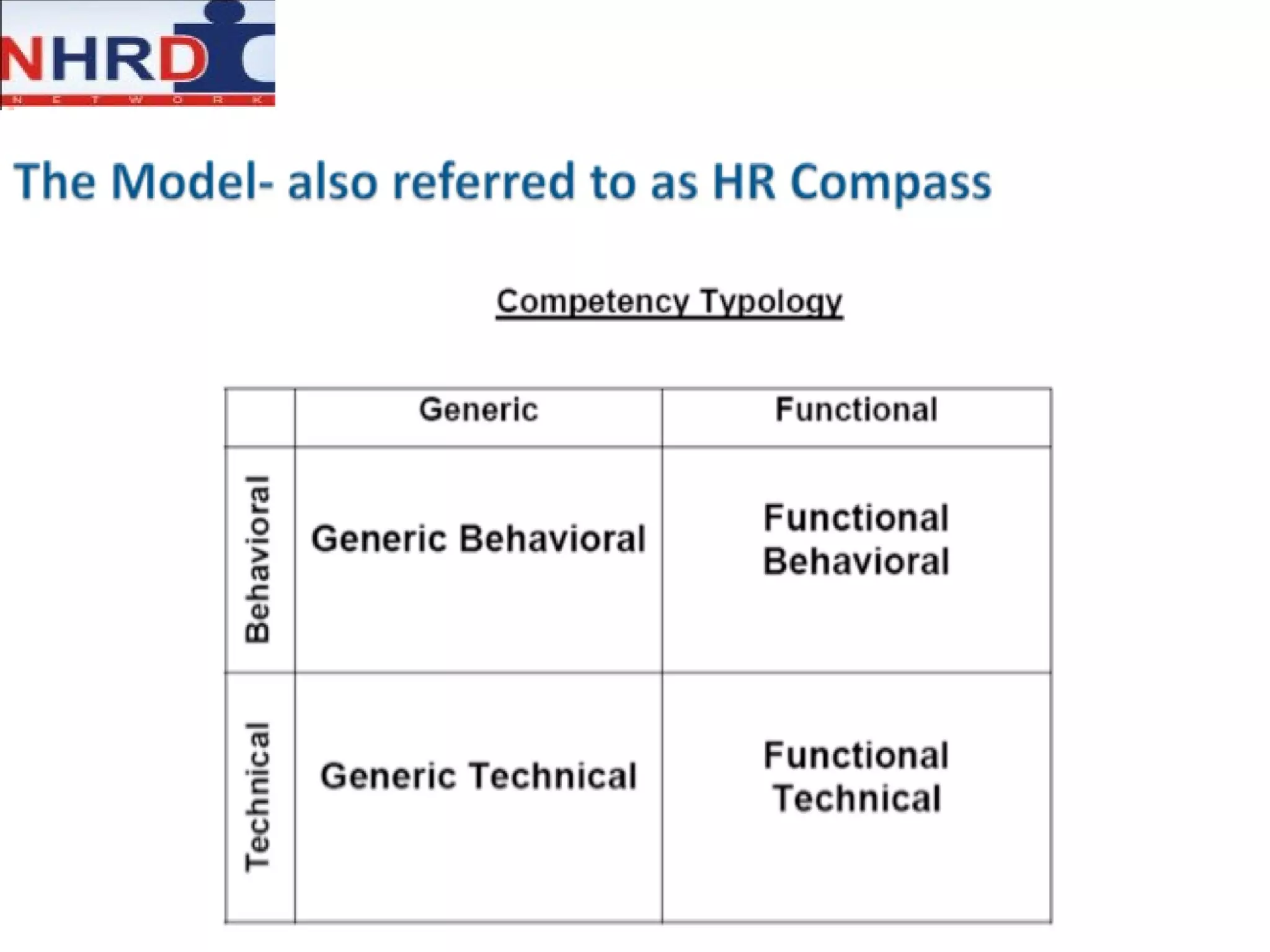
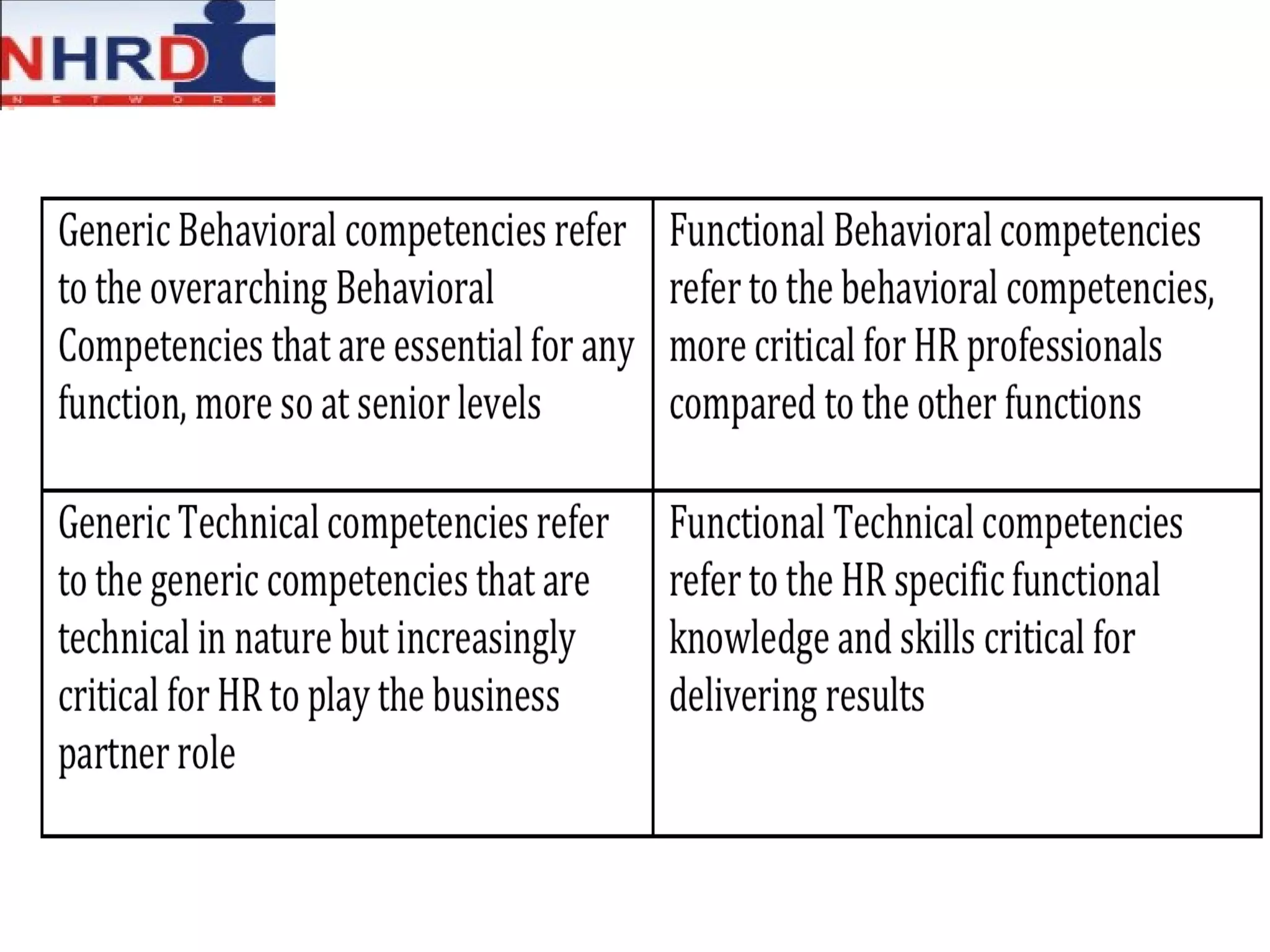
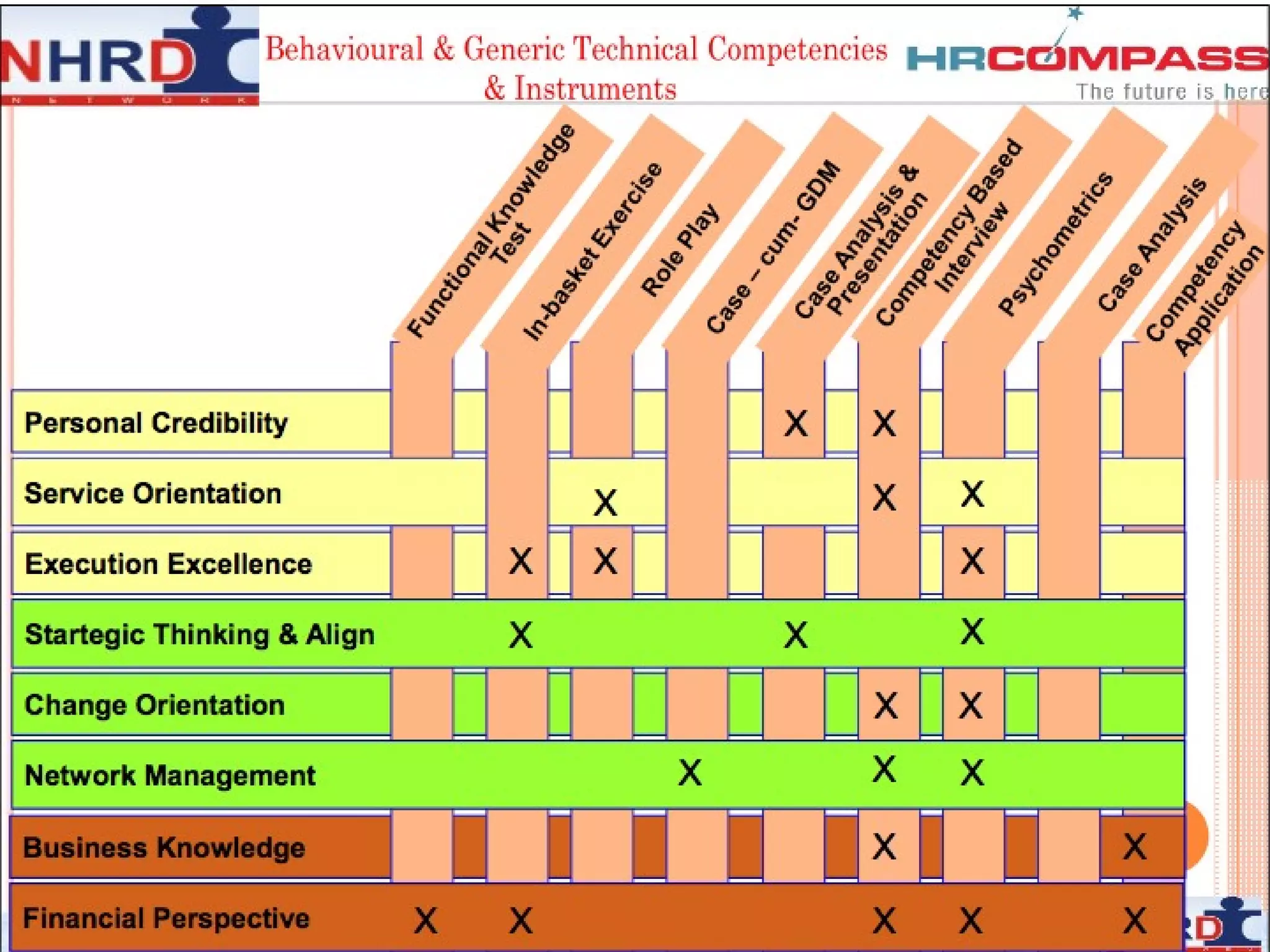
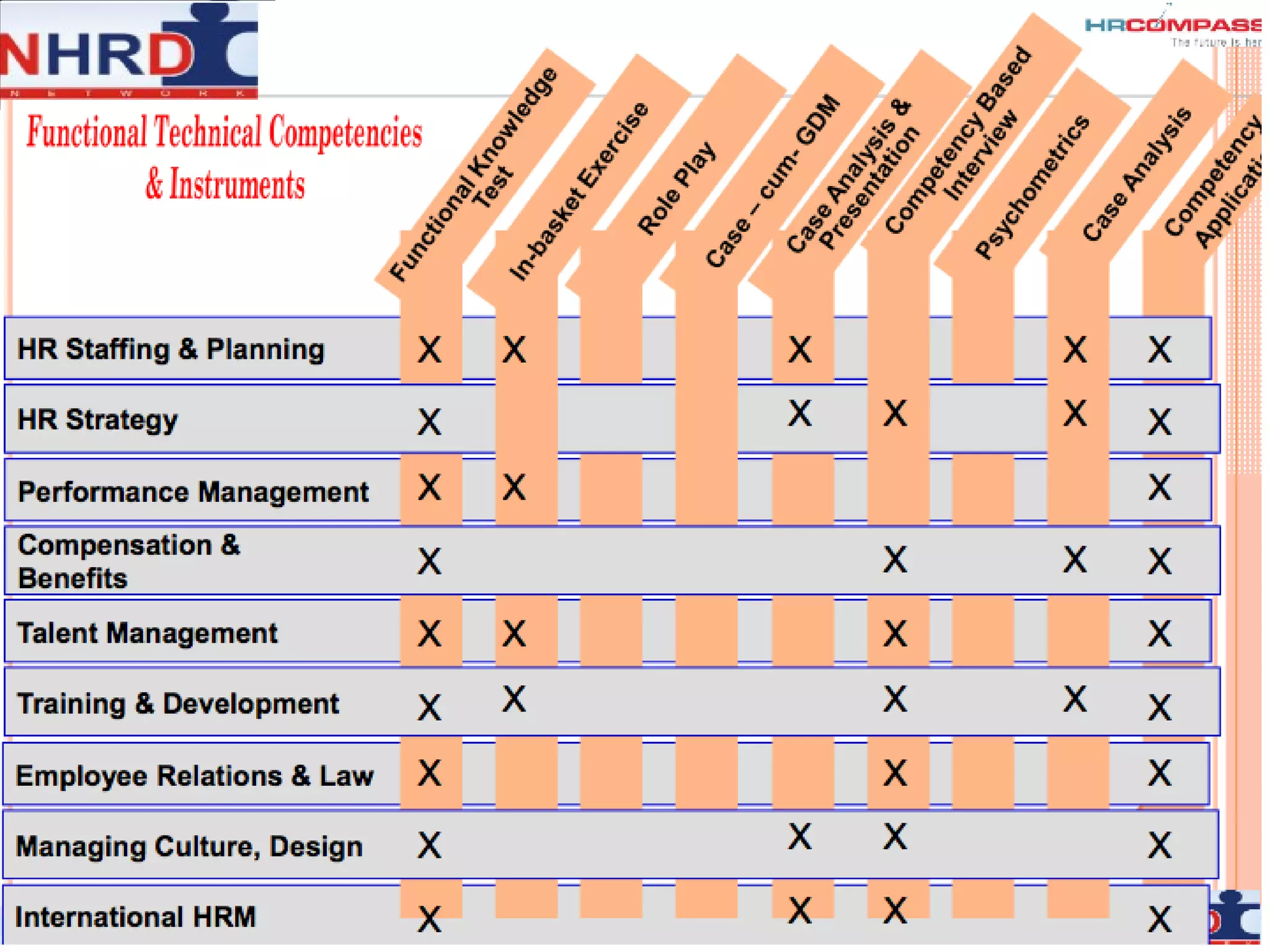
Classified HR Competencies Functional Behavioural Generic Behavioural Functional Technical Generic Technical
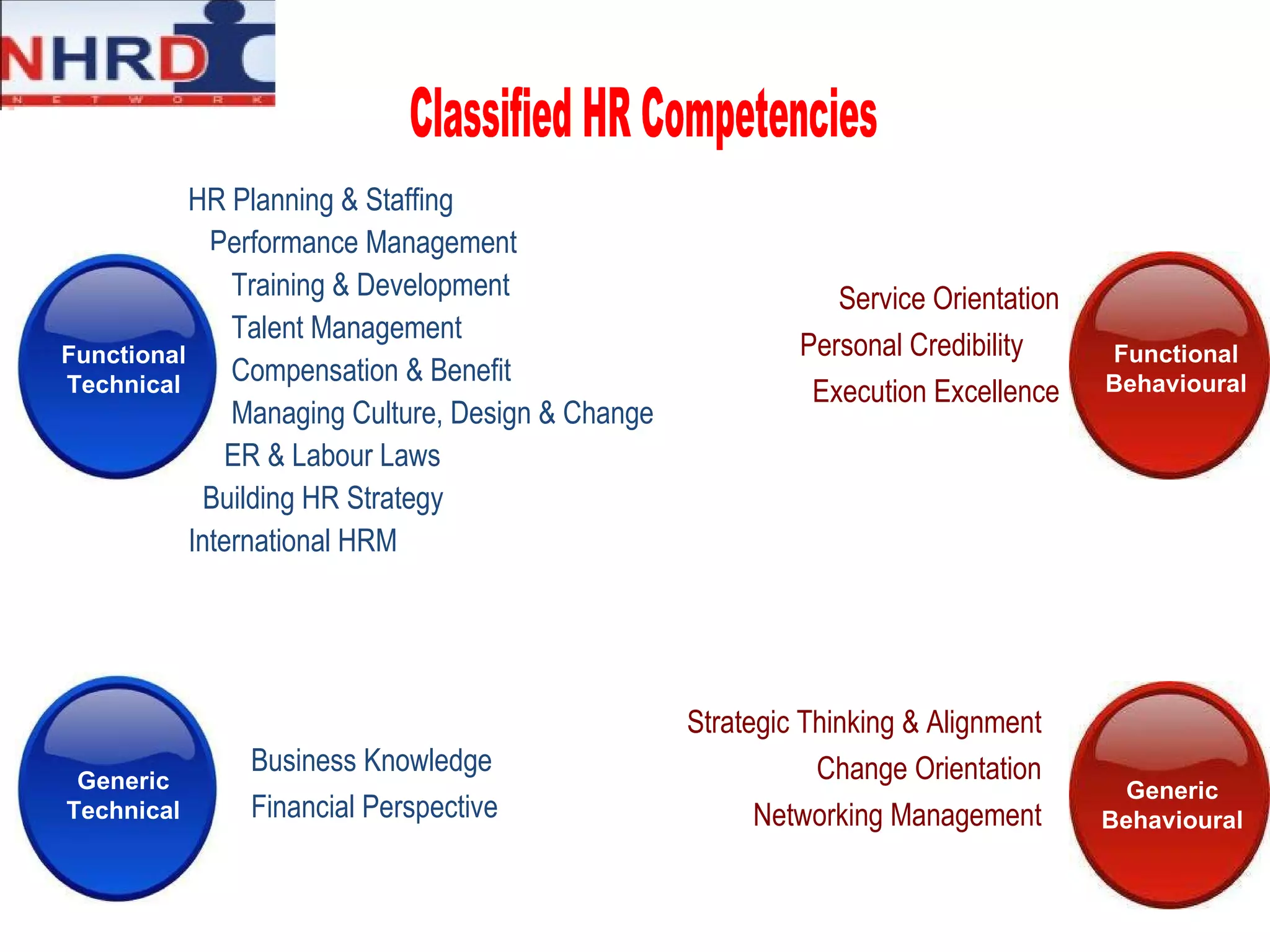
Classified HR Competencies HR Planning & Staffing Performance Management Training & Development Talent Management Compensation & Benefit Managing Culture, Design & Change ER & Labour Laws Building HR Strategy International HRM Service Orientation Personal Credibility  Execution Excellence Business Knowledge Financial Perspective Strategic Thinking & Alignment Change Orientation Networking Management Functional Behavioural Generic Behavioural Functional Technical Generic Technical
 
 
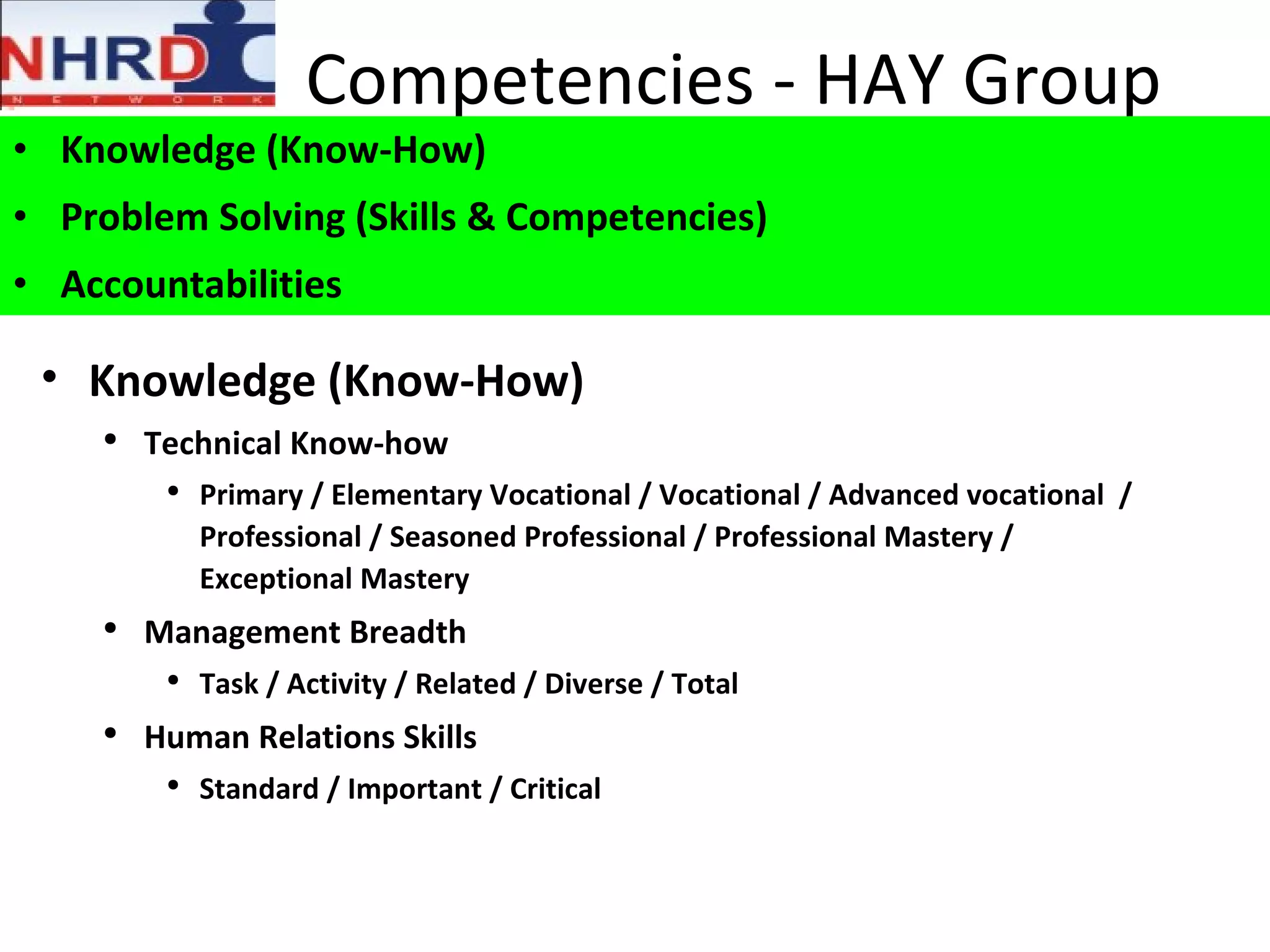
Competencies - HAY Group Knowledge (Know-How) Problem Solving (Skills & Competencies) Accountabilities Knowledge (Know-How) Technical Know-how Primary / Elementary Vocational / Vocational / Advanced vocational  / Professional / Seasoned Professional / Professional Mastery / Exceptional Mastery Management Breadth Task / Activity / Related / Diverse / Total Human Relations Skills Standard / Important / Critical
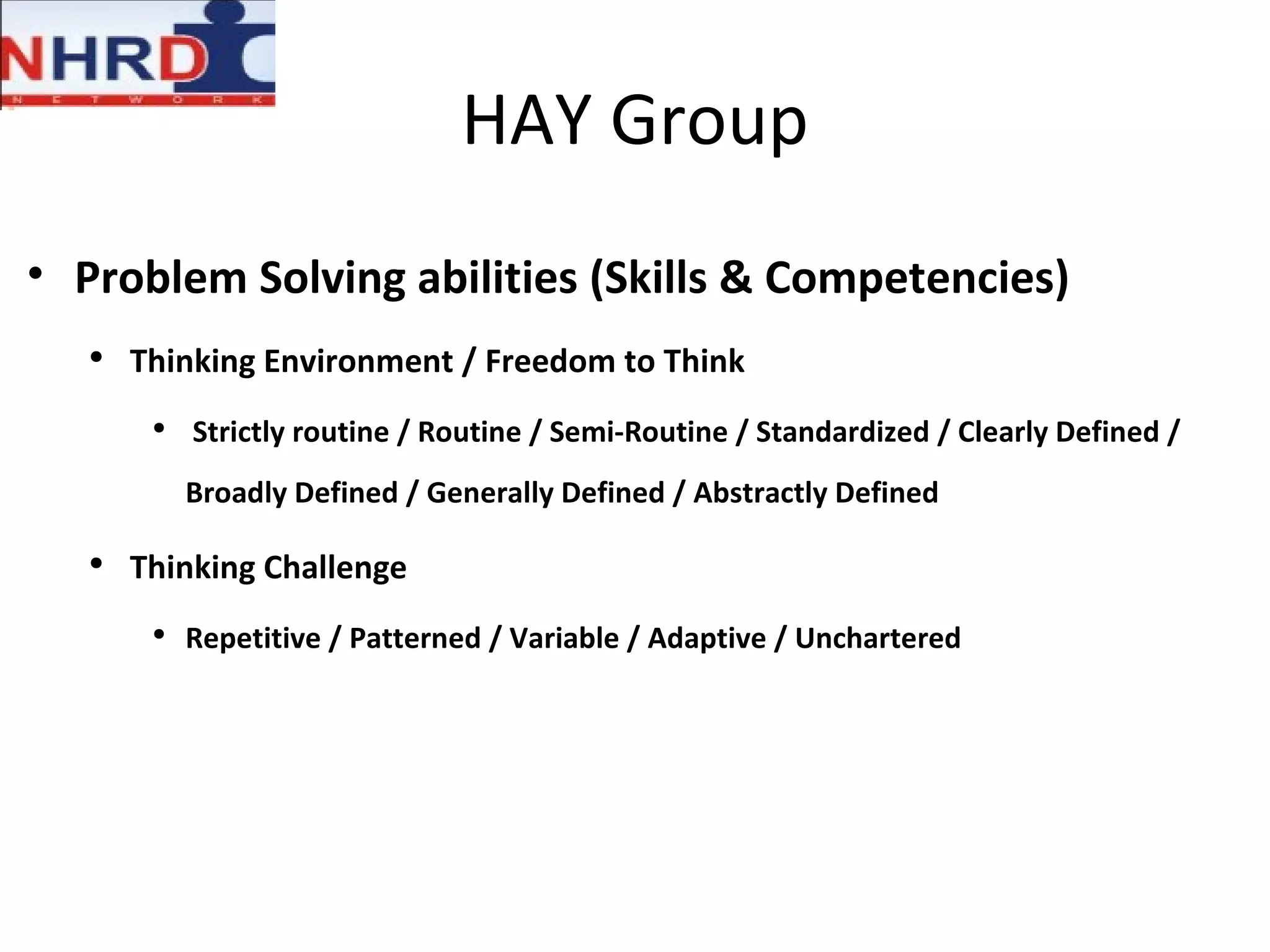
HAY Group Problem Solving abilities (Skills & Competencies) Thinking Environment / Freedom to Think Strictly routine / Routine / Semi-Routine / Standardized / Clearly Defined / Broadly Defined / Generally Defined / Abstractly Defined Thinking Challenge Repetitive / Patterned / Variable / Adaptive / Unchartered
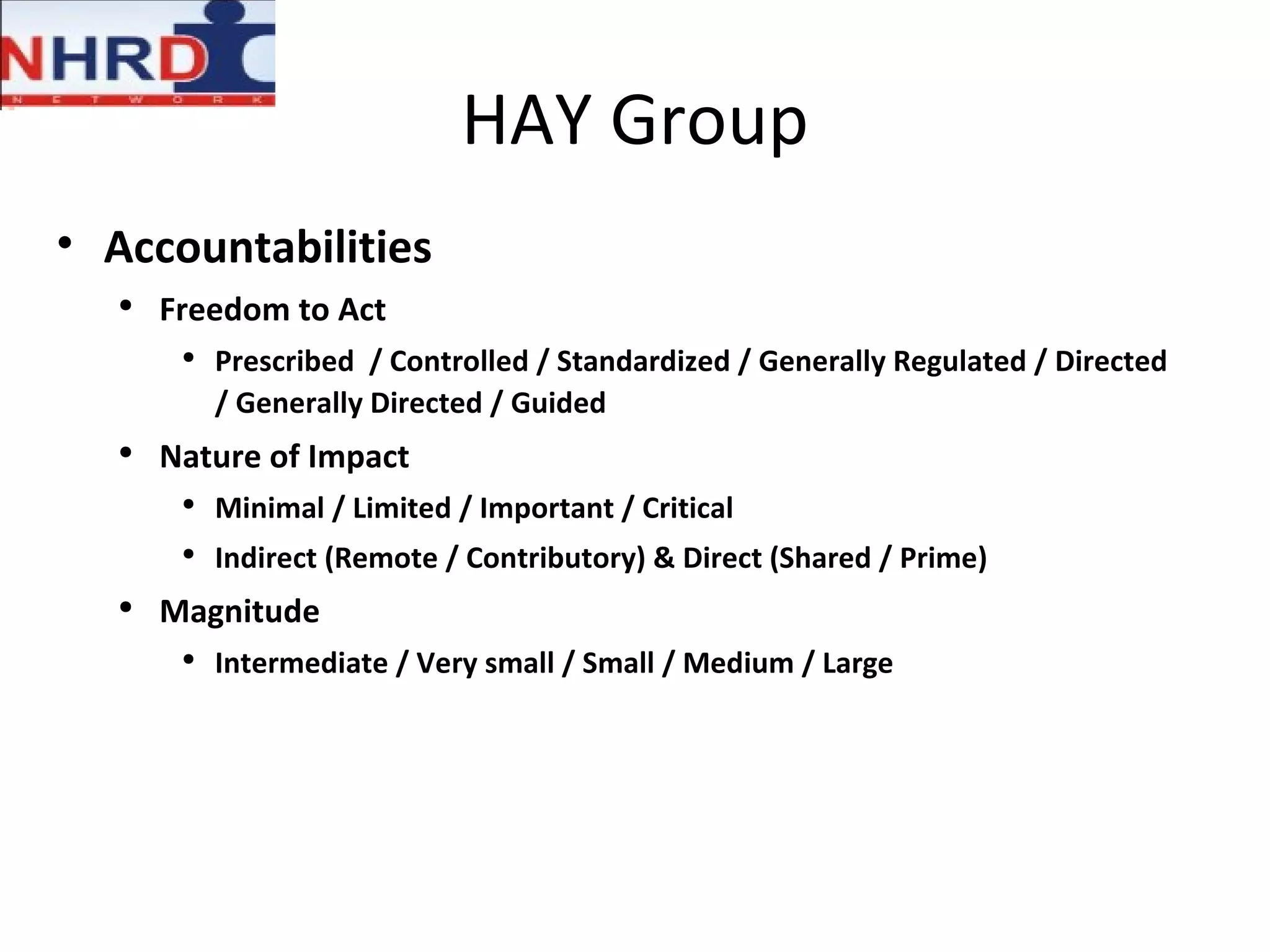
HAY Group Accountabilities Freedom to Act Prescribed  / Controlled / Standardized / Generally Regulated / Directed / Generally Directed / Guided Nature of Impact Minimal / Limited / Important / Critical Indirect (Remote / Contributory) & Direct (Shared / Prime) Magnitude Intermediate / Very small / Small / Medium / Large
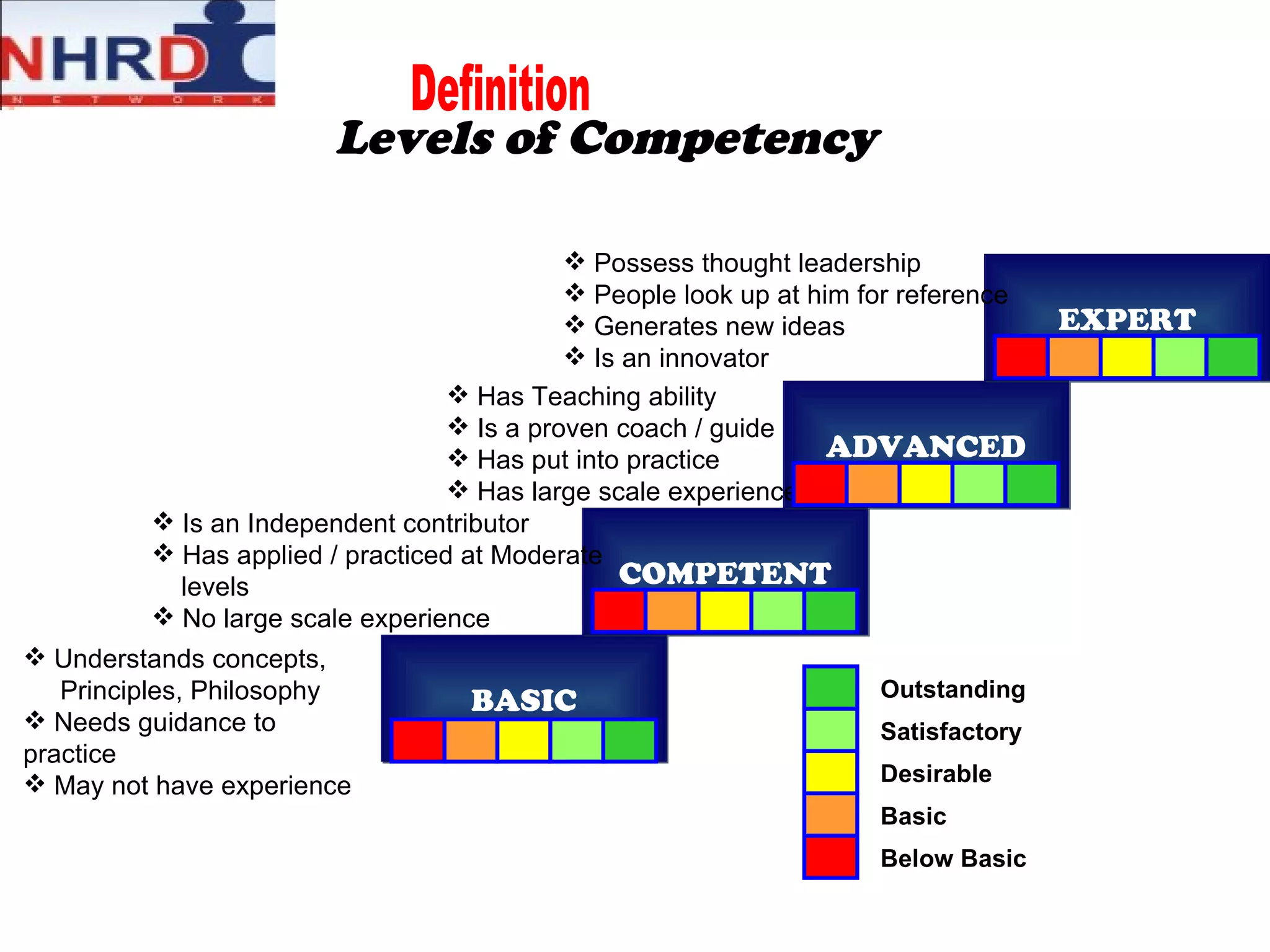
Levels of Competency Definition BASIC COMPETENT ADVANCED EXPERT Understands concepts,  Principles, Philosophy Needs guidance to practice May not have experience  Is an Independent contributor Has applied / practiced at Moderate  levels No large scale experience  Has Teaching ability Is a proven coach / guide Has put into practice Has large scale experience  Possess thought leadership People look up at him for reference Generates new ideas Is an innovator  Outstanding Satisfactory Desirable Basic Below Basic
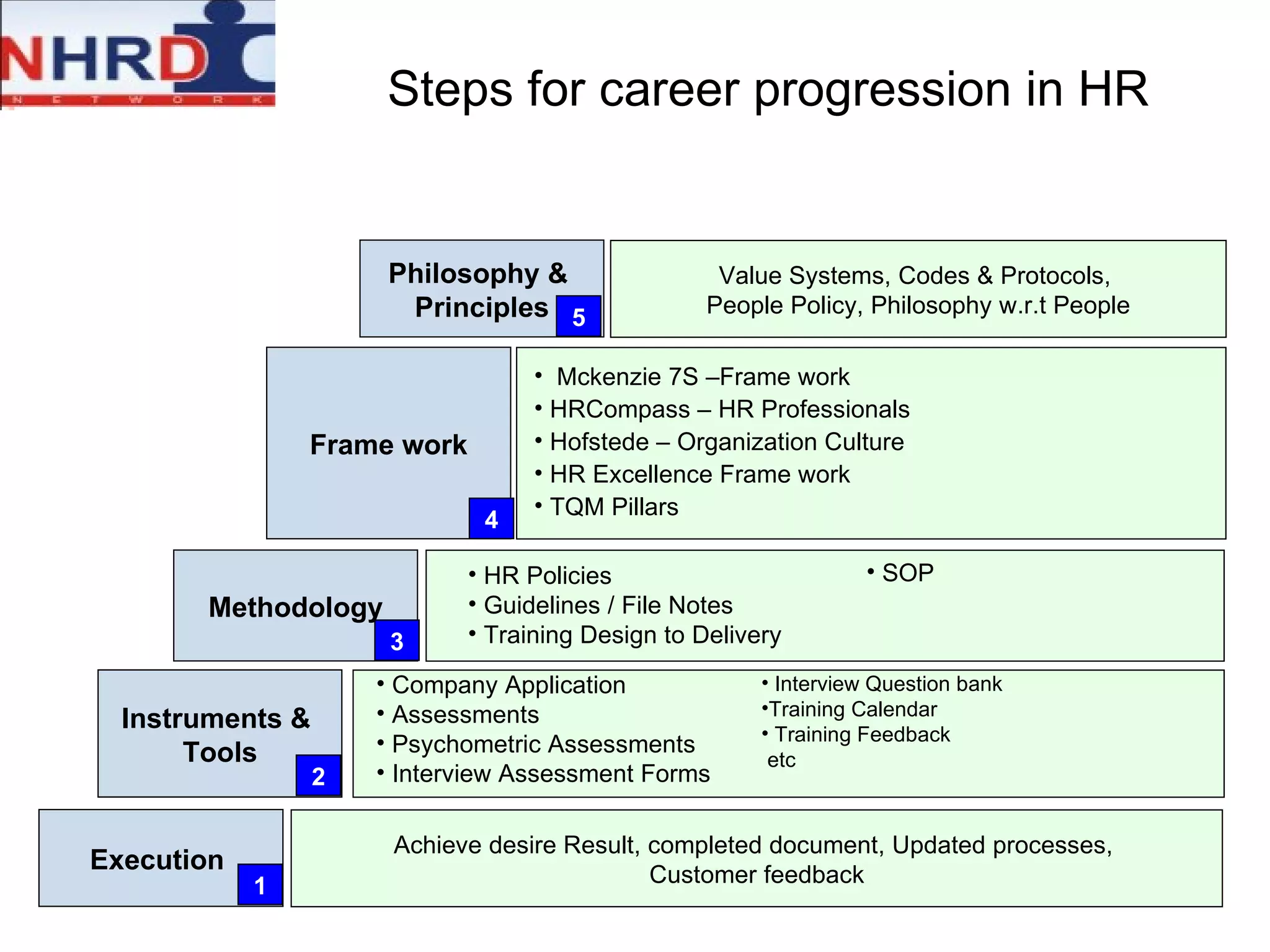
Instruments &  Tools Philosophy &  Principles Value Systems, Codes & Protocols,  People Policy, Philosophy w.r.t People Frame work Mckenzie 7S –Frame work HRCompass – HR Professionals  Hofstede – Organization Culture HR Excellence Frame work TQM Pillars Methodology HR Policies  Guidelines / File Notes Training Design to Delivery Execution  Achieve desire Result, completed document, Updated processes,  Customer feedback 1 2 3 4 5 Company Application Assessments Psychometric Assessments Interview Assessment Forms Interview Question bank  Training Calendar Training Feedback etc Steps for career progression in HR SOP
LUNCH BREAK
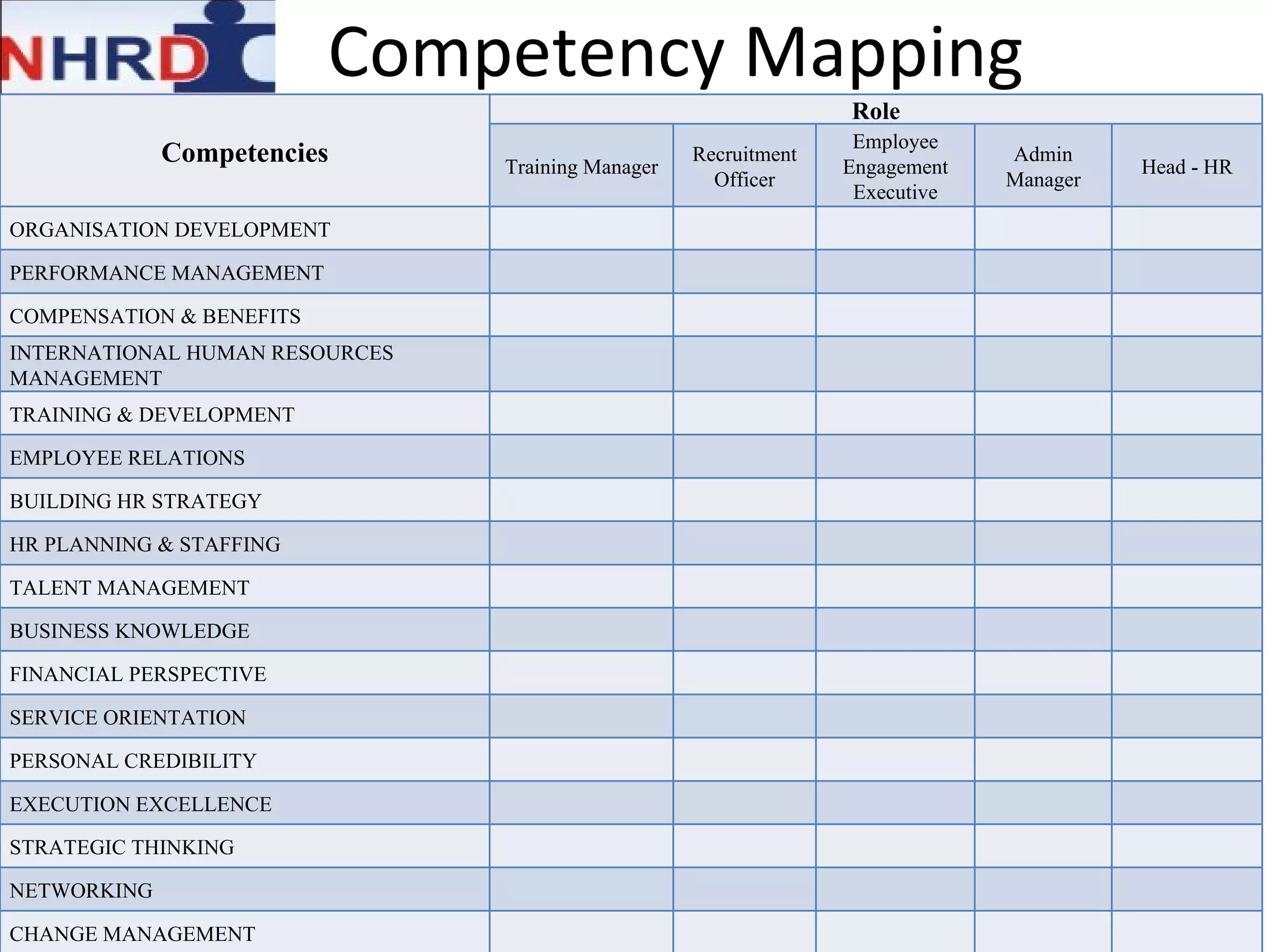
Competency Mapping Competencies Role Training Manager Recruitment Officer Employee Engagement Executive Admin Manager Head - HR ORGANISATION DEVELOPMENT PERFORMANCE MANAGEMENT COMPENSATION & BENEFITS INTERNATIONAL HUMAN RESOURCES MANAGEMENT TRAINING & DEVELOPMENT EMPLOYEE RELATIONS BUILDING HR STRATEGY HR PLANNING & STAFFING TALENT MANAGEMENT BUSINESS KNOWLEDGE FINANCIAL PERSPECTIVE SERVICE ORIENTATION PERSONAL CREDIBILITY EXECUTION EXCELLENCE STRATEGIC THINKING NETWORKING CHANGE MANAGEMENT
Linking Competency Model to HR Systems
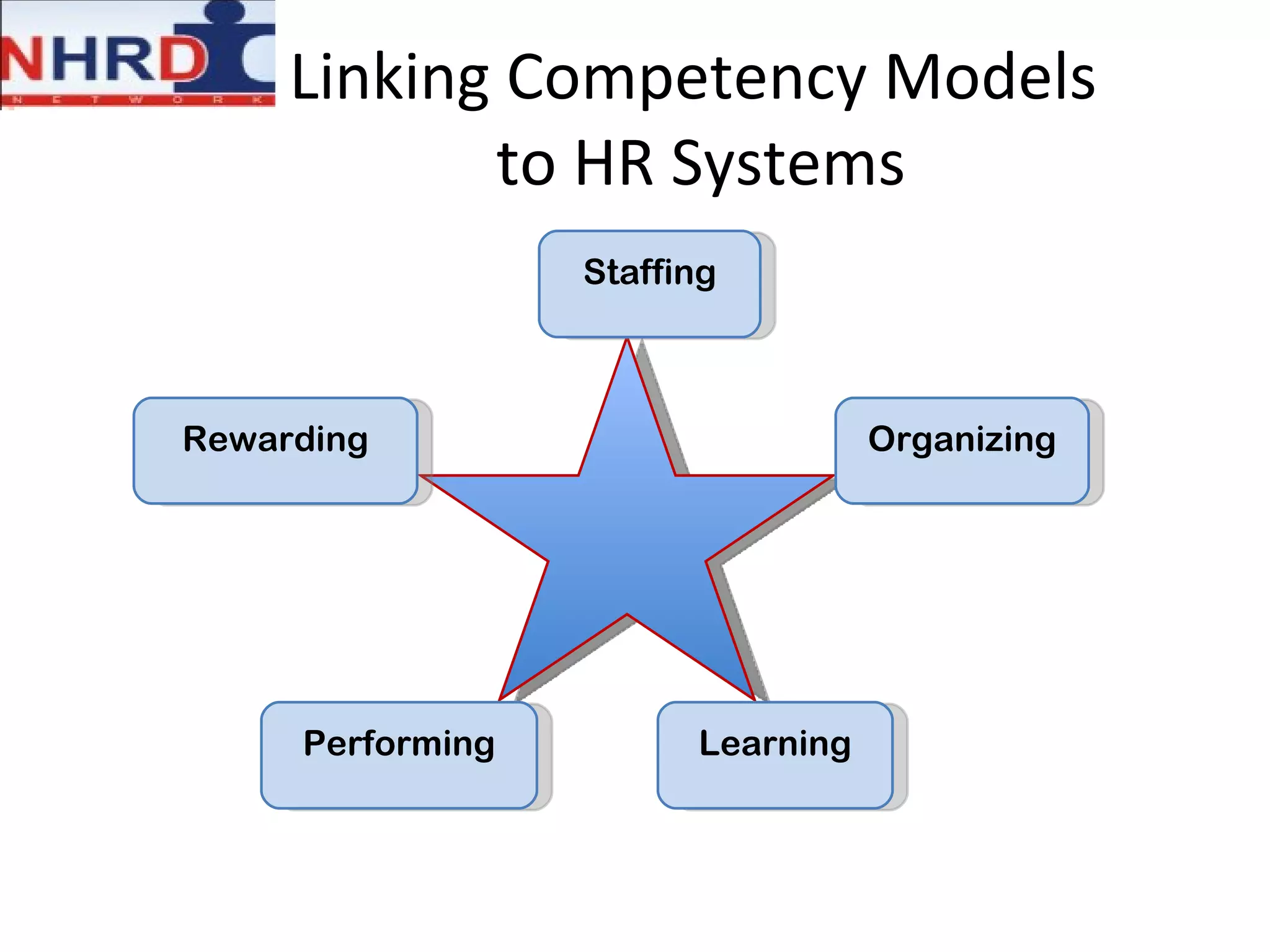
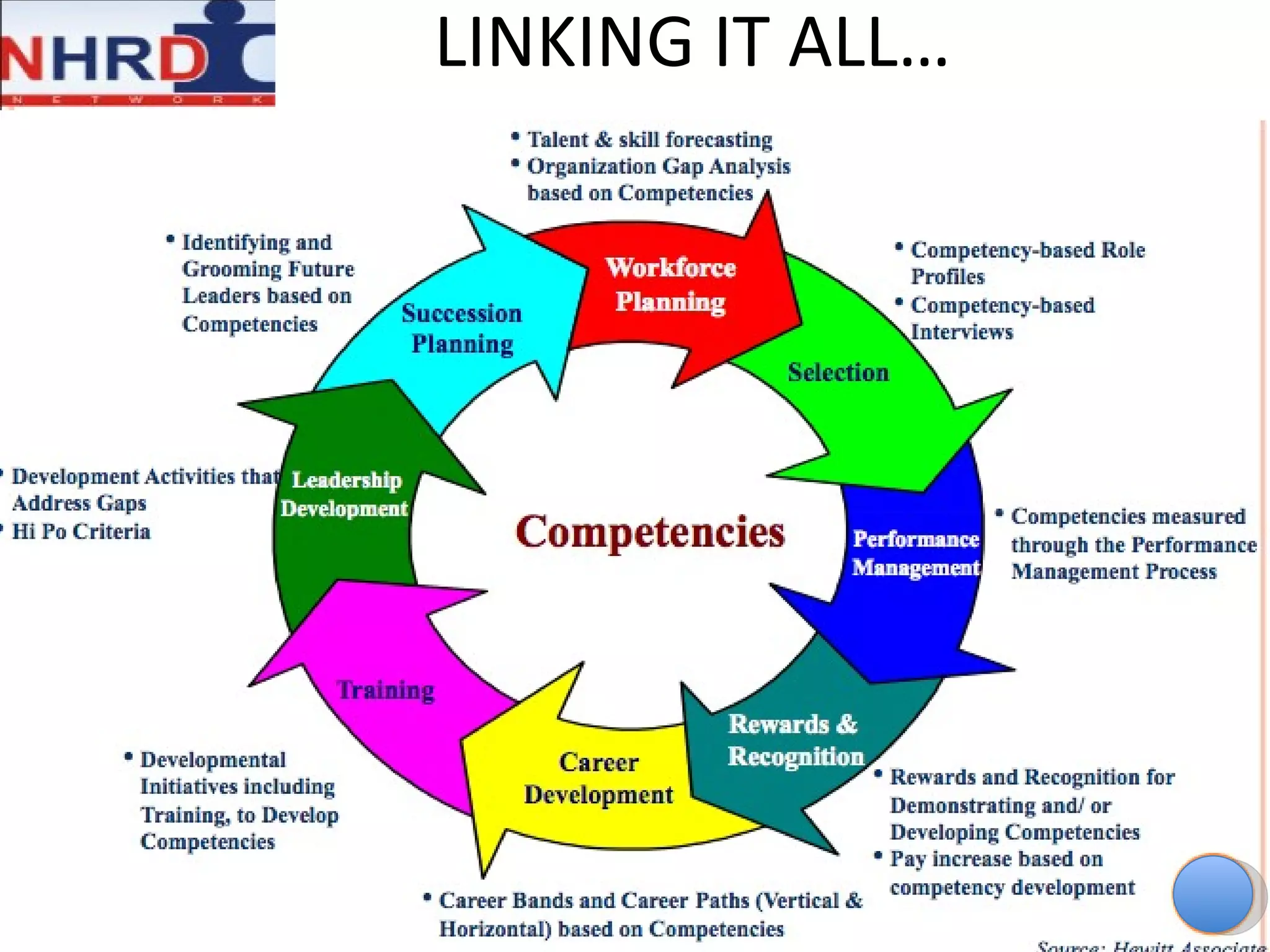
Linking Competency Models  to HR Systems Staffing Organizing Learning Performing Rewarding
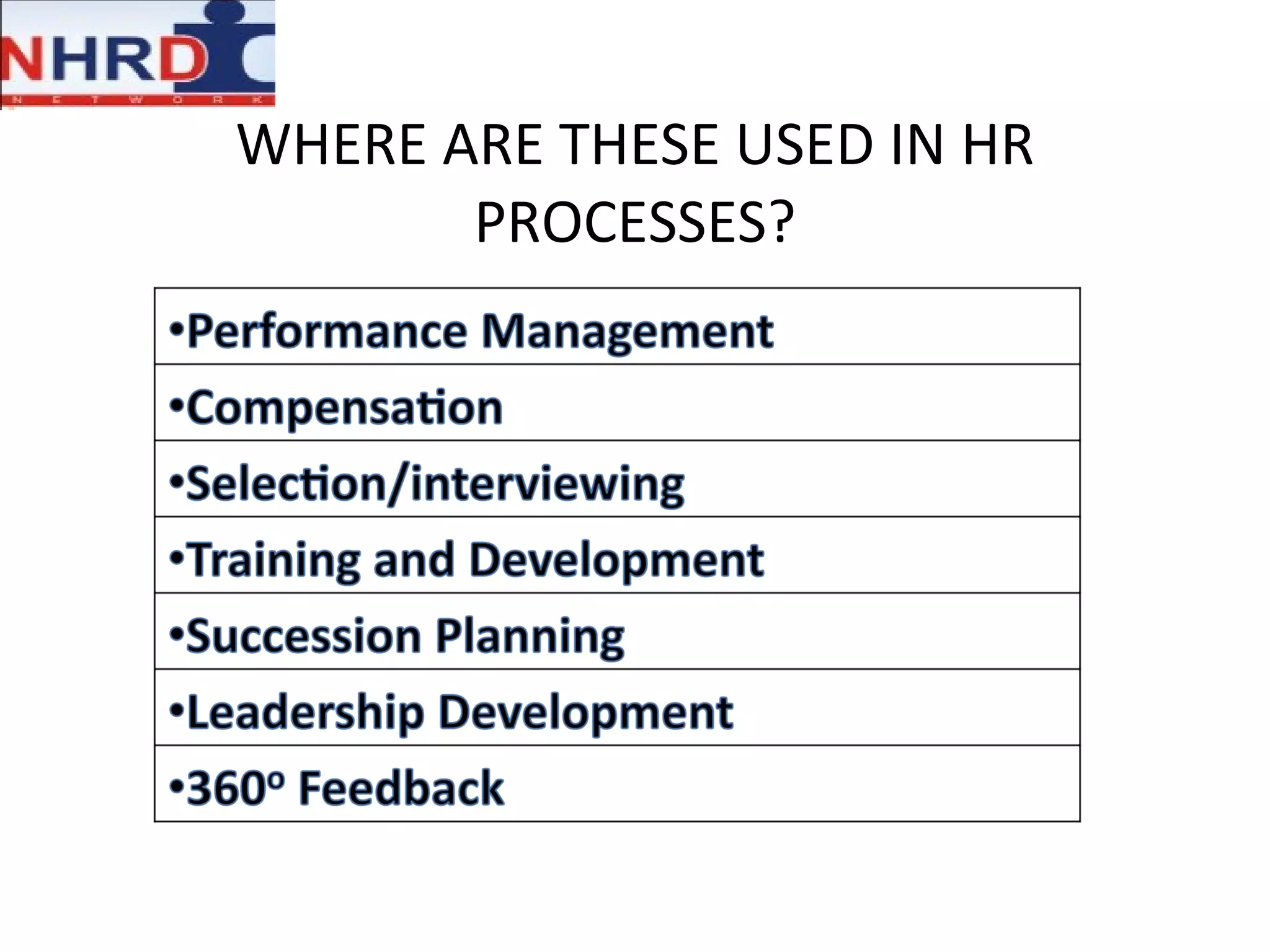
WHERE ARE THESE USED IN HR PROCESSES?
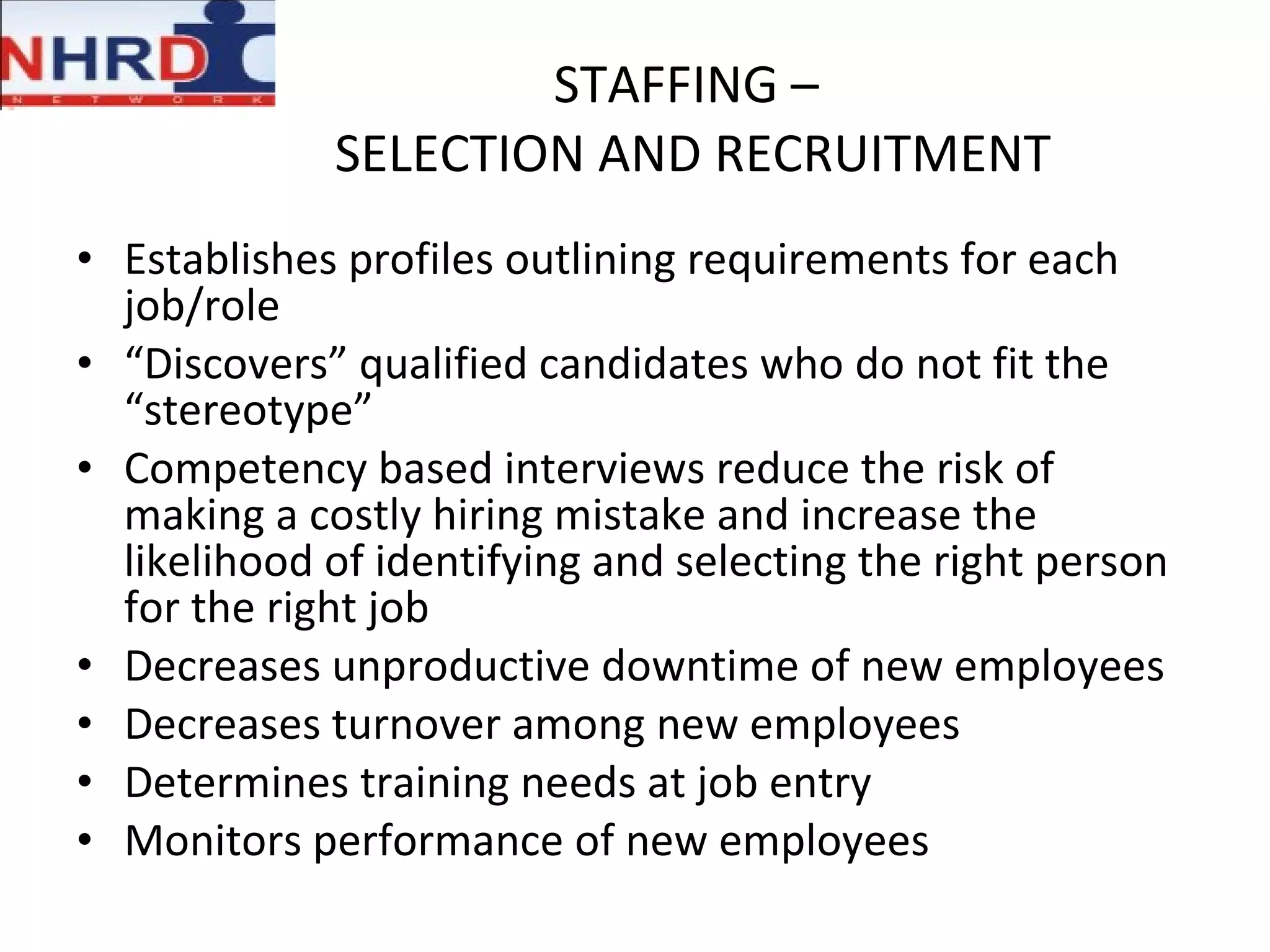
Establishes profiles outlining requirements for each job/role “ Discovers” qualified candidates who do not fit the “stereotype” Competency based interviews reduce the risk of making a costly hiring mistake and increase the likelihood of identifying and selecting the right person for the right job Decreases unproductive downtime of new employees Decreases turnover among new employees  Determines training needs at job entry  Monitors performance of new employees STAFFING –  SELECTION AND RECRUITMENT
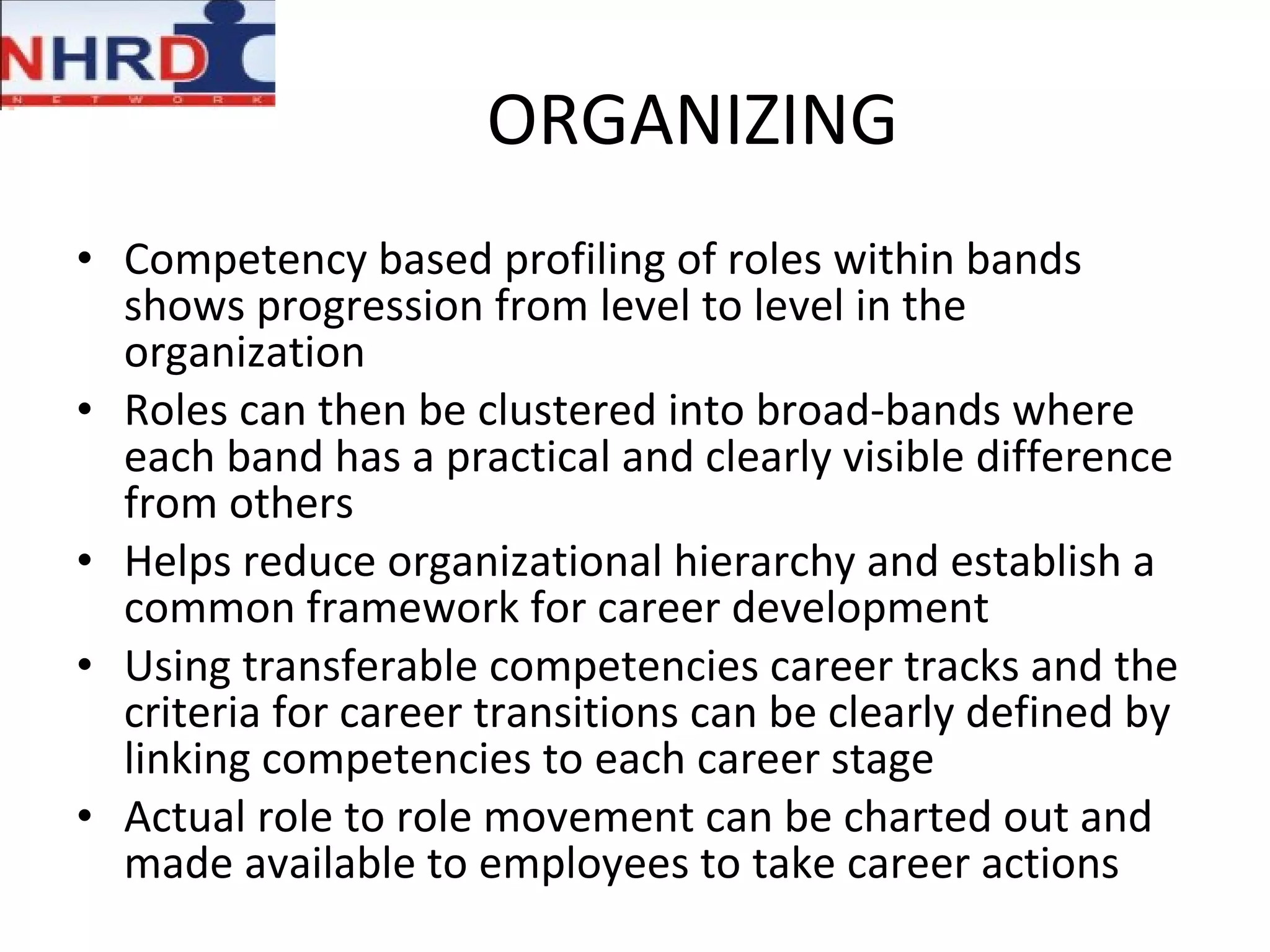
ORGANIZING Competency based profiling of roles within bands shows progression from level to level in the organization Roles can then be clustered into broad-bands where each band has a practical and clearly visible difference from others Helps reduce organizational hierarchy and establish a common framework for career development Using transferable competencies career tracks and the criteria for career transitions can be clearly defined by linking competencies to each career stage Actual role to role movement can be charted out and made available to employees to take career actions
TEA BREAK
LEARNING –  TRAINING AND CAREER DEVELOPMENT Captures the gap between current skill set of the workforce and required skill set Provides opportunity to identify/ develop specific training programmes by mapping them to competency gaps - identifies where the company should spend its training budget to achieve the greatest impact Puts career development responsibility and tools in the hands of the employee by making him responsible for his/ her own development - Required and achieved proficiency levels can be tracked by individual Gives the line managers a tool to empower them to develop people
PERFORMING Links results, expectations, and behavioral objectives to the business plan Provides managers with guidelines and resources Provides employees with clear understanding of the behaviors and skills to use in accomplishing results Establishes clear high performance standards - Competencies affect overall rating (along with achievement of results) Enables collection and proper analysis of factual data against the set standards Enables conducting of objective feedback meetings Provides direction with regard to specific areas of improvement
REWARDING Aligns pay systems to the goals/values of the organization Rewards an individual for acquiring valued skills and behaviors Serves as an input to merit pay increase decisions When competency ratings result in a shift in role, there is a pay implication linked to the role  Some organizations provide recognitionbonus (separate from short term incentives) for exemplary improvement/ demonstration of competencies Specific hot skill areas (especially in IT) are sometimes linked to hot skills bonuses
LINKING IT ALL…
Assessment and Tools
 
 
Thank you

HR Competency Workshop

  • 1.
  • 2.
    WHAT WILL WECOVER ? Understanding Competencies Why Competencies? Developing a Competency Model Linking Competency Model to HR Systems A look at HR Competencies – HR Compass Assessment and Tools
  • 3.
  • 4.
    SOME DEFINITIONS OFCOMPETENCIES Competency is an underlying characteristic of an employee (i.e., a motive, trait, skill, aspects of one’s self-image, social role, or a body of knowledge) which results in effective and/or superior performance. (Prof. Boyatzis, 1982) A Competency is a set of skills, related knowledge and attributes that allow an individual to successfully perform a task or an activity within a specific function or job. (UNIDO, 2002) Competencies are coachable, observable, measurable, and critical to successful individual or corporation performance.
  • 5.
  • 6.
  • 7.
  • 8.
    CLASSIFYING COMPETENCIES Universal Reflections of the company’s values, culture, and business imperatives that should be exhibited by all employees For example, guiding behaviors such as cost effective service delivery, customer focus, teamwork, communication skills, initiative Transferable Skills and abilities needed within several roles in varying degrees of importance and mastery For example, managerial and leadership skills Unique Specialized know-how or abilities required within a specific role or job For example, technical/ functional skills (Marketing Strategy, Drug Discovery)
  • 9.
  • 10.
  • 11.
    IMPORTANCE OF COMPETENCIESTool to meet Business Results Set performance expectations establishing common criteria for hiring, training, measuring, and rewarding people with the right capabilities to help the company gain competitive advantage
  • 12.
    IMPORTANCE OF COMPETENCIESRemind employees how they do things is as important as what they do Reward the person, not the job Identify gaps between current capabilities and future requirements Focus training and development efforts on areas with greatest need and/or impact Facilitate organizational change and building desired culture
  • 13.
  • 14.
    WHAT IS ACOMPETENCY MODEL? A competency model consists of: Competencies Proficiency Levels Behavioural Indicators Measurement approach Rating scale
  • 15.
  • 16.
    Steps in Developing a Competency Model
  • 17.
  • 18.
    A Look atHR Competencies – the HR COMPASS
  • 19.
    LET’S DISCUSS ANHR POSITION...... WHAT ARE THE EXPECTED OUTPUTS (KRA’S) OF THE JOB ? WHAT ARE THE EXPECTED BEHAVIORS THAT WILL LEAD TO SUCCESSFUL DELIVERY OF THE EXPECTED OUTPUTS ? WHAT KNOWLEDGE, SKILL & ABILITY WILL THIS POSITION NEED IN ORDER TO BE SUCCESSFUL ?
  • 20.
    Competencies ? Situation1 You are on tour far away from home. You get a phone call from your mother stating that the wash basin tap is broken and water is flowing. It is likely to flood into the room since the drain is also partially clogged. What will be your responses? What are the relevant competencies?
  • 21.
    Competencies ? Situation2 – Your close relative is admitted at hospital for a surgery in the eyes. After consulting several doctors, you have to finally zero down on a doctor to perform the surgery. Is there any competency required What are the 3 important competencies which you will look at?
  • 22.
    Competencies ? Situation3 You have been recruited by a CEO of a Organization as only HR professional which has 100 employees. This Organization is highly power intensive and has a 66 KV substation. You have an Electrical Engineer named Ramu, who is with your organization for the last 15 years. He takes care of the substation and all High voltage installations. Ramu is leaving the job. You have identified another candidate along with your CEO, who has committed to join on 1 March 2010. On 15 Feb 2010, the candidate informs that he is not joining. What will be your actions What are the relevant competencies
  • 23.
    Competencies in HR?Are there any competencies required for HR Professionals? Is there any competency required for Time Office personnel? Is there any competency required for person who is responsible for Personal files? What are the competencies required for the HR person responsible for Recruitment Training Performance Management Compensation & benefits etc
  • 24.
    Involved Professionals NHRDCII XLRI ACADEMIC SUPPORT Dr CSV Rathinam Prof Casimir Raj Prof Madhukar Sukla MOHIT GANDHI CII, SECRETARIAT, DELHI Prof R K Premarajan B Santhanam P Dwarakanath Satish Pradhan Aquil Busari Arvind Agarwal Anand Nayak Santrupt Misra Visty Banaji PLUS VIVEK PARANJPE RAVI VIRMANI C MAHALINGAM S VARADHARAJAN RANJAN ACHARYA R VIDYASAGAR PALLAB BANDOPADHYAYA P V R MURTHY PRINCE AUGUSTINE S Y SYDDIQUI ALLEN SEQUERIA RANJI ABRAHAM GERARD D’CUNHA P PADMAKUMAR B VENKATARAMANA N N AKHOURI HARSH BHOSALE L PRABHAKAR AMITA VIRMANI MAMTA PANDA M MUKHERJEE S MUKHERJEE A K CHOWDHURY Resource Group Work Group Leading the Initiative Support Group Academic Support VINEET KAUL D L SHARMA MARCEL PARKER G P RAO RAJENDRAN
  • 25.
    CONTEXT CONTEXT 2002Improve the Quality of HR Professionals Competent HR Professionals will Align to Business Needs Deliver HR Practice Impact Change Mgt 2003 2004 2005 2006 2007 2008 ADDED Severe Shortage of HR Professionals ie QUALITY & QUANTITY issue Develop HR Professionals at all levels Support Curriculum 2009 2010 2011 2012 ADDED Set standards in HR profession for development Develop HR Professionals at all levels To be the future Curriculum
  • 26.
    Human Resources ProfessionalsCompetencies Assessment Human Resources is highlighted with H & R in different colours Mariners’s Compass which indicates Direction Competencies required for an HR Professional to become the Star performer
  • 27.
    Human Resources ProfessionalsCompetencies Assessment Human Resources is highlighted with H & R in different colours Mariners’s Compass which indicates Direction Competencies required for an HR Professional to become the star performer
  • 28.
    HR FUNCTIONAL COMPETENCYIdentification of 11 functional Competencies Business Knowledge LEADERSHIP Personal Credibility HR Process Expertise Change Management Diversity Management Relationship Management Financial Perspective Strategic Thinking & Alignment Execution Excellence Service Orientation Employee Relationship HR CompMod
  • 29.
    Classified HR CompetenciesFunctional Behavioural Generic Behavioural Functional Technical Generic Technical
  • 30.
    Classified HR CompetenciesHR Planning & Staffing Performance Management Training & Development Talent Management Compensation & Benefit Managing Culture, Design & Change ER & Labour Laws Building HR Strategy International HRM Service Orientation Personal Credibility Execution Excellence Business Knowledge Financial Perspective Strategic Thinking & Alignment Change Orientation Networking Management Functional Behavioural Generic Behavioural Functional Technical Generic Technical
  • 31.
  • 32.
  • 33.
    Competencies - HAYGroup Knowledge (Know-How) Problem Solving (Skills & Competencies) Accountabilities Knowledge (Know-How) Technical Know-how Primary / Elementary Vocational / Vocational / Advanced vocational / Professional / Seasoned Professional / Professional Mastery / Exceptional Mastery Management Breadth Task / Activity / Related / Diverse / Total Human Relations Skills Standard / Important / Critical
  • 34.
    HAY Group ProblemSolving abilities (Skills & Competencies) Thinking Environment / Freedom to Think Strictly routine / Routine / Semi-Routine / Standardized / Clearly Defined / Broadly Defined / Generally Defined / Abstractly Defined Thinking Challenge Repetitive / Patterned / Variable / Adaptive / Unchartered
  • 35.
    HAY Group AccountabilitiesFreedom to Act Prescribed / Controlled / Standardized / Generally Regulated / Directed / Generally Directed / Guided Nature of Impact Minimal / Limited / Important / Critical Indirect (Remote / Contributory) & Direct (Shared / Prime) Magnitude Intermediate / Very small / Small / Medium / Large
  • 36.
    Levels of CompetencyDefinition BASIC COMPETENT ADVANCED EXPERT Understands concepts, Principles, Philosophy Needs guidance to practice May not have experience Is an Independent contributor Has applied / practiced at Moderate levels No large scale experience Has Teaching ability Is a proven coach / guide Has put into practice Has large scale experience Possess thought leadership People look up at him for reference Generates new ideas Is an innovator Outstanding Satisfactory Desirable Basic Below Basic
  • 37.
    Instruments & Tools Philosophy & Principles Value Systems, Codes & Protocols, People Policy, Philosophy w.r.t People Frame work Mckenzie 7S –Frame work HRCompass – HR Professionals Hofstede – Organization Culture HR Excellence Frame work TQM Pillars Methodology HR Policies Guidelines / File Notes Training Design to Delivery Execution Achieve desire Result, completed document, Updated processes, Customer feedback 1 2 3 4 5 Company Application Assessments Psychometric Assessments Interview Assessment Forms Interview Question bank Training Calendar Training Feedback etc Steps for career progression in HR SOP
  • 38.
  • 39.
    Competency Mapping CompetenciesRole Training Manager Recruitment Officer Employee Engagement Executive Admin Manager Head - HR ORGANISATION DEVELOPMENT PERFORMANCE MANAGEMENT COMPENSATION & BENEFITS INTERNATIONAL HUMAN RESOURCES MANAGEMENT TRAINING & DEVELOPMENT EMPLOYEE RELATIONS BUILDING HR STRATEGY HR PLANNING & STAFFING TALENT MANAGEMENT BUSINESS KNOWLEDGE FINANCIAL PERSPECTIVE SERVICE ORIENTATION PERSONAL CREDIBILITY EXECUTION EXCELLENCE STRATEGIC THINKING NETWORKING CHANGE MANAGEMENT
  • 40.
  • 41.
    Linking Competency Models to HR Systems Staffing Organizing Learning Performing Rewarding
  • 42.
    WHERE ARE THESEUSED IN HR PROCESSES?
  • 43.
    Establishes profiles outliningrequirements for each job/role “ Discovers” qualified candidates who do not fit the “stereotype” Competency based interviews reduce the risk of making a costly hiring mistake and increase the likelihood of identifying and selecting the right person for the right job Decreases unproductive downtime of new employees Decreases turnover among new employees Determines training needs at job entry Monitors performance of new employees STAFFING – SELECTION AND RECRUITMENT
  • 44.
    ORGANIZING Competency basedprofiling of roles within bands shows progression from level to level in the organization Roles can then be clustered into broad-bands where each band has a practical and clearly visible difference from others Helps reduce organizational hierarchy and establish a common framework for career development Using transferable competencies career tracks and the criteria for career transitions can be clearly defined by linking competencies to each career stage Actual role to role movement can be charted out and made available to employees to take career actions
  • 45.
  • 46.
    LEARNING – TRAINING AND CAREER DEVELOPMENT Captures the gap between current skill set of the workforce and required skill set Provides opportunity to identify/ develop specific training programmes by mapping them to competency gaps - identifies where the company should spend its training budget to achieve the greatest impact Puts career development responsibility and tools in the hands of the employee by making him responsible for his/ her own development - Required and achieved proficiency levels can be tracked by individual Gives the line managers a tool to empower them to develop people
  • 47.
    PERFORMING Links results,expectations, and behavioral objectives to the business plan Provides managers with guidelines and resources Provides employees with clear understanding of the behaviors and skills to use in accomplishing results Establishes clear high performance standards - Competencies affect overall rating (along with achievement of results) Enables collection and proper analysis of factual data against the set standards Enables conducting of objective feedback meetings Provides direction with regard to specific areas of improvement
  • 48.
    REWARDING Aligns paysystems to the goals/values of the organization Rewards an individual for acquiring valued skills and behaviors Serves as an input to merit pay increase decisions When competency ratings result in a shift in role, there is a pay implication linked to the role Some organizations provide recognitionbonus (separate from short term incentives) for exemplary improvement/ demonstration of competencies Specific hot skill areas (especially in IT) are sometimes linked to hot skills bonuses
  • 49.
  • 50.
  • 51.
  • 52.
  • 53.

Editor's Notes

  • #2 Get expectations and list them.
  • #10 Give them the worksheets to put down competencies for these and categorize them.
  • #12 Why competencies? What would those competencies achieve?
  • #30 Get them to identify competencies under each of these.
  • #37 Get them to come up with what they think is each level?
  • #38 Finish by 2 pm
  • #40 Use the worksheet given to them to map required competencies.
  • #41 Shyam will do this.
  • #51 Mapping exercise.