BEST PRACTICE STRATEGIC 
WORKFORCE/TALENT PLANNING 
(SWP) 
CHARLES COTTER 
20 NOVEMBER 2014 
SANDTON CONVENTION CENTRE
SCOPE OF PRESENTATION 
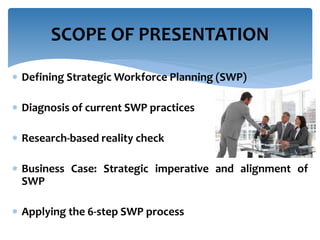
 Defining StrategicWorkforce Planning (SWP) 
 Diagnosis of current SWP practices 
 Research-based reality check 
 Business Case: Strategic imperative and alignment of 
SWP 
 Applying the 6-step SWP process
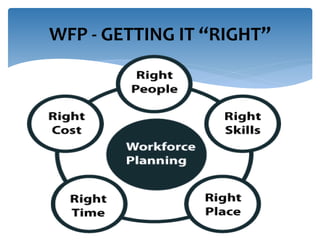
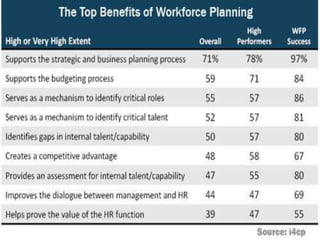
WFP - GETTING IT “RIGHT”
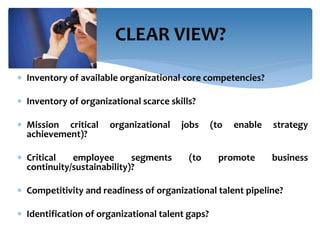
CLEAR VIEW? 
 Inventory of available organizational core competencies? 
 Inventory of organizational scarce skills? 
 Mission critical organizational jobs (to enable strategy 
achievement)? 
 Critical employee segments (to promote business 
continuity/sustainability)? 
 Competitivity and readiness of organizational talent pipeline? 
 Identification of organizational talent gaps?
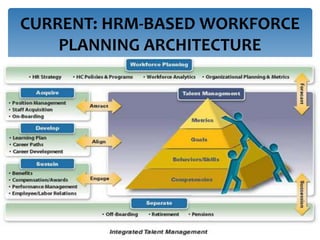
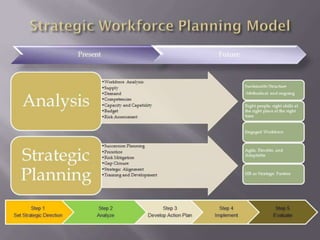
CURRENT: HRM-BASED WORKFORCE 
PLANNING ARCHITECTURE
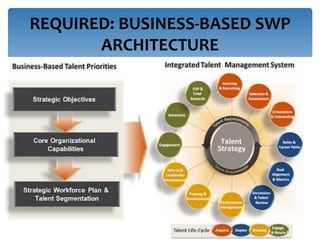
REQUIRED: BUSINESS-BASED SWP 
ARCHITECTURE
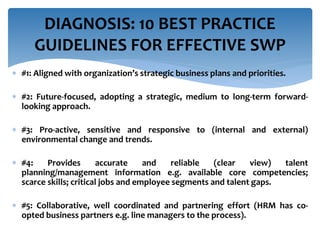
DIAGNOSIS: 10 BEST PRACTICE 
GUIDELINES FOR EFFECTIVE SWP 
 #1: Aligned with organization’s strategic business plans and priorities. 
 #2: Future-focused, adopting a strategic, medium to long-term forward-looking 
approach. 
 #3: Pro-active, sensitive and responsive to (internal and external) 
environmental change and trends. 
 #4: Provides accurate and reliable (clear view) talent 
planning/management information e.g. available core competencies; 
scarce skills; critical jobs and employee segments and talent gaps. 
 #5: Collaborative, well coordinated and partnering effort (HRM has co-opted 
business partners e.g. line managers to the process).
DIAGNOSIS: 10 BEST PRACTICE 
GUIDELINES FOR EFFECTIVE SWP 
 #6: Integrated (bundled) with other HR value chain processes e.g. 
Recruitment, Succession Planning, Retention and Leadership Development. 
 #7: Generates meaningful business intelligence which shapes, informs and 
influences business planning and supports strategic decision-making. 
 #8: Integrates both scientific (HRM metrics, predictive analytics and 
strategy maps) with artistic (planning) principles. 
 #9: Dynamic - regularly and systematically monitored, reviewed, evaluated 
and adapted (committed to continuous improvement processes). 
 #10: Yields a positive ROI, with tangible/demonstrable outcomes and 
impact i.e. creates sustainable HCM competitive advantages
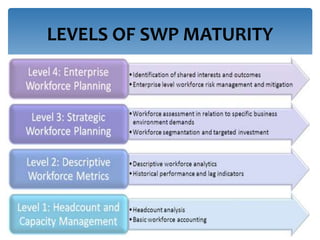
LEVELS OF SWP MATURITY
RESEARCH-BASED (BERSIN) REALITY 
CHECK 
 Although 92% of companies have some level of workforce planning, only 21% 
take a strategic, long-term approach to addressing the talent demand, talent 
supply and the actions necessary to close the gap between the two. 
 Only 11% of organizations have currently reached Level 3 of Maturity. 
 Only 10% have reached Level 4. 
 Although best-practice companies align workforce planning as an integral part 
of their business and financial planning, 67% of companies at every level still 
conduct workforce planning on an “as-needed” basis. 
 Only 25% of workforce plans are effective at helping business leaders forecast 
revenue and operating budgets. 
 Only 27% of workforce planning processes are conducted by recruiting and 
staffing departments . The majority of workforce planning processes are owned 
by individual business leaders – so they are disjointed from recruiting and even 
HRM.
THE STRATEGIC IMPERATIVE OF 
WORKFORCE PLANNING 
 “Strategic workforce planning helps organizations understand the talent 
required to deliver their strategy – without it, the costs are significant.” (Hay 
Group UK) 
 “A talented and aligned workforce is crucial for bringing strategy to life and 
ensuring an organization delivers on its objectives” (Hay Group UK) 
 “Bringing together the right information with the right people will 
dramatically improve a company’s ability to develop and act on strategic 
business opportunities” (Bill Gates) 
 “CEO’s expect the Human Resources function to play a much more active role 
in enabling business strategies.” (Deloitte, 2013) 
 “A company’s employees are its greatest asset and your people are your 
product .” (Richard Branson)
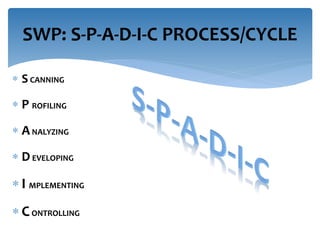
SWP: S-P-A-D-I-C PROCESS/CYCLE 
 S CANNING 
 P ROFILING 
 ANALYZING 
 DEVELOPING 
 I MPLEMENTING 
 CONTROLLING
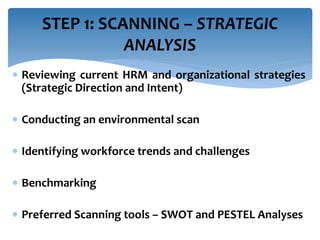
STEP 1: SCANNING – STRATEGIC 
ANALYSIS 
 Reviewing current HRM and organizational strategies 
(Strategic Direction and Intent) 
 Conducting an environmental scan 
 Identifying workforce trends and challenges 
 Benchmarking 
 Preferred Scanning tools – SWOT and PESTEL Analyses
STEP 2: PROFILING 
 Forecasting HR Demand (Futuring) 
 Measuring Current Supply
FUTURING 
 "Futuring is the field of using a systematic process for thinking about, 
picturing possible outcomes, and planning for the future. Futurists are 
people who actively view the present world as a window on possible 
future outcomes. They watch trends and try to envision what might 
happen.“ (Kirkwood, 2011) 
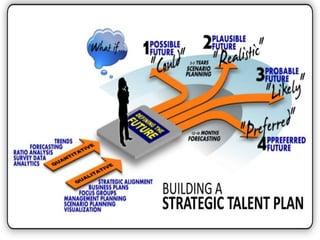
 Futuring is a broader concept than the forecasting traditionally done 
in Workforce Planning and enables organizations to look at the future 
in four different ways (Cillie-Schmidt, 2013): 
 The possible future - what could happen? 
 The plausible future - what could realistically happen? 
 The probable future - what is likely to happen? 
 The preferred future - what we want to happen?
FORECASTING HR DEMAND 
 Forecasting should consider the past and the present 
requirements as well as future organizational directions 
Number of employees 
Type of employees 
Skills requirements of these employees 
 Consider and assess the challenges and constraints 
 Preferred Scanning tools –”What If” and Scenario Planning
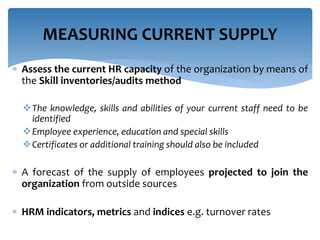
MEASURING CURRENT SUPPLY 
 Assess the current HR capacity of the organization by means of 
the Skill inventories/audits method 
The knowledge, skills and abilities of your current staff need to be 
identified 
Employee experience, education and special skills 
Certificates or additional training should also be included 
 A forecast of the supply of employees projected to join the 
organization from outside sources 
 HRM indicators, metrics and indices e.g. turnover rates
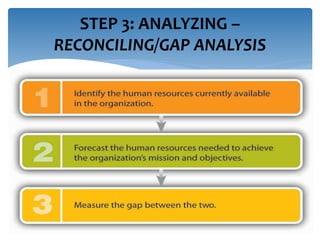
STEP 3: ANALYZING – 
RECONCILING/GAP ANALYSIS
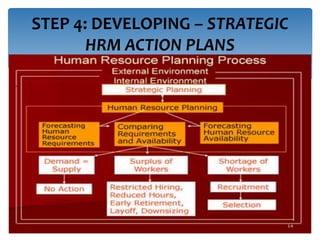
STEP 4: DEVELOPING – STRATEGIC 
HRM ACTION PLANS
STEP 5: IMPLEMENTING - 
INTERVENTIONS 
 Develop and initiate a Resourcing Strategy 
 Matching strategy (intervention) with scenario (surplus or 
deficit) 
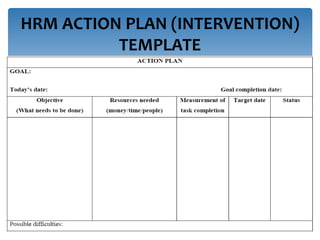
 Action plan-based implementation methodology
HRM ACTION PLAN (INTERVENTION) 
TEMPLATE
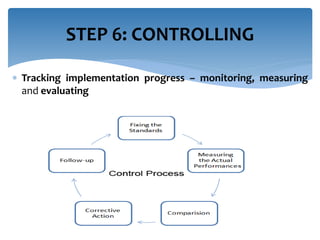
STEP 6: CONTROLLING 
 Tracking implementation progress – monitoring, measuring 
and evaluating
LEADERSHIP LESSONS: “TAKE-AWAYS” 
– SWP AND ALIGNMENT 
 SWP – getting it “right” 
 HRM requires a clear view 
 The strategic imperative of SWP 
 Alignment of SWP and business strategy 
 Application of best practice principles 
 Application of 6-step SPADIC SWP process
CONTACT DETAILS 
 CHARLES COTTER 
 084 562 9446 
 charlescot@polka.co.za 
 LINKED IN 
 TWITTER: Charles_Cotter

Strategic Workforce Planning_20 November 2014

  • 1.
    BEST PRACTICE STRATEGIC WORKFORCE/TALENT PLANNING (SWP) CHARLES COTTER 20 NOVEMBER 2014 SANDTON CONVENTION CENTRE
  • 2.
    SCOPE OF PRESENTATION  Defining StrategicWorkforce Planning (SWP)  Diagnosis of current SWP practices  Research-based reality check  Business Case: Strategic imperative and alignment of SWP  Applying the 6-step SWP process
  • 3.
    WFP - GETTINGIT “RIGHT”
  • 6.
    CLEAR VIEW? Inventory of available organizational core competencies?  Inventory of organizational scarce skills?  Mission critical organizational jobs (to enable strategy achievement)?  Critical employee segments (to promote business continuity/sustainability)?  Competitivity and readiness of organizational talent pipeline?  Identification of organizational talent gaps?
  • 7.
    CURRENT: HRM-BASED WORKFORCE PLANNING ARCHITECTURE
  • 8.
  • 9.
    DIAGNOSIS: 10 BESTPRACTICE GUIDELINES FOR EFFECTIVE SWP  #1: Aligned with organization’s strategic business plans and priorities.  #2: Future-focused, adopting a strategic, medium to long-term forward-looking approach.  #3: Pro-active, sensitive and responsive to (internal and external) environmental change and trends.  #4: Provides accurate and reliable (clear view) talent planning/management information e.g. available core competencies; scarce skills; critical jobs and employee segments and talent gaps.  #5: Collaborative, well coordinated and partnering effort (HRM has co-opted business partners e.g. line managers to the process).
  • 10.
    DIAGNOSIS: 10 BESTPRACTICE GUIDELINES FOR EFFECTIVE SWP  #6: Integrated (bundled) with other HR value chain processes e.g. Recruitment, Succession Planning, Retention and Leadership Development.  #7: Generates meaningful business intelligence which shapes, informs and influences business planning and supports strategic decision-making.  #8: Integrates both scientific (HRM metrics, predictive analytics and strategy maps) with artistic (planning) principles.  #9: Dynamic - regularly and systematically monitored, reviewed, evaluated and adapted (committed to continuous improvement processes).  #10: Yields a positive ROI, with tangible/demonstrable outcomes and impact i.e. creates sustainable HCM competitive advantages
  • 11.
    LEVELS OF SWPMATURITY
  • 12.
    RESEARCH-BASED (BERSIN) REALITY CHECK  Although 92% of companies have some level of workforce planning, only 21% take a strategic, long-term approach to addressing the talent demand, talent supply and the actions necessary to close the gap between the two.  Only 11% of organizations have currently reached Level 3 of Maturity.  Only 10% have reached Level 4.  Although best-practice companies align workforce planning as an integral part of their business and financial planning, 67% of companies at every level still conduct workforce planning on an “as-needed” basis.  Only 25% of workforce plans are effective at helping business leaders forecast revenue and operating budgets.  Only 27% of workforce planning processes are conducted by recruiting and staffing departments . The majority of workforce planning processes are owned by individual business leaders – so they are disjointed from recruiting and even HRM.
  • 13.
    THE STRATEGIC IMPERATIVEOF WORKFORCE PLANNING  “Strategic workforce planning helps organizations understand the talent required to deliver their strategy – without it, the costs are significant.” (Hay Group UK)  “A talented and aligned workforce is crucial for bringing strategy to life and ensuring an organization delivers on its objectives” (Hay Group UK)  “Bringing together the right information with the right people will dramatically improve a company’s ability to develop and act on strategic business opportunities” (Bill Gates)  “CEO’s expect the Human Resources function to play a much more active role in enabling business strategies.” (Deloitte, 2013)  “A company’s employees are its greatest asset and your people are your product .” (Richard Branson)
  • 16.
    SWP: S-P-A-D-I-C PROCESS/CYCLE  S CANNING  P ROFILING  ANALYZING  DEVELOPING  I MPLEMENTING  CONTROLLING
  • 17.
    STEP 1: SCANNING– STRATEGIC ANALYSIS  Reviewing current HRM and organizational strategies (Strategic Direction and Intent)  Conducting an environmental scan  Identifying workforce trends and challenges  Benchmarking  Preferred Scanning tools – SWOT and PESTEL Analyses
  • 18.
    STEP 2: PROFILING  Forecasting HR Demand (Futuring)  Measuring Current Supply
  • 19.
    FUTURING  "Futuringis the field of using a systematic process for thinking about, picturing possible outcomes, and planning for the future. Futurists are people who actively view the present world as a window on possible future outcomes. They watch trends and try to envision what might happen.“ (Kirkwood, 2011)  Futuring is a broader concept than the forecasting traditionally done in Workforce Planning and enables organizations to look at the future in four different ways (Cillie-Schmidt, 2013):  The possible future - what could happen?  The plausible future - what could realistically happen?  The probable future - what is likely to happen?  The preferred future - what we want to happen?
  • 21.
    FORECASTING HR DEMAND  Forecasting should consider the past and the present requirements as well as future organizational directions Number of employees Type of employees Skills requirements of these employees  Consider and assess the challenges and constraints  Preferred Scanning tools –”What If” and Scenario Planning
  • 22.
    MEASURING CURRENT SUPPLY  Assess the current HR capacity of the organization by means of the Skill inventories/audits method The knowledge, skills and abilities of your current staff need to be identified Employee experience, education and special skills Certificates or additional training should also be included  A forecast of the supply of employees projected to join the organization from outside sources  HRM indicators, metrics and indices e.g. turnover rates
  • 23.
    STEP 3: ANALYZING– RECONCILING/GAP ANALYSIS
  • 24.
    STEP 4: DEVELOPING– STRATEGIC HRM ACTION PLANS
  • 25.
    STEP 5: IMPLEMENTING- INTERVENTIONS  Develop and initiate a Resourcing Strategy  Matching strategy (intervention) with scenario (surplus or deficit)  Action plan-based implementation methodology
  • 26.
    HRM ACTION PLAN(INTERVENTION) TEMPLATE
  • 27.
    STEP 6: CONTROLLING  Tracking implementation progress – monitoring, measuring and evaluating
  • 28.
    LEADERSHIP LESSONS: “TAKE-AWAYS” – SWP AND ALIGNMENT  SWP – getting it “right”  HRM requires a clear view  The strategic imperative of SWP  Alignment of SWP and business strategy  Application of best practice principles  Application of 6-step SPADIC SWP process
  • 29.
    CONTACT DETAILS CHARLES COTTER  084 562 9446  charlescot@polka.co.za  LINKED IN  TWITTER: Charles_Cotter