1


Short Notes: Mgt 603

STRATEGIC MANAGEMENT
Lecture No. 23
    Strategy Analysis And Choice
Strategic Management: Concepts and Cases. 9th edition
Fred R. David
PowerPoint Slides by Anthony F. Chelte Western New England College
Chapter Outline
•      The Nature of Strategy Analysis and Choice
•      A Comprehensive Strategy-Formulation Framework
•      The Input Stage
•      The Matching Stage
•      The Decision Stage
•      Cultural Aspects of Strategy Choice
•      The Politics of Strategy Choice
•      The Role of a Board of Directors
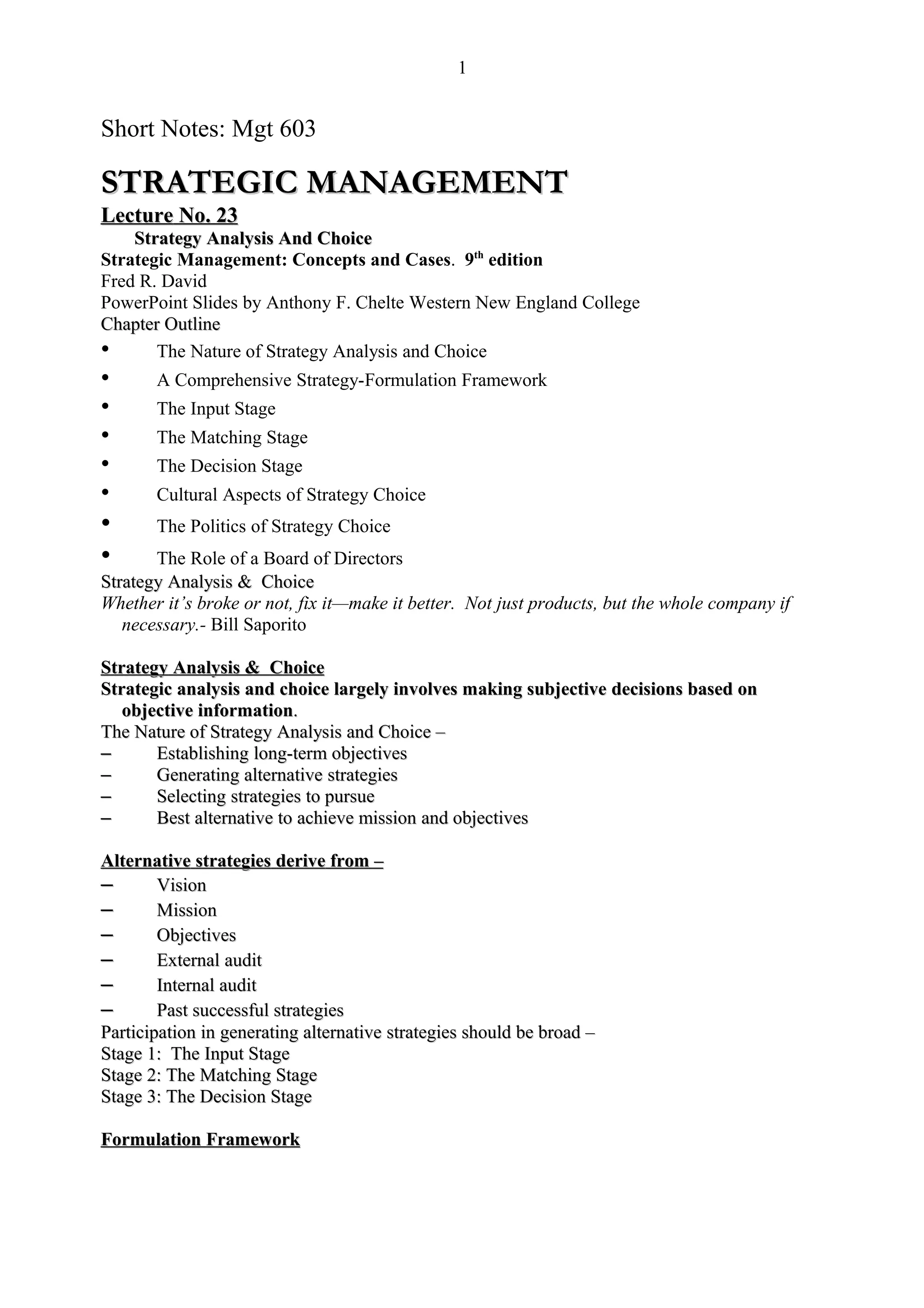
Strategy Analysis & Choice
Whether it’s broke or not, fix it—make it better. Not just products, but the whole company if
   necessary.- Bill Saporito

Strategy Analysis & Choice
Strategic analysis and choice largely involves making subjective decisions based on
   objective information.
             information.
The Nature of Strategy Analysis and Choice –
–      Establishing long-term objectives
–      Generating alternative strategies
–      Selecting strategies to pursue
–      Best alternative to achieve mission and objectives

Alternative strategies derive from –
–       Vision
–       Mission
–       Objectives
–       External audit
–       Internal audit
–       Past successful strategies
Participation in generating alternative strategies should be broad –
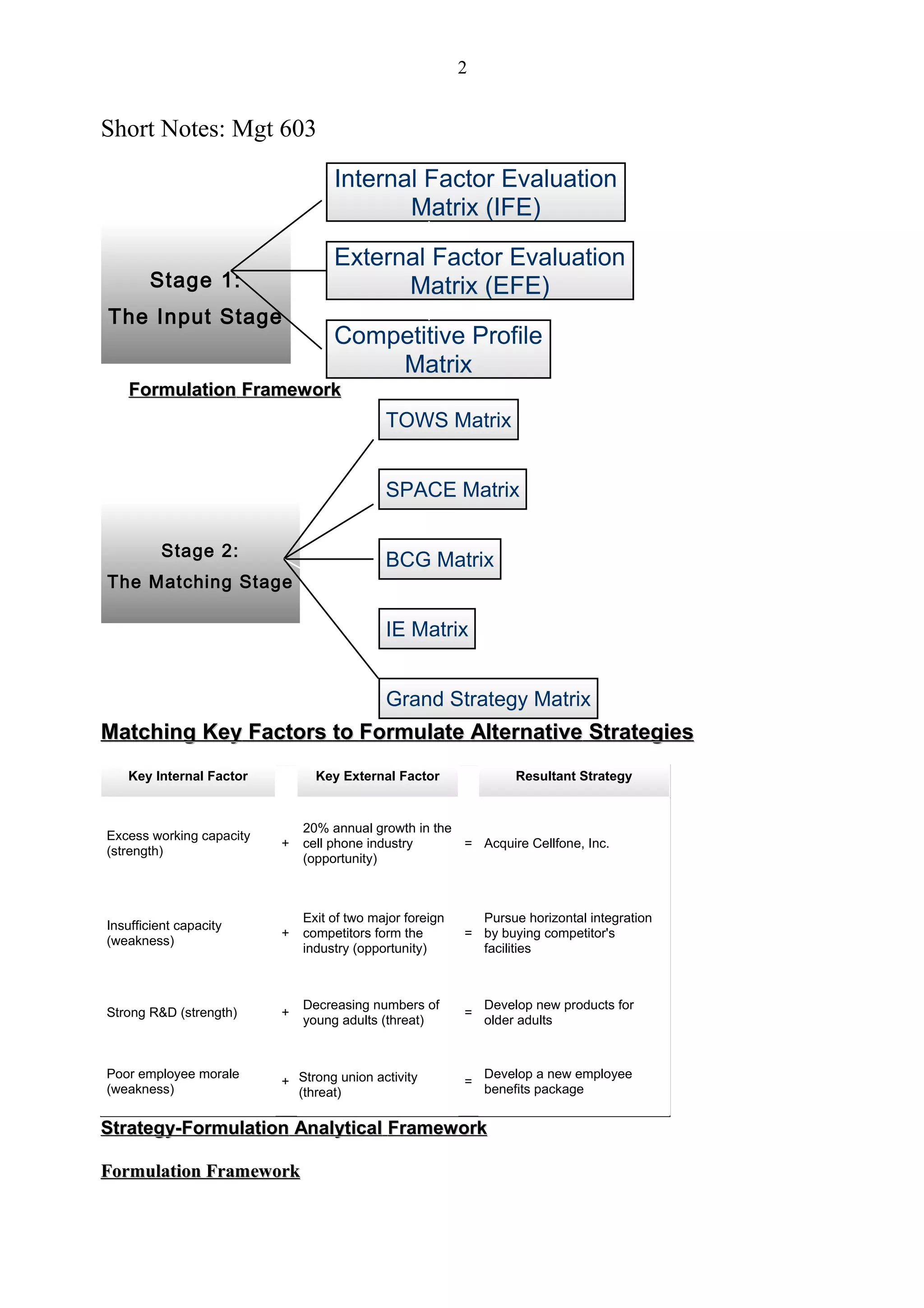
Stage 1: The Input Stage
Stage 2: The Matching Stage
Stage 3: The Decision Stage

Formulation Framework
2


Short Notes: Mgt 603

                                   Internal Factor Evaluation
                                          Matrix (IFE)

                                   External Factor Evaluation
       Stage 1:                          Matrix (EFE)
The Input Stage
                                   Competitive Profile
                                       Matrix
    Formulation Framework
                                            TOWS Matrix


                                            SPACE Matrix

         Stage 2:
                                            BCG Matrix
The Matching Stage

                                            IE Matrix


                                            Grand Strategy Matrix
Matching Key Factors to Formulate Alternative Strategies
   Key Internal Factor          Key External Factor                Resultant Strategy


                              20% annual growth in the
Excess working capacity
                          +   cell phone industry      = Acquire Cellfone, Inc.
(strength)
                              (opportunity)


                              Exit of two major foreign     Pursue horizontal integration
Insufficient capacity
                          +   competitors form the        = by buying competitor's
(weakness)
                              industry (opportunity)        facilities


                              Decreasing numbers of           Develop new products for
Strong R&D (strength)     +                               =
                              young adults (threat)           older adults


Poor employee morale                                          Develop a new employee
                          + Strong union activity         =
(weakness)                  (threat)                          benefits package


Strategy-Formulation Analytical Framework

Formulation Framework
3


Short Notes: Mgt 603


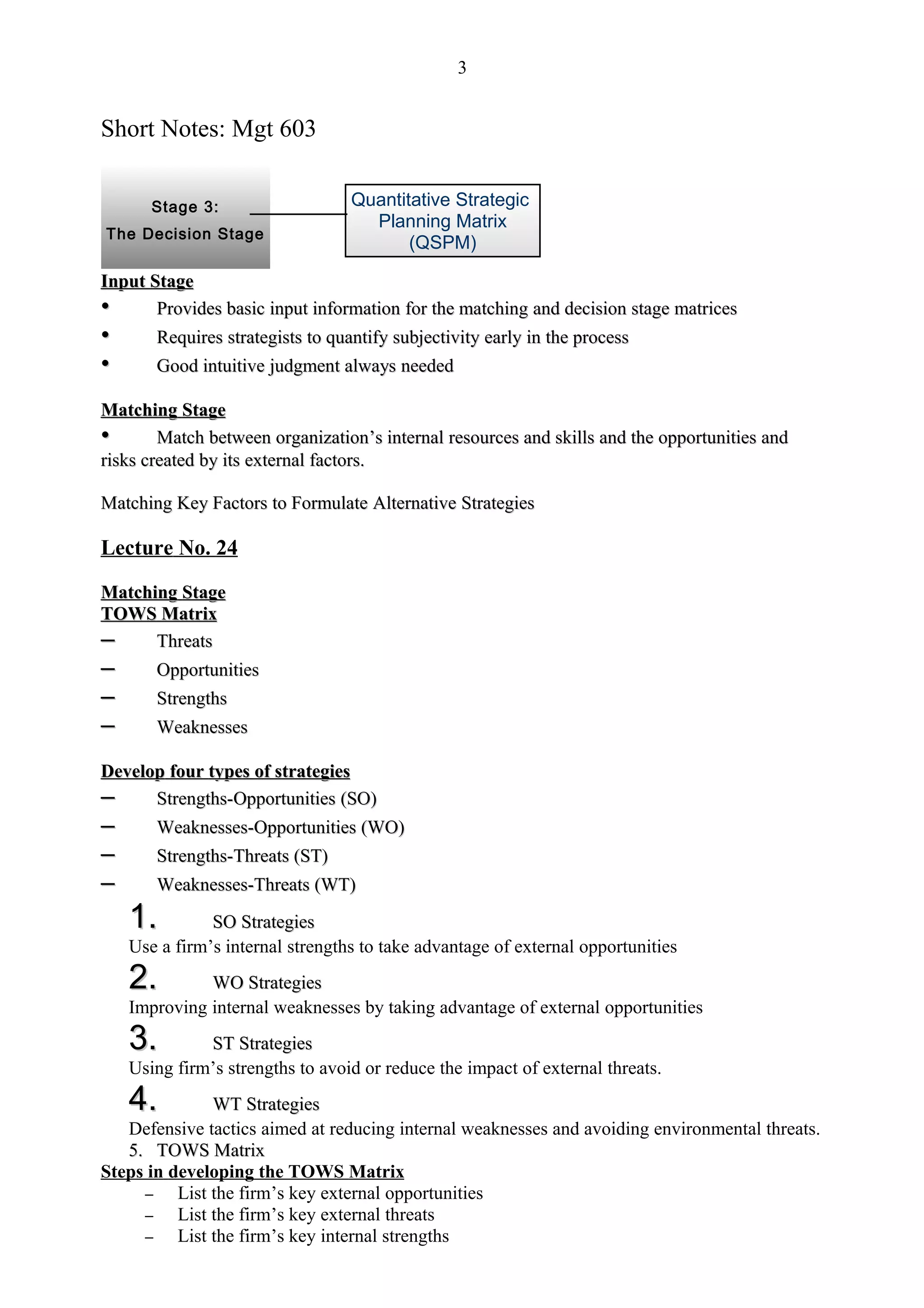
       Stage 3:                   Quantitative Strategic
                                    Planning Matrix
The Decision Stage
                                         (QSPM)

Input Stage
•      Provides basic input information for the matching and decision stage matrices
•      Requires strategists to quantify subjectivity early in the process
•      Good intuitive judgment always needed

Matching Stage
•       Match between organization’s internal resources and skills and the opportunities and
                         organization’
risks created by its external factors.

Matching Key Factors to Formulate Alternative Strategies

Lecture No. 24

Matching Stage
TOWS Matrix
–     Threats
–     Opportunities
–      Strengths
–      Weaknesses

Develop four types of strategies
–     Strengths-Opportunities (SO)
–      Weaknesses-Opportunities (WO)
–      Strengths-Threats (ST)
–      Weaknesses-Threats (WT)

    1.         SO Strategies
    Use a firm’s internal strengths to take advantage of external opportunities
    2.        WO Strategies
    Improving internal weaknesses by taking advantage of external opportunities
    3.        ST Strategies
    Using firm’s strengths to avoid or reduce the impact of external threats.
    4.         WT Strategies
   Defensive tactics aimed at reducing internal weaknesses and avoiding environmental threats.
   5. TOWS Matrix
Steps in developing the TOWS Matrix
     –    List the firm’s key external opportunities
     –    List the firm’s key external threats
     –    List the firm’s key internal strengths
4


Short Notes: Mgt 603
     –    List the firm’s key internal weaknesses

TOWS Matrix

Developing the TOWS Matrix
•   Match internal strengths with external opportunities and record the resultant SO Strategies
•   Match internal weaknesses with external opportunities and record the resultant WO
    Strategies
•   Match internal strengths with external threats and record the resultant ST Strategies
•   Match internal weaknesses with external threats and record the resultant WT Strategies
   Leave Blank               Strengths-S               Weaknesses-W

                              List Strengths              List Weaknesses


 Opportunities-O            SO Strategies               WO Strategies

   List Opportunities     Use strengths to take        Overcome weaknesses
                        advantage of opportunities     by taking advantage of
                                                            opportunities


     Threats-T              ST Strategies               WT Strategies

      List Threats        Use strengths to avoid       Minimize weaknesses
                                  threats                and avoid threats


Lecture No, 25-26

Formulation Framework
SPACE Matrix
Strategic Position and Action Evaluation Matrix
    Four quadrant framework
    Determines appropriate strategies
       Aggressive
       Conservative
       Defensive
       Competitive

Two Internal Dimensions
      Financial Strength [FS]
      Competitive Advantage [CA]

Two External Dimensions
     Environmental Stability [ES]
     Industry Strength [IS]

Overall Strategic position determined by:
    – Financial Strength [FS]
    – Competitive Advantage [CA]
    – Environmental Stability [ES]
5


Short Notes: Mgt 603
     – Industry Strength [IS]

Developing the SPACE Matrix:
• EFE Matrix
• IFE Matrix
• Financial Strength
• Competitive Advantage
• Environmental Stability
• Industry Strength
• Select variables to define FS, CA, ES, & IS
• Assign numerical ranking from +1 (worst) to +6 (best) for FS and IS; Assign numerical
    ranking from –1 (best) to –6 (worst) for ES and CA.
• Compute average score for FS, CA, ES, & IS
• Plot the average scores on the Matrix
• Add the two scores on the x-axis and plot point on X. Add the scores on the y-axis and plot
    Y. Plot the intersection of the new xy point.
• Draw a directional vector from origin through the new intersection point.
•      SPACE Factors
Internal Strategic Position                       External Strategic Position
Financial Strength (FS)                           Environmental Stability (ES)
Return on investment                              Technological changes
Leverage                                          Rate of inflation
Liquidity                                         Demand variability
Working capital                                   Price range of competing products
Cash flow                                         Barriers to entry
Ease of exit from market                          Competitive pressure
Risk involved in business                         Price elasticity of demand


      Internal Strategic Position                 External Strategic Position
Competitive Advantage CA                          Industry Strength (IS)
Market share                                      Growth potential
Product quality                                   Profit potential
Product life cycle                                Financial stability
Customer loyalty                                  Technological know-how
Competition’s capacity utilization                Resource utilization
Technological know-how                            Capital intensify
Control over suppliers & distributors             Ease of entry into market
                                                  Productivity, capacity utilization


SPACE Matrix
6


Short Notes: Mgt 603
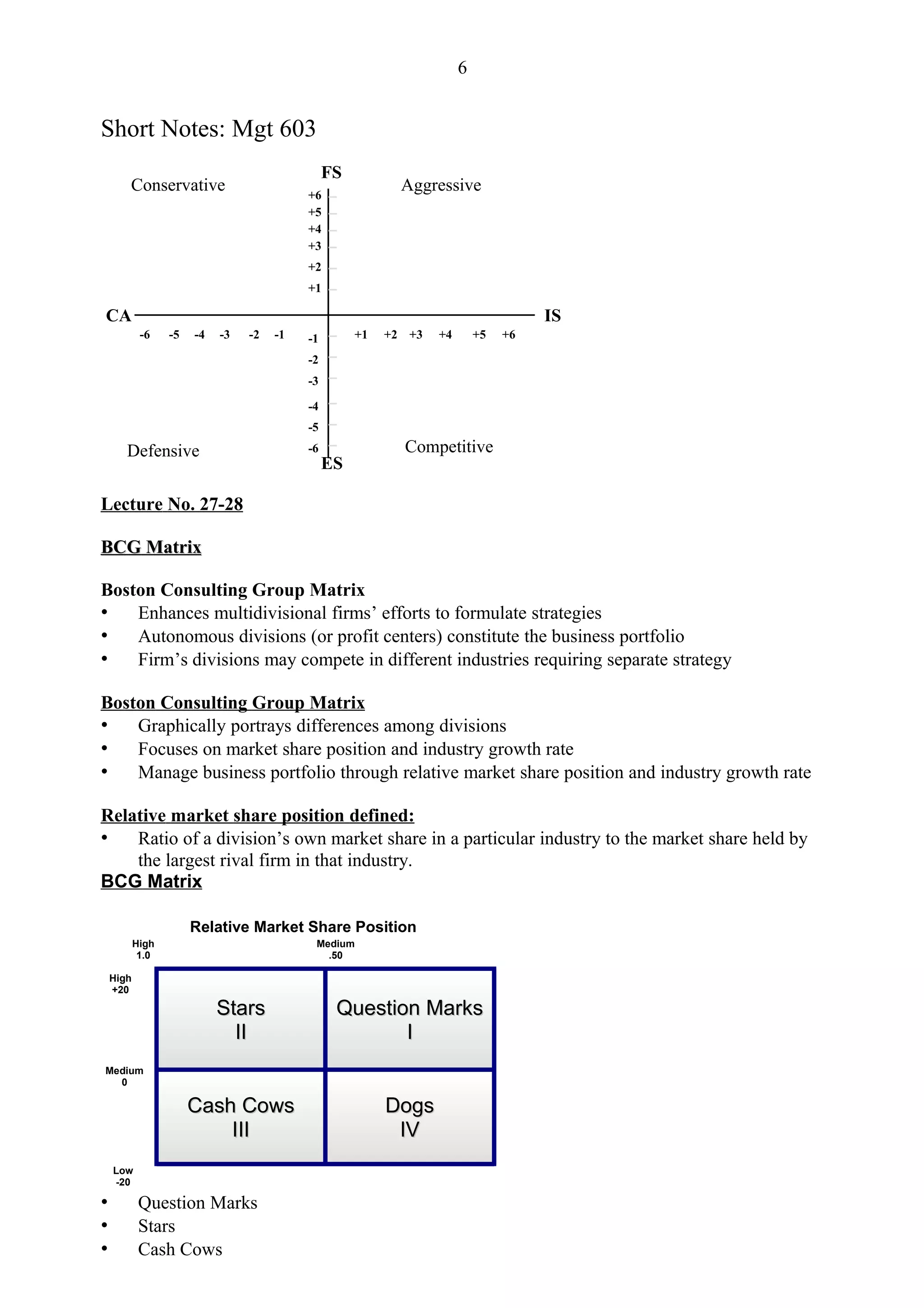
                                                FS
       Conservative                        +6
                                                            Aggressive
                                           +5
                                           +4
                                           +3
                                           +2
                                           +1

CA                                                                                     IS
            -6    -5   -4   -3   -2   -1   -1        +1   +2 +3   +4       +5   +6

                                           -2
                                           -3

                                           -4
                                           -5

       Defensive                           -6               Competitive
                                                ES

Lecture No. 27-28

BCG Matrix

Boston Consulting Group Matrix
• Enhances multidivisional firms’ efforts to formulate strategies
• Autonomous divisions (or profit centers) constitute the business portfolio
• Firm’s divisions may compete in different industries requiring separate strategy

Boston Consulting Group Matrix
• Graphically portrays differences among divisions
• Focuses on market share position and industry growth rate
• Manage business portfolio through relative market share position and industry growth rate

Relative market share position defined:
• Ratio of a division’s own market share in a particular industry to the market share held by
    the largest rival firm in that industry.
BCG Matrix

                       Relative Market Share Position
           High                             Medium                              Low
            1.0                               .50                                0.0

    High
    +20

                            Stars                Question Marks
                              II                        I
Medium
  0

                       Cash Cows                          Dogs
                           III                             IV
    Low
    -20

•           Question Marks
•           Stars
•           Cash Cows
7


Short Notes: Mgt 603
•   Dogs
Question Marks
      • Low relative market share position yet compete in high-growth industry.
         • Cash needs are high
         • Case generation is low
      • Decision to strengthen (intensive strategies) or divest
Stars
      • High relative market share and high industry growth rate.
         • Best long-run opportunities for growth and profitability
      • Substantial investment to maintain or strengthen dominant position
         • Integration strategies, intensive strategies, joint ventures

Cash Cows
     • High relative market share position, but compete in low-growth industry
        • Generate cash in excess of their needs
        • Milked for other purposes
     • Maintain strong position as long as possible
        • Product development, concentric diversification
        • If becomes weak—retrenchment or divestiture
Dogs
     • Low relative market share position and compete in slow or no market growth
        • Weak internal and external position
     • Decision to liquidate, divest, retrenchment

Lecture No. 29-30

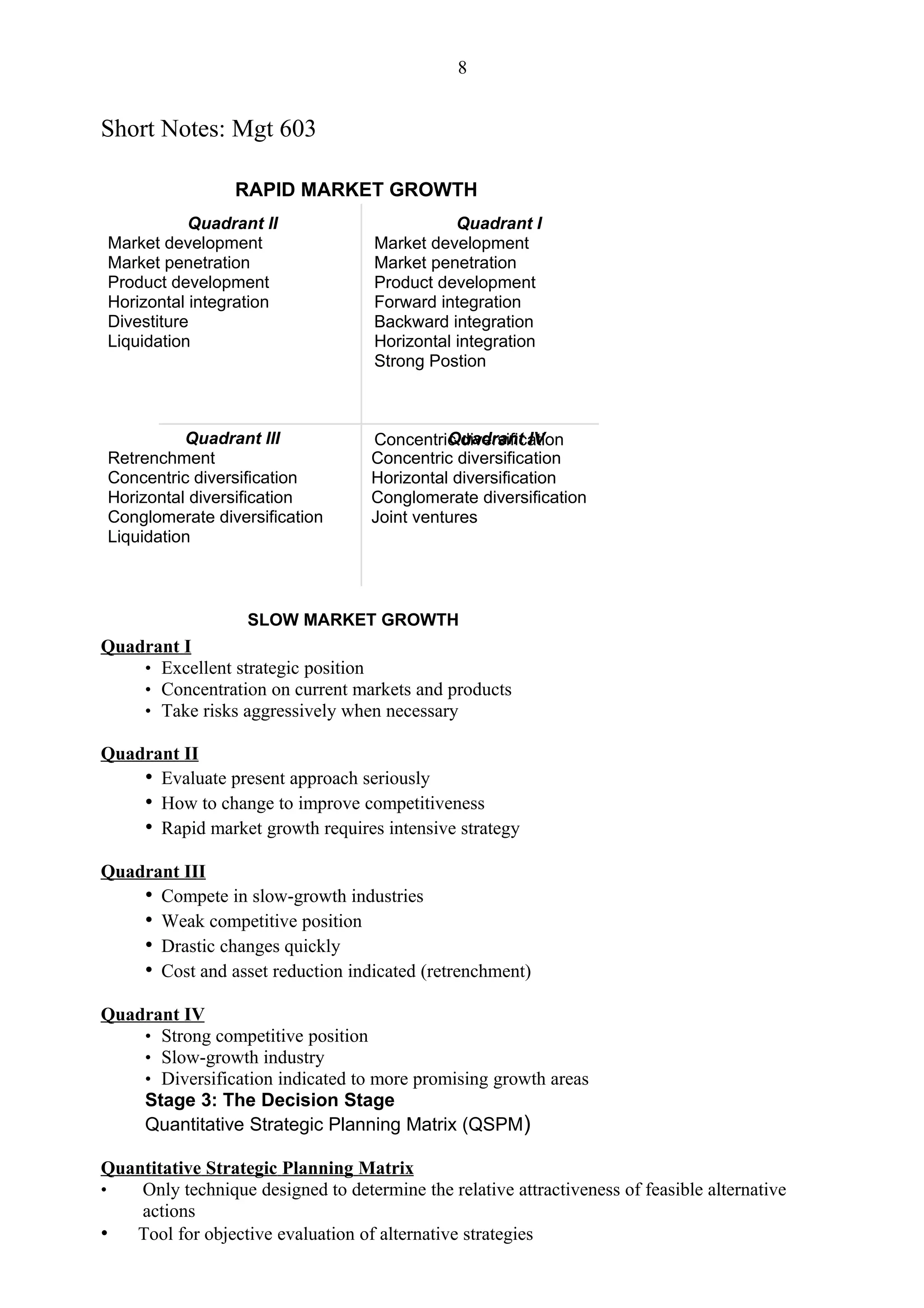
Grand Strategy Matrix
• Popular tool for formulating alternative strategies
• All organizations (or divisions) can be positioned in one of four quadrants
• Based on two evaluative dimensions:
    – Competitive position
    – Market growth
8


Short Notes: Mgt 603

                  RAPID MARKET GROWTH
           Quadrant II                         Quadrant I
Market development                  Market development
Market penetration                  Market penetration
Product development                 Product development
Horizontal integration              Forward integration
Divestiture                         Backward integration
Liquidation                         Horizontal integration
                                    Strong Postion


          Quadrant III                        Quadrant IV
                                    Concentric diversification
Retrenchment                        Concentric diversification
Concentric diversification          Horizontal diversification
Horizontal diversification          Conglomerate diversification
Conglomerate diversification        Joint ventures
Liquidation


                   SLOW MARKET GROWTH
Quadrant I
    • Excellent strategic position
    • Concentration on current markets and products
    • Take risks aggressively when necessary

Quadrant II
    • Evaluate present approach seriously
    • How to change to improve competitiveness
    • Rapid market growth requires intensive strategy
Quadrant III
    • Compete in slow-growth industries
    • Weak competitive position
    • Drastic changes quickly
    • Cost and asset reduction indicated (retrenchment)
Quadrant IV
    • Strong competitive position
    • Slow-growth industry
    • Diversification indicated to more promising growth areas
    Stage 3: The Decision Stage
    Quantitative Strategic Planning Matrix (QSPM)

Quantitative Strategic Planning Matrix
•   Only technique designed to determine the relative attractiveness of feasible alternative
    actions
• Tool for objective evaluation of alternative strategies
9


Short Notes: Mgt 603
•    Based on identified external and internal crucial success factors
•    Requires good intuitive judgment
•    List the firm’s key external opportunities & threats; list the firm’s key internal strengths
     and weaknesses
•    Assign weights to each external and internal critical success factor
•    Examine the Stage 2 (matching) matrices and identify alternative strategies that the
     organization should consider implementing
•    Determine the Attractiveness Scores (AS)
•    Compute the total Attractiveness Scores
•    Compute the Sum Total Attractiveness Score

QSPM
Limitations:
• Requires intuitive judgments and educated assumptions
• Only as good as the prerequisite inputs

Positives:
•    Sets of strategies examined simultaneously or sequentially
•    Requires the integration of pertinent external and internal factors in the decision-making
     process

Lecture No. 31

Chapter Outline
•     The nature of Strategy Implementation
•      Annual Objectives
•      Policies
•      Resource Allocation
•      Managing Conflict
•      Matching Structure with Strategy
•      Restructuring, Reengineering, and E-Engineering
•      Linking Performance and Pay to Strategies
•      Managing Resistance to Change
•      Managing the Natural Environment
•      Creating a Strategy-Supportive Culture
•      Production/Operations Concerns When Implementing Strategies
•      Human Resource Concerns When Implementing Strategies

Implementing Strategies: Management Issues
Pretend that every single person you meet has a sign around his or her neck that says, “Make
  me feel important.” -- Mary Kay Ash, CEO of Mary Kay, Inc.
Management Issues
•      Annual Objectives
•      Policies
•      Resources
•      Organizational structure
10


Short Notes: Mgt 603
•      Restructuring
•      Rewards/Incentives
•      Resistance to Change
•      Managers & strategy
•      Supportive culture
•      Production/operations
•      Human resources
•      Downsizing

Contrasting strategy formulation and strategy implementation
–     Formulation is positioning forces before the action
–     Implementation is managing forces during the action

Contrasting strategy formulation and strategy implementation
–     Formulation focuses on effectiveness
–     Implementation focuses on efficiency
–     Formulation is primarily an intellectual process
–     Implementation is primarily an operational process
–     Formulation requires good intuitive and analytical skills
–     Implementation requires special motivation and leadership skills
–     Formulation requires coordination among a few individuals
–     Implementation requires coordination among many persons

Strategy implementation –
–      Varies among different types and sizes of organizations

Strategy implementation Actions –
–      Altering sales territories
–      Adding new departments
–      Closing facilities
–      Hiring new employees
–      Cost-control procedures
–      Changing advertising strategies
–      Building new facilities

Formulation to Implementation transition –
–    Shift in responsibility
     • From strategists to division and functional managers
1.   Management Issues
2.   Management Issues (continued)
3.   Annual Objectives
•    Decentralized activity
•    Involves all managers in the firm

Annual Objectives
• Basis for allocating resources
11


Short Notes: Mgt 603

•    Primary mechanism for evaluating managers
•    Major instrument for monitoring progress toward long-term objectives
•    Establish organizational, divisional, and departmental priorities
•    Horizontal consistency of objectives
•    Vertical consistency of objectives

Objectives should state –
   – Quantity
   – Quality
   – Cost
   – Time

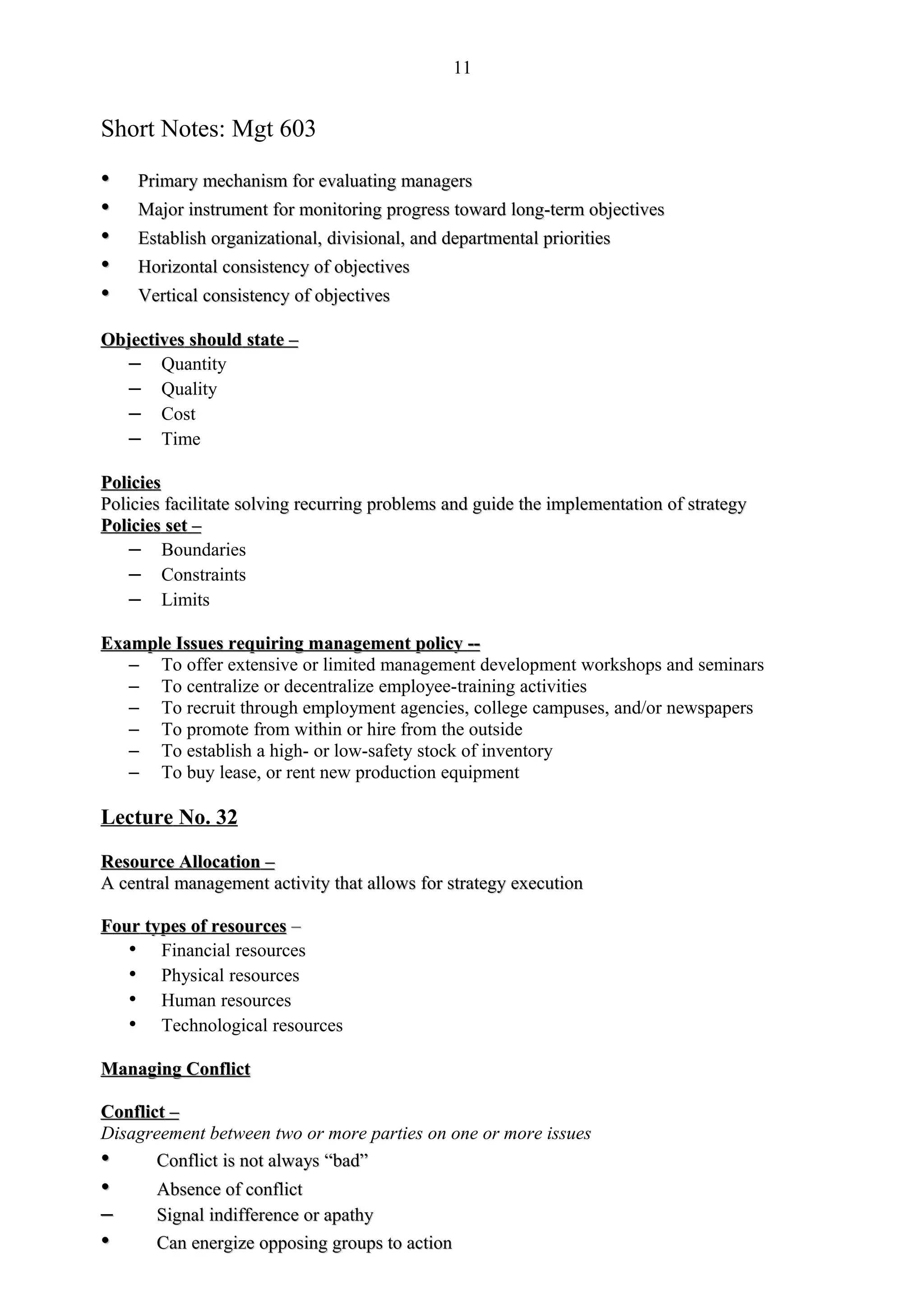
Policies
Policies facilitate solving recurring problems and guide the implementation of strategy
Policies set –
    – Boundaries
    – Constraints
    – Limits

Example Issues requiring management policy --
   – To offer extensive or limited management development workshops and seminars
   – To centralize or decentralize employee-training activities
   – To recruit through employment agencies, college campuses, and/or newspapers
   – To promote from within or hire from the outside
   – To establish a high- or low-safety stock of inventory
   – To buy lease, or rent new production equipment

Lecture No. 32

Resource Allocation –
A central management activity that allows for strategy execution

Four types of resources –
   • Financial resources
   • Physical resources
   • Human resources
   • Technological resources

Managing Conflict

Conflict –
Disagreement between two or more parties on one or more issues
•      Conflict is not always “bad”
                              “bad”
•      Absence of conflict
–      Signal indifference or apathy
•      Can energize opposing groups to action
12


Short Notes: Mgt 603

•      May help managers identify problems

Conflict Management and Resolution
–      Avoidance
–      Defusion
–      Confrontation

Matching Structure with Strategy
  1. Changes in Strategy
  2. Changes in Structure
• Structure largely dictates how objectives and policies will be established.
• Structure dictates how resources will be allocated
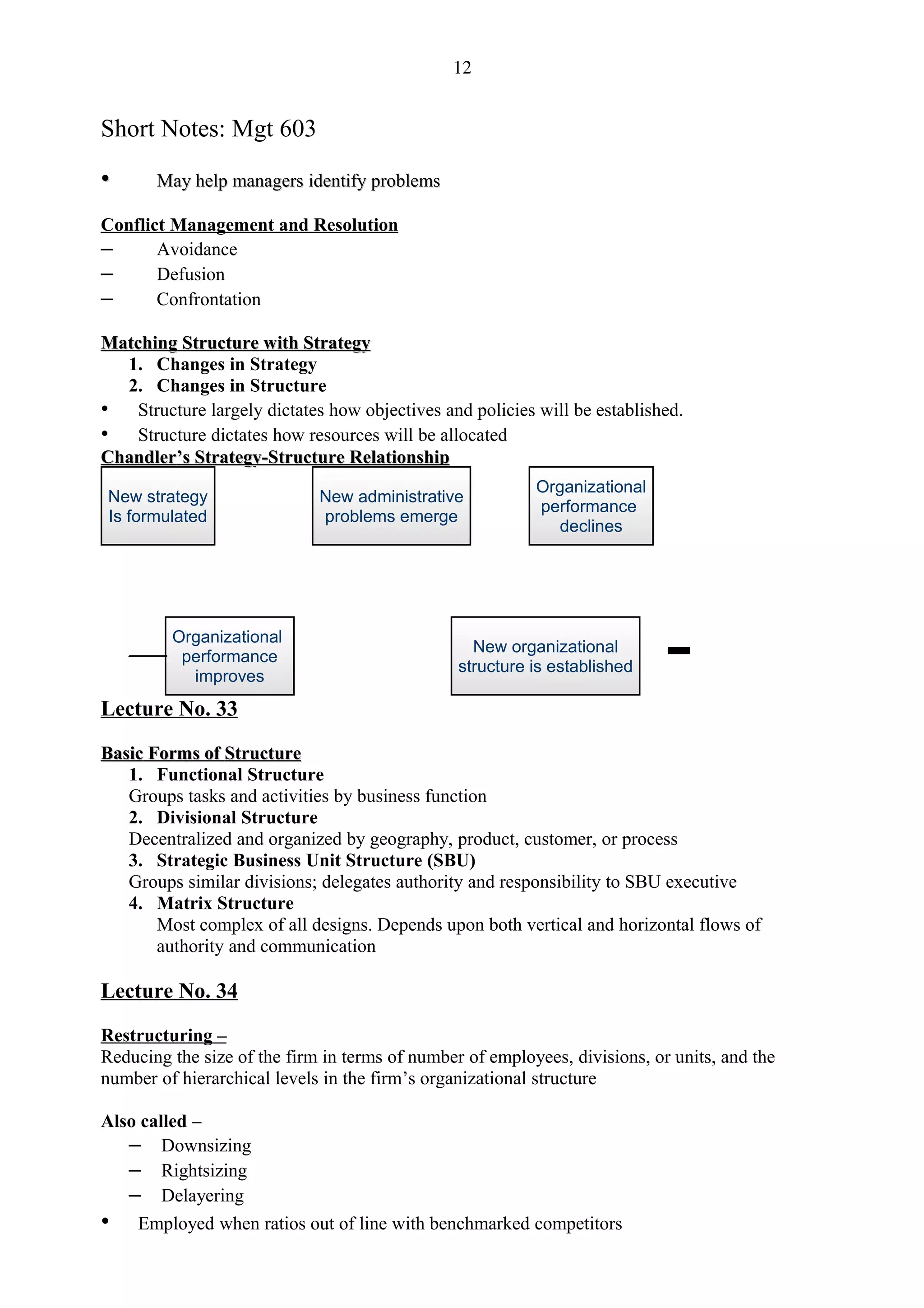
Chandler’s Strategy-Structure Relationship
                                                          Organizational
New strategy                 New administrative
                                                          performance
Is formulated                problems emerge
                                                            declines


         Organizational
                                                  New organizational
          performance
                                                structure is established
           improves
Lecture No. 33

Basic Forms of Structure
   1. Functional Structure
   Groups tasks and activities by business function
   2. Divisional Structure
   Decentralized and organized by geography, product, customer, or process
   3. Strategic Business Unit Structure (SBU)
   Groups similar divisions; delegates authority and responsibility to SBU executive
   4. Matrix Structure
       Most complex of all designs. Depends upon both vertical and horizontal flows of
       authority and communication

Lecture No. 34

Restructuring –
Reducing the size of the firm in terms of number of employees, divisions, or units, and the
number of hierarchical levels in the firm’s organizational structure

Also called –
   – Downsizing
   – Rightsizing
   – Delayering
• Employed when ratios out of line with benchmarked competitors
13


Short Notes: Mgt 603

•    Primary benefit sought is cost reduction
Reengineering
Involves reconfiguring or redesigning work, jobs, and processes to improve cost, quality, service
and speed.

Reengineering
Also called –
   – Process management
   – Process innovation
   – Process redesign
Concerned more with employee and customer well-being than shareholder well-being

Linking Performance and Pay to Strategies
Most companies practicing pay-for-performance
•       Dual bonus system becoming more common
–       Based on both annual objectives and long-term objectives
•       Profit Sharing
–       Incentive compensation used by 30% of companies
•       Gain Sharing
–       Performance targets set for employees or departments
Tests for Performance-Pay Plans
   1.          Does the plan capture attention?
   2.          Do employees understand the plan?
   3.          Is the plan improving communication?
   4.          Does the plan pay out when it should?
   5.          Is the company or unit performing better?

Managing Resistance to Change
Change raises anxiety over fear of:
–      Economic loss
–      Inconvenience
–      Uncertainty
–      Break in status-quo
Resistance to change –
–      Single greatest threat to successful strategy implementation

Change Strategies
•    Force Change Strategy
•      Educative Change Strategy
•      Rational or Self-Interest Change Strategy

Managing the Natural Environment
•      Wide appreciation for firms that conduct operations that “mend” rather than “harm” the
                                                                “mend”             “harm”
environment.

Creating a Strategy-Supportive Culture
14


Short Notes: Mgt 603
Strategists should strive to preserve, emphasize, and build upon aspects of existing culture that
   support new strategies.

Elements linking culture to strategy:
•   Formal statements of philosophy, charters, etc. used for recruitment and selection, and
    socialization
•   Designing of physical spaces, facades, buildings
•   Deliberate role modeling, teaching and coaching
•   Explicit reward and status system, promotion criteria
•   Stories, legends, myths about key people and events
•   What leaders pay attention to, measure and control
•   Leader reactions to critical incidents and crises
•   How the organization is designed and structured
•   Organizational systems and procedures
•   Criteria used for recruitment, selection, promotion, retirement

Lecture No. 35

Production/Operations Concerns
• Production processes typically constitute more than 70% of firm’s total assets
•    Decisions on:
    – Plant size
    – Inventory/inventory control
    – Quality control
    – Cost control
    – Technological innovation
Human Resource Concerns
• Assessing staffing needs and costs
•    Develop performance incentives
•    ESOPs
•    Child-care policies
•    Work-life balance

Lecture No. 36-37
Marketing variables affect success or failure of strategy implementation
•      Market Segmentation
•      Production Positioning

Marketing Decisions requiring polices –
–    Use exclusive dealerships or multiple channels of distribution
–    Use heavy, light, or no TV advertising
–    Limit (or not) the share of business done with a single customer
–    Be a price leader or price follower
–    Offer a complete or limited warranty
–    Reward salespeople based on straight commission or combination salary/commission
15


Short Notes: Mgt 603

•        Subdividing of a market into distinct subsets of customers according to needs and buying
habits
•        Widely used in implementing strategies
•        Small and specialized firms

Market Segmentation Important Variable:
• Market and product development, market penetration, and diversification require increased
    sales through new markets or products
• Firm can operate with limited resources. Enables a small firm by maximizing per-unit
    profits and per-segment sales.
•   Segmentation decisions directly affect marketing mix variables:
  -    Product, place, promotion, and price

Marketing Mix – Component Factors
Bases for Segmenting Markets –z
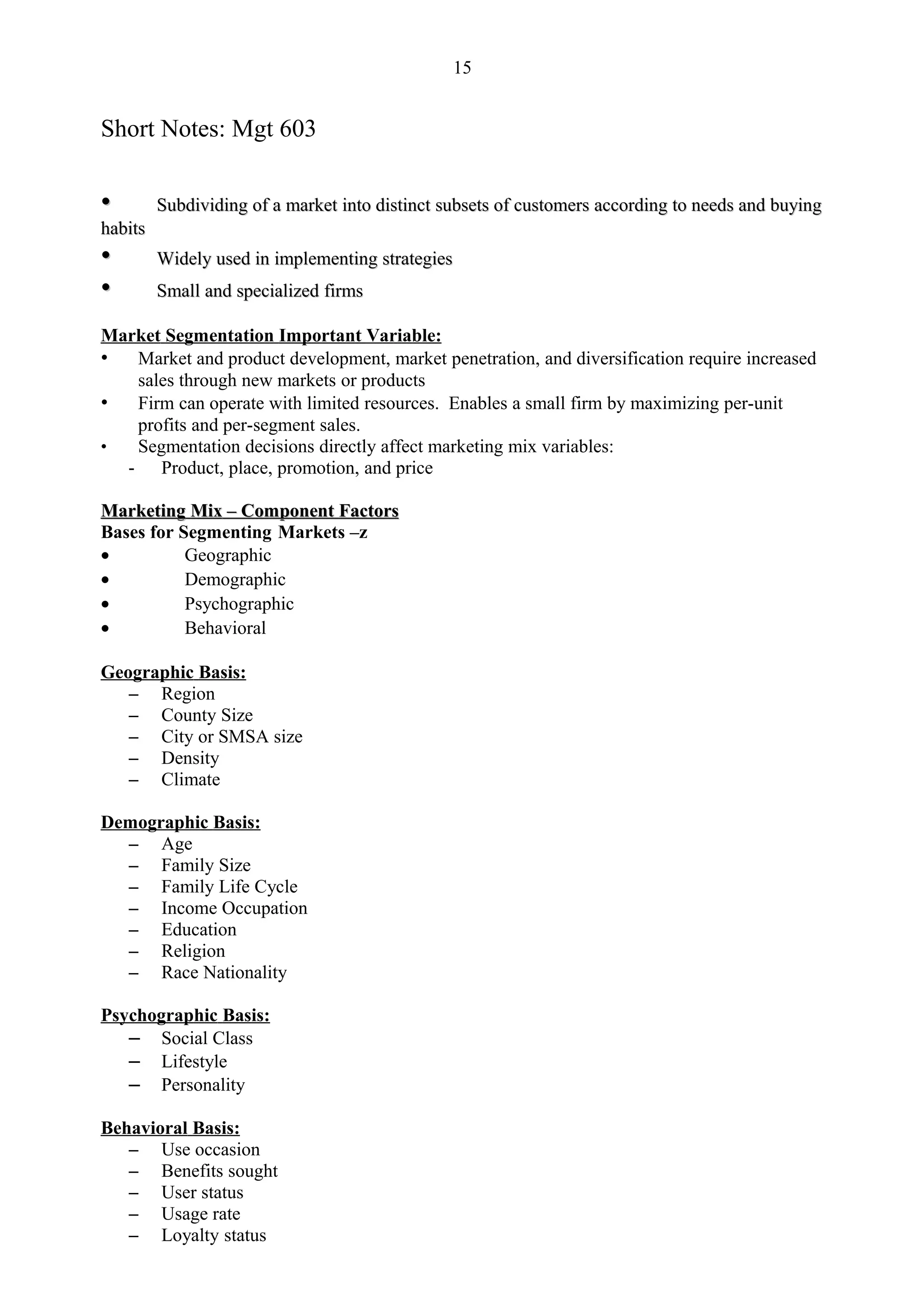
•          Geographic
•          Demographic
•          Psychographic
•          Behavioral

Geographic Basis:
   – Region
   – County Size
   – City or SMSA size
   – Density
   – Climate

Demographic Basis:
  – Age
  – Family Size
  – Family Life Cycle
  – Income Occupation
  – Education
  – Religion
  – Race Nationality

Psychographic Basis:
   – Social Class
   – Lifestyle
   – Personality

Behavioral Basis:
   – Use occasion
   – Benefits sought
   – User status
   – Usage rate
   – Loyalty status
16


Short Notes: Mgt 603
   –   Readiness Stage
   –   Attitude toward product

Developing schematic representations that reflect how products or services compare to
competitors’ on dimensions most important to success in the industry

Product Positioning based on:
   – Customers wants
   – Customers needs

Product Positioning Steps
1. Select Key Criteria
2. Diagram Map
3.     Plot competitors’ products
4.     Look for niches
5. Develop Marketing Plan

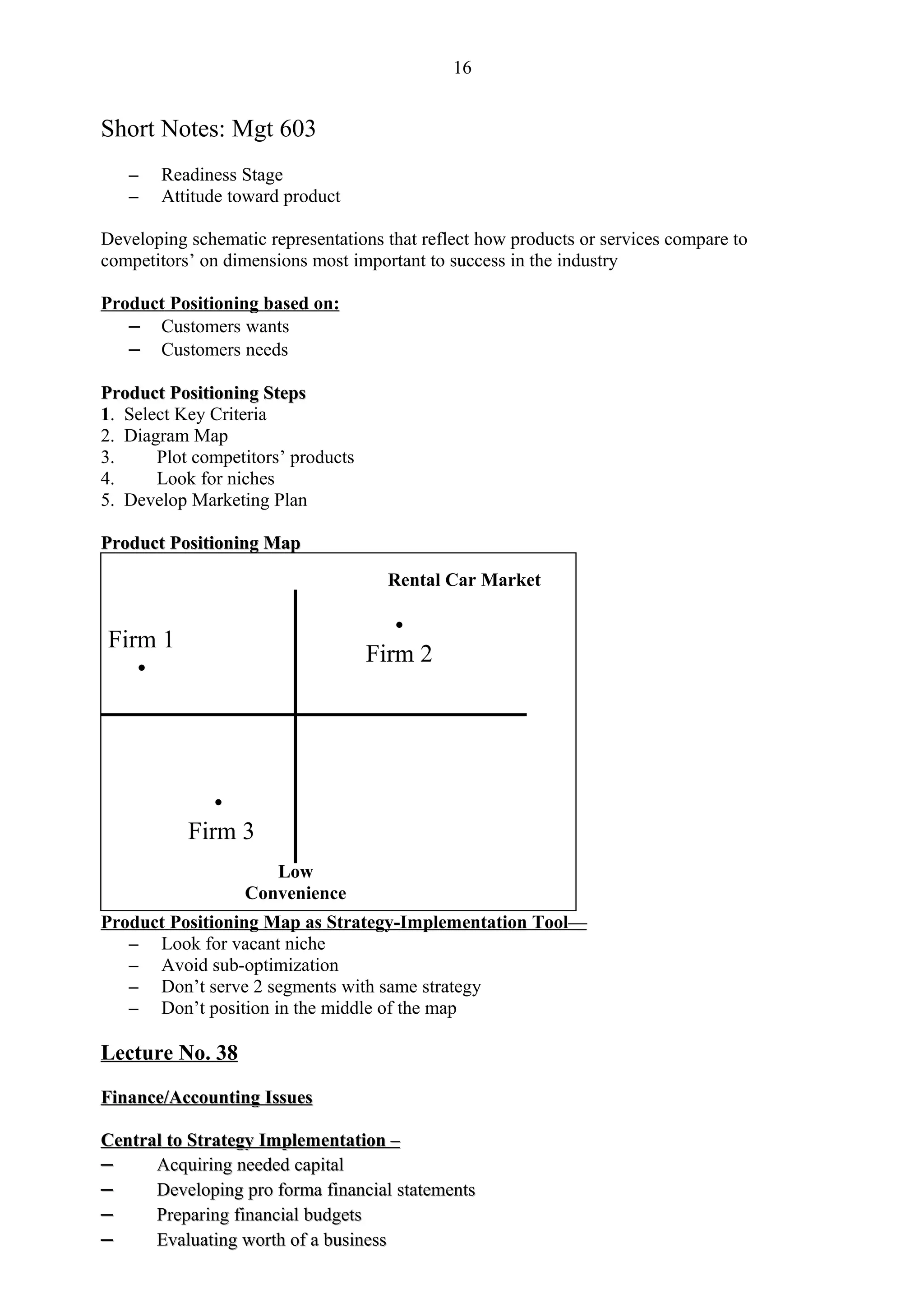
Product Positioning Map
                                     Rental Car Market

                                       •
Firm 1
                                    Firm 2
   •


              •
           Firm 3
                     Low
                  Convenience
Product Positioning Map as Strategy-Implementation Tool—
   – Look for vacant niche
   – Avoid sub-optimization
   – Don’t serve 2 segments with same strategy
   – Don’t position in the middle of the map

Lecture No. 38

Finance/Accounting Issues

Central to Strategy Implementation –
–     Acquiring needed capital
–     Developing pro forma financial statements
–     Preparing financial budgets
–     Evaluating worth of a business
17


Short Notes: Mgt 603

Finance/Accounting Issues
Acquiring Capital to Implement Strategies –

•      Basic sources of capital:
–      Debt
–      Equity
Debt vs. Equity Decisions –
•      EPS/EBIT analysis
–      Earnings per share/Earnings before interest and taxes

Pro Forma Financial Statements -
•      Allows an organization to examine the expected results of various actions and
approaches

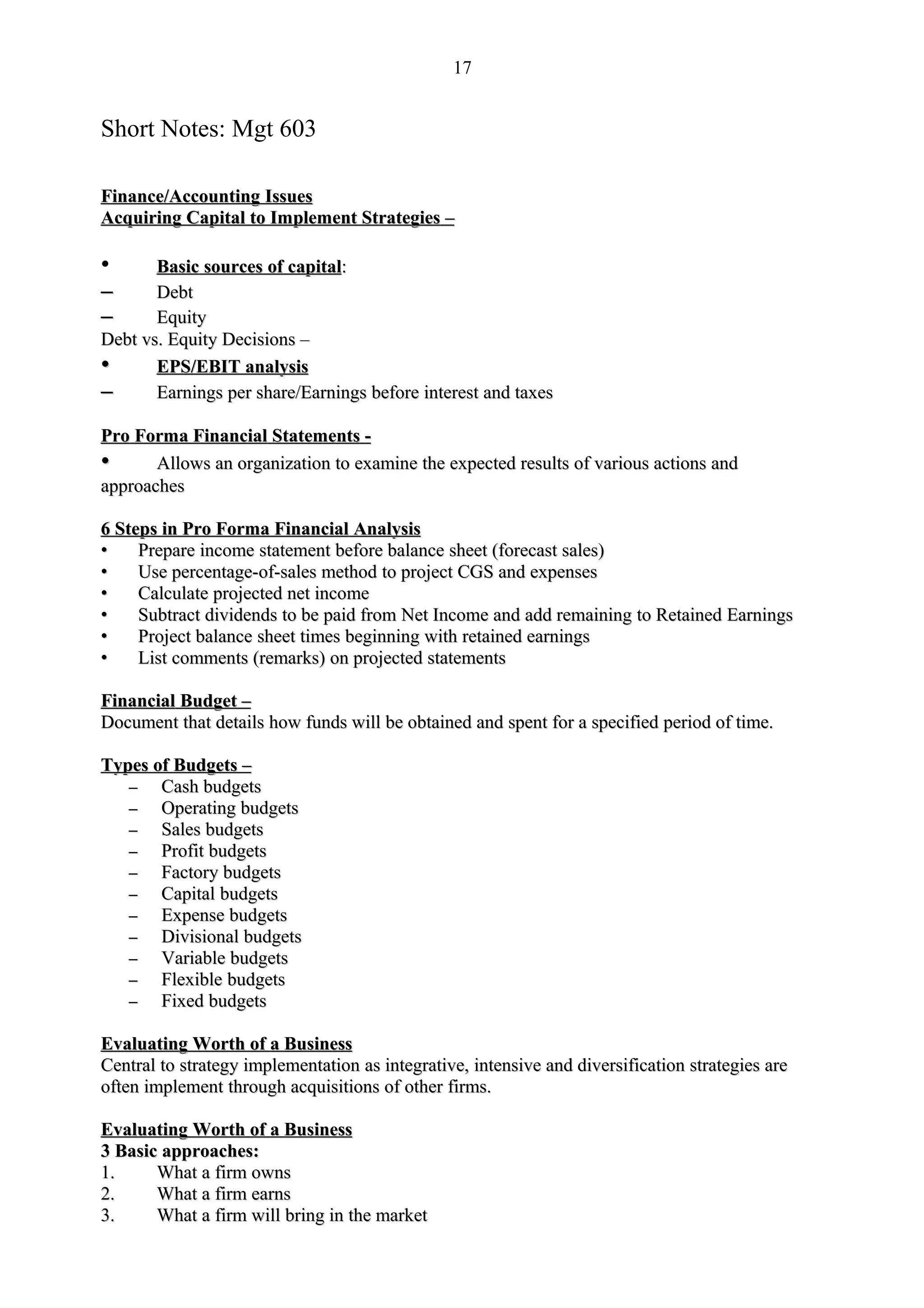
6 Steps in Pro Forma Financial Analysis
•    Prepare income statement before balance sheet (forecast sales)
•    Use percentage-of-sales method to project CGS and expenses
•    Calculate projected net income
•    Subtract dividends to be paid from Net Income and add remaining to Retained Earnings
•    Project balance sheet times beginning with retained earnings
•    List comments (remarks) on projected statements

Financial Budget –
Document that details how funds will be obtained and spent for a specified period of time.

Types of Budgets –
   –   Cash budgets
   –   Operating budgets
   –   Sales budgets
   –   Profit budgets
   –   Factory budgets
   –   Capital budgets
   –   Expense budgets
   –   Divisional budgets
   –   Variable budgets
   –   Flexible budgets
   –   Fixed budgets

Evaluating Worth of a Business
Central to strategy implementation as integrative, intensive and diversification strategies are
often implement through acquisitions of other firms.

Evaluating Worth of a Business
3 Basic approaches:
1.     What a firm owns
2.     What a firm earns
3.     What a firm will bring in the market
18


Short Notes: Mgt 603
Lecture No. 39

Same above given in chapter 38
Central to Strategy Implementation –
Evaluating Worth of a Business
3 Basic approaches: Till
Decisions Requiring Finance/Accounting Policies
1.     Raise capital w/ short-term, long-term preferred or common stock
2.     Lease or buy fixed assets
3.     Determine an appropriate dividend payout ratio
4.     Use LIFO, FIFO, or market-value accounting approach
5.     Extend time of accounts receivable
6.     Establish percentage discount on accounts for terms
7.     Determine the amount of cash kept on hand

Lecture No. 40

Systematic Review, Evaluation & Control –
–     Strategies become obsolete
–     Internal environments are dynamic
–     External environments are dynamic

•      Strategy evaluation is vital to the organization’s well-being

•      Alert management to potential or actual problems in a timely fashion
•      Erroneous strategic decisions can have severe negative impact on organizations

3 Basic Activities –
   • Examining the underlying bases of a firms’ strategy
   • Comparing expected to actual results
   • Corrective actions to ensure performance conforms to plans
Strategy evaluation –
–      Complex and sensitive undertaking
–      Overemphasis can be costly and counterproductive

In many organizations, evaluation is an appraisal of performance –
•     Have assets increased?
•     Increase in profitability?
•     Increase in sales?
•     Increase in productivity?
•     Profit margins, ROI and EPS ratios increased?

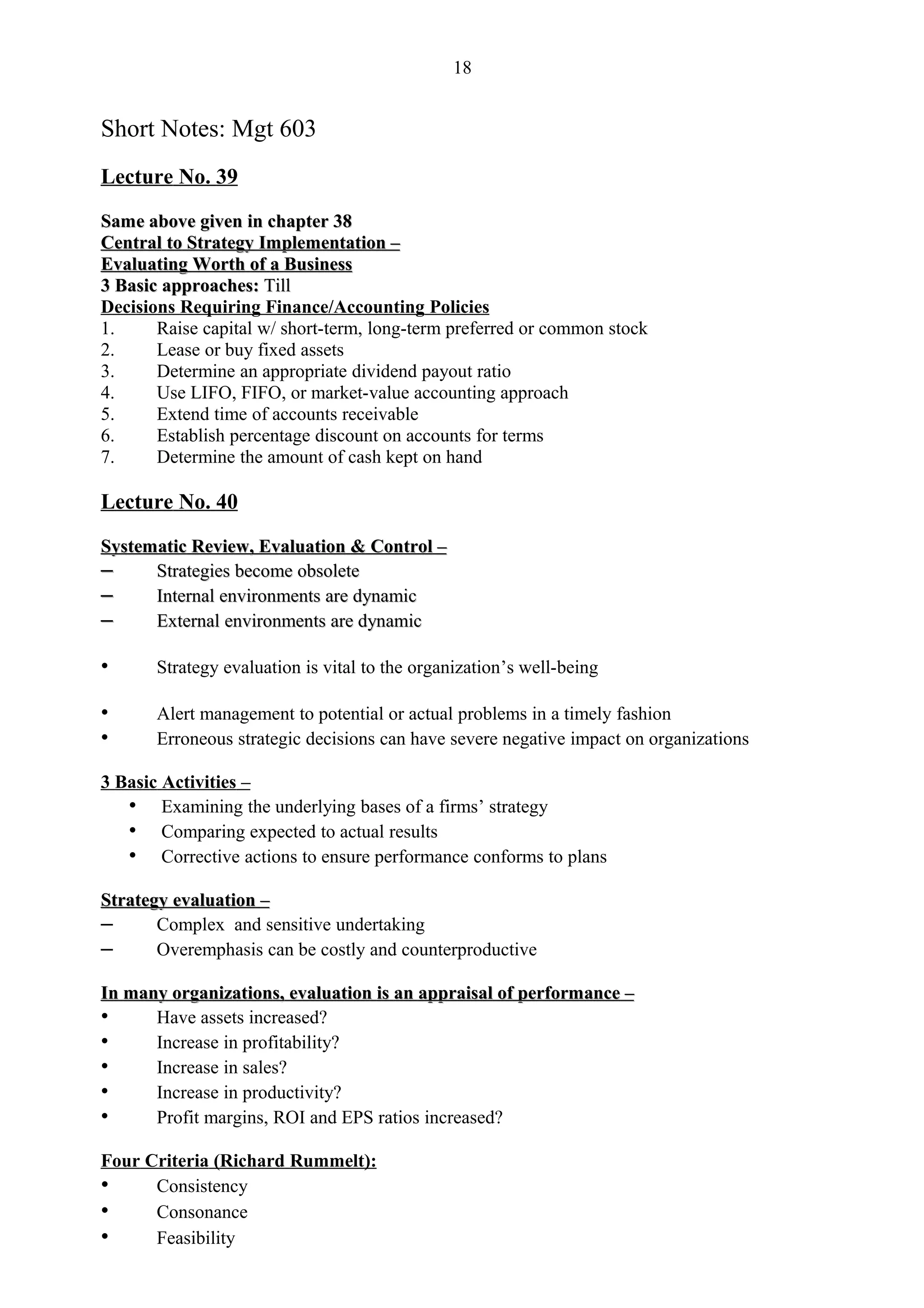
Four Criteria (Richard Rummelt):
•     Consistency
•     Consonance
•     Feasibility
19


Short Notes: Mgt 603
•       Advantage

Consistency
–      Strategy should not present inconsistent goals and policies.
       • Conflict and interdepartmental bickering symptomatic of managerial disorder and
         strategic inconsistency

Consonance
–     Need for strategies to examine sets of trends
      • Adaptive response to external environment
      • Trends are results of interactions among other trends

Feasibility
–      Neither overtax resources or create unsolvable sub-problems
       • Organizations must demonstrate the abilities, competencies, skills and talents to carry
         out a given strategy

Advantage
–     Creation or maintenance of competitive advantage
      • Superiority in resources, skills, or position

Difficulty in strategy evaluation –
• Increase in environment’s complexity
•    Difficulty predicting future with accuracy
•    Increasing number of variables

Difficulty in strategy evaluation –
•    Rate of obsolescence of plans
•    Domestic and global events
•    Decreasing time span for planning certainty

Strategy evaluation should –

    –   Initiative managerial questioning
    –   Trigger review of objectives and values
    –   Stimulate creativity in generating alternatives

Lecture No. 41

Porter Supply Chain Model
The Value Chain framework of Michael Porter is a model that helps to analyze specific activities
  through which firms can create value and competitive advantage.

The activities of the Value Chain
• Primary activities (line functions)
20


Short Notes: Mgt 603
• Support activities (Staff functions, overhead)
Primary activities (line functions)
•   Inbound Logistics
•   Operations
•   Outbound Logistics
•   Marketing and Sales
•   Service

Support activities (Staff functions, overhead)
•   Firm Infrastructure
•   Technology Development
•   Human Resource Management
•   Procurement

Creating a cost advantage based on the value chain
• A firm may create a cost advantage:
• By reducing the cost of individual value chain activities, or
• By reconfiguring the value chain.
10 cost drivers related to value chain activities
•    Economies of scale
•    Learning
•    Capacity utilization
•    Linkages among activities
•    Interrelationships among business units
•    Degree of vertical integration
•    Timing of market entry
•    Firm's policy of cost or differentiation
•    Geographic location
•    Institutional factors (regulation, union activity, taxes, etc.).

Lecture No. 42

Same in above chapter
Four Criteria (Richard Rummelt):
Strategy evaluation should –

Lecture No. 43

Review of underlying bases of strategy –
   – Develop revised EFE Matrix
21


Short Notes: Mgt 603
    – Develop revised IFE Matrix
Review effectiveness of strategy –
• Competitors’ reaction to strategy
• Competitors’ change in strategy
• Competitors’ changes in strengths and weaknesses
• Reasons for competitors’ strategic change
• Reasons for competitors’ successful strategies
• Competitors’ present market positions and profitability
• Potential for competitor retaliation
• Potential for cooperation with competitors
Monitor Threats and Opportunities and Weaknesses and Strengths
• Are our internal strengths still strengths?
• Have we added additional strengths?
• Are our weaknesses still weaknesses?
• Have we other internal weaknesses?
• Are opportunities still opportunities?
• Other external opportunities?
• Are threats still threats?
• Are there other threats?
• Are we vulnerable to a hostile takeover?
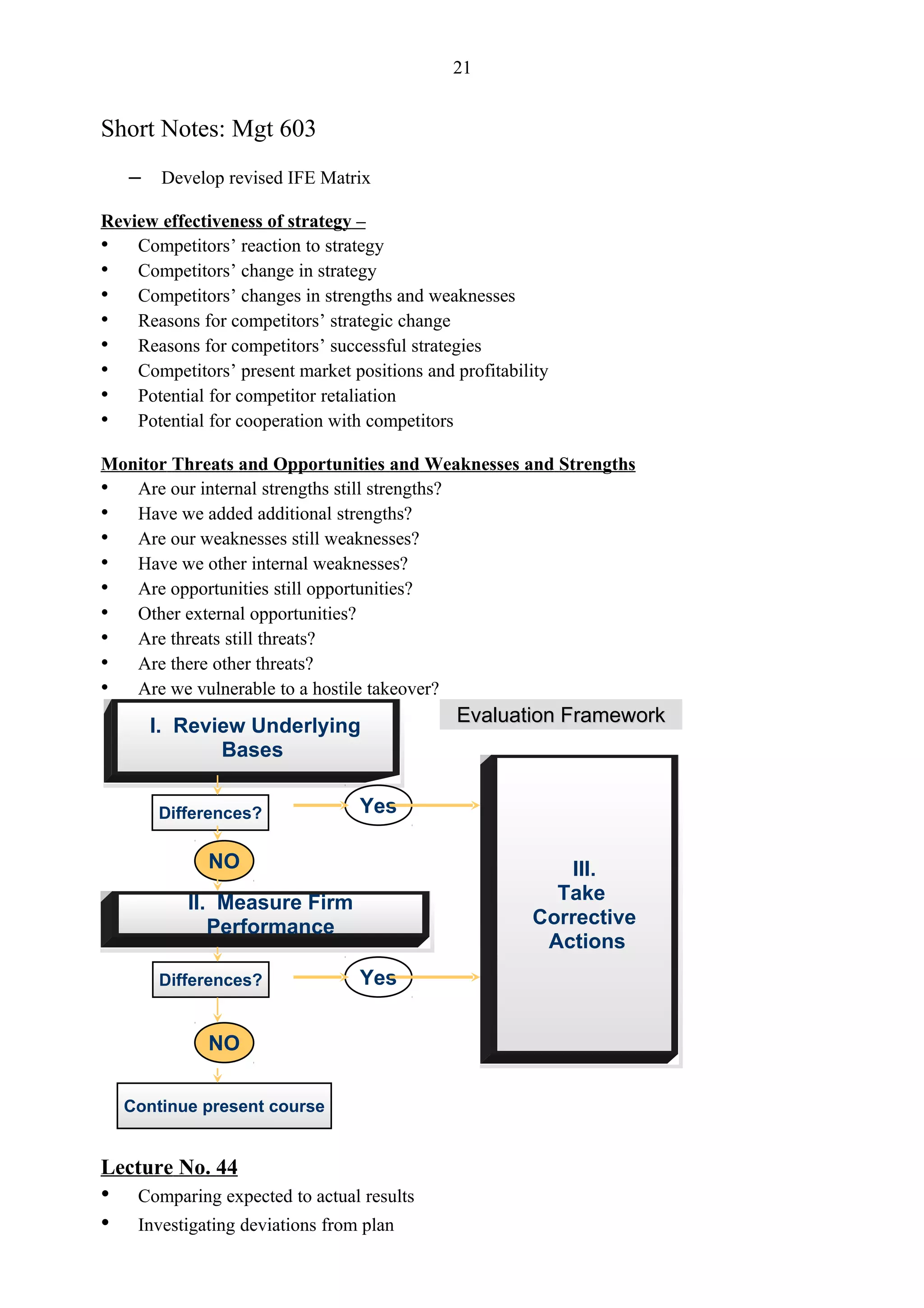
                                             Evaluation Framework
      I. Review Underlying
             Bases

       Differences?               Yes

              NO                                          III.
           II. Measure Firm                             Take
              Performance                             Corrective
                                                       Actions
        Differences?              Yes


              NO

    Continue present course


Lecture No. 44
•    Comparing expected to actual results
•    Investigating deviations from plan
22


Short Notes: Mgt 603

•   Evaluating individual performance
•   Progress toward stated objectives

Quantitative criteria for strategy evaluation –
  – Financial Ratios:
      • Compare performance over different periods
      • Compare performance to competitors
      • Compare performance to industry averages

Key Financial Ratios –
   – Return on investment
   – Return on equity
   – Profit margin
   – Market share
   – Debt to equity
   – Earnings per share
   – Sales growth
   – Asset growth

Qualitative evaluation of strategy -
  – Internal consistency of strategy
  – Consistency of strategy with environment
  – Strategy appropriate in view of resources
  – Acceptable degree of risk
  – Appropriate time frame
  – Workability of the strategy

Lecture No. 45

Basic requirements for effective strategy evaluation –
   – Economical
   – Meaningful
   – Generate useful information
   – Timely information
   – Provide a true picture of what is happening

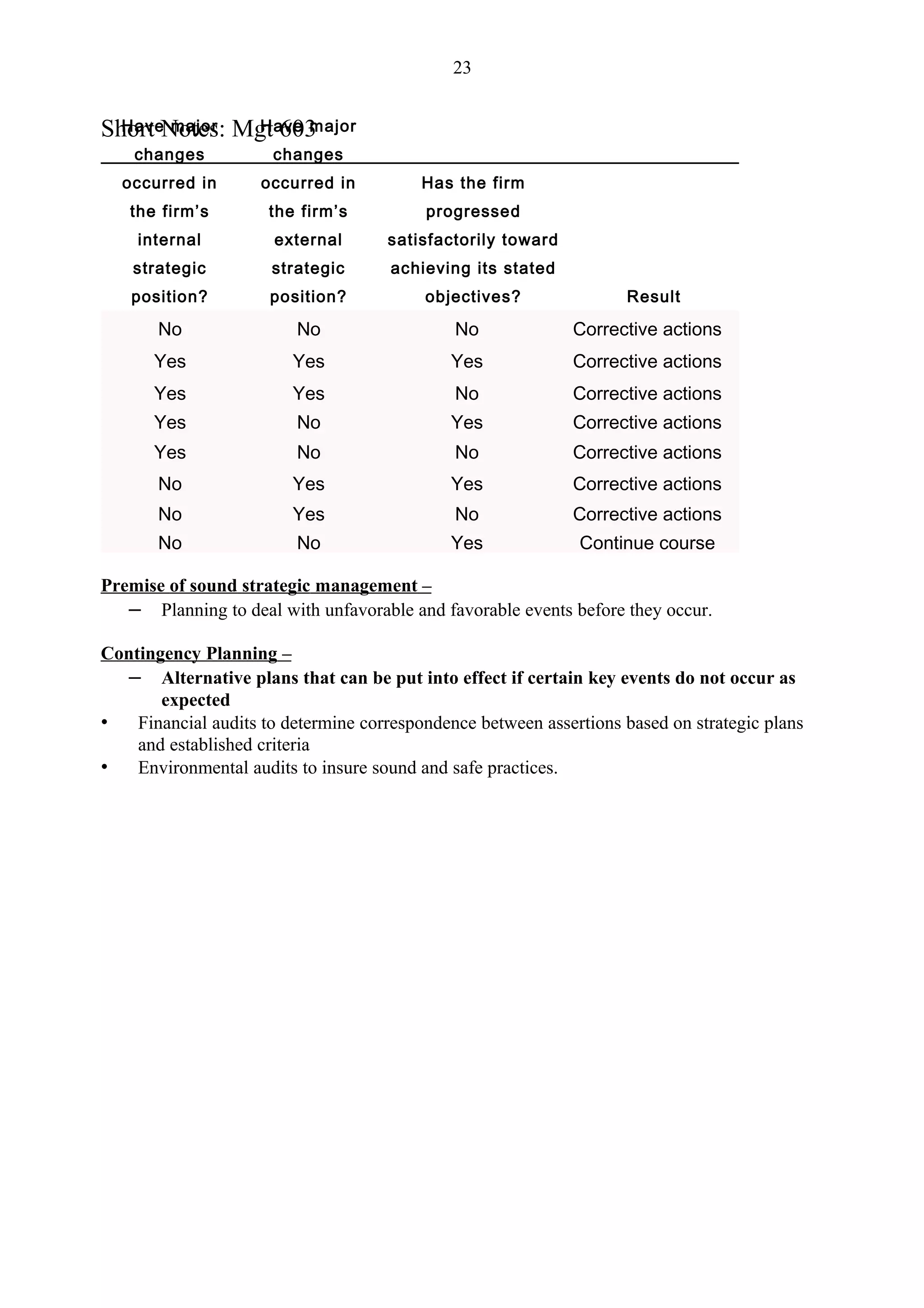
Strategy-Evaluation Assessment Matrix
23


  Have major   Have major
Short Notes: Mgt 603
    changes           changes
  occurred in       occurred in          Has the firm
   the firm’s        the firm’s          progressed
    internal          external      satisfactorily toward
    strategic        strategic       achieving its stated
   position?         position?           objectives?               Result

       No                No                  No             Corrective actions
      Yes               Yes                 Yes             Corrective actions
      Yes               Yes                  No             Corrective actions
      Yes                No                 Yes             Corrective actions
      Yes                No                  No             Corrective actions
       No               Yes                 Yes             Corrective actions
       No               Yes                  No             Corrective actions
       No                No                 Yes              Continue course

Premise of sound strategic management –
   – Planning to deal with unfavorable and favorable events before they occur.

Contingency Planning –
  – Alternative plans that can be put into effect if certain key events do not occur as
       expected
• Financial audits to determine correspondence between assertions based on strategic plans
    and established criteria
• Environmental audits to insure sound and safe practices.

Strategic short notes

  • 1.
    1 Short Notes: Mgt603 STRATEGIC MANAGEMENT Lecture No. 23 Strategy Analysis And Choice Strategic Management: Concepts and Cases. 9th edition Fred R. David PowerPoint Slides by Anthony F. Chelte Western New England College Chapter Outline • The Nature of Strategy Analysis and Choice • A Comprehensive Strategy-Formulation Framework • The Input Stage • The Matching Stage • The Decision Stage • Cultural Aspects of Strategy Choice • The Politics of Strategy Choice • The Role of a Board of Directors Strategy Analysis & Choice Whether it’s broke or not, fix it—make it better. Not just products, but the whole company if necessary.- Bill Saporito Strategy Analysis & Choice Strategic analysis and choice largely involves making subjective decisions based on objective information. information. The Nature of Strategy Analysis and Choice – – Establishing long-term objectives – Generating alternative strategies – Selecting strategies to pursue – Best alternative to achieve mission and objectives Alternative strategies derive from – – Vision – Mission – Objectives – External audit – Internal audit – Past successful strategies Participation in generating alternative strategies should be broad – Stage 1: The Input Stage Stage 2: The Matching Stage Stage 3: The Decision Stage Formulation Framework
  • 2.
    2 Short Notes: Mgt603 Internal Factor Evaluation Matrix (IFE) External Factor Evaluation Stage 1: Matrix (EFE) The Input Stage Competitive Profile Matrix Formulation Framework TOWS Matrix SPACE Matrix Stage 2: BCG Matrix The Matching Stage IE Matrix Grand Strategy Matrix Matching Key Factors to Formulate Alternative Strategies Key Internal Factor Key External Factor Resultant Strategy 20% annual growth in the Excess working capacity + cell phone industry = Acquire Cellfone, Inc. (strength) (opportunity) Exit of two major foreign Pursue horizontal integration Insufficient capacity + competitors form the = by buying competitor's (weakness) industry (opportunity) facilities Decreasing numbers of Develop new products for Strong R&D (strength) + = young adults (threat) older adults Poor employee morale Develop a new employee + Strong union activity = (weakness) (threat) benefits package Strategy-Formulation Analytical Framework Formulation Framework
  • 3.
    3 Short Notes: Mgt603 Stage 3: Quantitative Strategic Planning Matrix The Decision Stage (QSPM) Input Stage • Provides basic input information for the matching and decision stage matrices • Requires strategists to quantify subjectivity early in the process • Good intuitive judgment always needed Matching Stage • Match between organization’s internal resources and skills and the opportunities and organization’ risks created by its external factors. Matching Key Factors to Formulate Alternative Strategies Lecture No. 24 Matching Stage TOWS Matrix – Threats – Opportunities – Strengths – Weaknesses Develop four types of strategies – Strengths-Opportunities (SO) – Weaknesses-Opportunities (WO) – Strengths-Threats (ST) – Weaknesses-Threats (WT) 1. SO Strategies Use a firm’s internal strengths to take advantage of external opportunities 2. WO Strategies Improving internal weaknesses by taking advantage of external opportunities 3. ST Strategies Using firm’s strengths to avoid or reduce the impact of external threats. 4. WT Strategies Defensive tactics aimed at reducing internal weaknesses and avoiding environmental threats. 5. TOWS Matrix Steps in developing the TOWS Matrix – List the firm’s key external opportunities – List the firm’s key external threats – List the firm’s key internal strengths
  • 4.
    4 Short Notes: Mgt603 – List the firm’s key internal weaknesses TOWS Matrix Developing the TOWS Matrix • Match internal strengths with external opportunities and record the resultant SO Strategies • Match internal weaknesses with external opportunities and record the resultant WO Strategies • Match internal strengths with external threats and record the resultant ST Strategies • Match internal weaknesses with external threats and record the resultant WT Strategies Leave Blank Strengths-S Weaknesses-W List Strengths List Weaknesses Opportunities-O SO Strategies WO Strategies List Opportunities Use strengths to take Overcome weaknesses advantage of opportunities by taking advantage of opportunities Threats-T ST Strategies WT Strategies List Threats Use strengths to avoid Minimize weaknesses threats and avoid threats Lecture No, 25-26 Formulation Framework SPACE Matrix Strategic Position and Action Evaluation Matrix  Four quadrant framework  Determines appropriate strategies  Aggressive  Conservative  Defensive  Competitive Two Internal Dimensions  Financial Strength [FS]  Competitive Advantage [CA] Two External Dimensions  Environmental Stability [ES]  Industry Strength [IS] Overall Strategic position determined by: – Financial Strength [FS] – Competitive Advantage [CA] – Environmental Stability [ES]
  • 5.
    5 Short Notes: Mgt603 – Industry Strength [IS] Developing the SPACE Matrix: • EFE Matrix • IFE Matrix • Financial Strength • Competitive Advantage • Environmental Stability • Industry Strength • Select variables to define FS, CA, ES, & IS • Assign numerical ranking from +1 (worst) to +6 (best) for FS and IS; Assign numerical ranking from –1 (best) to –6 (worst) for ES and CA. • Compute average score for FS, CA, ES, & IS • Plot the average scores on the Matrix • Add the two scores on the x-axis and plot point on X. Add the scores on the y-axis and plot Y. Plot the intersection of the new xy point. • Draw a directional vector from origin through the new intersection point. • SPACE Factors Internal Strategic Position External Strategic Position Financial Strength (FS) Environmental Stability (ES) Return on investment Technological changes Leverage Rate of inflation Liquidity Demand variability Working capital Price range of competing products Cash flow Barriers to entry Ease of exit from market Competitive pressure Risk involved in business Price elasticity of demand Internal Strategic Position External Strategic Position Competitive Advantage CA Industry Strength (IS) Market share Growth potential Product quality Profit potential Product life cycle Financial stability Customer loyalty Technological know-how Competition’s capacity utilization Resource utilization Technological know-how Capital intensify Control over suppliers & distributors Ease of entry into market Productivity, capacity utilization SPACE Matrix
  • 6.
    6 Short Notes: Mgt603 FS Conservative +6 Aggressive +5 +4 +3 +2 +1 CA IS -6 -5 -4 -3 -2 -1 -1 +1 +2 +3 +4 +5 +6 -2 -3 -4 -5 Defensive -6 Competitive ES Lecture No. 27-28 BCG Matrix Boston Consulting Group Matrix • Enhances multidivisional firms’ efforts to formulate strategies • Autonomous divisions (or profit centers) constitute the business portfolio • Firm’s divisions may compete in different industries requiring separate strategy Boston Consulting Group Matrix • Graphically portrays differences among divisions • Focuses on market share position and industry growth rate • Manage business portfolio through relative market share position and industry growth rate Relative market share position defined: • Ratio of a division’s own market share in a particular industry to the market share held by the largest rival firm in that industry. BCG Matrix Relative Market Share Position High Medium Low 1.0 .50 0.0 High +20 Stars Question Marks II I Medium 0 Cash Cows Dogs III IV Low -20 • Question Marks • Stars • Cash Cows
  • 7.
    7 Short Notes: Mgt603 • Dogs Question Marks • Low relative market share position yet compete in high-growth industry. • Cash needs are high • Case generation is low • Decision to strengthen (intensive strategies) or divest Stars • High relative market share and high industry growth rate. • Best long-run opportunities for growth and profitability • Substantial investment to maintain or strengthen dominant position • Integration strategies, intensive strategies, joint ventures Cash Cows • High relative market share position, but compete in low-growth industry • Generate cash in excess of their needs • Milked for other purposes • Maintain strong position as long as possible • Product development, concentric diversification • If becomes weak—retrenchment or divestiture Dogs • Low relative market share position and compete in slow or no market growth • Weak internal and external position • Decision to liquidate, divest, retrenchment Lecture No. 29-30 Grand Strategy Matrix • Popular tool for formulating alternative strategies • All organizations (or divisions) can be positioned in one of four quadrants • Based on two evaluative dimensions: – Competitive position – Market growth
  • 8.
    8 Short Notes: Mgt603 RAPID MARKET GROWTH Quadrant II Quadrant I Market development Market development Market penetration Market penetration Product development Product development Horizontal integration Forward integration Divestiture Backward integration Liquidation Horizontal integration Strong Postion Quadrant III Quadrant IV Concentric diversification Retrenchment Concentric diversification Concentric diversification Horizontal diversification Horizontal diversification Conglomerate diversification Conglomerate diversification Joint ventures Liquidation SLOW MARKET GROWTH Quadrant I • Excellent strategic position • Concentration on current markets and products • Take risks aggressively when necessary Quadrant II • Evaluate present approach seriously • How to change to improve competitiveness • Rapid market growth requires intensive strategy Quadrant III • Compete in slow-growth industries • Weak competitive position • Drastic changes quickly • Cost and asset reduction indicated (retrenchment) Quadrant IV • Strong competitive position • Slow-growth industry • Diversification indicated to more promising growth areas Stage 3: The Decision Stage Quantitative Strategic Planning Matrix (QSPM) Quantitative Strategic Planning Matrix • Only technique designed to determine the relative attractiveness of feasible alternative actions • Tool for objective evaluation of alternative strategies
  • 9.
    9 Short Notes: Mgt603 • Based on identified external and internal crucial success factors • Requires good intuitive judgment • List the firm’s key external opportunities & threats; list the firm’s key internal strengths and weaknesses • Assign weights to each external and internal critical success factor • Examine the Stage 2 (matching) matrices and identify alternative strategies that the organization should consider implementing • Determine the Attractiveness Scores (AS) • Compute the total Attractiveness Scores • Compute the Sum Total Attractiveness Score QSPM Limitations: • Requires intuitive judgments and educated assumptions • Only as good as the prerequisite inputs Positives: • Sets of strategies examined simultaneously or sequentially • Requires the integration of pertinent external and internal factors in the decision-making process Lecture No. 31 Chapter Outline • The nature of Strategy Implementation • Annual Objectives • Policies • Resource Allocation • Managing Conflict • Matching Structure with Strategy • Restructuring, Reengineering, and E-Engineering • Linking Performance and Pay to Strategies • Managing Resistance to Change • Managing the Natural Environment • Creating a Strategy-Supportive Culture • Production/Operations Concerns When Implementing Strategies • Human Resource Concerns When Implementing Strategies Implementing Strategies: Management Issues Pretend that every single person you meet has a sign around his or her neck that says, “Make me feel important.” -- Mary Kay Ash, CEO of Mary Kay, Inc. Management Issues • Annual Objectives • Policies • Resources • Organizational structure
  • 10.
    10 Short Notes: Mgt603 • Restructuring • Rewards/Incentives • Resistance to Change • Managers & strategy • Supportive culture • Production/operations • Human resources • Downsizing Contrasting strategy formulation and strategy implementation – Formulation is positioning forces before the action – Implementation is managing forces during the action Contrasting strategy formulation and strategy implementation – Formulation focuses on effectiveness – Implementation focuses on efficiency – Formulation is primarily an intellectual process – Implementation is primarily an operational process – Formulation requires good intuitive and analytical skills – Implementation requires special motivation and leadership skills – Formulation requires coordination among a few individuals – Implementation requires coordination among many persons Strategy implementation – – Varies among different types and sizes of organizations Strategy implementation Actions – – Altering sales territories – Adding new departments – Closing facilities – Hiring new employees – Cost-control procedures – Changing advertising strategies – Building new facilities Formulation to Implementation transition – – Shift in responsibility • From strategists to division and functional managers 1. Management Issues 2. Management Issues (continued) 3. Annual Objectives • Decentralized activity • Involves all managers in the firm Annual Objectives • Basis for allocating resources
  • 11.
    11 Short Notes: Mgt603 • Primary mechanism for evaluating managers • Major instrument for monitoring progress toward long-term objectives • Establish organizational, divisional, and departmental priorities • Horizontal consistency of objectives • Vertical consistency of objectives Objectives should state – – Quantity – Quality – Cost – Time Policies Policies facilitate solving recurring problems and guide the implementation of strategy Policies set – – Boundaries – Constraints – Limits Example Issues requiring management policy -- – To offer extensive or limited management development workshops and seminars – To centralize or decentralize employee-training activities – To recruit through employment agencies, college campuses, and/or newspapers – To promote from within or hire from the outside – To establish a high- or low-safety stock of inventory – To buy lease, or rent new production equipment Lecture No. 32 Resource Allocation – A central management activity that allows for strategy execution Four types of resources – • Financial resources • Physical resources • Human resources • Technological resources Managing Conflict Conflict – Disagreement between two or more parties on one or more issues • Conflict is not always “bad” “bad” • Absence of conflict – Signal indifference or apathy • Can energize opposing groups to action
  • 12.
    12 Short Notes: Mgt603 • May help managers identify problems Conflict Management and Resolution – Avoidance – Defusion – Confrontation Matching Structure with Strategy 1. Changes in Strategy 2. Changes in Structure • Structure largely dictates how objectives and policies will be established. • Structure dictates how resources will be allocated Chandler’s Strategy-Structure Relationship Organizational New strategy New administrative performance Is formulated problems emerge declines Organizational New organizational performance structure is established improves Lecture No. 33 Basic Forms of Structure 1. Functional Structure Groups tasks and activities by business function 2. Divisional Structure Decentralized and organized by geography, product, customer, or process 3. Strategic Business Unit Structure (SBU) Groups similar divisions; delegates authority and responsibility to SBU executive 4. Matrix Structure Most complex of all designs. Depends upon both vertical and horizontal flows of authority and communication Lecture No. 34 Restructuring – Reducing the size of the firm in terms of number of employees, divisions, or units, and the number of hierarchical levels in the firm’s organizational structure Also called – – Downsizing – Rightsizing – Delayering • Employed when ratios out of line with benchmarked competitors
  • 13.
    13 Short Notes: Mgt603 • Primary benefit sought is cost reduction Reengineering Involves reconfiguring or redesigning work, jobs, and processes to improve cost, quality, service and speed. Reengineering Also called – – Process management – Process innovation – Process redesign Concerned more with employee and customer well-being than shareholder well-being Linking Performance and Pay to Strategies Most companies practicing pay-for-performance • Dual bonus system becoming more common – Based on both annual objectives and long-term objectives • Profit Sharing – Incentive compensation used by 30% of companies • Gain Sharing – Performance targets set for employees or departments Tests for Performance-Pay Plans 1. Does the plan capture attention? 2. Do employees understand the plan? 3. Is the plan improving communication? 4. Does the plan pay out when it should? 5. Is the company or unit performing better? Managing Resistance to Change Change raises anxiety over fear of: – Economic loss – Inconvenience – Uncertainty – Break in status-quo Resistance to change – – Single greatest threat to successful strategy implementation Change Strategies • Force Change Strategy • Educative Change Strategy • Rational or Self-Interest Change Strategy Managing the Natural Environment • Wide appreciation for firms that conduct operations that “mend” rather than “harm” the “mend” “harm” environment. Creating a Strategy-Supportive Culture
  • 14.
    14 Short Notes: Mgt603 Strategists should strive to preserve, emphasize, and build upon aspects of existing culture that support new strategies. Elements linking culture to strategy: • Formal statements of philosophy, charters, etc. used for recruitment and selection, and socialization • Designing of physical spaces, facades, buildings • Deliberate role modeling, teaching and coaching • Explicit reward and status system, promotion criteria • Stories, legends, myths about key people and events • What leaders pay attention to, measure and control • Leader reactions to critical incidents and crises • How the organization is designed and structured • Organizational systems and procedures • Criteria used for recruitment, selection, promotion, retirement Lecture No. 35 Production/Operations Concerns • Production processes typically constitute more than 70% of firm’s total assets • Decisions on: – Plant size – Inventory/inventory control – Quality control – Cost control – Technological innovation Human Resource Concerns • Assessing staffing needs and costs • Develop performance incentives • ESOPs • Child-care policies • Work-life balance Lecture No. 36-37 Marketing variables affect success or failure of strategy implementation • Market Segmentation • Production Positioning Marketing Decisions requiring polices – – Use exclusive dealerships or multiple channels of distribution – Use heavy, light, or no TV advertising – Limit (or not) the share of business done with a single customer – Be a price leader or price follower – Offer a complete or limited warranty – Reward salespeople based on straight commission or combination salary/commission
  • 15.
    15 Short Notes: Mgt603 • Subdividing of a market into distinct subsets of customers according to needs and buying habits • Widely used in implementing strategies • Small and specialized firms Market Segmentation Important Variable: • Market and product development, market penetration, and diversification require increased sales through new markets or products • Firm can operate with limited resources. Enables a small firm by maximizing per-unit profits and per-segment sales. • Segmentation decisions directly affect marketing mix variables: - Product, place, promotion, and price Marketing Mix – Component Factors Bases for Segmenting Markets –z • Geographic • Demographic • Psychographic • Behavioral Geographic Basis: – Region – County Size – City or SMSA size – Density – Climate Demographic Basis: – Age – Family Size – Family Life Cycle – Income Occupation – Education – Religion – Race Nationality Psychographic Basis: – Social Class – Lifestyle – Personality Behavioral Basis: – Use occasion – Benefits sought – User status – Usage rate – Loyalty status
  • 16.
    16 Short Notes: Mgt603 – Readiness Stage – Attitude toward product Developing schematic representations that reflect how products or services compare to competitors’ on dimensions most important to success in the industry Product Positioning based on: – Customers wants – Customers needs Product Positioning Steps 1. Select Key Criteria 2. Diagram Map 3. Plot competitors’ products 4. Look for niches 5. Develop Marketing Plan Product Positioning Map Rental Car Market • Firm 1 Firm 2 • • Firm 3 Low Convenience Product Positioning Map as Strategy-Implementation Tool— – Look for vacant niche – Avoid sub-optimization – Don’t serve 2 segments with same strategy – Don’t position in the middle of the map Lecture No. 38 Finance/Accounting Issues Central to Strategy Implementation – – Acquiring needed capital – Developing pro forma financial statements – Preparing financial budgets – Evaluating worth of a business
  • 17.
    17 Short Notes: Mgt603 Finance/Accounting Issues Acquiring Capital to Implement Strategies – • Basic sources of capital: – Debt – Equity Debt vs. Equity Decisions – • EPS/EBIT analysis – Earnings per share/Earnings before interest and taxes Pro Forma Financial Statements - • Allows an organization to examine the expected results of various actions and approaches 6 Steps in Pro Forma Financial Analysis • Prepare income statement before balance sheet (forecast sales) • Use percentage-of-sales method to project CGS and expenses • Calculate projected net income • Subtract dividends to be paid from Net Income and add remaining to Retained Earnings • Project balance sheet times beginning with retained earnings • List comments (remarks) on projected statements Financial Budget – Document that details how funds will be obtained and spent for a specified period of time. Types of Budgets – – Cash budgets – Operating budgets – Sales budgets – Profit budgets – Factory budgets – Capital budgets – Expense budgets – Divisional budgets – Variable budgets – Flexible budgets – Fixed budgets Evaluating Worth of a Business Central to strategy implementation as integrative, intensive and diversification strategies are often implement through acquisitions of other firms. Evaluating Worth of a Business 3 Basic approaches: 1. What a firm owns 2. What a firm earns 3. What a firm will bring in the market
  • 18.
    18 Short Notes: Mgt603 Lecture No. 39 Same above given in chapter 38 Central to Strategy Implementation – Evaluating Worth of a Business 3 Basic approaches: Till Decisions Requiring Finance/Accounting Policies 1. Raise capital w/ short-term, long-term preferred or common stock 2. Lease or buy fixed assets 3. Determine an appropriate dividend payout ratio 4. Use LIFO, FIFO, or market-value accounting approach 5. Extend time of accounts receivable 6. Establish percentage discount on accounts for terms 7. Determine the amount of cash kept on hand Lecture No. 40 Systematic Review, Evaluation & Control – – Strategies become obsolete – Internal environments are dynamic – External environments are dynamic • Strategy evaluation is vital to the organization’s well-being • Alert management to potential or actual problems in a timely fashion • Erroneous strategic decisions can have severe negative impact on organizations 3 Basic Activities – • Examining the underlying bases of a firms’ strategy • Comparing expected to actual results • Corrective actions to ensure performance conforms to plans Strategy evaluation – – Complex and sensitive undertaking – Overemphasis can be costly and counterproductive In many organizations, evaluation is an appraisal of performance – • Have assets increased? • Increase in profitability? • Increase in sales? • Increase in productivity? • Profit margins, ROI and EPS ratios increased? Four Criteria (Richard Rummelt): • Consistency • Consonance • Feasibility
  • 19.
    19 Short Notes: Mgt603 • Advantage Consistency – Strategy should not present inconsistent goals and policies. • Conflict and interdepartmental bickering symptomatic of managerial disorder and strategic inconsistency Consonance – Need for strategies to examine sets of trends • Adaptive response to external environment • Trends are results of interactions among other trends Feasibility – Neither overtax resources or create unsolvable sub-problems • Organizations must demonstrate the abilities, competencies, skills and talents to carry out a given strategy Advantage – Creation or maintenance of competitive advantage • Superiority in resources, skills, or position Difficulty in strategy evaluation – • Increase in environment’s complexity • Difficulty predicting future with accuracy • Increasing number of variables Difficulty in strategy evaluation – • Rate of obsolescence of plans • Domestic and global events • Decreasing time span for planning certainty Strategy evaluation should – – Initiative managerial questioning – Trigger review of objectives and values – Stimulate creativity in generating alternatives Lecture No. 41 Porter Supply Chain Model The Value Chain framework of Michael Porter is a model that helps to analyze specific activities through which firms can create value and competitive advantage. The activities of the Value Chain • Primary activities (line functions)
  • 20.
    20 Short Notes: Mgt603 • Support activities (Staff functions, overhead) Primary activities (line functions) • Inbound Logistics • Operations • Outbound Logistics • Marketing and Sales • Service Support activities (Staff functions, overhead) • Firm Infrastructure • Technology Development • Human Resource Management • Procurement Creating a cost advantage based on the value chain • A firm may create a cost advantage: • By reducing the cost of individual value chain activities, or • By reconfiguring the value chain. 10 cost drivers related to value chain activities • Economies of scale • Learning • Capacity utilization • Linkages among activities • Interrelationships among business units • Degree of vertical integration • Timing of market entry • Firm's policy of cost or differentiation • Geographic location • Institutional factors (regulation, union activity, taxes, etc.). Lecture No. 42 Same in above chapter Four Criteria (Richard Rummelt): Strategy evaluation should – Lecture No. 43 Review of underlying bases of strategy – – Develop revised EFE Matrix
  • 21.
    21 Short Notes: Mgt603 – Develop revised IFE Matrix Review effectiveness of strategy – • Competitors’ reaction to strategy • Competitors’ change in strategy • Competitors’ changes in strengths and weaknesses • Reasons for competitors’ strategic change • Reasons for competitors’ successful strategies • Competitors’ present market positions and profitability • Potential for competitor retaliation • Potential for cooperation with competitors Monitor Threats and Opportunities and Weaknesses and Strengths • Are our internal strengths still strengths? • Have we added additional strengths? • Are our weaknesses still weaknesses? • Have we other internal weaknesses? • Are opportunities still opportunities? • Other external opportunities? • Are threats still threats? • Are there other threats? • Are we vulnerable to a hostile takeover? Evaluation Framework I. Review Underlying Bases Differences? Yes NO III. II. Measure Firm Take Performance Corrective Actions Differences? Yes NO Continue present course Lecture No. 44 • Comparing expected to actual results • Investigating deviations from plan
  • 22.
    22 Short Notes: Mgt603 • Evaluating individual performance • Progress toward stated objectives Quantitative criteria for strategy evaluation – – Financial Ratios: • Compare performance over different periods • Compare performance to competitors • Compare performance to industry averages Key Financial Ratios – – Return on investment – Return on equity – Profit margin – Market share – Debt to equity – Earnings per share – Sales growth – Asset growth Qualitative evaluation of strategy - – Internal consistency of strategy – Consistency of strategy with environment – Strategy appropriate in view of resources – Acceptable degree of risk – Appropriate time frame – Workability of the strategy Lecture No. 45 Basic requirements for effective strategy evaluation – – Economical – Meaningful – Generate useful information – Timely information – Provide a true picture of what is happening Strategy-Evaluation Assessment Matrix
  • 23.
    23 Havemajor Have major Short Notes: Mgt 603 changes changes occurred in occurred in Has the firm the firm’s the firm’s progressed internal external satisfactorily toward strategic strategic achieving its stated position? position? objectives? Result No No No Corrective actions Yes Yes Yes Corrective actions Yes Yes No Corrective actions Yes No Yes Corrective actions Yes No No Corrective actions No Yes Yes Corrective actions No Yes No Corrective actions No No Yes Continue course Premise of sound strategic management – – Planning to deal with unfavorable and favorable events before they occur. Contingency Planning – – Alternative plans that can be put into effect if certain key events do not occur as expected • Financial audits to determine correspondence between assertions based on strategic plans and established criteria • Environmental audits to insure sound and safe practices.