Process of Strategic choice
Submit by:-
Krishangi purohit
Master of commerce(prev.)
Semester 2nd
Introduction
 Organization continually face the
challenge of exercising choice among
alternatives .Strategic choice is an
inalienable part of the decision making
process. The process of strategic
choice is essentially a decision making
process.
Strategic choice
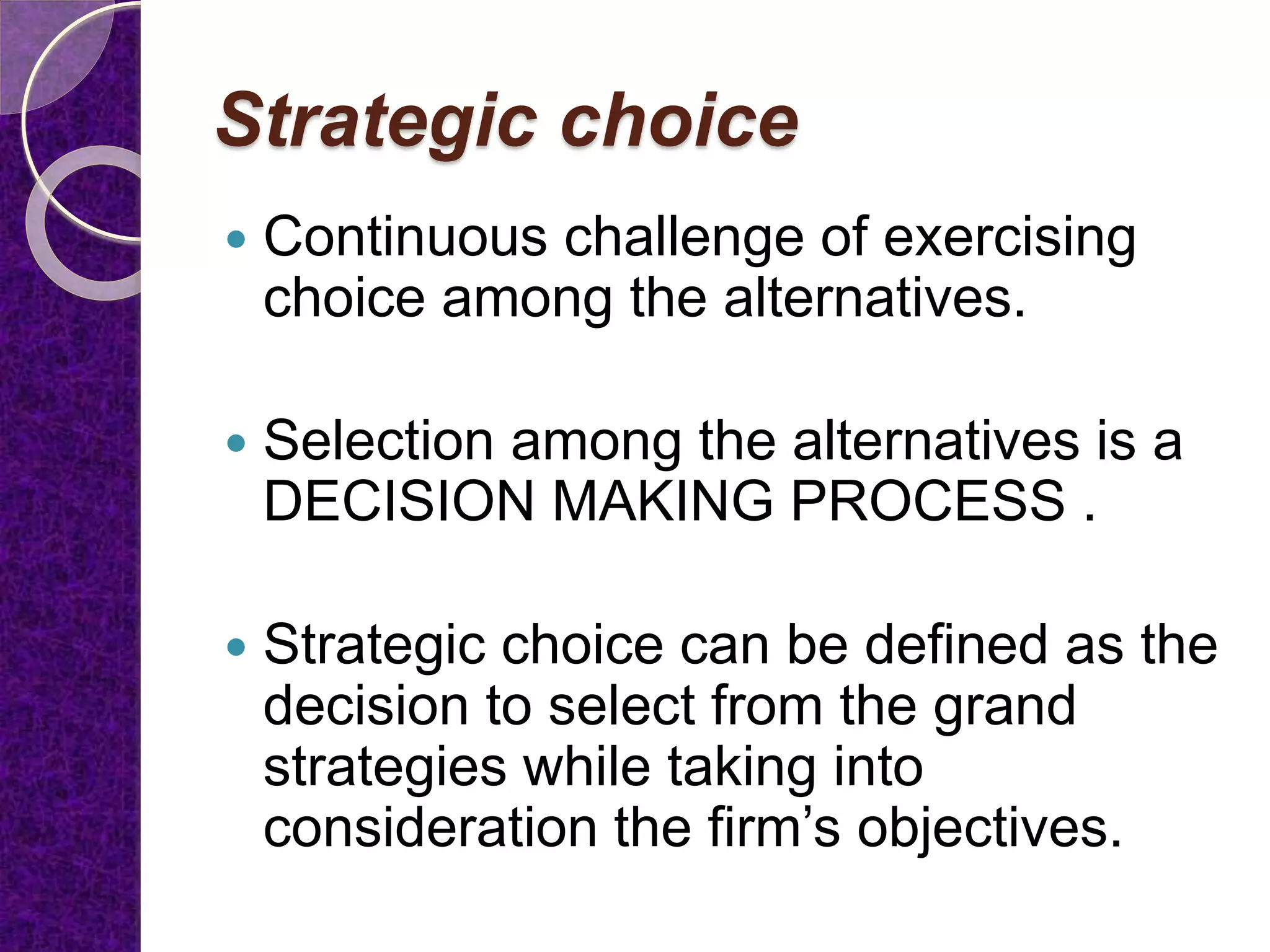
 Continuous challenge of exercising
choice among the alternatives.
 Selection among the alternatives is a
DECISION MAKING PROCESS .
 Strategic choice can be defined as the
decision to select from the grand
strategies while taking into
consideration the firm’s objectives.
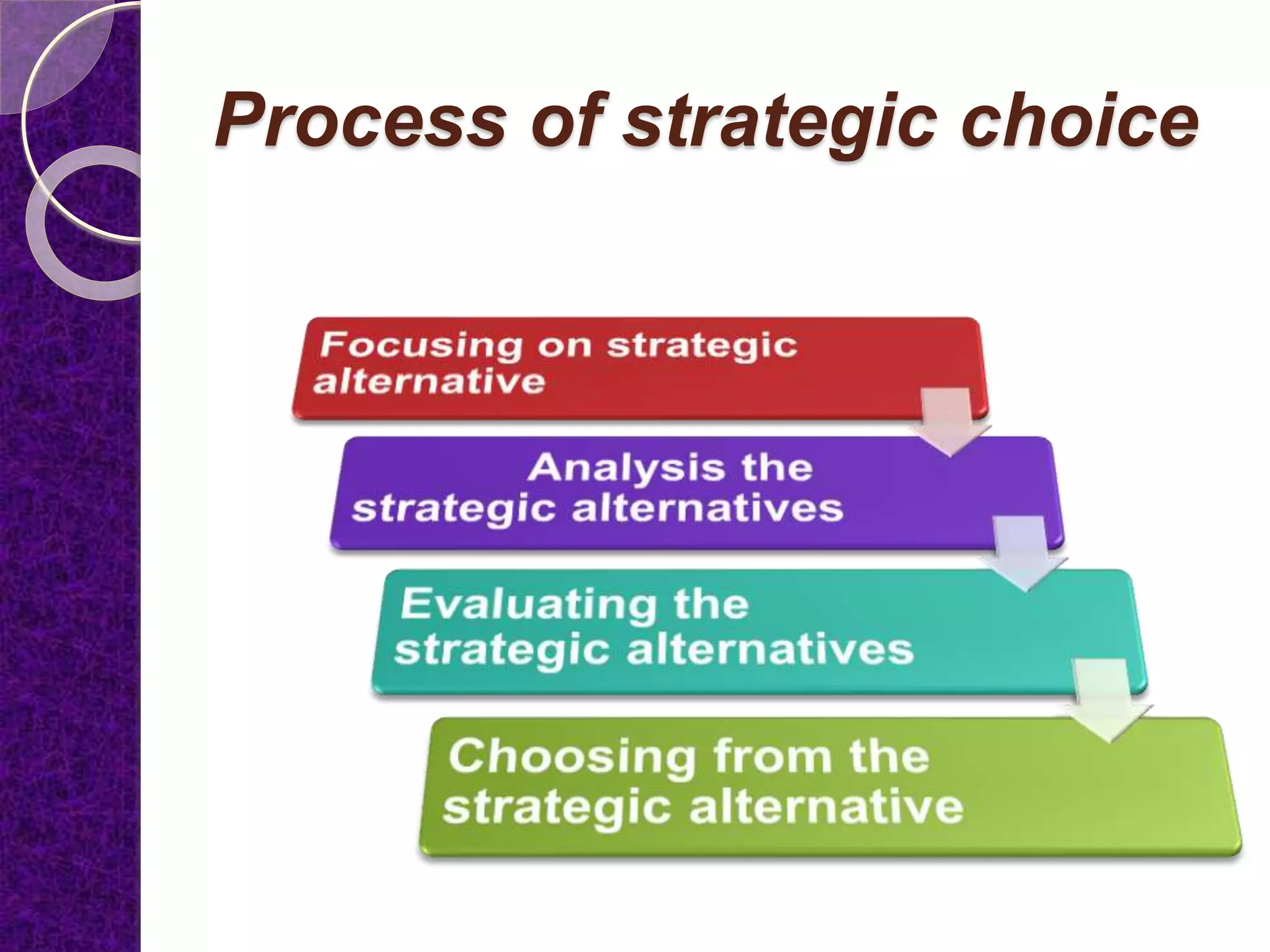
Process of strategic choice
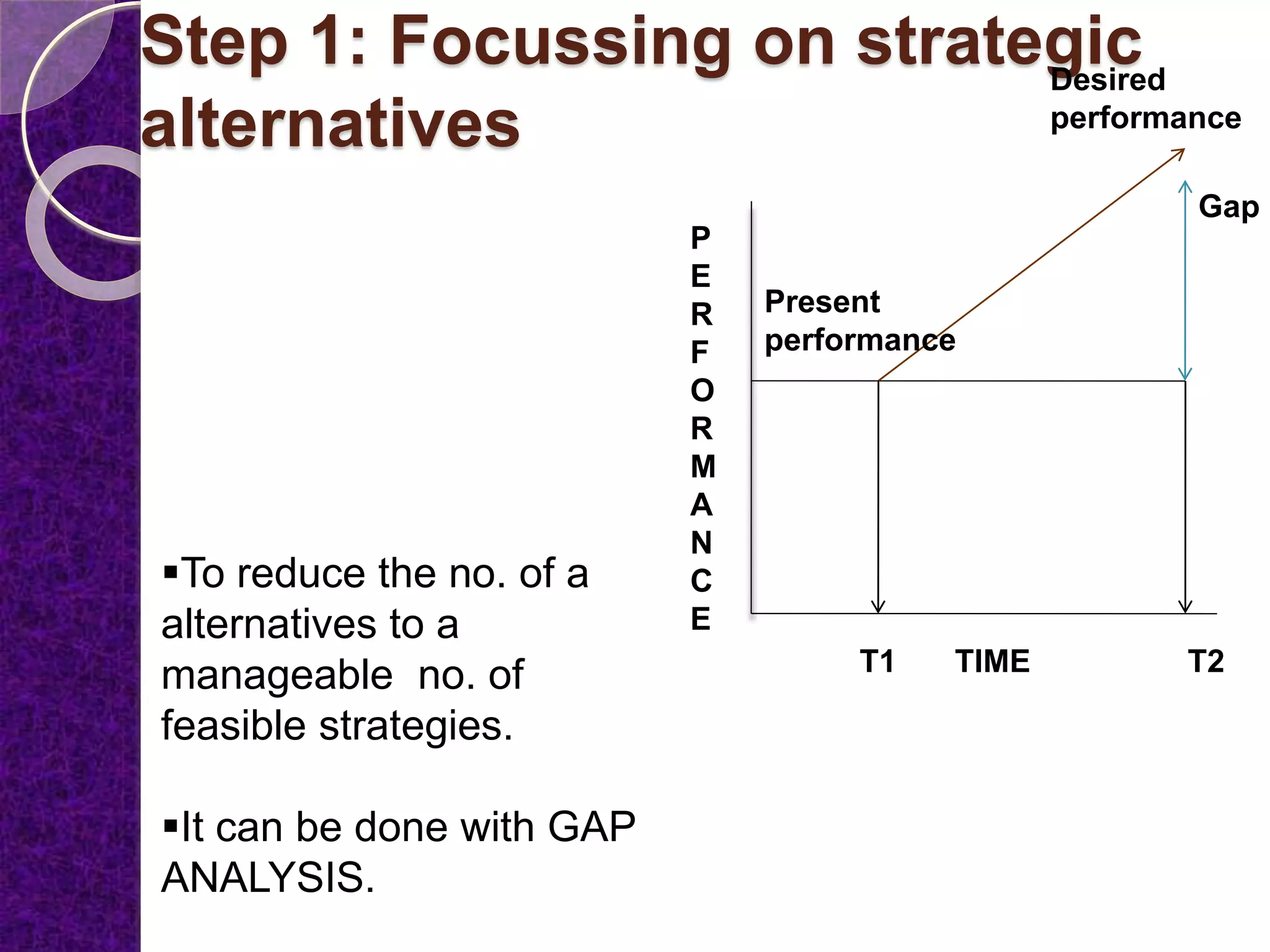
Step 1: Focussing on strategic
alternatives
T1 T2TIME
P
E
R
F
O
R
M
A
N
C
E
Present
performance
Gap
Desired
performance
To reduce the no. of a
alternatives to a
manageable no. of
feasible strategies.
It can be done with GAP
ANALYSIS.
Step 2: Analysis the strategic
alternatives
The selected feasible alternatives have to undergo through
analysis and such an analysis rely on certain factors
OBJECTIVE FACTOR SUBJECTIVE FACTORS
Based on analytical
techniques
They are hard facts or data
to facilitate a strategic choice
E.g. market share, market
demand , cost etc
Based on personal judgement
collective information
E.g. Top level management
perception
Step 3: Evaluating the strategic
alternatives
 It basically involves bringing together the analysis
done on the basis of selection factors.
 There is no set procedure and strategist may use
any approach according to circumstances.
 We usually follow strategic decision making
process.
1. Setting up
of objectives
to be achieved
2. Identify the
alternative
ways
3. Each
alternative is
evaluated in
terms of
objective
4. Best is
choosen
Step 4: Choosing among the
strategic alternatives
 Evaluation leads to clear idea which
alternative is most suitable under the
existing conditions.
 One or more strategies are choosen
and a blue print is prepared under
which those strategies are operated.
 Contingency strategies are also
formulated in order to deal with
unforeseen situation.

strategic choice in Strategic management

  • 1.
    Process of Strategicchoice Submit by:- Krishangi purohit Master of commerce(prev.) Semester 2nd
  • 2.
    Introduction  Organization continuallyface the challenge of exercising choice among alternatives .Strategic choice is an inalienable part of the decision making process. The process of strategic choice is essentially a decision making process.
  • 3.
    Strategic choice  Continuouschallenge of exercising choice among the alternatives.  Selection among the alternatives is a DECISION MAKING PROCESS .  Strategic choice can be defined as the decision to select from the grand strategies while taking into consideration the firm’s objectives.
  • 4.
  • 5.
    Step 1: Focussingon strategic alternatives T1 T2TIME P E R F O R M A N C E Present performance Gap Desired performance To reduce the no. of a alternatives to a manageable no. of feasible strategies. It can be done with GAP ANALYSIS.
  • 6.
    Step 2: Analysisthe strategic alternatives The selected feasible alternatives have to undergo through analysis and such an analysis rely on certain factors OBJECTIVE FACTOR SUBJECTIVE FACTORS Based on analytical techniques They are hard facts or data to facilitate a strategic choice E.g. market share, market demand , cost etc Based on personal judgement collective information E.g. Top level management perception
  • 7.
    Step 3: Evaluatingthe strategic alternatives  It basically involves bringing together the analysis done on the basis of selection factors.  There is no set procedure and strategist may use any approach according to circumstances.  We usually follow strategic decision making process. 1. Setting up of objectives to be achieved 2. Identify the alternative ways 3. Each alternative is evaluated in terms of objective 4. Best is choosen
  • 8.
    Step 4: Choosingamong the strategic alternatives  Evaluation leads to clear idea which alternative is most suitable under the existing conditions.  One or more strategies are choosen and a blue print is prepared under which those strategies are operated.  Contingency strategies are also formulated in order to deal with unforeseen situation.

Editor's Notes

  • #4 Strategic management involve the options for strategy in terms of both the direction in which strategy might move and the methods by which strategy might be pursued