Strategists Vision Mission statement Opportunities Threats Strengths Weakness Goals Objectives Strategies
Values Beliefs Culture Policies
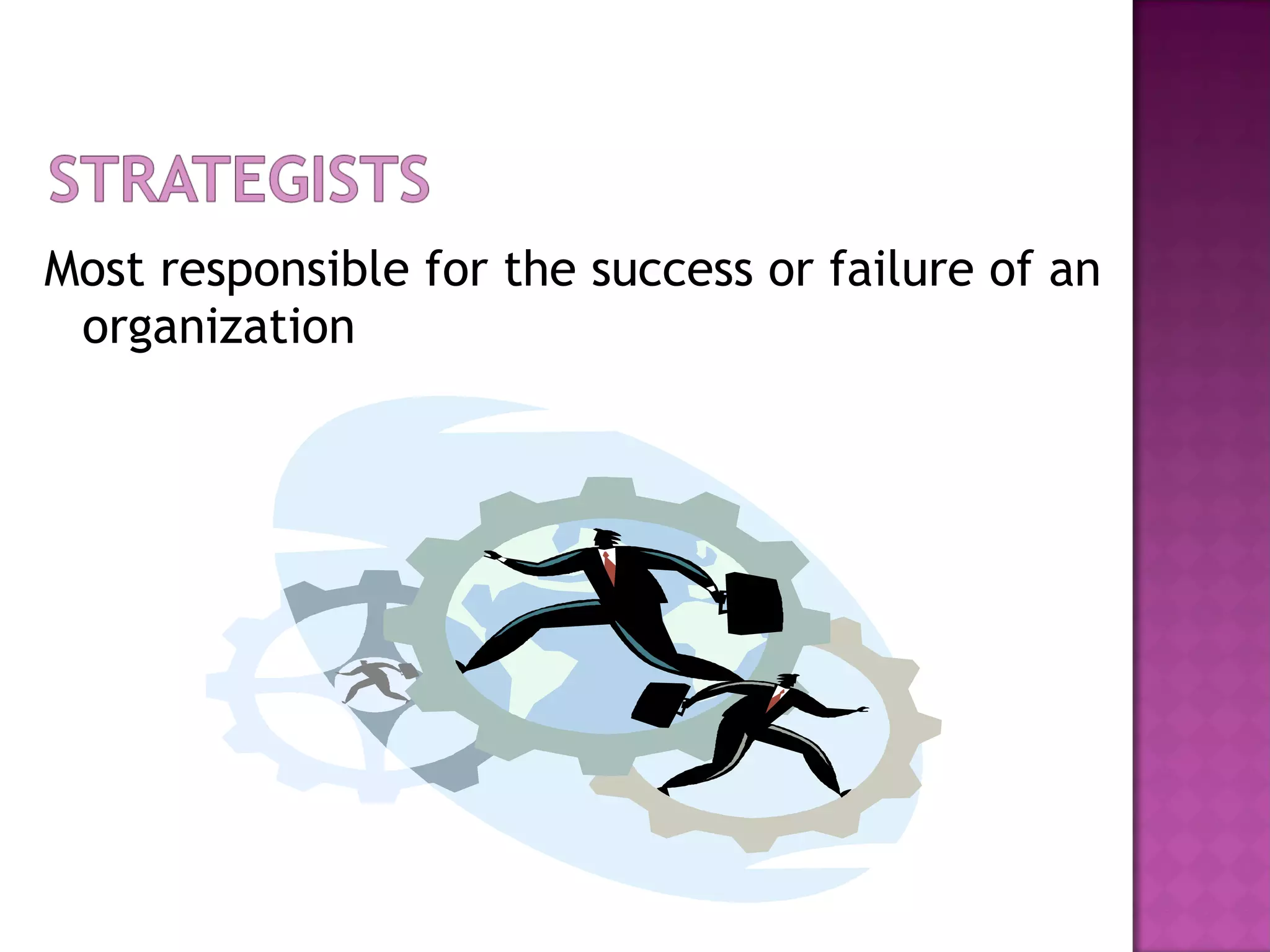
Most responsible for the success or failure of an organization
“ Vision refers to the goals that are broadest most general and all-inclusive. A vision describes aspirations for the future without specifying the means necessary to achieve those desired ends”. Alex Miller A vision is an image of its desired future
A vision refers to the category of intensions that are board, all inclusive and forward thinking. A vision describes aspirations for the future without specifying the means that will be used to achieve these desired ends. In short “ vision is the desired future state  “ the most successful consumer package goods company in the world.”
Include What the organization is to become. Broad and general purpose. Examples, 1  A world class manufacture 2  A quality organization 3 A provider of so-called legendary service
The visioning process addresses the fundamental question “ where do we want to be ?” This question is relevant to Individuals Organizations Nations
“ To be a fully developed nation on par with USA and Japan” Nation’s vision of Malaysia – 2020 Characteristics of vision Futuristic Positive Inspiring and challenging Not a fantasy or a wild dream (It is a dream in action)
Achievable Broad and general
Hemel and Prahalad have suggested five criteria for judging the relevance of the vision. Foresight –  what imagination Breadth –  how broad Uniqueness –  will it cause our competitors to be  surprised Consensus  Actionability
“ A vision becomes tangible as a mission statement. Writing such a statement specifies a leader’s values, beliefs about an organization and the directions in which should move. It can also identify what is unique about the character of the organization”  Gregory G Dess, Miller
A mission statement is a generalized statement of the overriding purpose of an organization. It can be through of as an expression of its reason for exist. There should be an agreement within the organization or with stakeholders. ORIGINS OF MISSION STATEMENT Set by senior managers Developed as the result of a consultation exercises with shareholders, staff, consumers, suppliers and others Developed by consultants
To provide a basis for consistent planning decisions To assist in translating purpose and direction into objectives suitable for assessments and control To provide consistent purpose between interest groups connected to the firm To establish organizational goals and ethics To improve understanding and support from key groups outside the firm.
What is our reason for being? What is our basics purpose ? What is unique about our organization? Who are , or who should be our major customers, clients or key market segments ? What is our principal goods and services, present and future ? What are the basic values, aspirations and philosophical priorities of the firm ?
Pierce and David suggest that Target customers and market Principal products and services Geographical domain Core technologies Concern for survival, growth and profitability Company philosophy Desire for public image
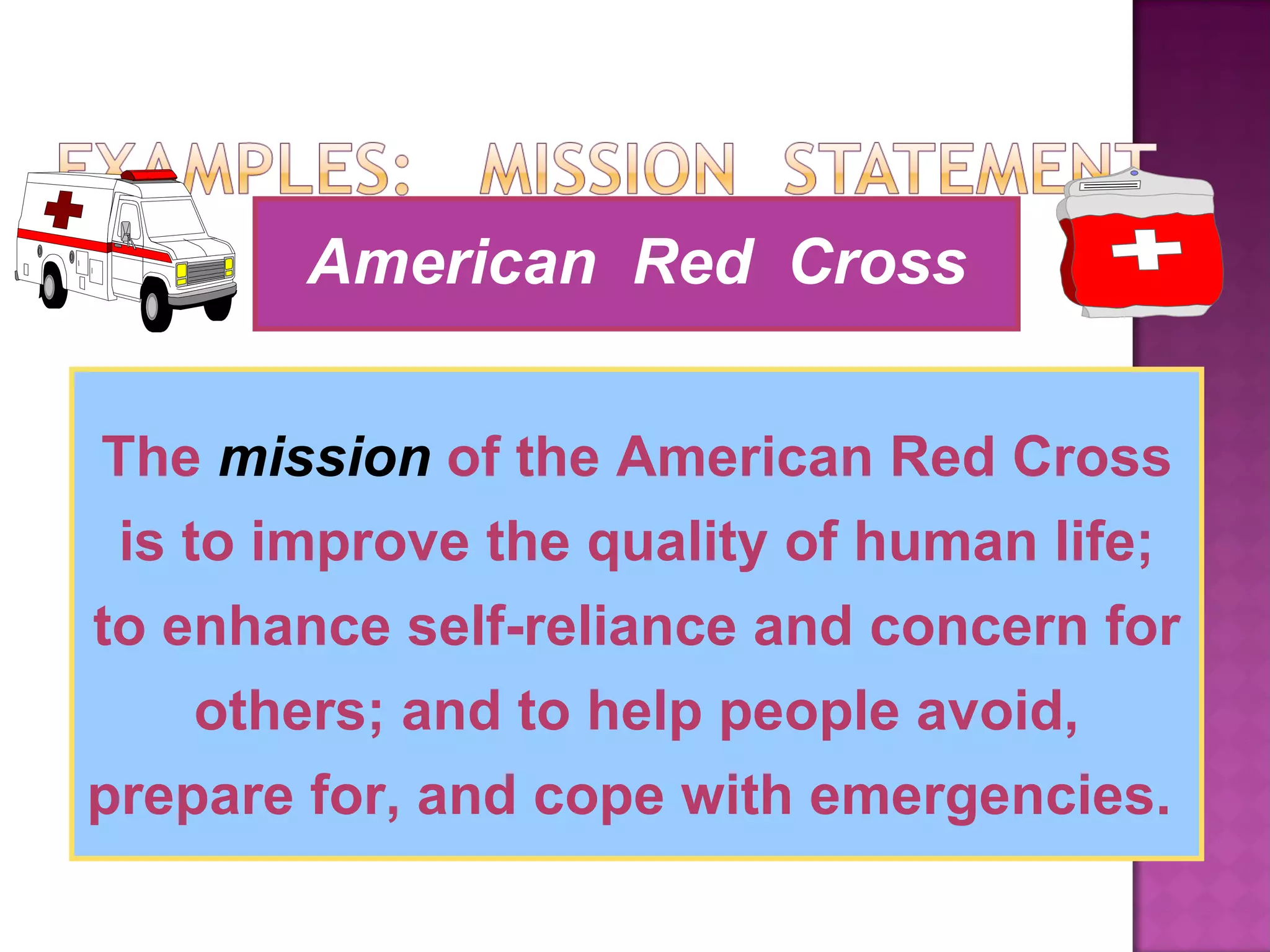
The  mission   of the American Red Cross is to improve the quality of human life; to enhance self-reliance and concern for others; and to help people avoid, prepare for, and cope with emergencies.   American  Red  Cross
Mission statement establishes boundaries to guide strategy formulation Mission statement acknowledges responsibilities to various stakeholders and establishes standards for organizational performance along corresponding dimensions Mission statement suggested standards of individual behavior.
They are often full of meaningless statements such as  the “best” or “Quality” which are open to interpretation and can not be formulated as precise objectives They can not constrain action because they can easily be written and in any case no one take them seriously They are commonly not shared by staff and other influential stakeholders.
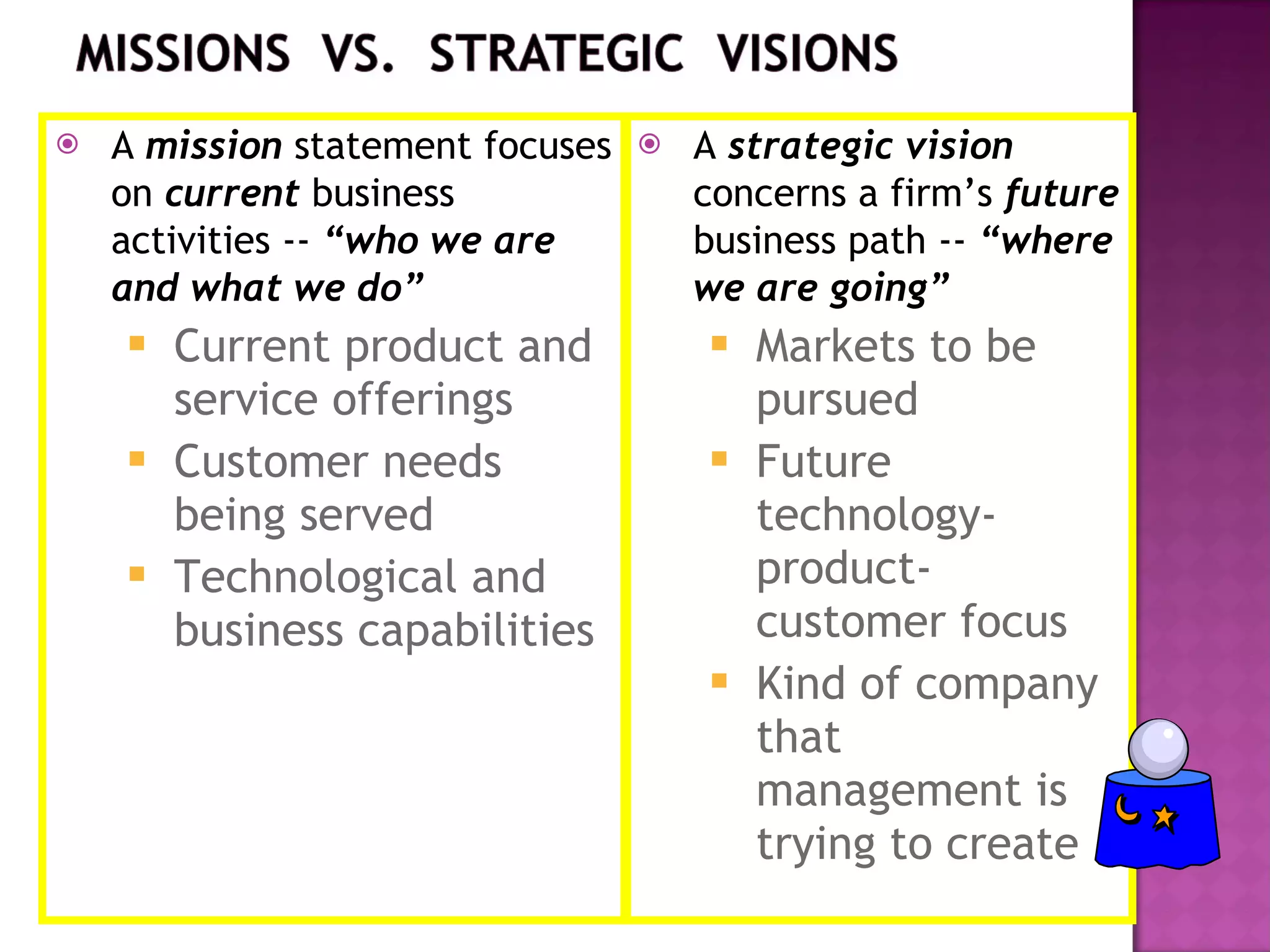
A  mission  statement focuses on  current  business activities --  “who we are and what we do” Current product and service offerings Customer needs being served Technological and business capabilities A   strategic vision  concerns a firm’s  future  business path --  “where we are going”   Markets to be pursued Future technology-product-customer focus Kind of company that management is  trying to create
These are qualitative statement about what the company likes to achieve. Examples Customer service, profitability, innovation etc. The following features help goals to be effective.
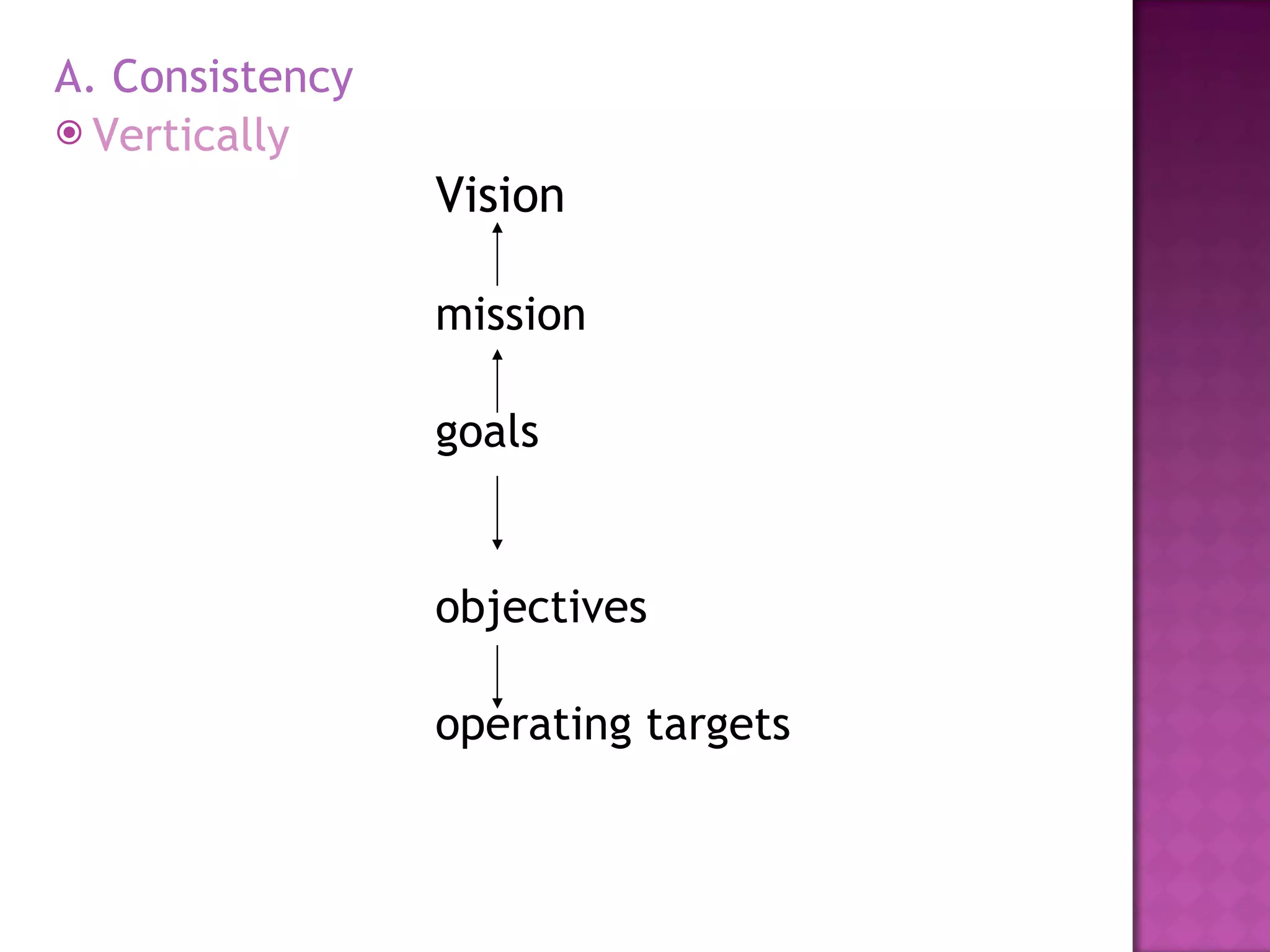
A. Consistency Vertically Vision mission goals objectives operating targets
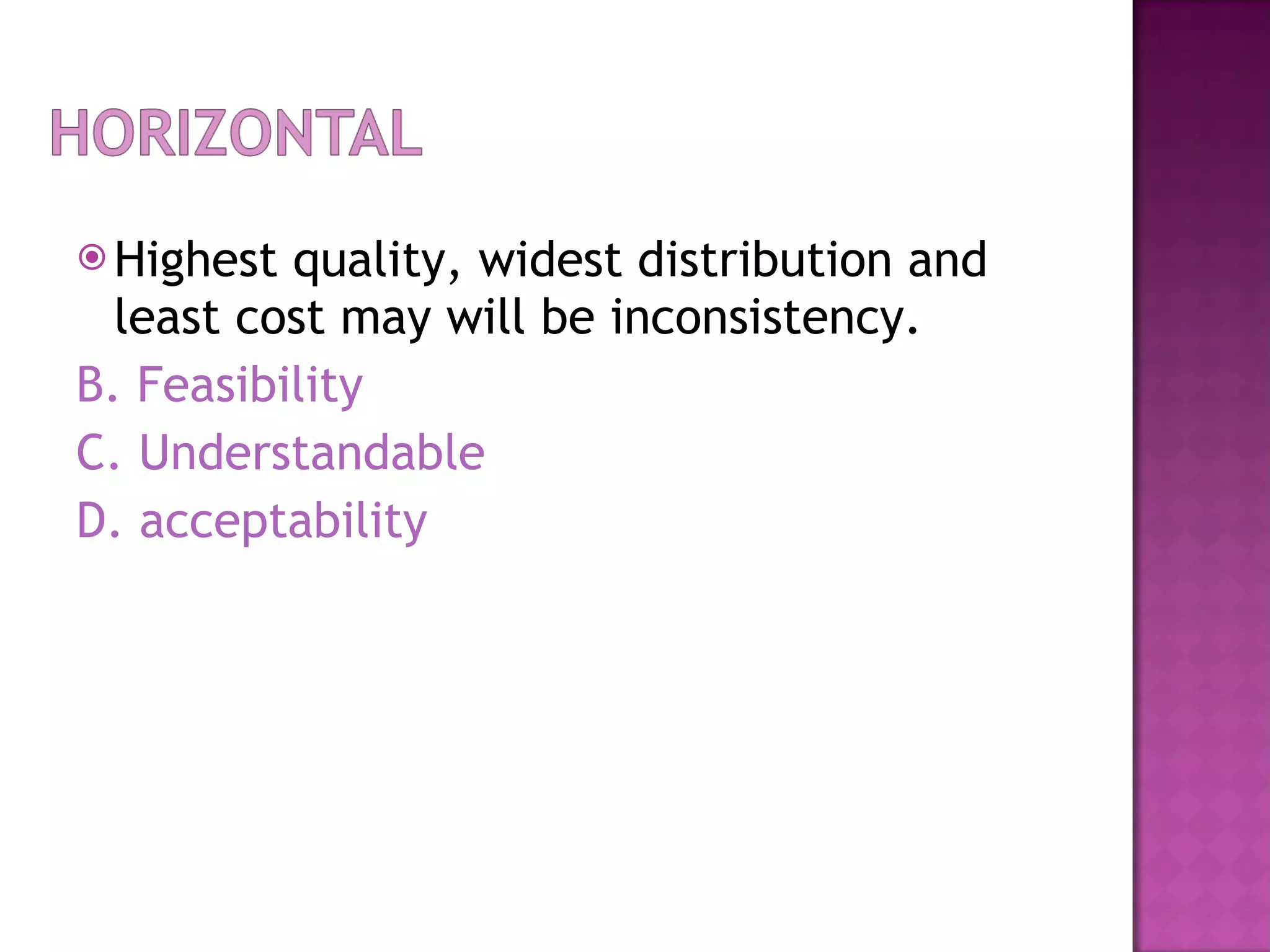
Highest quality, widest distribution and least cost may will be inconsistency. B. Feasibility C. Understandable D. acceptability
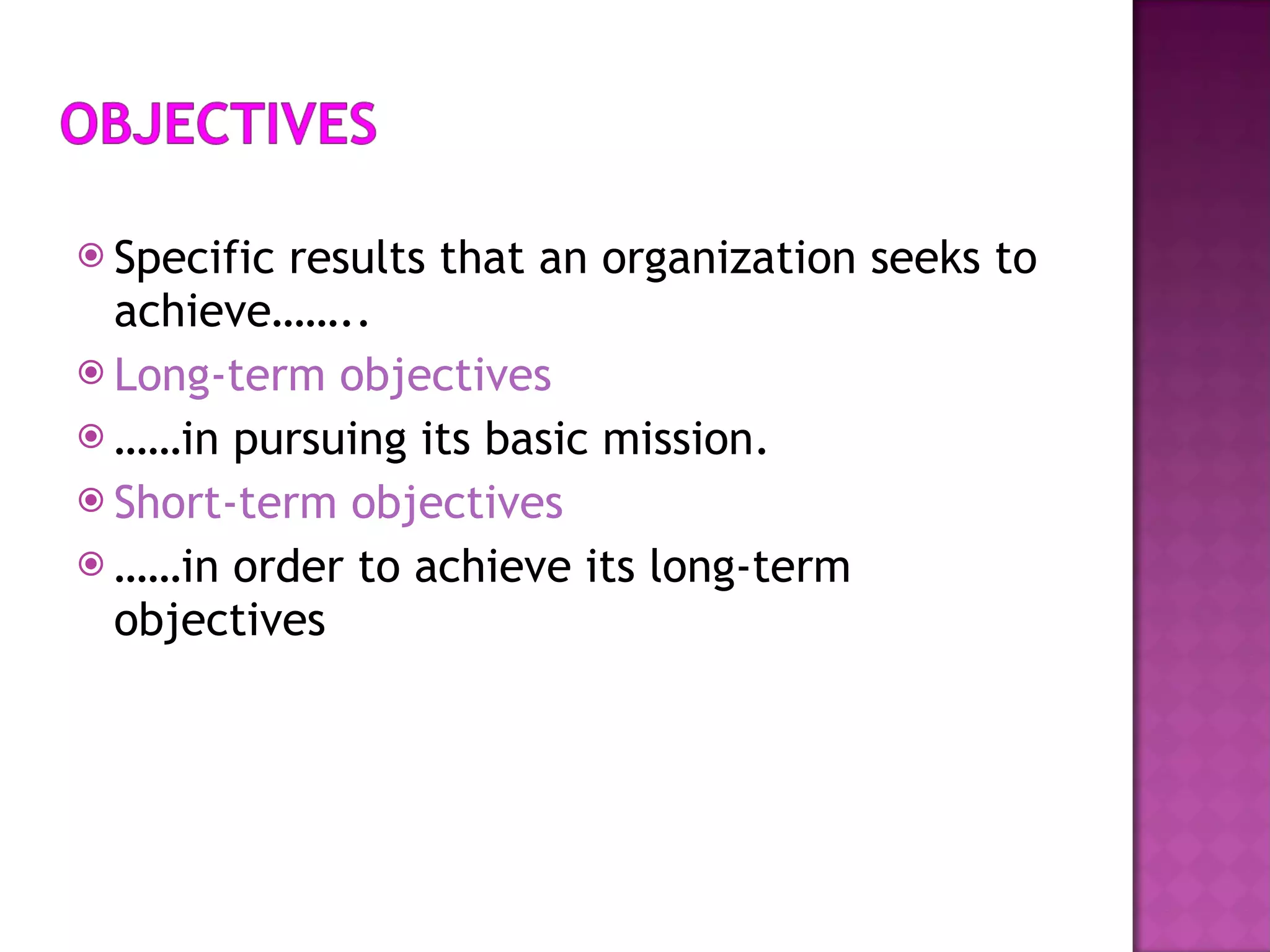
Specific results that an organization seeks to achieve……..  Long-term objectives …… in pursuing its basic mission. Short-term objectives …… in order to achieve its long-term objectives
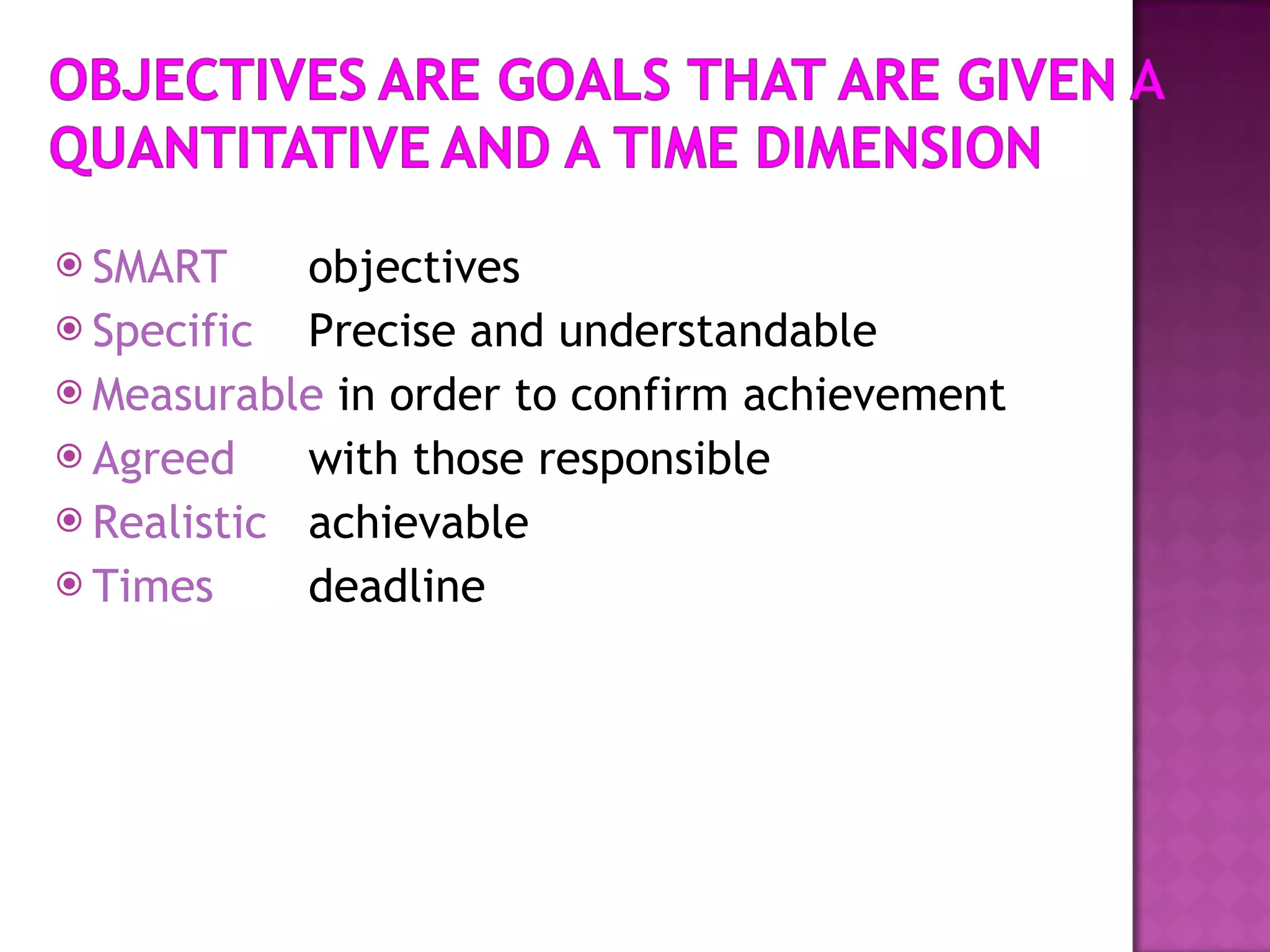
SMART   objectives Specific Precise and understandable Measurable   in order to confirm achievement Agreed with those responsible Realistic achievable Times deadline
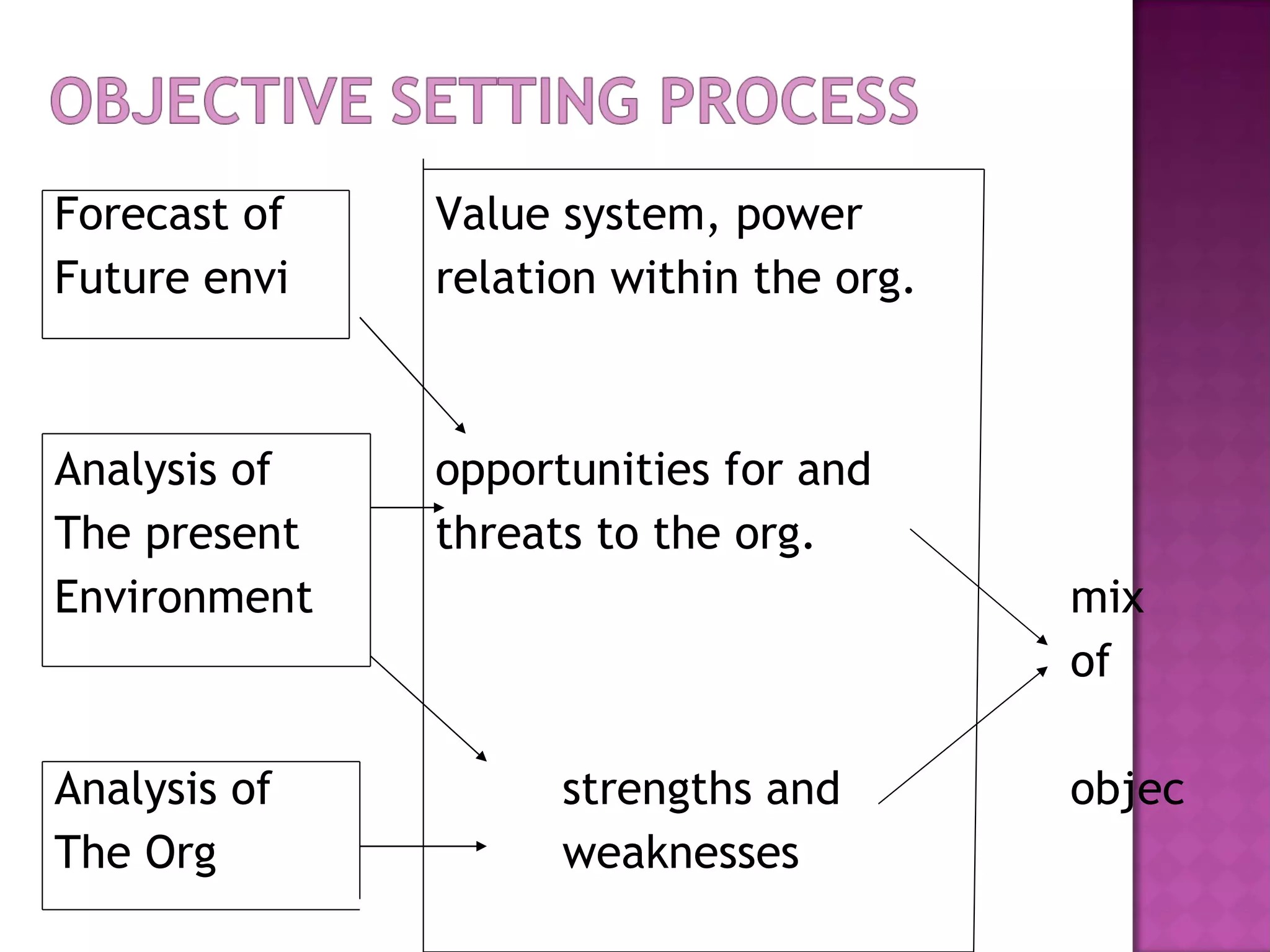
Forecast of Value system, power Future envi  relation within the org. Analysis of  opportunities for and  The present threats to the org. Environment mix of Analysis of  strengths and  objec  The Org weaknesses
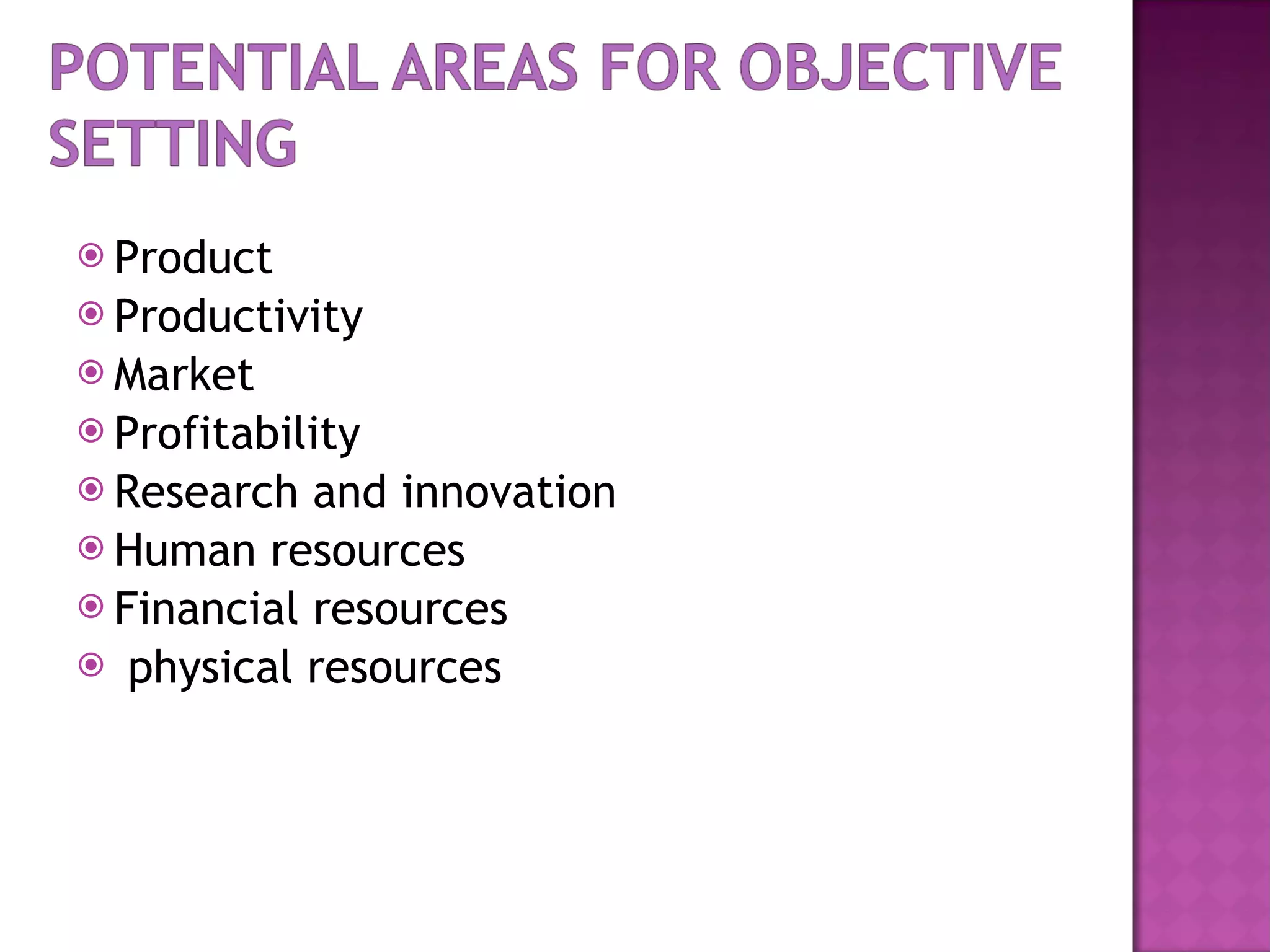
Product Productivity Market Profitability Research and innovation Human resources Financial resources physical resources
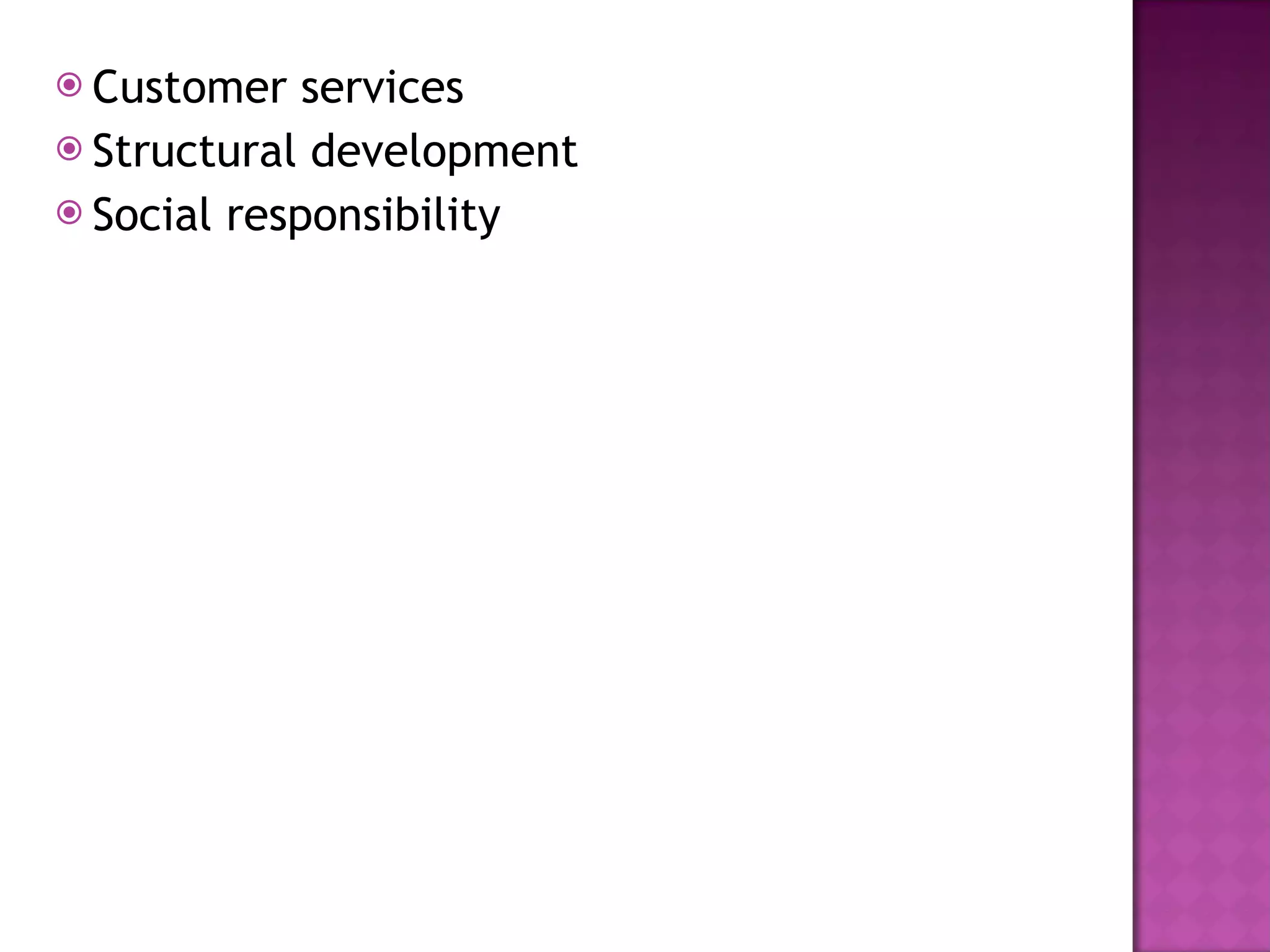
Customer services  Structural development Social responsibility
Type of goals Responsibility Mission Top management L/R objectives Top management S/R objectives Top management SBU L/R S/R objective SBU management Functional Functional Mgt Sub units Sub units Mgt Individuals individual employees
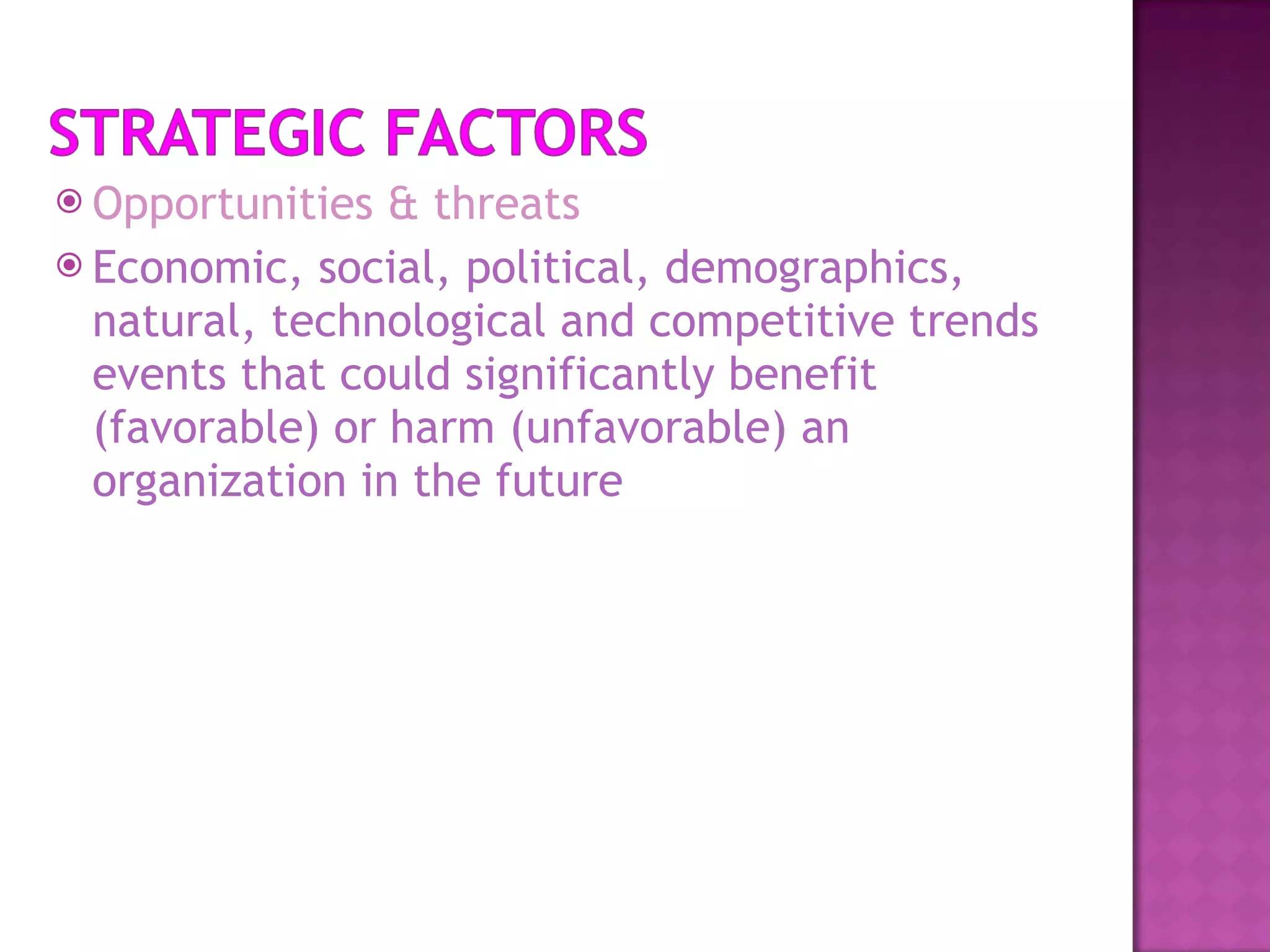
Opportunities & threats Economic, social, political, demographics, natural, technological and competitive trends events that could significantly benefit  (favorable) or harm (unfavorable) an organization in the future
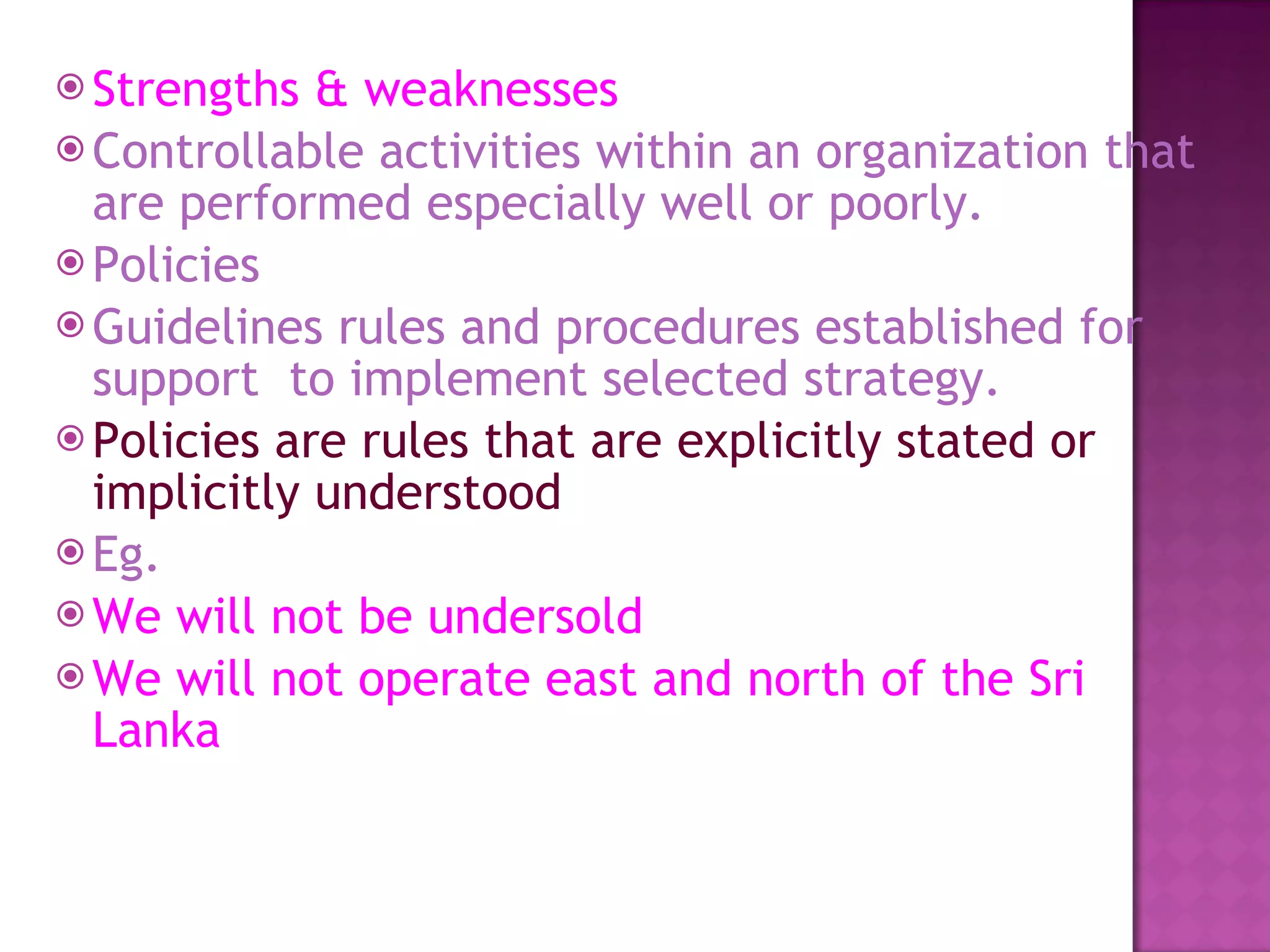
Strengths & weaknesses Controllable activities within an organization that are performed especially well or poorly. Policies Guidelines rules and procedures established for support  to implement selected strategy. Policies are rules that are explicitly stated or implicitly understood  Eg. We will not be undersold We will not operate east and north of the Sri Lanka
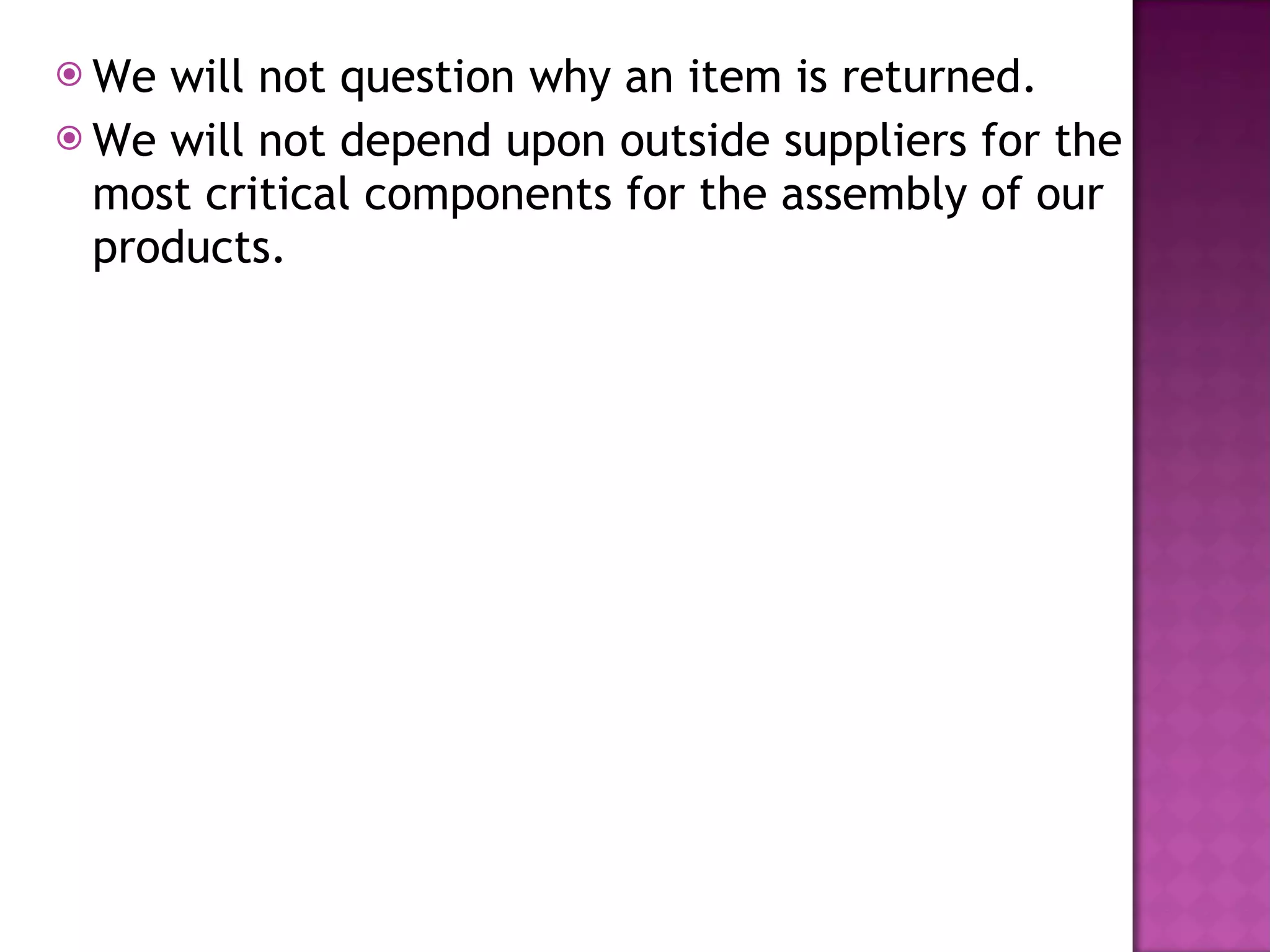
We will not question why an item is returned. We will not depend upon outside suppliers for the most critical components for the assembly of our products.
System of shared values and beliefs that shape a company’s people, organizational structures and control systems to produce behavioral norms  Alex Miller Value What is important Belief How things works Behavioral norms The way we do things around here.
Shared philosophies, expectations, attitudes and norms that knit an organization together Kilmann Basic assumptions and beliefs shared by organization members. Schein

Key terms in strategic management

  • 1.
    Strategists Vision Missionstatement Opportunities Threats Strengths Weakness Goals Objectives Strategies
  • 2.
  • 3.
    Most responsible forthe success or failure of an organization
  • 4.
    “ Vision refersto the goals that are broadest most general and all-inclusive. A vision describes aspirations for the future without specifying the means necessary to achieve those desired ends”. Alex Miller A vision is an image of its desired future
  • 5.
    A vision refersto the category of intensions that are board, all inclusive and forward thinking. A vision describes aspirations for the future without specifying the means that will be used to achieve these desired ends. In short “ vision is the desired future state “ the most successful consumer package goods company in the world.”
  • 6.
    Include What theorganization is to become. Broad and general purpose. Examples, 1 A world class manufacture 2 A quality organization 3 A provider of so-called legendary service
  • 7.
    The visioning processaddresses the fundamental question “ where do we want to be ?” This question is relevant to Individuals Organizations Nations
  • 8.
    “ To bea fully developed nation on par with USA and Japan” Nation’s vision of Malaysia – 2020 Characteristics of vision Futuristic Positive Inspiring and challenging Not a fantasy or a wild dream (It is a dream in action)
  • 9.
  • 10.
    Hemel and Prahaladhave suggested five criteria for judging the relevance of the vision. Foresight – what imagination Breadth – how broad Uniqueness – will it cause our competitors to be surprised Consensus Actionability
  • 11.
    “ A visionbecomes tangible as a mission statement. Writing such a statement specifies a leader’s values, beliefs about an organization and the directions in which should move. It can also identify what is unique about the character of the organization” Gregory G Dess, Miller
  • 12.
    A mission statementis a generalized statement of the overriding purpose of an organization. It can be through of as an expression of its reason for exist. There should be an agreement within the organization or with stakeholders. ORIGINS OF MISSION STATEMENT Set by senior managers Developed as the result of a consultation exercises with shareholders, staff, consumers, suppliers and others Developed by consultants
  • 13.
    A mission statementis a generalized statement of the overriding purpose of an organization. It can be through of as an expression of its reason for exist. There should be an agreement within the organization or with stakeholders. ORIGINS OF MISSION STATEMENT Set by senior managers Developed as the result of a consultation exercises with shareholders, staff, consumers, suppliers and others Developed by consultants
  • 14.
    To provide abasis for consistent planning decisions To assist in translating purpose and direction into objectives suitable for assessments and control To provide consistent purpose between interest groups connected to the firm To establish organizational goals and ethics To improve understanding and support from key groups outside the firm.
  • 15.
    What is ourreason for being? What is our basics purpose ? What is unique about our organization? Who are , or who should be our major customers, clients or key market segments ? What is our principal goods and services, present and future ? What are the basic values, aspirations and philosophical priorities of the firm ?
  • 16.
    Pierce and Davidsuggest that Target customers and market Principal products and services Geographical domain Core technologies Concern for survival, growth and profitability Company philosophy Desire for public image
  • 17.
    The mission of the American Red Cross is to improve the quality of human life; to enhance self-reliance and concern for others; and to help people avoid, prepare for, and cope with emergencies. American Red Cross
  • 18.
    Mission statement establishesboundaries to guide strategy formulation Mission statement acknowledges responsibilities to various stakeholders and establishes standards for organizational performance along corresponding dimensions Mission statement suggested standards of individual behavior.
  • 19.
    They are oftenfull of meaningless statements such as the “best” or “Quality” which are open to interpretation and can not be formulated as precise objectives They can not constrain action because they can easily be written and in any case no one take them seriously They are commonly not shared by staff and other influential stakeholders.
  • 20.
    A mission statement focuses on current business activities -- “who we are and what we do” Current product and service offerings Customer needs being served Technological and business capabilities A strategic vision concerns a firm’s future business path -- “where we are going” Markets to be pursued Future technology-product-customer focus Kind of company that management is trying to create
  • 21.
    These are qualitativestatement about what the company likes to achieve. Examples Customer service, profitability, innovation etc. The following features help goals to be effective.
  • 22.
    A. Consistency VerticallyVision mission goals objectives operating targets
  • 23.
    Highest quality, widestdistribution and least cost may will be inconsistency. B. Feasibility C. Understandable D. acceptability
  • 24.
    Specific results thatan organization seeks to achieve…….. Long-term objectives …… in pursuing its basic mission. Short-term objectives …… in order to achieve its long-term objectives
  • 25.
    SMART objectives Specific Precise and understandable Measurable in order to confirm achievement Agreed with those responsible Realistic achievable Times deadline
  • 26.
    Forecast of Valuesystem, power Future envi relation within the org. Analysis of opportunities for and The present threats to the org. Environment mix of Analysis of strengths and objec The Org weaknesses
  • 27.
    Product Productivity MarketProfitability Research and innovation Human resources Financial resources physical resources
  • 28.
    Customer services Structural development Social responsibility
  • 29.
    Type of goalsResponsibility Mission Top management L/R objectives Top management S/R objectives Top management SBU L/R S/R objective SBU management Functional Functional Mgt Sub units Sub units Mgt Individuals individual employees
  • 30.
    Opportunities & threatsEconomic, social, political, demographics, natural, technological and competitive trends events that could significantly benefit (favorable) or harm (unfavorable) an organization in the future
  • 31.
    Strengths & weaknessesControllable activities within an organization that are performed especially well or poorly. Policies Guidelines rules and procedures established for support to implement selected strategy. Policies are rules that are explicitly stated or implicitly understood Eg. We will not be undersold We will not operate east and north of the Sri Lanka
  • 32.
    We will notquestion why an item is returned. We will not depend upon outside suppliers for the most critical components for the assembly of our products.
  • 33.
    System of sharedvalues and beliefs that shape a company’s people, organizational structures and control systems to produce behavioral norms Alex Miller Value What is important Belief How things works Behavioral norms The way we do things around here.
  • 34.
    Shared philosophies, expectations,attitudes and norms that knit an organization together Kilmann Basic assumptions and beliefs shared by organization members. Schein