Powerpoint Templates
Page 1
Powerpoint Templates
INTERNATIONAL HUMAN
RESOURCE
MANAGEMENT
Presented by
RHIMY C RAJAN
Powerpoint Templates
Page 2
 What are reasons that encouraged global
organizations to develop international HR
strategies?
Global competition and differences in
organizational environment across nations.
Powerpoint Templates
Page 3
TYPES OF INTERNATIONAL ORGANIZATIONS
1.International Corporations
2.Multinational Corporations
3.Global Corporations
4.Transnational Corporations
Powerpoint Templates
Page 4
 International Corporations
• Domestic firms that builds on its existing capabilities to
penetrate overseas market.
Example : Honda, General Electric, P&G
Powerpoint Templates
Page 5
 Multinational Corporations
• MNCs have operating units (subsidiaries) located in foreign
countries
• Subsidiaries function as autonomous units
Examples : Shell, Philips, Xerox
Powerpoint Templates
Page 6
 Global Corporations
• Maintains control over its worldwide operations (subsidiaries)
through a centralized home office.
• They treat the entire world as a single market
Examples : Matsushita
Powerpoint Templates
Page 7
 Transnational Corporations
• Provides autonomy to independent country operations but
bring these operations together into an integrated whole
through networked structure
• They combines the local responsiveness of an MNC and the
efficiency of a global corporation
Examples : Ford & Unilever
Powerpoint Templates
Page 8
INTERNATIONAL HUMAN RESOURCE
MANAGEMENT
• Simple definition is ‘the process of managing people in
international settings’
• Scyllion (1995) defined IHRM as ‘the HRM issues and
problems arising from the internationalization of business, and
the HRM strategies, policies and practices which firms pursue
in response to the internationalization process
• IHRM is the management of HR in business operations in
atleast two nations
Powerpoint Templates
Page 9
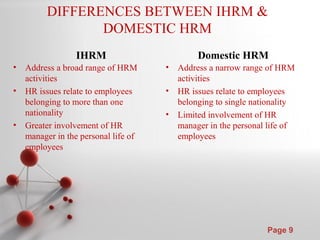
DIFFERENCES BETWEEN IHRM &
DOMESTIC HRM
IHRM
• Address a broad range of HRM
activities
• HR issues relate to employees
belonging to more than one
nationality
• Greater involvement of HR
manager in the personal life of
employees
Domestic HRM
• Address a narrow range of HRM
activities
• HR issues relate to employees
belonging to single nationality
• Limited involvement of HR
manager in the personal life of
employees
Powerpoint Templates
Page 10
IHRM
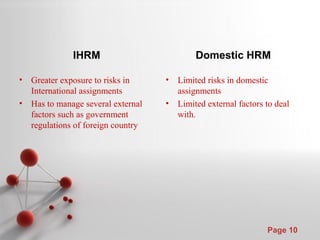
• Greater exposure to risks in
International assignments
• Has to manage several external
factors such as government
regulations of foreign country
Domestic HRM
• Limited risks in domestic
assignments
• Limited external factors to deal
with.
Powerpoint Templates
Page 11
External environment & IHRM
• Political Environment
• Cultural Environment
Powerpoint Templates
Page 12
IHRM Practices
• International staffing
• Pre-departure training for international assignments
• Repatriation
• Performance management in international
assignments
• Compensation issues in international assignments
Powerpoint Templates
Page 13
International staffing
• refers to the process of selecting employees for staffing
international operations of an MNC
MNCs can be staffed using three different sources
a. Home country or Parent Country National (PCN)
b. Host Country Nationals (HCN)
c. Third Country Nationals (TCN)
Powerpoint Templates
Page 14
• PCN
Employees of an organization who are citizens of the country in
which the headquarters of the company is located
• HCN
Employees of an organization who are the citizens of the
country in which the foreign subsidiary is located
• TCN
Employees of an organization who are the citizens of the
country other than the country where the organization is
headquarterd and the country that is hosting the subsidiary
Powerpoint Templates
Page 15
Approaches to staffing subsidiaries
• Ethnocentric
foreign subsidiary has little autonomy. All strategic decisions are made at
the headquarters. PCNs staff key positions at quarters as well as the foreign
subsidiary
• Polycentric
staff foreign subsidiaries of the firm with HCNs and headquarters consist
of PCNs
• Geocentric
staff my be PCNs, HCNs or TCNs
ability and not nationality is the key to staffing
Powerpoint Templates
Page 16
Pre-departure Training for International
Assignments
• To make it easier for the employee to assume job
responsibilities and be effective in the foreign country as soon
as possible
• To facilitate cultural adaptation as quickly and as effectively
as possible
Powerpoint Templates
Page 17
3 elements of T&D programme
1. Language training
2. Cultural training
3. Managing personal and family life
Powerpoint Templates
Page 18
Repatriation
• It is the process of bringing an expatriate home after he/she
has completed the international assignment.
Organizations can follow 3 practices
1. Create knowledge and develop global leadership skills
2. Ensure that candidates have cross-cultural skills to match their
technical abilities
3. Prepare people to make the transition back to their home
offices
Powerpoint Templates
Page 19
Performance Management in International
Assignments
Performance is the combination of several factors
 Compensation Package
 Task Assigned to the Expatriate
 Headquarter’s Support
 Environment
 Cultural Adjustment
Powerpoint Templates
Page 20
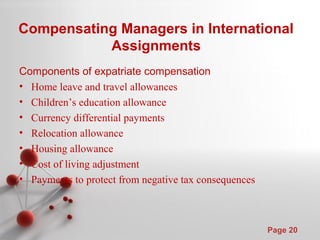
Compensating Managers in International
Assignments
Components of expatriate compensation
• Home leave and travel allowances
• Children’s education allowance
• Currency differential payments
• Relocation allowance
• Housing allowance
• Cost of living adjustment
• Payments to protect from negative tax consequences
Powerpoint Templates
Page 21
CONCLUSION
As organizations have gone global in their operations, the
impact of cultural differences as well as workforce issues have
caught the attention of the HR managers. As the world
becomes boundary less, the ability to work in a cross cultural
environment becomes a valuable asset for any executive.
Understanding, managing, and even exploiting these cultural
differences could well spell the difference between success
and failure in several business situations.
Powerpoint Templates
Page 22
Thank You

International human resource management

  • 1.
    Powerpoint Templates Page 1 PowerpointTemplates INTERNATIONAL HUMAN RESOURCE MANAGEMENT Presented by RHIMY C RAJAN
  • 2.
    Powerpoint Templates Page 2 What are reasons that encouraged global organizations to develop international HR strategies? Global competition and differences in organizational environment across nations.
  • 3.
    Powerpoint Templates Page 3 TYPESOF INTERNATIONAL ORGANIZATIONS 1.International Corporations 2.Multinational Corporations 3.Global Corporations 4.Transnational Corporations
  • 4.
    Powerpoint Templates Page 4 International Corporations • Domestic firms that builds on its existing capabilities to penetrate overseas market. Example : Honda, General Electric, P&G
  • 5.
    Powerpoint Templates Page 5 Multinational Corporations • MNCs have operating units (subsidiaries) located in foreign countries • Subsidiaries function as autonomous units Examples : Shell, Philips, Xerox
  • 6.
    Powerpoint Templates Page 6 Global Corporations • Maintains control over its worldwide operations (subsidiaries) through a centralized home office. • They treat the entire world as a single market Examples : Matsushita
  • 7.
    Powerpoint Templates Page 7 Transnational Corporations • Provides autonomy to independent country operations but bring these operations together into an integrated whole through networked structure • They combines the local responsiveness of an MNC and the efficiency of a global corporation Examples : Ford & Unilever
  • 8.
    Powerpoint Templates Page 8 INTERNATIONALHUMAN RESOURCE MANAGEMENT • Simple definition is ‘the process of managing people in international settings’ • Scyllion (1995) defined IHRM as ‘the HRM issues and problems arising from the internationalization of business, and the HRM strategies, policies and practices which firms pursue in response to the internationalization process • IHRM is the management of HR in business operations in atleast two nations
  • 9.
    Powerpoint Templates Page 9 DIFFERENCESBETWEEN IHRM & DOMESTIC HRM IHRM • Address a broad range of HRM activities • HR issues relate to employees belonging to more than one nationality • Greater involvement of HR manager in the personal life of employees Domestic HRM • Address a narrow range of HRM activities • HR issues relate to employees belonging to single nationality • Limited involvement of HR manager in the personal life of employees
  • 10.
    Powerpoint Templates Page 10 IHRM •Greater exposure to risks in International assignments • Has to manage several external factors such as government regulations of foreign country Domestic HRM • Limited risks in domestic assignments • Limited external factors to deal with.
  • 11.
    Powerpoint Templates Page 11 Externalenvironment & IHRM • Political Environment • Cultural Environment
  • 12.
    Powerpoint Templates Page 12 IHRMPractices • International staffing • Pre-departure training for international assignments • Repatriation • Performance management in international assignments • Compensation issues in international assignments
  • 13.
    Powerpoint Templates Page 13 Internationalstaffing • refers to the process of selecting employees for staffing international operations of an MNC MNCs can be staffed using three different sources a. Home country or Parent Country National (PCN) b. Host Country Nationals (HCN) c. Third Country Nationals (TCN)
  • 14.
    Powerpoint Templates Page 14 •PCN Employees of an organization who are citizens of the country in which the headquarters of the company is located • HCN Employees of an organization who are the citizens of the country in which the foreign subsidiary is located • TCN Employees of an organization who are the citizens of the country other than the country where the organization is headquarterd and the country that is hosting the subsidiary
  • 15.
    Powerpoint Templates Page 15 Approachesto staffing subsidiaries • Ethnocentric foreign subsidiary has little autonomy. All strategic decisions are made at the headquarters. PCNs staff key positions at quarters as well as the foreign subsidiary • Polycentric staff foreign subsidiaries of the firm with HCNs and headquarters consist of PCNs • Geocentric staff my be PCNs, HCNs or TCNs ability and not nationality is the key to staffing
  • 16.
    Powerpoint Templates Page 16 Pre-departureTraining for International Assignments • To make it easier for the employee to assume job responsibilities and be effective in the foreign country as soon as possible • To facilitate cultural adaptation as quickly and as effectively as possible
  • 17.
    Powerpoint Templates Page 17 3elements of T&D programme 1. Language training 2. Cultural training 3. Managing personal and family life
  • 18.
    Powerpoint Templates Page 18 Repatriation •It is the process of bringing an expatriate home after he/she has completed the international assignment. Organizations can follow 3 practices 1. Create knowledge and develop global leadership skills 2. Ensure that candidates have cross-cultural skills to match their technical abilities 3. Prepare people to make the transition back to their home offices
  • 19.
    Powerpoint Templates Page 19 PerformanceManagement in International Assignments Performance is the combination of several factors  Compensation Package  Task Assigned to the Expatriate  Headquarter’s Support  Environment  Cultural Adjustment
  • 20.
    Powerpoint Templates Page 20 CompensatingManagers in International Assignments Components of expatriate compensation • Home leave and travel allowances • Children’s education allowance • Currency differential payments • Relocation allowance • Housing allowance • Cost of living adjustment • Payments to protect from negative tax consequences
  • 21.
    Powerpoint Templates Page 21 CONCLUSION Asorganizations have gone global in their operations, the impact of cultural differences as well as workforce issues have caught the attention of the HR managers. As the world becomes boundary less, the ability to work in a cross cultural environment becomes a valuable asset for any executive. Understanding, managing, and even exploiting these cultural differences could well spell the difference between success and failure in several business situations.
  • 22.