Presented By:
Krishna Kumar Paul
MBA 6th Trimester,
Boston International College
krishnapaul57@gmail.com
STRATEGIC ANALYSIS AND CHOICE
Strategy Analysis & Choice
Strategic analysis and choice largely
involves making subjective decisions
based on objective information.
Strategy Analysis & Choice
The Nature of Strategy Analysis and Choice –
– Establishing long-term objectives
– Generating alternative strategies
– Selecting strategies to pursue
– Best alternative to achieve mission and objectives
Strategy Analysis & Choice
Alternative strategies derive from –
– Vision
– Mission
– Objectives
– External audit
– Internal audit
– Past successful strategies
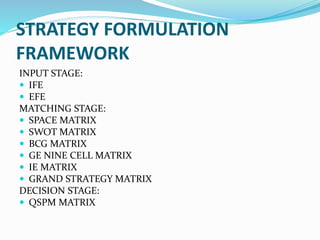
STRATEGY FORMULATION
FRAMEWORK
INPUT STAGE:
 IFE
 EFE
MATCHING STAGE:
 SPACE MATRIX
 SWOT MATRIX
 BCG MATRIX
 GE NINE CELL MATRIX
 IE MATRIX
 GRAND STRATEGY MATRIX
DECISION STAGE:
 QSPM MATRIX
Input Stage
• Provides basic input information for the matching
and decision stage matrices
• Requires strategists to quantify subjectivity early in
the process
• Good intuitive judgment always needed
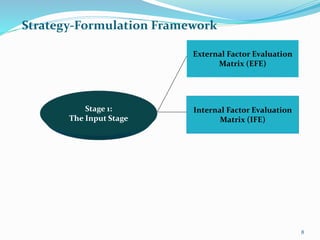
Strategy-Formulation Framework
External Factor Evaluation
Matrix (EFE)
Internal Factor Evaluation
Matrix (IFE)
Stage 1:
The Input Stage
8
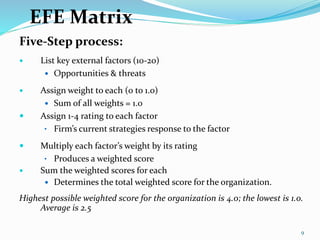
EFE Matrix
Five-Step process:
 List key external factors (10-20)
 Opportunities & threats
 Assign weight to each (0 to 1.0)
 Sum of all weights = 1.0
 Assign 1-4 rating to each factor
• Firm’s current strategies response to the factor
 Multiply each factor’s weight by its rating
• Produces a weighted score
 Sum the weighted scores for each
 Determines the total weighted score for the organization.
Highest possible weighted score for the organization is 4.0; the lowest is 1.0.
Average is 2.5
9
.201.20Political instability
.202.10Bad media exposure
.102.05Smokeless market
.153.05Production limits on tobacco
.202.10Legislation against the tobacco industry
Threats
.303.10Market growth
2.101.00TOTAL
.604.15Discount market
.051.05Internet growth
.153.05Increased demand
.151.15Global markets untapped
Weighted
score
RatingWeight
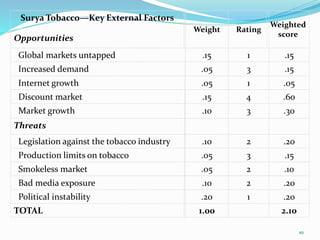
Surya Tobacco—Key External Factors
Opportunities
10
EFE
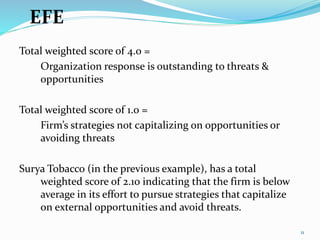
Total weighted score of 4.0 =
Organization response is outstanding to threats &
opportunities
Total weighted score of 1.0 =
Firm’s strategies not capitalizing on opportunities or
avoiding threats
Surya Tobacco (in the previous example), has a total
weighted score of 2.10 indicating that the firm is below
average in its effort to pursue strategies that capitalize
on external opportunities and avoid threats.
11
Internal Factor Evaluation (IFE) matrix
[It is similar to EFE Matrix, only difference is it uses
internal factors( strengths and weaknesses) rather
than external factors (opportunities and threats)]
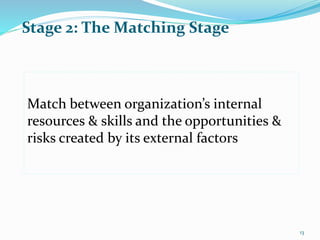
Stage 2: The Matching Stage
Match between organization’s internal
resources & skills and the opportunities &
risks created by its external factors
13
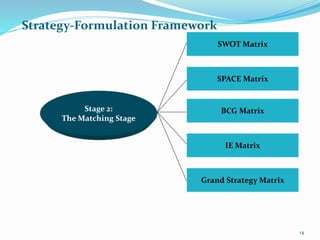
Strategy-Formulation Framework
SWOT Matrix
SPACE Matrix
BCG Matrix
IE Matrix
Grand Strategy Matrix
Stage 2:
The Matching Stage
14
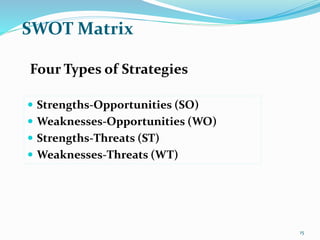
SWOT Matrix
 Strengths-Opportunities (SO)
 Weaknesses-Opportunities (WO)
 Strengths-Threats (ST)
 Weaknesses-Threats (WT)
Four Types of Strategies
15
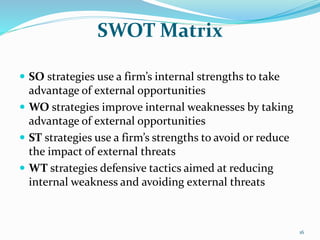
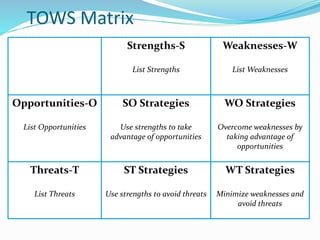
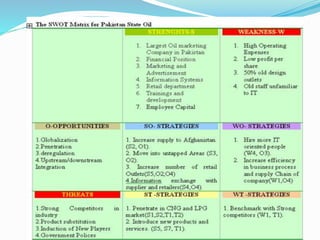
SWOT Matrix
 SO strategies use a firm’s internal strengths to take
advantage of external opportunities
 WO strategies improve internal weaknesses by taking
advantage of external opportunities
 ST strategies use a firm’s strengths to avoid or reduce
the impact of external threats
 WT strategies defensive tactics aimed at reducing
internal weakness and avoiding external threats
16
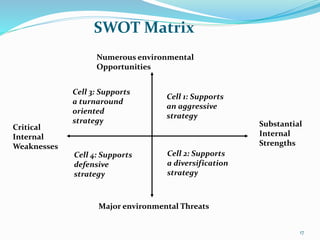
SWOT Matrix
Numerous environmental
Opportunities
Major environmental Threats
Substantial
Internal
Strengths
Critical
Internal
Weaknesses
Cell 3: Supports
a turnaround
oriented
strategy
Cell 1: Supports
an aggressive
strategy
Cell 2: Supports
a diversification
strategy
Cell 4: Supports
defensive
strategy
17
TOWS Matrix
WT Strategies
Minimize weaknesses and
avoid threats
ST Strategies
Use strengths to avoid threats
Threats-T
List Threats
WO Strategies
Overcome weaknesses by
taking advantage of
opportunities
SO Strategies
Use strengths to take
advantage of opportunities
Opportunities-O
List Opportunities
Weaknesses-W
List Weaknesses
Strengths-S
List Strengths
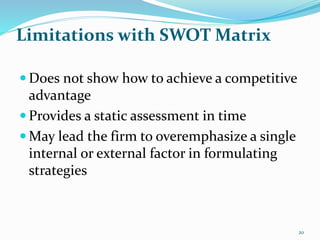
Limitations with SWOT Matrix
 Does not show how to achieve a competitive
advantage
 Provides a static assessment in time
 May lead the firm to overemphasize a single
internal or external factor in formulating
strategies
20
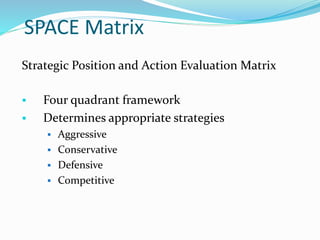
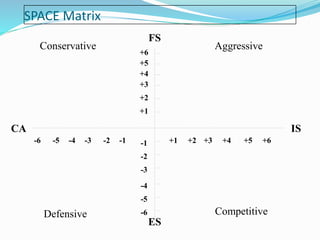
SPACE Matrix
Strategic Position and Action Evaluation Matrix
 Four quadrant framework
 Determines appropriate strategies
 Aggressive
 Conservative
 Defensive
 Competitive
SPACE Matrix
Two Internal Dimensions
 Financial Strength [FS]
 Competitive Advantage [CA]
Two External Dimensions
 Environmental Stability [ES]
 Industry Strength [IS]
SPACE Matrix
Overall Strategic position determined by:
 Financial Strength [FS]
 Competitive Advantage [CA]
 Environmental Stability [ES]
 Industry Strength [IS]
SPACE Matrix
Developing the SPACE Matrix:
 EFE Matrix
 IFE Matrix
 Financial Strength
 Competitive Advantage
 Environmental Stability
 Industry Strength
SPACE Matrix
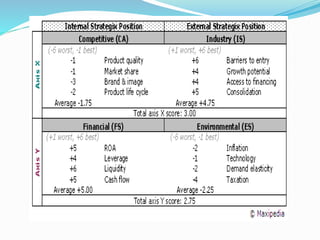
 Select variables to define FS, CA, ES, & IS
 Assign numerical ranking from +1 (worst) to +6
(best) for FS and IS; Assign numerical ranking
from –1 (best) to –6 (worst) for ES and CA.
 Compute average score for FS, CA, ES, & IS
SPACE Matrix
 Plot the average scores on the Matrix
 Add the two scores on the x-axis and plot point on
X. Add the scores on the y-axis and plot Y. Plot
the intersection of the new xy point.
 Draw a directional vector from origin through the
new intersection point.
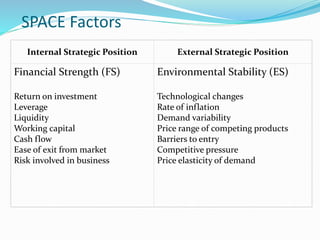
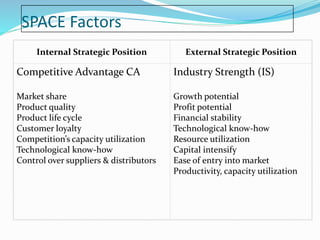
SPACE Factors
Environmental Stability (ES)
Technological changes
Rate of inflation
Demand variability
Price range of competing products
Barriers to entry
Competitive pressure
Price elasticity of demand
Financial Strength (FS)
Return on investment
Leverage
Liquidity
Working capital
Cash flow
Ease of exit from market
Risk involved in business
External Strategic PositionInternal Strategic Position
SPACE Factors
Industry Strength (IS)
Growth potential
Profit potential
Financial stability
Technological know-how
Resource utilization
Capital intensify
Ease of entry into market
Productivity, capacity utilization
Competitive Advantage CA
Market share
Product quality
Product life cycle
Customer loyalty
Competition’s capacity utilization
Technological know-how
Control over suppliers & distributors
External Strategic PositionInternal Strategic Position
SPACE Matrix
FS
+6
+1
+5
+4
+3
+2
-6
-5
-4
-3
-2
-1-6 -5 -4 -3 -2 -1 +1 +2 +3 +4 +5 +6
ES
CA IS
Conservative Aggressive
Defensive Competitive
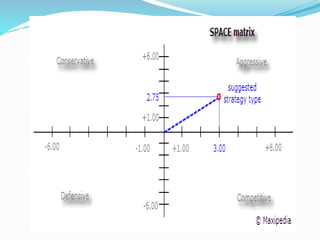
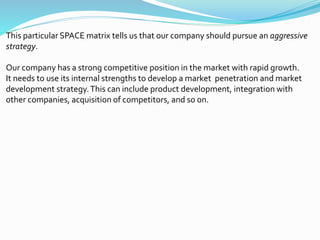
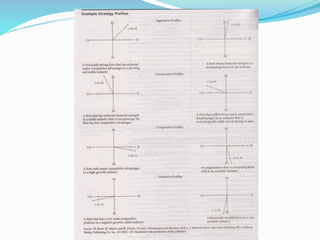
This particular SPACE matrix tells us that our company should pursue an aggressive
strategy.
Our company has a strong competitive position in the market with rapid growth.
It needs to use its internal strengths to develop a market penetration and market
development strategy.This can include product development, integration with
other companies, acquisition of competitors, and so on.
SPACE Matrix
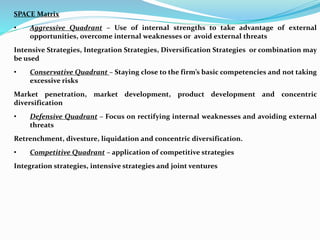
• Aggressive Quadrant – Use of internal strengths to take advantage of external
opportunities, overcome internal weaknesses or avoid external threats
Intensive Strategies, Integration Strategies, Diversification Strategies or combination may
be used
• Conservative Quadrant – Staying close to the firm’s basic competencies and not taking
excessive risks
Market penetration, market development, product development and concentric
diversification
• Defensive Quadrant – Focus on rectifying internal weaknesses and avoiding external
threats
Retrenchment, divesture, liquidation and concentric diversification.
• Competitive Quadrant – application of competitive strategies
Integration strategies, intensive strategies and joint ventures
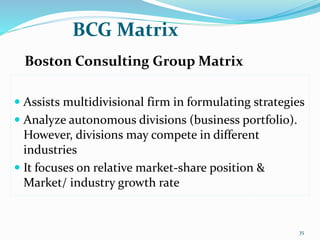
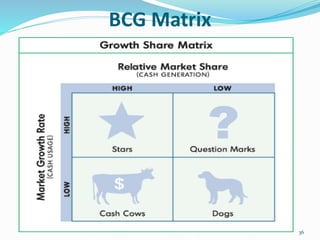
BCG Matrix
Boston Consulting Group Matrix
 Assists multidivisional firm in formulating strategies
 Analyze autonomous divisions (business portfolio).
However, divisions may compete in different
industries
 It focuses on relative market-share position &
Market/ industry growth rate
35
BCG Matrix
36
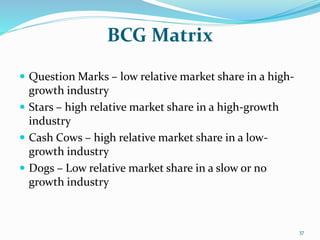
BCG Matrix
 Question Marks – low relative market share in a high-
growth industry
 Stars – high relative market share in a high-growth
industry
 Cash Cows – high relative market share in a low-
growth industry
 Dogs – Low relative market share in a slow or no
growth industry
37
The GE Nine-cell Planning Grid
(GEC’S Matrix)
 General Electric’s nine cell matrix attempts to
overcome some of the limitations of BCG matrix.
 First, GE grid uses multiple factors to assess
industry attractiveness and business strength,
rather than the single measures (market share and
market growth).
 Second, GE expanded the matrix from four cells to
nine- replacing the high/low axes with
high/medium/low axes to make finer distinction
between business portfolio positions.
38
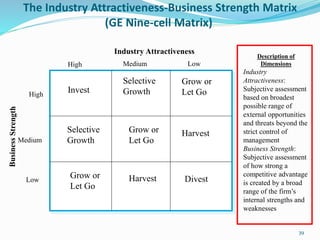
The Industry Attractiveness-Business Strength Matrix
(GE Nine-cell Matrix)
High Medium Low
Industry Attractiveness
High
Low
Medium
Invest
Selective
Growth
Grow or
Let Go
Harvest
Divest
Grow or
Let Go
Harvest
Selective
Growth
Grow or
Let Go
Description of
Dimensions
Industry
Attractiveness:
Subjective assessment
based on broadest
possible range of
external opportunities
and threats beyond the
strict control of
management
Business Strength:
Subjective assessment
of how strong a
competitive advantage
is created by a broad
range of the firm’s
internal strengths and
weaknesses
39
Advantages of the Industry Attractiveness-Business
Strength Matrix Over the BCG Matrix
Terminology is less offensive and more
understandable
Multiple measures associated with each dimension
tap many factors relevant to business strength and
market attractiveness
Allows for broader assessment during both
strategy formulation and implementation for a
multi business company
40
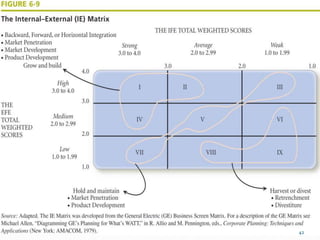
The Internal-External Matrix
 Positions an organization’s various divisions in a nine-
cell display
 Similar to BCG Matrix except the IE Matrix:
 Requires more information about the divisions
 Strategic implications of each matrix are different
41
42
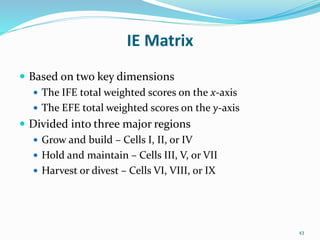
IE Matrix
 Based on two key dimensions
 The IFE total weighted scores on the x-axis
 The EFE total weighted scores on the y-axis
 Divided into three major regions
 Grow and build – Cells I, II, or IV
 Hold and maintain – Cells III, V, or VII
 Harvest or divest – Cells VI, VIII, or IX
43
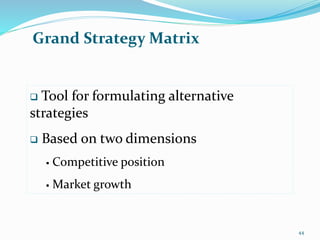
Grand Strategy Matrix
 Tool for formulating alternative
strategies
 Based on two dimensions
 Competitive position
 Market growth
44
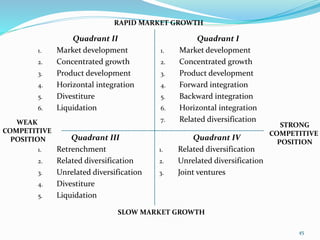
Quadrant IV
1. Related diversification
2. Unrelated diversification
3. Joint ventures
Quadrant III
1. Retrenchment
2. Related diversification
3. Unrelated diversification
4. Divestiture
5. Liquidation
Quadrant I
1. Market development
2. Concentrated growth
3. Product development
4. Forward integration
5. Backward integration
6. Horizontal integration
7. Related diversification
Quadrant II
1. Market development
2. Concentrated growth
3. Product development
4. Horizontal integration
5. Divestiture
6. Liquidation
RAPID MARKET GROWTH
SLOW MARKET GROWTH
WEAK
COMPETITIVE
POSITION
STRONG
COMPETITIVE
POSITION
45
Grand Strategy Matrix
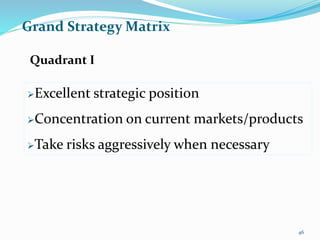
Excellent strategic position
Concentration on current markets/products
Take risks aggressively when necessary
Quadrant I
46
Grand Strategy Matrix
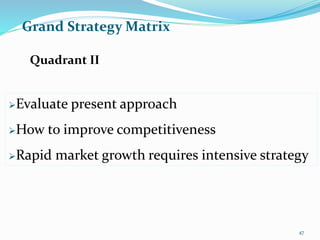
Evaluate present approach
How to improve competitiveness
Rapid market growth requires intensive strategy
Quadrant II
47
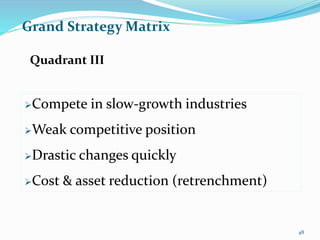
Grand Strategy Matrix
Compete in slow-growth industries
Weak competitive position
Drastic changes quickly
Cost & asset reduction (retrenchment)
Quadrant III
48
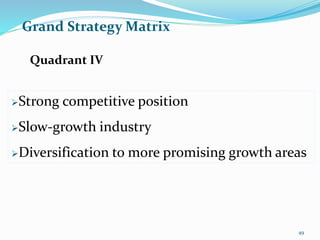
Grand Strategy Matrix
Strong competitive position
Slow-growth industry
Diversification to more promising growth areas
Quadrant IV
49
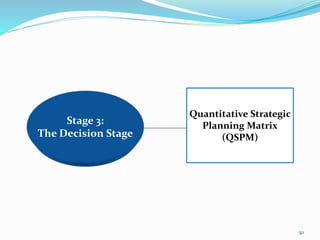
Stage 3:
The Decision Stage
Quantitative Strategic
Planning Matrix
(QSPM)
50
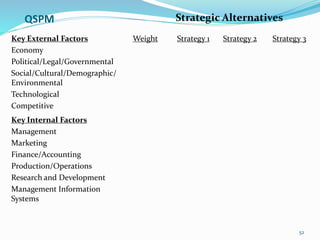
QSPM
Technique designed to determine
the relative attractiveness of feasible
alternative actions
Quantitative Strategic Planning Matrix
51
QSPM
Key Internal Factors
Management
Marketing
Finance/Accounting
Production/Operations
Research and Development
Management Information
Systems
Strategy 3Strategy 2Strategy 1WeightKey External Factors
Economy
Political/Legal/Governmental
Social/Cultural/Demographic/
Environmental
Technological
Competitive
Strategic Alternatives
52
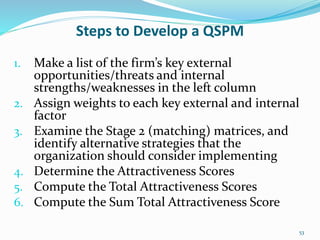
Steps to Develop a QSPM
1. Make a list of the firm’s key external
opportunities/threats and internal
strengths/weaknesses in the left column
2. Assign weights to each key external and internal
factor
3. Examine the Stage 2 (matching) matrices, and
identify alternative strategies that the
organization should consider implementing
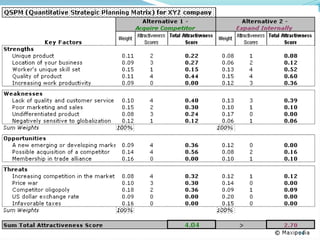
4. Determine the Attractiveness Scores
5. Compute the Total Attractiveness Scores
6. Compute the Sum Total Attractiveness Score
53
54
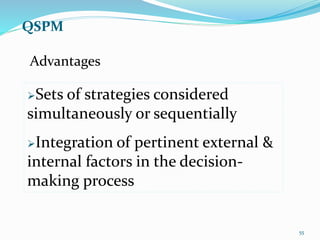
QSPM
Sets of strategies considered
simultaneously or sequentially
Integration of pertinent external &
internal factors in the decision-
making process
Advantages
55
QSPM
Requires intuitive judgments &
educated assumptions
Better to use only when all the
prerequisite information are available
Limitations
56
Thank You
57

Strategic analysis and choice

  • 1.
    Presented By: Krishna KumarPaul MBA 6th Trimester, Boston International College krishnapaul57@gmail.com STRATEGIC ANALYSIS AND CHOICE
  • 2.
    Strategy Analysis &Choice Strategic analysis and choice largely involves making subjective decisions based on objective information.
  • 3.
    Strategy Analysis &Choice The Nature of Strategy Analysis and Choice – – Establishing long-term objectives – Generating alternative strategies – Selecting strategies to pursue – Best alternative to achieve mission and objectives
  • 4.
    Strategy Analysis &Choice Alternative strategies derive from – – Vision – Mission – Objectives – External audit – Internal audit – Past successful strategies
  • 6.
    STRATEGY FORMULATION FRAMEWORK INPUT STAGE: IFE  EFE MATCHING STAGE:  SPACE MATRIX  SWOT MATRIX  BCG MATRIX  GE NINE CELL MATRIX  IE MATRIX  GRAND STRATEGY MATRIX DECISION STAGE:  QSPM MATRIX
  • 7.
    Input Stage • Providesbasic input information for the matching and decision stage matrices • Requires strategists to quantify subjectivity early in the process • Good intuitive judgment always needed
  • 8.
    Strategy-Formulation Framework External FactorEvaluation Matrix (EFE) Internal Factor Evaluation Matrix (IFE) Stage 1: The Input Stage 8
  • 9.
    EFE Matrix Five-Step process: List key external factors (10-20)  Opportunities & threats  Assign weight to each (0 to 1.0)  Sum of all weights = 1.0  Assign 1-4 rating to each factor • Firm’s current strategies response to the factor  Multiply each factor’s weight by its rating • Produces a weighted score  Sum the weighted scores for each  Determines the total weighted score for the organization. Highest possible weighted score for the organization is 4.0; the lowest is 1.0. Average is 2.5 9
  • 10.
    .201.20Political instability .202.10Bad mediaexposure .102.05Smokeless market .153.05Production limits on tobacco .202.10Legislation against the tobacco industry Threats .303.10Market growth 2.101.00TOTAL .604.15Discount market .051.05Internet growth .153.05Increased demand .151.15Global markets untapped Weighted score RatingWeight Surya Tobacco—Key External Factors Opportunities 10
  • 11.
    EFE Total weighted scoreof 4.0 = Organization response is outstanding to threats & opportunities Total weighted score of 1.0 = Firm’s strategies not capitalizing on opportunities or avoiding threats Surya Tobacco (in the previous example), has a total weighted score of 2.10 indicating that the firm is below average in its effort to pursue strategies that capitalize on external opportunities and avoid threats. 11
  • 12.
    Internal Factor Evaluation(IFE) matrix [It is similar to EFE Matrix, only difference is it uses internal factors( strengths and weaknesses) rather than external factors (opportunities and threats)]
  • 13.
    Stage 2: TheMatching Stage Match between organization’s internal resources & skills and the opportunities & risks created by its external factors 13
  • 14.
    Strategy-Formulation Framework SWOT Matrix SPACEMatrix BCG Matrix IE Matrix Grand Strategy Matrix Stage 2: The Matching Stage 14
  • 15.
    SWOT Matrix  Strengths-Opportunities(SO)  Weaknesses-Opportunities (WO)  Strengths-Threats (ST)  Weaknesses-Threats (WT) Four Types of Strategies 15
  • 16.
    SWOT Matrix  SOstrategies use a firm’s internal strengths to take advantage of external opportunities  WO strategies improve internal weaknesses by taking advantage of external opportunities  ST strategies use a firm’s strengths to avoid or reduce the impact of external threats  WT strategies defensive tactics aimed at reducing internal weakness and avoiding external threats 16
  • 17.
    SWOT Matrix Numerous environmental Opportunities Majorenvironmental Threats Substantial Internal Strengths Critical Internal Weaknesses Cell 3: Supports a turnaround oriented strategy Cell 1: Supports an aggressive strategy Cell 2: Supports a diversification strategy Cell 4: Supports defensive strategy 17
  • 18.
    TOWS Matrix WT Strategies Minimizeweaknesses and avoid threats ST Strategies Use strengths to avoid threats Threats-T List Threats WO Strategies Overcome weaknesses by taking advantage of opportunities SO Strategies Use strengths to take advantage of opportunities Opportunities-O List Opportunities Weaknesses-W List Weaknesses Strengths-S List Strengths
  • 20.
    Limitations with SWOTMatrix  Does not show how to achieve a competitive advantage  Provides a static assessment in time  May lead the firm to overemphasize a single internal or external factor in formulating strategies 20
  • 21.
    SPACE Matrix Strategic Positionand Action Evaluation Matrix  Four quadrant framework  Determines appropriate strategies  Aggressive  Conservative  Defensive  Competitive
  • 22.
    SPACE Matrix Two InternalDimensions  Financial Strength [FS]  Competitive Advantage [CA] Two External Dimensions  Environmental Stability [ES]  Industry Strength [IS]
  • 23.
    SPACE Matrix Overall Strategicposition determined by:  Financial Strength [FS]  Competitive Advantage [CA]  Environmental Stability [ES]  Industry Strength [IS]
  • 24.
    SPACE Matrix Developing theSPACE Matrix:  EFE Matrix  IFE Matrix  Financial Strength  Competitive Advantage  Environmental Stability  Industry Strength
  • 25.
    SPACE Matrix  Selectvariables to define FS, CA, ES, & IS  Assign numerical ranking from +1 (worst) to +6 (best) for FS and IS; Assign numerical ranking from –1 (best) to –6 (worst) for ES and CA.  Compute average score for FS, CA, ES, & IS
  • 26.
    SPACE Matrix  Plotthe average scores on the Matrix  Add the two scores on the x-axis and plot point on X. Add the scores on the y-axis and plot Y. Plot the intersection of the new xy point.  Draw a directional vector from origin through the new intersection point.
  • 27.
    SPACE Factors Environmental Stability(ES) Technological changes Rate of inflation Demand variability Price range of competing products Barriers to entry Competitive pressure Price elasticity of demand Financial Strength (FS) Return on investment Leverage Liquidity Working capital Cash flow Ease of exit from market Risk involved in business External Strategic PositionInternal Strategic Position
  • 28.
    SPACE Factors Industry Strength(IS) Growth potential Profit potential Financial stability Technological know-how Resource utilization Capital intensify Ease of entry into market Productivity, capacity utilization Competitive Advantage CA Market share Product quality Product life cycle Customer loyalty Competition’s capacity utilization Technological know-how Control over suppliers & distributors External Strategic PositionInternal Strategic Position
  • 29.
    SPACE Matrix FS +6 +1 +5 +4 +3 +2 -6 -5 -4 -3 -2 -1-6 -5-4 -3 -2 -1 +1 +2 +3 +4 +5 +6 ES CA IS Conservative Aggressive Defensive Competitive
  • 31.
    This particular SPACEmatrix tells us that our company should pursue an aggressive strategy. Our company has a strong competitive position in the market with rapid growth. It needs to use its internal strengths to develop a market penetration and market development strategy.This can include product development, integration with other companies, acquisition of competitors, and so on.
  • 33.
    SPACE Matrix • AggressiveQuadrant – Use of internal strengths to take advantage of external opportunities, overcome internal weaknesses or avoid external threats Intensive Strategies, Integration Strategies, Diversification Strategies or combination may be used • Conservative Quadrant – Staying close to the firm’s basic competencies and not taking excessive risks Market penetration, market development, product development and concentric diversification • Defensive Quadrant – Focus on rectifying internal weaknesses and avoiding external threats Retrenchment, divesture, liquidation and concentric diversification. • Competitive Quadrant – application of competitive strategies Integration strategies, intensive strategies and joint ventures
  • 35.
    BCG Matrix Boston ConsultingGroup Matrix  Assists multidivisional firm in formulating strategies  Analyze autonomous divisions (business portfolio). However, divisions may compete in different industries  It focuses on relative market-share position & Market/ industry growth rate 35
  • 36.
  • 37.
    BCG Matrix  QuestionMarks – low relative market share in a high- growth industry  Stars – high relative market share in a high-growth industry  Cash Cows – high relative market share in a low- growth industry  Dogs – Low relative market share in a slow or no growth industry 37
  • 38.
    The GE Nine-cellPlanning Grid (GEC’S Matrix)  General Electric’s nine cell matrix attempts to overcome some of the limitations of BCG matrix.  First, GE grid uses multiple factors to assess industry attractiveness and business strength, rather than the single measures (market share and market growth).  Second, GE expanded the matrix from four cells to nine- replacing the high/low axes with high/medium/low axes to make finer distinction between business portfolio positions. 38
  • 39.
    The Industry Attractiveness-BusinessStrength Matrix (GE Nine-cell Matrix) High Medium Low Industry Attractiveness High Low Medium Invest Selective Growth Grow or Let Go Harvest Divest Grow or Let Go Harvest Selective Growth Grow or Let Go Description of Dimensions Industry Attractiveness: Subjective assessment based on broadest possible range of external opportunities and threats beyond the strict control of management Business Strength: Subjective assessment of how strong a competitive advantage is created by a broad range of the firm’s internal strengths and weaknesses 39
  • 40.
    Advantages of theIndustry Attractiveness-Business Strength Matrix Over the BCG Matrix Terminology is less offensive and more understandable Multiple measures associated with each dimension tap many factors relevant to business strength and market attractiveness Allows for broader assessment during both strategy formulation and implementation for a multi business company 40
  • 41.
    The Internal-External Matrix Positions an organization’s various divisions in a nine- cell display  Similar to BCG Matrix except the IE Matrix:  Requires more information about the divisions  Strategic implications of each matrix are different 41
  • 42.
  • 43.
    IE Matrix  Basedon two key dimensions  The IFE total weighted scores on the x-axis  The EFE total weighted scores on the y-axis  Divided into three major regions  Grow and build – Cells I, II, or IV  Hold and maintain – Cells III, V, or VII  Harvest or divest – Cells VI, VIII, or IX 43
  • 44.
    Grand Strategy Matrix Tool for formulating alternative strategies  Based on two dimensions  Competitive position  Market growth 44
  • 45.
    Quadrant IV 1. Relateddiversification 2. Unrelated diversification 3. Joint ventures Quadrant III 1. Retrenchment 2. Related diversification 3. Unrelated diversification 4. Divestiture 5. Liquidation Quadrant I 1. Market development 2. Concentrated growth 3. Product development 4. Forward integration 5. Backward integration 6. Horizontal integration 7. Related diversification Quadrant II 1. Market development 2. Concentrated growth 3. Product development 4. Horizontal integration 5. Divestiture 6. Liquidation RAPID MARKET GROWTH SLOW MARKET GROWTH WEAK COMPETITIVE POSITION STRONG COMPETITIVE POSITION 45
  • 46.
    Grand Strategy Matrix Excellentstrategic position Concentration on current markets/products Take risks aggressively when necessary Quadrant I 46
  • 47.
    Grand Strategy Matrix Evaluatepresent approach How to improve competitiveness Rapid market growth requires intensive strategy Quadrant II 47
  • 48.
    Grand Strategy Matrix Competein slow-growth industries Weak competitive position Drastic changes quickly Cost & asset reduction (retrenchment) Quadrant III 48
  • 49.
    Grand Strategy Matrix Strongcompetitive position Slow-growth industry Diversification to more promising growth areas Quadrant IV 49
  • 50.
    Stage 3: The DecisionStage Quantitative Strategic Planning Matrix (QSPM) 50
  • 51.
    QSPM Technique designed todetermine the relative attractiveness of feasible alternative actions Quantitative Strategic Planning Matrix 51
  • 52.
    QSPM Key Internal Factors Management Marketing Finance/Accounting Production/Operations Researchand Development Management Information Systems Strategy 3Strategy 2Strategy 1WeightKey External Factors Economy Political/Legal/Governmental Social/Cultural/Demographic/ Environmental Technological Competitive Strategic Alternatives 52
  • 53.
    Steps to Developa QSPM 1. Make a list of the firm’s key external opportunities/threats and internal strengths/weaknesses in the left column 2. Assign weights to each key external and internal factor 3. Examine the Stage 2 (matching) matrices, and identify alternative strategies that the organization should consider implementing 4. Determine the Attractiveness Scores 5. Compute the Total Attractiveness Scores 6. Compute the Sum Total Attractiveness Score 53
  • 54.
  • 55.
    QSPM Sets of strategiesconsidered simultaneously or sequentially Integration of pertinent external & internal factors in the decision- making process Advantages 55
  • 56.
    QSPM Requires intuitive judgments& educated assumptions Better to use only when all the prerequisite information are available Limitations 56
  • 57.