Presentation on Chapter # 06
Strategy Analysis & Choice

 Strategy Formulation Steps.
 The Input Stage.
 The Matching Stage.
 The Decision Stage.
 Behavioral, Political, Ethical & Social Responsibility in strategy Analysis.
 Role, Responsibilities & Duties of Board of Directors.
Topics for Discussion

"Strategic management is not a box of tricks or a bundle of
techniques. It is analytical thinking and commitment of resources to action.
But quantification alone is not planning. Some of the most important issues
in strategic management cannot be quantified at all."
—Peter Drucker
"When a crisis forces choosing among alternatives, most people will
choose the worst possible one."
—Rudin’s Law
Notable Quotes

Stage 1: The Input Stage
 External Factor Evaluation Matrix (EFE)
 Competitive Profile Matrix (CPM)
 Internal Factor Evaluation Matrix (IFE)
The Strategy Formulation Framework

Five (5) Key Forces affecting the Opportunities & Threats:
 Economic forces
 Social, Cultural, Demographic, & Environmental Forces
 Political, Governmental & Legal Forces
 Technological Factors
 Competitive Forces
External Factor Evaluation Matrix (EFE)

 Availability Of Credit
 Level Of Disposable Income
 Interest Rate
 Inflation Rate
 GDP Trends
 Unemployment Trends
 Stock Market Trends
 Tax Rates
 Monetary Policy
 Fiscal Policy
 Value Of Dollar At National & International Level
Economic Forces

 Number Of Births
 Number Of Deaths
 Number Of Marriages
 Number Of Divorces
 Waste Management
 Air Pollution
 Water Pollution
 Social Security Problem
 Per Capita Income
 Buying Habits
 Attitude Toward Savings
 Average Level Of Education
Social, Cultural, Demographical &
Environmental Forces

 Government Rules & Regulations
 Change In Tax Laws
 Political Actions Committee
 Number Of Patents
 Changes in Patents Laws
 Law & Order
 Import & Export Rules & Regulations
 World Oil , Currency & Gold prices
Political, Governmental & Legal
Forces

 Alter life cycle of products
 Increase speed of distribution
 Create new products and services
 Ease limitations of geographic markets
 Alter economies of scale
 Changes in entry & exit barriers
Technological Factors

Collection and evaluation of information on competitors is essential for
successful strategy formulation .Identifying the rival firms.
 Strengths
 Weaknesses
 Capabilities
 Opportunities
 Threats
 Objectives
 Strategies
Competitive Forces
Five-Step process:
 List key external factors (10-20)
 Opportunities & threats
 Assign weight to each (0 to 1.0)
 Sum of all weights = 1.0
 Assign 1-4 rating to each factor
 Firm’s current strategies response to the factor
 Multiply each factor’s weight by its rating
 Produces a weighted score
External Factor Evaluation Matrix (EFE)

 Sum the weighted scores for each
 Determines the total weighted score for the organization.
 Highest possible weighted score for the organization is 4.0; the lowest,
1.0. Average = 2.5
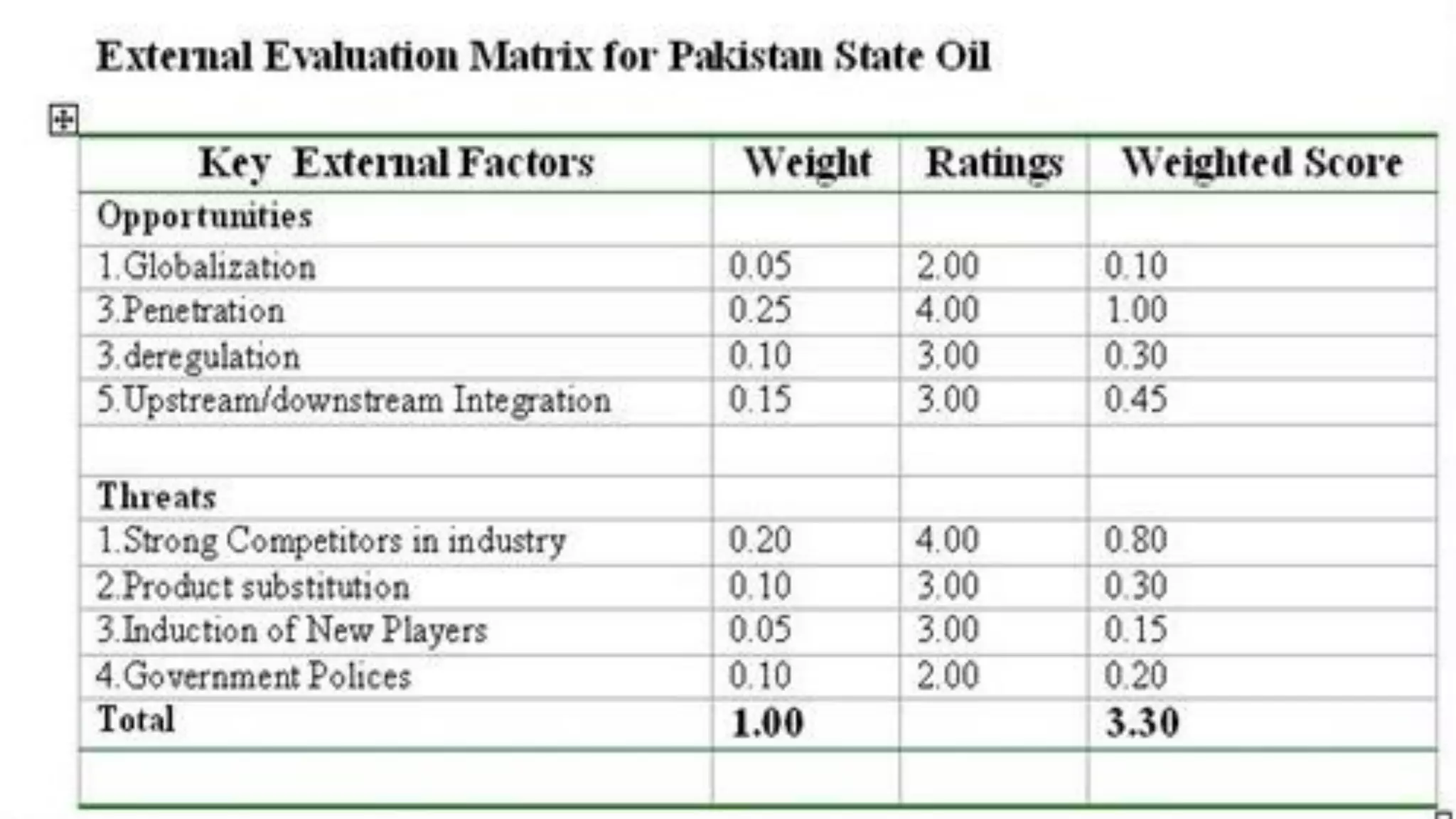
External Factor Evaluation Matrix (EFE)

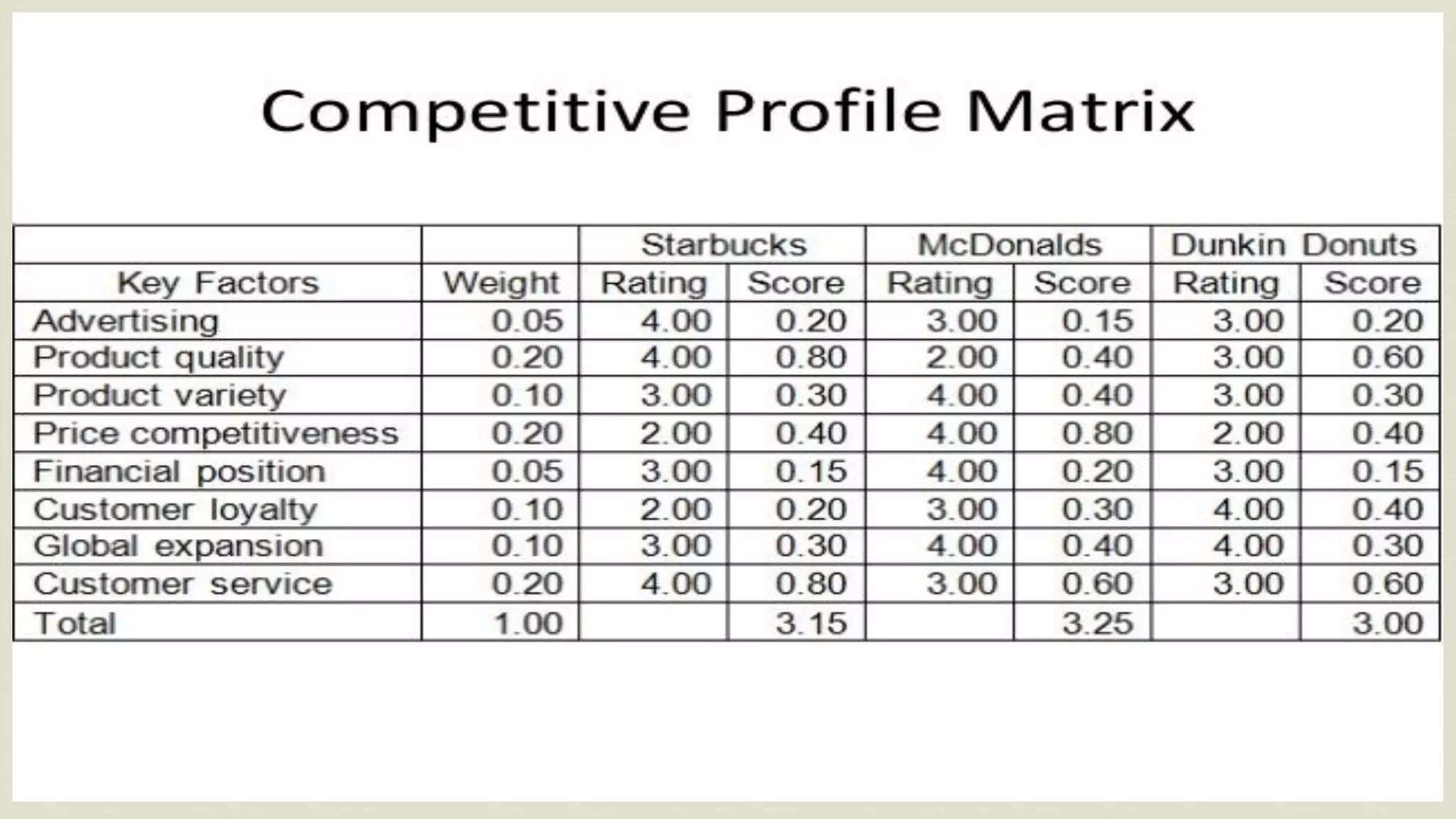
Competitive Profile Matrix
Identifies firm’s major competitors and their strengths &
weaknesses in relation to a sample firm’s strategic position.
The weights and total weighted scores in both a CPM and an EFE
have the same meaning. However, critical success factors in a CPM include
both internal and external issues; therefore, the ratings refer to strengths
and weaknesses, where 4 = major strength, 3 = minor strength, 2 = minor
weakness, and 1 = major weakness.

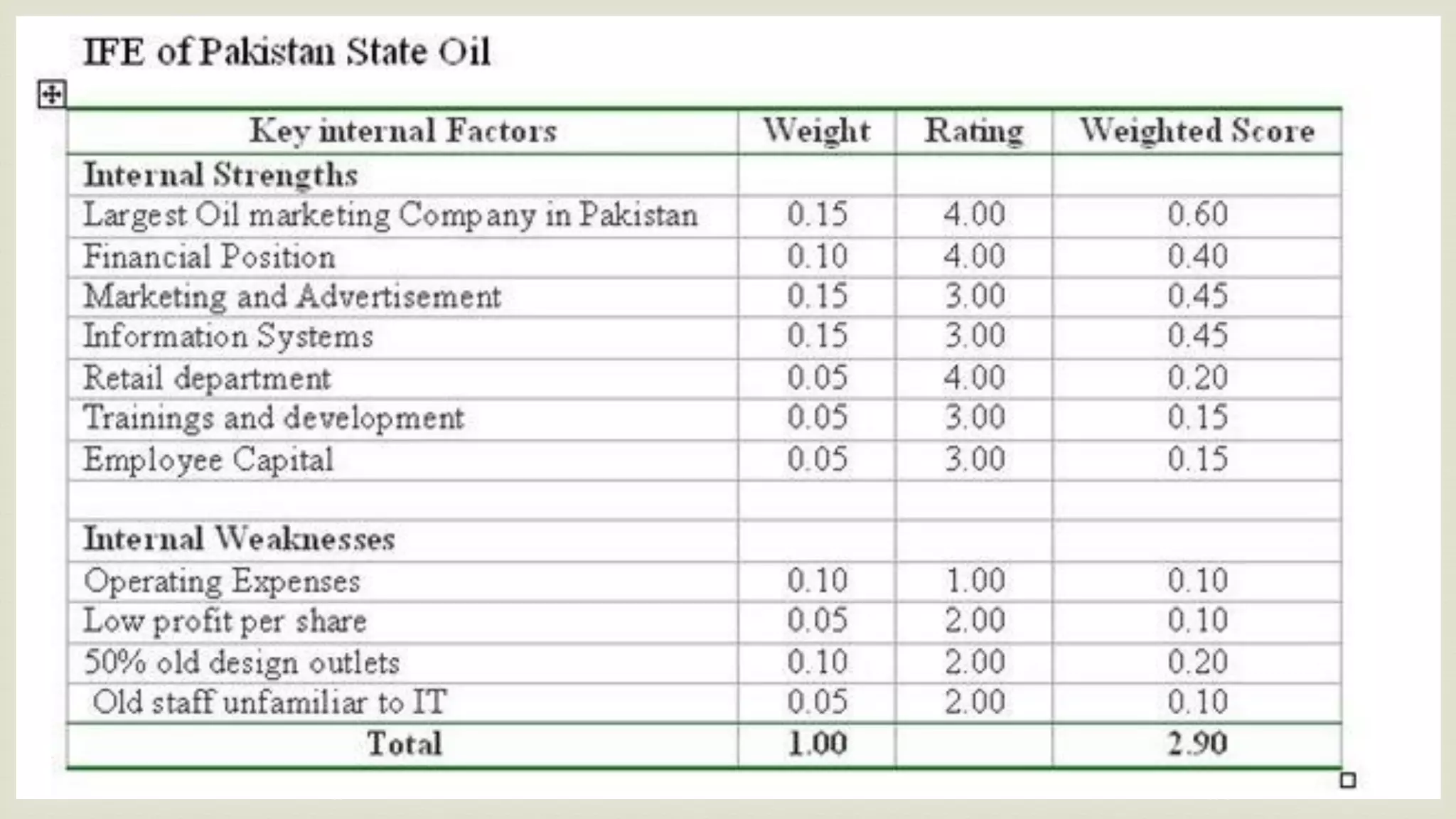
Internal Factor Evaluation Matrix (IFE)
Information from
Management
Marketing
Finance/accounting
Production/operations
Research & Development
Management Information Systems

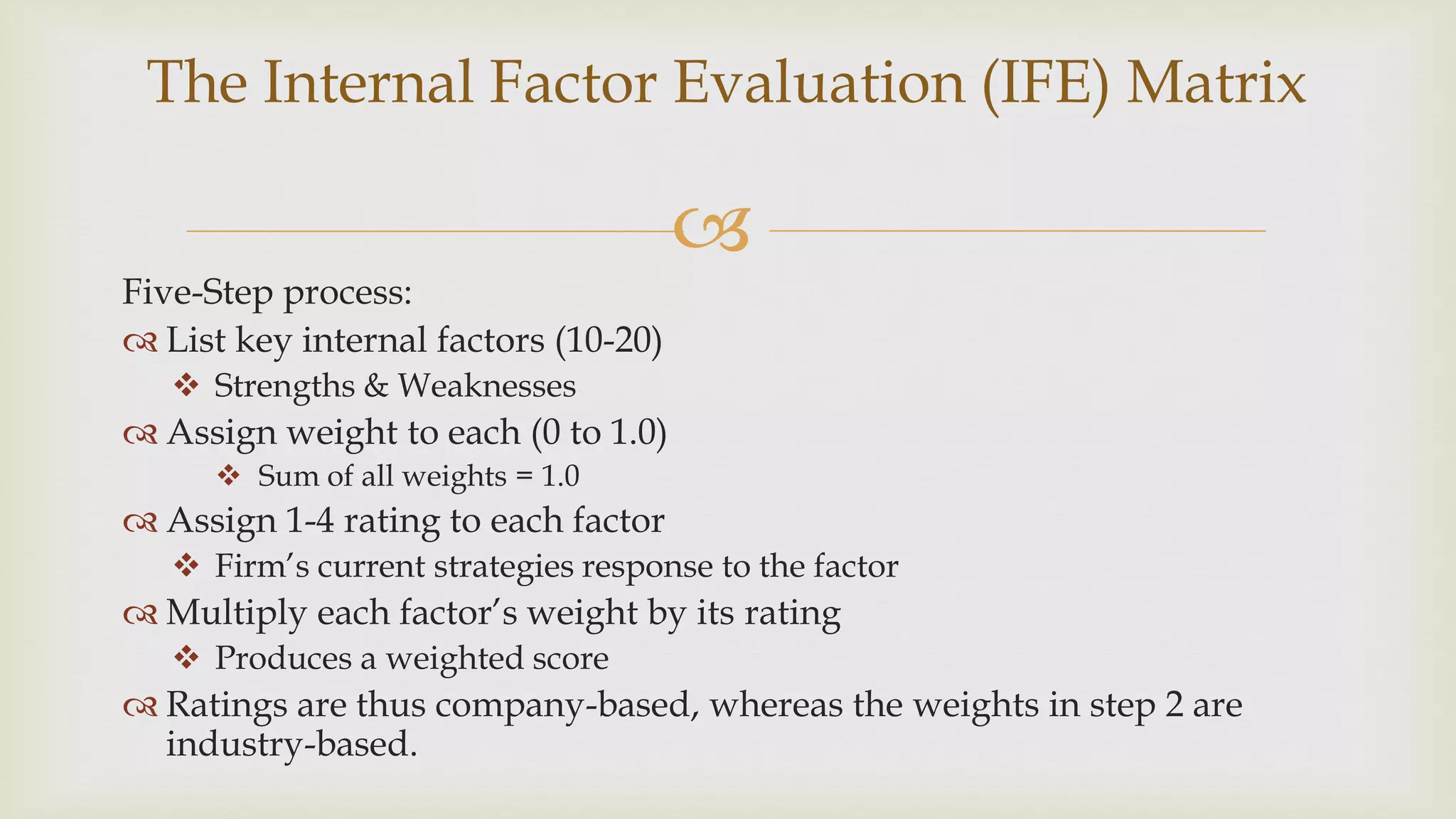
Five-Step process:
 List key internal factors (10-20)
 Strengths & Weaknesses
 Assign weight to each (0 to 1.0)
 Sum of all weights = 1.0
 Assign 1-4 rating to each factor
 Firm’s current strategies response to the factor
 Multiply each factor’s weight by its rating
 Produces a weighted score
 Ratings are thus company-based, whereas the weights in step 2 are
industry-based.
The Internal Factor Evaluation (IFE) Matrix

The Strategy Formulation Framework
Stage 2: The Matching Stage
 Strength Weakness Opportunities Threats (SWOT Matrix).
 Strategic Position & Action Evaluation (Space Matric).
 Boston Consulting Group (BCG Matrix).
 Internal-External (IE Matrix).
 Grand Strategy Matrix.

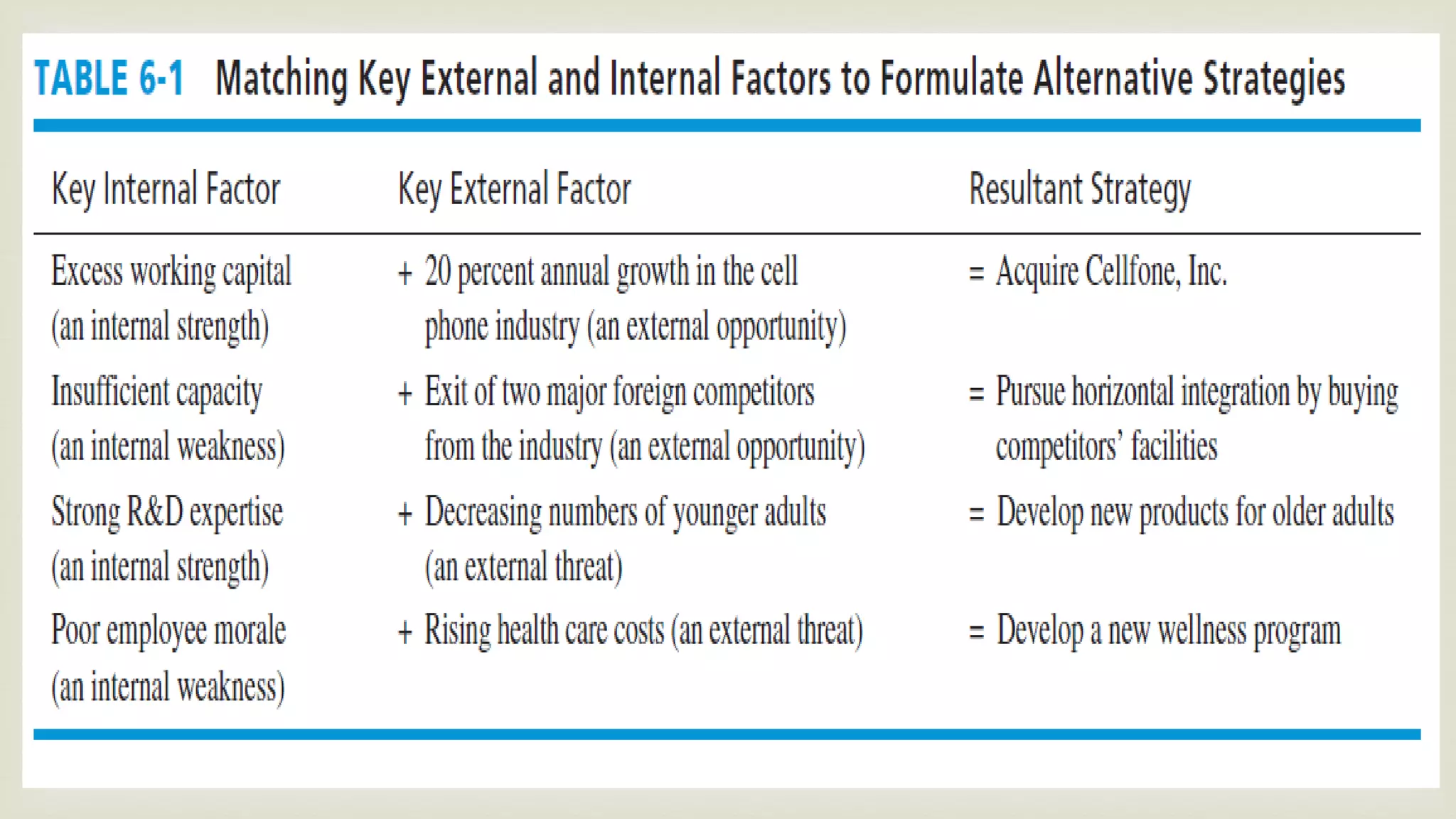
 List the firm’s key external opportunities
 List the firm’s key external threats
 List the firm’s key internal strengths
 List the firm’s key internal weaknesses
 Match internal strengths with external opportunities
Strength Weakness Opportunities Threats
(SWOT Matrix).

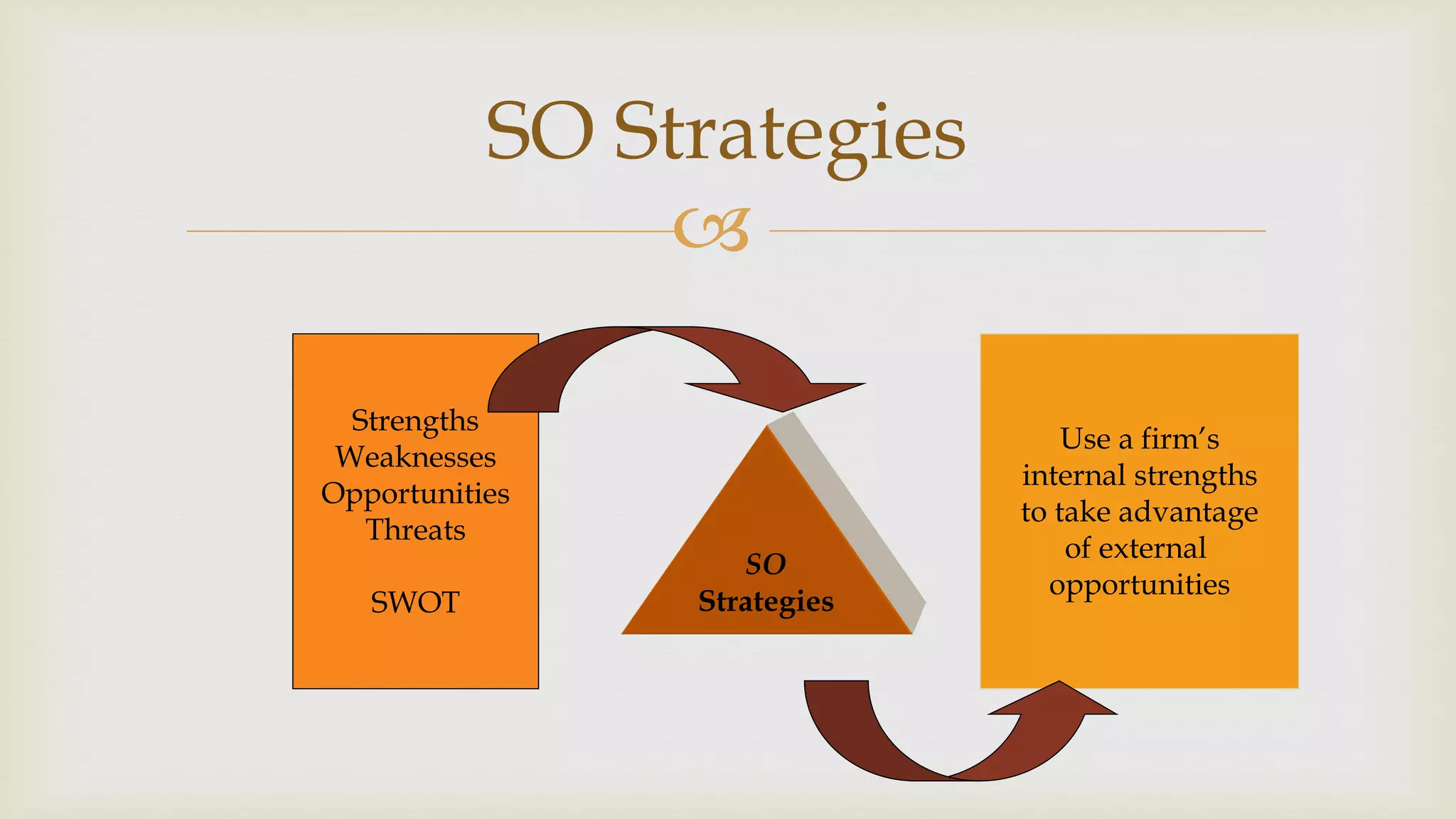
SO Strategies
Use a firm’s
internal strengths
to take advantage
of external
opportunities
SO
Strategies
Strengths
Weaknesses
Opportunities
Threats
SWOT

WO Strategies
Improving internal
weaknesses by
taking advantage
of external
opportunities
WO
Strategies
Strengths
Weaknesses
Opportunities
Threats
SWOT

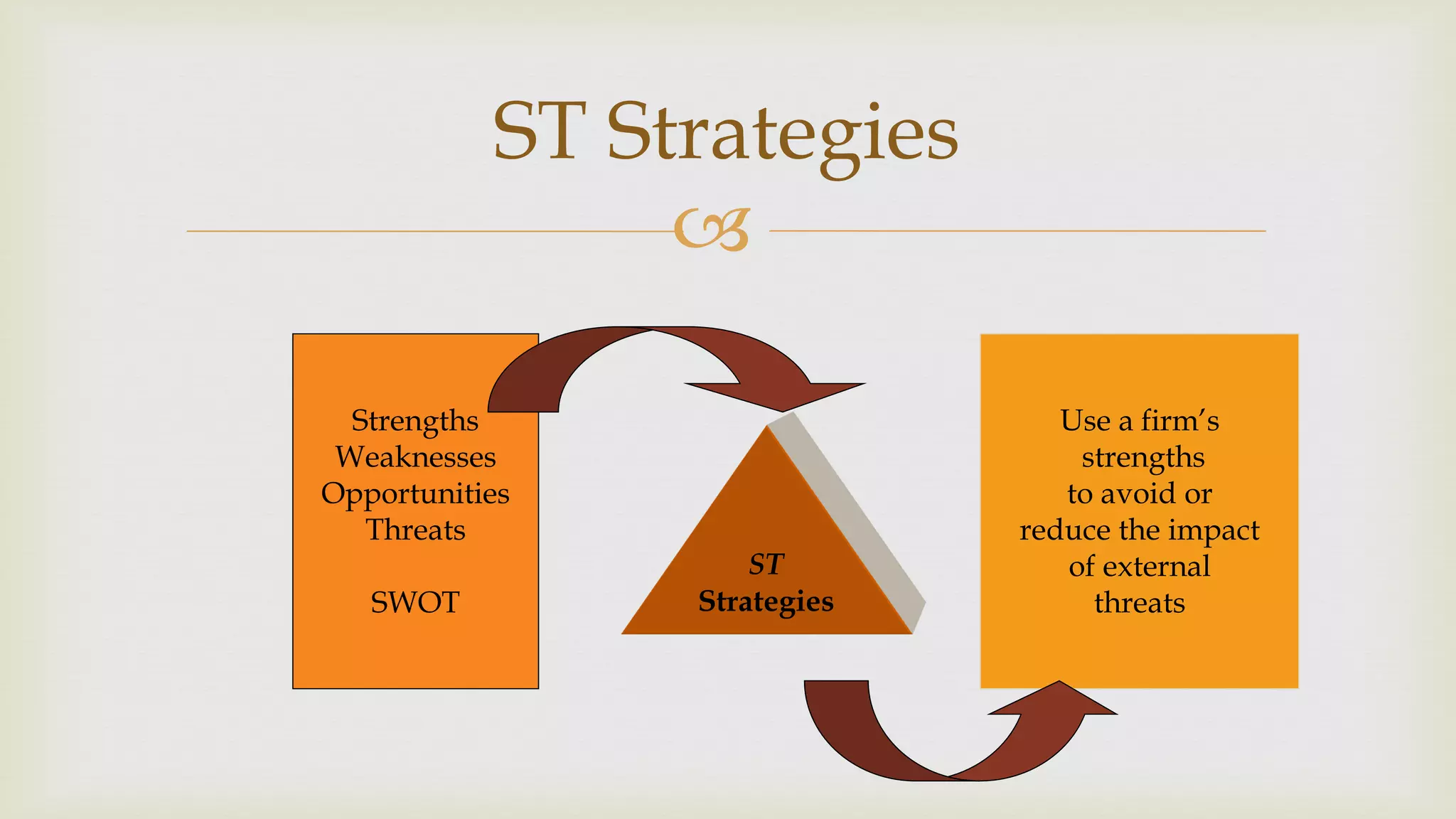
ST Strategies
Use a firm’s
strengths
to avoid or
reduce the impact
of external
threats
ST
Strategies
Strengths
Weaknesses
Opportunities
Threats
SWOT

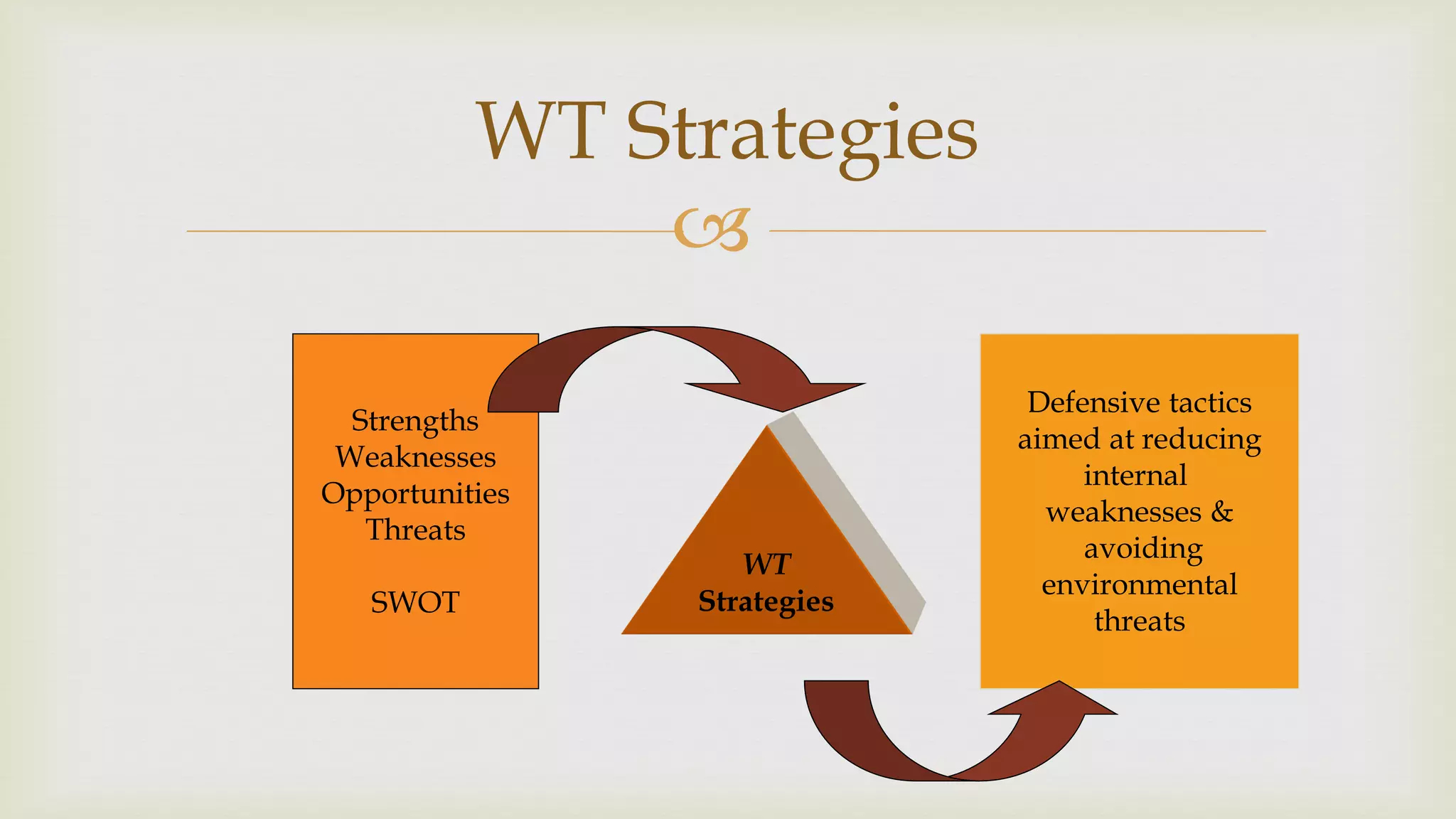
WT Strategies
Defensive tactics
aimed at reducing
internal
weaknesses &
avoiding
environmental
threats
WT
Strategies
Strengths
Weaknesses
Opportunities
Threats
SWOT


Ch 6 -27
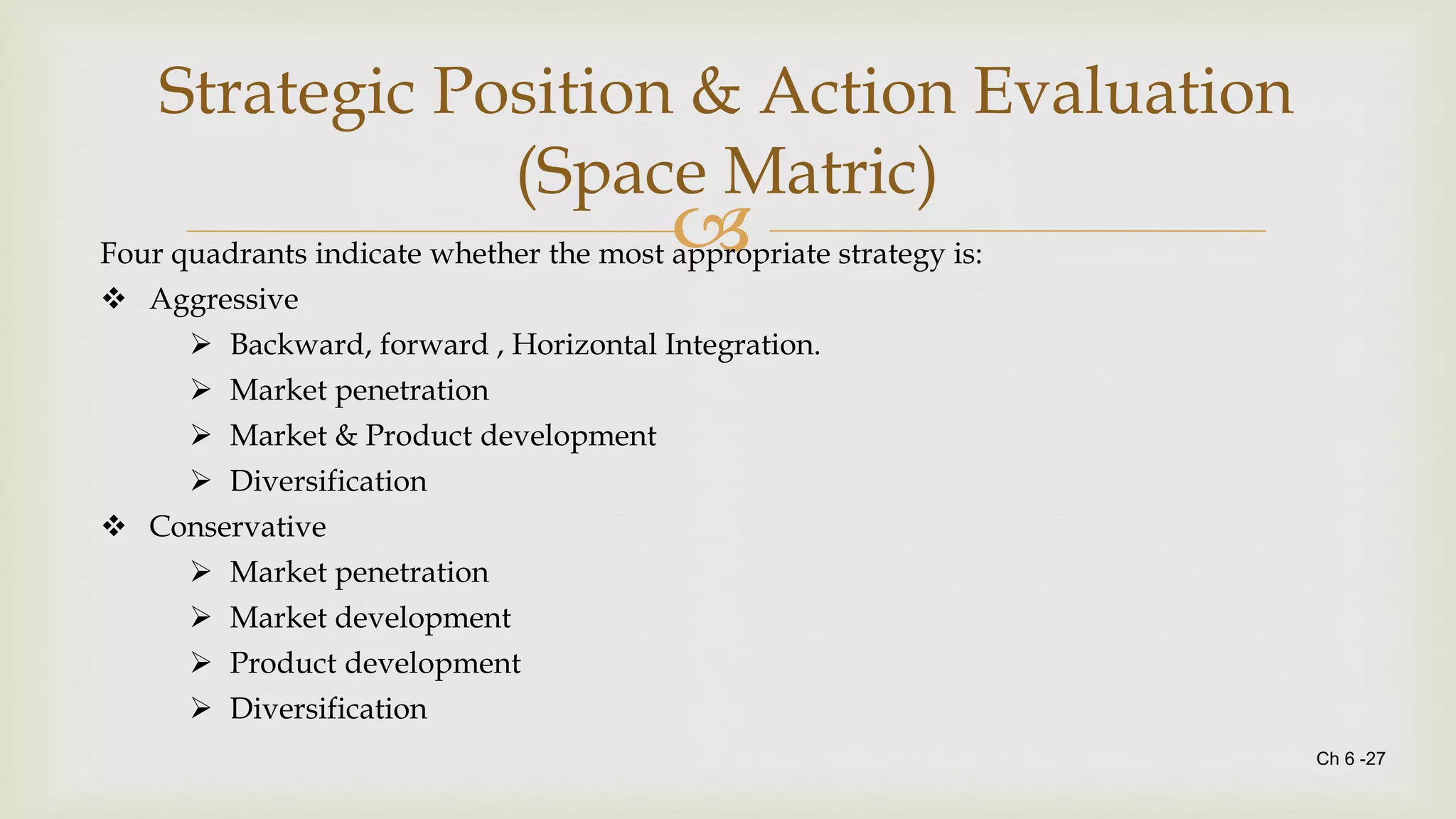
Strategic Position & Action Evaluation
(Space Matric)
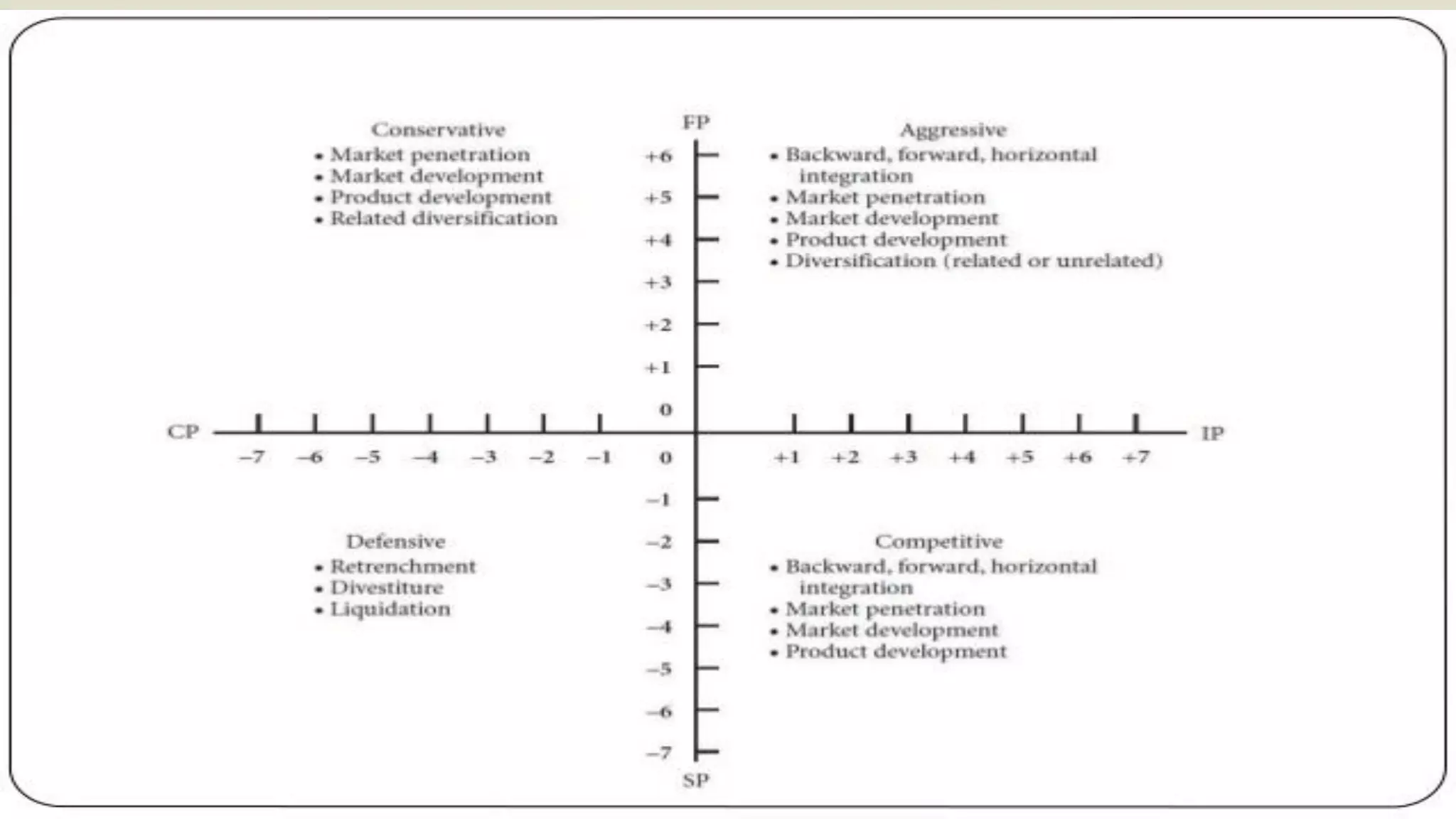
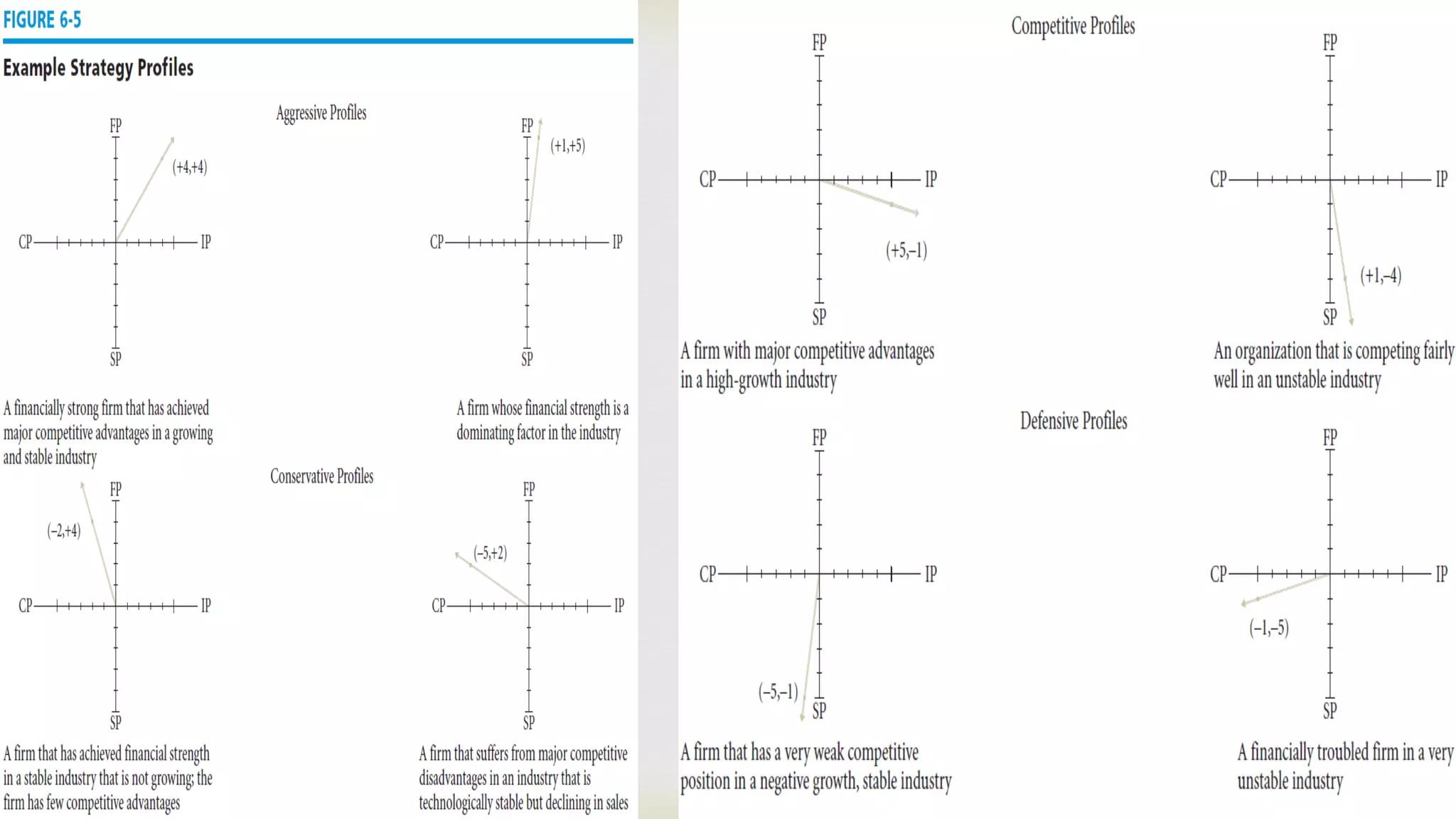
Four quadrants indicate whether the most appropriate strategy is:
 Aggressive
 Backward, forward , Horizontal Integration.
 Market penetration
 Market & Product development
 Diversification
 Conservative
 Market penetration
 Market development
 Product development
 Diversification

Ch 6 -28
Strategic Position & Action Evaluation
(Space Matrix)
Four quadrants indicate whether the most appropriate strategy is:
 Defensive
 Retrenchment
 Divestiture
 Liquidation
 Competitive
 Backward, forward & Horizontal Integration
 Market penetration
 Market development
 Product development

Strategic Position & Action Evaluation
(Space Matrix)
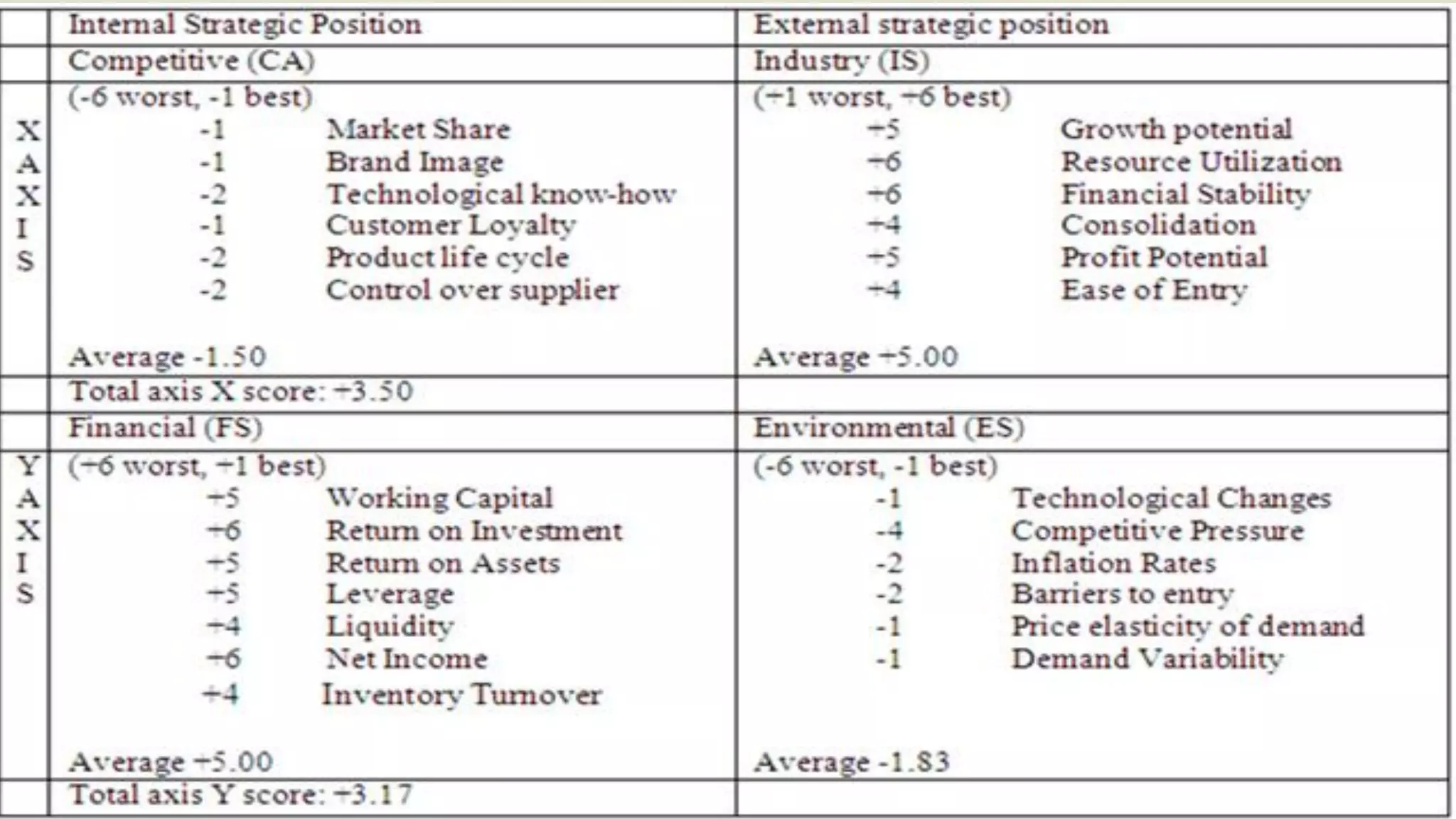
 Two internal dimensions (financial position) [FP] and competitive
position [CP])
 Two external dimensions (stability position [SP] and industry position
[IP])
 Most important determinants of an organization’s overall strategic
position

Steps to Develop a SPACE
Matrix
 Select a set of variables to define financial position (FP), competitive
position (CP), stability position (SP), and industry position (IP)
 Assign a numerical value ranging from +1 (worst) to +7 (best) to each of
the variables that make up the FP and IP dimensions.
 Assign a numerical value ranging from –1 (best) to –7 (worst) to each of
the variables that make up the SP and CP dimensions.
 Compute an average score for FP, CP, IP, and SP.
 Plot the average scores for FP, IP, SP, and CP on the appropriate axis in
the SPACE Matrix.

Steps to Develop a SPACE
Matrix
 Add the two scores on the x-axis and plot the resultant point on X. Add
the two scores on the y-axis and plot the resultant point on Y. Plot the
intersection of the new xy point.
 Draw a directional vector from the origin of the SPACE Matrix through
the new intersection point
This vector reveals the type of strategies recommended for the organization:
aggressive, competitive, defensive, or conservative

The Boston Consulting Group
(BCG) Matrix
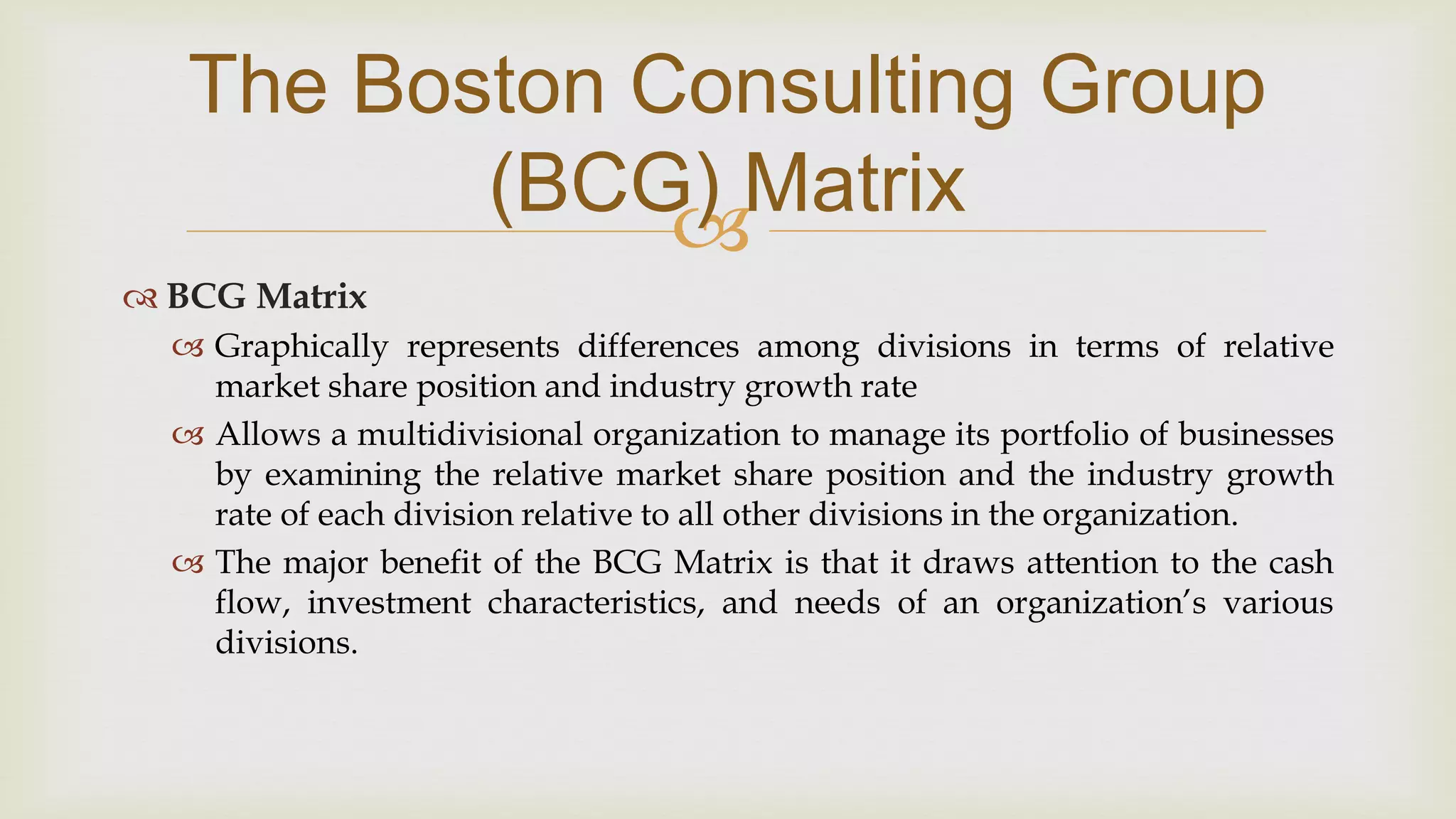
 BCG Matrix
 Graphically represents differences among divisions in terms of relative
market share position and industry growth rate
 Allows a multidivisional organization to manage its portfolio of businesses
by examining the relative market share position and the industry growth
rate of each division relative to all other divisions in the organization.
 The major benefit of the BCG Matrix is that it draws attention to the cash
flow, investment characteristics, and needs of an organization’s various
divisions.

The BCG Matrix

The BCG Matrix
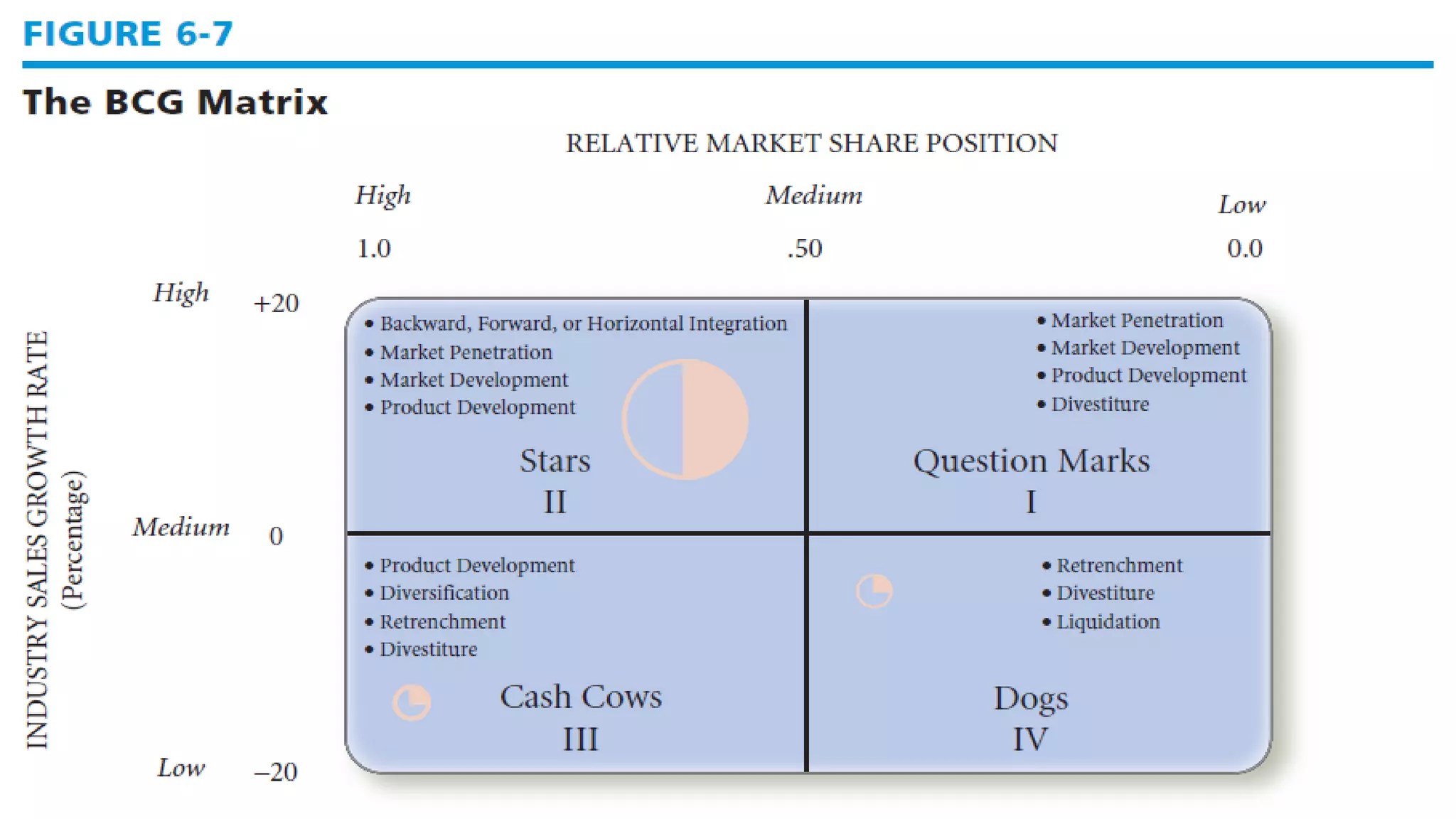
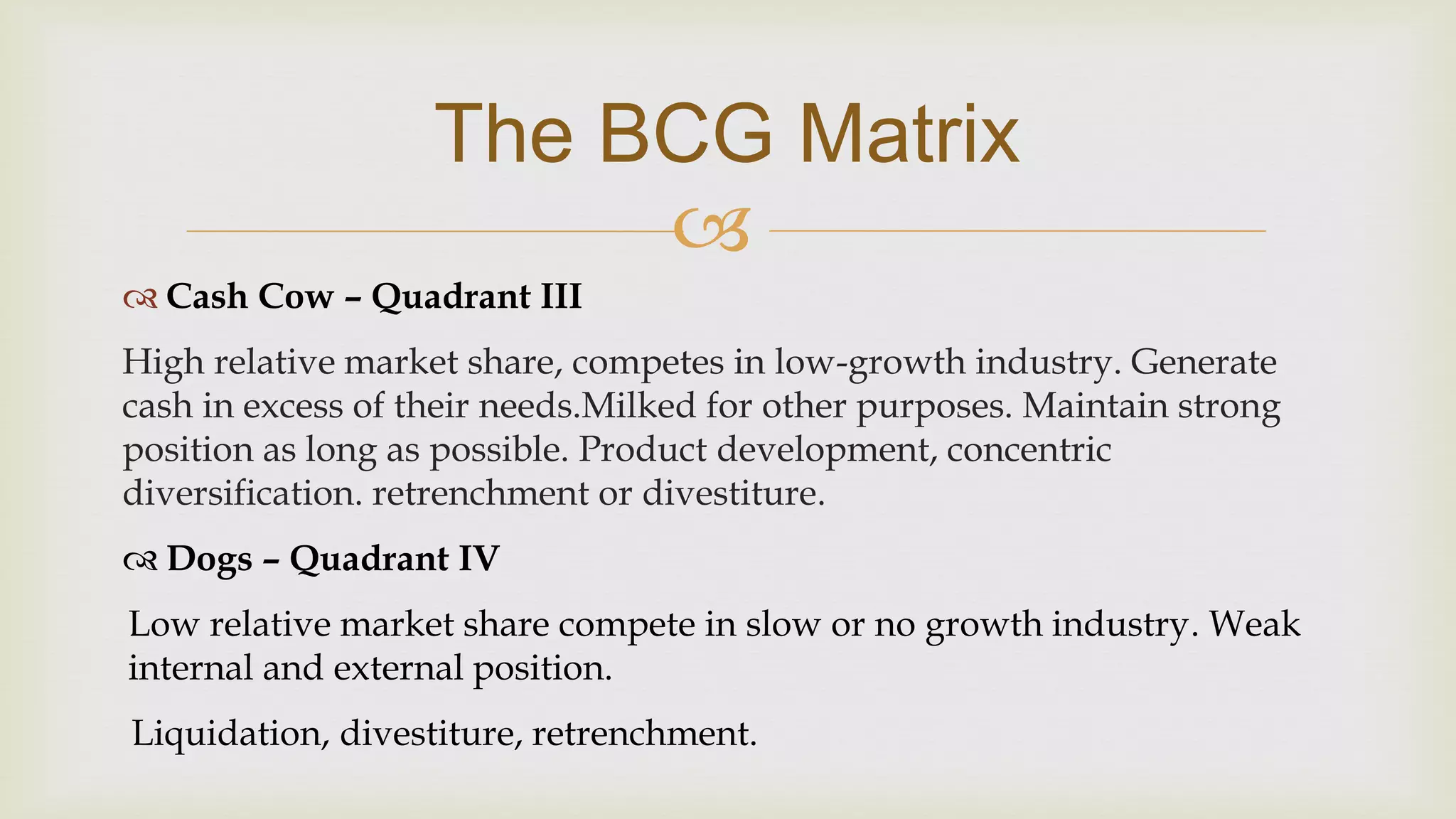
 Question marks – Quadrant I
Organization must decide whether to strengthen them by pursuing an intensive
strategy, market penetration, market development, or product development) or to sell
them.
Stars – Quadrant II
 High relative market share and high growth rate. Best long-run opportunities
for growth & profitability.
 Substantial investment to maintain or strengthen dominant position
Integration strategies, intensive strategies, joint ventures.

The BCG Matrix
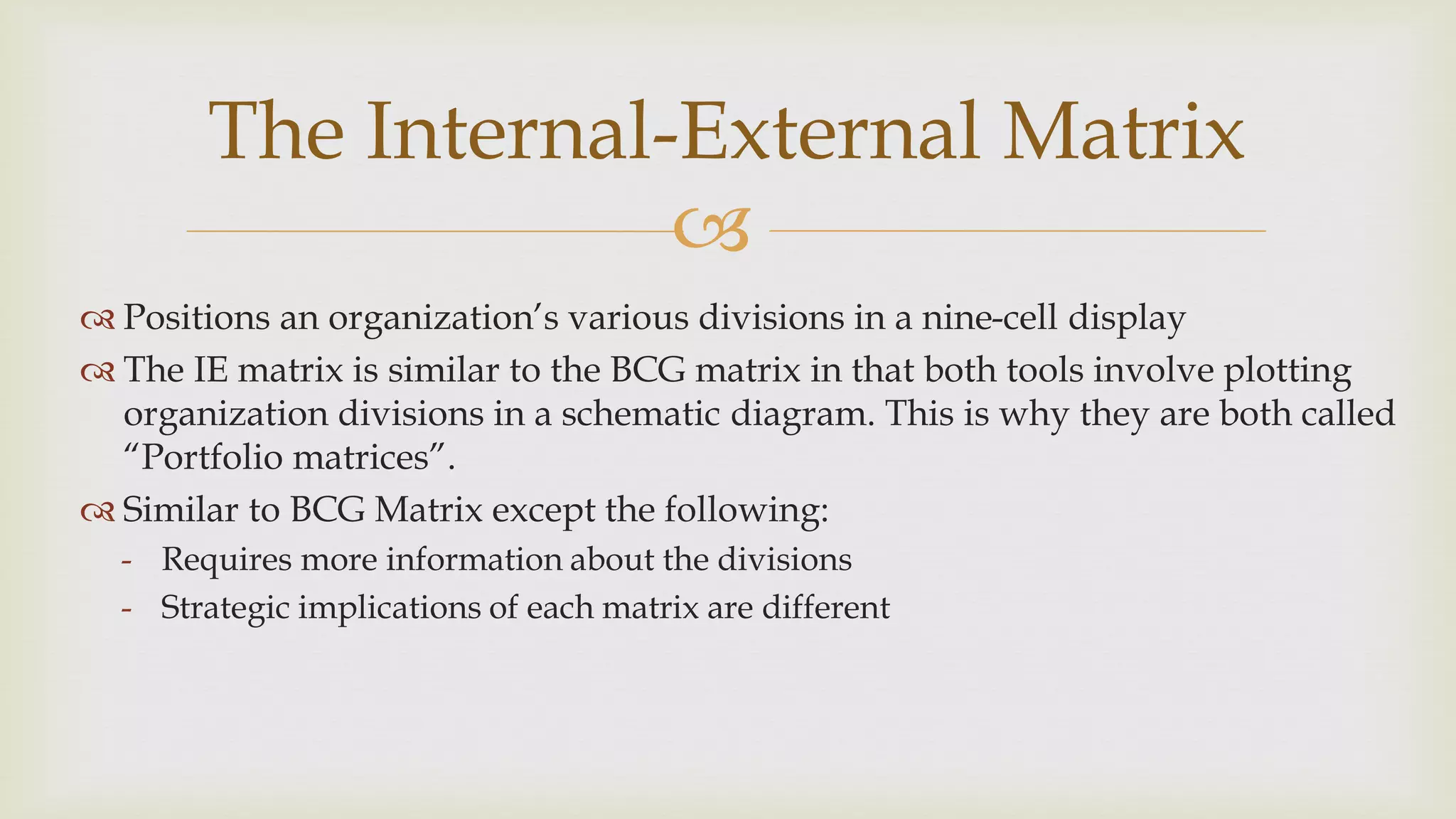
 Cash Cow – Quadrant III
High relative market share, competes in low-growth industry. Generate
cash in excess of their needs.Milked for other purposes. Maintain strong
position as long as possible. Product development, concentric
diversification. retrenchment or divestiture.
 Dogs – Quadrant IV
Low relative market share compete in slow or no growth industry. Weak
internal and external position.
Liquidation, divestiture, retrenchment.

The Internal-External Matrix
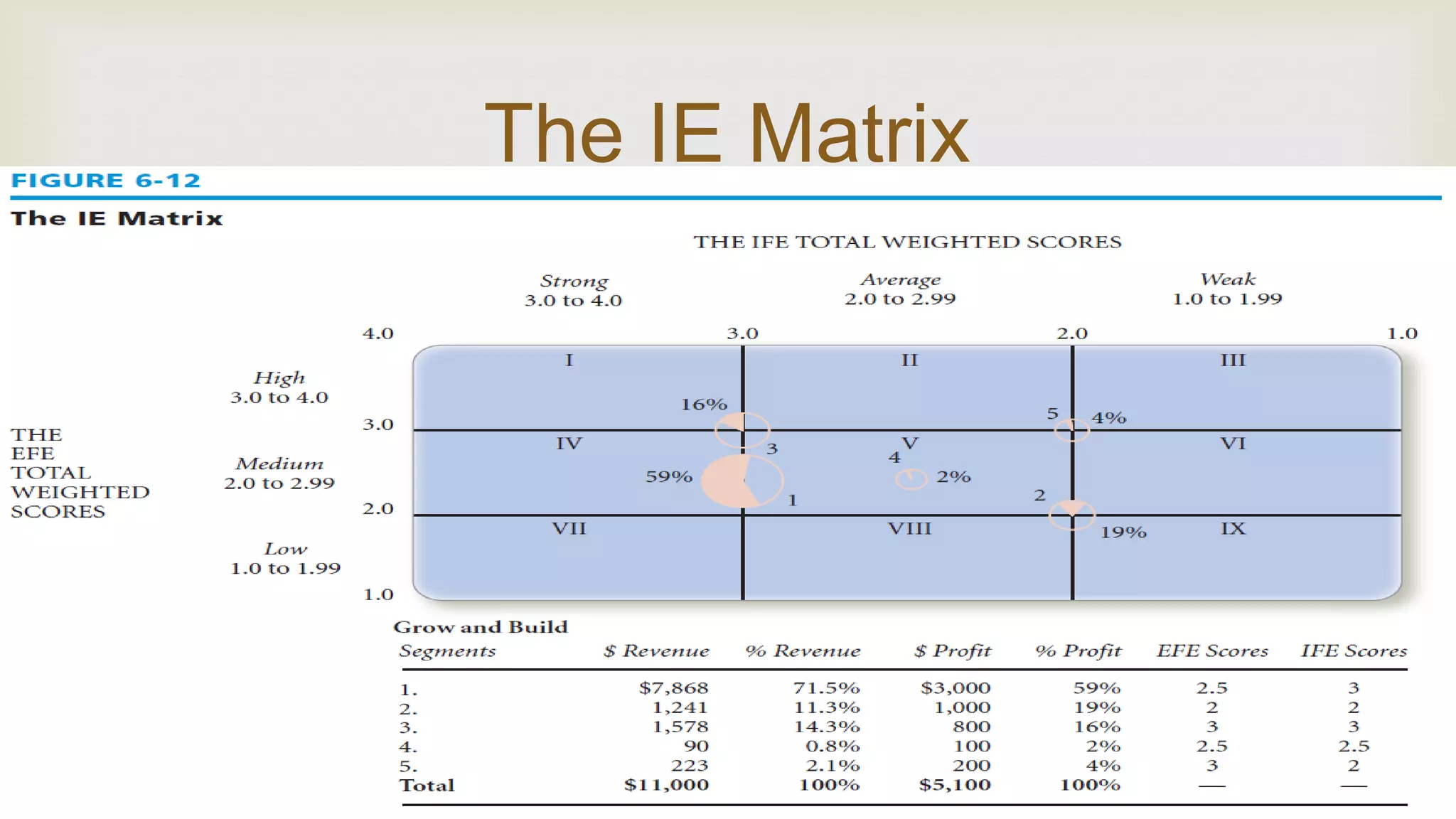
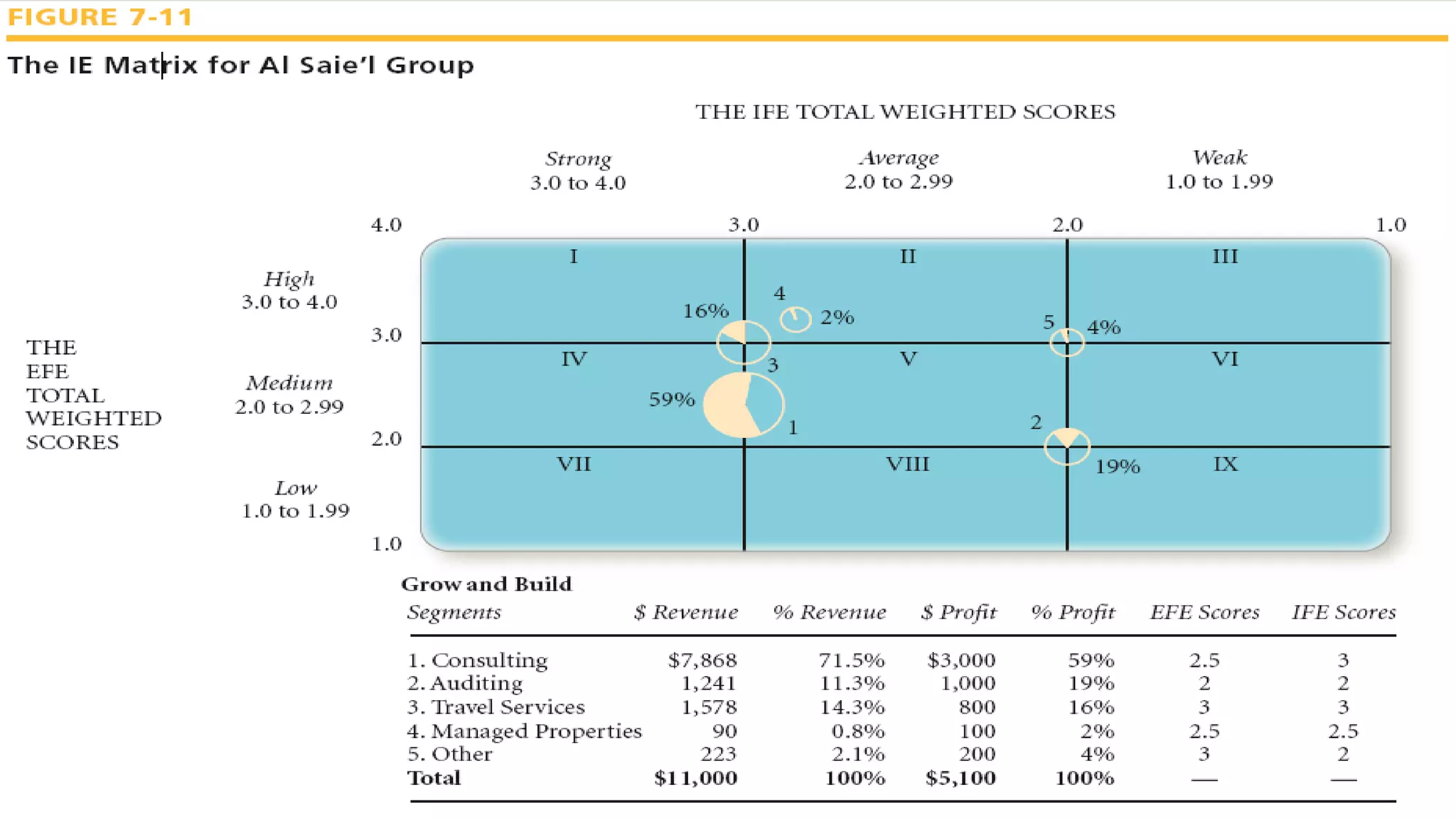
 Positions an organization’s various divisions in a nine-cell display
 The IE matrix is similar to the BCG matrix in that both tools involve plotting
organization divisions in a schematic diagram. This is why they are both called
“Portfolio matrices”.
 Similar to BCG Matrix except the following:
- Requires more information about the divisions
- Strategic implications of each matrix are different

The Internal-External (IE) Matrix

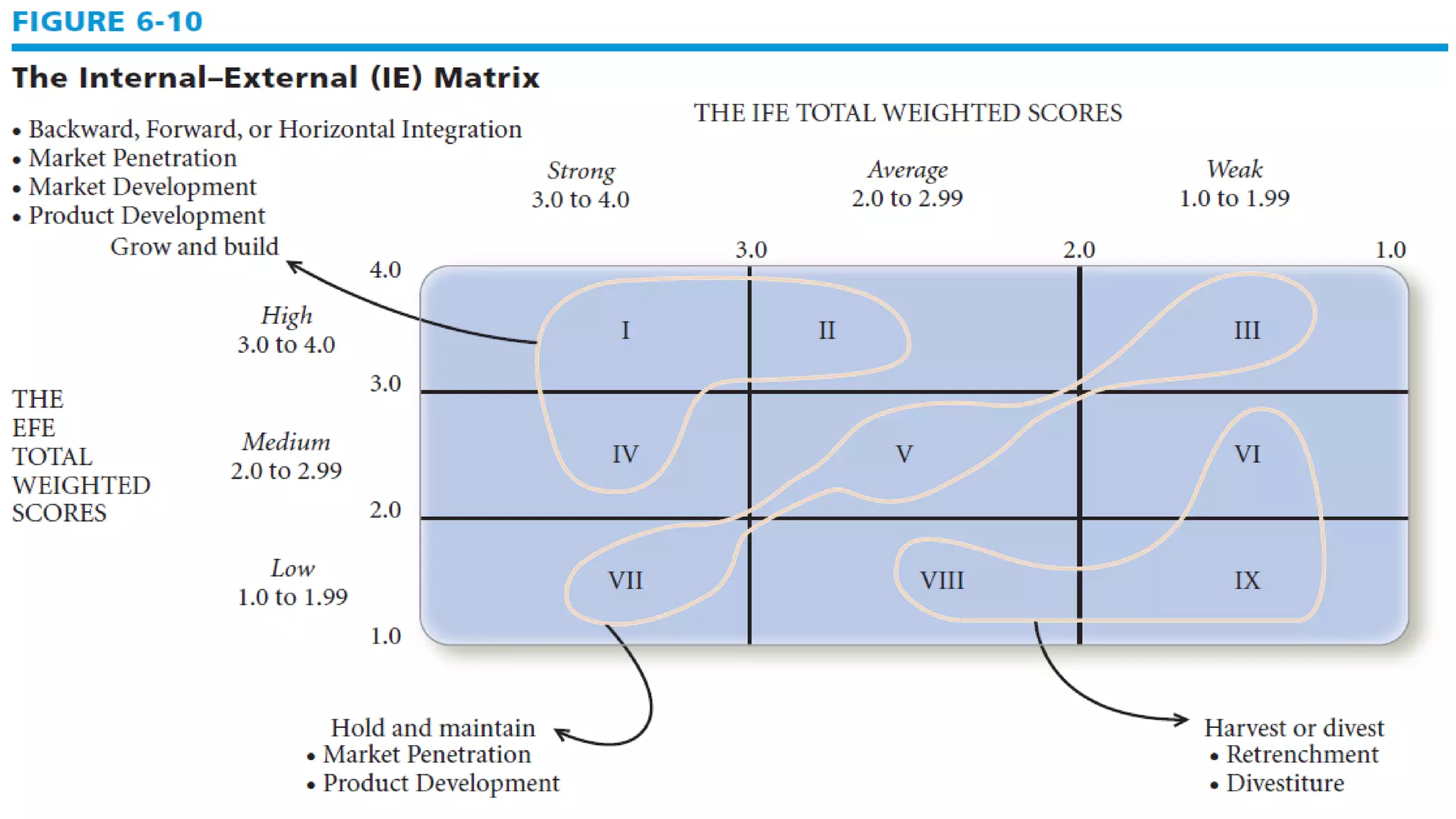
IE Matrix
 Based on two key dimensions
- The IFE total weighted scores on the x-axis
- The EFE total weighted scores on the y-axis
 Divided into three major regions
- Grow and build – Cells I, II, or IV
- Hold and maintain – Cells III, V, or VII
- Harvest or divest – Cells VI, VIII, or IX

The IE Matrix
6-42

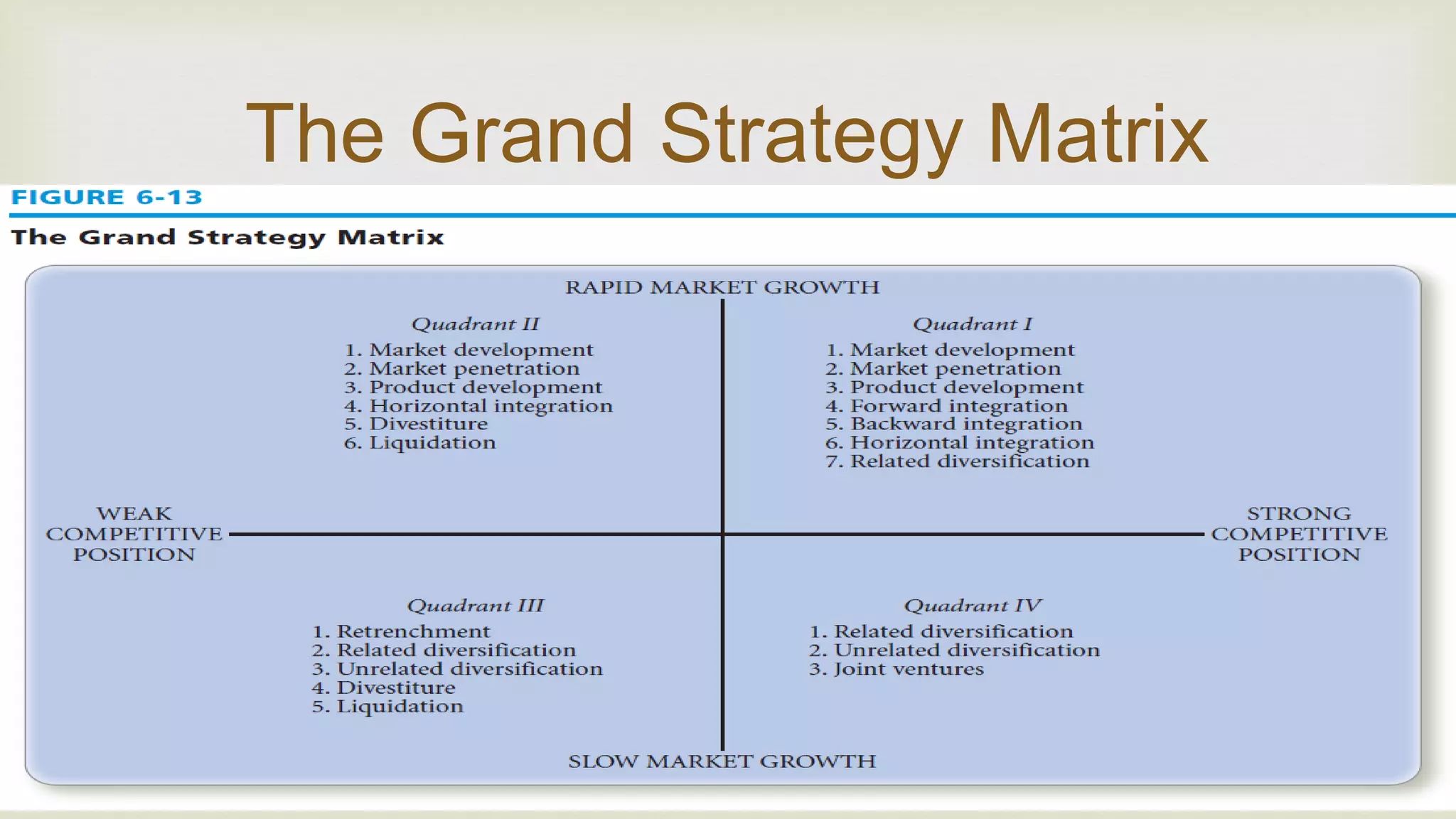
The Grand Strategy Matrix
 Grand Strategy Matrix
 Grand strategy matrix has become popular tool for formulating alternatives
strategies. A grand strategy matrix is a tool used by businesses to devise
alternative strategies. These four elements make up a four-quadrant strategy
matrix in which every organization or company division is placed for easy
identification of the best strategy based on the company's competitive state
and growth.
 Based on four evaluative dimensions:
 Strong competitive position to Weak competitive position
 Rapid market growth to Slow market growth

The Grand Strategy Matrix

The Grand Strategy Matrix
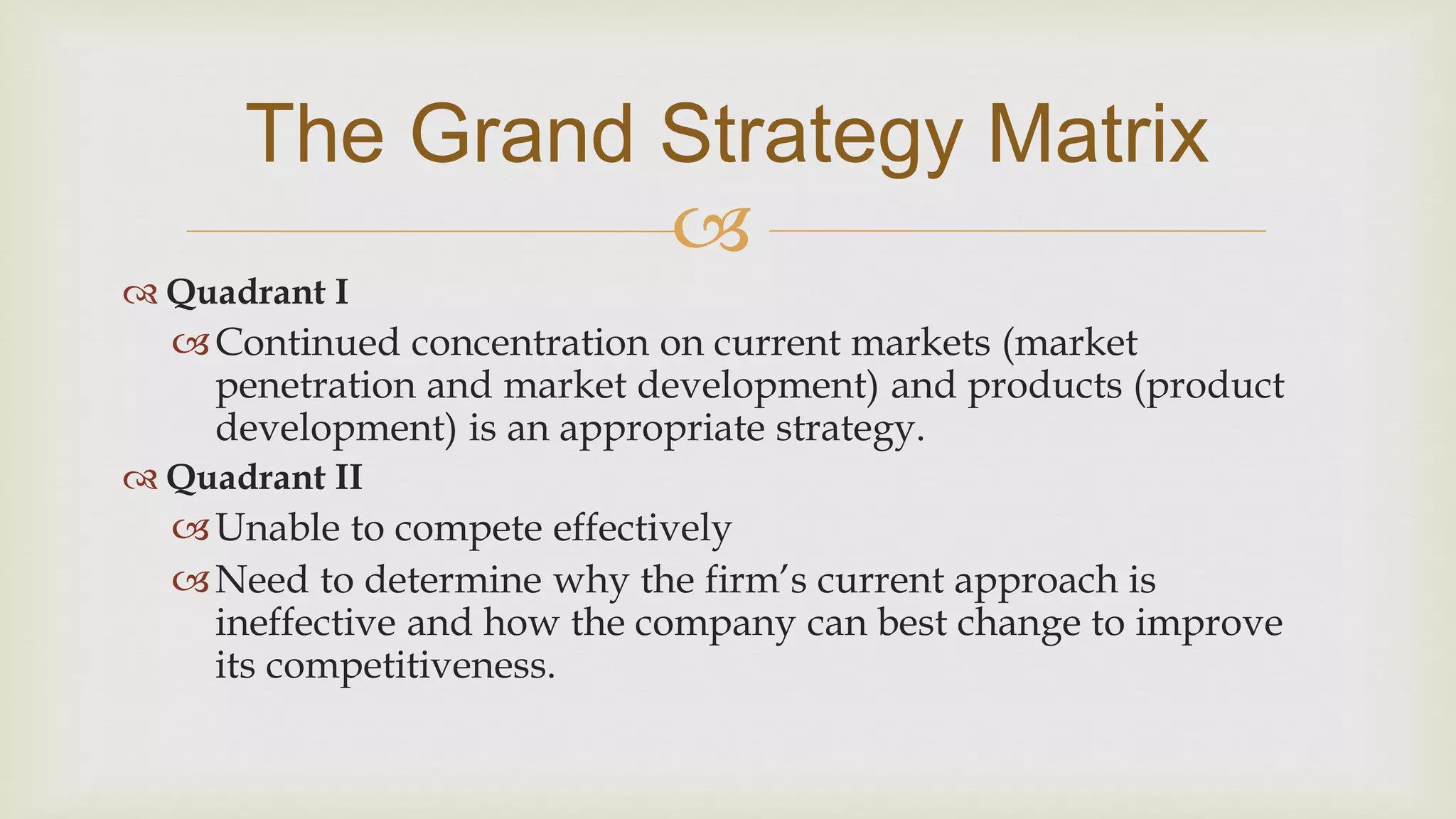
 Quadrant I
Continued concentration on current markets (market
penetration and market development) and products (product
development) is an appropriate strategy.
 Quadrant II
Unable to compete effectively
Need to determine why the firm’s current approach is
ineffective and how the company can best change to improve
its competitiveness.

The Grand Strategy Matrix
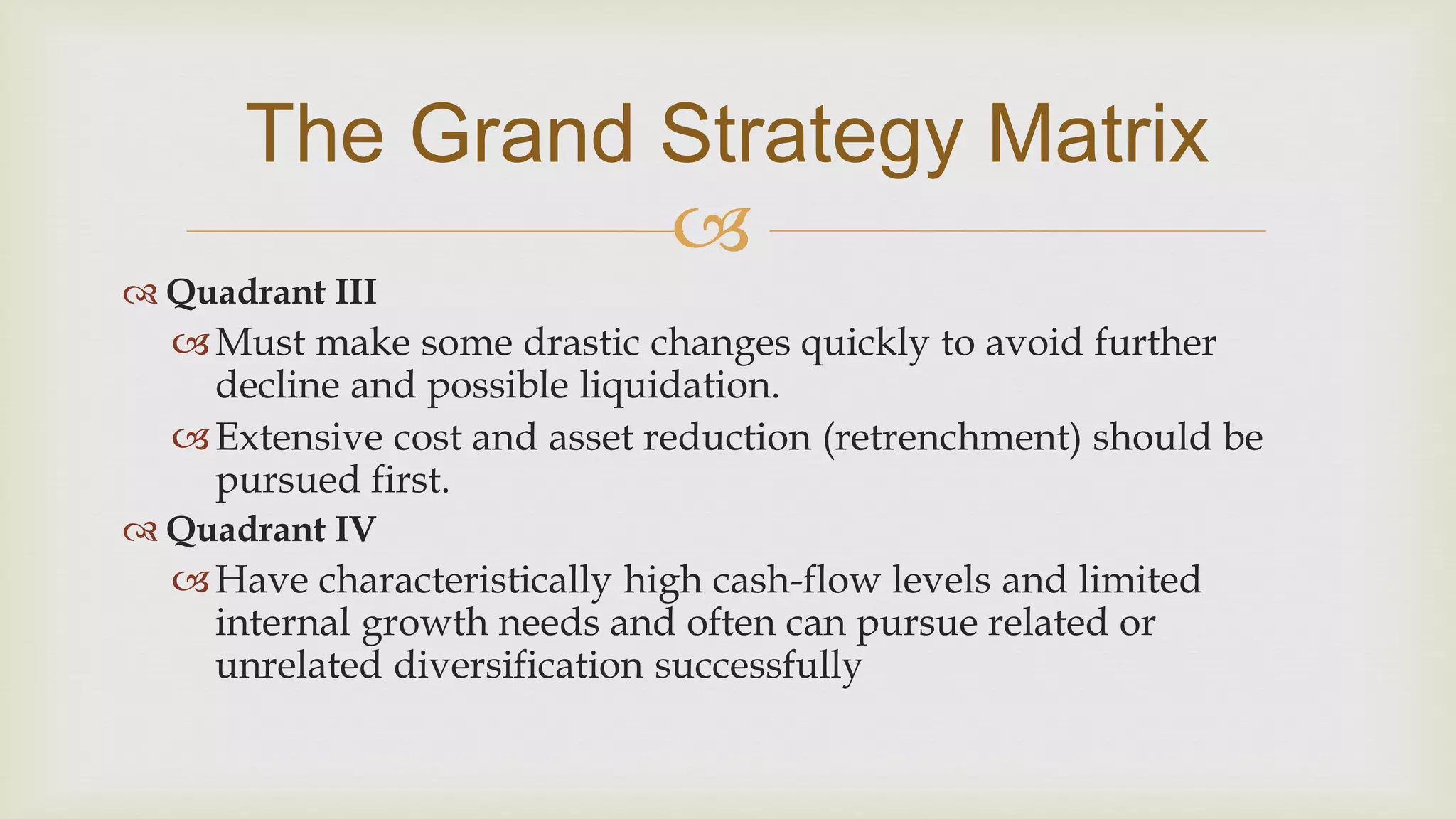
 Quadrant III
Must make some drastic changes quickly to avoid further
decline and possible liquidation.
Extensive cost and asset reduction (retrenchment) should be
pursued first.
 Quadrant IV
Have characteristically high cash-flow levels and limited
internal growth needs and often can pursue related or
unrelated diversification successfully

The Strategy Formulation Framework
Stage 3: The Decision Stage
 The Quantitative Strategic Planning Matrix (QSPM)

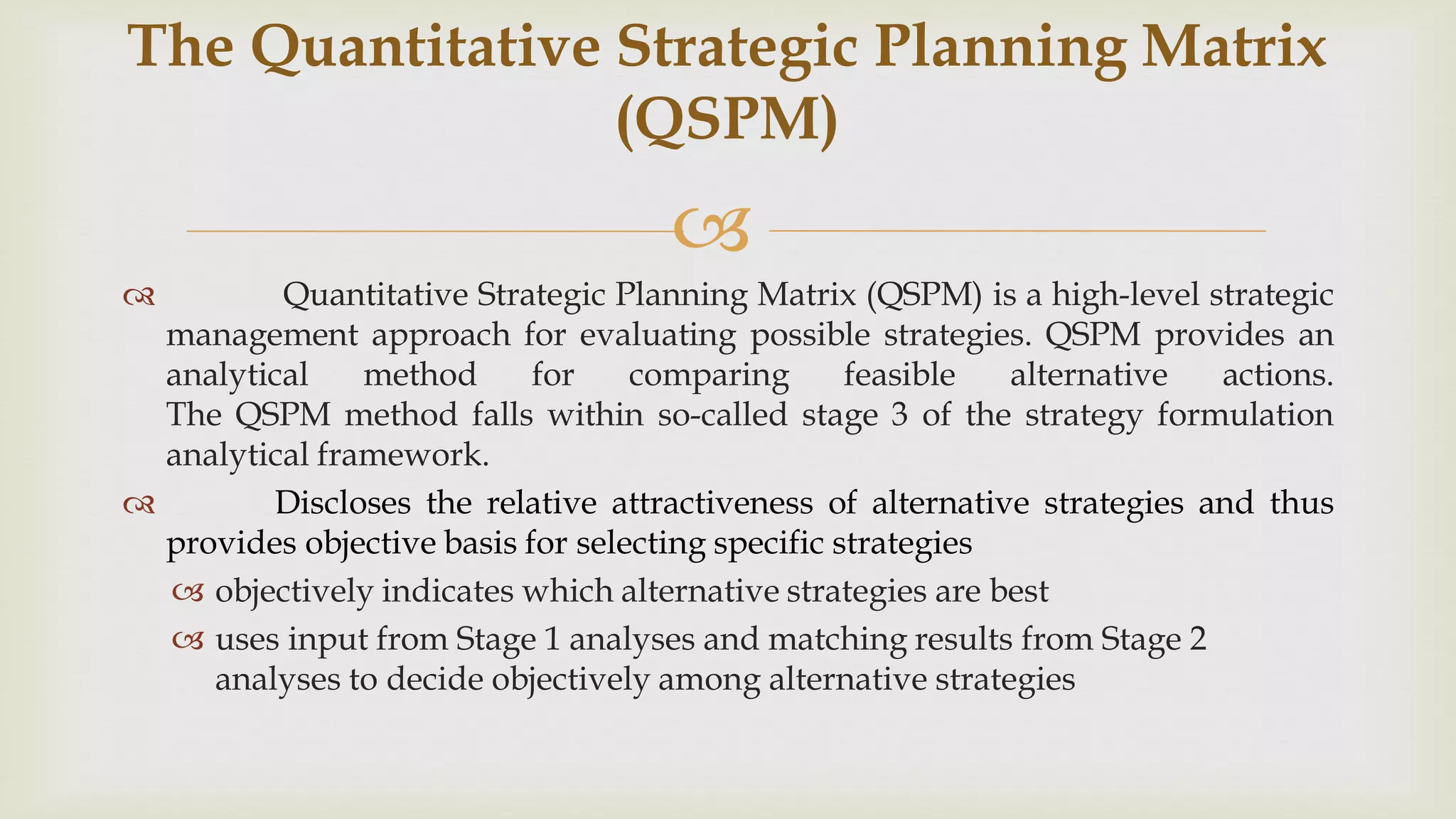
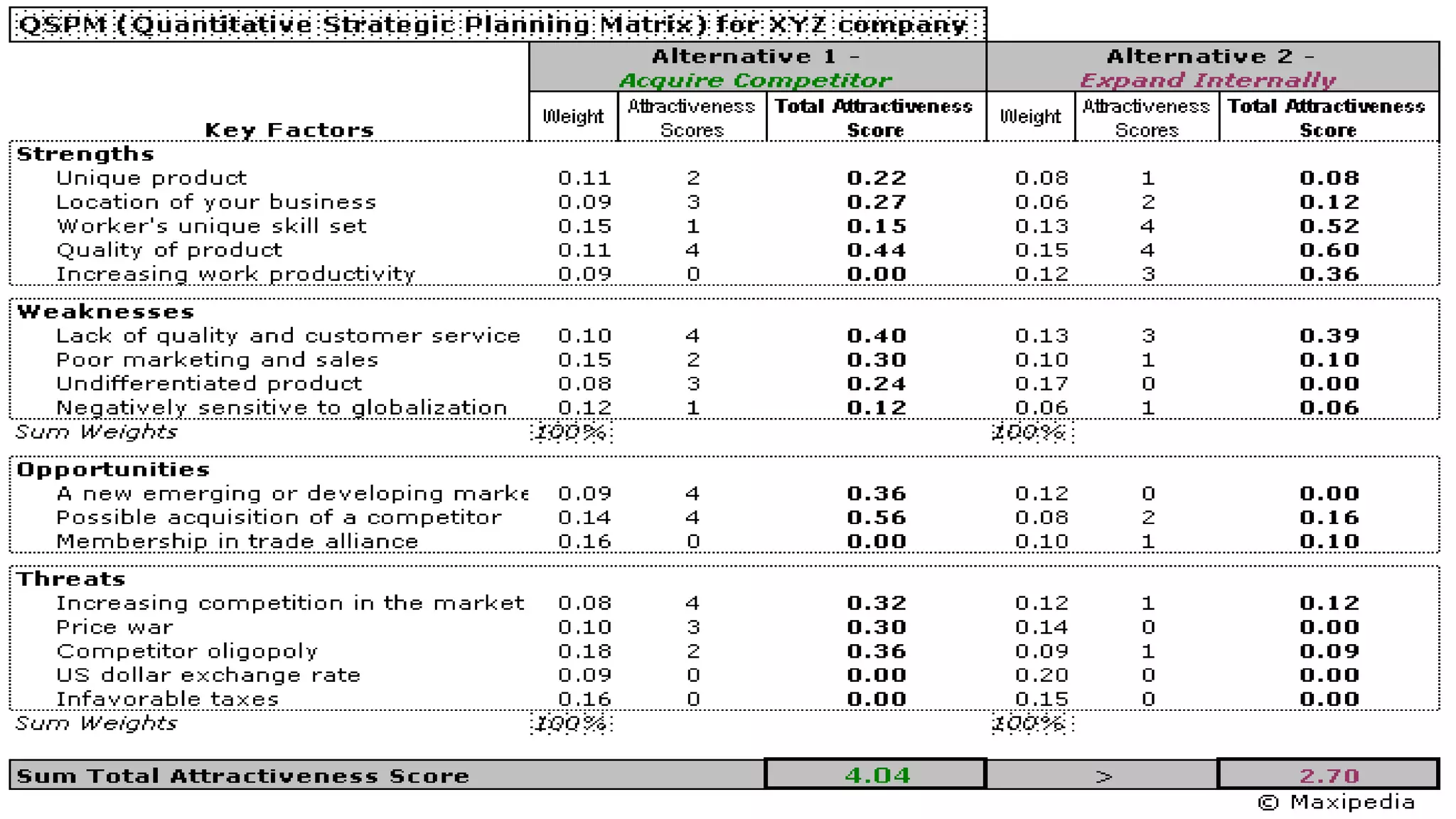
 Quantitative Strategic Planning Matrix (QSPM) is a high-level strategic
management approach for evaluating possible strategies. QSPM provides an
analytical method for comparing feasible alternative actions.
The QSPM method falls within so-called stage 3 of the strategy formulation
analytical framework.
 Discloses the relative attractiveness of alternative strategies and thus
provides objective basis for selecting specific strategies
 objectively indicates which alternative strategies are best
 uses input from Stage 1 analyses and matching results from Stage 2
analyses to decide objectively among alternative strategies
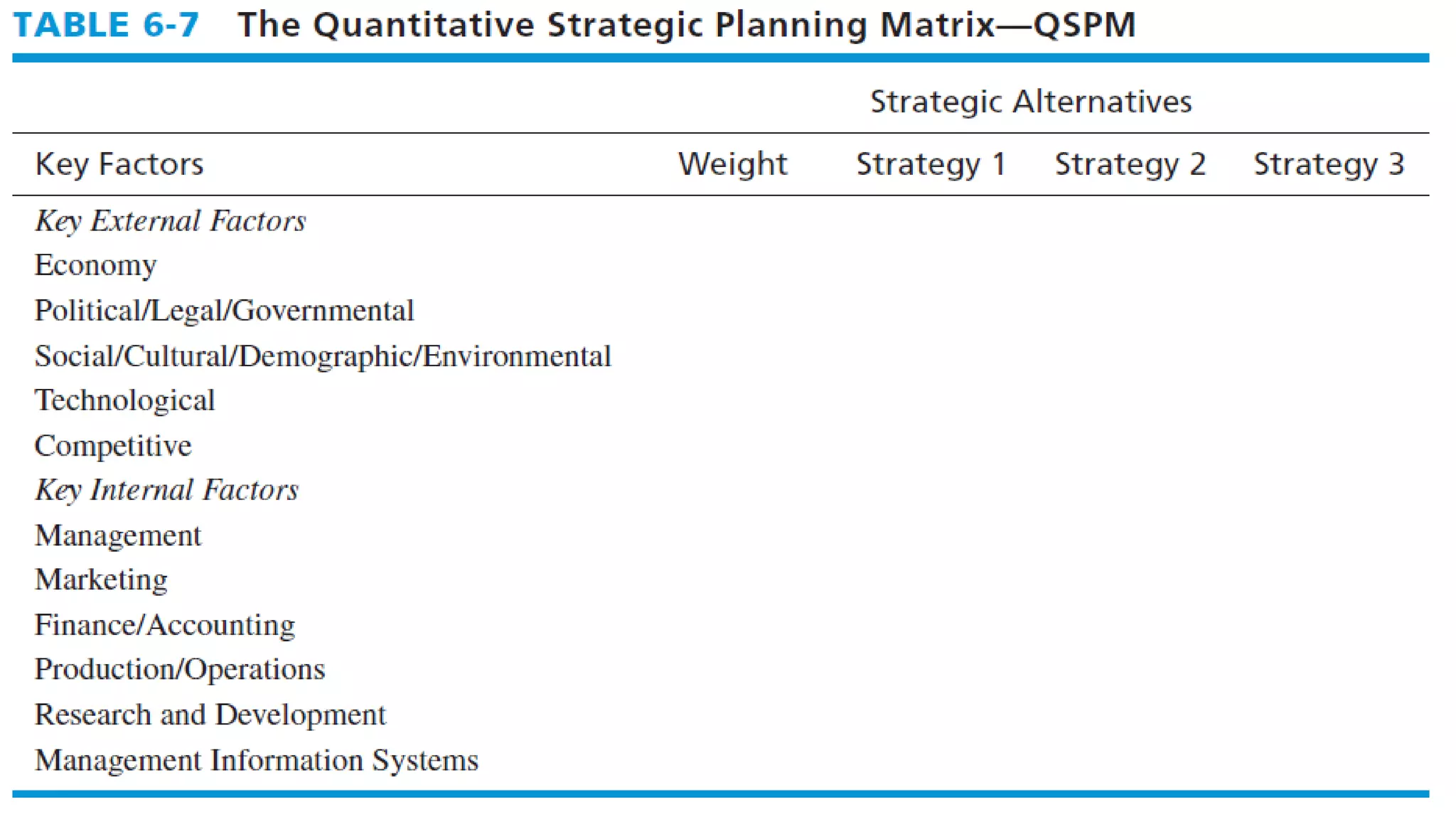
The Quantitative Strategic Planning Matrix
(QSPM)

The Quantitative Strategic
Planning Matrix (QSPM)
6-50

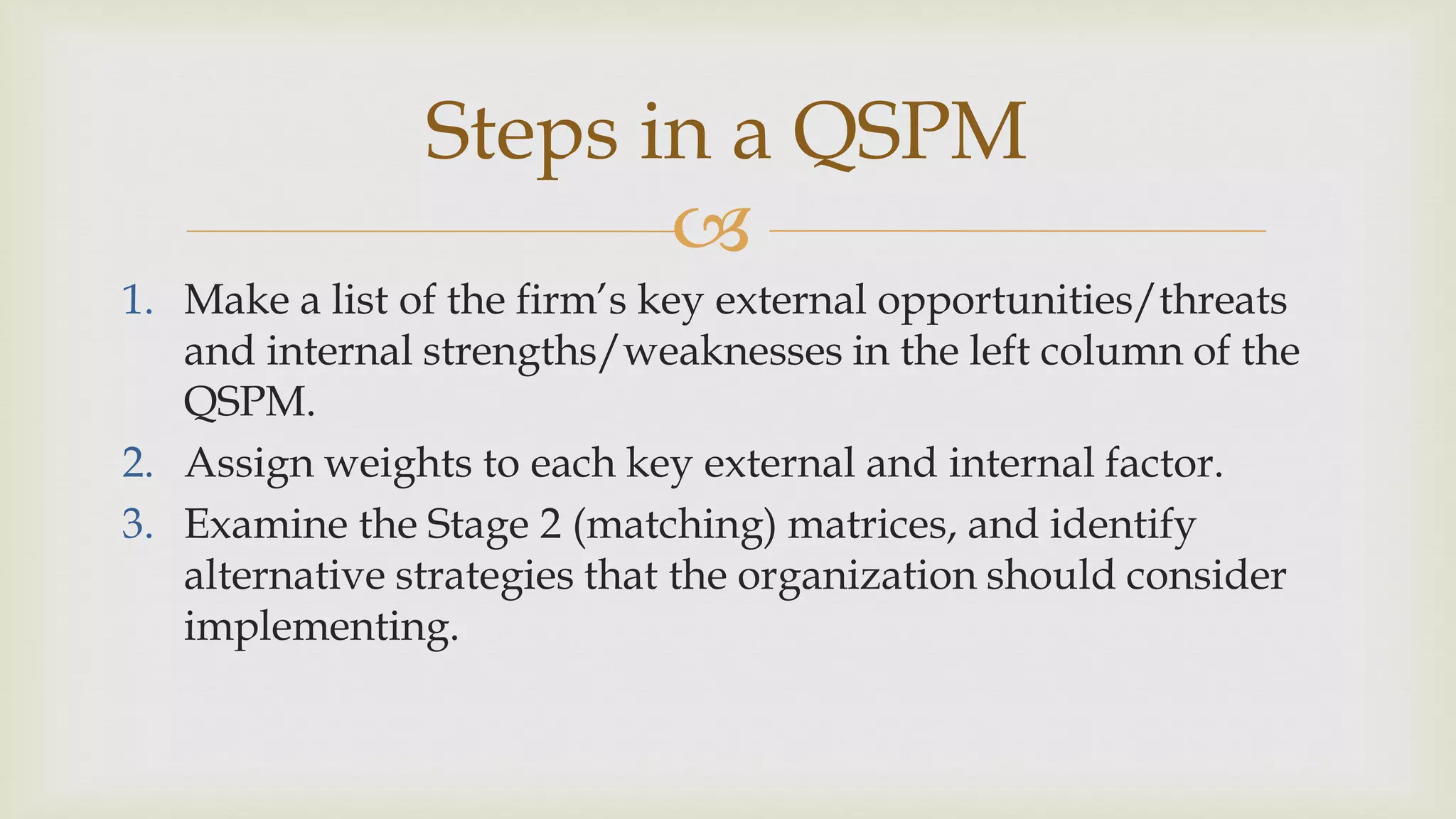
Steps in a QSPM
1. Make a list of the firm’s key external opportunities/threats
and internal strengths/weaknesses in the left column of the
QSPM.
2. Assign weights to each key external and internal factor.
3. Examine the Stage 2 (matching) matrices, and identify
alternative strategies that the organization should consider
implementing.

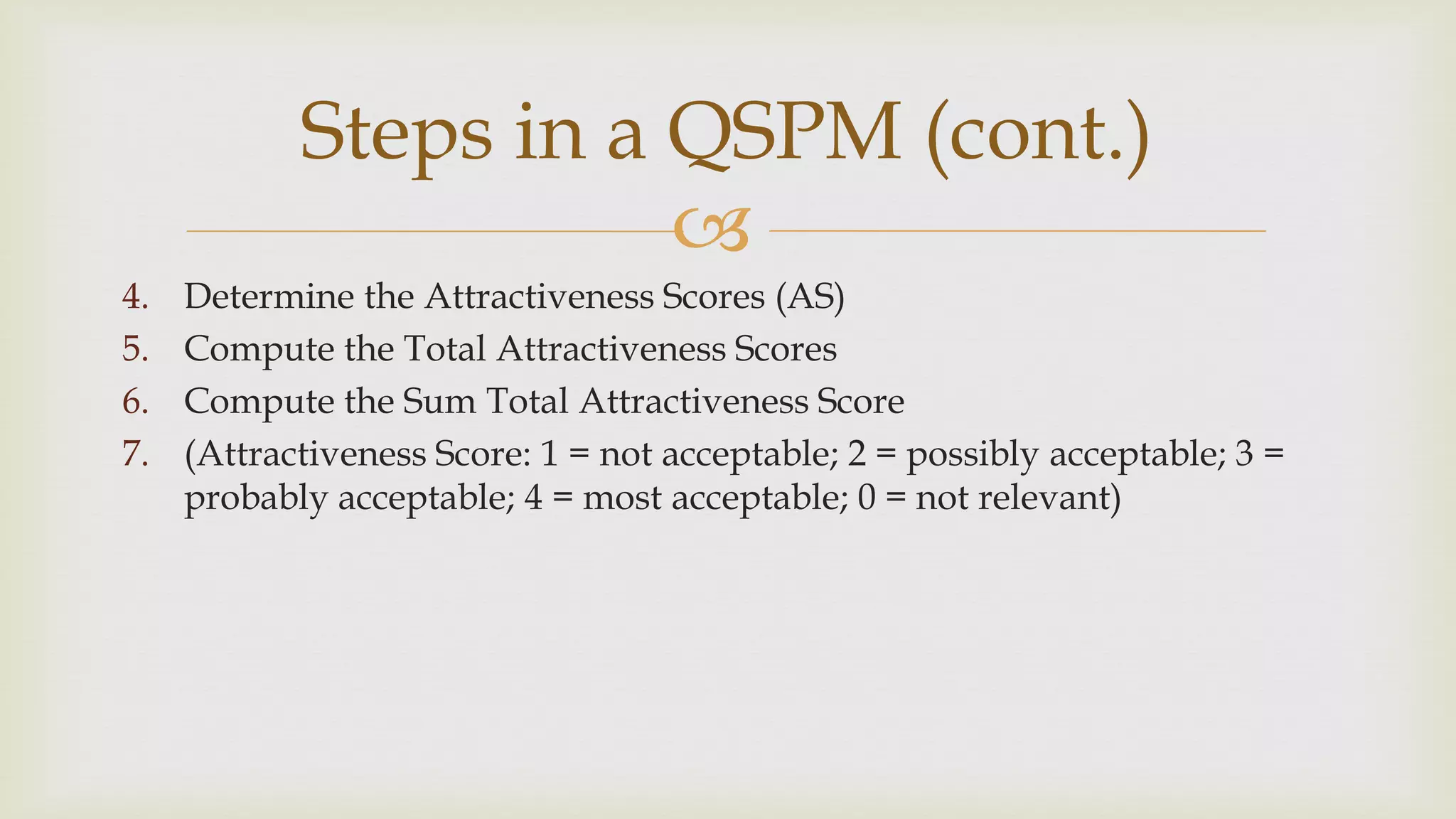
Steps in a QSPM (cont.)
4. Determine the Attractiveness Scores (AS)
5. Compute the Total Attractiveness Scores
6. Compute the Sum Total Attractiveness Score
7. (Attractiveness Score: 1 = not acceptable; 2 = possibly acceptable; 3 =
probably acceptable; 4 = most acceptable; 0 = not relevant)

Positive Features of the QSPM
 Sets of strategies can be examined sequentially or simultaneously
 Requires strategists to integrate pertinent external and internal factors
into the decision process
 Can be adapted for use by small and large for-profit and nonprofit
organizations

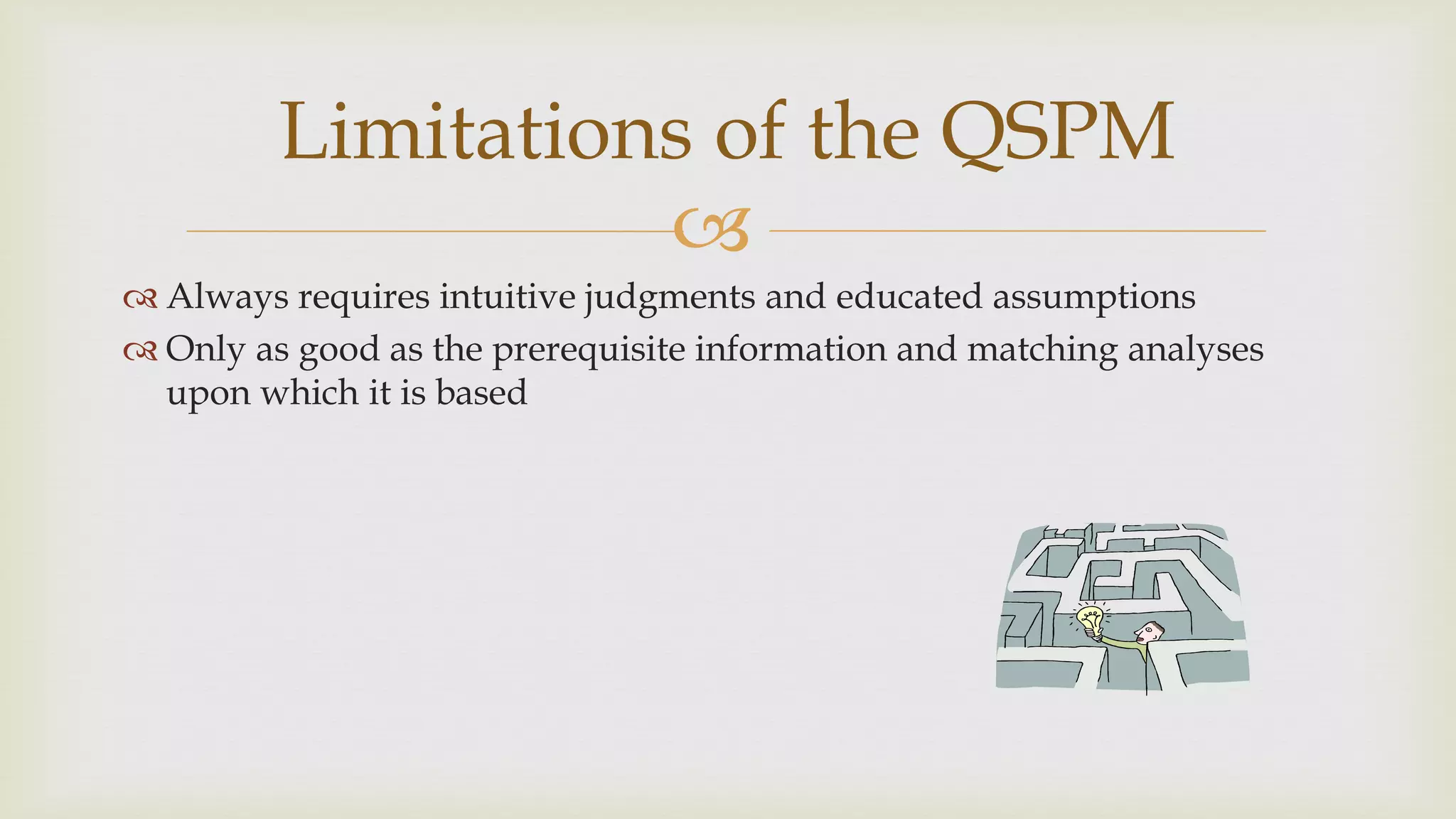
Limitations of the QSPM
 Always requires intuitive judgments and educated assumptions
 Only as good as the prerequisite information and matching analyses
upon which it is based

The Politics of Strategy Choice
 Political maneuvering consumes valuable time, subverts organizational
objectives, diverts human energy, and results in the loss of some
valuable employees.
 Political biases and personal preferences get unduly embedded in
strategy choice decisions.
 The hierarchy of command in an organization, combined with the
career aspirations of different people and the need to allocate scarce
resources, guarantees the formation of coalitions of individuals who
strive to take care of themselves first and the organization second, third,
or fourth.

Governance Issues
 Board of directors
 A group of individuals who are elected by the ownership of a corporation
to have oversight and guidance over management and who look out for
shareholders interests.

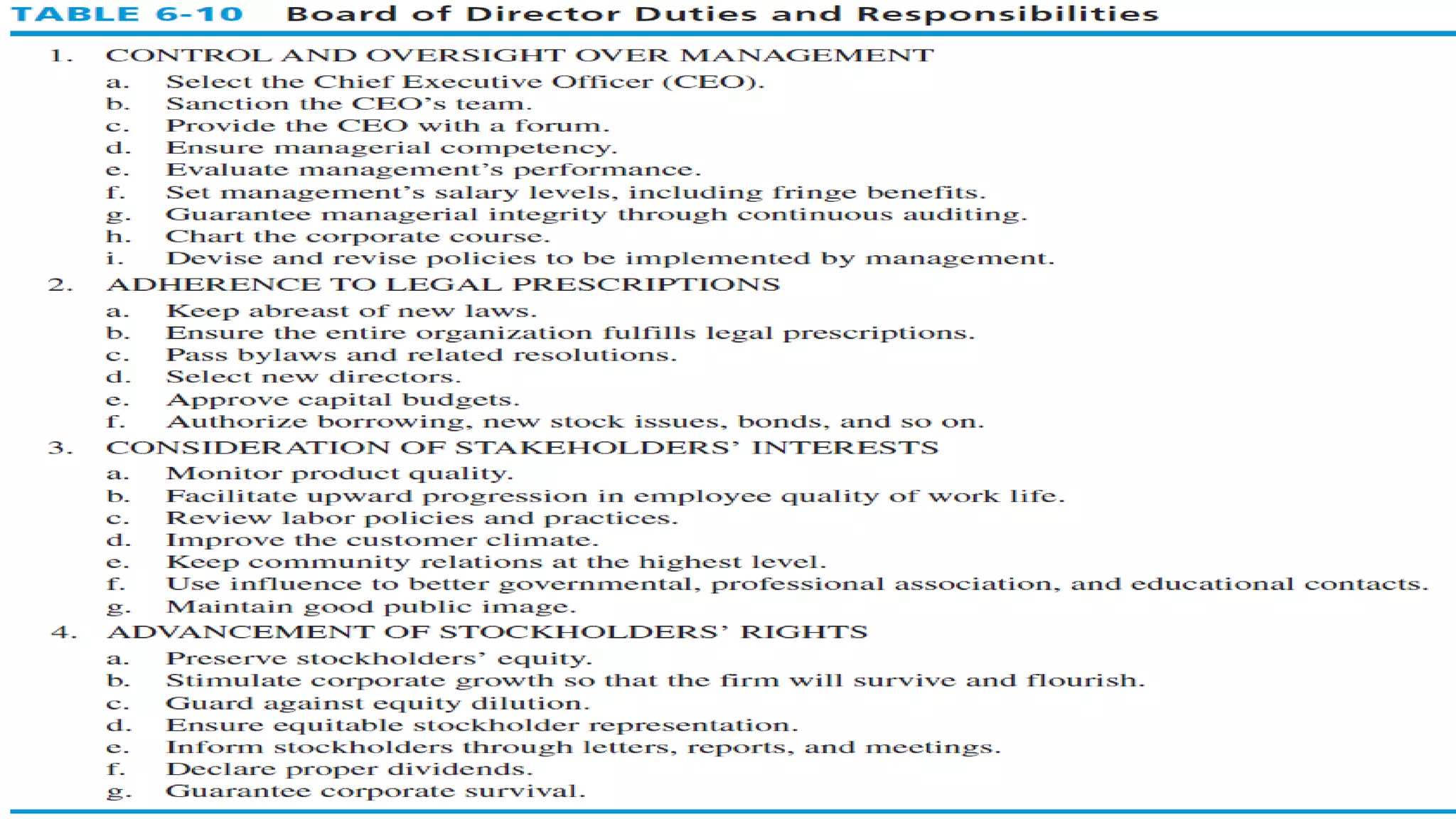
Board of Director Duties and
Responsibilities
6-58

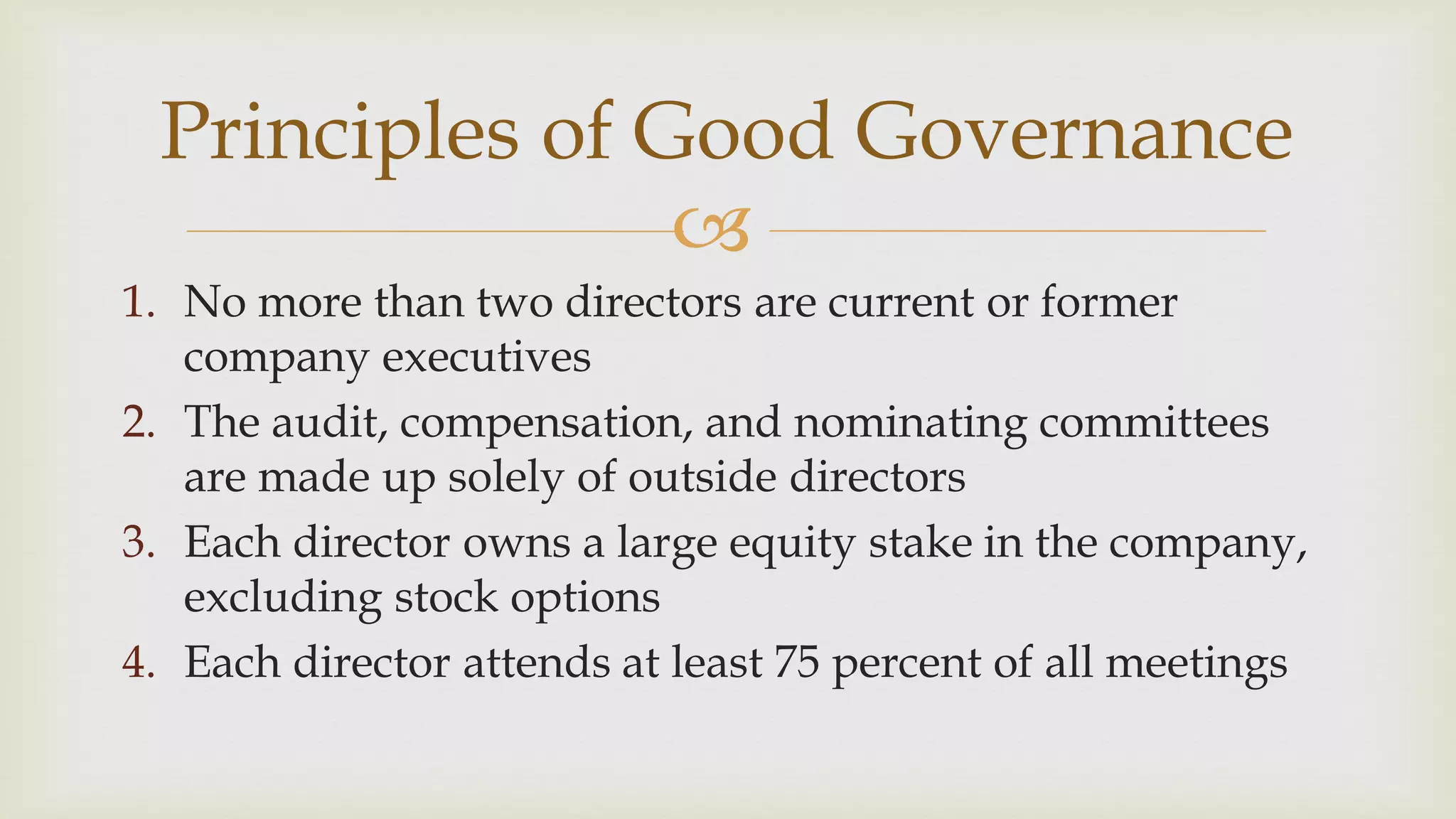
Principles of Good Governance
1. No more than two directors are current or former
company executives
2. The audit, compensation, and nominating committees
are made up solely of outside directors
3. Each director owns a large equity stake in the company,
excluding stock options
4. Each director attends at least 75 percent of all meetings

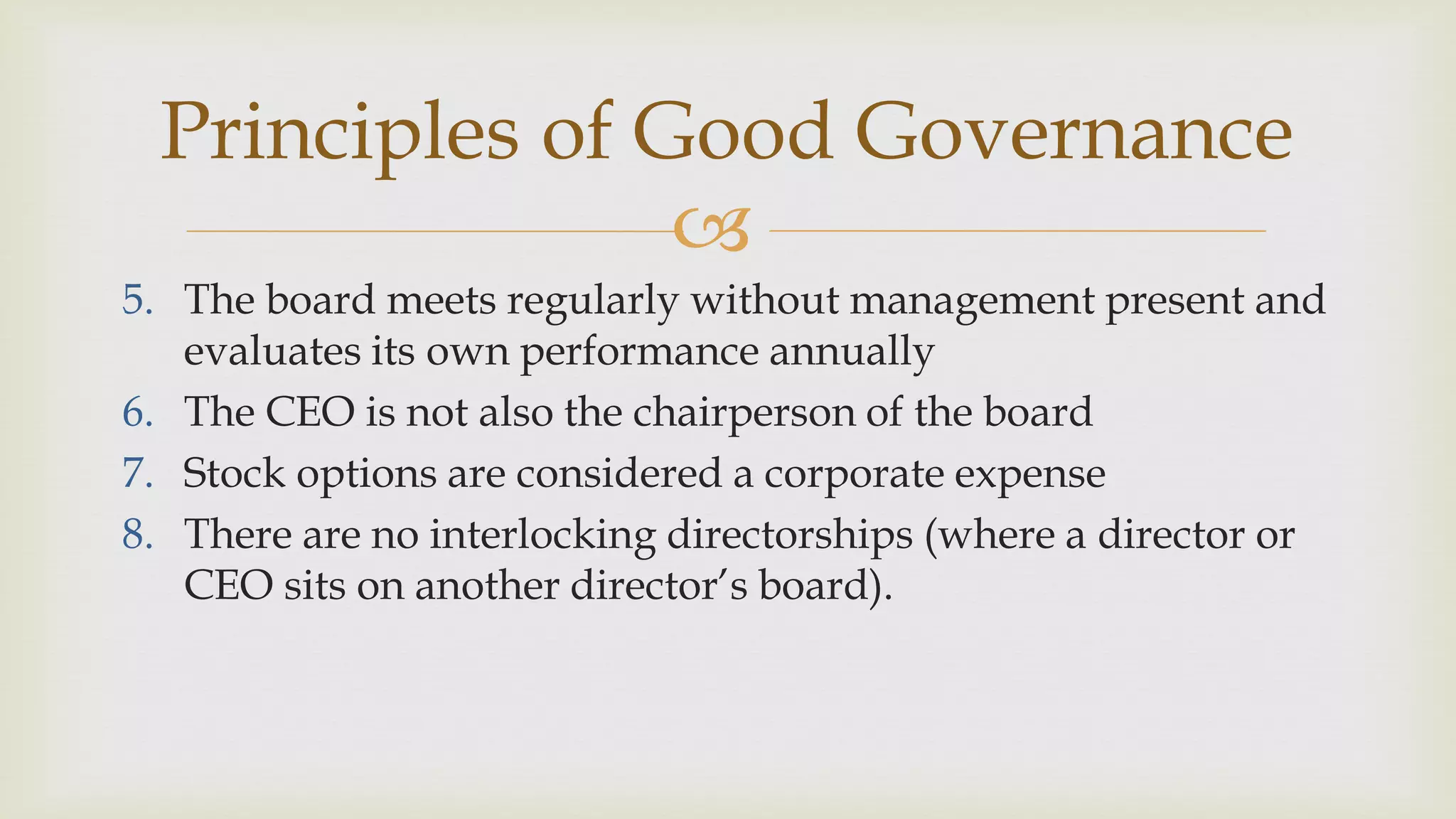
Principles of Good Governance
5. The board meets regularly without management present and
evaluates its own performance annually
6. The CEO is not also the chairperson of the board
7. Stock options are considered a corporate expense
8. There are no interlocking directorships (where a director or
CEO sits on another director’s board).
Principles of management

Principles of management

  • 2.
    Presentation on Chapter# 06 Strategy Analysis & Choice
  • 3.
      Strategy FormulationSteps.  The Input Stage.  The Matching Stage.  The Decision Stage.  Behavioral, Political, Ethical & Social Responsibility in strategy Analysis.  Role, Responsibilities & Duties of Board of Directors. Topics for Discussion
  • 4.
     "Strategic management isnot a box of tricks or a bundle of techniques. It is analytical thinking and commitment of resources to action. But quantification alone is not planning. Some of the most important issues in strategic management cannot be quantified at all." —Peter Drucker "When a crisis forces choosing among alternatives, most people will choose the worst possible one." —Rudin’s Law Notable Quotes
  • 5.
     Stage 1: TheInput Stage  External Factor Evaluation Matrix (EFE)  Competitive Profile Matrix (CPM)  Internal Factor Evaluation Matrix (IFE) The Strategy Formulation Framework
  • 6.
     Five (5) KeyForces affecting the Opportunities & Threats:  Economic forces  Social, Cultural, Demographic, & Environmental Forces  Political, Governmental & Legal Forces  Technological Factors  Competitive Forces External Factor Evaluation Matrix (EFE)
  • 7.
      Availability OfCredit  Level Of Disposable Income  Interest Rate  Inflation Rate  GDP Trends  Unemployment Trends  Stock Market Trends  Tax Rates  Monetary Policy  Fiscal Policy  Value Of Dollar At National & International Level Economic Forces
  • 8.
      Number OfBirths  Number Of Deaths  Number Of Marriages  Number Of Divorces  Waste Management  Air Pollution  Water Pollution  Social Security Problem  Per Capita Income  Buying Habits  Attitude Toward Savings  Average Level Of Education Social, Cultural, Demographical & Environmental Forces
  • 9.
      Government Rules& Regulations  Change In Tax Laws  Political Actions Committee  Number Of Patents  Changes in Patents Laws  Law & Order  Import & Export Rules & Regulations  World Oil , Currency & Gold prices Political, Governmental & Legal Forces
  • 10.
      Alter lifecycle of products  Increase speed of distribution  Create new products and services  Ease limitations of geographic markets  Alter economies of scale  Changes in entry & exit barriers Technological Factors
  • 11.
     Collection and evaluationof information on competitors is essential for successful strategy formulation .Identifying the rival firms.  Strengths  Weaknesses  Capabilities  Opportunities  Threats  Objectives  Strategies Competitive Forces
  • 12.
    Five-Step process:  Listkey external factors (10-20)  Opportunities & threats  Assign weight to each (0 to 1.0)  Sum of all weights = 1.0  Assign 1-4 rating to each factor  Firm’s current strategies response to the factor  Multiply each factor’s weight by its rating  Produces a weighted score External Factor Evaluation Matrix (EFE)
  • 13.
      Sum theweighted scores for each  Determines the total weighted score for the organization.  Highest possible weighted score for the organization is 4.0; the lowest, 1.0. Average = 2.5 External Factor Evaluation Matrix (EFE)
  • 15.
     Competitive Profile Matrix CompetitiveProfile Matrix Identifies firm’s major competitors and their strengths & weaknesses in relation to a sample firm’s strategic position. The weights and total weighted scores in both a CPM and an EFE have the same meaning. However, critical success factors in a CPM include both internal and external issues; therefore, the ratings refer to strengths and weaknesses, where 4 = major strength, 3 = minor strength, 2 = minor weakness, and 1 = major weakness.
  • 17.
     Internal Factor EvaluationMatrix (IFE) Information from Management Marketing Finance/accounting Production/operations Research & Development Management Information Systems
  • 18.
     Five-Step process:  Listkey internal factors (10-20)  Strengths & Weaknesses  Assign weight to each (0 to 1.0)  Sum of all weights = 1.0  Assign 1-4 rating to each factor  Firm’s current strategies response to the factor  Multiply each factor’s weight by its rating  Produces a weighted score  Ratings are thus company-based, whereas the weights in step 2 are industry-based. The Internal Factor Evaluation (IFE) Matrix
  • 20.
     The Strategy FormulationFramework Stage 2: The Matching Stage  Strength Weakness Opportunities Threats (SWOT Matrix).  Strategic Position & Action Evaluation (Space Matric).  Boston Consulting Group (BCG Matrix).  Internal-External (IE Matrix).  Grand Strategy Matrix.
  • 21.
      List thefirm’s key external opportunities  List the firm’s key external threats  List the firm’s key internal strengths  List the firm’s key internal weaknesses  Match internal strengths with external opportunities Strength Weakness Opportunities Threats (SWOT Matrix).
  • 22.
     SO Strategies Use afirm’s internal strengths to take advantage of external opportunities SO Strategies Strengths Weaknesses Opportunities Threats SWOT
  • 23.
     WO Strategies Improving internal weaknessesby taking advantage of external opportunities WO Strategies Strengths Weaknesses Opportunities Threats SWOT
  • 24.
     ST Strategies Use afirm’s strengths to avoid or reduce the impact of external threats ST Strategies Strengths Weaknesses Opportunities Threats SWOT
  • 25.
     WT Strategies Defensive tactics aimedat reducing internal weaknesses & avoiding environmental threats WT Strategies Strengths Weaknesses Opportunities Threats SWOT
  • 26.
  • 27.
     Ch 6 -27 StrategicPosition & Action Evaluation (Space Matric) Four quadrants indicate whether the most appropriate strategy is:  Aggressive  Backward, forward , Horizontal Integration.  Market penetration  Market & Product development  Diversification  Conservative  Market penetration  Market development  Product development  Diversification
  • 28.
     Ch 6 -28 StrategicPosition & Action Evaluation (Space Matrix) Four quadrants indicate whether the most appropriate strategy is:  Defensive  Retrenchment  Divestiture  Liquidation  Competitive  Backward, forward & Horizontal Integration  Market penetration  Market development  Product development
  • 30.
     Strategic Position &Action Evaluation (Space Matrix)  Two internal dimensions (financial position) [FP] and competitive position [CP])  Two external dimensions (stability position [SP] and industry position [IP])  Most important determinants of an organization’s overall strategic position
  • 31.
     Steps to Developa SPACE Matrix  Select a set of variables to define financial position (FP), competitive position (CP), stability position (SP), and industry position (IP)  Assign a numerical value ranging from +1 (worst) to +7 (best) to each of the variables that make up the FP and IP dimensions.  Assign a numerical value ranging from –1 (best) to –7 (worst) to each of the variables that make up the SP and CP dimensions.  Compute an average score for FP, CP, IP, and SP.  Plot the average scores for FP, IP, SP, and CP on the appropriate axis in the SPACE Matrix.
  • 32.
     Steps to Developa SPACE Matrix  Add the two scores on the x-axis and plot the resultant point on X. Add the two scores on the y-axis and plot the resultant point on Y. Plot the intersection of the new xy point.  Draw a directional vector from the origin of the SPACE Matrix through the new intersection point This vector reveals the type of strategies recommended for the organization: aggressive, competitive, defensive, or conservative
  • 35.
     The Boston ConsultingGroup (BCG) Matrix  BCG Matrix  Graphically represents differences among divisions in terms of relative market share position and industry growth rate  Allows a multidivisional organization to manage its portfolio of businesses by examining the relative market share position and the industry growth rate of each division relative to all other divisions in the organization.  The major benefit of the BCG Matrix is that it draws attention to the cash flow, investment characteristics, and needs of an organization’s various divisions.
  • 36.
  • 37.
     The BCG Matrix Question marks – Quadrant I Organization must decide whether to strengthen them by pursuing an intensive strategy, market penetration, market development, or product development) or to sell them. Stars – Quadrant II  High relative market share and high growth rate. Best long-run opportunities for growth & profitability.  Substantial investment to maintain or strengthen dominant position Integration strategies, intensive strategies, joint ventures.
  • 38.
     The BCG Matrix Cash Cow – Quadrant III High relative market share, competes in low-growth industry. Generate cash in excess of their needs.Milked for other purposes. Maintain strong position as long as possible. Product development, concentric diversification. retrenchment or divestiture.  Dogs – Quadrant IV Low relative market share compete in slow or no growth industry. Weak internal and external position. Liquidation, divestiture, retrenchment.
  • 39.
     The Internal-External Matrix Positions an organization’s various divisions in a nine-cell display  The IE matrix is similar to the BCG matrix in that both tools involve plotting organization divisions in a schematic diagram. This is why they are both called “Portfolio matrices”.  Similar to BCG Matrix except the following: - Requires more information about the divisions - Strategic implications of each matrix are different
  • 40.
  • 41.
     IE Matrix  Basedon two key dimensions - The IFE total weighted scores on the x-axis - The EFE total weighted scores on the y-axis  Divided into three major regions - Grow and build – Cells I, II, or IV - Hold and maintain – Cells III, V, or VII - Harvest or divest – Cells VI, VIII, or IX
  • 42.
  • 44.
     The Grand StrategyMatrix  Grand Strategy Matrix  Grand strategy matrix has become popular tool for formulating alternatives strategies. A grand strategy matrix is a tool used by businesses to devise alternative strategies. These four elements make up a four-quadrant strategy matrix in which every organization or company division is placed for easy identification of the best strategy based on the company's competitive state and growth.  Based on four evaluative dimensions:  Strong competitive position to Weak competitive position  Rapid market growth to Slow market growth
  • 45.
  • 46.
     The Grand StrategyMatrix  Quadrant I Continued concentration on current markets (market penetration and market development) and products (product development) is an appropriate strategy.  Quadrant II Unable to compete effectively Need to determine why the firm’s current approach is ineffective and how the company can best change to improve its competitiveness.
  • 47.
     The Grand StrategyMatrix  Quadrant III Must make some drastic changes quickly to avoid further decline and possible liquidation. Extensive cost and asset reduction (retrenchment) should be pursued first.  Quadrant IV Have characteristically high cash-flow levels and limited internal growth needs and often can pursue related or unrelated diversification successfully
  • 48.
     The Strategy FormulationFramework Stage 3: The Decision Stage  The Quantitative Strategic Planning Matrix (QSPM)
  • 49.
      Quantitative StrategicPlanning Matrix (QSPM) is a high-level strategic management approach for evaluating possible strategies. QSPM provides an analytical method for comparing feasible alternative actions. The QSPM method falls within so-called stage 3 of the strategy formulation analytical framework.  Discloses the relative attractiveness of alternative strategies and thus provides objective basis for selecting specific strategies  objectively indicates which alternative strategies are best  uses input from Stage 1 analyses and matching results from Stage 2 analyses to decide objectively among alternative strategies The Quantitative Strategic Planning Matrix (QSPM)
  • 50.
  • 51.
     Steps in aQSPM 1. Make a list of the firm’s key external opportunities/threats and internal strengths/weaknesses in the left column of the QSPM. 2. Assign weights to each key external and internal factor. 3. Examine the Stage 2 (matching) matrices, and identify alternative strategies that the organization should consider implementing.
  • 52.
     Steps in aQSPM (cont.) 4. Determine the Attractiveness Scores (AS) 5. Compute the Total Attractiveness Scores 6. Compute the Sum Total Attractiveness Score 7. (Attractiveness Score: 1 = not acceptable; 2 = possibly acceptable; 3 = probably acceptable; 4 = most acceptable; 0 = not relevant)
  • 53.
     Positive Features ofthe QSPM  Sets of strategies can be examined sequentially or simultaneously  Requires strategists to integrate pertinent external and internal factors into the decision process  Can be adapted for use by small and large for-profit and nonprofit organizations
  • 54.
     Limitations of theQSPM  Always requires intuitive judgments and educated assumptions  Only as good as the prerequisite information and matching analyses upon which it is based
  • 56.
     The Politics ofStrategy Choice  Political maneuvering consumes valuable time, subverts organizational objectives, diverts human energy, and results in the loss of some valuable employees.  Political biases and personal preferences get unduly embedded in strategy choice decisions.  The hierarchy of command in an organization, combined with the career aspirations of different people and the need to allocate scarce resources, guarantees the formation of coalitions of individuals who strive to take care of themselves first and the organization second, third, or fourth.
  • 57.
     Governance Issues  Boardof directors  A group of individuals who are elected by the ownership of a corporation to have oversight and guidance over management and who look out for shareholders interests.
  • 58.
     Board of DirectorDuties and Responsibilities 6-58
  • 59.
     Principles of GoodGovernance 1. No more than two directors are current or former company executives 2. The audit, compensation, and nominating committees are made up solely of outside directors 3. Each director owns a large equity stake in the company, excluding stock options 4. Each director attends at least 75 percent of all meetings
  • 60.
     Principles of GoodGovernance 5. The board meets regularly without management present and evaluates its own performance annually 6. The CEO is not also the chairperson of the board 7. Stock options are considered a corporate expense 8. There are no interlocking directorships (where a director or CEO sits on another director’s board).